
20 Crochet Candy Corn Pillow Ideas for Sweet Halloween Decor
Crochet candy corn pillows can range from genuine couch-size cushions to small stuffed accents that behave more like miniature shelf pillows. That difference matters. A broad, firmly stuffed triangle can anchor a Halloween sofa arrangement, while a palm-size plush works better in baskets, tiered trays, desks, and grouped displays.
The 20 ideas below include flat-panel construction, rounded amigurumi shaping, chunky blanket-yarn versions, no-sew designs, muted color palettes, character faces, and decorative limbs. Each project points to an original creator tutorial rather than recreating its instructions here. Use the notes to compare scale, structure, stuffing, finishing, and display purpose before choosing a project—and check the linked tutorial for exact construction details.
Quick List
- Crochet Classic Candy Corn Throw Pillow
- Crochet Giant Ragdoll Candy Corn Nap Pillow
- Crochet Blanket-Yarn Candy Corn Plush Pillow
- Crochet Super-Bulky Candy Corn Squish Pillow
- Crochet Cone-Shape Candy Corn Accent Pillow
- Crochet Two-Panel Halloween Candy Corn Pillow
- Crochet Ragdoll Candy Corn Colorwork Pillow
- Crochet Oval-Base Candy Corn Mini Pillow
- Crochet Chenille Candy Corn Shelf Pillow
- Crochet Two-Size Candy Corn Pillow Pair
- Crochet Chubby One-Piece Candy Corn Pillow
- Crochet Ombre Candy Corn Accent Pillow
- Crochet Candy Corn Cutie Pillow Family
- Crochet Mini Candy Corn Basket Pillow
- Crochet Cotton Candy Corn Bowl-Filler Pillow
- Crochet Candy Corn Character Pillow with Limbs
- Crochet Folded-Seam Candy Corn Mini Pillow
- Crochet No-Sew Candy Corn Accent Pillow
- Crochet Rounded Candy Corn Amigurumi Pillow
- Crochet Witch-Hat Candy Corn Character Pillow
Choose the Pillow Scale Before You Choose the Pattern
“Candy corn pillow” covers several different finished uses. Full-size or near-full-size pieces make sense on couches, beds, benches, and reading chairs because their width and stuffing give them enough visual presence to stand beside ordinary cushions. Smaller amigurumi versions are better treated as pillow-style decor, not cushions intended to support a person.
Before buying yarn, check the tutorial’s finished dimensions and compare them with the intended location. A piece that looks substantial in a close-up photograph may only be a few inches tall. Conversely, moving to substantially thicker yarn can increase size but may also change stripe proportions, seam bulk, fabric stiffness, and stuffing requirements. When resizing beyond options explicitly given by the designer, treat the change as an experiment rather than assuming every proportion will scale automatically.
Yarn, Stuffing, and Shape Work Together
A candy corn silhouette is simple enough that fabric behavior becomes very visible. Dense crochet fabric generally produces cleaner edges and contains stuffing better, while looser stitches can reveal fiberfill or let a pointed top lose definition. Plush and blanket yarn create a softer, rounder appearance; smoother yarn makes color boundaries and shaping easier to see.
Stuffing is equally important. Adding too little can leave a large triangular pillow slumped at the corners, but forcing in too much may turn straight sides into bulging curves. Work gradually, checking the front and side profile before closing the opening. For two-panel projects, pay particular attention to the base corners and point. For in-the-round pieces, distribute filling into the narrow tip before the opening becomes difficult to reach.
Faces and Embellishments Change More Than the Style
A plain white-orange-yellow pillow can fit into fairly restrained fall decor, while eyes, blush, smiles, limbs, scars, or hats push the same basic shape toward Halloween character decor. Decide which direction you want before attaching anything permanent.
For a decorative piece intended around babies, toddlers, or pets, reconsider hard safety eyes, buttons, beads, or other detachable components. Embroidered features may be more appropriate depending on the intended use, but no handmade embellishment should be assumed automatically child-safe. Large pillows also receive more handling than shelf ornaments, so decorative pieces that protrude can affect comfort and care. Follow the original creator’s construction guidance and the yarn manufacturer’s care information rather than assuming every stuffed crochet project can be washed in the same way.
1. Crochet Classic Candy Corn Throw Pillow

This option is closest to the straightforward interpretation of the keyword: a recognizable candy-corn-shaped throw cushion with broad yellow, orange, and white sections. Jayda InStitches presents the project specifically as a Halloween throw cushion rather than a tiny amigurumi, making it a useful starting point if you want something that reads as an actual pillow from across the room. The source uses medium-weight acrylic yarn and shows a traditional striped look rather than a heavily accessorized character.
For a couch or accent chair, the uncomplicated silhouette is an advantage because it can sit beside patterned Halloween pillows without adding another busy motif.
Let the Silhouette Do the Decorating
Candy corn already has unusually strong visual recognition. If the yellow, orange, and white bands are proportioned clearly, a face is not necessary for the object to read correctly. Leaving the front plain can also make the finished pillow easier to combine with pumpkins, plaid textiles, black-and-white decor, or neutral fall pieces.
If you prefer character styling, check the tutorial before adding features so your placement does not conflict with seams or shaping.
Check the Back as Carefully as the Front
A throw pillow can be viewed from multiple angles, unlike a small shelf ornament that always faces forward. Before closing the piece, look at the side transitions, the point, and the lower corners. Uneven stuffing or a bulky closing area is more noticeable on a larger object.
Rotate the pillow as you fill it rather than assessing only the front. This helps preserve an even triangular profile instead of creating one full side and one flat side.
2. Crochet Giant Ragdoll Candy Corn Nap Pillow

For a more substantial statement piece, the Underground Crafter design moves into genuinely huggable pillow territory. Marie Segares describes the giant softie as large enough to hug or nap on, and the construction uses two broad, flat triangular pieces rather than a narrow amigurumi cone. The original project uses super-bulky yarn and a character face, although the creator also notes that the face can be omitted for a simpler pillow.
That flat ragdoll construction gives this idea a very different profile from round-worked candy corns: broad, graphic, and suited to a bed, floor cushion grouping, or oversized Halloween display.
Large Pieces Magnify Small Shape Problems
The longer the side edges become, the easier it is to notice inconsistent increases, mismatched panels, or corners that do not align. Lay the two pieces together before joining and compare the outline from point to base.
If one panel has relaxed more than the other, avoid trying to correct a major discrepancy by stretching aggressively during seaming. Matching fabric tension earlier usually produces a cleaner final perimeter.
Consider the Face Before Stuffing
A large pillow invites contact in a way that a tiny ornament does not. Raised plastic features may be fine for display but less comfortable if someone will actually lean against the piece. An embroidered expression or completely plain front can give a flatter surface.
If the finished project is intended for children, review every decorative component for the intended recipient rather than relying on the word “softie” as a safety indication.
Support the Wide Base
Large candy corn pillows can look deflated when the filling migrates toward the center. As you stuff, push small amounts toward both lower corners and check that the bottom edge stays broad enough to balance the pointed top.
The goal is shape support, not maximum firmness. Excess filling can distort the flat ragdoll character into a rounded wedge.
Original Tutorial and Creator Credit
Creator/Site: Underground Crafter
3. Crochet Blanket Yarn Candy Corn Plush Pillow

Creating Me offers a soft flat-panel candy corn pillow made with blanket yarn, giving the classic triangle noticeably more loft and plush texture. The source constructs two shaped pieces, joins them around the edge, and stuffs the form; the finished example is about 10 inches tall.
That middle scale makes this a practical bridge between a tiny amigurumi and an oversized nap pillow. It can sit on an entry bench, tucked chair, seasonal shelf, or in a basket with blankets without occupying the space of a standard square throw cushion.
Blanket Yarn Softens Sharp Geometry
Thick plush yarn visually rounds edges, so a theoretically sharp point can look softer than one made in smooth worsted yarn. That is not necessarily a flaw—it creates the squishy appearance many people want from Halloween plush decor.
If a sharply defined triangle matters more than maximum softness, compare the fabric edge as you work and consider whether the source yarn texture matches your intended look before substituting.
Joining Color Bands Deserves Attention
On a two-panel pillow, the edge seam crosses all three candy-corn colors. A conspicuous contrasting join can visually outline the entire piece, while a color-conscious edge can make the panels appear more integrated.
Follow the creator’s joining information rather than improvising midway through assembly. Changing edge treatment after half the pillow is closed can make the perimeter look inconsistent.
Stuff Before the Point Becomes Inaccessible
The narrow upper section is easy to neglect when the bulk of the filling naturally settles toward the wider base. Add and distribute stuffing progressively, reaching into the point while there is still enough opening to do so.
Check the silhouette against a flat surface. A properly filled point should keep its intended taper without becoming either hollow or overly rounded.
Original Tutorial and Creator Credit
Creator/Site: Creating Me
4. Crochet Super Bulky Candy Corn Squish Pillow

CreationsMisfit takes the project in a thicker, rounder direction with a candy corn described directly as a pillow/plushie. The video lists size-6 yarn, a large hook, stuffing, and the three traditional colors, so the finished look is noticeably squishier than fine-yarn amigurumi. The creator also flags corrections to two stitch counts on screen, which makes watching the actual video important rather than relying on an incomplete recollection of the construction.
This version suits readers who want the soft visual weight of modern plush crochet without committing to a giant floor-size piece.
Thick Yarn Makes Tension More Visible
Super-bulky yarn builds surface area quickly. A small tension change can therefore create a noticeable bump, narrowed stripe, or unexpected lean in relatively few stitches.
Stop at each color transition and look at the overall profile rather than waiting until the pillow is closed. Correcting a shape issue while the work is still accessible is easier than trying to disguise it with stuffing.
Keep the Stuffing Compatible With “Squish”
A plush pillow does not need to be packed as firmly as a display figure that must stand rigidly upright. If softness is the goal, add enough filling to support the silhouette while retaining some compression.
Underfilling the point, however, can make the top collapse. Treat the narrow tip and broad body as separate filling zones instead of pushing one large wad into the center.
Original Tutorial and Creator Credit
Creator: CreationsMisfit
5. Crochet Cone Shape Candy Corn Accent Pillow

B.Hooked’s candy corn plush develops its shape through gradual increases while working from the point toward the wider bottom. The original tutorial provides both small and large versions and uses half-double crochet with a soft medium-weight yarn.
Compared with flat-panel pillows, this creates a more dimensional cone-like form. It works especially well as a standing accent in a basket, on a shelf, or mixed into a cluster of pumpkins because it has depth from every viewing angle. Think of it as a compact sculptural pillow rather than something designed to replace a couch cushion.
A Round-Worked Pillow Needs a Good Base
A three-dimensional candy corn can look fine from the front but tip or twist when placed upright. Before finishing, check whether the lower section distributes evenly around the base.
Stuffing concentrated on one side can exaggerate any spiral tendency in the crochet. Rotate the piece several times during filling so you are judging the entire circumference.
Color Jogs Can Be Positioned Strategically
Spiral construction can produce visible transitions where one stripe ends and the next begins. The B.Hooked source itself discusses the color jog and orientation.
For display, decide which side is the front before final finishing. A less conspicuous transition can be turned toward the back rather than trying to make every join completely invisible.
Size Should Match the Display
A compact cone is useful where a broad flat pillow would feel oversized. Place it in a basket, on stacked books, or beside other dimensional decor where its side profile contributes to the arrangement.
If you need something for actual lounging, choose one of the larger flat-panel projects instead of expecting a small stuffed cone to function like a throw cushion.
Original Tutorial and Creator Credit
Creator/Site: B.Hooked
6. Crochet Two Panel Halloween Candy Corn Pillow

Knot Bad’s candy corn uses two flat panels, then joins and stuffs them, producing a defined 2-D triangular shape rather than a fully rounded cone. The source also presents both traditional candy-corn colors and a separate Halloween-themed color option, along with optional facial details.
That makes this idea useful for anyone who likes graphic pillows with strong edges. At roughly mini-cushion scale in the original yarn, it works well for shelves and baskets, while the basic panel concept visually resembles a reduced-size ragdoll pillow.
Flat Panels Make Color Placement Easy to Judge
When the piece is lying flat, you can see the width and height of every band before assembly. Use that advantage. Compare the two panels side by side to confirm that the transitions line up at the same level.
Even a small mismatch can become conspicuous after the side seam pulls the panels together, especially when the three stripes are intentionally bold.
Traditional or Halloween Palette?
The source supports an alternate Halloween color treatment, so this design offers more than a simple yarn substitution. Traditional white-orange-yellow reads immediately as candy, while green, purple, orange, or scar-like details push it toward monster decor.
Choose based on the other seasonal items in the room. A restrained couch arrangement may benefit from the traditional version; a character shelf can handle the bolder one.
Embellish Before Access Gets Difficult
Faces are often easier to position while a panel still lies flat and the back of the fabric remains accessible. Check the creator’s assembly order before adding or changing features.
For any adaptation involving embroidery, buttons, or safety eyes, also consider whether the final piece is purely decorative or likely to be handled frequently.
Original Tutorial and Creator Credit
Creator/Site: Knot Bad
7. Crochet Ragdoll Candy Corn Colorwork Pillow

Spin a Yarn Crochet also works in two panels, but its construction uses deliberate colorwork within some rows to shape the boundaries between the candy-corn sections. The designer describes the project as part of the site’s characteristic flat ragdoll style, with the finished source version around six inches tall.
That creates a different visual effect from simply switching colors across a straight horizontal stripe. For a mini pillow display, the colorwork gives the candy shape more contour while keeping the front and back relatively flat.
Watch the Wrong Side of the Colorwork
Flat colorwork can look tidy from the front while carrying strands or ends accumulate messily behind it. Before joining the two panels, confirm that loose yarn will not create visible lumps once stuffing presses against the fabric.
Avoid pulling carried yarn so tightly that the panel puckers. A smooth panel before assembly is easier to shape into an even stuffed piece.
Match Both Panels Before Joining
Two independently made panels can differ slightly in tension even when the stitch counts match. Put them together on a flat table before assembly and compare height, width, and point alignment.
If one panel visibly ripples, address the fabric issue before stuffing. Joining is not a reliable way to force two substantially different shapes into agreement.
Use the Ragdoll Profile Intentionally
This style has less front-to-back depth than a rounded amigurumi, which makes it useful against a wall, basket side, or the back of a shelf. It also layers well with other flat seasonal pieces.
For a freestanding centerpiece viewed from every angle, a more dimensional design may make better use of the display space.
Original Tutorial and Creator Credit
Creator/Site: Spin a Yarn Crochet
8. Crochet Oval Base Candy Corn Mini Pillow

Grace and Yarn builds its candy corn from an oval foundation rather than relying on a simple circular cone. The creator specifically discusses using the oval to maintain the broad candy-corn shape and places the color changes toward the side. The source version is a small hand-size stuffed piece with optional facial features.
That flattened base gives this mini pillow accent a plumper front without making it completely round. It is a useful shape for a windowsill, desk, tiered tray, or a basket of several small candy corns.
An Oval Base Changes the Front View
A circular base naturally wants to produce a cone. An oval gives more width across one axis, which can make the front silhouette look closer to an actual candy corn.
If you substitute a much thicker yarn, watch whether the oval becomes disproportionately long. The source’s shaping logic should be followed rather than assuming width and height will remain identical after a major material change.
Faces Need Visual Breathing Room
On a small piece, moving the eyes only a little can make the expression look crowded or unexpectedly wide. Before permanently securing features, view the piece at normal display distance rather than only close to your hands.
If you prefer neutral fall decor, leaving off the expression also lets the silhouette and color bands carry the design.
Original Tutorial and Creator Credit
Creator/Site: Grace and Yarn
9. Crochet Chenille Candy Corn Shelf Pillow

OkieGirlBling’n’Things uses plush chunky yarn to create a small, soft candy corn with a face. The source describes a compact finished piece and shows how the thick chenille-style material turns a relatively small amigurumi into a visibly cushioned object.
This is best understood as a shelf pillow rather than a sofa cushion. It can add soft texture to a tray, cubby, bookcase, or Halloween basket without requiring the yarn quantity or storage space of a full-size seasonal pillow.
Plush Yarn Can Hide and Create Problems
The fuzzy surface helps soften color joins and minor stitch irregularities, but it can also make individual loops harder to see. Count carefully and use a stitch marker rather than relying on the fabric texture to show where a round begins.
If you are new to chenille yarn, practice the magic ring or starting section with scrap yarn first if needed; reopening fuzzy stitches repeatedly can damage the strand.
Stuffing Should Not Expose Gaps
A very soft yarn does not automatically create dense fabric. Stretch the work lightly before closing and check whether pale stuffing shows between stitches, especially around increases and decreases.
If holes are obvious, changing the stuffing color is not the real fix. The fabric itself needs sufficient density for the intended stuffed use.
Original Tutorial and Creator Credit
Creator/Site: OkieGirlBling’n’Things
10. Crochet Two Size Candy Corn Pillow Pair

Stitch by Fay presents one candy corn construction in two materially different scales: a larger plush version and a much smaller version made with lighter yarn. The source explicitly explains that yarn and hook choices change the final size and provides separate material examples for the two versions.
That makes it a useful foundation for a coordinated pillow pair or nested display. One larger plush can act as the focal shelf pillow while smaller companions fill nearby gaps, giving a grouped arrangement more rhythm than repeating identical sizes.
Scale Changes More Than Height
When yarn becomes thicker, facial features, stuffing firmness, and stitch definition also change. A safety eye that looks balanced on a small piece may appear undersized on a plush version.
Treat each size as its own visual composition. Check face proportions and color-band balance rather than mechanically enlarging every accessory.
Repetition Works Best With Controlled Variation
A pair can share the same colors and expression while differing only in size, or you can keep the shape constant and change the face. Avoid changing size, palette, expression, and embellishments all at once if you want the pieces to read as a coordinated set.
Grouping is particularly useful for mantels and deep shelves where a single mini candy corn may look lost.
Original Tutorial and Creator Credit
Creator/Site: Stitch by Fay
11. Crochet Chubby One Piece Candy Corn Pillow
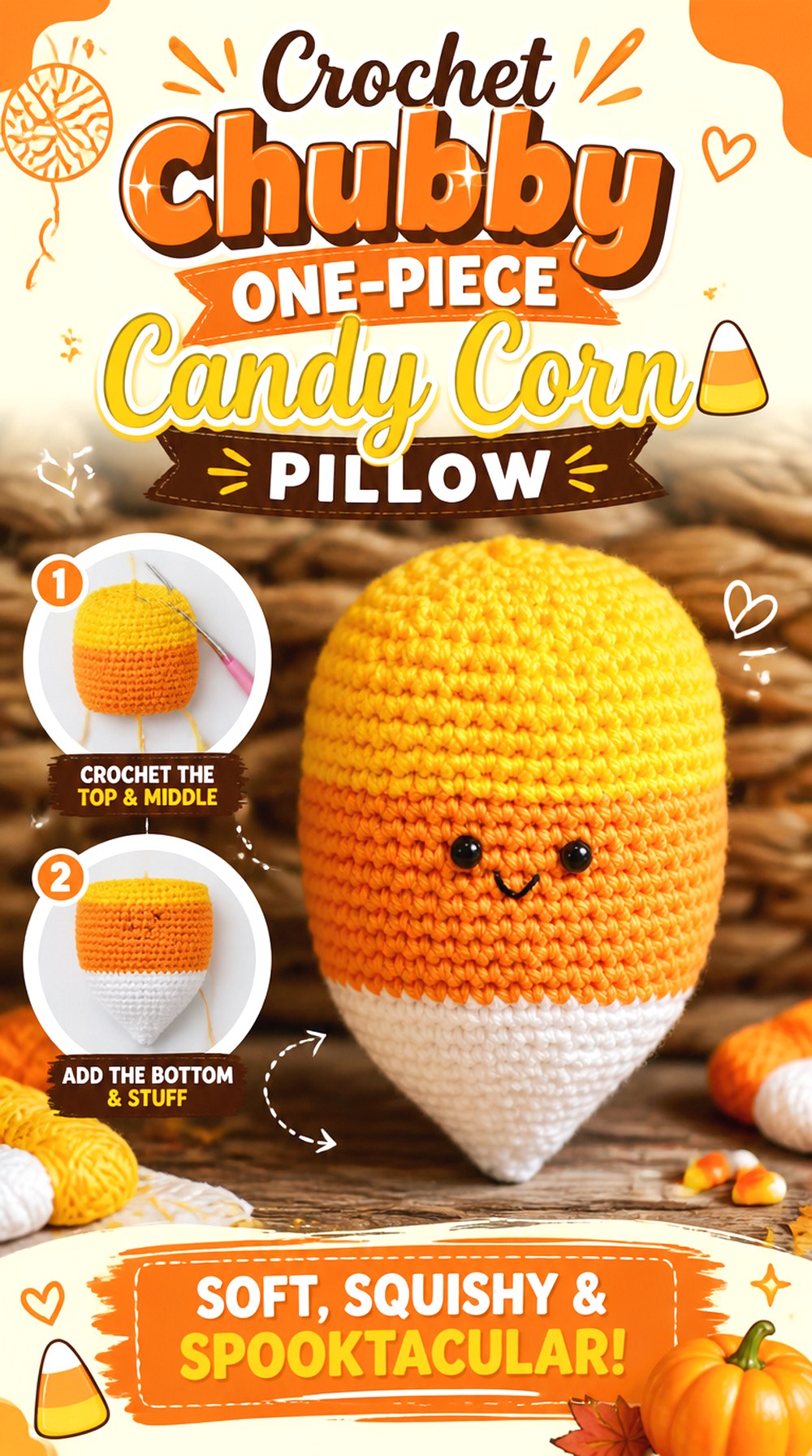
Little World of Whimsy’s candy corn is a rounded, chubby amigurumi worked as a single main piece. The creator emphasizes a no-sew body and a stuffed shape with a broad midsection rather than the flat triangular profile of ragdoll designs.
Used as a mini pillow accent, the fuller silhouette works well in displays where you want an object that can stand among pumpkins or other stuffed decor. It reads softer and more toy-like than the sharply edged flat-panel projects.
Chubby Shapes Need Even Filling
A rounded design can become lopsided if stuffing is inserted as one dense lump. Break filling into smaller portions and distribute it around the perimeter, not only through the center.
Check the piece from the side as well as from the front. A candy corn can look symmetrical head-on while leaning noticeably backward once set on a shelf.
A Plain Face Can Be More Flexible
The source includes a cute expression, but a larger or neutral home-decor adaptation does not have to retain it. Without facial details, the same chubby shape becomes a simple sculptural candy.
This is useful if the pillow will sit beside already-characterful pumpkins, ghosts, or dolls and you want the arrangement to avoid feeling visually crowded.
Original Tutorial and Creator Credit
Creator/Site: Little World of Whimsy
12. Crochet Ombre Candy Corn Accent Pillow

Crochet 365 Knit Too provides a classic candy corn pattern plus documented variations, including a plush version and an ombre interpretation using shades outside the traditional palette. The creator also discusses how dark yarn can reduce the visibility of black eyes, which is an important design consideration when changing colors.
For an accent pillow, that makes this one of the strongest options for moving away from literal Halloween orange. Rust, blush, cream, muted mustard, or tonal pinks can preserve the striped triangular concept while integrating more easily with an existing room palette.
Contrast-Test Embellishments First
Before attaching dark eyes or embroidery, place the feature against the actual yarn in normal room lighting. A combination that looks distinct under a bright craft lamp may disappear across a dim living room.
If the darkest stripe does not provide enough contrast, change the facial treatment rather than forcing the original feature color into a new palette.
Ombre Works Best When Bands Stay Distinct
Candy corn recognition depends partly on visible sections. Three colors that are too close in value can merge into one block from a distance.
Take a quick photo of the yarns side by side before starting. Viewing the image in grayscale can help reveal whether the stripes have enough tonal separation, even if the hues themselves differ.
Original Tutorial and Creator Credit
Creator/Site: Crochet 365 Knit Too
13. Crochet Candy Corn Cutie Pillow Family

The Loopy Lamb’s Candy Corn Cutie Crew is designed around a compact no-sew amigurumi and offers additional size options through the creator’s extended pattern. The source also includes detailed embroidery guidance for the face.
That makes the concept well suited to a “family” of mini pillows: one larger candy corn as the visual anchor with smaller companions arranged around it. A graduated group has more depth on a mantel, shelf, or entry table than several identical pieces lined up at the same height.
Build the Group Around One Constant
To keep multiple characters from feeling random, maintain at least one repeated element—perhaps the same stripe colors, eye treatment, or yarn family. Then vary only scale or expression.
This restraint matters especially with highly saturated Halloween colors. Too many independent changes can make a small display feel busier than a much larger single pillow.
Pay Attention to Embroidery Placement
The source gives specific finishing support for its expression. When creating several pieces, small differences in mouth height or eye spacing can be used intentionally to give each character personality.
If you want them to look like a matched set instead, mark feature placement consistently before embroidering.
Original Tutorial and Creator Credit
Creator/Site: The Loopy Lamb
14. Crochet Mini Candy Corn Basket Pillow

Rose and Lily Amigurumi’s mini candy corn is a very compact stuffed project worked in plush yarn, with a full video tutorial referenced from the original pattern page. The source also specifically cautions against safety eyes for children under three.
Because of its scale, treat this version as a mini pillow or basket filler rather than a functional cushion. Several can sit among pinecones, crocheted pumpkins, or folded napkins in a seasonal centerpiece without dominating the arrangement.
Small Projects Reward Clean Color Changes
There are fewer stitches available to disguise an uneven transition, so one conspicuous jog can become a major part of the visible stripe. Slow down at each change and make sure the new color is secured according to the source.
A neat transition is particularly important when the piece will be viewed close-up on a desk or tiered tray.
Think About the Recipient Before Adding Eyes
Small hard components change the suitability of a stuffed project. The original source provides a specific warning regarding safety eyes and young children.
For purely decorative adult displays, follow the creator’s intended finish. For young recipients, review alternative facial methods and the entire project—not only the eyes—for appropriate construction.
Original Tutorial and Creator Credit
Creator/Site: Rose and Lily Amigurumi
15. Crochet Cotton Candy Corn Bowl Filler Pillow

Petals to Picots uses worsted-weight cotton for a tiny stuffed candy corn, creating a firmer, more defined surface than fluffy chenille versions. The source’s finished sample is only a few inches across, so this is squarely a bowl-filler or miniature pillow accent rather than a lounging cushion.
Its small size makes it particularly practical for leftover-yarn projects and repeated table decor. Cotton also gives the stitches a crisp appearance, which suits candy corn’s simple graphic bands.
Cotton Produces a Different Hand
Compared with plush polyester yarn, cotton usually has less fuzzy loft and shows stitch structure more clearly. That can make the stripes look precise, but it also means uneven tension is easier to see.
If you substitute another fiber, expect the finished surface and firmness to change even when the overall shape remains recognizable.
Bowl Fillers Need Visual Quantity
One very small candy corn can disappear in a deep basket. Before starting, estimate how many finished pieces the container needs and whether other decor will share the space.
Mixing candy corns with larger neutral objects can reduce the number required while still letting the striped pieces function as bright accents.
Original Tutorial and Creator Credit
Creator/Site: Petals to Picots
16. Crochet Candy Corn Character Pillow with Limbs

StringyDingDing’s Candy Corn Food Friends takes the basic shape into character territory by adding optional arms and legs after the striped stuffed body. The source also includes eyes and a stitched smile, creating a much more animated result than a plain decorative triangle.
As a pillow-style accent, this version works best where personality matters more than minimalism: children’s room decor, a playful Halloween shelf, or a collection of food-themed amigurumi. The dangling features break up the simple triangle and make the piece feel like a figure rather than a conventional cushion.
Limbs Affect How the Piece Sits
Before placing arms and legs, decide whether the candy corn should stand, sit, lean, or lie flat in the final display. Decorative limbs that look balanced while held in the hand may fall awkwardly when the piece rests against a wall.
Use the original placement guidance as your baseline instead of moving parts purely for appearance.
Keep Character Details Consistent
Eyes, smile, limbs, and stripe colors are already several visual elements. Additional bows, hats, or appliqués can quickly compete with the basic form.
If you want to customize, change one dominant detail at a time—such as the expression or limb color—then reassess before adding another.
Original Tutorial and Creator Credit
Creator/Site: StringyDingDing
17. Crochet Folded Seam Candy Corn Mini Pillow
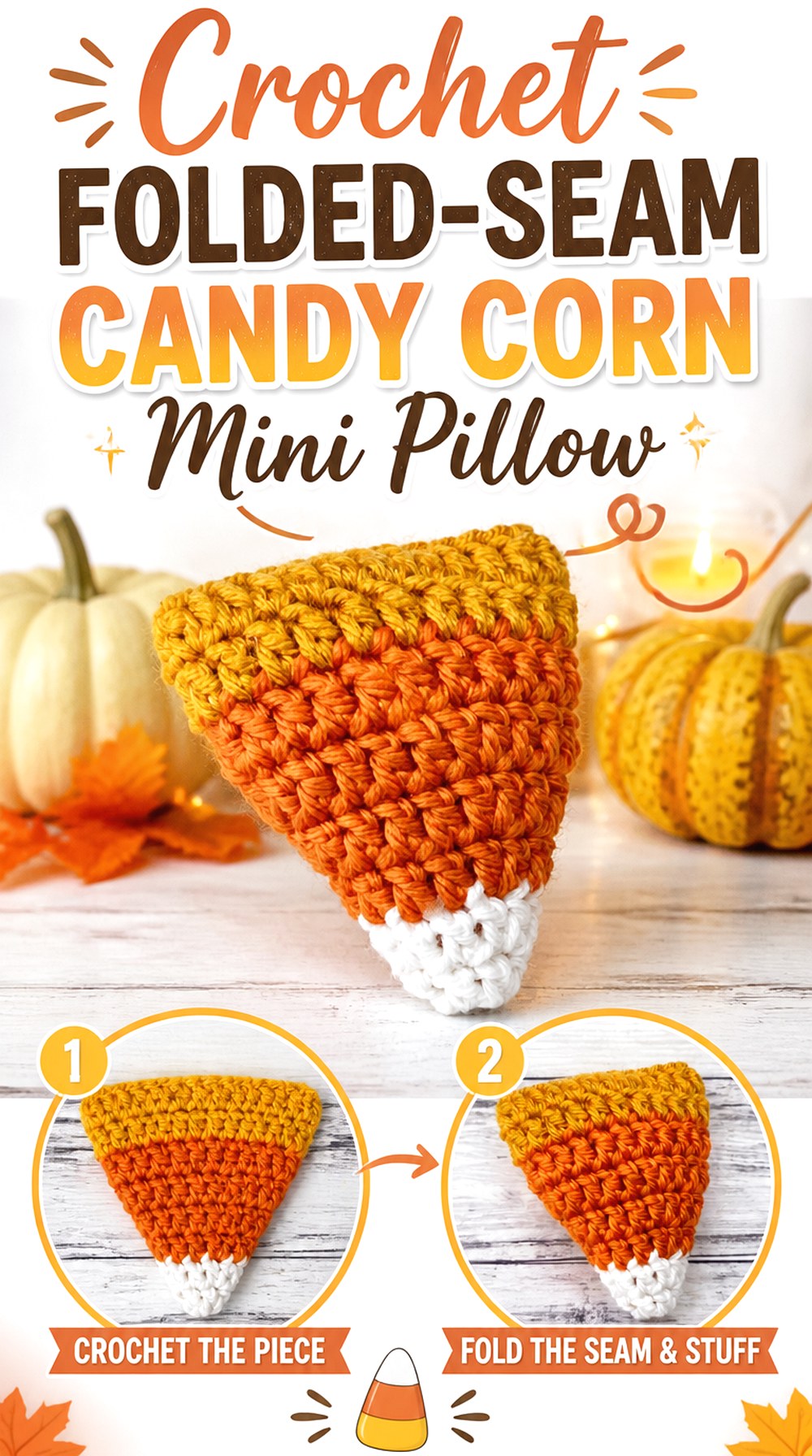
The love. life. yarn. design is constructed in the round and then folded so the final opening can be seamed closed, creating a somewhat flatter candy-corn shape than many fully rounded amigurumi designs. The creator discusses several possible seaming methods and notes that the project can be made in other yarn weights with an appropriate hook.
That folded finish makes the project useful as a compact mini pillow. It can lie flatter in a basket or place setting than a deep cone while still containing a small amount of stuffing.
The Closing Seam Becomes Part of the Shape
A folded opening can help define the broad base, but a tight or uneven seam may pull one corner higher than the other. Before fastening off, lay the piece flat and confirm that the two sides meet evenly.
Choose the creator-supported finishing approach that gives you the edge appearance you prefer rather than assuming every seam technique looks identical.
Light Stuffing Can Be Intentional
Because this design is small and folded, it does not need the same filling density as a large ragdoll pillow. A lighter fill can preserve the flatter candy shape.
However, make sure the point still receives enough fiberfill to remain recognizable. A hollow white tip can collapse even when the wider orange and yellow sections look full.
Original Tutorial and Creator Credit
Creator/Site: love. life. yarn.
18. Crochet No Sew Candy Corn Accent Pillow

The Pudgy Rabbit’s candy corn is a compact, no-sew stuffed design worked in rounds using white, orange, and yellow worsted-weight yarn. The pattern and accompanying tutorial keep the shape stripped back to the candy itself, without requiring separate limbs or decorative pieces.
For seasonal decor, that simplicity is valuable. A group of plain mini pillows can fill a tray or bowl without turning the arrangement into a collection of characters, and the limited finishing makes the three stripes the main visual feature.
Minimal Design Exposes Proportion
With no face or accessories to distract the eye, the relationship between the white point, orange center, and yellow base becomes the design. Compare the silhouette after each section and make sure the widening feels gradual.
If you use unconventional colors, preserve enough contrast that the three bands remain readable as intentional sections.
No-Sew Does Not Mean No Finishing
Even when no separate pieces require attachment, yarn ends, the closing area, and color transitions still determine how polished the object looks. Secure and conceal ends according to the tutorial instead of treating the final round as an afterthought.
A clean closure is particularly important if the mini pillow will sit where its base or back remains visible.
Original Tutorial and Creator Credit
Creator/Site: The Pudgy Rabbit
19. Crochet Rounded Candy Corn Amigurumi Pillow

Hooked Yarns Plus uses a rounded in-the-round construction, worsted-weight yarn, stuffing, safety eyes, and an embroidered smile. The tutorial builds a broad lower section before narrowing through the orange and white areas, creating a bulbous, friendly profile rather than a thin flat triangle.
As a mini pillow accent, this shape is useful in displays that need a little volume. It stands apart from the two-panel options because the body looks substantial from the side, not just from the front.
Rounded Bases Need Controlled Stuffing
The broad lower section can become overly spherical if it receives most of the fiberfill. Feed stuffing upward as you go so the orange and white sections retain enough volume to support the taper.
Set the piece down periodically. A hand-held shape can look balanced but reveal a lopsided base when released.
Facial Features Anchor the Front
Once eyes and a mouth are added, one side clearly becomes the front. Position visible color-change seams and any less tidy transitions accordingly where the tutorial allows.
Before securing features, center them against the widest part of the shape rather than simply counting from the round marker, which may not visually correspond to the front.
Original Tutorial and Creator Credit
Creator: Hooked Yarns Plus
20. Crochet Witch Hat Candy Corn Character Pillow
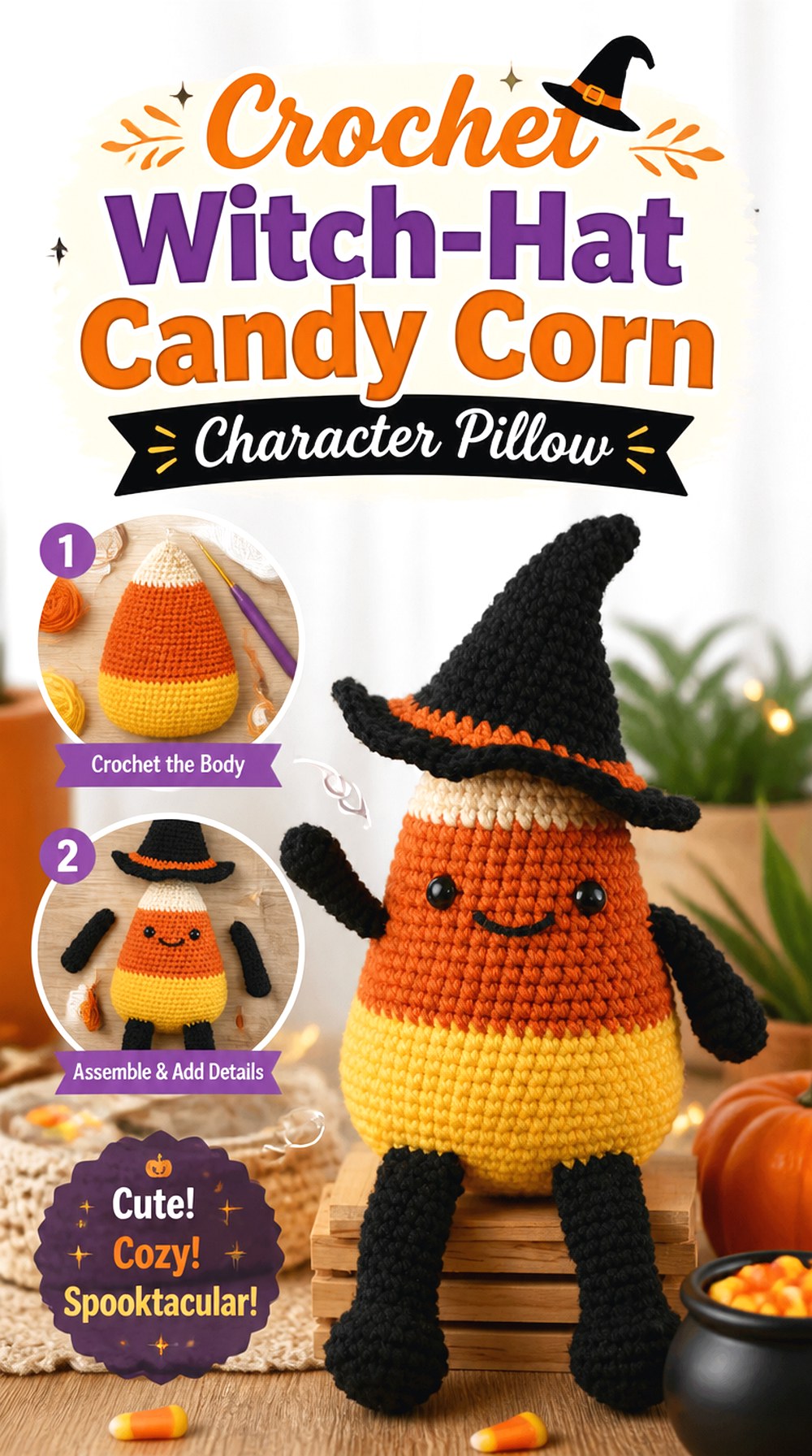
Zamiguz turns candy corn into a full Halloween character with black limbs, a face, and an optional witch-hat styling shown with the project. The designer discusses developing the color placement and limb treatment so the finished figure has more visual personality than a standard striped amigurumi.
This is the most costume-driven option in the list. It works well as a centerpiece for a playful Halloween display where a plain striped pillow might feel too understated, particularly alongside ghosts, witches, bats, or other crocheted characters.
Accessories Need a Clear Hierarchy
The candy corn body should remain recognizable even after adding a hat, limbs, and facial details. If you customize further, avoid covering so much of the stripes that the underlying candy motif disappears.
The hat can function as the focal accessory; everything else should support rather than compete with it.
Display Stability Changes With a Hat
A pointed hat adds height and visual weight near the narrowest part of the body. Depending on yarn and stuffing, that can make the character appear top-heavy.
Before permanently finishing optional accessories, place the stuffed body in its intended location and check how it balances. Shelf support may matter more than it would for a plain low-profile plush.
Child-Safety Decisions Still Apply
Character projects naturally invite interaction, but that does not automatically make every attached feature appropriate for young children. Review the eyes, limbs, hat, embroidery, and any added embellishments according to the actual recipient and use.
For decorative adult displays, focus instead on secure finishing so pieces do not loosen during seasonal storage.
Original Tutorial and Creator Credit
Creator/Site: Zamiguz
Which Crochet Candy Corn Pillow Style Should You Choose?
For a real couch, bed, or nap pillow, start with the Jayda InStitches throw cushion, Underground Crafter’s giant ragdoll softie, or Creating Me’s blanket-yarn pillow. They provide enough scale and broad surface area to behave more like conventional cushions.
For shelves, baskets, and tiered trays, the B.Hooked, Grace and Yarn, OkieGirlBling’n’Things, Stitch by Fay, Rose and Lily, or Petals to Picots styles make more sense because their smaller footprint is an advantage.
Choose Knot Bad or Spin a Yarn Crochet when flat-panel construction appeals to you. Pick Little World of Whimsy or Hooked Yarns Plus for a rounder stuffed body. For maximum personality, StringyDingDing and Zamiguz move into character territory with limbs and accessories.
Conclusion
The strongest crochet candy corn pillow choice depends less on the orange-yellow-white palette than on scale and construction. Large flat-panel pieces give you genuine throw-pillow presence, while small rounded amigurumi work better as shelf pillows, basket fillers, and Halloween characters. Plush yarn emphasizes softness; smooth yarn makes shaping and stripe definition more visible. Faces and accessories can shift the same basic form from simple fall decor to playful Halloween styling.
Before starting, decide where the finished piece will live and how much handling it will receive. Then use the original tutorials linked above for the creators’ exact construction, materials, sizing, and finishing details.
Frequently Asked Questions
Can I turn a small crochet candy corn amigurumi pattern into a large pillow?
Sometimes a thicker yarn and larger compatible hook can increase the scale substantially, and several creators above explicitly demonstrate size or yarn-weight variations. However, enlarging a pattern is not guaranteed to preserve the same proportions or fabric behavior. A larger object needs more stuffing, may develop heavier seams, and can stretch differently. For a true couch-size result, choosing a source already designed as a pillow is usually more predictable than dramatically enlarging a miniature.
What yarn works best for a crochet candy corn pillow?
It depends on the finish you want. Plush, chenille, and blanket yarn create a soft, rounded, highly tactile pillow, while smooth acrylic or cotton makes stitches, stripe boundaries, and shaping easier to see. For stuffed projects, whatever yarn you choose should form fabric dense enough to contain the filling. When substituting yarn, compare the creator’s recommended weight and hook information rather than assuming the same hook will suit a different fiber.
How firmly should I stuff a candy corn pillow?
Use enough filling to support the point, side edges, and lower corners without forcing the fabric outward. Large flat pillows often need careful distribution into the base corners, while small amigurumi need filling pushed into the narrow tip before the opening closes. Overstuffing can make a triangle bulge into a rounded wedge; underfilling can leave the point folded and the base collapsed. Add small amounts gradually and inspect the piece from several angles.
Can I leave the face off a crochet candy corn pillow?
Yes, when the source construction does not depend on facial pieces. A plain white-orange-yellow candy corn often works better with understated fall decor and can be more comfortable if the project will actually be used as a cushion. If the tutorial includes eyes or other features as part of the finishing, simply check the original instructions before omitting them so you understand when those components are normally inserted.
Are safety eyes suitable for candy corn pillows made for children?
Do not assume that hard “safety eyes” make a handmade project suitable for every child. Some original tutorials themselves caution against using such components for very young children. For a child-directed project, review all detachable or protruding pieces, including eyes, buttons, beads, limbs, and accessories. Embroidered features may remove some hard components, but the overall construction and intended age still need to be considered.
How should I store crochet Halloween pillows after the season?
Make sure the pillow is completely dry and clean according to the yarn label and creator guidance before storing it. Avoid crushing highly stuffed shapes under heavy decorations, because the point or corners may become distorted. Character pillows with hats, limbs, or other protruding pieces benefit from a little extra space. Care requirements vary by fiber, stuffing, and embellishment, so do not assume that every project can be machine-washed before packing it away.


