
18 Crochet Mushroom Cardigan Ideas
Mushroom cardigans can range from bold garments covered in toadstools to everyday cardigans with one carefully placed woodland motif. That makes the theme much more flexible than simply changing cap colors. Shape, fabric density, closure, sleeve volume, cardigan length, and mushroom placement can all change how the finished piece looks and wears.
The ideas below include cropped cardigans, granny-square constructions, a zip front, lace and mesh layers, patchwork, raglan shaping, a long duster, pockets, cables, a bomber silhouette, and a cocoon shape. Only some available tutorials are specifically mushroom-themed, so the collection is transparent about adaptation: when a video teaches the cardigan base rather than mushroom decoration, use it for construction and plan the mushroom elements separately. This keeps the original creator’s instructions intact while giving you more ways to build a mushroom cardigan that fits your preferred style.
Quick List
- Crochet All-Over Mushroom Crop Cardigan
- Crochet Statement-Back Mushroom Hexagon Cardigan
- Crochet Mushroom Granny Square Zip Cardigan
- Crochet Collared Mushroom Granny-Stitch Cardigan
- Crochet Scattered-Mushroom Lace Crop Cardigan
- Crochet Mushroom Tie-Front Crop Cardigan
- Crochet Mushroom Collared Button Crop Cardigan
- Crochet Floral and Mushroom Granny Square Cardigan
- Crochet Moss-Stitch Mushroom Everyday Cardigan
- Crochet Mushroom Chevron Duster Cardigan
- Crochet Woodland Mushroom Patchwork Cardigan
- Crochet Mushroom Raglan Cardigan
- Crochet Mushroom Mesh Cardigan
- Crochet Mushroom Oversized Pocket Cardigan
- Crochet Mushroom Cable Cardigan
- Crochet Mushroom Shell-Stitch Cardigan
- Crochet Mushroom Bomber Cardigan
- Crochet Mushroom Cocoon Cardigan
Plan Mushroom Placement Before You Commit to the Cardigan
A mushroom motif has more visual weight than an ordinary color change, especially when the cap, stem, spots, and background all contrast. Decide first whether mushrooms should cover the garment, repeat in a predictable grid, appear only on the back, or work as smaller accents around pockets and fronts.
Joined-square cardigans make repeated motifs easy to organize, but square dimensions need to agree before assembly. On solid or textured cardigans, appliqués give you more freedom because you can position them after much of the garment exists. Pin or temporarily place motifs before sewing them permanently. Pay particular attention to side seams, underarms, closures, pocket openings, and cardigan edges; a mushroom that looks centered on a flat panel may shift noticeably once the garment is worn.
Fit, Drape, and Motif Weight Need to Work Together
A mushroom cardigan still needs to function as a garment. Dense motifs, heavy borders, dimensional appliqués, and many color changes can make a cardigan feel more substantial than an open mesh or lace version. The effect becomes more noticeable when decoration is concentrated on only one section, such as a large back panel.
For square-based garments, compare blocked motif dimensions rather than relying on the size directly off the hook. As a simple planning example, four blocked squares measuring 5 inches each would span about 20 inches before joins, edging, and the intended garment ease are considered. That is planning math rather than a universal sizing formula. For other constructions, follow the tutorial’s fitting method and check the garment at shoulders, armholes, sleeve length, and front opening before permanently attaching mushroom embellishments.
1. Crochet All Over Mushroom Crop Cardigan
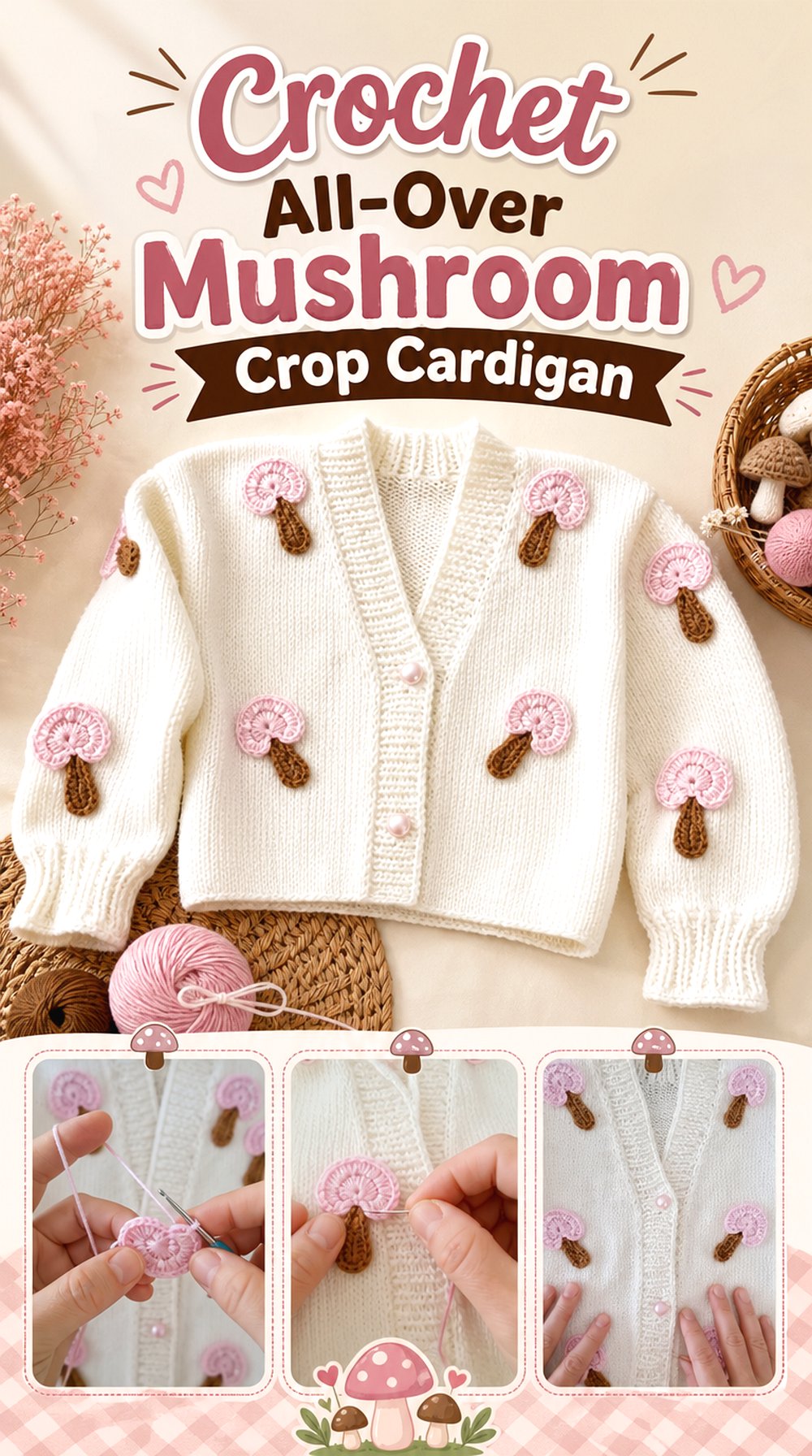
This idea puts mushrooms at the center of the garment rather than treating them as a small finishing detail. A shorter cardigan keeps the woodland theme visually concentrated, making it suitable for someone who wants an unmistakably mushroom-focused piece instead of a neutral cardigan with one appliqué.
The supporting video is particularly relevant because it is explicitly presented as a mushroom cardigan project rather than a generic cardigan base. Still, use the creator’s tutorial for the actual construction instead of trying to recreate its stitch sequence from the finished appearance.
Let the Shorter Length Carry a Stronger Motif
A cropped silhouette gives decorative mushrooms less surface area to compete across. That means a repeated motif can feel deliberate rather than scattered. Before choosing how many mushrooms to include, compare the intended cardigan length with the scale of each motif. Large mushrooms may need breathing room, while tiny repeated versions can create a busier surface.
Check Mushroom Placement at the Front Opening
The two front sections are immediately noticeable when a cardigan is worn open. Avoid positioning a recognizable mushroom so close to the edge that edging or a closure cuts through the cap. Lay the cardigan flat first, then check the placement while the fronts sit in their natural worn position.
Keep Sleeve Decoration in Balance
Full mushroom coverage on the body does not automatically require equally dense sleeves. Simplifying the sleeves can keep the cardigan from becoming visually overloaded. Another option is to repeat only one element—such as a small cap motif—near the cuff while reserving complete mushrooms for the body.
Creator: Ayşegülce Fikirler
2. Crochet Statement Back Mushroom Hexagon Cardigan

A hexagon cardigan gives you a relaxed base that can carry one prominent mushroom composition instead of dozens of small motifs. Keep the main cardigan comparatively simple and turn the back into the focal area with a large appliqué, a cluster of mushrooms, or a separately planned motif panel.
The linked tutorial teaches a granny hexagon cardigan rather than a mushroom-specific version. That makes this an adaptation idea: follow the creator for cardigan construction, then develop the mushroom decoration independently.
Treat the Back as One Composition
Instead of placing mushrooms wherever empty space appears, think of the back like a single illustration. A tall mushroom with smaller caps around it can create clearer hierarchy than several equal-size motifs. Temporarily pin every element in place before sewing so you can evaluate spacing with the cardigan fully opened out.
Check the Folded Hexagon Before Adding Decoration
Hexagon construction changes direction as the crochet folds into the cardigan shape. A motif positioned while the work still looks like a flat geometric piece may not land where expected on the finished garment. Complete enough of the construction to identify the true back area before committing decorative elements.
Leave High-Flex Areas Less Crowded
Underarms and sleeve folds move more than the center back. Keeping larger appliqués away from those areas can make the finished cardigan feel less bulky and can reduce distortion of carefully shaped mushroom caps.
Creator: ElyseCrochets
3. Crochet Mushroom Granny Square Zip Cardigan

A zipper changes a mushroom granny-square cardigan from an open layering piece into a more jacket-like garment. Mushroom squares can be mixed with quieter filler squares so the motifs remain readable without covering every inch of the cardigan.
The supporting tutorial shows a granny-square cardigan with a zipper, giving this idea a construction reference where the front closure matters. The mushroom squares themselves are the adaptation. Nora Moon’s channel currently lists the tutorial under the exact title below.
Plan Both Fronts as a Pair
A zipper creates a strong center line, so mismatched mushroom placement becomes especially obvious. Lay the left and right front square arrangements next to each other before joining. They do not need perfect mirror symmetry, but the visual weight should feel intentional when the zipper is closed.
Keep Motifs Clear of the Zipper Edge
Highly dimensional mushrooms or loose appliqué edges directly beside a zipper can interfere with the clean opening line. Reserve flatter squares for the innermost column and move more dimensional mushroom details outward toward the chest, shoulder, or sleeve.
Match Square Dimensions Before Assembly
A mushroom square and a plain filler square may use different internal stitch structures. Even if both are called granny squares, compare their blocked width and height. If they differ noticeably, correct that before joining rather than forcing mismatched edges together and creating puckering around the zipper.
Creator: Nora Moon – handmade clothes with love
4. Crochet Collared Mushroom Granny Stitch Cardigan

A collar gives a woodland cardigan a more structured upper edge and provides another place to use mushroom color without adding another literal mushroom. Consider a neutral granny-stitch body, selected mushroom appliqués, and a collar that repeats the cap color.
Hannah Drapinski’s tutorial specifically features a granny-stitch collared cardigan, making it a useful base for this variation. The mushroom treatment is an editorial adaptation rather than a feature of the original tutorial.
Use the Collar to Frame the Motifs
If the largest mushrooms sit on the chest or upper back, a strongly contrasting collar can compete with them. A quieter collar lets the mushrooms dominate. Alternatively, repeat just one motif color in the collar to create a relationship without turning the neckline into another busy focal area.
Consider the Sleeve Shape Before Adding Caps
A prominent sleeve mushroom looks very different on a hanging sleeve than on a bent arm. If you want sleeve motifs, temporarily position them while wearing or draping the cardigan. Upper-sleeve placement often gives larger motifs more uninterrupted space than the elbow area.
Decide Whether Buttons Need to Disappear or Stand Out
Mushroom cardigans already contain several small visual details. Neutral buttons can keep the attention on the motifs; contrasting buttons create another decorative rhythm down the center front. Decide which role the closure should play before choosing mushroom placement close to it.
Creator: Hannah Drapinski
5. Crochet Scattered Mushroom Lace Crop Cardigan

nstead of a dense cottagecore surface, this idea combines an airy cropped cardigan with only a few small mushrooms. The contrast can make each appliqué feel more deliberate. It also gives you an option for warmer weather or indoor layering when a full, dense mushroom cardigan would feel visually heavy.
Chenda DIY’s video is a cropped lace cardigan tutorial, not a mushroom garment, so use it for the base silhouette and treat the mushroom accents as a separate customization.
Avoid Overloading Open Lace
An appliqué creates a solid patch over an otherwise open fabric. Several large mushrooms can therefore change both the look and local drape. Start with fewer motifs than you think you need, place them temporarily, and add more only if the cardigan still feels visually empty.
Give the Front Tie Its Own Space
A front-tie or open-front area already creates movement near the center of the garment. Keep mushrooms slightly away from the tie points so the motifs remain visible and the ties can fall naturally without catching on dimensional decoration.
Creator: Chenda DIY
6. Crochet Mushroom Tie-Front Crop Cardigan

A tie-front shape keeps much of the center torso open, so mushrooms can be concentrated on the sleeves, lower front edges, or back instead of being split down a button band. This is a good route when you want a mushroom theme with a lighter, less coat-like finished silhouette.
Alona crochets has a dedicated cropped tie-front cardigan tutorial. The linked video supports the garment shape; it does not need to be treated as the source of the mushroom decoration.
Use the Open Center to Control Visual Density
Because the garment does not create one continuous solid front, two oversized chest mushrooms can look disconnected. Smaller motifs moving outward from the front edge—or one stronger motif on the back—often suit the silhouette more naturally.
Keep the Tie Functional
Do not let decorative stems, dangling embellishments, or raised cap edges crowd the tie attachment area. Test the cardigan tied and untied before permanently sewing appliqués around that point. The front should still open, knot, and hang without the mushroom decoration becoming part of the closure.
Creator: Alona crochets
7. Crochet Mushroom Collared Button Crop Cardigan
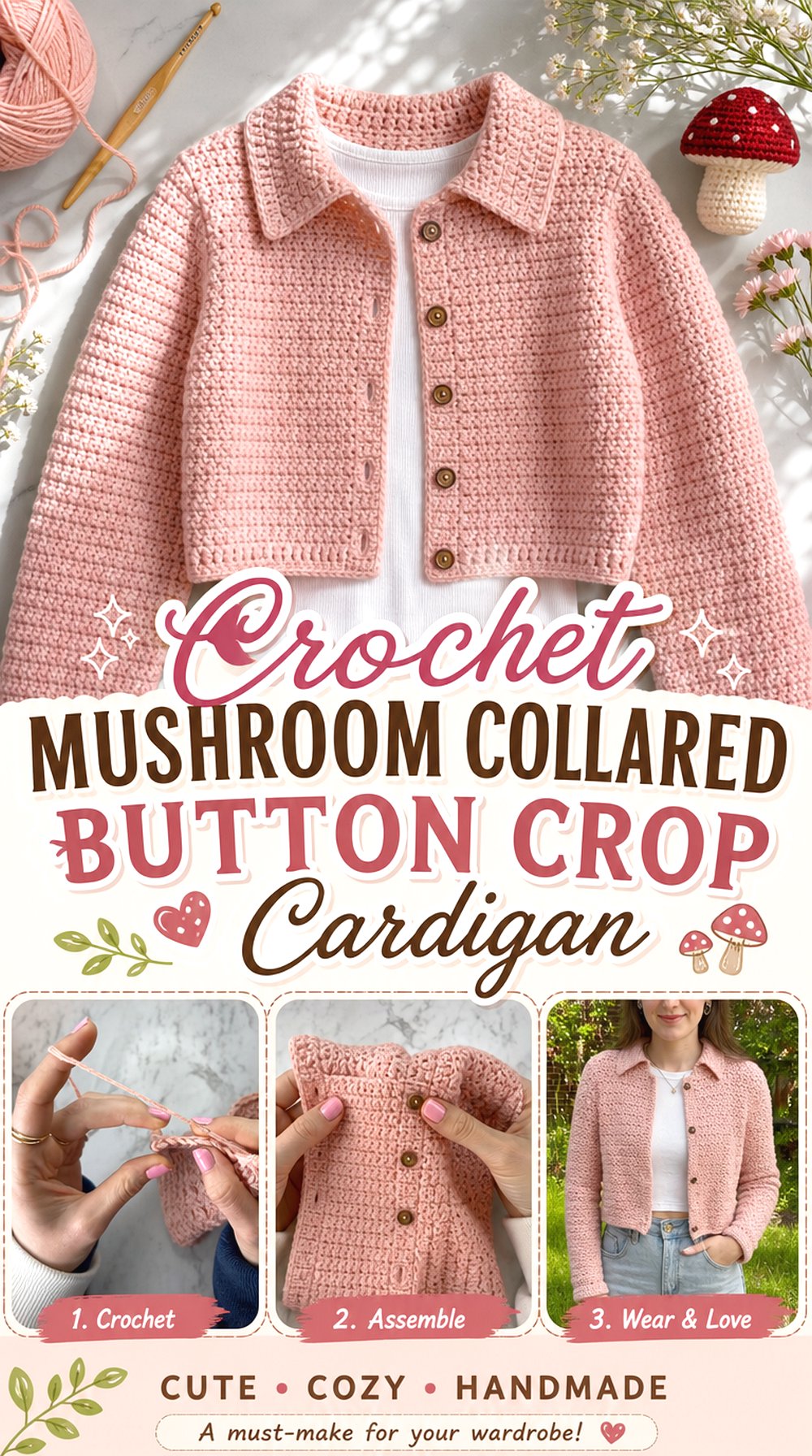
This version combines three clear design features: a shorter body, defined collar, and front buttons. Rather than covering everything with mushrooms, use a few cap-and-stem motifs as accents around the lower front or back shoulder area.
Stephanie Tashi’s tutorial is specifically for a cropped cardigan with a collar and uses a lemon-peel-stitch design. That texture gives the mushroom adaptation a different background from open granny stitches or lace.
Let Texture Replace Some Extra Decoration
A visibly textured cardigan already has surface interest. Fewer mushrooms can therefore have more impact than they would on plain fabric. Before adding appliqués, look at the cardigan from several feet away; if the stitch texture already reads strongly, treat mushrooms as focal points rather than filler.
Balance the Collar and Button Line
The collar and vertical closure form two strong structural lines. Position mushrooms so they support that geometry instead of competing with it. One motif near a lower corner or a larger design on the back can preserve the cardigan’s tailored-looking front.
Check the Cropped Hem Before Choosing Motif Size
A tall mushroom may consume most of a short front panel. Compare the motif height with the actual available fabric after the cardigan reaches its finished length. If the cap approaches the armhole or collar, scale down rather than squeezing it into the space.
Creator: Stephanie Tashi
8. Crochet Floral and Mushroom Granny Square Cardigan

Flowers and mushrooms naturally create a woodland theme without requiring every square to use the same motif. Alternate mushroom squares with floral or quieter geometric squares to build a cardigan that feels collected rather than overly repetitive.
Bella Coco’s tutorial teaches a floral granny-square cardigan and shows the square-based construction needed for this style. Mushroom squares are an adaptation, so compare them carefully with the tutorial’s intended squares before substituting.
Alternate Motifs With Purpose
Random distribution can work, but planned repetition usually makes mixed motifs easier to read. Decide whether mushrooms are the primary motif with flowers as filler, or whether both should carry equal visual weight. Sketching the front and back grid on paper can prevent accidental clustering.
Compare Finished Square Size, Not Just Round Count
Two motifs can use completely different stitch structures and still need to occupy the same space in the cardigan. Block samples before planning the full quantity. If a mushroom square refuses to match the floral square cleanly, it may need a compatible border—or it may be better used as an appliqué.
Watch Motif Direction on the Sleeves
A mushroom has an obvious top and bottom, unlike many abstract granny squares. Mark the intended orientation when laying out sleeves and shoulders so a cap does not accidentally rotate sideways after joining.
Creator: Bella Coco
9. Crochet Moss Stitch Mushroom Everyday Cardigan

For a quieter mushroom cardigan, start with an everyday moss-stitch layer and add only a handful of woodland accents. The compact-looking background can make a mushroom appliqué read almost like embroidery or a sewn patch, especially when the surrounding cardigan uses restrained colors.
Crochet.With.Coffee’s tutorial provides the moss-stitch cardigan base. The mushrooms described here are a customization rather than part of that original cardigan.
Put Mushrooms Where They Will Stay Readable
Small appliqués can disappear in areas where the cardigan folds repeatedly. Upper pockets, the upper back, and lower front corners are worth considering because they can provide a clearer field. Check the garment on the body rather than judging placement solely while it lies flat.
Use Cap Color as a Repeating Accent
You do not need repeated full mushrooms to create continuity. A cap color can reappear in cuffs, edging, or another small detail, helping one or two appliqués feel integrated into the cardigan rather than added at the end.
Creator: Crochet.With.Coffee
10. Crochet Mushroom Chevron Duster Cardigan

A long duster gives you dramatically more vertical space than a cropped cardigan. Instead of filling that area with identical mushrooms, let the chevron structure provide movement and use fungi as occasional accents along the lower fronts or back.
AC Crochets lists a dedicated “Crochet Chevron Cardigan – Duster Cardigan Tutorial.” Because the source garment is not mushroom-specific, the strongest adaptation is one that respects the existing chevron lines instead of covering them.
Work With the Chevron Direction
Chevron fabric already points the eye across and down the garment. Place mushroom appliqués where they follow that movement rather than interrupting a strong peak or valley awkwardly. A motif placed between major visual lines can remain clear without hiding the cardigan’s underlying texture.
Treat the Extra Length as Negative Space
A long cardigan does not need decoration from shoulder to hem. Leaving stretches of undecorated fabric gives the mushrooms room to become focal points. A small cluster near the lower section can produce more impact than evenly spacing identical motifs everywhere.
Recheck Weight Before Adding a Dense Lower Border
Long cardigans already contain more fabric than cropped styles. Adding a thick mushroom border only at the hem can change the way the lower portion hangs. Temporarily attach or pin planned motifs first and evaluate the drape before making the decoration permanent.
Creator: AC Crochets
11. Crochet Woodland Mushroom Patchwork Cardigan
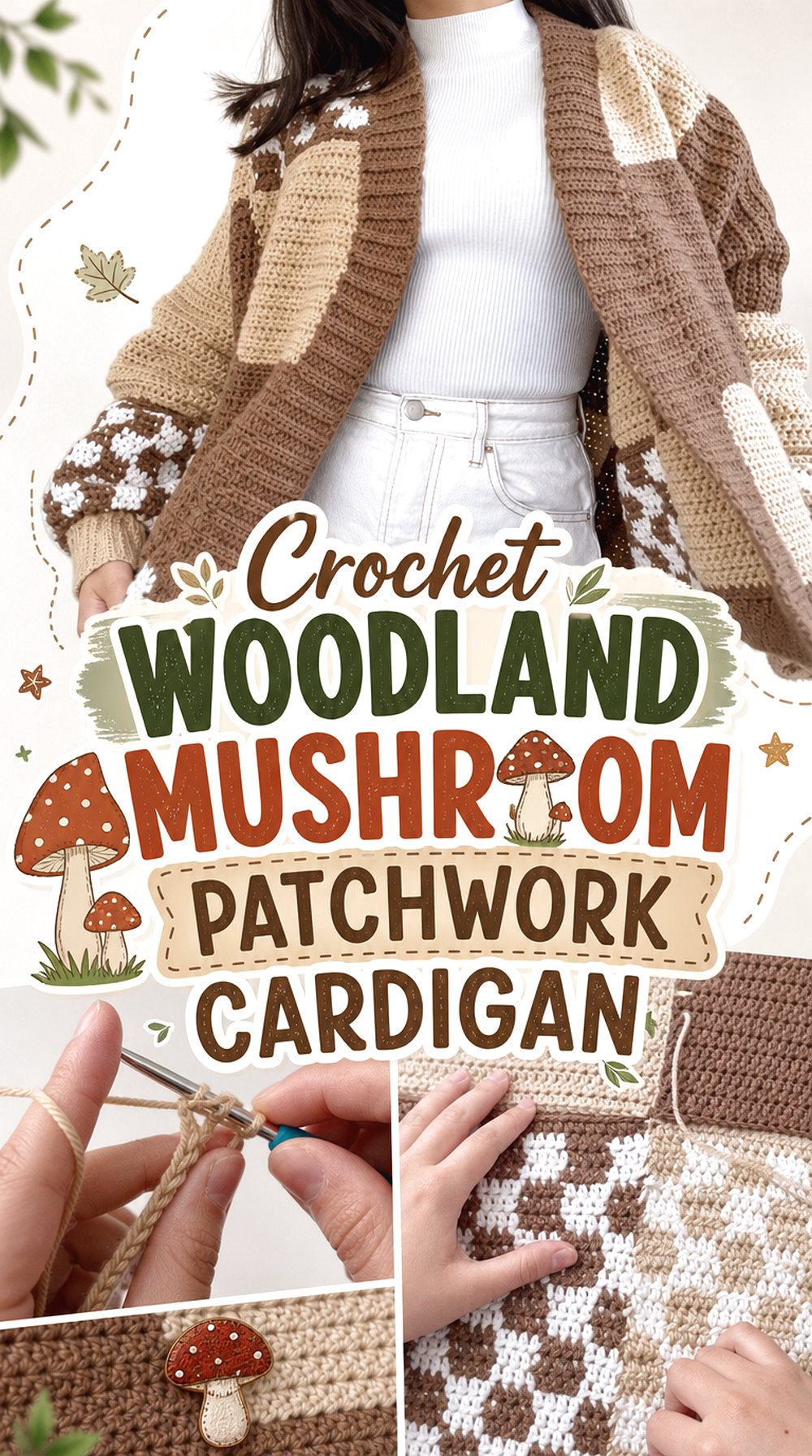
Patchwork provides perhaps the most flexible base for a mushroom theme because each block can have its own role. Some sections can hold mushrooms, others can use earthy solid colors, and a few can be deliberately plain to stop the finished cardigan from becoming chaotic.
Yarnalina’s channel lists “Crochet Brown Patchwork Cardigan Tutorial,” providing a clear patchwork-cardigan starting point. The mushroom blocks are the article’s adaptation rather than an element attributed to that tutorial.
Assign Roles to the Blocks Before Crocheting
Separate your plan into feature blocks, supporting colors, and quiet areas. That is more useful than choosing every square independently. Mushroom blocks can then appear at intentional locations such as the upper front, back center, or sleeve rather than wherever a blank patch remains.
Keep the Back From Becoming a Leftover Layout
It is easy to spend the strongest squares on the fronts and realize later that the back has no focal point. Plan front, back, and sleeves together. A centered mushroom block or small repeated cluster can help the cardigan read as one complete design from every angle.
Limit Competing Textures Around Detailed Mushrooms
If a mushroom block uses surface crochet, dimensional spots, or appliqué, surrounding it with several equally raised textures may reduce clarity. Put detailed mushrooms beside simpler blocks when you want the motif to be instantly recognizable.
Creator: Yarnalina
12. Crochet Mushroom Raglan Cardigan
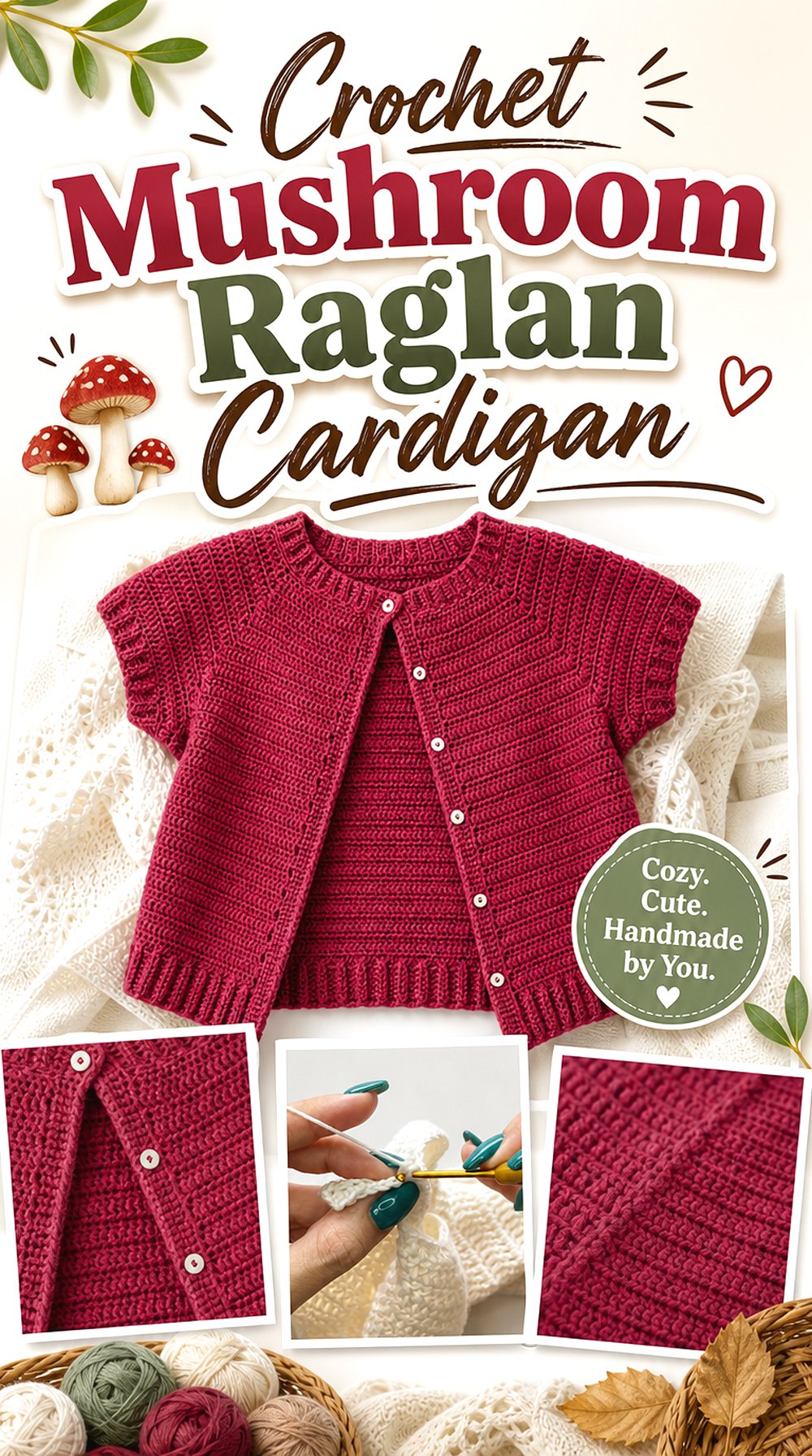
A raglan cardigan creates strong diagonal lines from neckline toward the underarms. Rather than interrupting those lines with large appliqués, this mushroom version can keep the yoke relatively clean and place woodland motifs lower on the torso or sleeves.
Granny Gaia currently lists “Crochet raglan cardigan tutorial” on the channel. Use the tutorial for its cardigan construction and treat mushroom placement as an independent surface-design decision.
Protect the Raglan Lines
The shaping around the upper body is part of what visually defines this construction. Keeping the largest mushrooms away from those diagonal lines makes the shape easier to read and prevents a large cap from being split by a structural transition.
Build a Lower-Body Mushroom Border Carefully
A loose line of mushrooms near the lower body can create a woodland-ground effect without covering the entire garment. Varying motif height can keep the border from looking mechanically repeated, but check the arrangement across both fronts and back so the visual line does not jump abruptly at the side.
Add Sleeve Motifs After Checking Arm Position
A mushroom placed perfectly on a flat sleeve can rotate toward the inside of the arm once worn. Put the cardigan on, mark the outward-facing sleeve area, and use those marks as your guide before attaching a statement motif.
Creator: Granny Gaia
13. Crochet Mushroom Mesh Cardigan

A mesh cardigan offers the strongest contrast between open fabric and solid mushroom motifs in this collection. Use that contrast intentionally. A few flat mushrooms can stand out sharply against the negative space, while too many heavy appliqués may make an otherwise airy garment feel visually unbalanced.
Brunaticality has a public tutorial titled “Crochet Mesh Cardigan Tutorial | Quick and Easy Crochet Tutorial | Brunaticality Crochet.” The mushroom treatment is separate from the source design.
Give an Appliqué Enough Fabric to Hold On To
Open mesh provides fewer solid anchoring points than dense fabric. Before choosing a large mushroom, look at how much of its perimeter can be secured without pulling the mesh inward. A smaller or lighter motif may sit more cleanly than a thick multilayer appliqué.
Use Solid Areas as Natural Motif Zones
If the cardigan includes firmer borders, cuffs, or other less-open sections, those can be useful places for smaller mushroom details. They create a more stable visual background and reduce the contrast between a very dense appliqué and extremely open mesh.
Avoid Turning an Airy Cardigan Into a Heavy Patchwork Piece
The appeal of mesh is partly its open appearance. Preserve enough undecorated fabric for that quality to remain obvious. If you want many mushrooms, a granny-square or patchwork base elsewhere in this collection is likely a more compatible starting point.
Creator: Brunaticality
14. Crochet Mushroom Oversized Pocket Cardigan

Large pockets give mushroom decoration a practical focal area. Instead of sewing fungi directly across the entire cardigan, turn each pocket into a miniature woodland scene or place one bold mushroom on only one pocket for deliberate asymmetry.
The forthefrills channel lists the Briar tutorial under “Oversized Pocket Crochet Cardigan – How to crochet a cardigan tutorial – for the frills.” The linked cardigan supplies the oversized pocketed foundation, while the mushroom treatment is an adaptation.
Decorate the Pocket Before Final Placement When Practical
A flat pocket is easier to arrange and inspect than one already attached to a finished cardigan. However, first determine which section will remain visible once the pocket is in use. Keep important parts of a mushroom away from the very top edge if they could disappear when the opening stretches.
Oversized Proportions Can Handle a Larger Motif
A tiny mushroom can look lost on a broad relaxed cardigan. Consider scaling the motif relative to the pocket or back panel rather than using the same appliqué size you would choose for a cropped garment.
Reinforce the Design, Not Just the Theme
Repeating a pocket mushroom on both fronts creates symmetry; using one pocket as the focal point feels more playful. Either works, but choose intentionally. Randomly adding a second motif simply because the other pocket is empty can weaken the stronger composition.
Creator: forthefrills
15. Crochet Mushroom Cable Cardigan

Cables already provide strong dimensional texture, so this mushroom cardigan idea works best with restraint. Instead of attaching multiple bulky mushrooms over the cable panels, keep the texture visible and introduce the theme through selected flat appliqués, color accents, or one larger motif on a comparatively quiet section.
Katie Joslin’s channel lists “Crochet Cable Cardigan Tutorial (made to measure),” which makes this a useful base for a texture-led variation.
Keep Detailed Mushrooms Off the Strongest Cable Sections
Raised cables and raised appliqués compete for attention when stacked in the same area. Place a mushroom beside a cable feature, on a smoother panel, or across the upper back only if that region gives the motif enough visual separation.
Use Color to Suggest Mushrooms Without Adding Bulk
A cardigan does not need dozens of literal mushrooms to belong in this collection. Repeating cap-inspired reds, rusts, creams, browns, or other chosen woodland tones in trims or narrow details can support one main mushroom motif while preserving the cable texture.
Block Before Final Appliqué Placement
Textured panels can change their appearance after finishing and blocking. Complete that stage according to the source instructions and fiber needs before deciding the exact center point for a large appliqué. Otherwise, your “centered” mushroom may shift once the fabric relaxes.
Creator: Katie Joslin
16. Crochet Mushroom Shell Stitch Cardigan
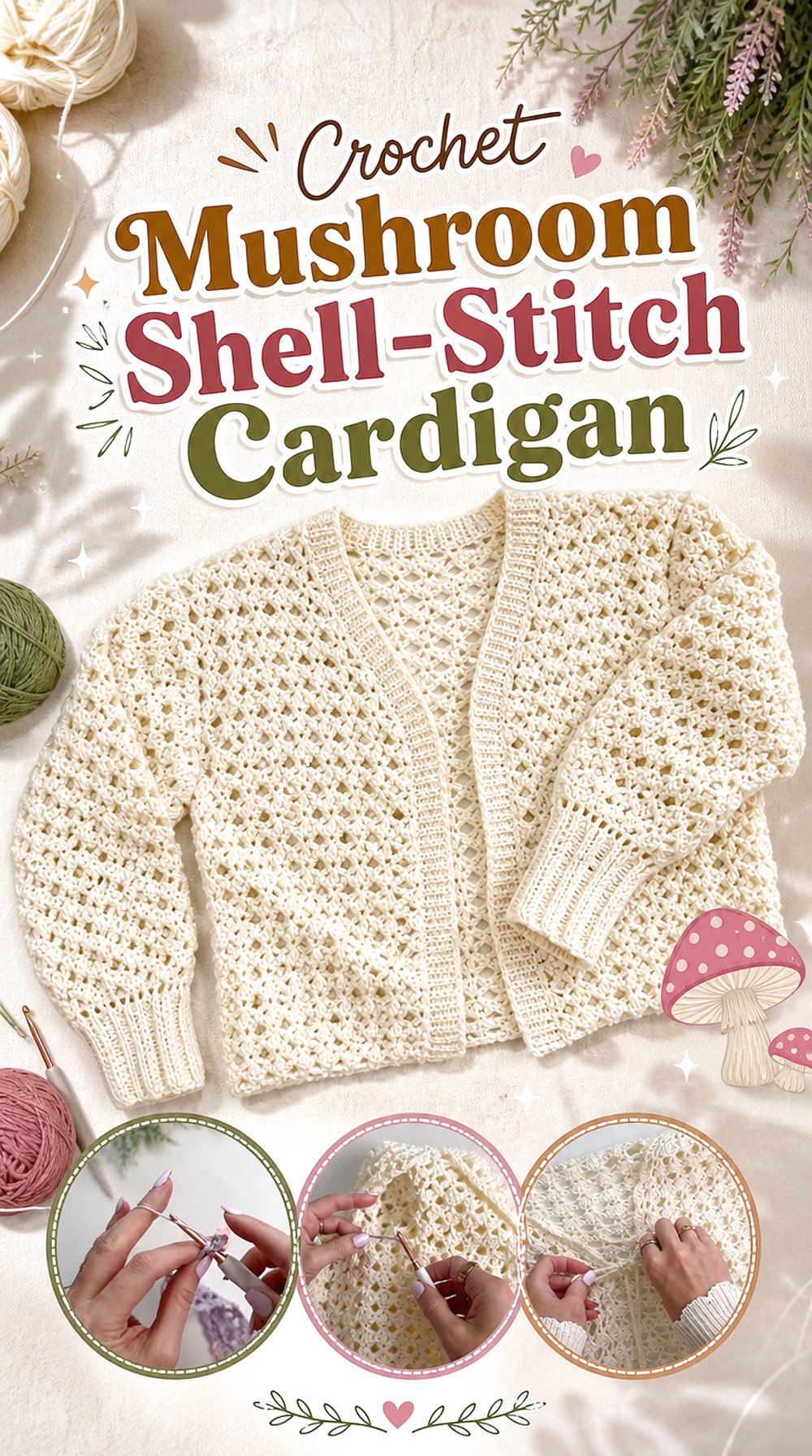
Shell stitches create a decorative fabric before any mushroom is added, making this a good choice for a softer botanical interpretation. Small mushrooms can sit among the texture like woodland details rather than becoming the entire surface design.
MJ’s Off The Hook Designs currently lists “Solea Shell Stitch Cardigan Tutorial | How to Crochet a Seamless Cardigan.” The mushroom accents in this idea are independent additions to that cardigan concept.
Let the Shell Texture Remain Visible
Covering decorative stitchwork with oversized appliqués defeats much of the reason to choose this base. Keep mushrooms concentrated in a limited zone—such as one shoulder, lower front, or back corner—so the shell texture remains a major part of the finished garment.
Match the Motif Edge to the Softer Background
A very stiff mushroom can look pasted onto an otherwise flowing cardigan. Compare the flexibility of an appliqué with the cardigan fabric before attaching it. If there is a large mismatch, consider a smaller motif or a flatter decorative method.
Build a Botanical Story Without Adding More Motifs
The shell texture can already suggest petals or leaves depending on the color treatment. That means one or two mushrooms may be enough to establish the woodland theme. Leaving some interpretation to the stitch pattern produces a quieter alternative to full mushroom patchwork.
Creator: MJ’s Off The Hook Designs
17. Crochet Mushroom Bomber Cardigan
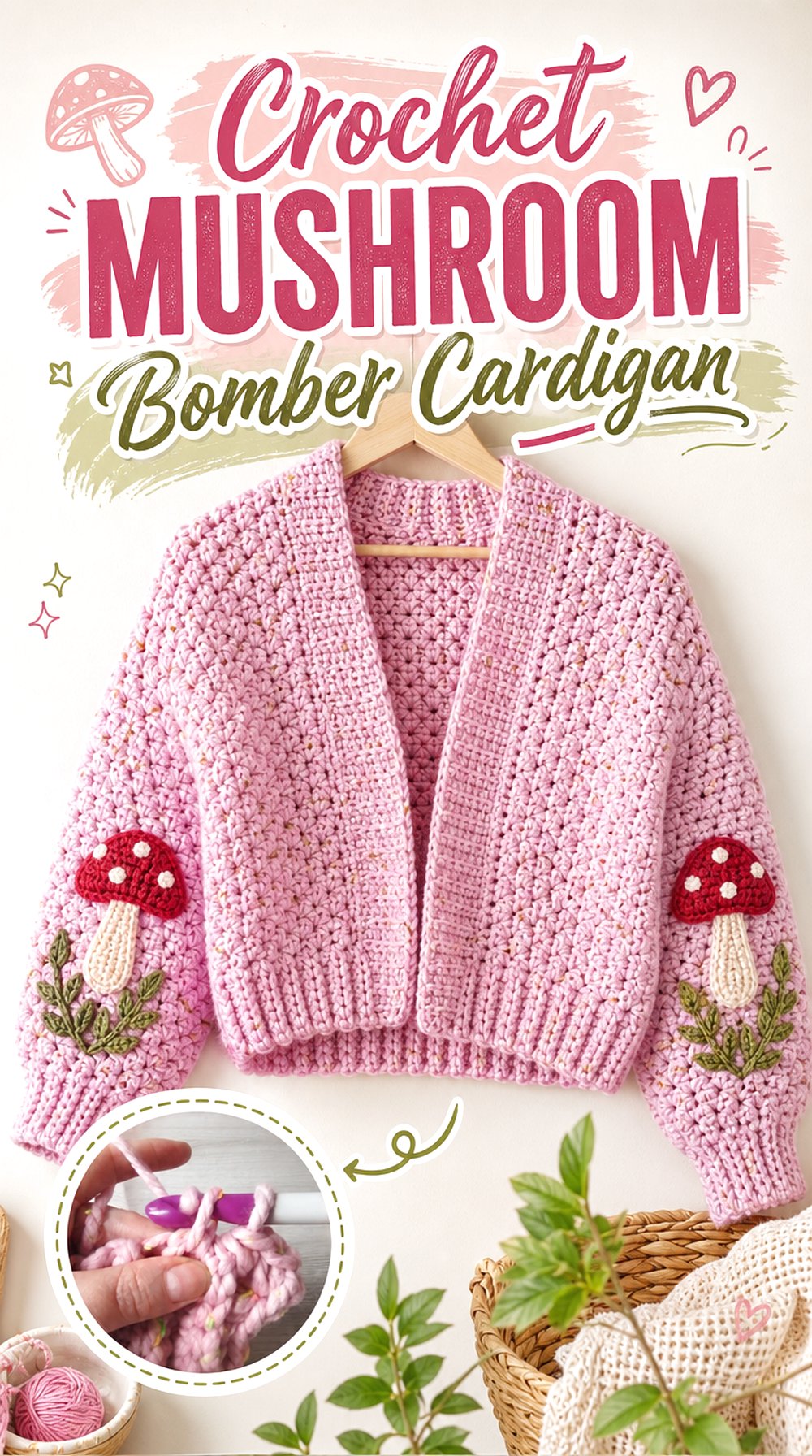
A bomber cardigan creates a shorter, more jacket-like silhouette than a flowing duster or cocoon. That makes it a strong base for graphic mushroom placement: one large back mushroom, matching sleeve caps, or a small chest emblem can give it a playful varsity-jacket feel without relying on granny squares.
Hey Carrie has a public video titled “Crochet Bomber Cardigan Tutorial.” Use the creator’s video for the bomber construction; the mushroom concept is a separate design direction.
Make the Back Motif Read Like an Emblem
A bomber silhouette can carry one large central motif effectively. Keep enough blank fabric around the mushroom for the outline to remain recognizable. Adding several small elements around it may weaken the clean emblem effect.
Keep the Lower Edge Visually Strong
Short jackets tend to have an obvious bottom line. If you add mushrooms near the hem, decide whether they should form a deliberate border or stay clearly above it. Motifs that accidentally cross the edge can make the garment look unfinished unless that interruption is part of the plan.
Check Sleeve Motifs With the Jacket Closed
A bomber’s proportions change depending on whether the front is open or closed. Check sleeve and chest placement in both positions before sewing decorative pieces permanently so the design works as a jacket rather than only as a flat photograph.
Creator: Hey Carrie
18. Crochet Mushroom Cocoon Cardigan

The cocoon is the loosest silhouette in the collection. Instead of defined front panels and traditional shoulders, it wraps around the body with a softer outline. Mushroom decoration therefore works particularly well as a broad back composition or a scattered border rather than a precisely mirrored front arrangement.
Fiber Flux’s “Cranberry Muffin Cocoon Cardigan (SIMPLE & So Beautiful!)” is a full cocoon-cardigan project and provides a suitable construction reference for this final idea.
Design for the Cocoon While It Is Folded
The large fabric section changes dramatically when converted into the wearable shape. Do not attach a statement mushroom based only on the appearance of the flat piece. Establish how the back, sides, and openings will sit first, then mark the actual visible zones.
A Border Can Work Better Than a Centered Motif
A loose cocoon does not always create the same obvious central back panel as a conventional cardigan. A wandering mushroom border along a visible lower section can follow the relaxed form more naturally and remain recognizable as the cardigan shifts.
Keep Dimensional Additions Proportionate
The softness of a cocoon is part of its appeal. Several thick appliqués can locally stiffen the fabric or change how it folds. If you want extensive mushroom coverage, consider flatter motifs and reserve dimensional caps for one or two focal areas.
Creator: Fiber Flux
Which Mushroom Cardigan Direction Should You Choose?
For the strongest mushroom-first look, start with the all-over crop, granny-square zip cardigan, floral-and-mushroom square cardigan, or woodland patchwork version. Their construction naturally supports repeated graphics.
If you prefer mushrooms as an accent, the moss-stitch, cable, shell-stitch, collared crop, and bomber options give the motif more negative space. The lace and mesh versions create the lightest visual effect but require more care when attaching solid appliqués to open fabric.
For dramatic proportions, the chevron duster provides vertical length, while the oversized pocket cardigan offers large areas for statement motifs. The raglan gives a cleaner shaped upper body, and the cocoon creates the loosest outline. Choose the cardigan construction first; then make mushroom scale, density, and placement serve that shape rather than forcing the same motif layout onto every garment.
Conclusion
The most convincing crochet mushroom cardigan does not necessarily have the most mushrooms. A patchwork or granny-square design can support repeated fungi, while a cable, shell-stitch, moss-stitch, or bomber cardigan may look stronger with one carefully positioned statement motif. Cropped and collared styles give you a compact canvas; dusters and oversized cardigans provide more room for larger compositions; mesh and lace call for lighter decoration.
Choose the silhouette you would genuinely wear first, then decide whether mushrooms should be the main fabric, a repeated square, a pocket feature, a back emblem, or a small accent. For the exact cardigan construction, sizing, stitch sequence, and finishing used by each designer, follow the original tutorials credited above.
Frequently Asked Questions
Can I add a crochet mushroom appliqué to any cardigan?
Many cardigan fabrics can accept an appliqué, but the result depends on structure. A dense solid fabric usually provides more anchoring area than an open mesh. Very heavy appliqués can also change how a light cardigan hangs. Before permanently attaching one, place the finished motif on the cardigan, check its flexibility against the fabric, and make sure it does not interfere with closures, arm movement, or important construction lines.
Can I replace ordinary granny squares with mushroom granny squares?
Only when the finished squares are compatible. Compare blocked dimensions, edge structure, and stitch density before making the full garment quantity. A mushroom square that is wider, taller, or substantially denser than the tutorial’s intended square may distort the joins. If the difference is small, an appropriate border may help equalize dimensions; if it is large, using the mushroom as an appliqué may be a cleaner option.
Where should I place a large mushroom on a crochet cardigan?
The center back is one of the clearest options because it usually provides a larger uninterrupted viewing area, but it is not automatically right for every construction. Hexagon, cocoon, raglan, and patchwork cardigans divide the garment differently. Assemble enough of the cardigan to identify its true visible back area, then temporarily pin the mushroom in place and check the garment while worn before sewing.
Should mushroom appliqués be attached before or after blocking?
For most adaptation projects, it is useful to know the cardigan’s finished dimensions and drape before committing to final appliqué placement. Blocking can change how a panel sits, particularly when motifs or textured fabric relax. Follow the creator’s finishing guidance and the care requirements of your chosen fiber. If the mushroom itself also needs shaping, prepare both components before making the final placement decision.
How can I keep a mushroom cardigan from looking too busy?
Separate focal motifs from supporting details. Instead of using mushrooms on every available panel, combine them with quiet background areas, plain granny squares, restrained edging, or repeated colors drawn from the mushroom caps. You can also vary scale: one large back mushroom plus two small sleeve accents usually reads differently from a garment covered in equal-size motifs. Decide which element should attract the eye first.
What should I check before combining a mushroom motif with a YouTube cardigan tutorial?
Confirm the tutorial’s intended sizing method, garment construction, yarn or gauge requirements, and any details you personally need, such as closure, sleeve length, or finished fit. Then evaluate your mushroom motif independently for scale, density, orientation, and attachment method. A cardigan tutorial can provide an excellent base without automatically making every mushroom square or appliqué compatible with that construction.


