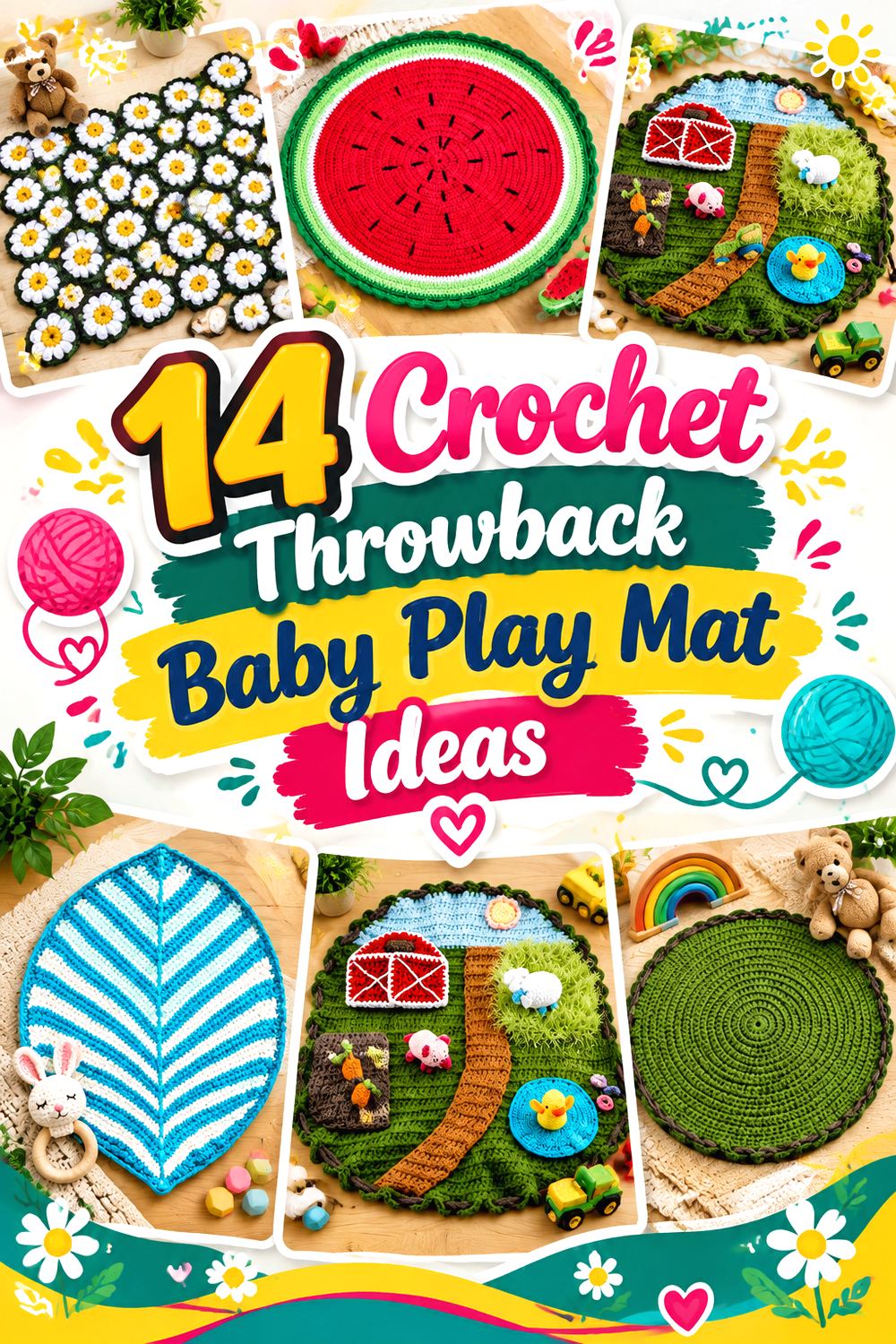
14 Crochet Throwback Baby Play Mat Ideas
A throwback baby play mat can borrow from vintage crochet without looking like a museum piece. Bold flowers, granny-square grids, concentric rainbows, graphic fruit, animal silhouettes, and chunky textured surfaces all bring a recognizable retro character, while different constructions make the finished mats useful in very different ways.
The ideas below range from simple flat floor pieces to motif-based rugs and more elaborate activity designs. Some tutorials were created specifically as baby play mats; others are original rug or playroom patterns that can inspire a supervised floor-play version. That distinction matters, particularly when a project includes fuzzy fibers, raised decorations, or separate toys. Use the comparisons and checkpoints here to choose a shape, surface, and scale that suit your space, then follow the credited original tutorial for the actual construction details.
Quick List
- Crochet Giant Retro Flower Baby Play Mat
- Crochet Concentric Rainbow Circle Play Mat
- Crochet Scalloped Sunshine Baby Play Mat
- Crochet Two-Tone Granny Square Play Mat
- Crochet Plush Throwback Rectangle Play Mat
- Crochet Three-Color Squishy Baby Play Mat
- Crochet Ribbon Nursery Floor Play Mat
- Crochet Neon Mandala Baby Floor Mat
- Crochet Raceway Play-Mat Blanket
- Crochet Faux-Fur Bear Nursery Play Mat
- Crochet Leaf-Shaped Retro Baby Play Mat
- Crochet Farmyard Story Play Mat
- Crochet Watermelon Graphic Nursery Play Mat
- Crochet Daisy-Motif Throwback Floor Mat
Build the Throwback Look With Shape, Not Just Color
A convincing retro mat does not need to depend entirely on an avocado-and-orange palette. Shape and layout often communicate the idea more clearly. Oversized daisies suggest bold 1960s and 1970s interiors, concentric rings recall colorful vintage rugs, granny squares create an unmistakable handmade grid, and a watermelon or mandala supplies the graphic impact associated with playful mid-century and later retro decor.
Color can reinforce those forms. Mustard, rust, olive, cream, dusty coral, aqua, brown, and saturated primary colors all offer different vintage directions, but they are options rather than requirements. A flower mat in contemporary neutrals still keeps its throwback silhouette. Likewise, a granny-square mat in two quiet colors can feel nostalgic without overwhelming a nursery. Start with the construction feature you want to emphasize, then use color to support it.
Choose a Surface for Supervised Floor Play
For a baby-focused mat, a relatively flat surface is easier to inspect than a design crowded with loose embellishments. Check finished ends, motif joins, borders, raised details, and any areas where little fingers could catch. Dense crochet may also be simpler for direct floor play than very open motifs, although the best choice still depends on the tutorial, yarn, tension, and intended use.
Interactive projects deserve an extra distinction. A race-track mat or farm scene may include separate toys or dimensional components that are appealing for an older child but should not automatically be treated as infant play features. Simplifying the project to its flat base can preserve the theme.
Most importantly, a crochet floor mat is not an infant sleep product. CPSC guidance says babies who fall asleep elsewhere should be moved to an appropriate crib, bassinet, play yard, or bedside sleeper.
Plan the Footprint, Weight, and Care Before Starting
Large floor crochet consumes more material and becomes heavier than its small swatch suggests. Before committing, mark the proposed footprint on the floor and decide whether you want a compact tummy-time area, a room-defining nursery rug, or a mat that can travel between rooms.
Material choice changes the result as much as size. Plush blanket yarn creates a very different surface from ribbon yarn, braided cord, ordinary yarn, or faux fur. Substituting between them can change drape, thickness, stitch definition, and the amount of yarn required. When a tutorial gives gauge or finished measurements, use those figures as project-specific references rather than assuming another yarn will behave identically.
Care also depends on the actual fiber and any mixed materials. Follow the yarn label and creator guidance rather than applying one washing method to every play mat.
1. Crochet Giant Retro Flower Baby Play Mat
1. Crochet Giant Retro Flower Baby Play Mat
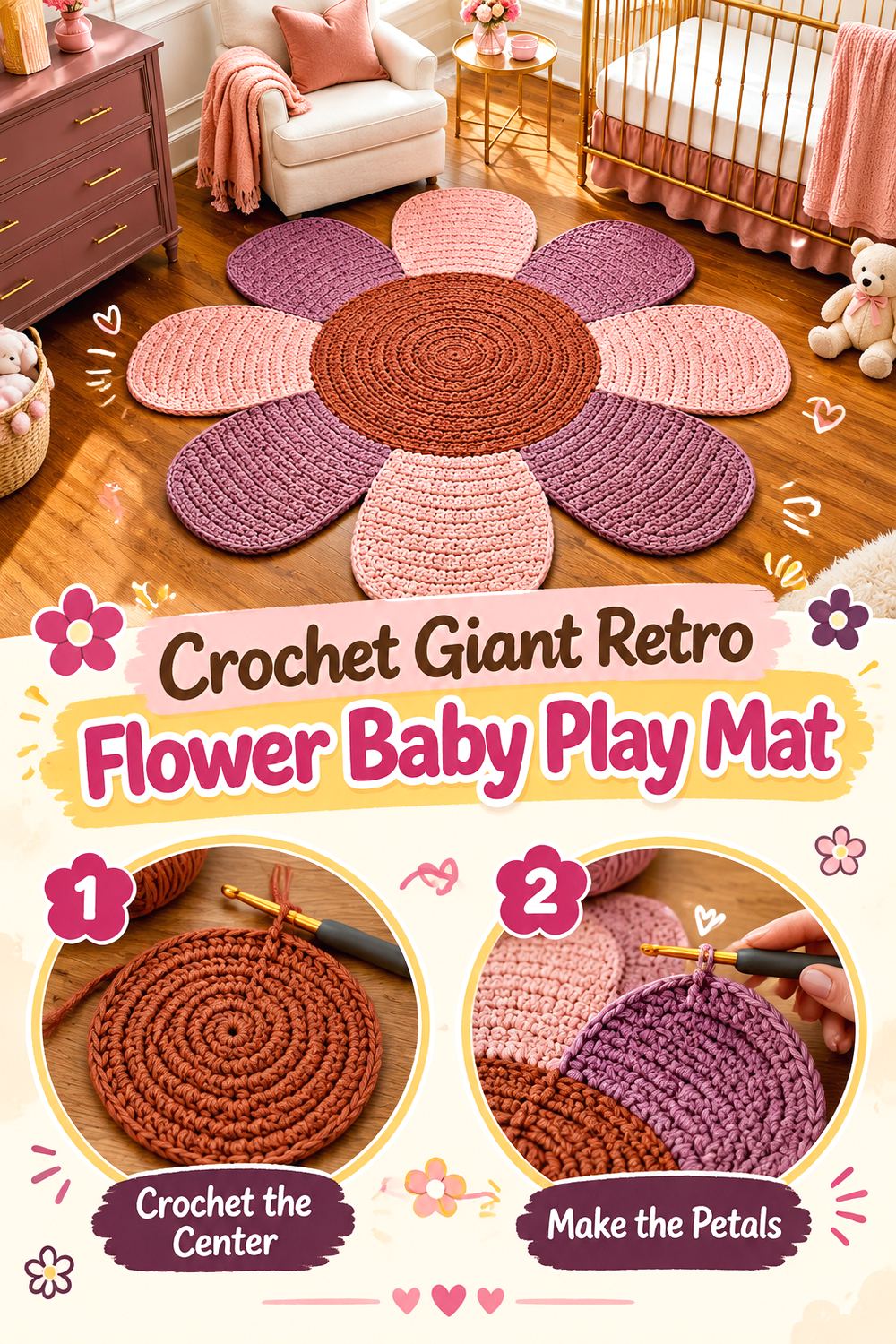
An oversized flower immediately makes the floor part of the nursery design. Jan Bay’s original tutorial uses a broad circular center surrounded by eight oversized petals, with the petals worked directly from the center rather than made as separate pieces. The tutorial deliberately avoids buttons, beads, and other loose surface decorations, which keeps the flower’s visual interest focused on silhouette and color.
This idea is strongest when you want the play mat to remain useful visually after the earliest floor-play stage. The flower can read as a nursery rug later, so it does not depend on baby-specific imagery. Warm rust, pink, mustard, brown, or cream can make the shape feel especially throwback.
Make the Petal Silhouette the Main Feature
Because the outline already carries so much personality, the mat does not need additional appliqués to make it interesting. Strong separation between the center and petal colors will emphasize the flower from across the room, while a lower-contrast palette makes it feel softer and more contemporary.
Whatever palette you choose, judge the flower as a whole every so often. Uneven-looking petals or an off-center visual balance will be more noticeable in a graphic silhouette than in a plain rectangle.
Treat the Published Dimensions as Targets
This particular source includes an important limitation: its stated dimensions and material estimates were calculated and checked for internal consistency rather than taken from a physically test-crocheted sample. The creator specifically advises checking gauge and making sure the center remains flat.
That makes flatness a better checkpoint than chasing an exact diameter. If you change cord or hook size, expect the footprint and material use to change as well.
Original Tutorial and Creator Credit
Creator/Site: Jan Bay / Unique Baby Gear Ideas
2. Crochet Concentric Rainbow Circle Play Mat
2. Crochet Concentric Rainbow Circle Play Mat
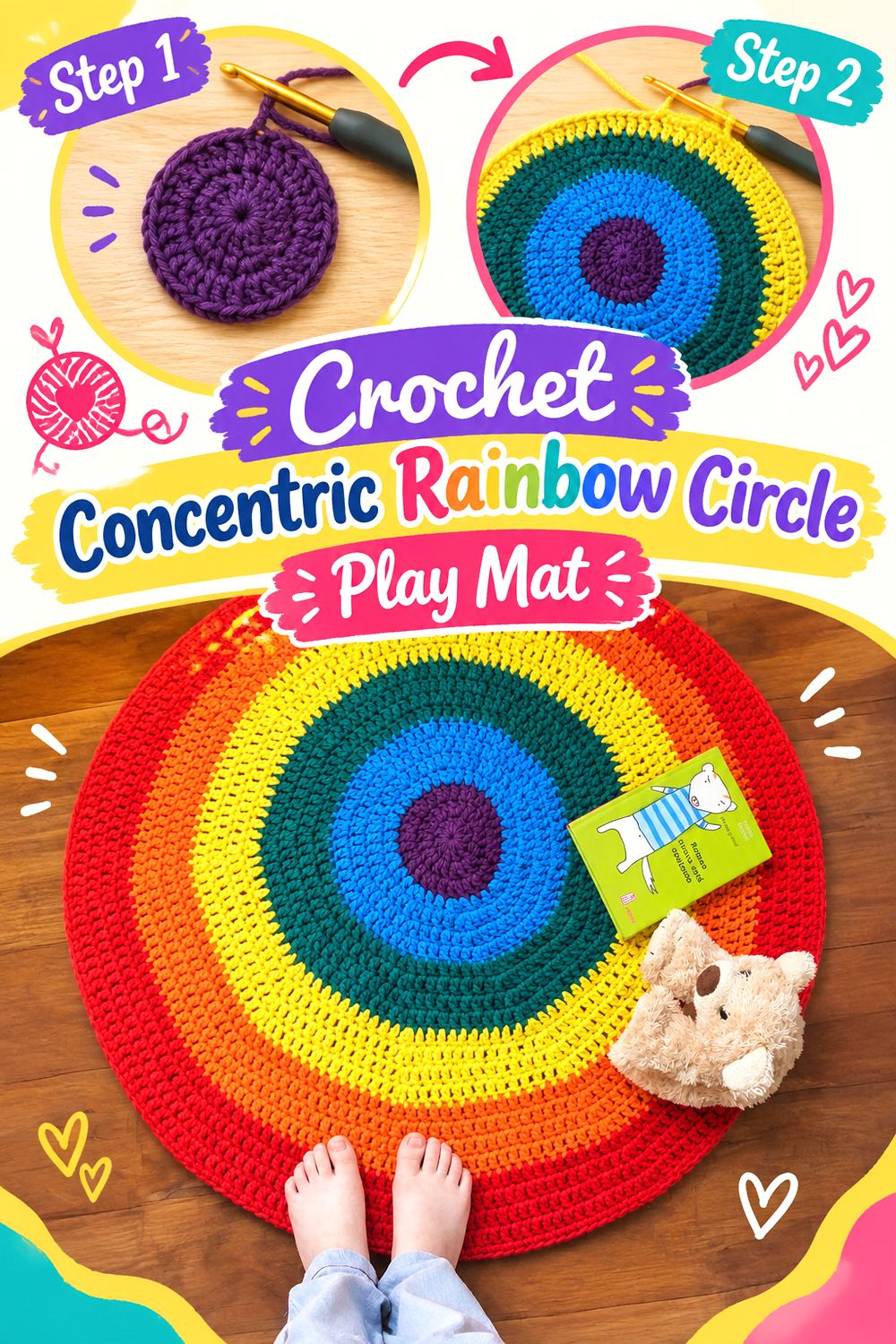
A round rainbow mat captures the cheerful, color-blocked side of throwback interiors without requiring a figurative motif. Oh La Lana!’s original playmat is worked as a circular design with successive bands of rainbow color and uses chunky or bulky yarn; the published version is approximately 37 inches in diameter.
This approach works especially well when a nursery already contains several patterned pieces because the geometry remains simple even with six or more colors. For a different era-inspired mood, the same ring concept could shift toward harvest gold, burnt orange, brown, cream, and avocado or toward bright 1980s-inspired contrasts.
Preserve the Concentric Read
The rings are what make this mat distinct. If neighboring colors are too similar in value, several bands may visually merge when viewed from standing height. Lay yarn choices next to one another before beginning and consider whether each transition is obvious enough for the effect you want.
You do not have to reproduce a literal rainbow. A controlled progression of three or four repeating vintage colors can keep the circular rhythm while integrating more quietly with the room.
Watch the Outer Edge as the Circle Grows
Large circles make tension differences increasingly visible. Set the work on a flat surface periodically rather than waiting until the final edge. A perimeter that cups or develops persistent waves is a signal to check your tension and compare your work with the creator’s gauge and instructions.
Changing yarn thickness or hook size can also alter the balance of the increases. Treat substitution as a new gauge decision rather than a purely cosmetic color change.
Original Tutorial and Creator Credit
Creator/Site: Cecilia / Oh La Lana!
3. Crochet Scalloped Sunshine Baby Play Mat
3. Crochet Scalloped Sunshine Baby Play Mat
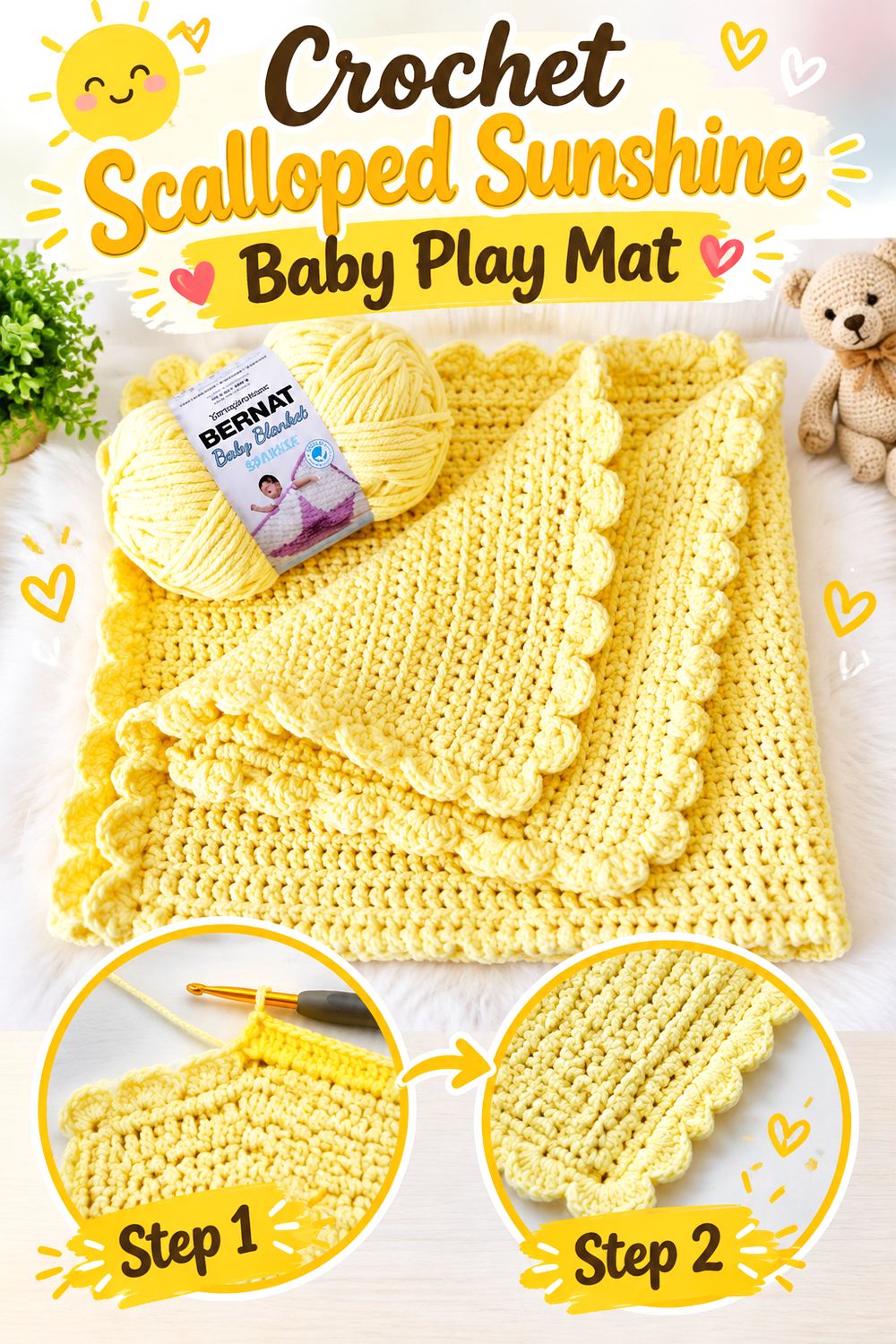
This version combines a substantial square field with a decorative scalloped finish, giving a familiar baby mat silhouette a noticeably more nostalgic edge. Daisy Farm Crafts presents the project as a thick, squishy baby playmat and uses blanket-style yarn with a scalloped border.
A square mat is easy to position beside furniture, but the curved border prevents it from looking purely utilitarian. In mustard or warm yellow it can lean into a sunny 1970s look; pale mint, coral, cream, or dusty blue can move it toward a softer vintage nursery direction. The border is enough of a focal detail that the central field can stay visually quiet.
Treat the Scallops as a Functional Edge Too
Decorative borders can change how a mat sits on the floor. After finishing, look at the corners and each side rather than only the individual scallops. The goal is a border that decorates the outline without pulling the center inward or creating exaggerated waves.
If you substitute a yarn with significantly different bulk or bounce, make a small sample of the edging first. A border that behaves well in one blanket yarn may respond differently in another fiber.
Check the Bulk Before Committing to a Large Square
Plush yarn can make a satisfying floor surface, but scale affects weight, storage, drying, and portability. Before enlarging the mat, decide where it will normally live and how you will care for the finished piece.
If your yarn choice differs from the source, follow its own care label. Decorative fibers, sparkle, and other specialty finishes may have requirements that are not interchangeable with another version of blanket yarn.
Original Tutorial and Creator Credit
Creator/Site: Daisy Farm Crafts
4. Crochet Two Tone Granny Square Play Mat
4. Crochet Two Tone Granny Square Play Mat
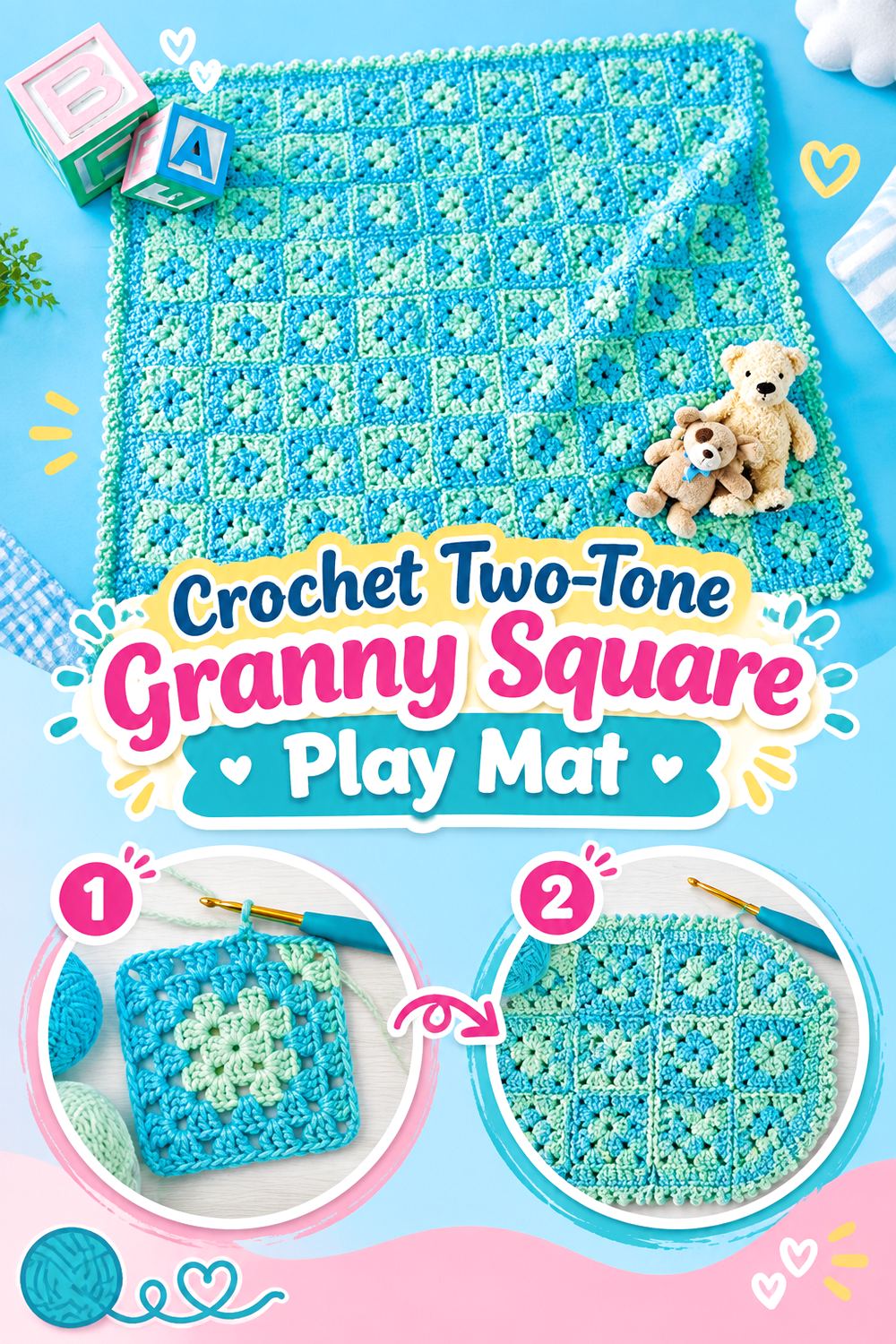
Few crochet structures signal “throwback” as immediately as a grid of granny squares. The Red Heart Baby Play Mat credited to Glenda Winkleman is built around granny-square motifs, and the pattern has appeared through Yarnspirations as an original Red Heart design.
A limited two-color treatment can make the old-school structure feel graphic rather than busy. Alternating the color emphasis from square to square adds a checkerboard quality while preserving the individual motifs. This is also a useful option when you prefer modular work: the visual result depends not only on each square but on how consistently the complete grid comes together.
Make the Joins a Design Priority
In motif construction, joining is not merely a finishing step. Uneven joins can pull otherwise consistent squares out of alignment, creating bumps or channels across the finished floor surface. Compare motif dimensions before assembly and resolve obvious differences early.
After joining several rows, spread the work out completely. A flat inspection makes it easier to spot twisting, stretched seams, or a grid that is gradually drifting out of square.
Decide How Open You Want the Fabric
Traditional granny construction naturally creates spaces. For a baby floor mat, consider how open the finished motifs feel at your actual gauge rather than assuming every granny square has the same density.
A different hook or yarn can alter those openings substantially. If you prefer a denser result, choose a tutorial or adaptation method that supports that goal instead of informally filling gaps in ways that could distort the motifs.
Use Contrast to Emphasize the Grid
Two-tone granny squares can deliver a strong retro effect without using many yarn colors. High contrast highlights each block and join; closer values create a more blended patchwork.
Make the color decision at layout stage rather than square by square. Placing several completed motifs together before joining can reveal accidental stripes or clusters that are difficult to notice while working on isolated pieces.
Original Tutorial and Creator Credit
Creator/Site: Glenda Winkleman / Red Heart at Yarnspirations
5. Crochet Plush Throwback Rectangle Play Mat
5. Crochet Plush Throwback Rectangle Play Mat
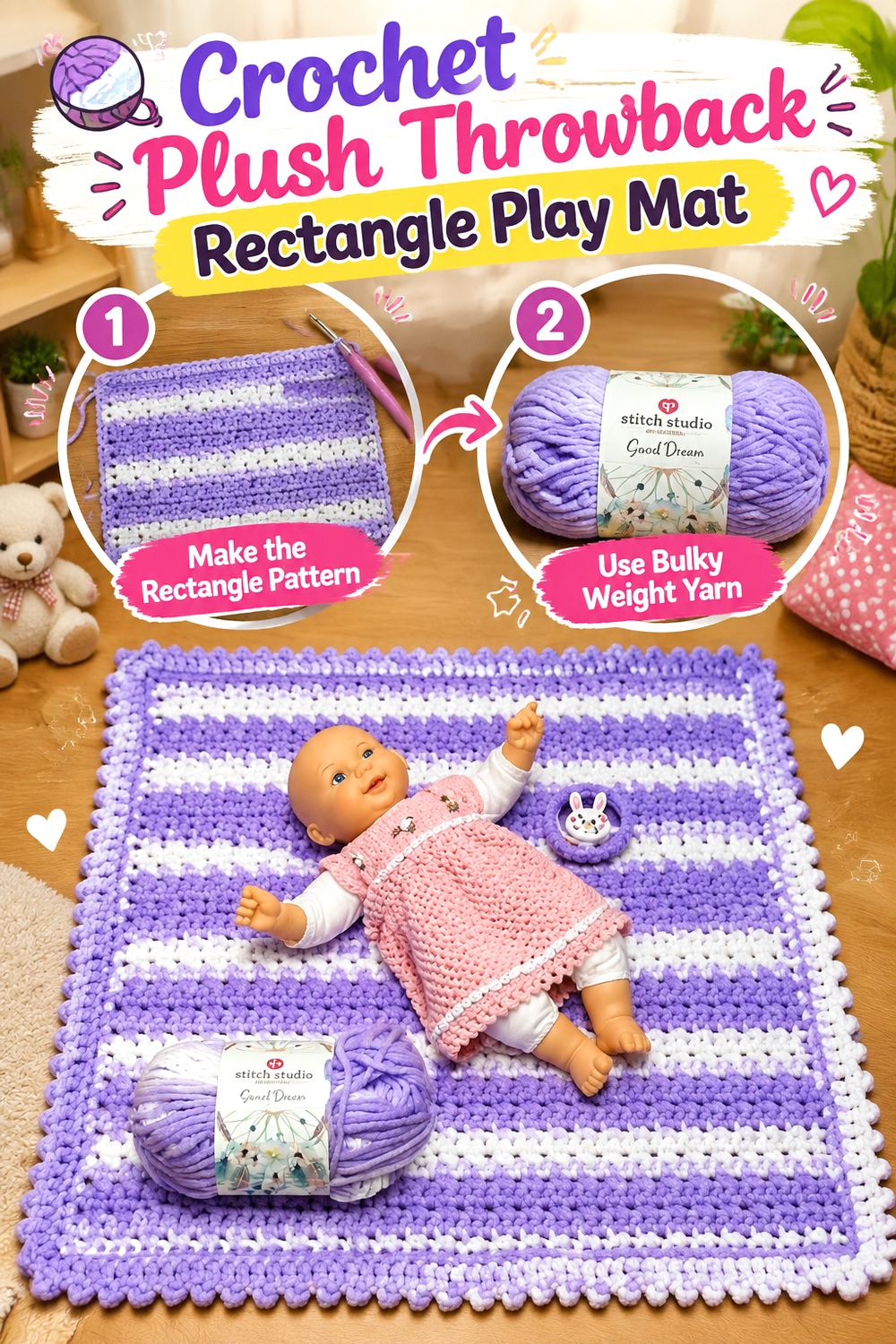
Creative Grandma’s Sweet Dream Play Mat offers a classic rectangular alternative to the more decorative silhouettes in this list. The video tutorial uses bulky yarn and presents the finished piece specifically as a floor play mat for a baby, with guidance for readers who want to make the mat larger.
The simple format is a useful canvas for retro color rather than retro shape. Wide stripes, cream-and-mustard blocking, muted rainbow bands, or a brown-and-orange combination can change the mood without complicating the outline. A rectangle also makes sense when the mat needs to fit between a crib, chair, dresser, or other fixed furniture.
Measure the Floor, Not the Crib
Decide on the footprint by measuring the open floor area where the mat will actually be used. A larger project is not automatically more practical if it overlaps furniture legs, door swings, or a walkway.
The tutorial discusses enlarging its original mat, but any increase also changes yarn requirements and final weight. Confirm the creator’s resizing information before purchasing materials for a substantially larger version.
Let the Simple Form Carry a Strong Palette
Because the silhouette is quiet, this project can support bolder color blocking than a flower or animal rug without becoming visually crowded. Repeated broad bands are particularly effective when you want a 1970s blanket-like look.
For a calmer nursery, use the same structural simplicity with two related tones. The throwback quality can come from the color relationship rather than from adding tassels, appliqués, or other loose embellishments.
Original Tutorial and Creator Credit
Creator: Creative Grandma
6. Crochet Three Color Squishy Baby Play Mat
6. Crochet Three Color Squishy Baby Play Mat
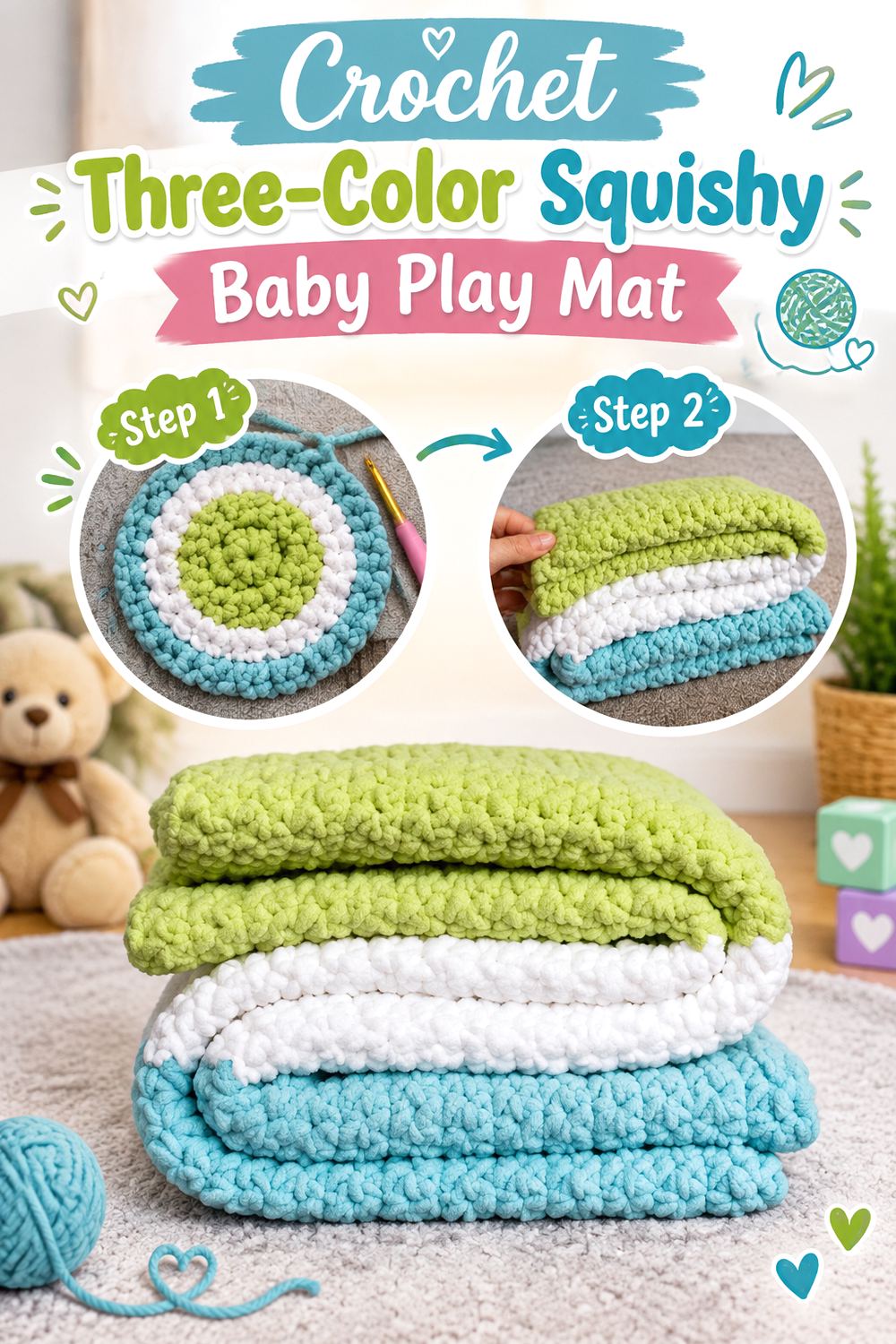
The Turtle Trunk’s Crochet Play Mat Tutorial is another plush option, but its three-color presentation gives it a different visual role. The creator describes the mat as soft and squishy for baby floor play and demonstrates it with Bernat Blanket Yarn, including quantities for a three-color version.
That makes this a strong candidate for a controlled throwback stripe palette. Instead of a literal rainbow, try three colors with clearly different jobs: a dark anchor, a warm middle tone, and a light neutral. The chunky texture keeps the surface visually substantial even when the color scheme itself is restrained.
Keep Broad Stripes Visually Calm
Three colors are enough to create rhythm without turning the mat into a highly patterned focal point. Before beginning, decide whether you want equal visual emphasis or one dominant color with two accents.
Look at yarn combinations from several feet away. Colors that appear clearly different in a skein can merge once crocheted into a plush surface, especially when their values are similar.
Inspect Plush Yarn as the Mat Is Used
Soft chenille-style and blanket yarns can obscure individual stitches more than smooth yarn, so finished ends and wear points deserve deliberate inspection. Check the mat periodically for anything that has loosened rather than assuming the fuzzy surface will make small changes obvious.
Care should follow the specific yarn label and tutorial guidance. If you substitute another plush fiber, do not assume its laundering instructions or long-term behavior will match the source yarn.
Original Tutorial and Creator Credit
Creator: The Turtle Trunk
7. Crochet Ribbon Nursery Floor Play Mat
7. Crochet Ribbon Nursery Floor Play Mat
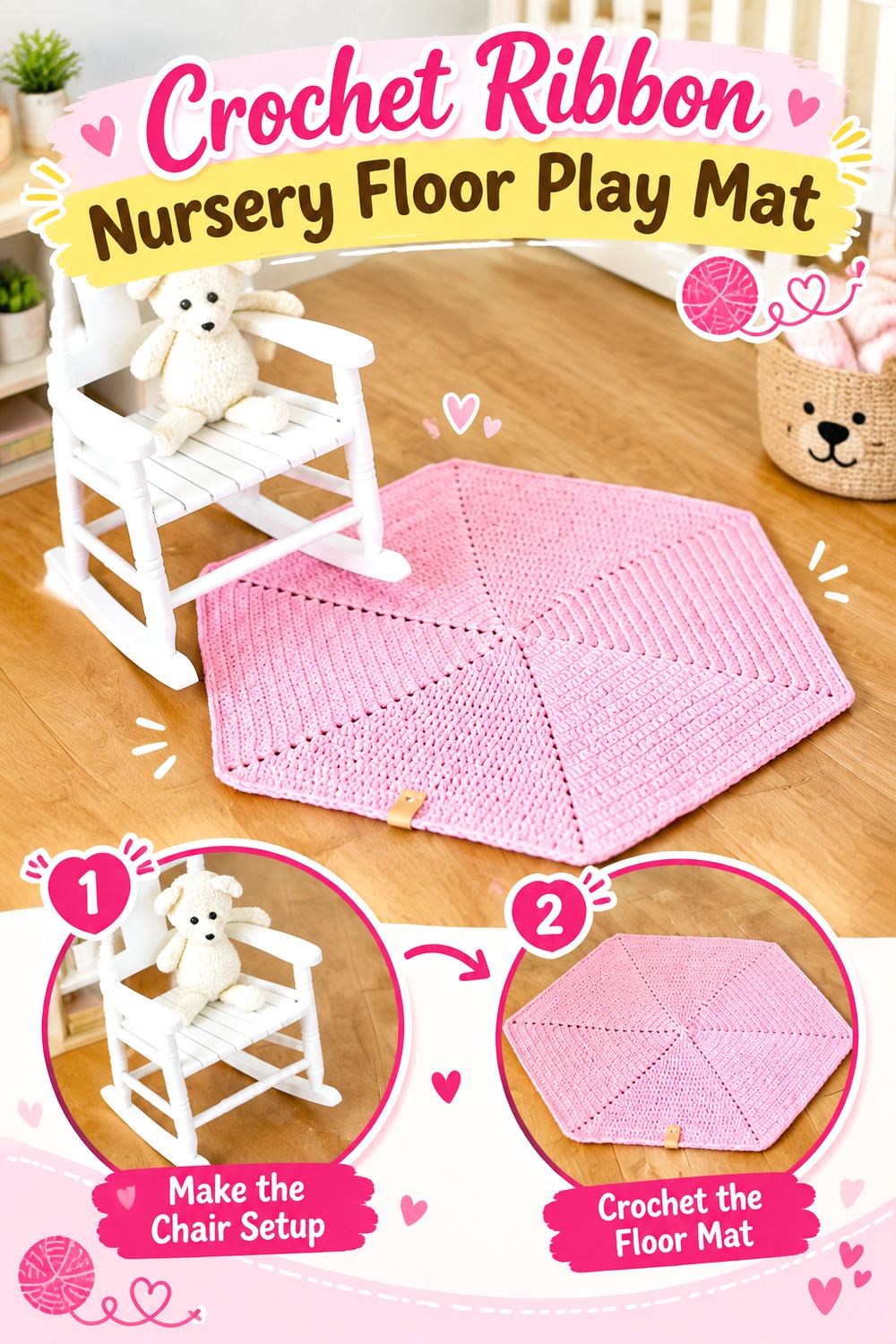
Hobbii’s BabyRoom Rug, designed by Tine Sommer Hansen, brings a lower-profile interior-rug approach to the list. The original is crocheted in Hobbii Ribbon and is presented as a children’s-room floor mat with a simple, timeless design and a leather detail.
For baby floor play, the appeal lies in borrowing the broad flat rug concept rather than automatically reproducing every decorative element. A ribbon-yarn mat in warm brown, olive, ochre, cream, or dusty rose can look convincingly retro while remaining visually streamlined. This option suits readers who want something that still looks like intentional room decor when no toys are on it.
Ribbon Yarn Changes the Feel of the Project
Ribbon yarn behaves differently from fluffy blanket yarn. Its flatter structure can emphasize stitch definition and produce a more rug-like visual surface, while the completed piece may also feel heavier or firmer depending on gauge.
If substituting another material, compare more than the label’s nominal weight. Work a meaningful sample and judge thickness, flexibility, edge behavior, and how comfortably it lies flat before scaling up.
Simplify Decorative Extras for Direct Baby Use
The original Hobbii design includes a leather detail. For a baby-focused adaptation, decide whether any non-yarn decoration contributes enough to justify keeping it on a surface intended for close floor contact.
A stripped-back version can still preserve the design’s character through yarn texture and color. Whenever you alter the source in this way, use the original tutorial for core construction while treating the baby-specific simplification as your adaptation.
Original Tutorial and Creator Credit
Creator/Site: Tine Sommer Hansen / Hobbii Design
8. Crochet Neon Mandala Baby Floor Mat
8. Crochet Neon Mandala Baby Floor Mat
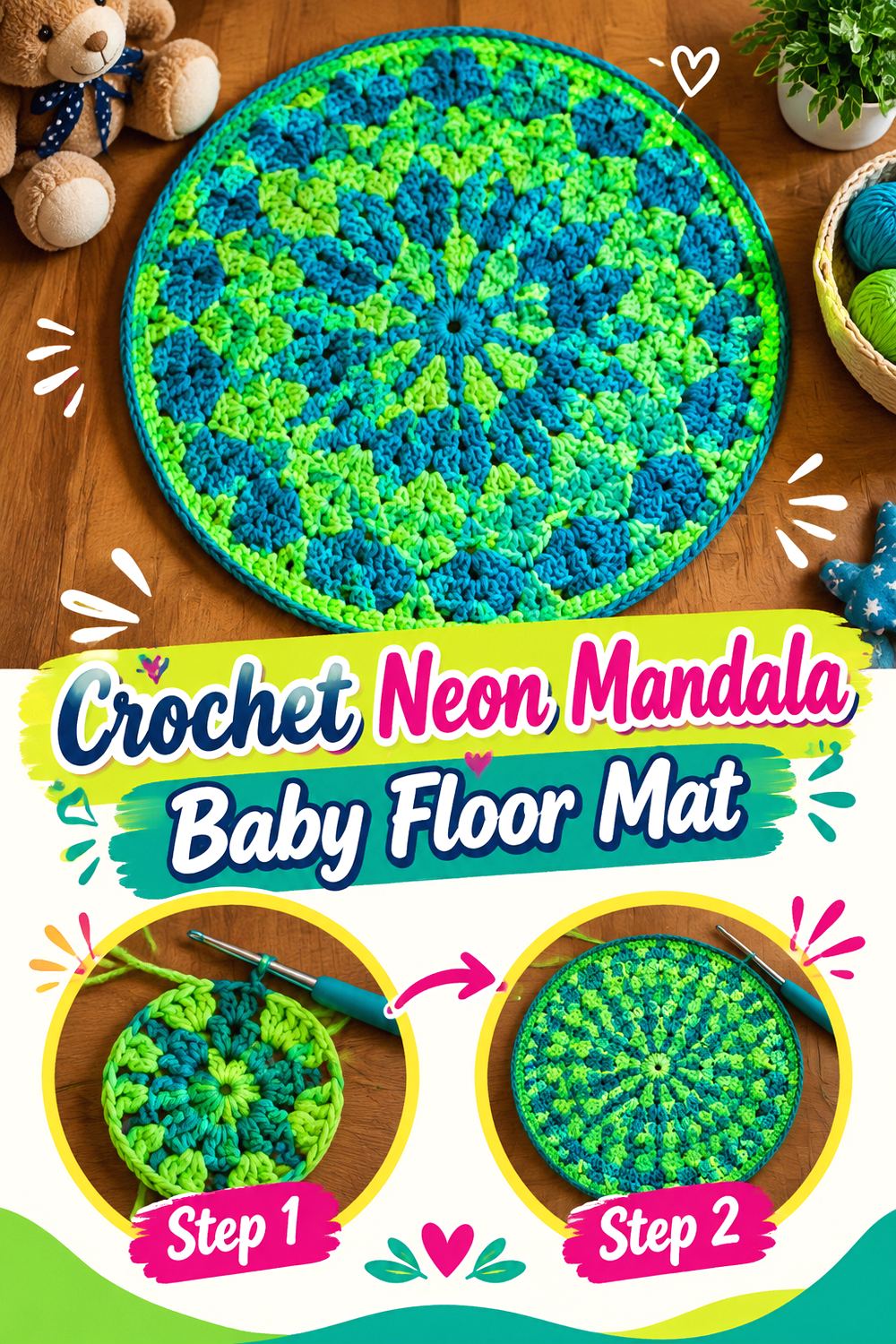
A mandala shifts the throwback mood toward bright 1970s craft culture or bold 1980s color, depending on the palette. Tamara Kelly’s Shocking Mandala Rug was made for a playroom and uses a large circular motif with super-bulky yarn and high-impact color.
As a baby floor-mat idea, its advantage is visual interest without requiring separate toys or attached appliqués. The expanding motif provides the decoration. Choose electric contrasts for a maximalist look, or convert the same graphic concept into rust, ochre, olive, and cream for a warmer retro room.
Bold Color Needs an Equally Stable Shape
The eye follows the repeated sections of a mandala closely, so irregular expansion can become more visible than it would on a plain mat. Pause periodically and view the whole circle on a level floor.
If you make material substitutions, watch for both cupping and rippling. A dramatic motif only works as a floor piece if the finished fabric is willing to lie where you put it.
Scale the Statement to the Room
A high-contrast mandala can dominate a small nursery, which may be exactly what you want. If other textiles already contain busy prints, however, reducing the number of colors can preserve the motif while lowering visual competition.
You can also pull two shades from existing room decor rather than introducing an entirely new rainbow. The geometry will still carry the retro character.
Original Tutorial and Creator Credit
Creator/Site: Tamara Kelly / Moogly
9. Crochet Raceway Play Mat Blanket
9. Crochet Raceway Play Mat Blanket
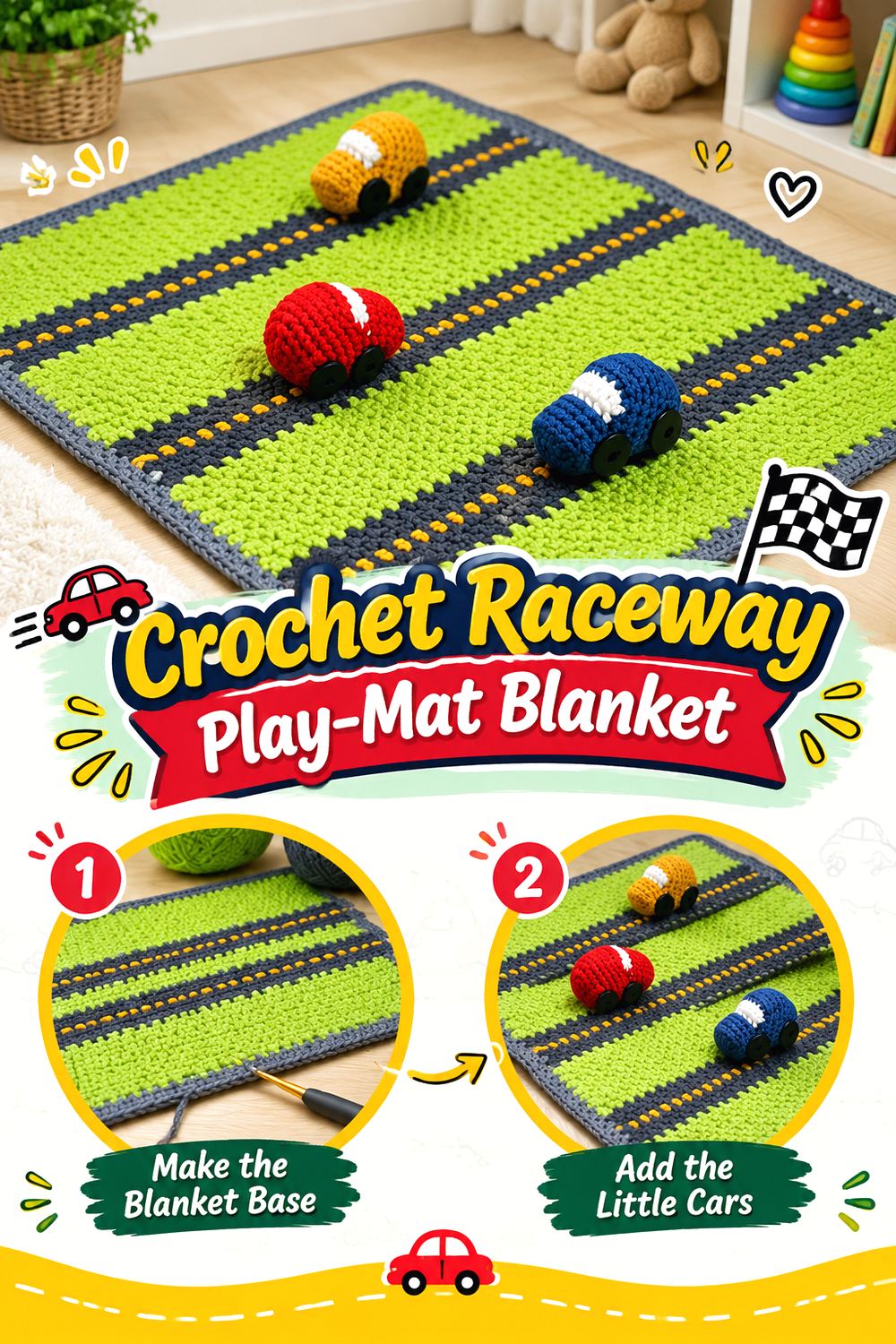
Repeat Crafter Me’s race-car “Playnket” combines a soft rectangular blanket with graphic roadway bands, making it a very different throwback project from a nursery rug. The original is intended to lie flat for vehicle play while also working as a portable blanket-like piece, and the tutorial includes separate crochet cars.
For a baby-focused version, the flat roadway base is the more relevant idea. The track itself supplies plenty of visual contrast without requiring the separate cars during infant floor play. Later, the interactive concept can evolve with the child when toys are developmentally appropriate.
Separate the Baby Mat From the Toy-Car Set
The source includes small stuffed crochet cars, but an infant floor mat and an activity set for an older child have different use considerations. Do not assume every component of a multi-age tutorial belongs in the baby setup.
For early floor play, keeping the textile base clear maintains the race-track theme while eliminating unnecessary loose objects. Store the cars separately until they suit the child’s stage and your supervision plan.
Keep the Track Readable Without Extra Pieces
A strong road design should still look like a roadway when nothing is placed on it. Contrast between the track, lane markings, and surrounding field will do more for this project than adding numerous surface decorations.
Try a vintage toy-box palette such as moss green, charcoal, mustard, and cream, or switch to bright primary colors for a later-century throwback feel.
Portability Can Guide the Size
The original project was conceived partly as a compact, take-along piece. If portability appeals to you, resist automatically enlarging it to nursery-rug proportions.
A smaller flexible mat can move between the living room and nursery or be packed away with toys. A larger version provides more track area but also requires more yarn and storage space. Decide which job matters first.
Original Tutorial and Creator Credit
Creator/Site: Repeat Crafter Me
10. Crochet Faux Fur Bear Nursery Play Mat
10. Crochet Faux Fur Bear Nursery Play Mat
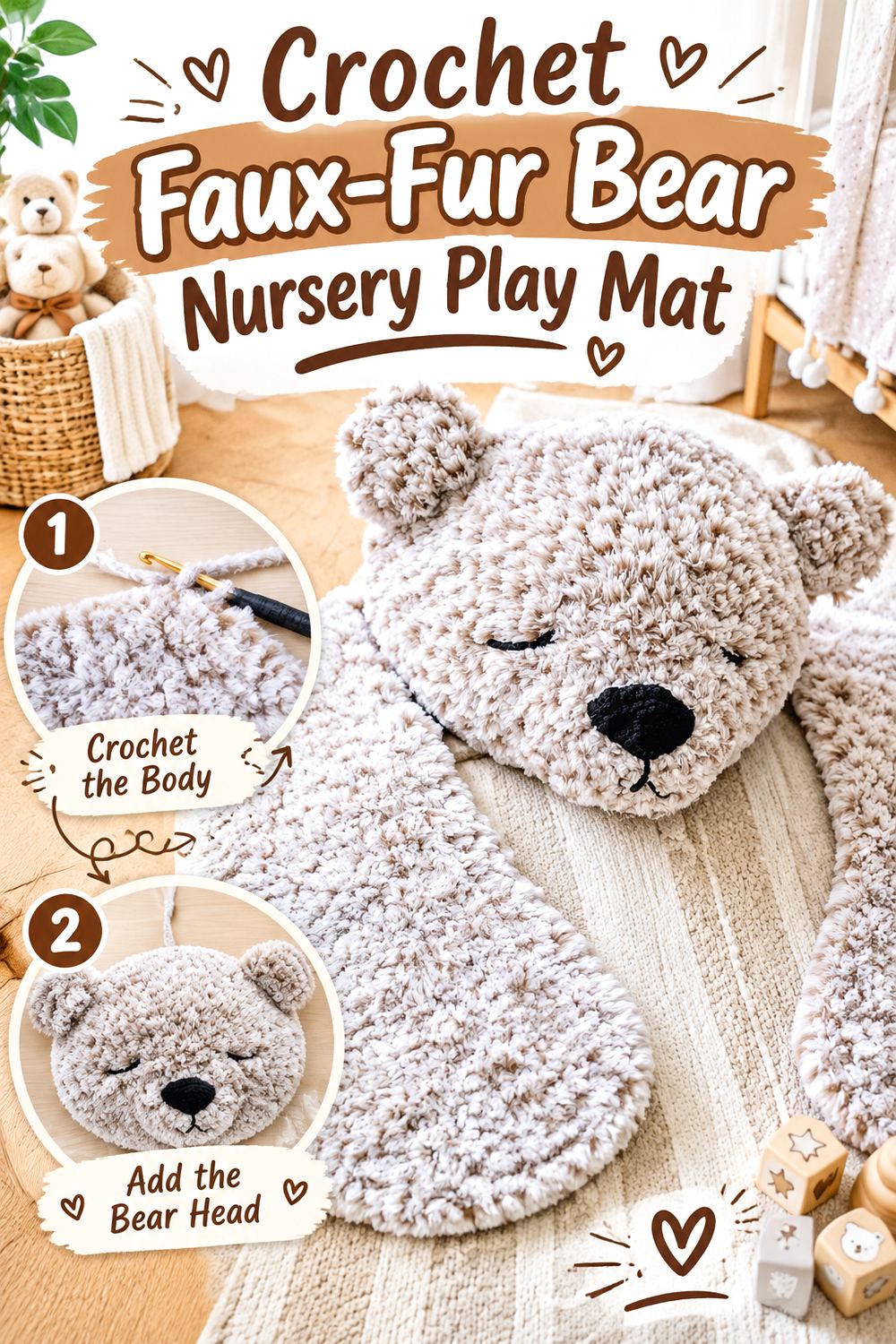
For a cabin-inspired or 1970s woodland nursery, an animal silhouette offers a very different kind of nostalgia. Jess Coppom’s bear blanket rug for Make & Do Crew is presented as a rustic throw, child’s play mat, or nursery rug and is made with fuzzy faux-fur yarn.
The recognizable bear outline does most of the decorative work, so the project does not need a complicated color plan. A natural neutral keeps the emphasis on shape and texture. This is a more specialized surface than a smooth yarn mat, however, and the fuzzy fiber deserves extra inspection if you intend to use it where a baby will have close face and hand contact.
Faux Fur Hides Both Stitches and Wear
Fuzzy yarn can make stitch anatomy difficult to see while crocheting and can also make later inspection less immediate. Check finished seams, ends, and shaped areas by touch as well as sight.
Before choosing any faux-fur yarn for baby floor use, review the manufacturer’s current care and use information. Do not assume all fuzzy yarns shed, wash, or wear in the same way simply because they have a similar appearance.
Keep the Animal Silhouette Clean
The bear shape is strongest when its outline remains obvious. If you alter yarn thickness or heavily resize the project, pay attention to whether the proportions of the body and extremities still read clearly from above.
A strong silhouette also means fewer added decorations are necessary. For a baby-focused version, visual interest can come from the overall animal form instead of extra detachable accessories.
Original Tutorial and Creator Credit
Creator/Site: Jess Coppom / Make & Do Crew
11. Crochet Leaf Shaped Retro Baby Play Mat
11. Crochet Leaf Shaped Retro Baby Play Mat
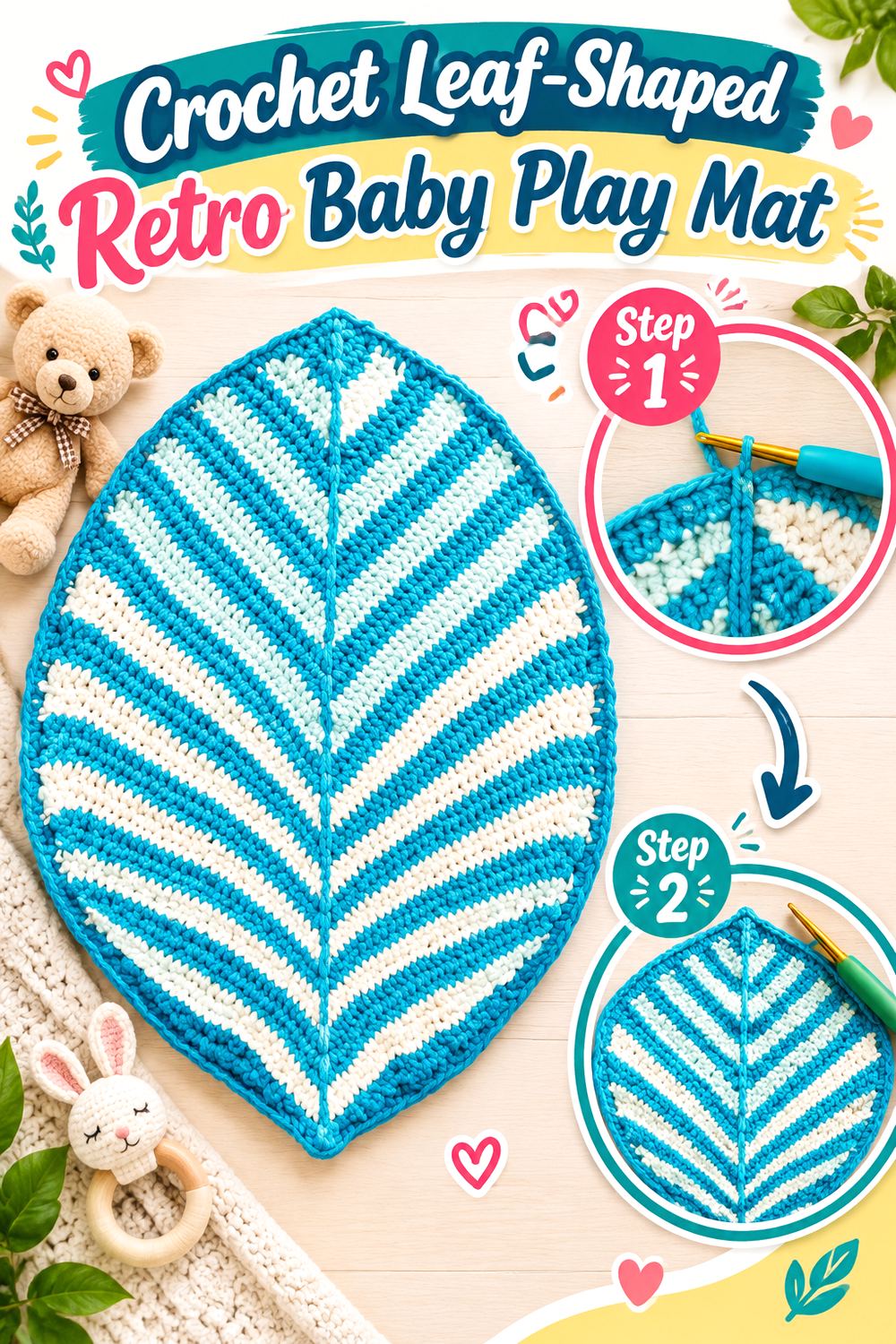
The Bernat Leafy Time Baby Playmat replaces the usual circle or rectangle with a large leaf silhouette. Yarnspirations describes the plush project as leaf-shaped, with different stripe treatments on its two sides and surface detail through the center that reinforces the botanical form.
This works particularly well for a nature-themed throwback nursery, where the shape can carry the vintage reference through olive, avocado, moss, mustard, or cream instead of relying on nursery pastels. An irregular organic outline also softens a room filled with rectangular furniture.
Use the Center Detail as a Visual Anchor
A leaf can look like an arbitrary oval if its characteristic structure disappears. The center treatment in the source helps the shape read botanically, so color placement should support rather than obscure that line.
If you develop your own palette, consider how the eye moves from the narrow end through the center. Strong contrast at every edge is not required; one deliberate central feature may be enough.
Check an Irregular Shape Against the Actual Floor
A leaf occupies floor space differently from a square of comparable width. Mark its approximate footprint before starting, especially if the intended location is beside a chair, crib, or dresser.
Also consider orientation. Rotating the finished mat may make it fit the room better, so do not evaluate the dimensions as though the project has only one usable direction.
Original Tutorial and Creator Credit
Creator/Site: Bernat / Yarnspirations
12. Crochet Farmyard Story Play Mat
12. Crochet Farmyard Story Play Mat
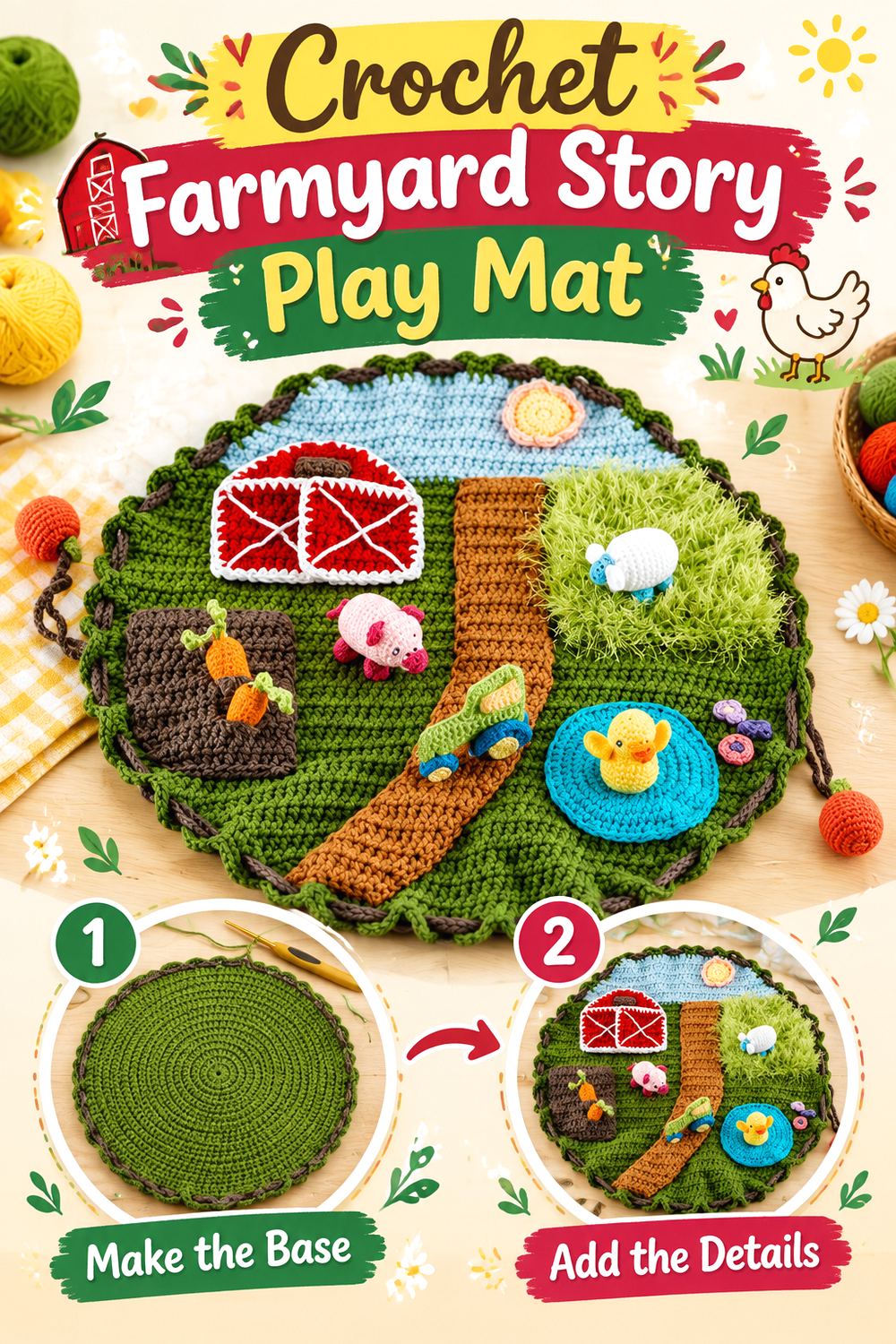
Lion Brand’s Down on the Farm Playmat takes the concept well beyond a flat rug. The original is categorized as both a home and toy project, and supporting pattern information describes an interactive farm scene with buildings and other attached or assembled elements.
That makes it one of the most imaginative ideas here, but also one that benefits from deciding who will actually use it. For an infant, the farm can inspire a simplified flat landscape. For an older child, the dimensional scene can become part of pretend play. The throwback connection comes naturally from the handmade story-mat format, reminiscent of portable textile play sets.
Decide Whether You Are Making a Baby Mat or an Activity Set
Those two goals lead to different choices. A baby’s floor surface benefits from simplicity and easy inspection, while an older child’s activity mat can use more dimensional scenery.
Before beginning all the small elements in the original pattern, decide whether they support your intended stage of use. You can admire the full farm concept without assuming every component must accompany an infant on the floor.
Treat Attached Pieces as Individual Checkpoints
Interactive crochet creates more joins, ends, and raised areas than a simple one-piece mat. Each attachment deserves inspection rather than being treated as decoration that will automatically remain secure.
Where the intended user is very young, fewer components can make the piece easier to monitor. Follow the creator’s assembly directions for the design you make, and reconsider any personal embellishment that introduces an unnecessary loose part.
Scale the Scene Before Enlarging It
Enlarging a story mat is more complicated than adding length to a plain rectangle because buildings, roads, fields, and other features have visual relationships.
If you want a substantially larger farm, plan where the extra space will go instead of simply enlarging one element. Keeping the landscape balanced will make the scene more readable and can prevent one motif from dominating the whole mat.
Original Tutorial and Creator Credit
Creator/Site: Lion Brand Yarn
13. Crochet Watermelon Graphic Nursery Play Mat
13. Crochet Watermelon Graphic Nursery Play Mat
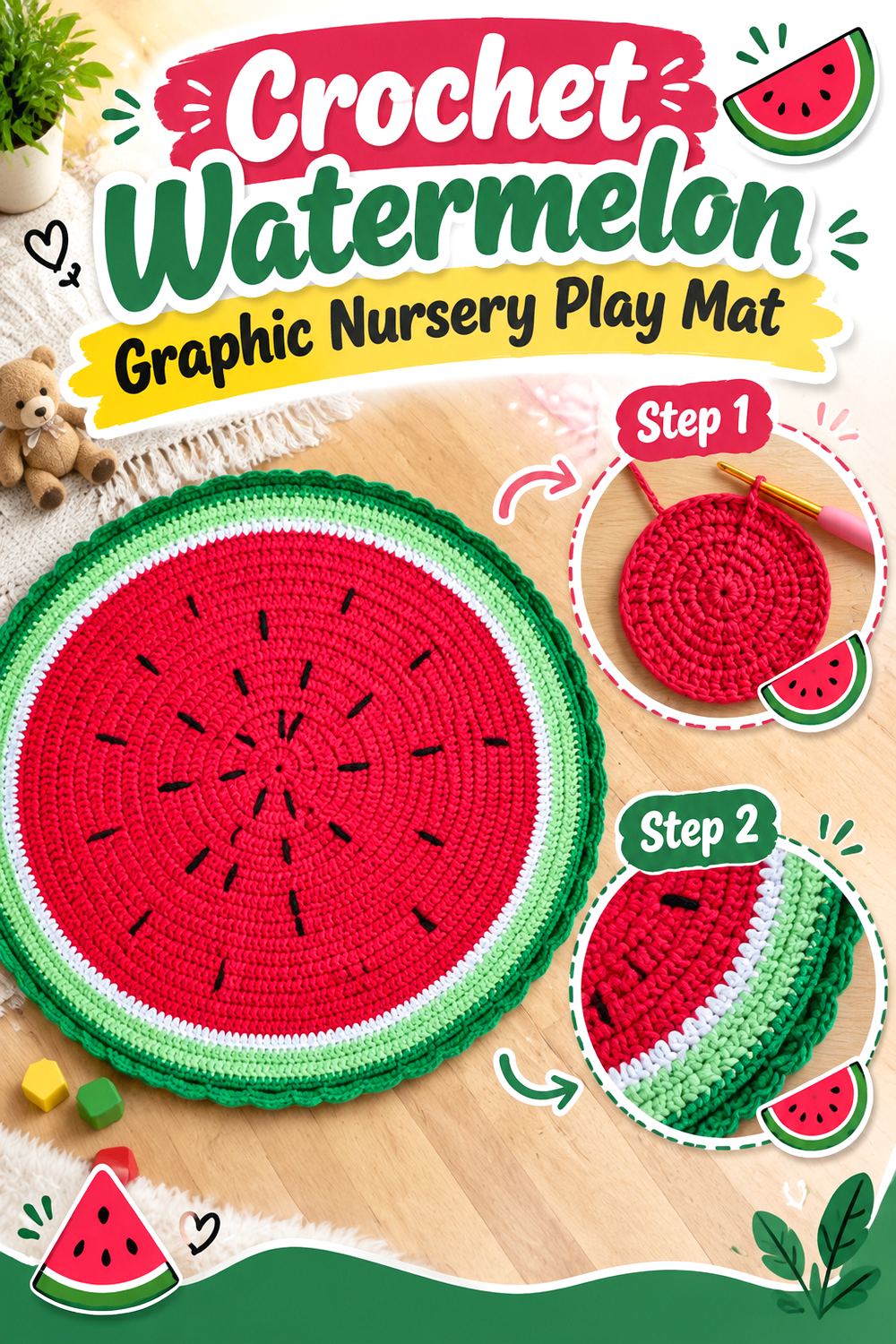
A giant fruit motif brings instant mid-century-to-1970s playfulness without relying on conventional baby imagery. Jennifer Santos’ Watermelon – Rug for Hobbii is a crochet rug built around a watermelon motif, giving this idea a bold graphic identity that distinguishes it from the floral, rainbow, and animal projects elsewhere in the list.
As a nursery adaptation, its appeal is largely visual: pink or red, green, white, and dark accent tones create a familiar image with very little explanation. You can also mute those colors if the room already contains strong patterns.
Motif Readability Relies on Color Boundaries
Graphic fruit works because viewers recognize the major areas immediately. If the rind, flesh, and accent colors are too close in value, the image can lose impact from across the room.
Before purchasing a large amount of yarn, group your proposed colors together and photograph them in ordinary room light. That simple comparison can reveal whether the sections remain distinct outside bright store or screen lighting.
Keep Added Details Flat for Baby-Focused Use
If you customize the watermelon with additional seed-like accents or other embellishments, consider whether those details really need to be raised or separate. Flat colorwork can provide the same graphic cue with a simpler surface.
The original Hobbii design should remain your construction reference. Any baby-specific simplification or alteration is an adaptation, so check that it does not interfere with the way the underlying rug is intended to lie.
Original Tutorial and Creator Credit
Creator/Site: Jennifer Santos – Super Cute Design / Hobbii Design
14. Crochet Daisy Motif Throwback Floor Mat
14. Crochet Daisy Motif Throwback Floor Mat
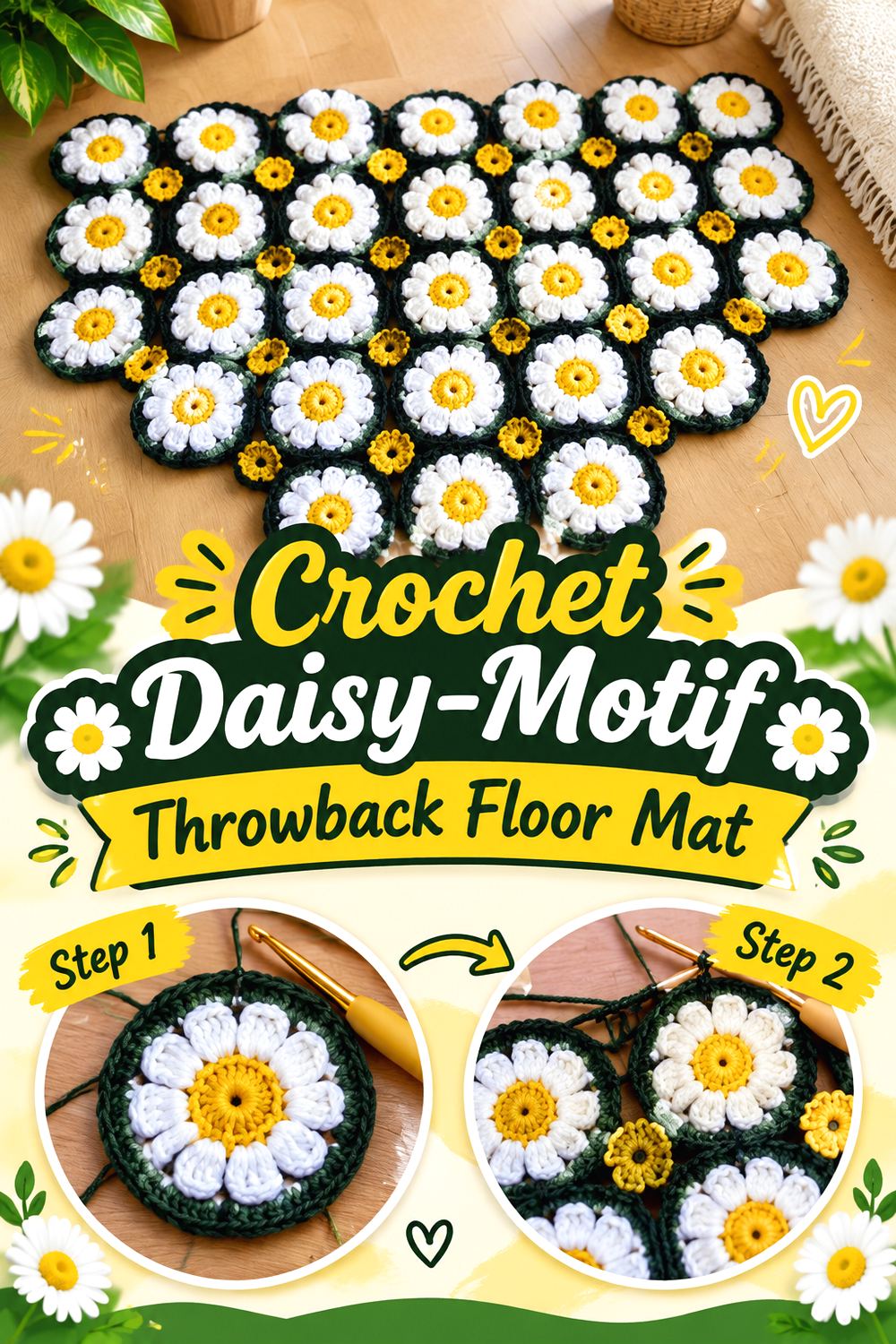
Meladora’s Creations approaches flowers differently from the single giant bloom at the beginning of this list. The Crochet Daisy Rug is assembled from flower motifs, producing a repeated floral surface rather than one oversized silhouette. The source describes it as a plush rug made from joined flower motifs.
For a throwback nursery, a field of daisies can lean toward 1960s flower-power styling or toward 1970s craft-room decor. Because the original rug is relatively compact, treat it as inspiration for a small supervised floor mat or nursery accent unless you deliberately plan and test a larger motif layout.
Joined Flowers Create a Different Floor Texture
A motif rug has natural transitions between flowers, so inspect the joins as part of the finished surface. Consistent motif size matters because one tighter or looser flower can affect several neighboring seams.
Lay completed motifs together before permanent assembly. This also lets you evaluate whether the spaces between flowers are appropriate for the way you intend to use the mat.
Enlarge Through Layout, Not Guesswork
If you want more floor coverage, planning additional motifs is generally easier to evaluate visually than trying to make every flower dramatically larger without understanding the consequences.
Sketch the proposed layout or arrange finished motifs temporarily first. Check overall width, length, edge shape, and the number of joins the larger piece will introduce before committing to the full expansion.
Original Tutorial and Creator Credit
Creator/Site: Meladora’s Creations
Which Throwback Play-Mat Style Fits Your Space?
| Project | Main throwback cue | Construction character | Useful choice when you want | Main checkpoint |
|---|---|---|---|---|
| Giant Flower | Oversized retro bloom | Large shaped silhouette | A nursery focal point | Keep center and petals flat |
| Rainbow Circle | Concentric color rings | Expanding round mat | Graphic color without appliqués | Watch outer-edge flatness |
| Scalloped Sunshine | Decorative curved border | Plush square | A familiar footprint with vintage detail | Check border tension |
| Granny Square | Patchwork grid | Joined motifs | Traditional crochet character | Inspect motif joins |
| Plush Rectangle | Retro color blocking | Simple rectangular field | Flexible furniture placement | Confirm resizing needs |
| Three-Color Squishy | Broad plush color areas | Thick blanket-yarn mat | Soft visual simplicity | Inspect fuzzy yarn and ends |
| Ribbon Floor Mat | Low-profile textile texture | Interior-style rug | A mat that doubles as room decor | Test substitutions for flatness |
| Neon Mandala | Bold radial geometry | Circular motif | A strong statement piece | Control expansion and rippling |
| Raceway | Vintage toy-road graphic | Blanket/play surface | A design that can evolve with age | Separate infant use from toy pieces |
| Faux-Fur Bear | Woodland animal silhouette | Fuzzy shaped rug | Rustic retro texture | Inspect fiber and attachments |
| Leaf-Shaped Mat | Botanical silhouette | Irregular plush shape | Organic nursery styling | Test the footprint in the room |
| Farmyard Story Mat | Textile play scene | Interactive construction | A project for later pretend play too | Review every raised component |
| Watermelon Graphic | Oversized fruit motif | Graphic floor rug | Bright mid-century playfulness | Keep color areas readable |
| Daisy-Motif Mat | Repeating flower-power motifs | Joined floral units | Modular retro florals | Check every seam and opening |
Conclusion
The most convincing crochet throwback baby play mats use construction as part of the nostalgia. A giant flower or leaf changes the room through silhouette, granny squares and daisies bring recognizable handmade structure, while rainbows, mandalas, race tracks, and watermelon graphics rely on bold visual geometry. Plush rectangles and ribbon mats offer quieter alternatives when the nursery already has plenty of pattern.
Choose first by surface, footprint, and intended stage of use, then decide how strongly you want the vintage palette to show. Keep infant floor play supervised and separate it from sleep or age-inappropriate loose play pieces. Once you have chosen a direction, use the credited original tutorials for exact construction, gauge, materials, and project-specific adjustments.
Frequently Asked Questions
Can a crochet baby play mat be used for sleep?
No. Treat these projects as supervised floor-play surfaces or nursery rugs, not infant sleep products. Current CPSC guidance says babies should sleep in products intended for sleep, such as compliant cribs, bassinets, play yards, or bedside sleepers. If a baby falls asleep elsewhere, the CPSC advises moving the baby to an appropriate sleep space.
What type of yarn is best for a crochet baby play mat?
There is no single best yarn for every design. Blanket yarn can create a plush surface, ribbon yarn makes a more rug-like fabric, smooth yarn preserves motif definition, and cord can give a shaped mat more body. Use the material specified by the tutorial when you want the closest result. For substitutions, swatch first and check texture, density, fiber care, finished weight, and how well the fabric lies flat.
How can I make a play mat look retro without using orange and brown?
Use structure instead of relying only on a vintage palette. Granny squares, oversized daisies, concentric rings, bold fruit, scalloped edges, checkerboard layouts, and radial mandalas all communicate throwback styling even in modern colors. A cream-and-sage flower can still look retro because of its silhouette, while a simple rectangle can gain a period feel through broad mustard, olive, or muted rainbow bands.
Can I enlarge a crochet rug pattern into a baby play mat?
Sometimes, but the right method depends on its construction. Adding length to a simple rectangle is different from enlarging a circle, shaped flower, mandala, or motif grid. Increased rounds may change the mathematics needed to keep a circle flat, while motif projects may be easier to enlarge by adding units. Check whether the original designer provides resizing guidance rather than assuming additional stitches will preserve the shape.
Are granny squares and flower motifs practical for baby floor mats?
They can be, provided the finished fabric and joins suit your intended use. Check openings, seam consistency, loose ends, and any raised joins before putting the mat into service. Motif size and openness can change dramatically with yarn and tension, so inspect the actual finished surface rather than judging from the pattern photograph alone. A flatter, denser construction may be simpler if you specifically want an uncomplicated infant floor surface.
How should a crochet baby play mat be washed?
Follow the care directions for the exact yarn and any additional materials in your project. Fibers that look similar may have very different washing, drying, or reshaping requirements, and leather, faux fur, cord, stuffing, or other mixed materials can complicate care further. The original tutorial may also contain project-specific guidance. Avoid assigning one universal machine-wash routine to every handmade floor mat.
How do I keep a handmade play mat looking flat?
Start with correct gauge and inspect the piece on a flat surface while you work. Persistent cupping, rippling, uneven motif seams, or a border that pulls inward is easier to address before the project is finished. For shaped circles and flowers, follow the tutorial’s increase structure carefully. For joined motifs, compare unit sizes before assembly. Blocking or reshaping should only be done in a way appropriate for the yarn and creator’s care guidance.