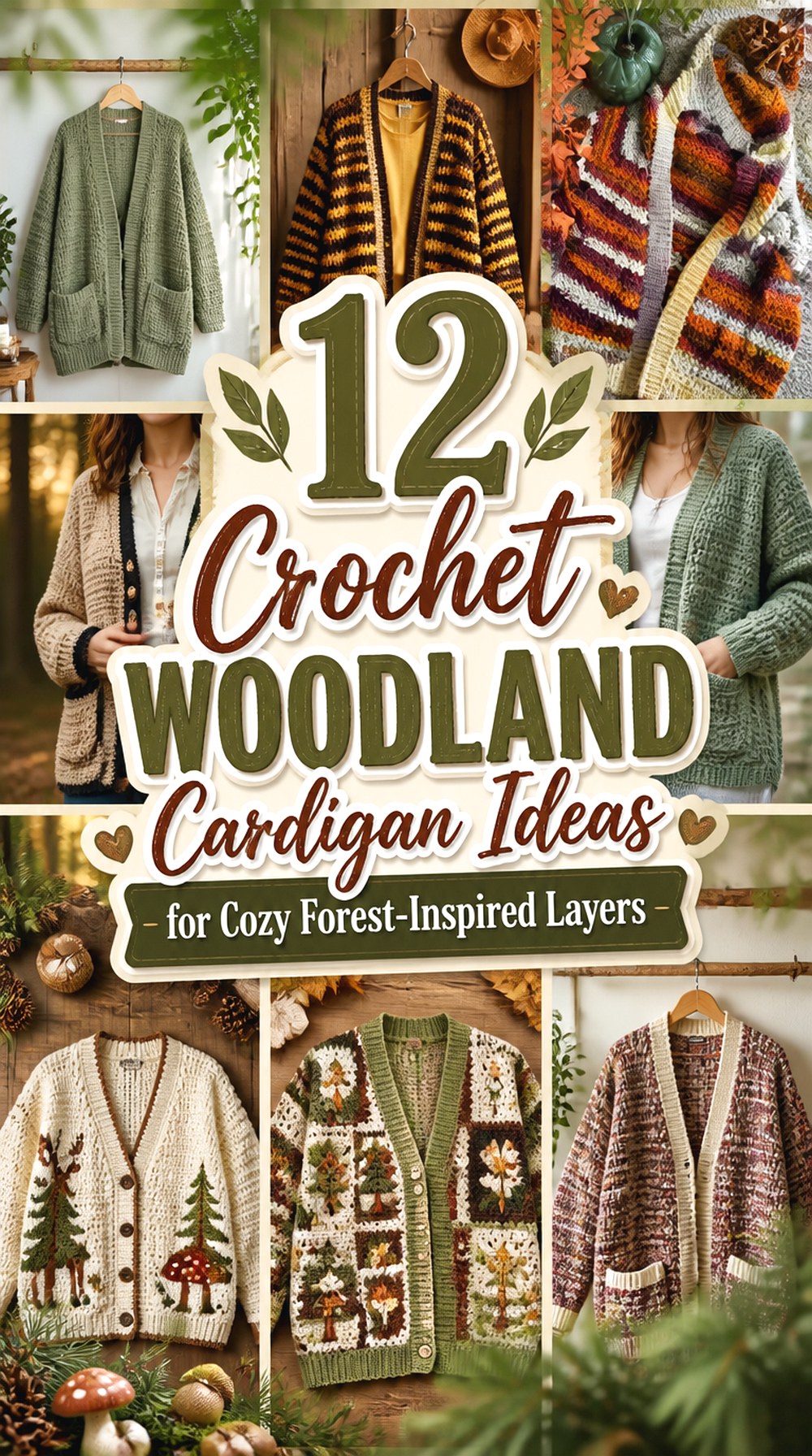
12 Crochet Woodland Cardigan Ideas for Cozy Forest-Inspired Layers
A crochet woodland cardigan does not need to be covered in mushrooms, leaves, or woodland animals to capture a forest-inspired look. Construction and texture can do just as much work. Chunky patchwork can feel rustic, raised stitches can suggest bark, open mesh creates a lighter botanical mood, and a hooded cardigan naturally suits a cozy outdoor-layer aesthetic.
The 12 ideas below deliberately use different cardigan structures so you can choose the garment first and build the woodland theme around it. Some suit scattered motifs, while others look stronger with an earthy palette and textured fabric alone. The credited videos teach the underlying cardigan constructions; not every creator is making a specifically woodland-themed garment. That distinction gives you room to adapt the look without misrepresenting the original tutorials.
Quick List
- Crochet Drop-Shoulder Woodland Cardigan
- Crochet Paneled Woodland Cardigan with Front Band
- Crochet Patchwork Woodland Cardigan
- Crochet Alpine-Texture Woodland Cardigan
- Crochet Hexagon Woodland Cardigan
- Crochet Open-Mesh Woodland Cardigan with Ties
- Crochet Cable-and-Puff Woodland Cardigan
- Crochet Hooded Raglan Woodland Cardigan
- Crochet Bulky Collared Woodland Cardigan
- Crochet Oversized Pocket Woodland Cardigan
- Crochet Chevron-Stripe Woodland Cardigan
- Crochet Relaxed Unisex Woodland Cardigan
Decide What “Woodland” Means Before Choosing the Cardigan
Woodland crochet can lean subtle or literal. For a cardigan you expect to wear frequently, a palette of moss, bark, oatmeal, rust, muted mustard, lichen gray, and deep green can establish the theme without adding a single appliqué. Texture can reinforce that effect through raised stitches, cables, patchwork, or visible joins.
Motifs create a more illustrative result. Mushrooms, leaves, acorns, flowers, berries, moths, and small forest animals can work as granny-square centers or separate embellishments, but they change the planning. A motif inserted into a garment needs to cooperate with the surrounding fabric in blocked size, flexibility, and weight. If your favorite cardigan tutorial does not use motifs, treat it as a construction reference and confirm your decorative elements separately before committing to a full garment.
Check Fit Before Adding Heavy Woodland Details
Decorative crochet can change the way a cardigan hangs. Dense granny squares, dimensional appliqués, surface decorations, and heavily textured stitches may add weight or stiffness compared with plain fabric. That matters most around shoulders, sleeves, front bands, and pockets, where extra weight can pull a garment out of shape.
Start with the sizing method used by your chosen tutorial. If finished measurements are available, compare them with a cardigan you already like rather than relying only on a size label. For made-to-measure designs, pay particular attention to body width, upper-arm room, sleeve length, and armhole depth. Block sample motifs before planning them into panels. Two squares that appear identical immediately off the hook can behave differently after blocking if their stitch density or fiber content differs.
Match the Woodland Details to the Construction
Modular cardigans give you the most obvious places for woodland imagery. Patchwork and granny-style constructions can dedicate individual squares to mushrooms, leaves, flowers, or color-blocked forest shades. Paneled cardigans work differently: a textured center panel, contrasting cuff, pocket, or front band may provide enough emphasis without disrupting the main garment.
Continuous or top-down designs are useful when you want uninterrupted color transitions. They also avoid the challenge of fitting decorative squares into a fixed panel grid. For open mesh, keep embellishment selective so it does not overwhelm the lighter fabric. On dense or bulky cardigans, smaller motifs may disappear visually, so texture, trim, and color placement can be more effective than adding numerous separate decorations.
1. Crochet Drop Shoulder Woodland Cardigan
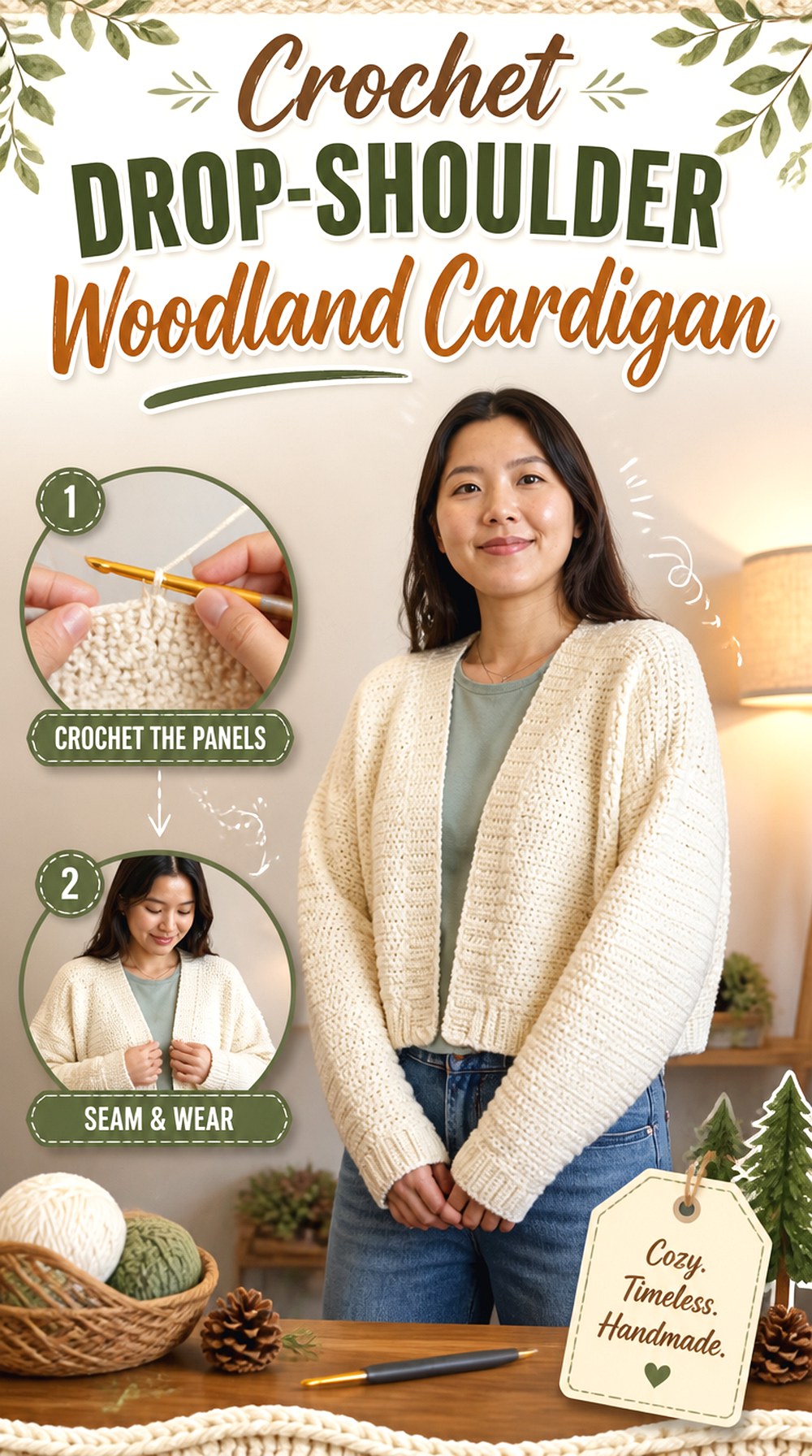
A simple drop-shoulder cardigan is a useful starting point when the woodland character will come primarily from color rather than complicated construction. VivCrochets’ tutorial uses a timeless drop-shoulder shape with ribbed finishes and reduces the main garment to three crocheted pieces, giving this version a relatively clean visual framework.
For a woodland interpretation, consider broad areas of moss, bark, cream, or muted rust instead of trying to place a different motif everywhere. The uncomplicated silhouette gives earthy colors room to read clearly and makes this option especially suitable if you want a cardigan that hints at the theme while remaining easy to coordinate with everyday clothing.
The Shoulder Line Leaves Room for Color Blocking
A drop shoulder creates a broad transition between the body and sleeve rather than tightly shaping the armhole. Visually, that gives you useful space for deliberate color changes. A darker shoulder and sleeve can frame a lighter body, or the sleeves can carry a gradual forest palette while the body stays neutral.
Before changing colors, decide whether you want the transition to emphasize or soften the dropped shoulder. Large abrupt blocks make the construction more noticeable; closely related earthy shades create a quieter effect.
Keep Added Motifs Away From Critical Seams
If you want leaves, mushrooms, or small appliqués on an otherwise simple cardigan, position them after considering where the shoulder and sleeve seams fall. Thick embellishment directly over a seam can make that area feel bulkier and may affect how comfortably it sits.
A better planning approach is to mark the completed seam lines first and arrange decorative pieces on the flat garment before attaching them permanently. This also lets you check visual balance from the front and back rather than judging each motif independently.
2. Crochet Paneled Woodland Cardigan with Front Band
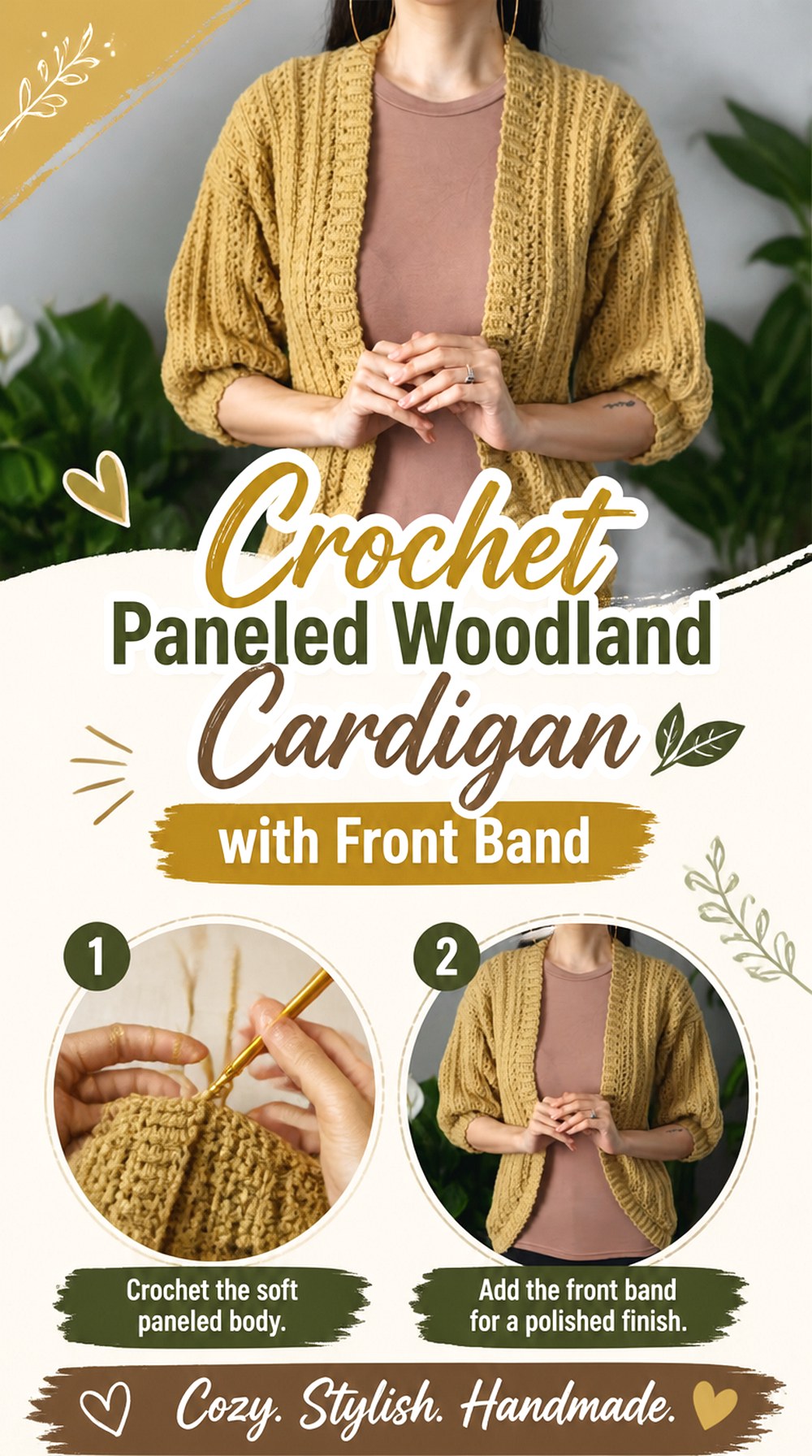
This paneled cardigan route works well when you want the woodland theme concentrated around the opening rather than distributed across the whole garment. TCDDIY’s tutorial constructs separate front sections, a back, sleeves, cuffs, and a front band, creating several natural areas where contrasting colors can be introduced.
One practical adaptation is to keep the main fabric in a quiet mushroom beige or muted green and use the front band and cuffs as the darker “frame.” Another option is to reverse the contrast. Because the opening runs vertically from neckline toward the hem, this construction can create a strong forest-inspired color story without requiring graphic motifs.
Let the Front Band Carry the Strongest Accent
A cardigan band sits close to the face and runs through a large portion of the garment, so a relatively narrow area of color can have considerable visual impact. Deep pine, dark brown, or rust can therefore be more effective here than scattering the same accent randomly.
Compare your accent yarn with the main fabric after making a sample. A noticeably denser band can pull or ripple along the opening, so appearance should not be the only consideration when choosing the contrasting yarn.
Use the Panel Breaks as Planning Boundaries
Separate panels make it easier to plan woodland colors before assembly. Instead of changing shades every few rows, you can assign a distinct role to each component: neutral back, darker fronts, matching sleeves, or contrasting cuffs.
Keep the final silhouette in mind. A very dark front paired with a pale back produces a different effect from symmetrical front and back coloring. Photographing the pieces laid out in approximate garment position can help you spot imbalance before they are joined.
Original Tutorial and Creator Credit
Creator: TCDDIY
3. Crochet Patchwork Woodland Cardigan
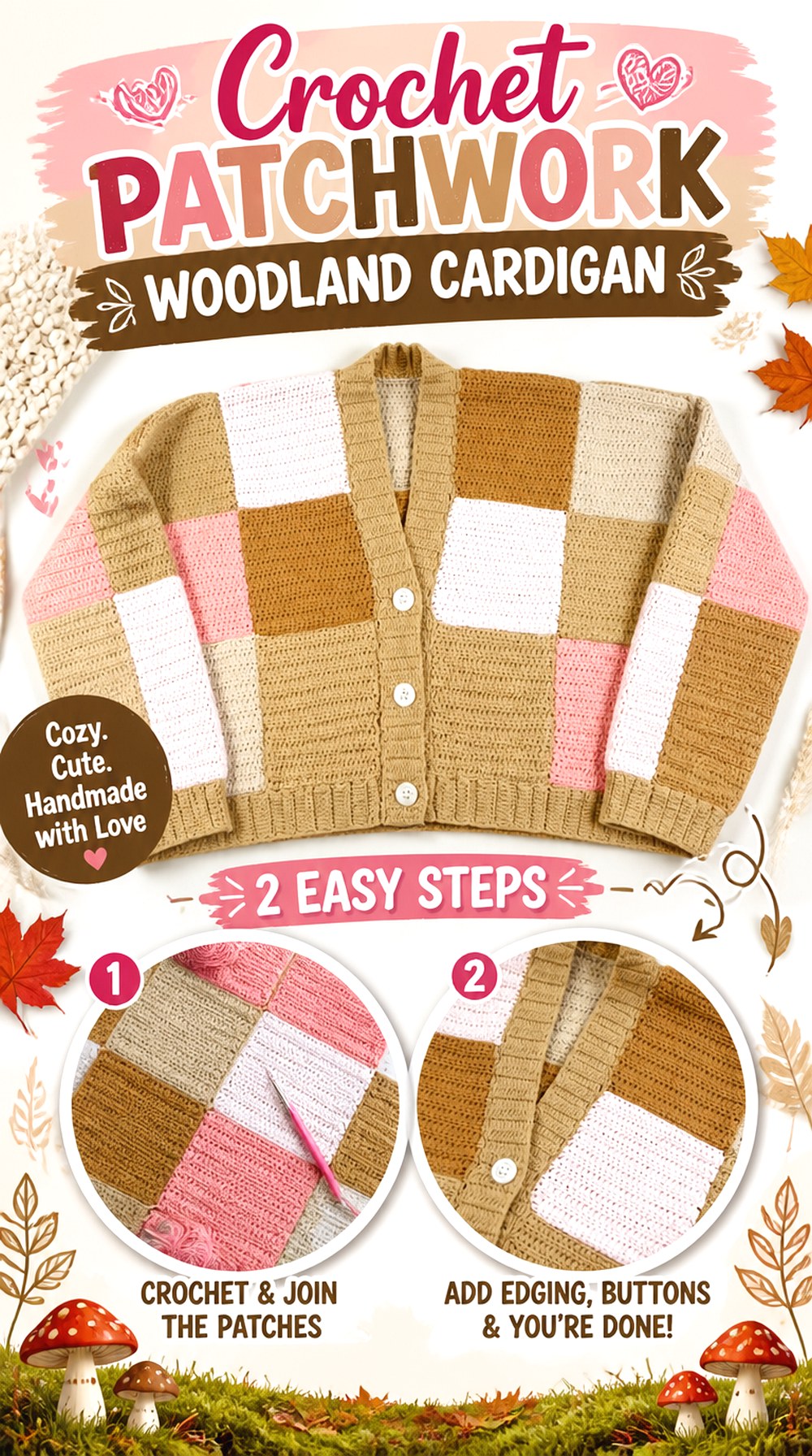
Patchwork is one of the most flexible choices for a highly visible woodland theme because each square becomes its own design space. Chenda DIY’s cardigan tutorial is built from crocheted squares and includes the garment edging, ribbed sections, and button finishing.
You could build an entirely earthy checkerboard using forest green, brown, cream, ochre, and rust, or reserve selected squares for compatible woodland motifs while keeping the remaining pieces simpler. Resist the temptation to make every square equally detailed. A few focal motifs surrounded by quieter blocks usually leave the finished garment easier to read and make layout planning less chaotic.
Block Every Square Before Final Layout Decisions
A decorative mushroom or leaf square may use different stitch structures from a plain filler square. Even when both were intended to be the same size, their finished dimensions can differ once relaxed or blocked.
Arrange only finished, blocked squares when deciding the cardigan grid. Compare edges as well as overall width. If one motif repeatedly pulls inward or flares outward, resolve the compatibility problem before joining an entire panel rather than expecting the seams to hide it.
Spread Statement Motifs Across the Garment
Placing every detailed woodland square on one front panel can make the cardigan look unintentionally lopsided. Lay out the back, fronts, and sleeves together and consider how the motifs relate when the cardigan is actually worn.
A statement square on the upper back can balance detail near a front hem, while a pair of smaller motifs can connect the sleeves to the body. Take a photo of the proposed arrangement; viewing the image at thumbnail size often makes uneven visual weight easier to notice.
Joining Becomes Part of the Woodland Design
The joins in a patchwork cardigan are visible enough to influence the finished aesthetic. A contrasting join can create a strong outlined grid, while a close color match allows the individual squares to blend together more quietly.
That choice matters particularly with woodland palettes, which can become visually busy when several earthy shades and motifs are already competing. Decide whether the seams should function as another graphic element or disappear into the overall surface before committing to a joining color.
Original Tutorial and Creator Credit
Creator: Chenda DIY
4. Crochet Alpine Texture Woodland Cardigan
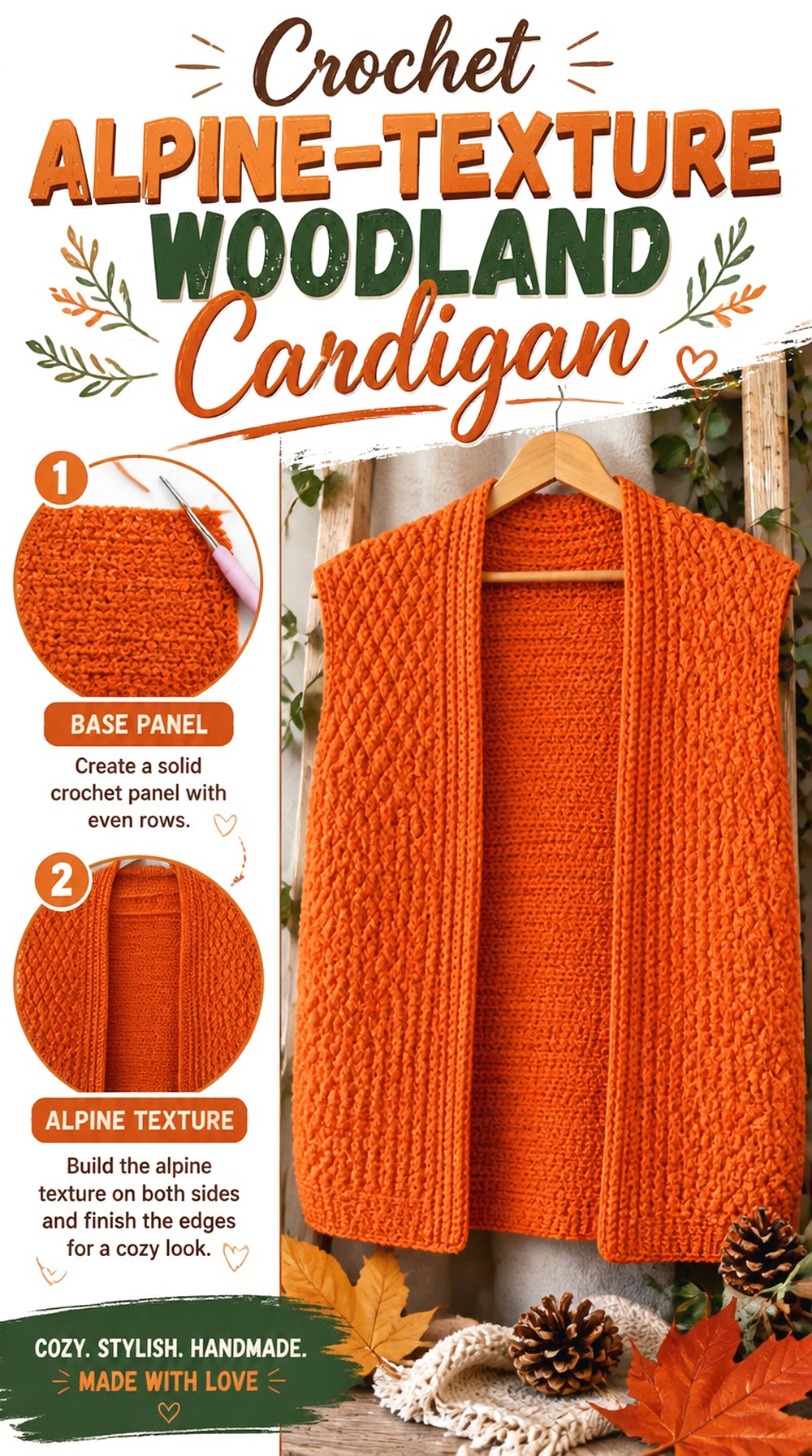
The alpine stitch gives this cardigan enough surface character that it can suggest a woodland mood without added motifs. AC Crochets uses the textured stitch throughout a measurement-based cardigan and discusses adapting the garment to fit rather than treating one finished size as universal.
For the forest theme, a single bark brown, cedar, moss, or muted amber can be more effective than frequent color changes because shadows across the raised texture become part of the design. This is a strong alternative to patchwork if you like rustic detail but do not want numerous ends, motif joins, or illustrated squares.
Texture Needs Enough Stitch Definition to Stay Visible
Highly variegated yarn can compete with raised stitchwork. If the alpine texture is the main woodland feature, first view a swatch from normal wearing distance rather than only close up. A solid or gently shifting color may make the relief easier to see.
Fiber and yarn construction also affect definition. Instead of assuming a yarn will behave like the tutorial sample, make enough fabric to evaluate both the raised texture and the drape before committing to an entire cardigan.
Check Weight as the Body Gets Larger
Textured fabric can feel very different as a full garment than it does as a small swatch. Added length, oversized sleeves, or dense borders all contribute to the amount of material hanging from the shoulders.
Periodically hold or try on the developing cardigan if the construction allows. If your woodland adaptation includes pockets or appliqués as well, consider their weight as part of the garment rather than treating each decorative addition separately.
Let Texture Replace Excess Decoration
The alpine surface already provides considerable visual information. Adding large appliqués, several contrasting borders, and many colors at once can hide the characteristic stitch pattern.
One restrained approach is to use the main texture as the “bark” element and add just one secondary woodland cue, such as contrasting cuffs or a small motif near a pocket. This preserves the tactile character that makes this cardigan different from the square-based options.
Original Tutorial and Creator Credit
Creator: AC Crochets
5. Crochet Hexagon Woodland Cardigan
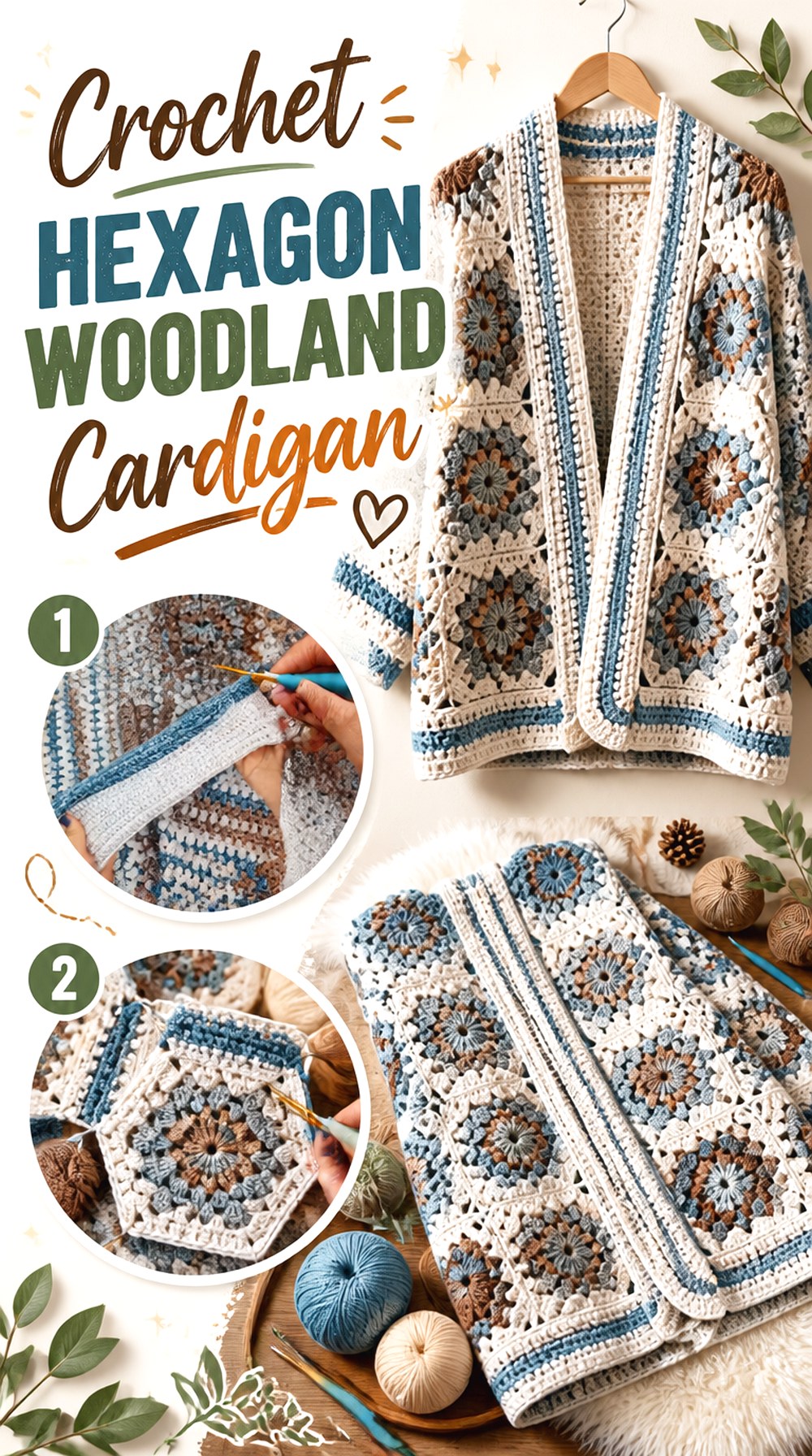
A hexagon cardigan creates its shape very differently from a traditional front-and-back panel garment, making it a useful choice when you want the construction itself to add visual interest. Unique stitch designs’ tutorial demonstrates a hexagon cardigan and uses a yarn described in the video information with an earthy “Frozen Earth” colorway, making the source particularly compatible with this roundup’s natural direction.
For your version, gradual changes among lichen, moss, brown, cream, and rust can emphasize the expanding geometry. Alternatively, a restrained two- or three-color sequence can keep the shape noticeable without turning the cardigan into a rainbow-style piece.
Color Changes Radiate Differently in a Hexagon
A color sequence worked through an expanding hexagon does not behave like horizontal stripes on a rectangular panel. Each new color interacts with the folds that eventually become the body and sleeves.
Before choosing a complicated woodland sequence, study where the finished hexagon folds in the tutorial. If a particular shade is intended to frame the front opening or sleeve, confirm its likely position in the folded garment rather than judging the flat hexagon alone.
Check Sleeve and Body Proportions Separately
A hexagon can reach a comfortable body width while the sleeve still needs adjustment, or the reverse. That is why simply making the piece “bigger” is not always enough to produce the proportions you want.
When adapting the design, compare the developing garment with an existing cardigan that has a comfortable sleeve and body fit. Pay attention to underarm room and sleeve length instead of using overall width as your only checkpoint.
Keep Motifs Secondary to the Geometry
If you want literal woodland imagery on a hexagon cardigan, consider adding it after the main garment shape is clear. Large granny-square substitutions can complicate a construction that depends on the geometry of the hexagon itself.
Small surface details near the hem, cuffs, or front opening are easier to evaluate without disturbing the underlying structure. The distinctive folded construction is already a strong design feature and does not need heavy decoration to feel intentional.
Original Tutorial and Creator Credit
Creator: Unique stitch designs
6. Crochet Open Mesh Woodland Cardigan with Ties
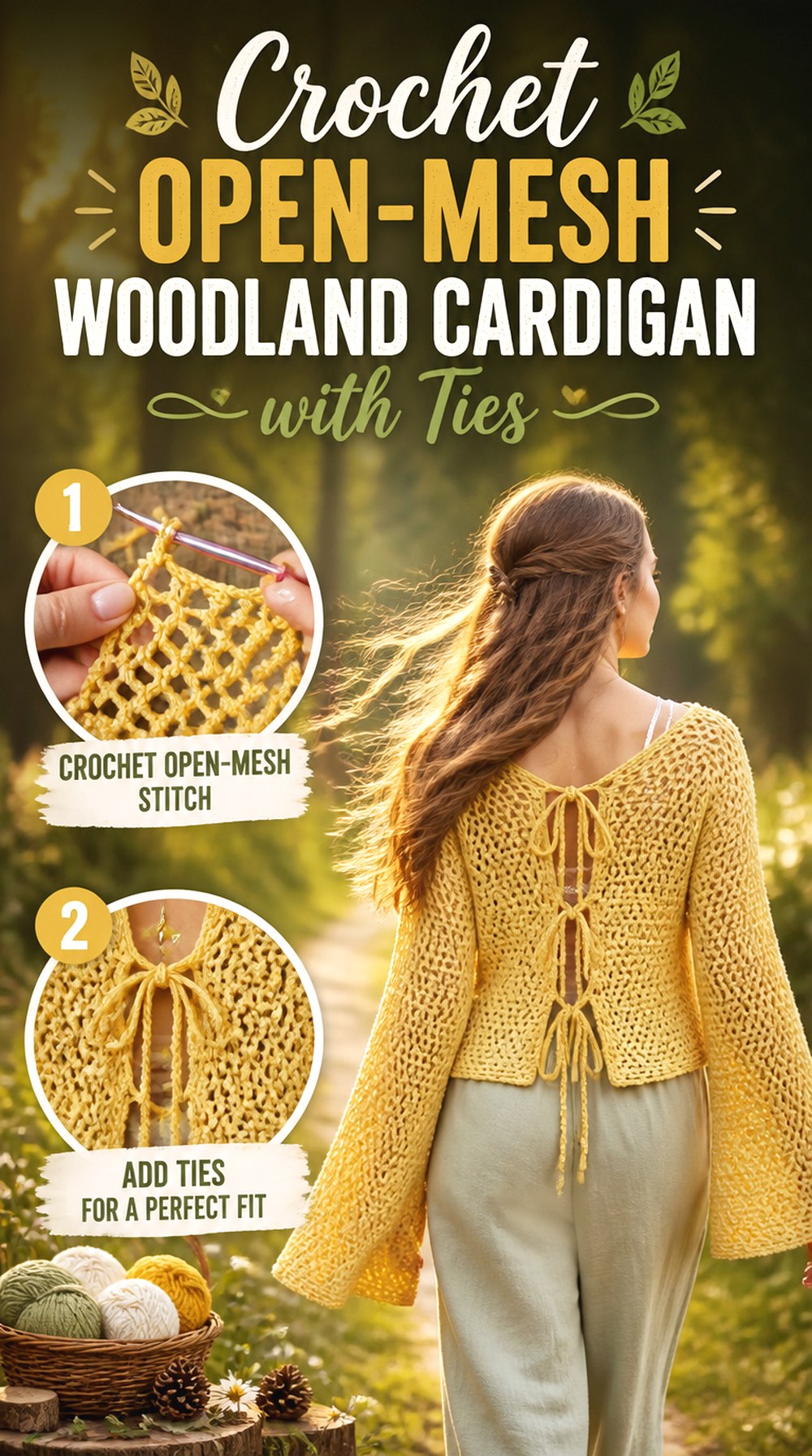
Woodland style does not have to mean a heavy fall cardigan. Crochet with Linni’s mesh cardigan provides a lighter layering option, with an open fabric, adjustable sizing approach, and front ties included in the tutorial.
A muted fern green, mushroom neutral, or natural brown can give open mesh a botanical feel while preserving its airy character. This version also works when you want the cardigan itself to remain visually light and let a few carefully chosen details provide the theme. Because the fabric has substantial open space, avoid treating it like a dense patchwork base; decorations that are too heavy may distort the mesh.
Keep Embellishments Light Enough for the Mesh
Dense appliqués can pull against an open fabric and create sagging or uneven tension around the attachment points. If you want botanical detail, test a single embellishment on a swatch of the actual mesh before repeating it across the garment.
Another option is to let color provide the woodland character and leave the fabric undecorated. With openwork, negative space is part of the finished appearance, so preserving that openness can be more effective than filling every available area.
Pay Attention to the Front-Tie Placement
Ties change both styling and tension at the cardigan opening. If you add a contrasting woodland accent around the tie area, remember that this section moves and bears light pulling when the cardigan is fastened.
Avoid placing bulky decoration directly where the tie connects to the body. Keeping that junction relatively clean allows the closure to function without competing with an appliqué or thick decorative edging.
Original Tutorial and Creator Credit
Creator: Crochet with Linni
7. Crochet Cable and Puff Woodland Cardigan
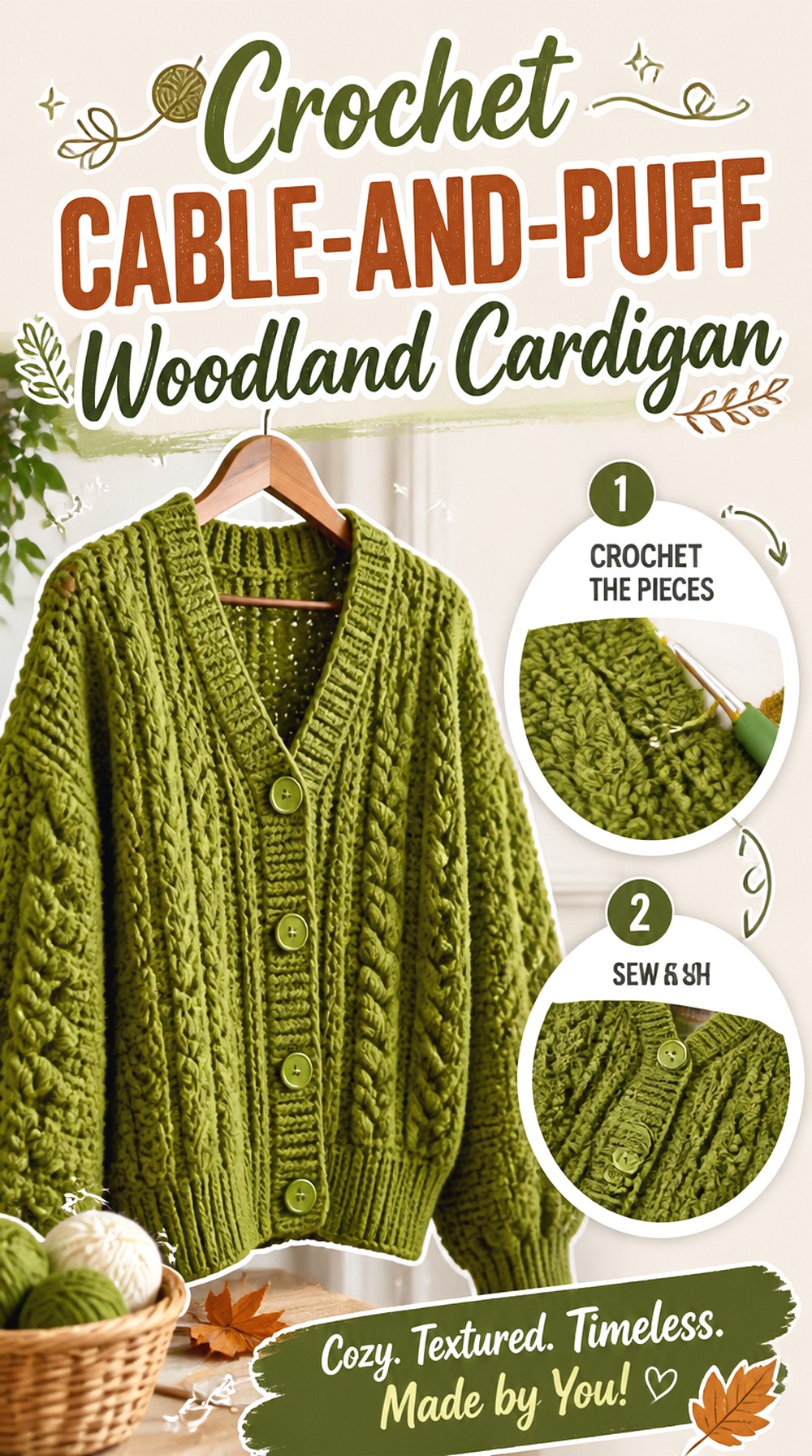
Cables are an obvious fit for a woodland cardigan when you prefer texture over illustrated motifs. Katie Joslin’s cardigan combines cable panels, ribbed puff panels, and twisted-stitch sections, then assembles those components into the body and sleeves. The design is made to measure and includes buttoned finishing.
In a bark brown, deep olive, soft mushroom, or muted cream, the changing textures can evoke roots and tree bark without requiring literal forest imagery. This is also one of the more visually detailed options in the collection, so the woodland palette can stay restrained and still produce a distinctive cardigan.
Panel Order Controls the Finished Rhythm
With several textured panel types, placement matters almost as much as color. Repeating the most prominent cable at regular intervals creates a more organized surface, while irregular distribution feels more patchwork-like.
Before assembly, arrange the completed panels in their intended order and view them from several feet away. Check whether one side appears denser or more textured than the other. That visual check is easier to correct before the panels become a complete body or sleeve.
Buttons Can Support the Woodland Palette
A button-front cardigan introduces another visible material near the center of the garment. Rather than adding several unrelated decorative elements, treat the buttons as part of the palette.
Wood-look or neutral buttons may suit the concept, but compatibility matters more than appearance alone. Confirm that the buttons fit the finished buttonholes and are appropriate for the garment’s care routine before attaching the full set.
Raised Texture Benefits From Deliberate Blocking
Cable and puff sections can relax differently from flatter surrounding fabric. Blocking helps you evaluate how the separate textures sit together, but the correct method depends on the fiber you use.
Follow the yarn label and use a sample whenever you are uncertain about heat, moisture, or stretching. The goal is to encourage the panels to settle evenly without flattening the dimensional texture that gives this cardigan its woodland character.
Original Tutorial and Creator Credit
Creator: Katie Joslin
8. Crochet Hooded Raglan Woodland Cardigan
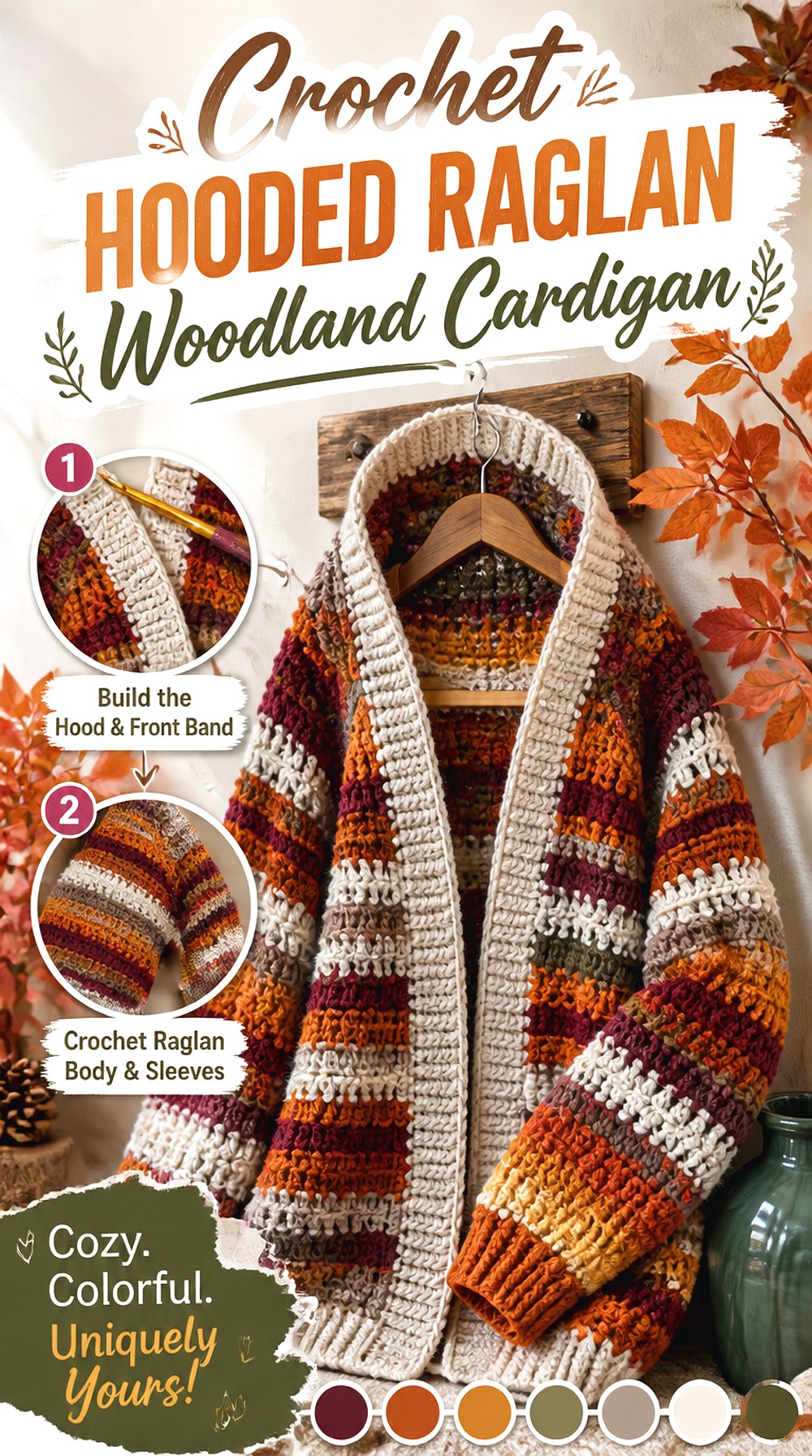
A hood immediately changes the personality of a cardigan, making this version particularly well suited to a forest-walk or cabin-inspired interpretation. MJ’s Off The Hook Designs teaches a seamless top-down raglan cardigan in the Suzette stitch, with options that include a long hooded version with pockets or a shorter button-up treatment.
Because the garment develops from the neckline downward, it is a useful option when you would rather avoid arranging a large grid of motifs. An autumnal self-striping yarn or a controlled sequence of earthy shades can carry the woodland theme through the continuous body, while the hood and pockets provide functional visual anchors.
A Top-Down Yoke Gives You an Early Fit Check
With raglan construction, the shoulder and upper-body shaping develops before the lower body is finished. Use that opportunity to assess how the cardigan sits around the neck, upper chest, armholes, and sleeves rather than postponing all fit decisions until the end.
If you are substituting yarn, the tutorial’s stated gauge and size information become particularly important. A woodland colorway is not a useful substitution if it produces a fabric that changes the intended dimensions substantially.
Treat the Hood as a Major Design Area
A hood occupies more visual space than a narrow collar, especially from the back. If you are using multiple colors, decide whether the hood should continue the body sequence, contrast with it, or become the main woodland accent.
A highly detailed hood paired with a highly detailed body can become busy. If you want a motif on the back of the hood, consider simplifying the surrounding color transitions so that the decorative element has room to stand out.
Pocket Decorations Need to Work in Use
Pockets are natural places for mushroom, acorn, leaf, or small floral accents because they are easy to see. They are also functional parts of the cardigan.
Arrange any embellishment with the pocket opening in mind. Thick details too close to the opening can interfere with access or catch on objects. A motif placed lower on the pocket face usually separates decoration from the area that experiences the most handling.
Original Tutorial and Creator Credit
Creator: MJ’s Off The Hook Designs
9. Crochet Bulky Collared Woodland Cardigan
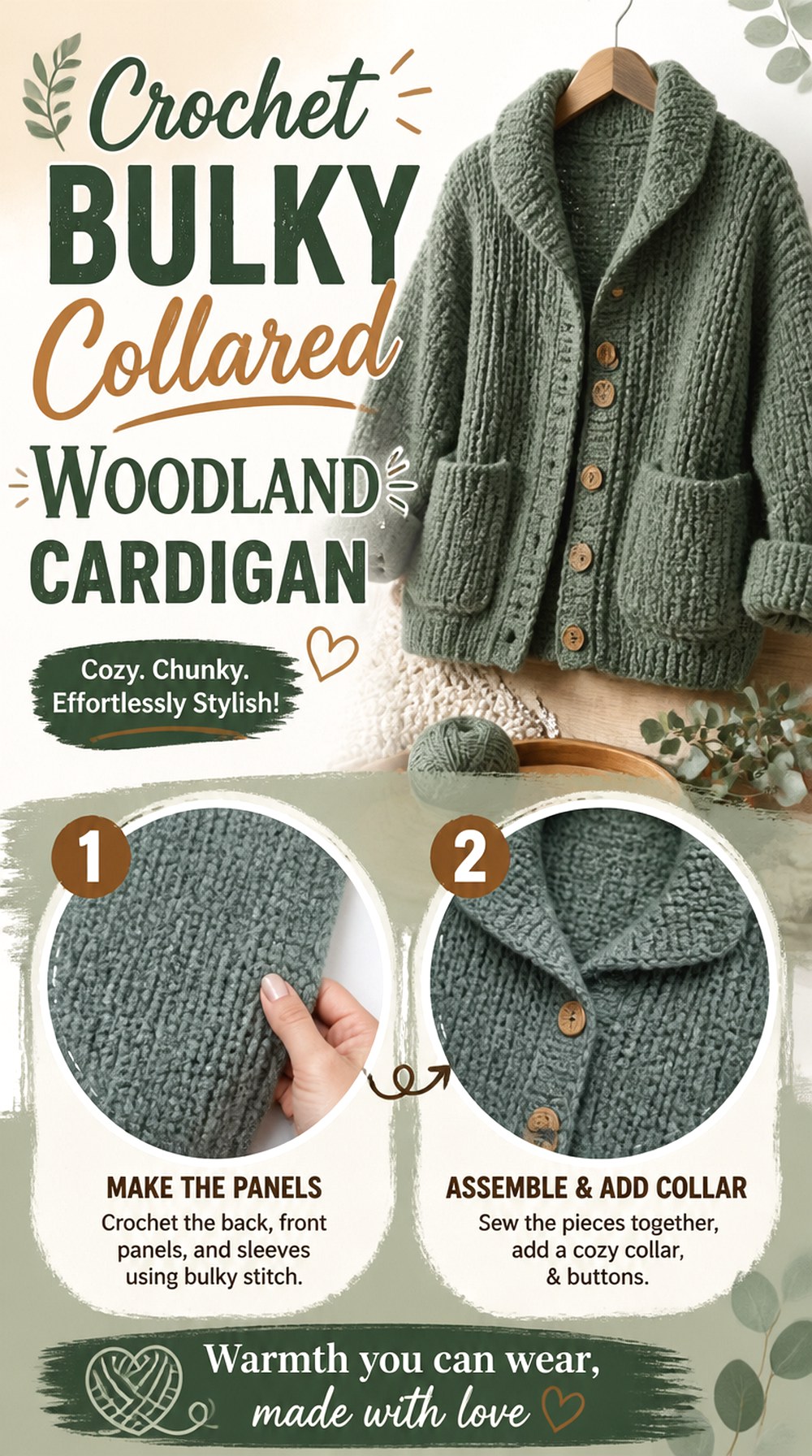
For a heavier cabin-style look, the classic collared cardigan from KnitcroAddict offers a noticeably different route from mesh, patchwork, or hexagon construction. The tutorial uses bulky yarn, forms the cardigan from five separate pieces, and adds the collar after assembly.
That substantial fabric suits a woodland palette built around cedar brown, evergreen, stone, oatmeal, or deep rust. Since the silhouette already has visual weight, this is a good candidate for simple color placement rather than numerous appliqués. A contrasting collar or cuff can create enough emphasis while keeping the broad surfaces calm.
Bulky Yarn Magnifies Small Fit Differences
A thick fabric occupies more physical space around the body and sleeves than a fine mesh, so do not assume the same measurements will feel identical across both styles. Compare the tutorial’s finished measurements with the amount of layering you actually intend to wear underneath.
If substituting yarn, make a gauge sample and evaluate thickness as well as stitch count. Two yarns categorized similarly can still produce noticeably different hand and drape in a finished garment.
The Collar Can Frame an Otherwise Quiet Cardigan
Because the collar is added as a separate finishing feature, it offers a natural place for contrast. A dark evergreen body with a bark-toned collar, for example, can communicate the woodland direction without complicated motif placement.
Keep the cuffs and collar visually related if you want a more cohesive result. If every finishing edge uses a different strong shade, those borders may compete with one another instead of framing the main body.
Keep Heavy Appliqués Away From the Neckline
The collar already creates thickness around the neck and front opening. Additional dimensional mushrooms, flowers, or layered leaves in the same area may make the edge feel crowded.
If you want literal imagery, shift the focal motif lower toward a pocket area, hem, or upper back. That gives the collar space to sit naturally and separates structural finishing from decorative detail.
Original Tutorial and Creator Credit
Creator: KnitcroAddict
10. Crochet Oversized Pocket Woodland Cardigan
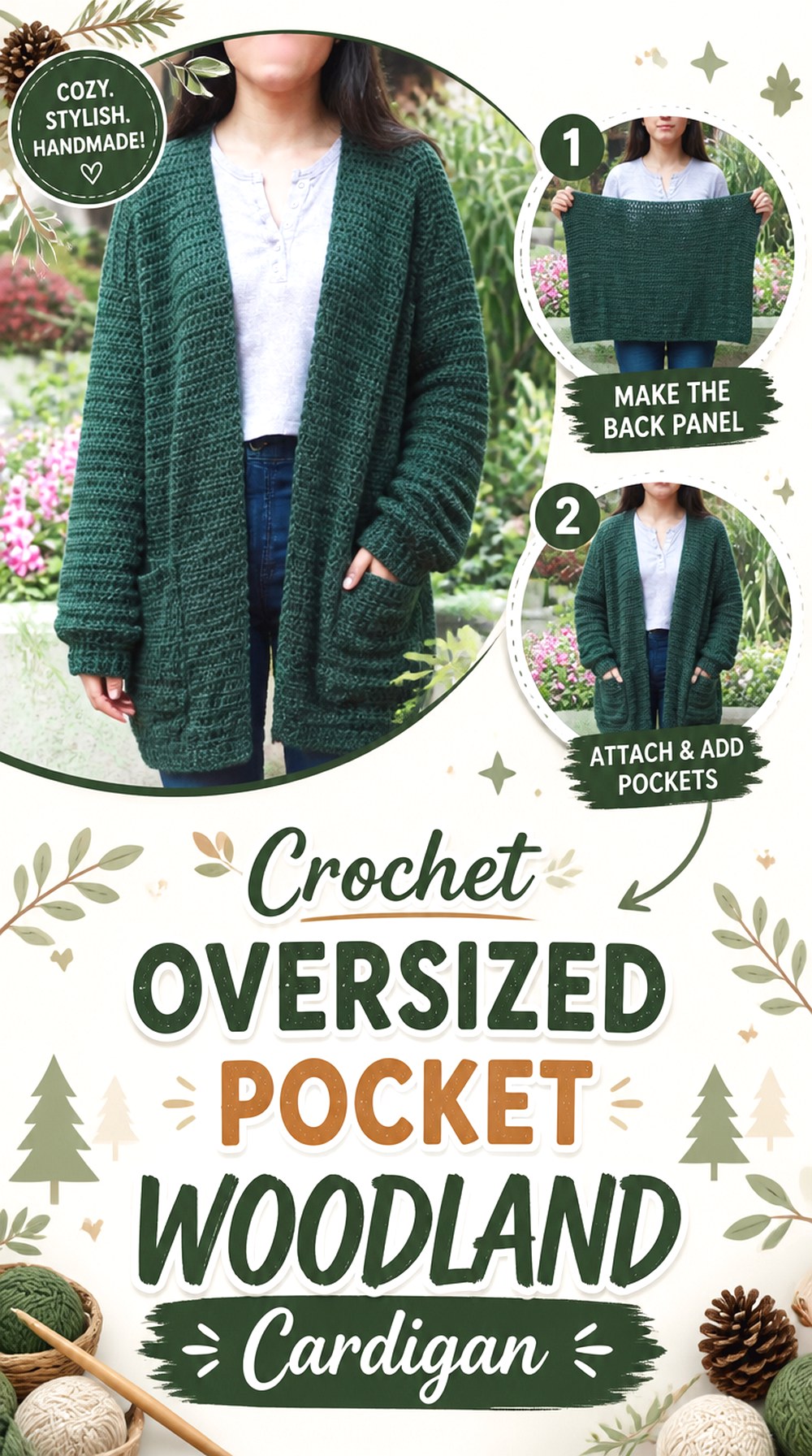
An oversized cardigan gives a woodland theme room to breathe. For The Frills’ pocket cardigan is intentionally slouchy, with wide sleeves, ribbed finishing, and large front pockets.
Instead of treating the entire garment as a decorative canvas, you can keep the body in one earthy shade and make the pockets the focal point. A pair of coordinated mushroom, leaf, acorn, or floral decorations would create a clear woodland reference while the rest of the cardigan stays wearable and uncomplicated. The relaxed proportions also make this option appealing when layering is more important than a close-fitting silhouette.
Use the Pockets as a Matched Design Pair
Two front pockets create symmetry, but they do not have to be identical. One could carry a mushroom motif and the other a small cluster of leaves, provided the scale and color weight feel balanced.
Lay both pockets next to each other before attaching any decoration. If one motif is much darker or larger, adjust its placement or surrounding details so the pair still reads as intentional when viewed across the whole cardigan front.
Wide Sleeves Need Their Own Decoration Plan
A generous sleeve creates tempting space for extra motifs, but everything placed there will move, bend, and brush against surfaces. Reserve the most dimensional details for less active areas if snagging or bulk would bother you.
Color bands, surface stitching, or flatter details can communicate the woodland concept on sleeves without adding substantial thickness. Check the design with your arms relaxed as well as extended; sleeve decoration often looks different when the garment is being worn.
Positive Ease Should Be a Deliberate Choice
The tutorial describes an oversized cardigan, so compare that intended ease with how you prefer to layer clothing. An oversized woodland cardigan can work well over shirts or lighter sweaters, but adding size simply because you want a cozy result may give more volume than expected.
Use the creator’s sizing information rather than automatically sizing up. Woodland styling comes from the palette and details; it does not require making the garment larger than its intended proportions.
Original Tutorial and Creator Credit
Creator: forthefrills
11. Crochet Chevron Stripe Woodland Cardigan
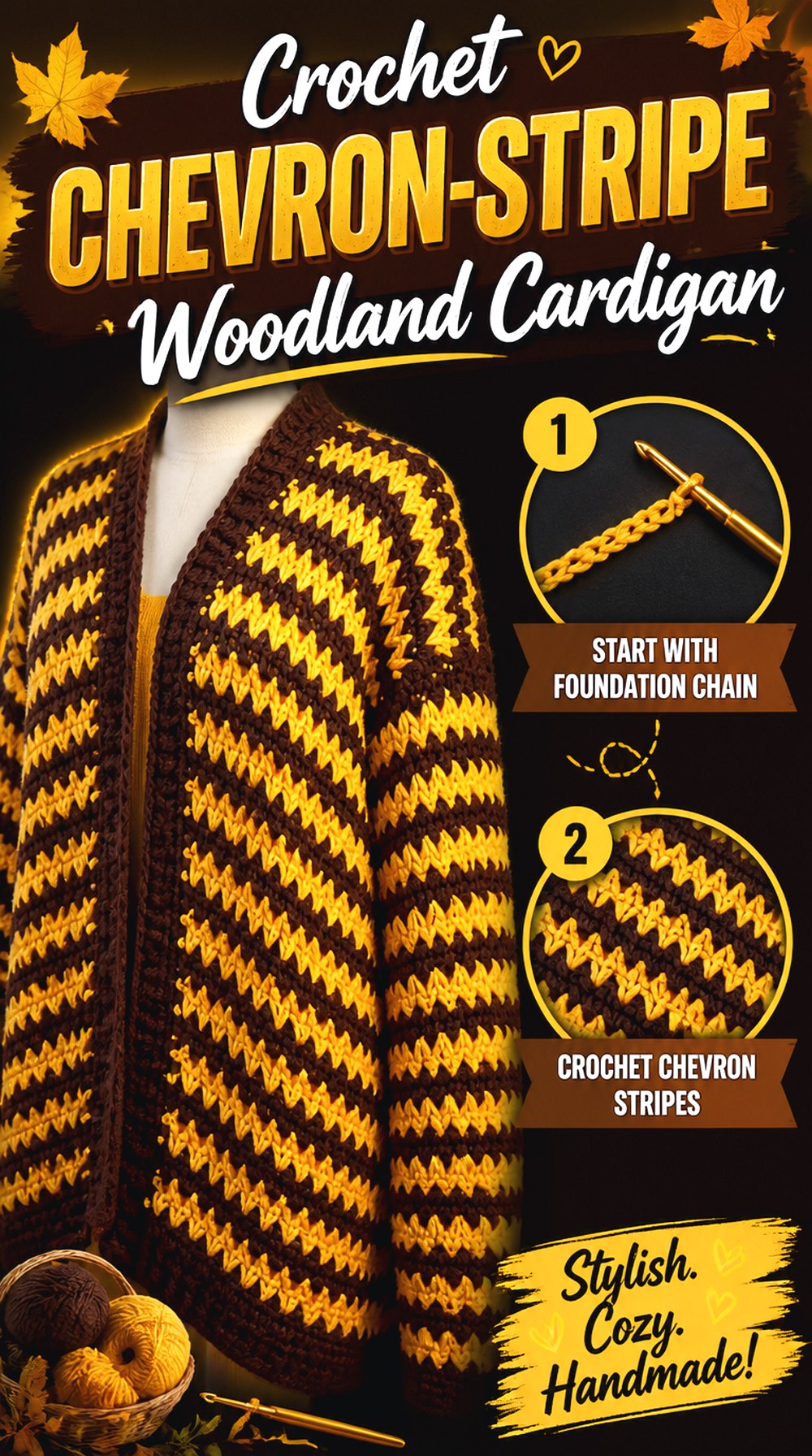
Chevron stripes offer a completely different way to use woodland colors. Shyler crochets’ cardigan tutorial centers on a striped chevron design made with chunky yarn, giving the fabric a strong directional pattern before any additional decoration is considered.
For a forest interpretation, replace high-contrast brights with a sequence such as evergreen, moss, ochre, bark, and cream. The zigzag can then suggest hills, trails, or layered forest colors without relying on literal appliqués. Because the chevron already creates movement across the garment, this is one of the options where extra motifs should be used sparingly.
Plan the Color Sequence Before the First Large Panel
A repeating chevron makes color-order mistakes more noticeable than irregular patchwork. Make a small sequence test first and decide whether your woodland colors will repeat predictably or move gradually from dark to light.
Also consider how often a high-contrast cream or pale shade appears. Frequent pale stripes will make the overall cardigan feel lighter, while closely related greens and browns create a more blended, shadowy forest effect.
Let the Zigzag Remain the Main Feature
Large appliqués placed over chevrons can interrupt the directional pattern and make both elements harder to read. If you want a literal woodland detail, use a relatively quiet area such as a cuff, lower front, or isolated patch.
Another option is to skip motifs entirely and use the zigzag plus palette as the full concept. A woodland cardigan does not need recognizable forest objects when its color and rhythm already communicate the theme.
Original Tutorial and Creator Credit
Creator: Shyler crochets
12. Crochet Relaxed Unisex Woodland Cardigan
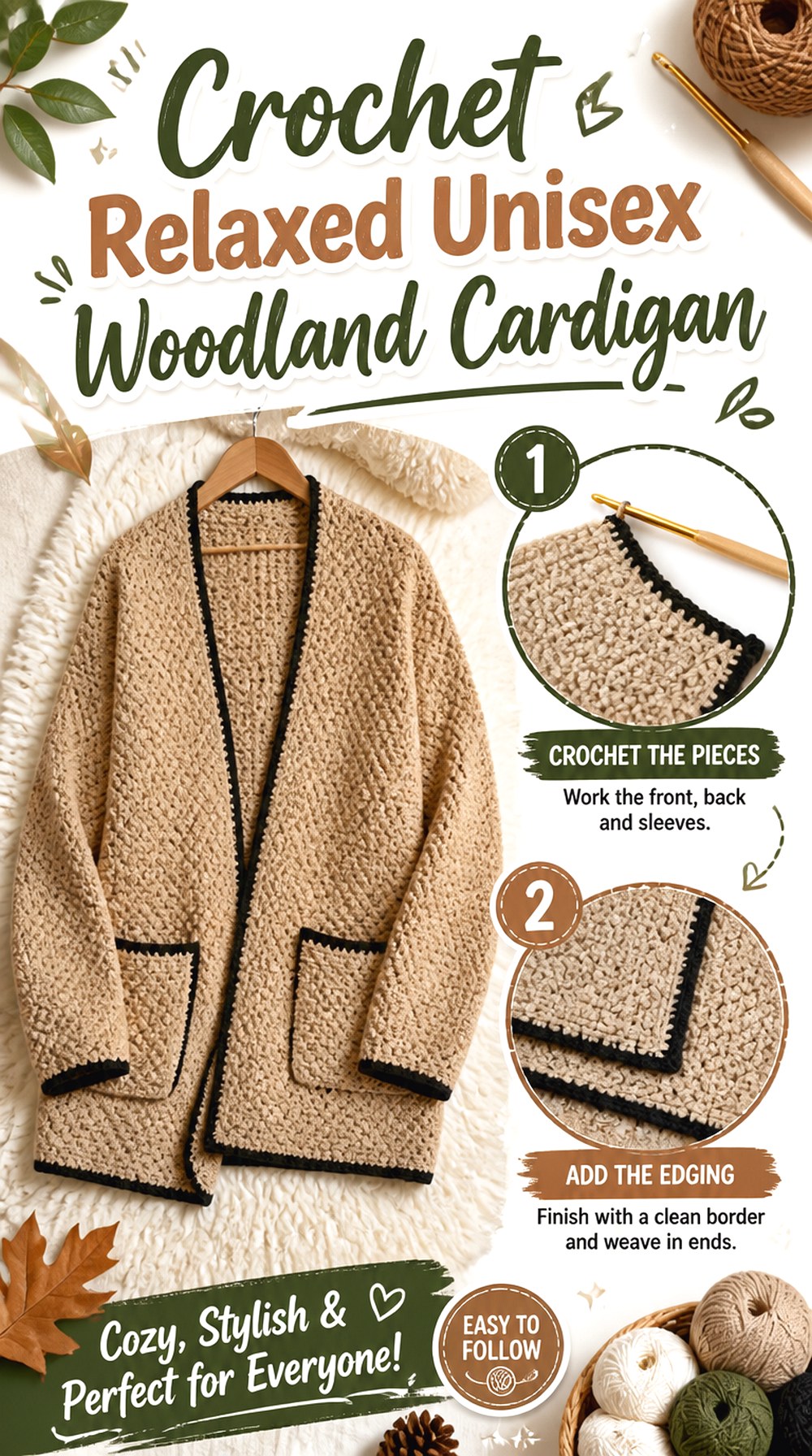
A simple unisex cardigan is a practical final option for readers who like the woodland palette but do not want a distinctly motif-heavy or decorative garment. Bag-O-Day Crochet’s tutorial presents a relaxed cardigan designed with positive ease and provides multiple sizing options in the video information.
This construction suits quiet cabin colors particularly well: charcoal and moss, cream and bark, or a mostly neutral body with a darker edging color. The understated approach also makes the cardigan easier to style with existing clothing. If you want a personalized woodland reference, a small chest, cuff, or pocket detail can be enough rather than redesigning every panel.
Compare the Intended Ease With Your Favorite Cardigan
The tutorial intentionally includes positive ease, so the useful question is not simply whether the garment “fits.” Decide how much room you actually enjoy in a cardigan.
Measure a relaxed cardigan you already wear and compare its width with your body measurement and the tutorial’s sizing information. That gives you a more personal reference than choosing solely from a standard size name, especially if you plan to wear the new cardigan over thicker layers.
Use Edging Color to Define the Silhouette
A contrasting border can make a simple cardigan look deliberately woodland-inspired without changing its construction. Dark brown around a moss body or deep green around oatmeal creates a clear outline and keeps the theme controlled.
Before choosing a sharp contrast, consider whether you want the border to dominate. A close tonal shade produces a quieter cabin look, while a noticeably darker trim emphasizes the opening, hem, and overall garment shape.
Conclusion
The right crochet woodland cardigan depends on how strongly you want the forest theme to appear. Choose the patchwork cardigan when individual motifs and color blocks are the priority, the alpine or cable versions when texture should provide most of the character, and the mesh cardigan when you want a lighter botanical layer. The hexagon and chevron options make color placement more prominent, while the hooded raglan and oversized pocket designs provide obvious areas for selective woodland details.
For a quieter everyday garment, the drop-shoulder, collared, paneled, or relaxed unisex versions can rely almost entirely on earthy color. Once you choose the construction, use the original tutorials for their exact garment instructions and verify sizing, yarn, gauge, and finishing details before adapting the design.
Frequently Asked Questions
Does a crochet woodland cardigan need mushroom or leaf motifs?
No. A woodland theme can come from color, texture, silhouette, or decorative motifs. Moss green, bark brown, rust, oatmeal, lichen gray, and other natural shades can establish the idea on their own. Raised textures such as cables or alpine stitch can also give the fabric an organic feel. Literal mushrooms, leaves, acorns, or flowers are useful when you want a more illustrative result, but they are not required.
Can I replace plain cardigan squares with woodland granny squares?
Possibly, but do not assume two square designs are interchangeable simply because they have the same number of rounds. Crochet motifs can differ in blocked dimensions, stitch density, thickness, stretch, and edge structure. Make and block a sample of the woodland motif and a sample of the square used in the cardigan. Compare their actual edges before deciding whether they can share the same garment layout.
Where should I place heavier woodland motifs on a cardigan?
Avoid concentrating unnecessary weight at areas already carrying structural stress, particularly the shoulders and neckline. Lower front panels, pockets, or selected areas of the back may be easier places to introduce dense motifs, depending on the construction. Before attaching anything permanently, lay the finished cardigan flat and arrange the decorations on top. Then check the placement while the garment is worn, because fabric hangs differently on the body.
Should I block woodland motifs before joining them into a cardigan?
Blocking before layout is useful when motif dimensions influence the final garment. It lets you compare the real finished size of different squares and identify pieces that pull inward, flare, or differ noticeably from their neighbors. The appropriate blocking method depends on the fiber, so follow the yarn’s care information rather than applying heat or aggressive stretching automatically. After joining, the completed garment may also need finishing according to its yarn and construction.
What yarn qualities matter most for a woodland cardigan?
Think first about the finished fabric rather than the color name. A cardigan needs a yarn that produces suitable drape, stitch definition, weight, and comfort for its particular construction. Cables benefit from visible texture, while mesh needs enough flexibility to remain open. Large patchwork garments can accumulate weight as squares and joins are added. Always compare your chosen yarn with the tutorial’s gauge or measurement method and check its care instructions.
How can I keep a motif-heavy woodland cardigan from looking too busy?
Establish a hierarchy. Choose a few focal motifs and let simpler squares, neutral sections, or solid-color fabric surround them. Repeating every possible woodland symbol across every panel can make individual details disappear into visual noise. Lay the entire front, back, and sleeves out together before joining or attaching decorations. A photograph of the arrangement can help you judge whether color and motif weight are balanced across the whole garment.