17 Plum and Mushroom Taupe Crochet Decor Ideas
Plum and mushroom taupe give crochet decor two very different visual roles to work with. Plum is deep enough to create definition around motifs, borders, and textured areas, while mushroom taupe can cover larger sections without making the whole project feel equally dark. The balance between them matters as much as the colors themselves.
You can make plum the dominant shade for a richer accent piece, let mushroom taupe lead when you want the project to blend more quietly with neutral furnishings, or divide the colors across motifs and repeated details. The 17 ideas below use that relationship differently across pillows, blankets, storage pieces, tabletop crochet, wall decor, and smaller accents.
The linked tutorials support the crochet project concepts. The plum and mushroom taupe palettes are color adaptations you can apply while following the creator’s construction guidance.
Quick List
- Plum And Mushroom Taupe Crochet Pillow
- Mushroom Taupe And Plum Crochet Throw Blanket
- Plum And Mushroom Taupe Granny Square Crochet Blanket
- Mushroom Taupe And Plum Crochet Storage Basket
- Plum And Mushroom Taupe Crochet Wall Hanging
- Mushroom Taupe And Plum Crochet Plant Hanger
- Mushroom Taupe And Plum Crochet Table Runner
- Plum And Mushroom Taupe Crochet Coasters
- Plum And Mushroom Taupe Crochet Area Rug
- Mushroom Taupe And Plum Crochet Floor Pouf
- Mushroom Taupe And Plum Crochet Tissue Box Cover
- Plum And Mushroom Taupe Crochet Wreath
- Plum And Mushroom Taupe Crochet Garland
- Plum And Mushroom Taupe Crochet Doily
- Mushroom Taupe And Plum Crochet Flower Kitchen Pad
- Mushroom Taupe And Plum Crochet Plant Pot Cover
- Plum And Mushroom Taupe Crochet Mug Rug
How to Balance Plum and Mushroom Taupe Across Crochet Decor
Decide which color should occupy the largest visual area before you begin distributing smaller accents. On a pillow, wall hanging, or rug, a plum-dominant arrangement creates a stronger dark focal point, so mushroom taupe becomes especially useful around borders, joins, fringe, or raised details. On a basket, table runner, or plant cover, mushroom taupe can instead form the main field while plum marks the edges or selected decorative areas.
The two colors do not have to appear in equal amounts. In fact, an equal split can make some pieces feel visually divided when there is no obvious feature separating the colors. A clear dominant shade with a smaller supporting color often makes the placement easier to read.
Check Plum and Mushroom Taupe Contrast Before a Large Crochet Project
Plum and mushroom taupe are different hues, but the amount of visible contrast depends on the particular yarns you choose. A very deep mushroom taupe can sit closer to plum in lightness than expected, which may reduce separation around small motifs or textured stitches.
Place the yarns beside each other and look at them both close up and from several feet away. A grayscale photo can also help you notice whether they remain distinct in light and dark value. This matters particularly for granny-square boundaries, wall-hanging motifs, lace openings, borders, and other areas where color is supposed to clarify the crochet structure.
1. Plum And Mushroom Taupe Crochet Pillow
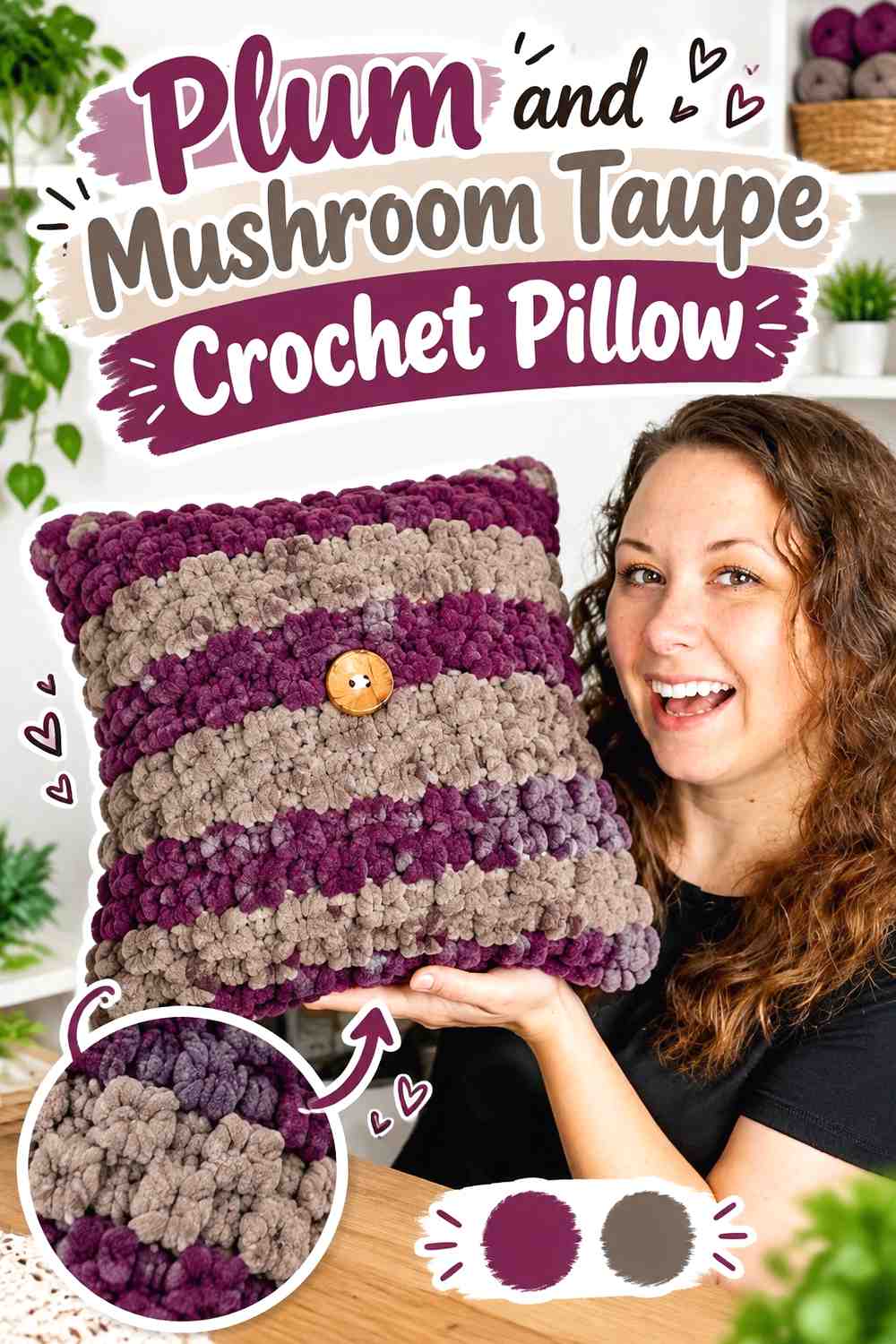
A crochet pillow gives plum enough uninterrupted space to act as the main statement color without requiring the entire decor scheme to become dark. Use plum across the front face when you want the cushion to function as an accent, then introduce mushroom taupe around the perimeter, on selected motifs, or on a contrasting back. If the pillow contains raised stitches, the lighter supporting shade can also help separate those details from the deeper field.
Let Plum Lead the Crochet Pillow Face
Giving plum most of the front surface makes the color direction clear as soon as the pillow is seen on a sofa, chair, or bed. Instead of scattering equal amounts of mushroom taupe throughout every section, reserve the neutral for areas that already create a visual break, such as an outer border or repeated motif detail. That keeps the pillow from looking unnecessarily segmented.
If your plum yarn is especially dark, check whether the stitch texture remains visible from normal viewing distance before committing the entire front to it.
Mushroom Taupe Keeps Plum Pillow Texture Defined
Mushroom taupe can be especially useful next to bobbles, cables, raised motifs, or prominent edging because it creates a lighter transition around the plum. You do not need to outline every textured area. A taupe frame around the main pillow face or a few repeated taupe details can provide enough separation.
When substituting the neutral, preserve the contrast relationship rather than trying to match an exact taupe. Choose a muted neutral that still reads noticeably lighter than your plum.
Creator Credit: Yarn Stash with Marching North
2. Mushroom Taupe And Plum Crochet Throw Blanket

For a larger surface such as a throw, mushroom taupe can take the dominant role and keep plum from covering too much visual area. Taupe can form the main body while plum appears in broad bands, repeated accents, or the outer border. Because blankets are usually viewed both folded and spread out, repeat plum in more than one location if you want the palette to remain recognizable in either position.
Mushroom Taupe Gives the Crochet Throw More Breathing Room
A mushroom taupe main field allows the blanket’s stitch texture to carry more of the visual interest. It also leaves room for plum to become a deliberate focal color instead of competing across the entire surface.
Before choosing how much taupe to use, think about how the throw will usually be displayed. If only one folded edge will remain visible on a sofa, placing some plum near that edge can keep the darker color present even when most of the blanket is folded away.
Plum Works Best as Repeated Blanket Bands or a Framing Border
Plum can define the outer edge of a mushroom taupe throw, but a single dark border may feel disconnected if no plum appears elsewhere. Repeating the shade in an internal band, selected stripe, or occasional motif can connect the border to the rest of the blanket.
If you prefer a quieter result, keep those plum sections relatively narrow. If you want stronger contrast, widen one or two focal bands rather than adding many small accents that compete with the crochet texture.
Creator Credit: DIY FROM HOME CROCHET
3. Plum And Mushroom Taupe Granny Square Crochet Blanket

Granny squares provide natural locations for separating plum from mushroom taupe. One practical direction is to let plum establish the focal area of each square while mushroom taupe repeats closer to the outside. Another is to alternate plum-led and taupe-led squares across the blanket. The important point is to establish a repeat system before making many motifs so the finished blanket does not appear randomly distributed.
Plum Centers Give the Crochet Granny Squares a Clear Focal Point
Placing plum toward the center of repeated squares gives the darkest shade a consistent job. The eye can follow those darker centers across the finished blanket even when the surrounding rounds or joins vary.
If your plum and mushroom taupe are close in value, make a sample square and view it from the distance at which the blanket will normally be seen. A color boundary that appears obvious in your hands may become much softer once dozens of motifs are joined.
Mushroom Taupe Outer Rounds Keep Plum Squares Connected
Using mushroom taupe around the outside of plum-centered motifs can create a repeated neutral boundary before the squares meet. This is especially helpful when you want the individual plum areas to remain visible rather than merging into one large dark patch.
You can also reverse a limited number of motifs, making mushroom taupe the center and plum the surrounding accent. Keep the reversal deliberate so it reads as part of the layout rather than an accidental break in the pattern.
Creator Credit: Danii’s Ways
4. Mushroom Taupe And Plum Crochet Storage Basket
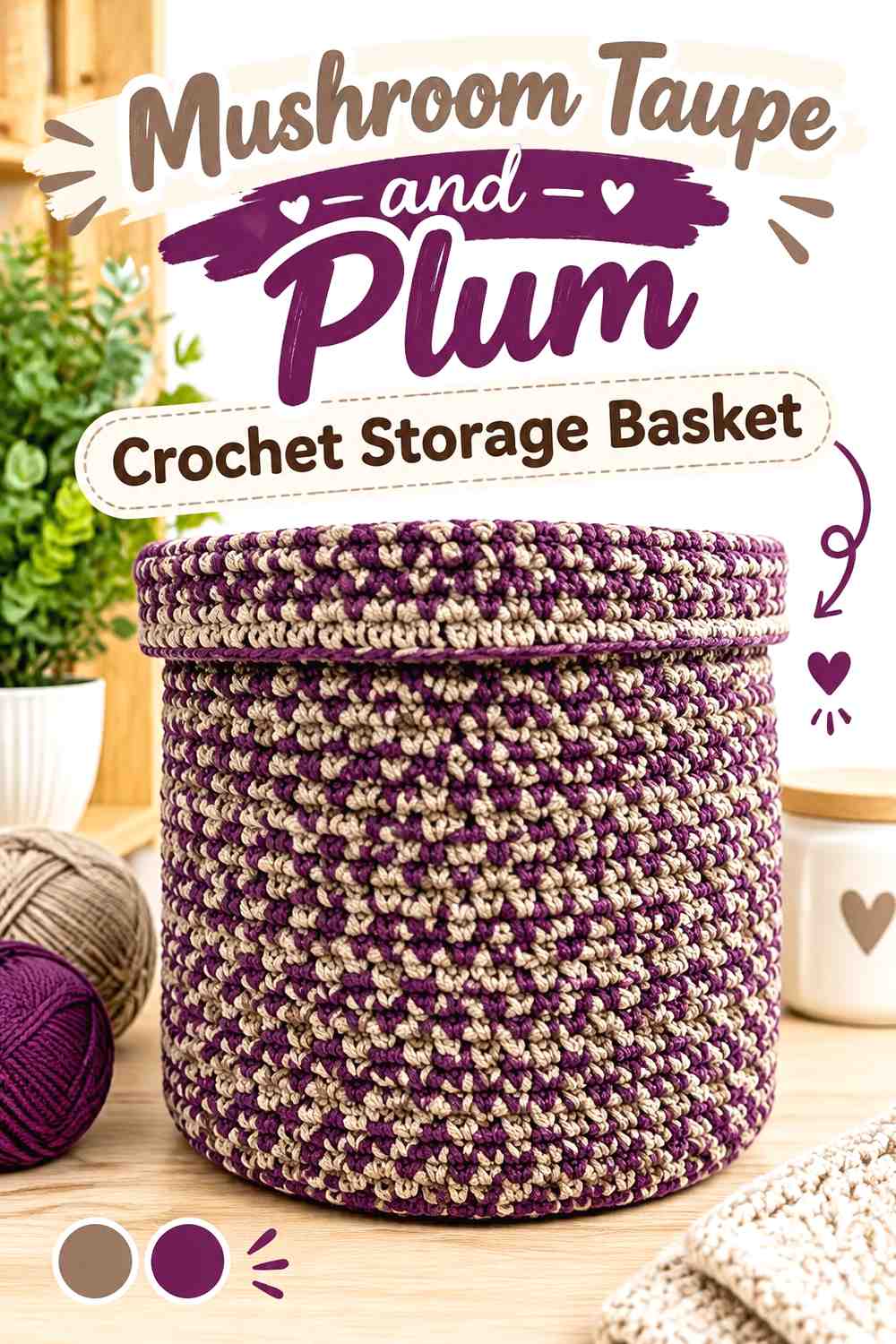
A storage basket benefits from a clear division between the main body and the details that define its shape. Mushroom taupe can cover most of the basket while plum is reserved for the top edge, handles, or a deliberate band. This places the deeper color where it can emphasize the silhouette without turning the entire basket into a dark block.
Mushroom Taupe Makes the Crochet Basket Body Visually Lighter
Use mushroom taupe across the broad sidewalls when you want the basket to sit comfortably among wood, beige, gray, or other subdued household surfaces. Because the body occupies most of the visible area, this choice makes taupe the unmistakable dominant shade.
If the crochet has pronounced texture, compare it in your actual room lighting. A taupe that is too close to surrounding furniture may need more visible plum nearby to keep the basket’s outline from disappearing.
Plum Defines the Basket Rim and Handles Without Taking Over
The rim is a natural location for plum because it already creates a horizontal stopping point. Handles, if the basket design includes them, can repeat the shade so the dark accent appears in more than one location.
Avoid adding plum independently to every possible detail. A dark rim, handles, base, and several body bands can shift the visual hierarchy away from mushroom taupe. Choose the structural details you most want to emphasize and let the remaining areas stay neutral.
Creator Credit: Crochet With Julie
5. Plum And Mushroom Taupe Crochet Wall Hanging

Wall decor is seen against another color, so the surrounding wall becomes part of the palette. Plum can carry the strongest motifs or denser sections of a crochet wall hanging, while mushroom taupe can separate those areas through openwork, secondary motifs, or fringe. Before finalizing the balance, hold both yarns against the wall where the piece will actually hang.
Plum Should Carry the Strongest Wall-Hanging Motifs
Use plum where you want the eye to land first, such as a central motif, prominent geometric section, or broad lower band. Concentrating the deepest color gives the wall hanging a focal point instead of distributing dark accents evenly from top to bottom.
On a dark wall, however, plum may lose some edge definition. In that setting, surrounding the plum section with mushroom taupe can create the separation the motif needs.
Mushroom Taupe Keeps Plum Fringe and Open Spaces Distinct
Mushroom taupe works well where the design shifts from dense crochet to fringe or open sections. Those lighter areas give the plum sections a visual pause and prevent a textured wall piece from reading as one solid shape from across the room.
If the fringe is the main feature, you can reverse the relationship by using taupe for the crocheted field and plum for selected strands. Repetition matters more than using equal amounts of both colors.
Creator Credit: Studio Boho Crochê
6. Mushroom Taupe And Plum Crochet Plant Hanger
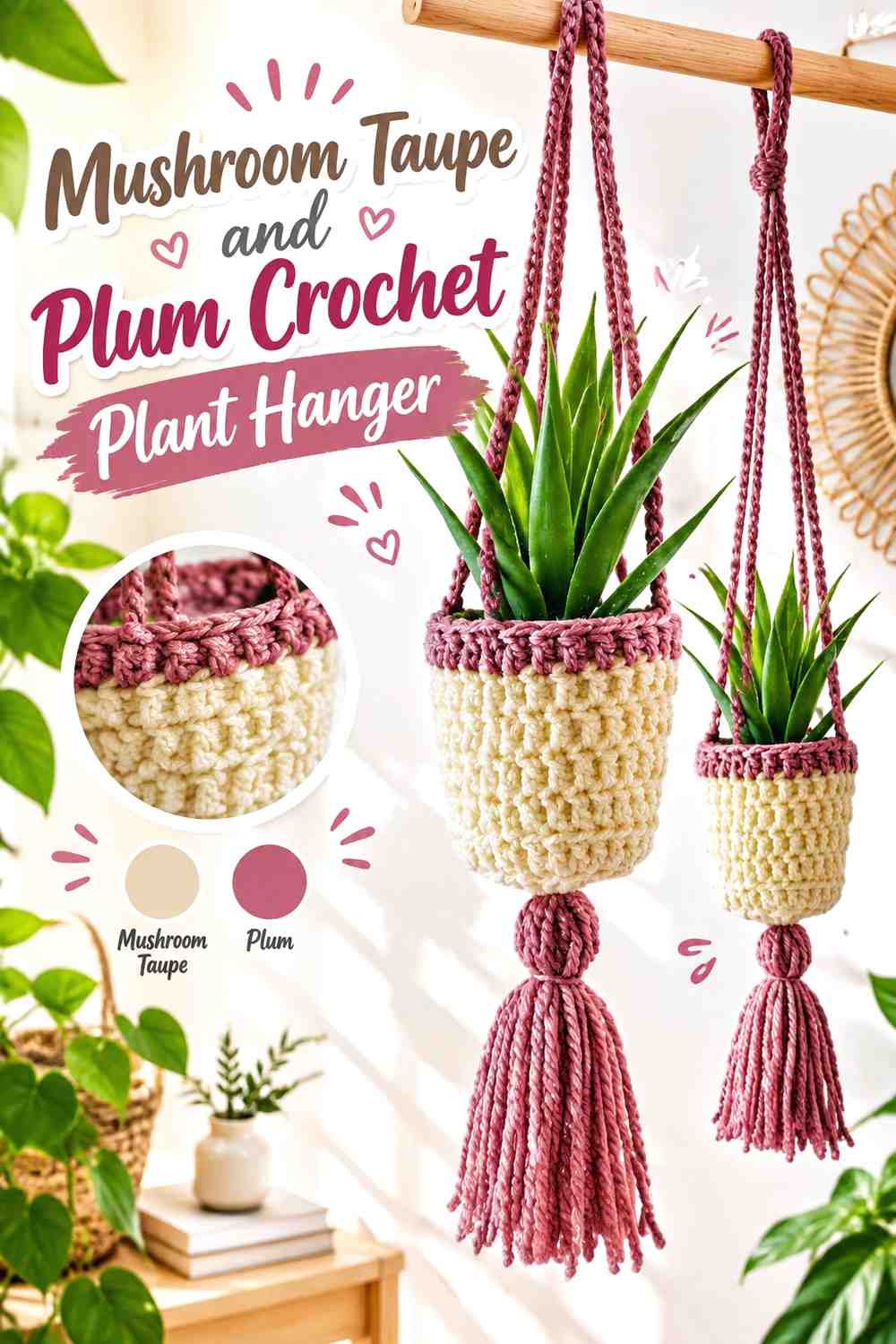
A plant hanger already surrounds a pot and plant, so its palette needs to work with more visual elements than an isolated decor piece. Mushroom taupe can keep most of the hanger understated, while plum appears in a band, upper section, lower gathering point, or tassel detail. Check the colors beside the actual planter rather than choosing them independently.
Mushroom Taupe Lets the Crochet Plant Hanger Stay Secondary to the Plant
When mushroom taupe covers most of the hanger, the crochet texture remains visible without forcing the hanger to become the darkest element in the display. This is useful around colorful pots or plants with visually dense foliage.
The exact taupe still matters. Place the yarn beside the pot first; if both are nearly identical, a larger plum section may be needed to create a noticeable boundary between the crocheted holder and the container.
Plum Works Better as a Controlled Plant-Hanger Accent
Plum can mark a transition point in the hanger or repeat at the top and bottom to create visual continuity. A small isolated plum patch in the middle may look accidental, whereas two related placements make the color appear intentional.
If you want plum to lead instead, keep mushroom taupe around the edges or connecting areas. That prevents every strand or textured section from carrying the same dark visual weight.
Creator Credit: Bella Coco
7. Mushroom Taupe And Plum Crochet Table Runner
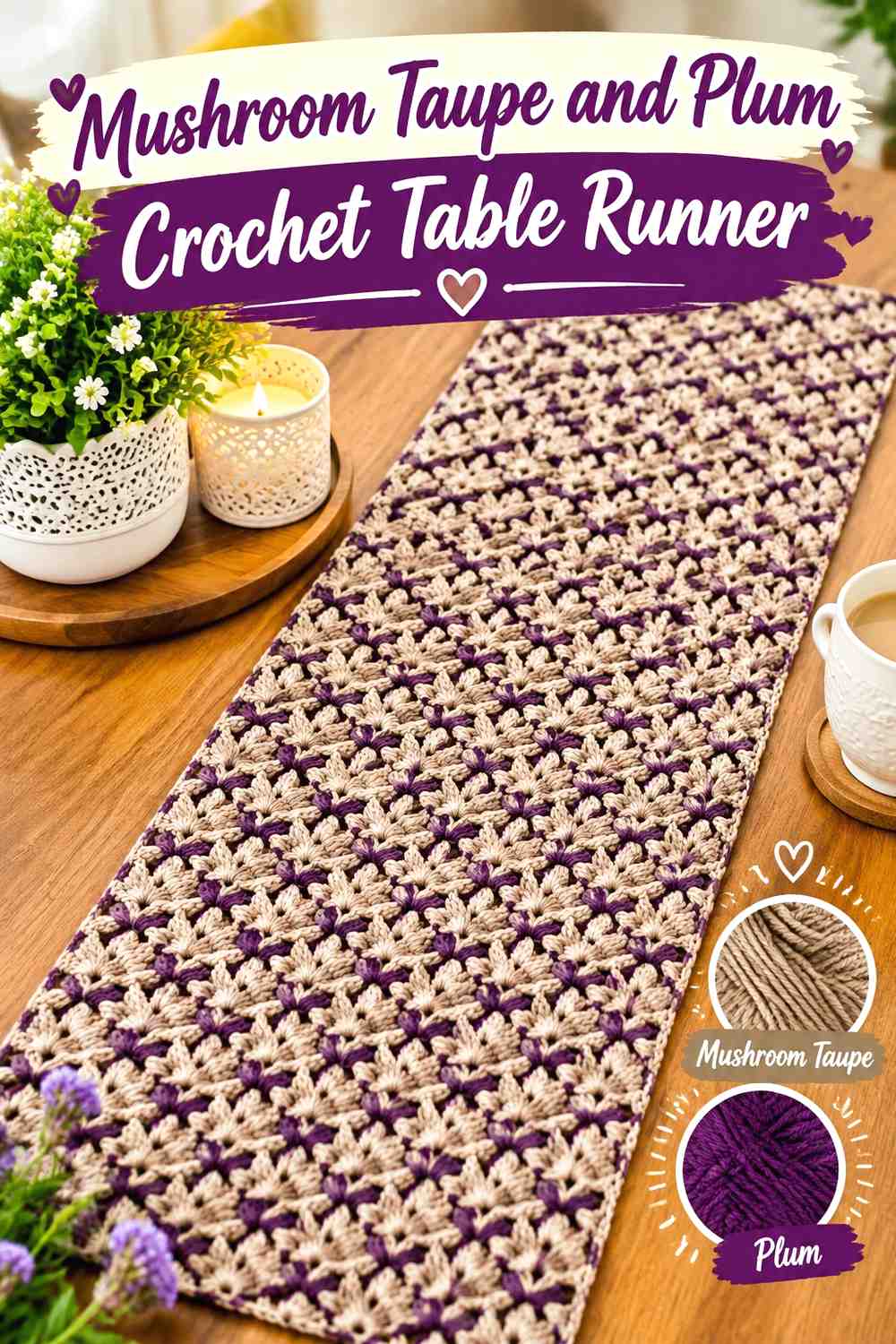
A table runner occupies a long horizontal area, so color placement can guide the eye along the table rather than simply dividing the piece in half. Mushroom taupe makes a useful main field, while plum can appear at the ends, through the center, or in repeated motifs. Consider what part of the runner remains visible once dishes or decor are placed on top.
Mushroom Taupe Gives the Crochet Table Runner a Calm Main Field
Using mushroom taupe across most of the runner allows openwork or textured stitches to remain the primary pattern. This can be especially useful when the tabletop itself has strong grain, color variation, or other visual detail.
Test the taupe directly on the table. A shade that nearly disappears against the surface may need a more substantial plum border, while strong natural contrast between the table and taupe may allow plum to remain a much smaller accent.
Plum Can Mark the Runner Ends or Center Without Crowding the Table
Plum at both ends creates a clear frame and remains visible even when the middle is partly covered. A central plum section produces a different effect but may disappear beneath a centerpiece or serving pieces.
Choose placement according to how the table is actually used. If you add plum at the ends, consider repeating a smaller plum detail nearer the center so the darker color does not appear detached from the rest of the crochet.
Creator Credit: Raji’s Craft Hobby
8. Plum And Mushroom Taupe Crochet Coasters

A coaster set is a good place to use the same two colors in several proportions. One coaster can be plum-led while another reverses the arrangement, yet the set still feels connected because the palette remains consistent. Keep one repeated feature—such as the center or outer edge—the same across the set if you want stronger visual unity.
Plum Centers Give Each Crochet Coaster a Strong Visual Anchor
Plum can occupy the center while mushroom taupe surrounds it, giving each small piece an immediately visible focal area. Because coasters have limited surface space, a defined center often works more clearly than scattering several tiny plum accents around the edge.
If your coaster includes prominent stitch texture, make sure the deep plum does not hide the detail you most want to see. Moving plum to a simpler central area can leave more intricate edging in the lighter taupe.
Mushroom Taupe Edges Keep the Plum Coaster Set Coordinated
A mushroom taupe outer edge can act as the repeated feature across every coaster even when the center colors change. This keeps the perimeter lighter and gives the plum a consistent boundary.
For a more varied set, reverse one or two coasters so mushroom taupe fills the center and plum frames the edge. Repeat that reversal intentionally rather than making every coaster different, which can weaken the sense that they belong together.
Creator Credit: Designs by Phanessa
9. Plum And Mushroom Taupe Crochet Area Rug
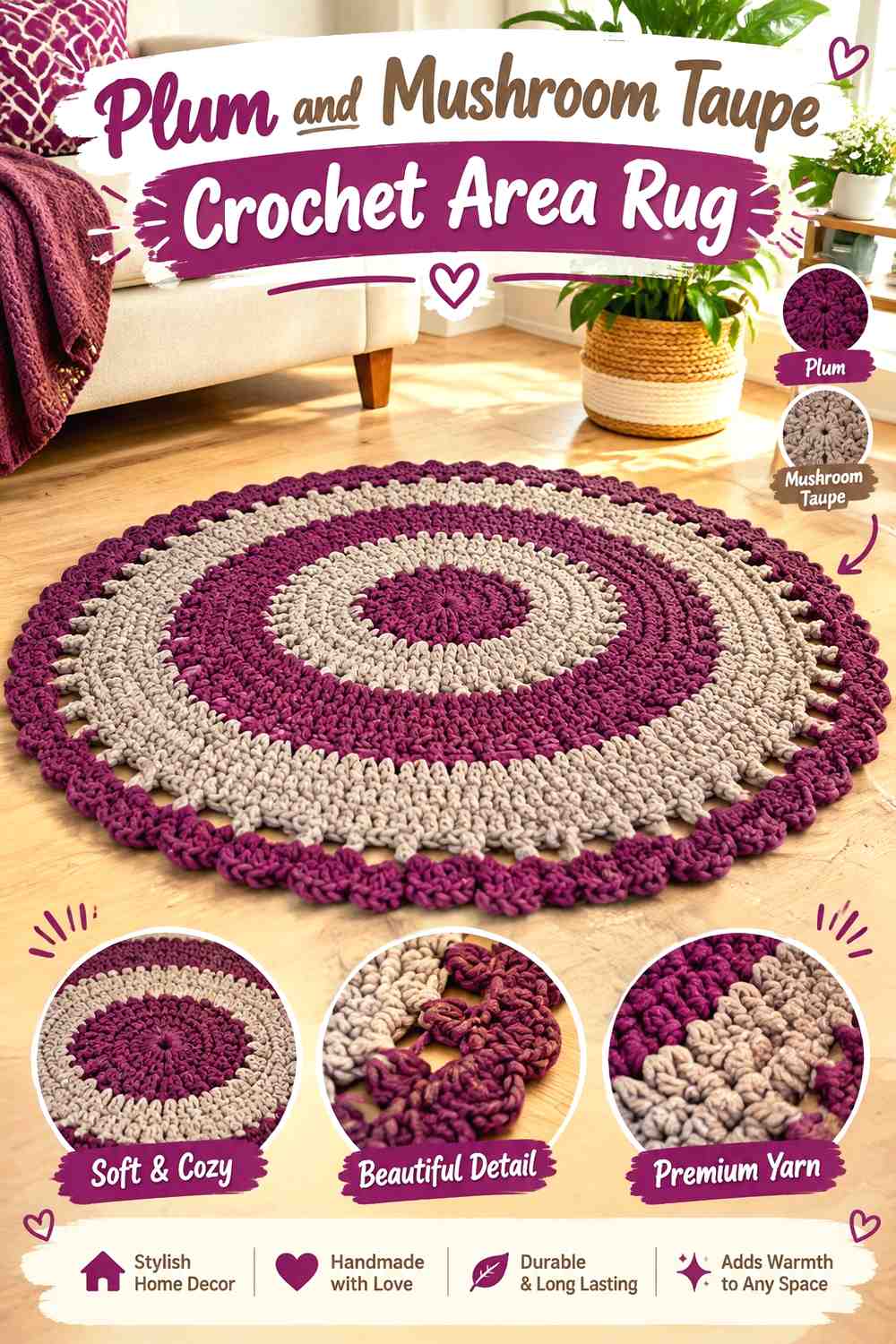
A rug is usually viewed from farther away than a coaster or pillow, so tiny color changes can disappear. Plum needs enough visual area to remain recognizable, while mushroom taupe can create breathing room between darker sections. Broad bands, large repeated areas, or clearly separated shapes tend to communicate the palette more effectively than scattered small accents.
Plum Needs Enough Area to Read Clearly From Standing Distance
Before repeating a narrow plum detail across an entire rug, make a sample and place it on the floor. Step away and check whether the dark color still reads as a deliberate part of the design.
If it disappears into the surrounding taupe, increase the visual area of plum rather than automatically adding more separate accent locations. One broader plum region can be clearer than many small dark marks.
Mushroom Taupe Can Separate Plum Rug Bands on Dark or Light Floors
Mushroom taupe can serve as the space between plum bands or concentric areas, preventing the darker sections from merging. The amount you need depends partly on the floor beneath the rug.
On a dark floor, a more generous taupe outer area can help define the rug’s silhouette. On a pale floor, plum may already provide strong outer-edge contrast, allowing mushroom taupe to stay more central. Test both colors on the actual floor before deciding.
Creator Credit: Jayda InStitches
10. Mushroom Taupe And Plum Crochet Floor Pouf
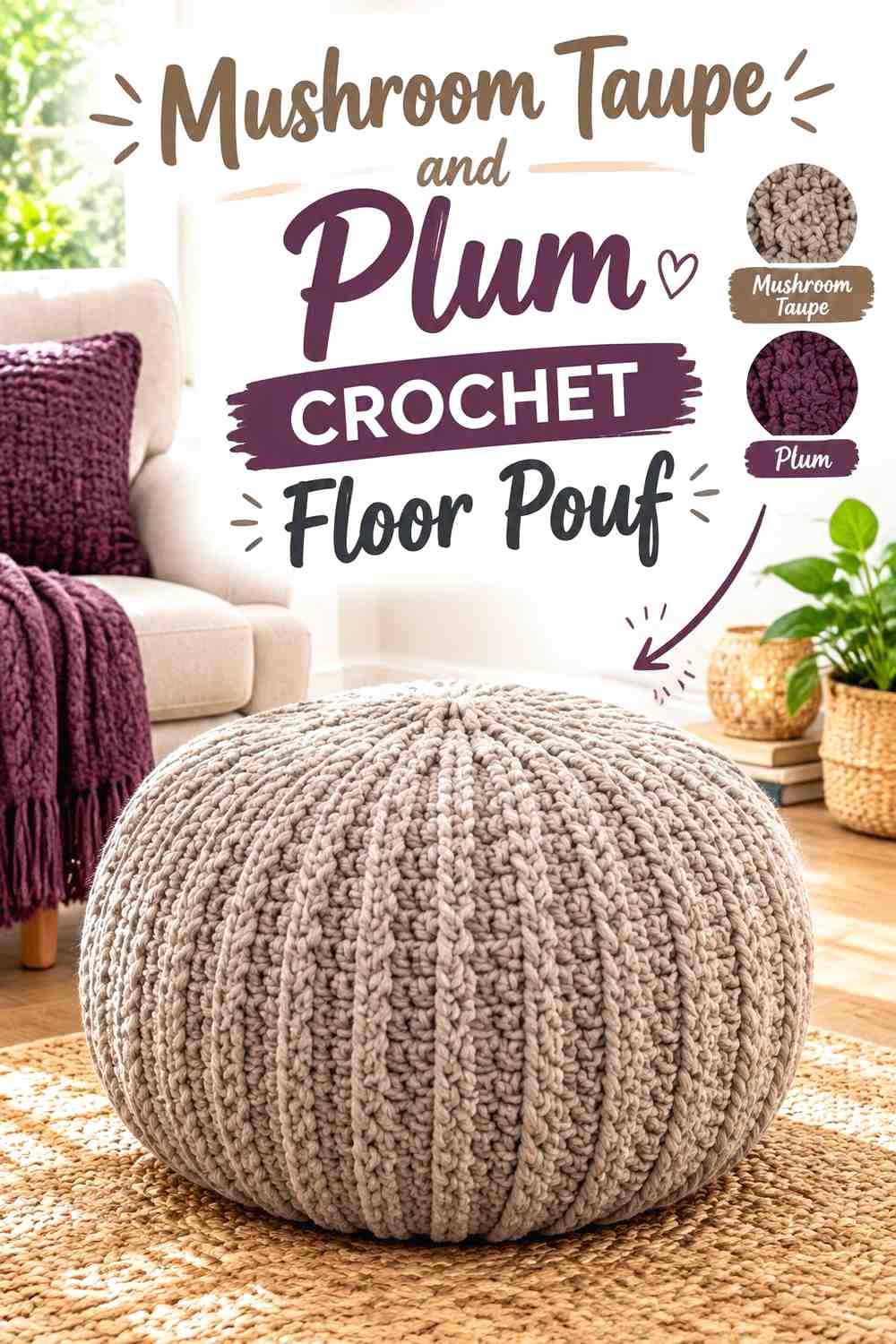
A floor pouf has several visible planes, which makes it useful for controlled color blocking. Mushroom taupe can dominate the broad body while plum highlights ribs, sections, or the top. Because the item is three-dimensional, check how the color arrangement looks from the side as well as from above.
Mushroom Taupe Keeps the Crochet Pouf From Becoming One Dark Block
Covering most of the pouf in mushroom taupe lets the silhouette and texture remain visible without giving every section the same heavy visual weight. The neutral also provides a background against which smaller plum areas can be read more clearly.
If the pouf has pronounced texture, place your two yarns against that texture in a sample. A very dark taupe may reduce the contrast more than expected once shadows from the stitches are added.
Plum Can Emphasize Pouf Ribs, Panels, or Top Details
Plum works well on a feature that repeats around the pouf because the color then follows the form instead of appearing as an isolated patch. A repeated rib, sectional accent, or top detail can provide enough dark color without covering the entire piece.
Keep the location consistent around the visible sides. Uneven plum placement may be more noticeable on a freestanding object that can be viewed from several directions.
Creator Credit: MJ’s Off The Hook Designs
11. Mushroom Taupe And Plum Crochet Tissue Box Cover
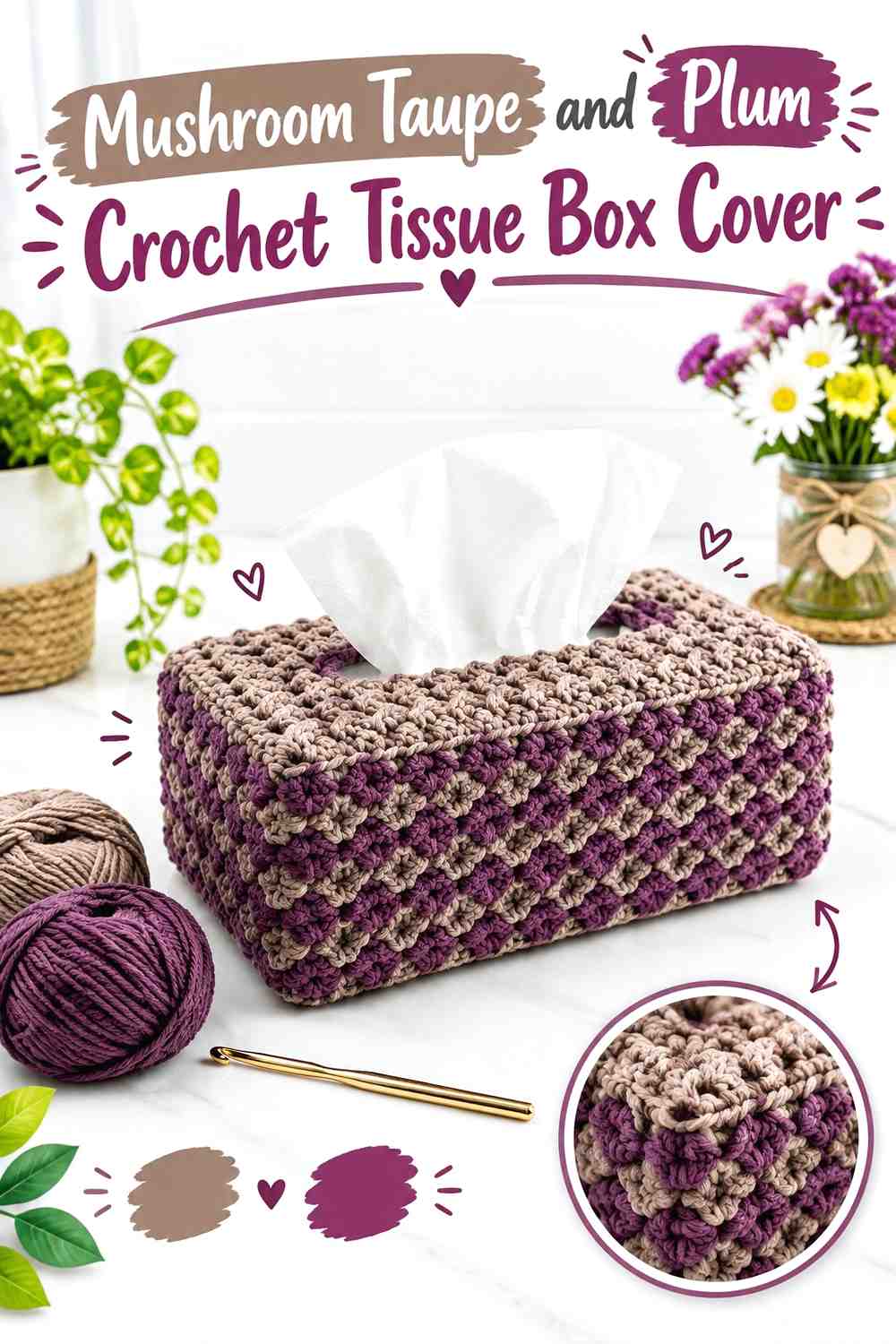
A tissue box cover has a simple overall shape, so small differences in edging and opening color can make a large visual difference. Mushroom taupe can cover the sides while plum defines the top opening, bottom edge, or one controlled decorative band. This also keeps the color scheme readable without turning a small functional object into a heavily striped piece.
Mushroom Taupe Works Well Across the Main Tissue Box Surface
Using mushroom taupe on the larger side panels gives the cover a neutral base and allows the crochet texture to remain visible. It also creates enough uninterrupted space for the mushroom shade to read clearly rather than becoming a narrow separator between plum sections.
If the cover sits against a taupe wall or tabletop, check whether its outline needs stronger plum near the lower edge to prevent the piece from visually blending into its surroundings.
Plum Frames the Tissue Opening and Lower Edge Without Overloading It
The opening at the top naturally draws attention, making it a useful place for plum. Repeating the same shade along the bottom edge can balance that upper accent and visually connect the cover from top to base.
If both edges feel too heavy in your chosen plum, keep one prominent and reduce the other. The goal is to use the dark shade to clarify the shape, not to outline every seam or transition.
Creator Credit: Jo to the World Creations
12. Plum And Mushroom Taupe Crochet Wreath
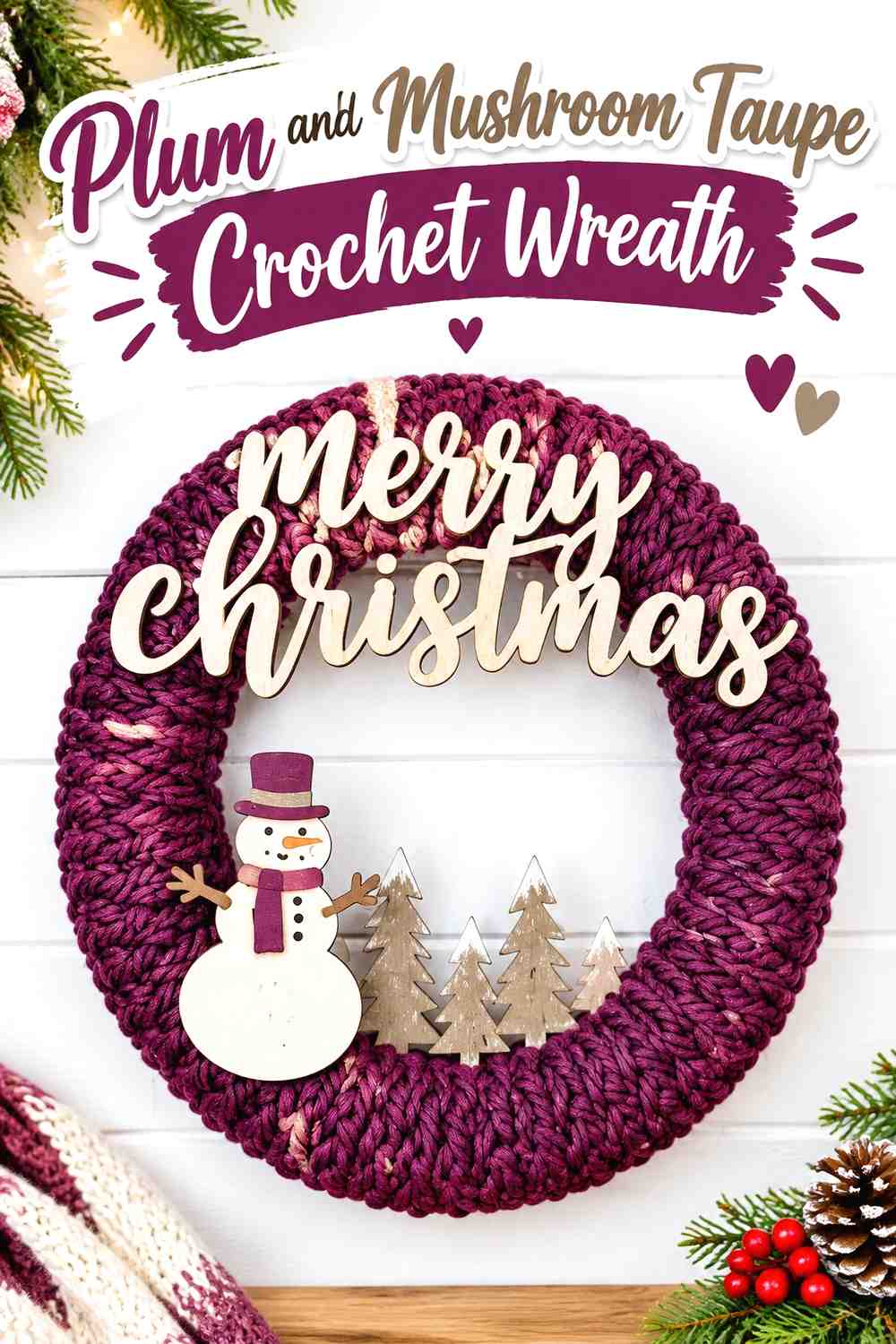
A crochet wreath needs enough contrast to remain legible against a door or wall. Plum can create the main visual mass, while mushroom taupe separates decorative areas or provides a lighter base. Because the background is always visible through and around a wreath, test the finished palette against its intended display location.
Plum Gives the Crochet Wreath a Stronger Door or Wall Presence
Plum can cover a substantial portion of the wreath when you want the piece to function as a dark accent. Instead of distributing the color in tiny equal intervals, group some plum areas so they remain visible from across the room or from farther down a hallway.
If the display surface is similarly dark, place mushroom taupe near the outside or around important decorative features so the wreath’s circular outline stays distinct.
Mushroom Taupe Prevents Plum Wreath Details From Merging Together
When several plum motifs or textured elements sit close together, mushroom taupe can act as a separator. Use it between dark areas, around selected motifs, or as a repeated secondary feature rather than simply filling whatever space remains.
For a taupe-dominant wreath, reverse that logic: let mushroom taupe form the main base and place plum in several repeated focal points. The repetition keeps the accent connected around the circle.
Creator Credit: Winding Road Crochet
13. Plum And Mushroom Taupe Crochet Garland
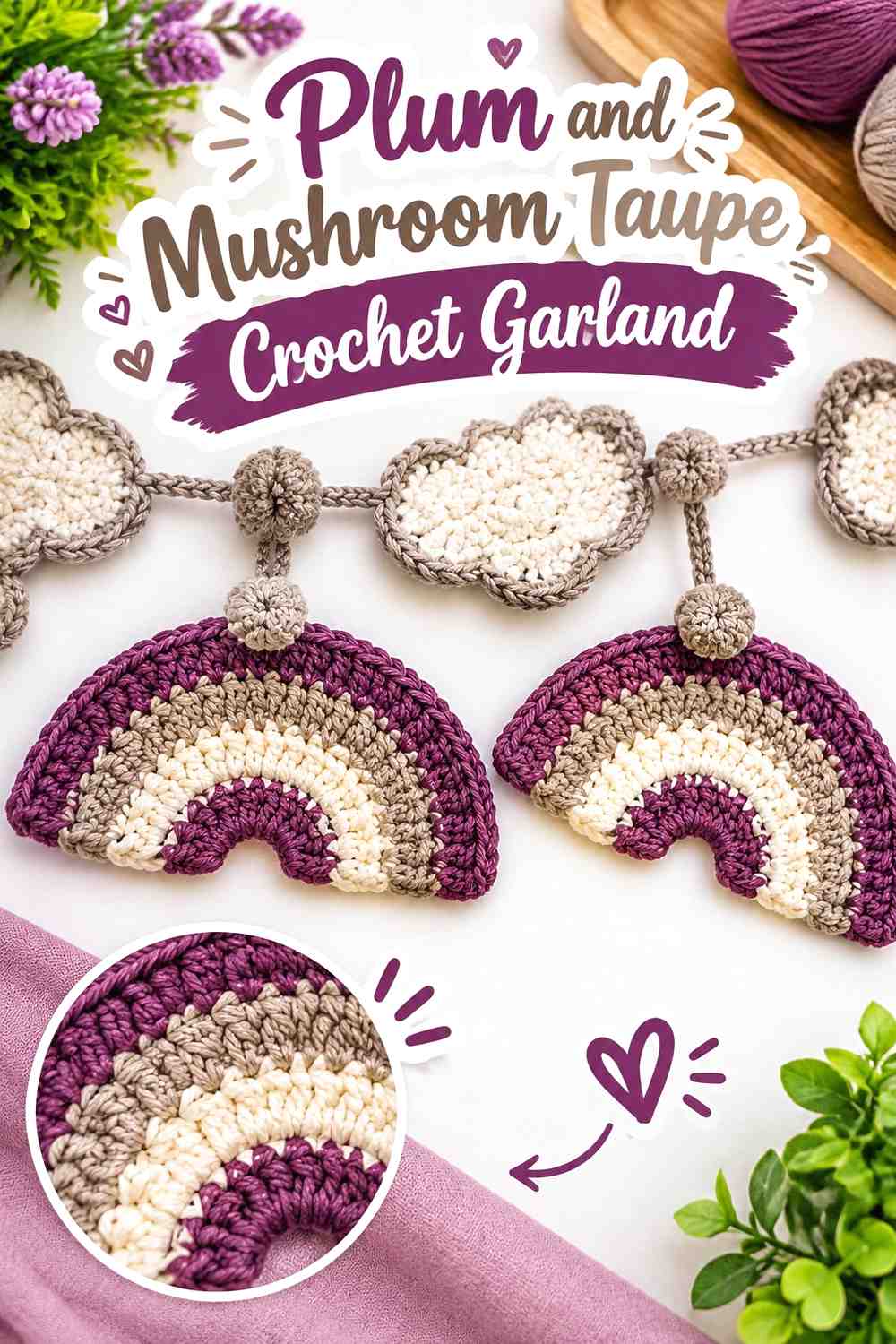
A garland naturally divides color into repeated units, which makes alternating plum and mushroom taupe straightforward. The connector or chain also becomes an important color decision because it visually links every motif. Decide whether you want that connector to blend into the wall or become part of the palette.
Alternate Plum and Mushroom Taupe Motifs for an Even Garland Rhythm
A simple plum-taupe-plum-taupe repeat gives each color comparable presence without forcing every individual motif to contain both shades. This can be clearer than dividing very small motifs into multiple color sections.
If you want plum to dominate, repeat two plum motifs for every mushroom taupe motif or make the visually largest motifs plum. Establish the sequence before assembling the full garland so the distribution remains intentional from end to end.
Use Mushroom Taupe as the Connector When Plum Motifs Need More Space
A mushroom taupe connector can visually separate dark plum motifs and stop neighboring shapes from merging when the garland is viewed at a distance. It can also sit more quietly against many neutral walls.
If the display wall is close to the same taupe value, plum may work better for the connector instead. Hold a short sample against the actual wall to determine which color provides the boundary you want.
Creator Credit: Hooked by Robin
14. Plum And Mushroom Taupe Crochet Doily

A two-color doily can use contrast to make openwork more visible rather than treating color as simple decoration. Plum provides a dark focal area, while mushroom taupe can lighten the outer section or separate distinct visual zones. The tabletop underneath will show through the openings, so include its color when judging the finished balance.
Plum Makes Crochet Doily Openwork More Noticeable on Light Surfaces
On a pale tabletop, plum can create a strong outline around open spaces and help the overall doily shape remain visible. You can use it across the main field or concentrate it in a central area that you want to emphasize.
Before making plum dominant, check whether the darker yarn still allows smaller textured details to be seen. If some definition is lost, move mushroom taupe nearer those details instead of changing the entire palette.
Mushroom Taupe Softens a Plum Doily Without Hiding the Lace Shape
Mushroom taupe can create a quieter outer area around a plum center, which reduces the amount of dark color at the perimeter. The exact transition should follow natural visual divisions in the doily rather than an arbitrary halfway split.
If the tabletop is also taupe or brown, make sure the outer section does not disappear into it. In that case, reversing the arrangement and placing plum closer to the edge may provide a clearer silhouette.
Creator Credit: NotikaLand crochet and knitting
15. Mushroom Taupe And Plum Crochet Flower Kitchen Pad
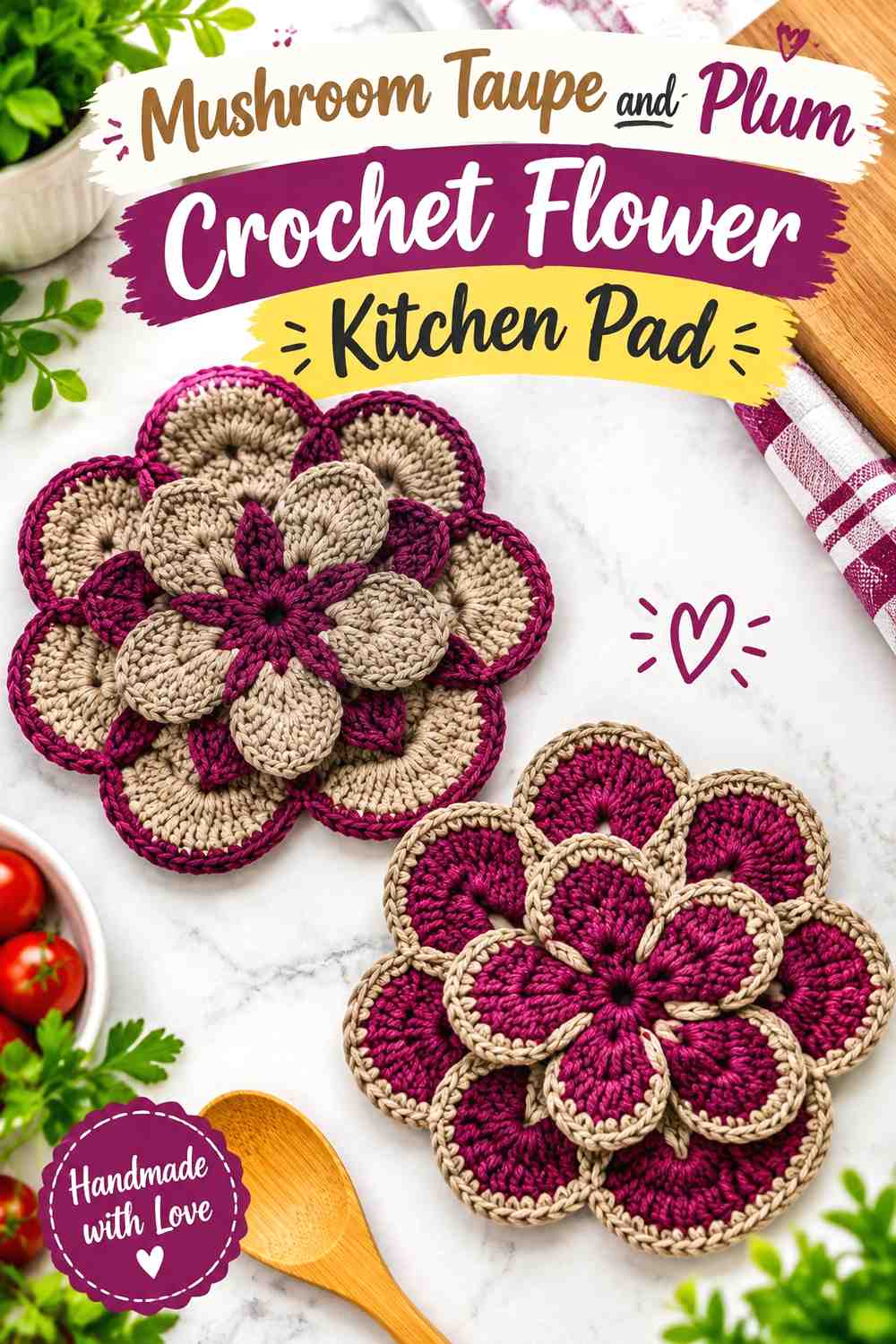
A flower-shaped kitchen pad gives plum and mushroom taupe obvious places to separate: center, petals, outer edge, or repeated petal details. Let one shade define the flower shape while the other supports it. Because this piece may sit near dishes, appliances, and countertops, check the palette in the kitchen rather than judging it only from the yarn skeins.
Plum Works Well on the Crochet Flower Petals or Center Details
Plum can make the flower shape more distinct when used consistently across either the petals or the center. Avoid distributing it randomly among several unrelated small areas unless the design already has a clear repeat structure.
For a plum-led flower, use mushroom taupe to outline the center or outer edge. For a taupe-led version, keep plum concentrated in the center so the darker color creates one strong focal point.
Mushroom Taupe Keeps a Plum Kitchen Pad From Looking Too Busy
When the flower design already contains substantial texture, mushroom taupe can provide quieter space between plum areas. This is especially useful if the kitchen contains several other colors and the crochet piece does not need to introduce another highly divided pattern.
If the piece will be used around hot cookware, choose materials and use conditions according to appropriate project and yarn guidance rather than assuming a particular color or appearance makes the crochet suitable for heat.
Creator Credit: naztazia
16. Mushroom Taupe And Plum Crochet Plant Pot Cover
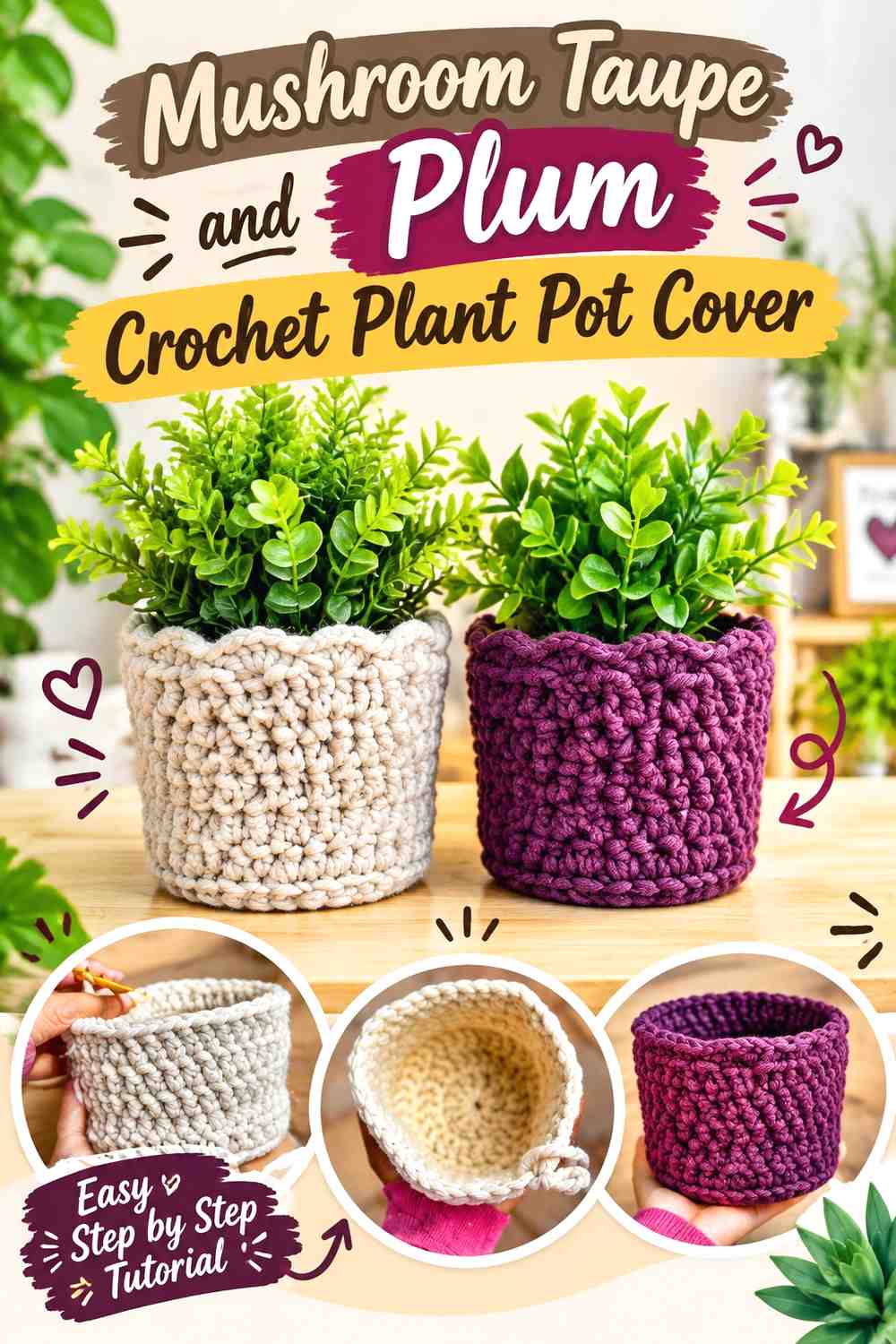
A plant pot cover can use mushroom taupe across most of the body while plum defines the rim or a repeated band. Since the pot cover sits directly beneath foliage, the color arrangement should be evaluated with the plant and pot together. A palette that looks balanced by itself may shift once surrounded by green leaves or a strongly colored container.
Mushroom Taupe Lets the Plant Pot Cover Stay Secondary to the Plant
A taupe-dominant cover gives the crochet texture a visible but restrained role around the container. It works particularly well when you want the plant itself, rather than the cover, to carry most of the visual activity.
If the existing pot is close to mushroom taupe, decide whether you want the cover to blend with it or clearly separate from it. A plum rim can create that separation without requiring a fully plum body.
Plum Can Turn the Crochet Pot Cover Rim Into the Main Accent
The upper rim is naturally close to the plant, making it an effective location for a plum accent. Repeating a small amount of plum lower on the cover can connect the rim to the rest of the piece if the upper band otherwise feels isolated.
For a stronger plum presence, widen one deliberate band rather than adding many narrow stripes. That keeps the broad mushroom taupe surface intact while still giving the darker shade meaningful visual weight.
Creator Credit: Smitha Katti
17. Plum And Mushroom Taupe Crochet Mug Rug
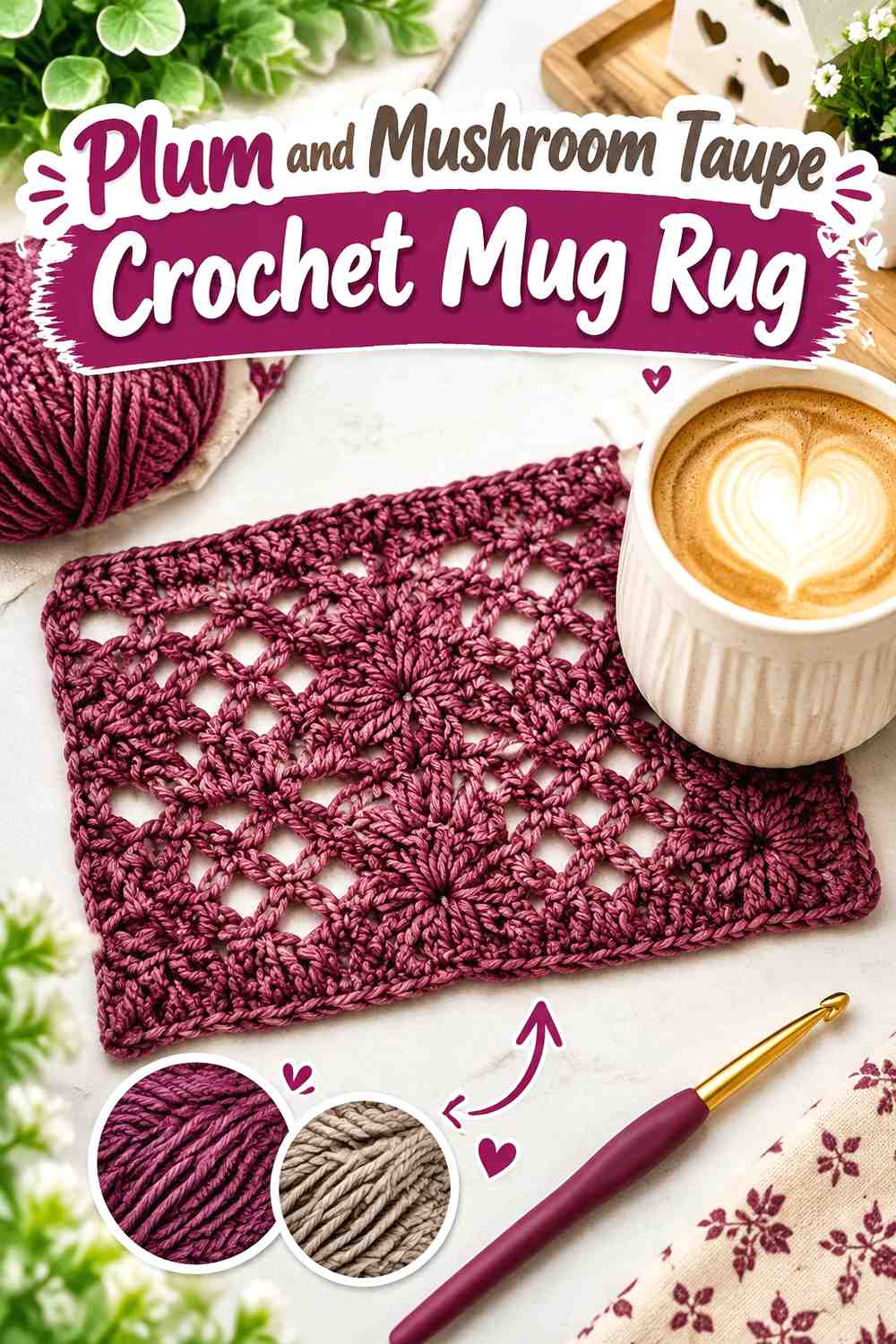
A mug rug is small enough that plum and mushroom taupe can be divided boldly without overwhelming the piece. Plum can fill the main rectangle while taupe frames it, or the arrangement can be reversed for a more neutral result. Because a mug will cover part of the surface, keep an important portion of the secondary color near an exposed edge if you want both shades visible during use.
Plum Gives the Crochet Mug Rug a Clear Coffee-Station Accent
A plum main field lets the mug rug become one of the deeper color notes on a counter, desk, or side table. Keep the broad center relatively consistent if you want the crochet texture, rather than several color changes, to provide the pattern.
If a dark mug will sit on the rug, mushroom taupe around part of the center or edge may create more visible separation between the mug and the crocheted surface.
Mushroom Taupe Keeps Plum Fringe or Borders From Competing With the Mug
Mushroom taupe can frame a plum center through edging or fringe, allowing the two colors to remain visible even when the middle of the mug rug is partly covered. The lighter perimeter also keeps the plum from extending visually into every detail.
For a taupe-led version, reverse the balance and reserve plum for the outer edge or fringe. Compare both arrangements with the mug you plan to use before deciding which shade deserves the larger area.
Creator Credit: Stringsandthreads
Conclusion
Plum and mushroom taupe can produce very different crochet decor depending on which shade receives the larger share of the project. For a more neutral-led room accent, the mushroom taupe throw, basket, plant hanger, table runner, pouf, tissue box cover, and plant pot cover keep the deeper shade controlled. If you want plum to function as a more obvious focal color, the pillow, wall hanging, rug, wreath, doily, and mug rug give it more visual area.
The granny-square blanket, coasters, garland, and flower kitchen pad work especially well when you want the two colors to repeat more evenly. Whatever project you choose, compare the actual yarns under the lighting and against the surfaces where the decor will be used. Preserving a clear dominant-supporting relationship is usually more useful than trying to divide plum and mushroom taupe into identical amounts.
Frequently Asked Questions
Should Plum or Mushroom Taupe Be the Main Color in Crochet Decor?
Use plum as the dominant shade when you want the crochet piece to create a deeper focal point. It can work especially well across a pillow face, wall hanging, wreath, rug, or small accent piece.
Choose mushroom taupe as the dominant color when the item covers more visual area or when you want the crochet to sit more quietly among neutral furnishings. Blankets, baskets, poufs, runners, and pot covers are good places to consider a taupe-led balance. Neither arrangement is automatically better; the item size and surrounding decor should guide the decision.
How Can I Tell Whether Plum and Mushroom Taupe Have Enough Contrast?
Place the two yarns directly beside each other rather than comparing them from memory. Then look at them from several feet away. If their boundary becomes hard to distinguish, they may be closer in lightness than their different hues suggest.
A grayscale photo can provide another quick check. This is particularly useful before committing to small granny-square details, lace sections, borders, or raised textures where the color change needs to remain visible.
Does Mushroom Taupe Create a Softer Contrast Than Cream With Plum Crochet?
It often can, provided your mushroom taupe is darker than the cream you would otherwise use. Cream typically introduces a lighter, brighter separation against deep plum, while mushroom taupe can keep the transition more subdued.
The exact result depends on the yarns, however. A pale mushroom taupe may contrast strongly with plum, while a deep taupe may produce a much more tonal effect. Compare the actual shades rather than relying on the color names alone.
Where Should Plum Go on Large Mushroom Taupe Crochet Decor?
Look for areas that already define the object’s structure: a blanket border, basket rim, pouf section, table-runner end, or repeated motif center. Those locations give plum a clear purpose.
If plum appears only once on a very large item, it can feel disconnected. Repeat it in a second smaller location when necessary. That does not mean every edge needs plum; two or three related placements are often enough to establish a visible color relationship.
Can I Add a Third Color to Plum and Mushroom Taupe Crochet Decor?
Yes, but give the third shade a specific role rather than dividing all three colors equally by default. A lighter neutral could provide extra separation around small details, while another muted color could appear in limited motifs or accents.
Before adding it, decide whether plum remains the darkest anchor and mushroom taupe remains the neutral support. Keeping those roles clear makes it easier to introduce another shade without losing the original two-color direction.
How Do I Substitute a Different Plum or Mushroom Taupe Yarn?
Preserve the relationship between the colors rather than searching only for matching names. A replacement plum should still be deep enough to function as the stronger visual anchor if that is its role. A mushroom taupe substitute should retain the muted neutral quality and remain sufficiently different in lightness from the plum.
Place replacement yarns beside each other and check them in the room where the finished decor will be used. That comparison is more useful than assuming two yarns labeled “plum” or “taupe” will create the same result.