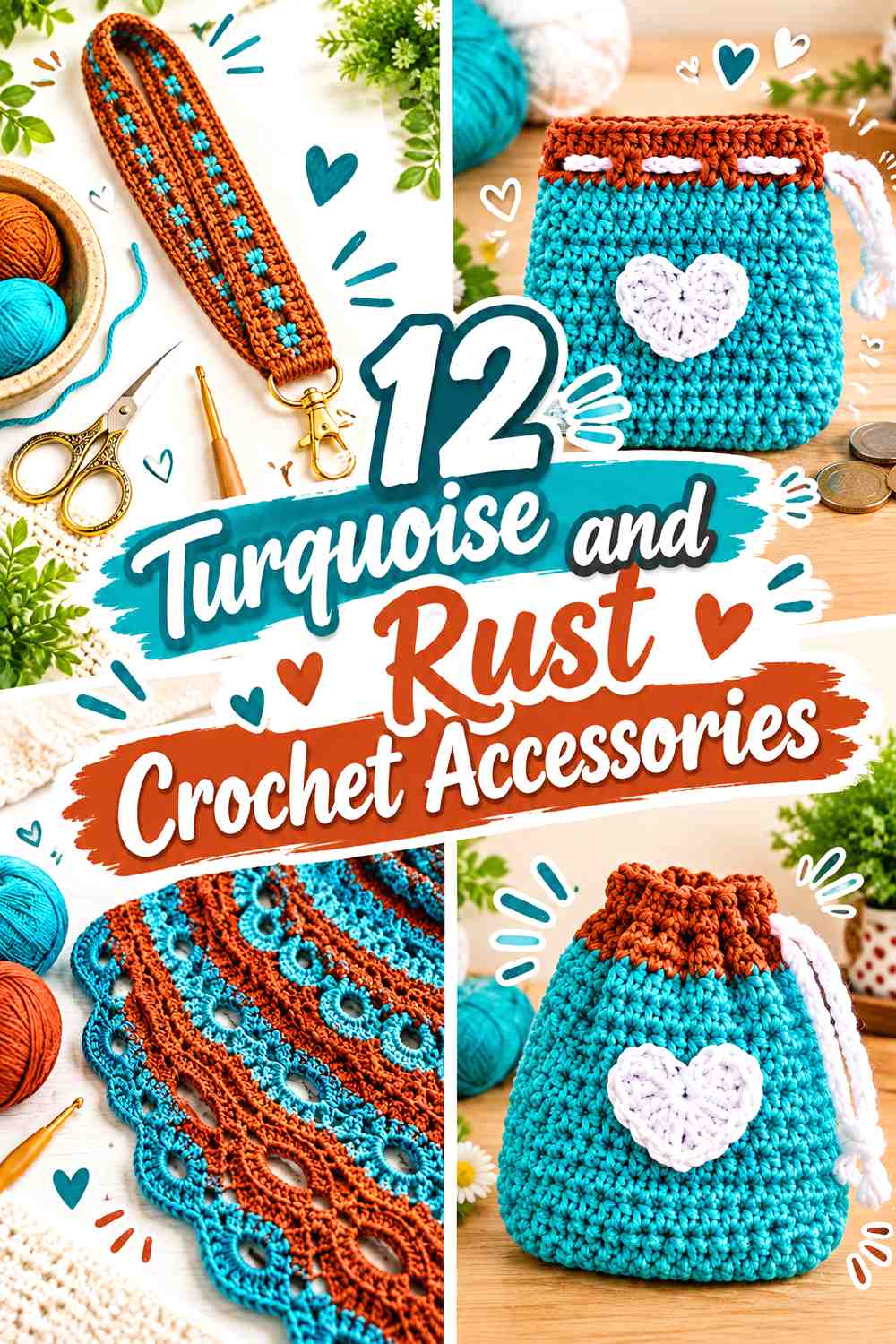
12 Turquoise and Rust Crochet Accessories
Turquoise and rust create a useful crochet pairing because the colors are clearly different without requiring harsh black-and-white contrast. Turquoise can bring a cooler blue-green area into an accessory, while rust introduces a warmer red-orange or brown-orange note. The real design decision is not simply whether to use both colors, but how much space each one gets.
A turquoise-dominant scarf will read very differently from a rust-dominant beanie, even when the same two colors are involved. Stripes can distribute them evenly, checkerboards make the contrast more graphic, and small turquoise edging on a mostly rust accessory gives the combination a much quieter appearance.
The 12 ideas below use different color hierarchies and placements so you can decide whether turquoise should cover the main fabric, rust should lead, or the two shades should share the accessory more evenly. The linked tutorials support the accessory constructions; the turquoise-and-rust palettes are independent color adaptations.
Quick List
- Turquoise Rust And Cream Crochet Scarf
- Rust Dominant Turquoise Crochet Beanie
- Turquoise Crochet Headband With Rust Center Detail
- Turquoise And Rust Checkered Crochet Tote Bag
- Rust Crochet Scrunchie With Turquoise Edging
- Turquoise And Rust Striped Crochet Fingerless Gloves
- Deep Turquoise Crochet Cowl With Rust Accent Rows
- Turquoise And Rust Color Block Crochet Shawl
- Rust Crochet Bucket Hat With Turquoise Brim
- Turquoise Crochet Coin Purse With Rust Closure Edge
- Turquoise And Rust Granny Style Crochet Bandana
- Rust Crochet Lanyard With Turquoise Repeated Accents
Decide Whether Turquoise or Rust Should Lead the Accessory
Giving turquoise and rust exactly the same visual weight can work for checkerboards or deliberate stripes, but many accessories become easier to read when one shade clearly dominates. A scarf or shawl provides enough surface area for broad color blocks, while a small scrunchie or lanyard usually benefits from a simpler main-color-plus-accent arrangement.
Before crocheting, place the two yarns together and decide which one you want to notice first. Then reserve the second shade for edges, stripes, motifs, handles, ties, or another repeated detail. This prevents the palette from becoming visually fragmented.
Check Turquoise and Rust for Light-and-Dark Contrast
Turquoise and rust differ strongly in hue, but that does not guarantee strong value contrast. A dark turquoise and deep rust can appear surprisingly similar when viewed from a distance, making small motifs or narrow stripes less distinct.
If definition matters, photograph the yarns and view the image in grayscale. When both shades turn into nearly the same gray, consider using a lighter turquoise or a darker rust. You can also introduce a small amount of cream or another light neutral when a detailed stitch area needs more separation.
Repeat Rust and Turquoise Accents Instead of Using Them Once
A single isolated patch of rust on an otherwise turquoise accessory can appear accidental. Repeating rust at another edge, stripe, tie, tassel, or handle point makes the color feel connected to the rest of the design.
The same principle works when rust dominates. Small turquoise details placed in two or three visible locations can establish a deliberate rhythm without forcing the cooler shade to compete with the main fabric.
1. Turquoise Rust And Cream Crochet Scarf
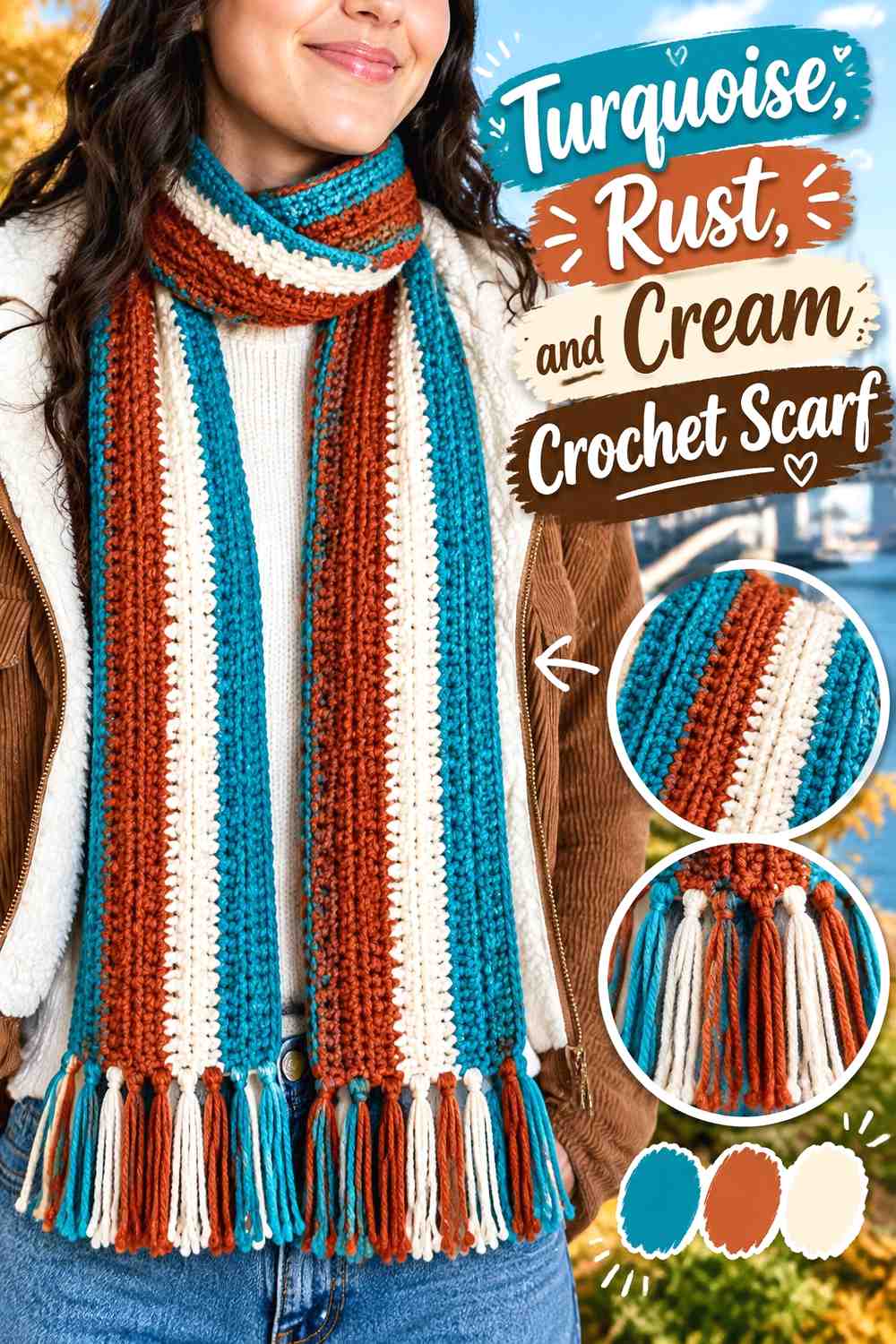
Let turquoise cover most of this crochet scarf, then interrupt the larger cool field with controlled rust sections and narrow cream transitions. The cream is useful when your turquoise and rust yarns are both fairly dark because it keeps adjoining color changes from visually merging. For a long scarf, repeating the rust rather than placing it only at one end also keeps the color balance intentional from either direction.
Turquoise Gives the Crochet Scarf a Continuous Main Field
Use turquoise through the longest uninterrupted portions if you want the scarf to read primarily as turquoise. Long stretches of the same shade also allow ribbing or other surface texture to remain visually continuous rather than being broken by frequent color changes.
When planning rust placement, lay the scarf concept out symmetrically before committing. Rust near both ends can frame the turquoise center, while several spaced rust bands create a more rhythmic look.
Rust Works Better as a Repeated Crochet Scarf Accent
Rust has more impact when it appears at more than one point. Try it in broader end sections, narrow recurring bands, or tassels that repeat a rust stripe already present in the scarf.
If the rust feels too heavy beside turquoise, reduce the width of the rust sections instead of changing the whole palette. That preserves the warm-cool contrast while returning turquoise to the dominant role.
Cream Can Separate Dark Turquoise and Rust Scarf Sections
A small cream transition can help when deep turquoise and deep rust have similar lightness. It does not need to occupy much of the scarf; narrow cream bands between the two stronger colors may provide enough visual break.
Keep cream consistent rather than inserting it randomly. Using it in the same relationship to each rust section makes the three-color sequence easier to follow.
Creator Credit: VivCrochets
2. Rust Dominant Turquoise Crochet Beanie
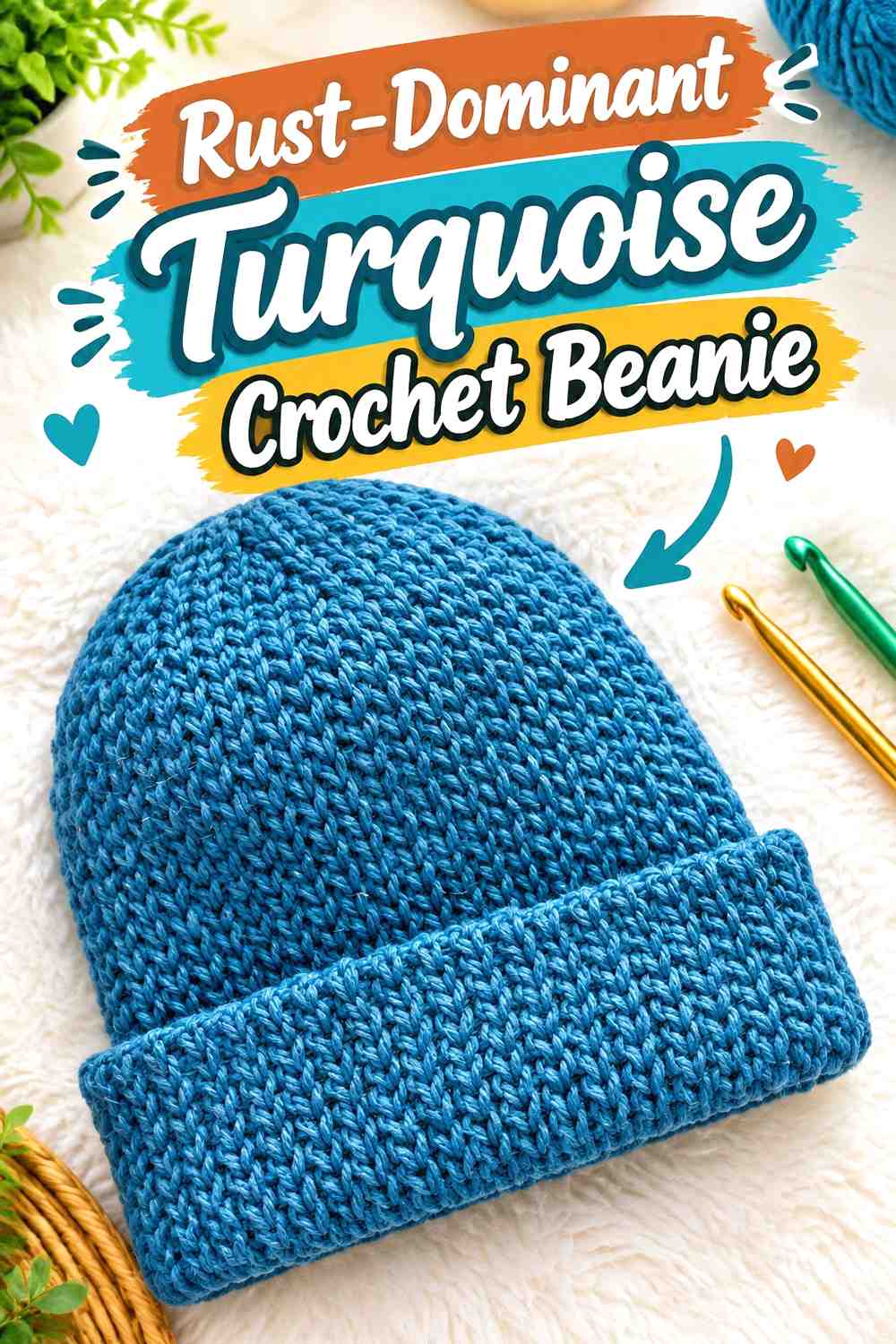
Rust can carry the main body of this crochet beanie while turquoise is concentrated around the lower edge or a limited set of stripes. Because a beanie has relatively little surface compared with a scarf or shawl, restricting turquoise to one clearly defined zone keeps the two-color plan from becoming overly busy.
Rust Keeps the Crochet Beanie Visually Unified
Using rust through most of the crown and body gives the hat one continuous base. This is especially helpful when the crochet fabric already has noticeable ribbing or knit-like texture; frequent color changes could compete with those vertical lines.
Before adding turquoise, look at where the beanie naturally changes direction or texture. A lower band is often a clearer location for contrast than a small patch placed in the middle of the crown.
Turquoise Can Define the Crochet Beanie Edge
A turquoise band near the lower edge places the cooler shade where it can be seen without breaking the entire rust surface into small sections. You can keep the band narrow for a restrained accent or widen it if you want turquoise to share more visual weight.
If both colors are dark, compare them in grayscale before using turquoise for fine edging. A slightly lighter turquoise will make a narrow edge easier to distinguish from the rust body.
Creator Credit: lerugi crochets
3. Turquoise Crochet Headband With Rust Center Detail

A headband offers limited space, so turquoise and rust need a simple hierarchy. Use turquoise across most of the band and place rust around the center, twist, knot area, or another small focal section. This concentrates the warm shade where it can become a deliberate detail rather than a competing second background.
Turquoise Should Cover Most of the Crochet Headband
A continuous turquoise band makes the shape easier to read and keeps the accessory from looking chopped into several short color blocks. It also lets raised or padded construction remain the main structural feature.
If your turquoise is especially saturated, consider a more muted rust rather than an equally vivid orange-rust. That keeps the contrast visible without making two strong colors fight for attention in such a small accessory.
Rust Can Mark the Crochet Headband Focal Point
Place rust where the headband already has visual emphasis, such as around a central twist or gathered area. Using the accent at an existing structural feature gives it a reason to be there.
Avoid adding unrelated rust patches elsewhere unless you intentionally want a striped headband. One concentrated rust area plus a very small repeated edge detail is usually enough to connect the colors.
Creator Credit: Brunaticality
4. Turquoise And Rust Checkered Crochet Tote Bag

A checkerboard gives turquoise and rust nearly equal visual importance, making this one of the stronger two-color statements in the collection. The tote body provides enough area for the alternating blocks to read clearly, while the handles and upper edge give you opportunities to decide which color should visually frame the checks.
Turquoise and Rust Need Clear Separation in Crochet Checks
Checkerboards rely on each block remaining visually distinct. If your turquoise and rust are very close in value, the grid may look softer than expected even though the hues are different.
Place the yarns side by side before starting the full bag. If the contrast is weak, choose a lighter turquoise or deeper rust rather than adding more colors immediately.
Rust Can Ground the Turquoise Crochet Tote Handles
When turquoise and rust share the checked body evenly, using one color consistently for the handles helps establish hierarchy. Rust handles can create a warmer, darker-looking frame around the graphic bag body.
Alternatively, turquoise handles shift the emphasis in the opposite direction. Whichever color you choose, using the same shade around the top edge can make the handles feel connected to the bag rather than added afterward.
Turquoise and Rust Checks Should Stay Consistent Across the Tote
Plan the checker alignment before reaching the second side of the bag. A regular alternation helps the turquoise-and-rust pattern remain legible across the front, back, and visible side areas.
Pay particular attention near handles or other interruptions. Geometric colorwork makes an accidental duplicate block or shifted sequence easier to notice.
Creator Credit: Kenikse Crochet
5. Rust Crochet Scrunchie With Turquoise Edging

A scrunchie is small enough that two equally dominant colors can quickly become visually crowded. Use rust across most of the gathered crochet surface and turquoise only around an outer ruffle, final edge, or another repeated detail.
Rust Gives the Crochet Scrunchie One Strong Main Color
Keeping the gathered body rust allows the folds to create their own texture without additional color changes interrupting them. This is useful because a scrunchie is constantly compressed and expanded, so tiny color sections may not remain equally visible.
Choose your rust by role rather than by a commercial shade name. A softened brick-like rust creates a quieter accessory, while a brighter orange-rust gives the small piece much more visual intensity.
Turquoise Should Stay Visible on the Crochet Scrunchie Edge
Place turquoise where gathering will not hide it completely. An outer edge or ruffled section gives the cooler shade a more dependable place to remain visible when the scrunchie is worn.
If a thin turquoise edge disappears into the rust, increase the width slightly or choose a turquoise with stronger light-dark contrast instead of adding additional colors.
Creator Credit: Treasurie
6. Turquoise And Rust Striped Crochet Fingerless Gloves

Fingerless gloves are a useful place for repeated turquoise-and-rust stripes because the paired accessories need to look related from several angles. Keep the stripe order consistent across both gloves and decide whether cuffs should repeat one of the stripe colors or act as a stronger visual anchor.
Rust Can Anchor the Crochet Glove Cuffs
Using rust at the cuffs gives each glove a clear starting point and concentrates the warmer color near the wrist. From there, turquoise stripes can become more prominent across the hand.
This arrangement is especially useful if turquoise is the lighter shade in your yarn pair because the lighter sections can make textured areas across the hand easier to see.
Turquoise and Rust Stripes Should Match Across Both Crochet Gloves
Lay both pieces beside each other periodically so the color sequence does not drift. Even when the construction is correct, a misplaced stripe will be noticeable because the gloves are normally viewed as a pair.
You do not need identical yarn quantities in each color. Wider turquoise sections with narrow rust repeats create a turquoise-led set, while equal stripe widths produce a more balanced two-color result.
Turquoise Can Highlight Crochet Glove Texture
If the glove design includes visually detailed stitchwork, place the lighter of your two colors across the area where you want that texture to show most clearly.
When turquoise and rust are similar in value, consider broader stripes. Larger color areas can remain easier to read than narrow alternating bands.
Creator Credit: Loopy Mabel Crochet
7. Deep Turquoise Crochet Cowl With Rust Accent Rows
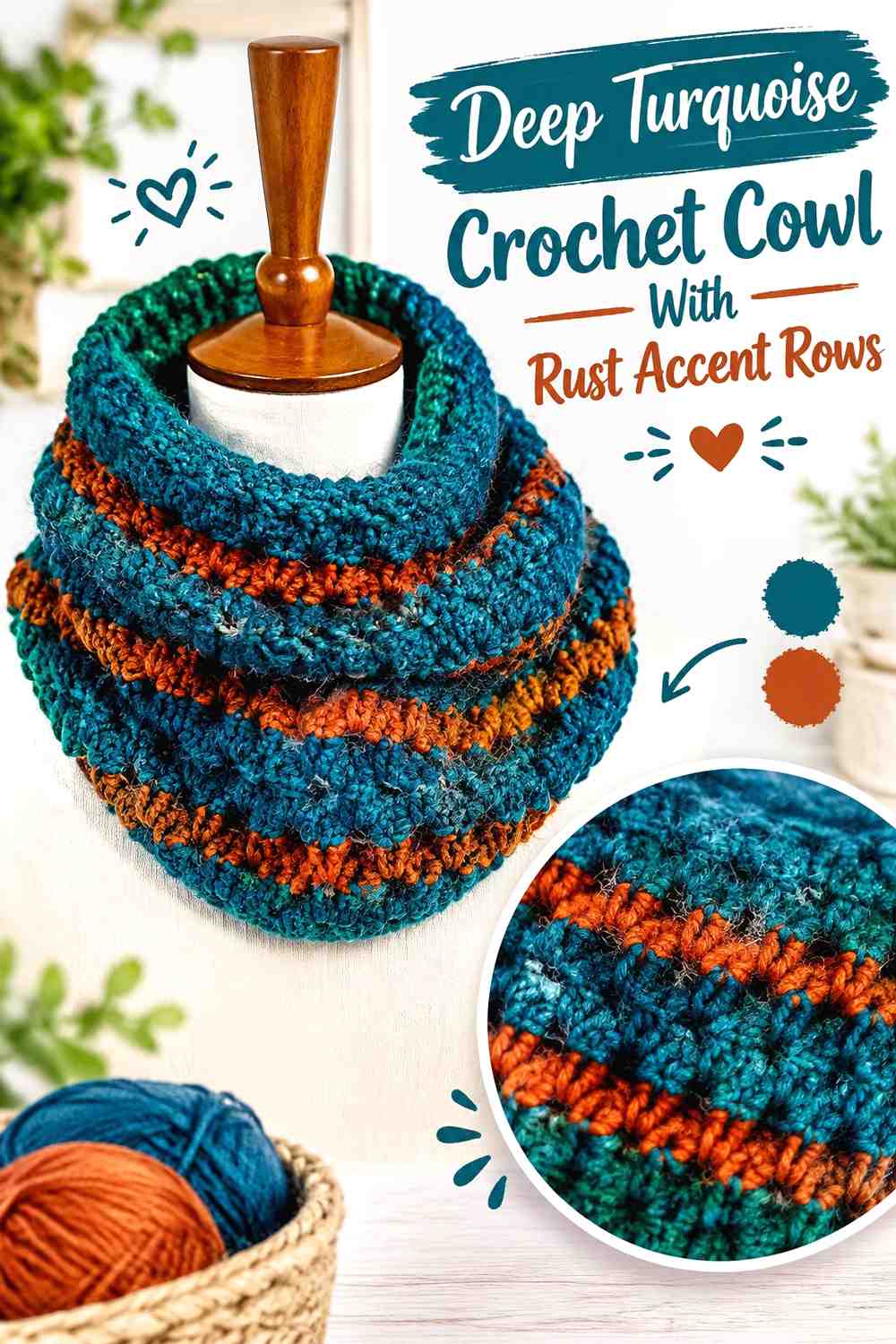
A cowl works well with deep turquoise as the dominant color because the continuous loop lets one shade create a strong surrounding field. Rust can then appear in a few strategic rows, along the upper and lower edges, or in texture details that repeat around the circumference.
Deep Turquoise Can Carry Most of the Crochet Cowl
Use turquoise for the largest areas when you want the cowl to remain visually calm despite the contrasting palette. A continuous turquoise section also gives textured stitches or decorative edging enough uninterrupted space to remain noticeable.
If the turquoise is extremely dark, test the fabric under normal indoor light. Dark yarn can reduce the visibility of subtle texture even when the stitch pattern is well defined.
Rust Can Frame the Turquoise Crochet Cowl
Rust at the top and bottom edges creates a simple frame that remains visible from multiple angles. This is usually more controlled than scattering isolated rust areas through the cowl.
For a softer transition, use narrow rust accents. For a stronger autumn-oriented look, widen the rust sections while still keeping turquoise dominant through the center.
Turquoise and Rust Need Repetition Around the Crochet Cowl
Because a cowl rotates during wear, an accent visible only on one small section may disappear. Repeating rust around complete rows or along continuous edging prevents the palette from depending on one front-facing position.
Creator Credit: Yarnspirations
8. Turquoise And Rust Color Block Crochet Shawl
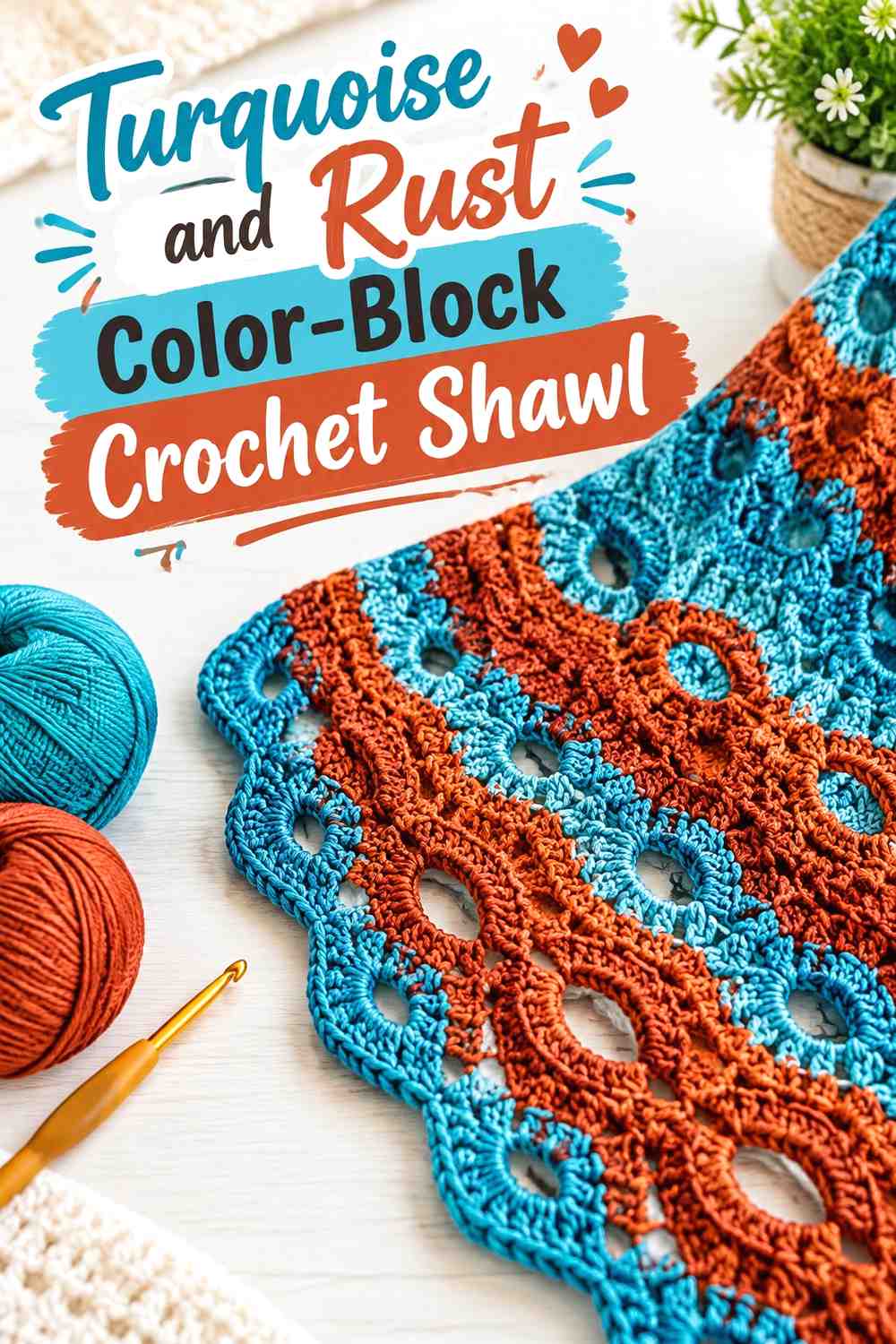
A shawl provides enough area to let turquoise and rust appear in broad sections instead of frequent narrow stripes. Start with one color near the upper or central area, transition into the second through larger bands, and repeat the first shade near the edge if you want the palette to feel connected from beginning to end.
Turquoise Can Keep the Crochet Shawl Center Lighter
If your turquoise is lighter than the rust, using it across the central or upper portion can keep the area nearest the face from becoming the darkest part of the shawl.
Large turquoise sections are also useful when openwork is important. The color can remain continuous enough for the lace structure to be read before rust introduces a second strong visual element.
Rust Works Well Across a Broader Crochet Shawl Border
A wide rust border gives the shawl a defined lower edge and places the warmer color where there is enough surface area for it to feel intentional.
If the border seems visually heavy, insert one thin turquoise repeat before the final rust section. That small return of the dominant color can link the edge back to the body.
Turquoise and Rust Should Not Hide Crochet Shawl Openwork
Openwork already creates light-and-shadow contrast. Avoid changing color so frequently that every openwork repeat becomes a separate visual block.
Broader sections usually allow both the color placement and the lace pattern to remain readable at the same time.
Creator Credit: Bella Coco
9. Rust Crochet Bucket Hat With Turquoise Brim
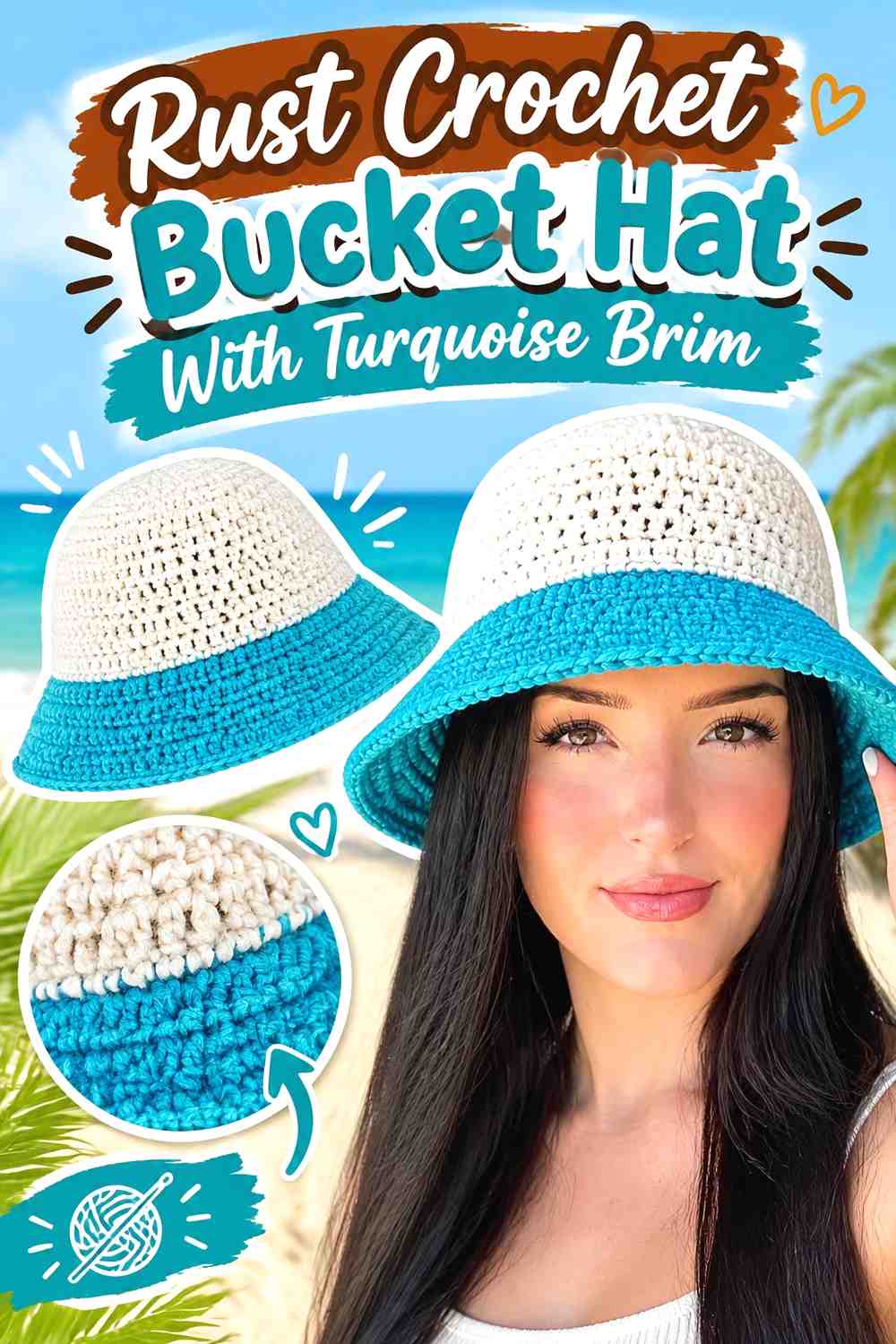
Use rust through the crown and sides of this crochet bucket hat, then switch to turquoise at the brim. The construction naturally creates distinct hat zones, so color blocking can follow the shape instead of introducing arbitrary stripes.
Rust Gives the Crochet Bucket Hat Crown a Solid Base
Keeping the crown and side wall rust lets those sections function as one continuous main field. This makes the later turquoise brim feel like a deliberate structural contrast.
If your rust is very bright, use a slightly muted turquoise so the brim remains distinct without creating two equally intense color fields.
Turquoise Makes the Crochet Bucket Hat Brim a Separate Feature
The brim is one of the easiest places to introduce turquoise because its direction already changes from the sides of the hat. The color shift reinforces that construction change.
For a stronger connection between the two shades, repeat a very small turquoise detail higher on the hat or add a narrow rust finishing edge to the turquoise brim.
Rust Edging Can Reconnect a Turquoise Crochet Brim
When a wide turquoise brim feels disconnected from the rust crown, returning to rust for the final outer edge can visually tie the two sections together.
Keep that last rust line narrow enough that turquoise still reads as the brim color rather than becoming hidden between two rust areas.
Creator Credit: ElyseCrochets 💌
10. Turquoise Crochet Coin Purse With Rust Closure Edge

A coin purse gives you a compact surface where turquoise can dominate while rust defines the opening. Concentrating the warmer shade around the top also helps the color placement follow the function of the accessory rather than dividing the small body into unnecessary blocks.
Turquoise Keeps the Crochet Coin Purse Body Simple
Use turquoise across most of the pouch body so the shape and stitch texture stay easy to read. Small accessories rarely need equal amounts of two strong colors to make the palette recognizable.
If your turquoise yarn has noticeable tonal variation, keep rust particularly controlled so the pouch does not become visually crowded.
Rust Can Define the Crochet Coin Purse Opening
Place rust along the upper edge, flap, closure area, or another detail associated with opening the pouch. This creates a practical visual focal point.
A rust edge can also disguise the fact that the opening is structurally separate from the body, turning that transition into part of the color design.
Turquoise and Rust Need Enough Contrast on Small Crochet Details
Small purses are viewed at close range, but very narrow accents can still disappear when the two yarns have similar value. Compare them before committing to a fine rust border.
If necessary, widen the rust section rather than introducing a third color. This keeps the two-color identity intact.
Creator Credit: hibouchoucaillou
11. Turquoise And Rust Granny Style Crochet Bandana

A granny-style bandana gives turquoise and rust repeated spaces where color changes can become part of the triangular layout. Turquoise can dominate the main body while rust appears every few sections, or the colors can alternate more evenly for a stronger striped result.
Turquoise Can Keep the Crochet Bandana Center Consistent
Start with turquoise through the central area if you want the bandana to read as mostly turquoise. Keeping the first several sections consistent also lets the triangular shaping remain easy to see.
Rust can then be introduced farther from the center, where increasing width gives the accent color more visible surface.
Rust Can Emphasize the Crochet Bandana Outer Edge
Using rust along the final border creates a warm frame around the turquoise center. It also makes the outer triangular shape more distinct when viewed against hair or clothing.
If the edge feels too dark or heavy, use rust for only part of the border and return to turquoise for the ties.
Turquoise Ties Can Balance a Rust Crochet Bandana Border
A rust outer section can visually outweigh the turquoise center because the border surrounds so much of the piece. Turquoise ties provide another visible repetition of the dominant shade.
This is particularly useful when the bandana is worn tied, because the turquoise remains visible beyond the rust-edged triangle.
Creator Credit: LalaBeCrocheting
12. Rust Crochet Lanyard With Turquoise Repeated Accents
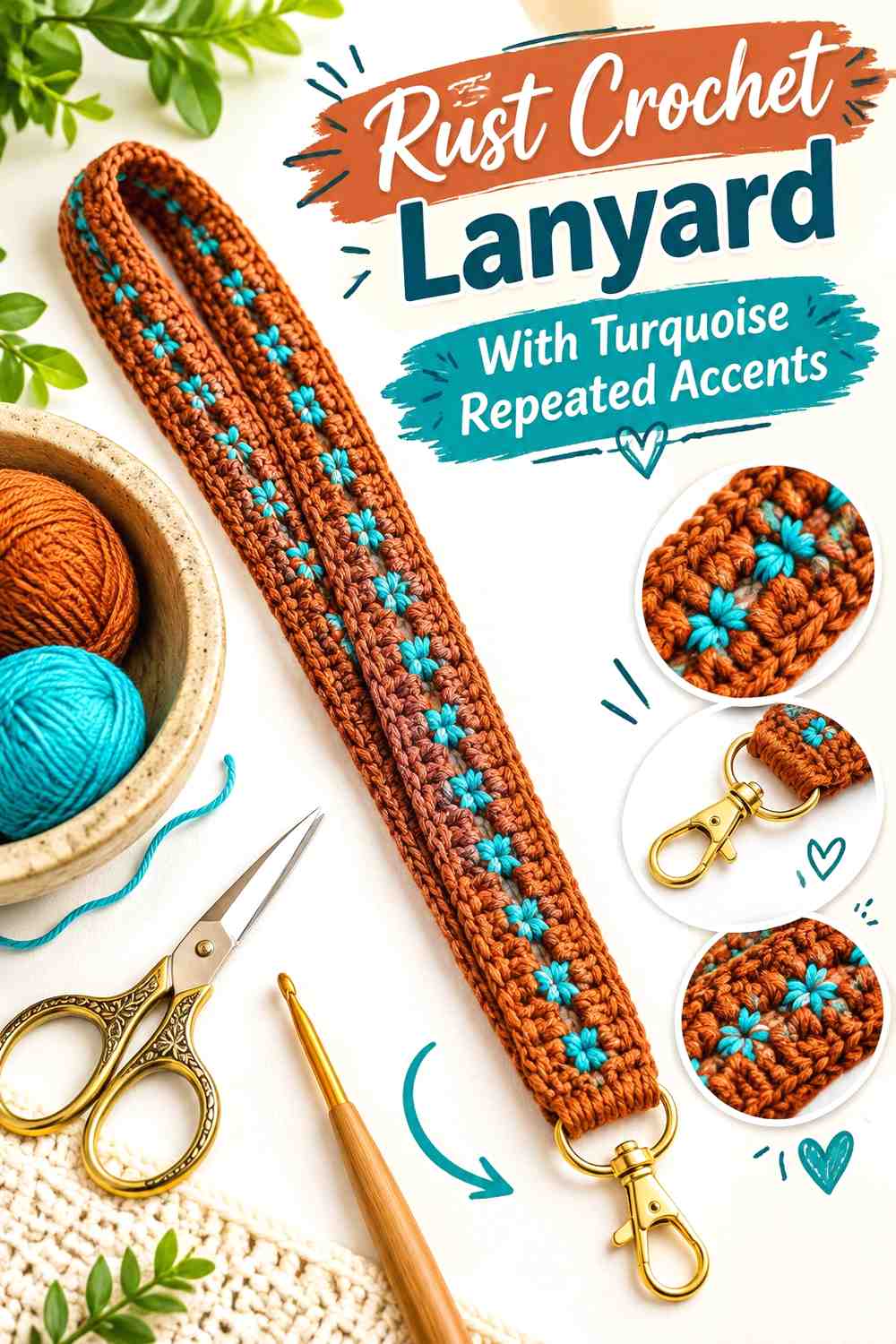
A lanyard is long and narrow, so its palette needs repetition rather than large color blocks. Rust can form the continuous background while short turquoise sections recur along the length. The repeated accent is easier to follow than one turquoise section placed at only one end.
Rust Can Form the Continuous Crochet Lanyard Base
Keeping most of the lanyard rust preserves a clear visual line from top to bottom. This also gives the narrow accessory enough continuity to avoid looking fragmented.
Because a lanyard twists during use, make sure the rust base looks consistent from both sides before deciding where turquoise should appear.
Turquoise Should Repeat Along the Crochet Lanyard
Use turquoise at several intervals rather than once. Small repeated accents remain visible as the lanyard shifts position and make the two-color scheme recognizable from more than one angle.
Keep the spacing relatively deliberate. Randomly sized turquoise sections can make the narrow piece appear uneven unless a deliberately irregular stripe pattern is your goal.
Rust Can Return Around the Crochet Lanyard Hardware Area
If turquoise appears near the lower attachment point, bring rust back around the final section so the hardware area connects visually with the dominant lanyard body.
This is also a useful checkpoint for balance: if the bottom has become much more turquoise-heavy than the rest, reduce the accent before finishing.
Creator Credit: Winding Road Crochet
Conclusion
Turquoise and rust can produce several very different crochet accessory palettes depending on which color receives the most surface area. For a cooler overall result, let turquoise dominate the scarf, headband, cowl, coin purse, or bandana and use rust around edges or repeated details. For a warmer direction, reverse the hierarchy on the beanie, scrunchie, bucket hat, or lanyard.
The checkerboard tote and striped fingerless gloves are stronger choices when you want both colors to share the design more evenly. A color-block shawl provides the most room to adjust the balance gradually with broad sections.
Whichever accessory you choose, compare the yarns for both hue and light-dark value before beginning. A small swatch or side-by-side yarn check can reveal whether the turquoise-and-rust separation is strong enough for your intended stripes, edging, motifs, or texture. Use the original creator tutorials for the exact project construction while adapting the color distribution to your chosen palette.
Frequently Asked Questions
Do turquoise and rust work together in crochet accessories?
Yes. They provide clear warm-cool contrast, but the final effect depends on the exact shades and how much space each receives. Muted turquoise with brick rust creates a softer combination, while clearer turquoise with brighter orange-rust produces stronger visual contrast.
Should turquoise or rust be the dominant crochet color?
Either can dominate. Turquoise creates a cooler overall field when used across most of an accessory, while rust shifts the piece toward a warmer earthy direction. Choose the dominant shade first, then decide where the second color can repeat as trim, stripes, borders, handles, ties, or other details.
How can I tell whether turquoise and rust have enough contrast?
Place the yarns beside each other and look at them from a distance. You can also photograph them and convert the image to grayscale. If both shades become nearly the same gray, small colorwork details may blend together even though the hues look different.
Can I add cream to turquoise and rust crochet accessories?
Yes. Cream can provide a light visual break when turquoise and rust are both medium or dark in value. It works particularly well as a narrow separator between stripes or around detailed stitch areas. Keep it secondary if you still want turquoise and rust to define the main palette.
What should I substitute if I cannot find the exact turquoise shade?
Preserve the shade’s role rather than searching for an identical commercial color. If turquoise is meant to be the lighter accent, choose another blue-green that remains clearly lighter than the rust. If it is the dominant deep color, choose a blue-green with similar depth and saturation.
How do I keep a turquoise-and-rust crochet accessory from looking too busy?
Give one color more surface area, then repeat the second in a limited number of intentional locations. Small accessories such as scrunchies, headbands, coin purses, and lanyards usually need fewer color changes than large scarves or shawls. Repetition is more useful than adding many isolated accents.