11 Crochet Autumn Mushroom Garland Ideas for Cozy Fall Decor
A crochet autumn mushroom garland can lean in several directions: tiny woodland mushrooms strung along a simple cord, bold red-and-white toadstools, dimensional hanging ornaments, or graphic mushroom pennants that read almost like traditional bunting. Those differences matter because a lightweight appliqué chain hangs very differently from a garland filled with stuffed crochet pieces.
These 11 ideas cover flat, dimensional, square, diamond, mixed-shape, and character-style mushrooms so you can choose a construction that suits a mantel, shelf, wall, doorway, or seasonal display. Several source tutorials teach the mushroom component rather than a complete garland; in those cases, the garland treatment below is an adaptation concept, while the original creator remains the source for exact crochet construction.
Quick List
- Crochet Mixed-Cap Mushroom Drop Garland
- Crochet Patchwork Toadstool Bunting
- Crochet Mini Mushroom Mantel Chain
- Crochet Scrap-Yarn Toadstool Applique Garland
- Crochet Fly Agaric Applique Banner
- Crochet Oversized Toadstool Accent Garland
- Crochet Mushroom Diamond Pennant Garland
- Crochet Framed Mushroom Square Bunting
- Crochet Soft Mushroom Drop Swag
- Crochet Woodland Mushroom Medley Garland
- Crochet Scarfed Mini Mushroom Charm Garland
Choose the Garland Structure Before the Autumn Palette
Color may be the first thing you notice, but construction determines how the finished garland behaves. Flat appliqués are useful when you want a light strand that can sit close to a wall or shelf edge. Granny-style squares and diamonds create more visual area, so fewer pieces can make the display feel substantial. Dimensional mushrooms project away from the cord and create stronger shadows, but they also add more weight.
Decide where the garland will hang before making a full batch. A narrow bookcase may suit tiny motifs, while a wide blank wall can visually support larger pennants or mixed mushroom shapes. If you plan to adapt several tutorials into one strand, compare the finished motifs beside one another first rather than assuming different constructions will automatically look balanced.
Plan Spacing Around Weight, Rotation, and Visibility
A mushroom can look perfect on the table and then twist sideways once suspended. Before joining every motif, temporarily clip or tie a few finished pieces to your proposed cord and hang the sample where the final garland will go. Check which direction the caps face, whether dimensional pieces rotate, and whether heavy ornaments pull neighboring sections downward.
Spacing also changes the mood. Closely grouped mushrooms create a dense woodland look; more open spacing makes each silhouette easier to recognize. A crocheted chain can stretch when it carries several stuffed pieces, so a separate non-stretch decorative cord may be worth considering for heavier arrangements. Keep hanging crochet decorations away from open flames, hot stove surfaces, candles, heaters, and other heat sources.
Build an Autumn Palette Without Losing the Mushroom Shapes
Rust, pumpkin orange, mustard, moss, burgundy, oatmeal, tan, and deep brown all work naturally with an autumn mushroom theme, but too many similar mid-tones can make caps and stems merge visually. Contrast is often more useful than simply adding more colors. A cream stem beneath a brown cap or a pale background around a rust mushroom gives the silhouette room to read.
Fiber choice affects the result too. A smoother yarn can emphasize small color changes and cap details, while a fuzzier yarn softens edges. Firmer fibers may help flat motifs keep a clear outline; softer yarn can suit dimensional ornaments where a cushioned shape is part of the appeal. Whatever you choose, make one sample first and judge it after the fabric has relaxed.
1. Crochet Mixed Cap Mushroom Drop Garland

This version stays closest to a classic crochet mushroom garland: recognizable caps and stems hang directly from a crocheted strand instead of being framed as bunting. BlueMushroomStudios’ tutorial specifically demonstrates mushrooms that can be connected into a garland, making it a useful starting point if you want the cord and mushroom components to feel like one coordinated project.
For autumn styling, vary the cap colors rather than repeating only bright red. Burnt orange, muted brick, chestnut, ochre, and olive can create a gathered-from-the-forest look while preserving the same basic mushroom silhouette.
Uneven Cap Colors Make the Repeat Feel More Organic
Alternating colors in a strict sequence produces a tidy decorative rhythm. A less predictable arrangement can feel closer to a woodland collection. Lay every completed mushroom on the floor or table before attaching it and move the colors until the darkest caps are distributed rather than clustered at one end.
This is especially useful with earth tones, where several similar shades can visually merge. Include occasional lighter or stronger caps to create points for the eye to stop.
Test the Hanging Angle Before Securing Every Mushroom
The attachment point determines whether a mushroom hangs vertically, leans, or rotates toward the wall. Test a few finished pieces on the cord before committing to the whole arrangement.
If one mushroom consistently turns away, adjusting its suspension point is usually more useful than trying to reshape the cap. For a mantel display, view the sample from normal standing distance rather than judging it only from close range.
Let the Cord Disappear or Become Part of the Palette
A cord close to the wall color keeps attention on the mushrooms. A contrasting rust, moss, or brown strand becomes another visible design line. Neither approach is automatically better; the right choice depends on whether you want a floating-mushroom effect or an intentionally handmade chain.
For a heavily decorated strand, keep the cord visually simpler so it does not compete with every cap.
2. Crochet Patchwork Toadstool Bunting

Alesha Creates takes a flexible approach: the tutorial teaches small mushrooms and explicitly presents turning them into a garland as an option. That makes this idea useful when you do not necessarily want every mushroom permanently assigned to one decoration.
Treat the finished pieces like a collection of small autumn ornaments. Some can go on the garland, while extras can become package toppers or seasonal accents elsewhere. Compared with the continuous appearance of the first idea, this layout can look more deliberately assembled, particularly if each mushroom is attached with a short hanging connection rather than worked directly into the main cord.
A Loose Bunting Layout Is Easier to Rearrange
If your seasonal display space changes from year to year, individually attachable motifs give you more flexibility. You can shorten the visible span by moving the mushrooms closer together or spread them along a longer cord without remaking the motifs themselves.
Before final assembly, decide whether the garland should have symmetrical spacing or a more informal cluster-and-gap rhythm.
Mix Autumn Shades Without Making Every Piece Unique
Too many one-off color combinations can make a small garland look disconnected. A more controlled approach is to repeat two or three stem shades while allowing greater variety in the caps.
That creates continuity without turning the strand into an exact ABAB repeat. Photographing the loose arrangement before attachment can also help you preserve a layout you like.
Keep Detachable Pieces Secure During Display
If you use removable ties or loops, check them after the garland has been hanging for a while. Dimensional or heavier motifs can work loose more easily than flat appliqués.
For homes with small children or pets, treat loose decorations and dangling cords as display items rather than toys and position them where they cannot be readily pulled down.
Original Tutorial and Creator Credit
Creator: Alesha Creates
3. Crochet Mini Mushroom Mantel Chain

Winding Road Crochet’s tutorial focuses on a mini mushroom designed for autumn crochet decor. A repeated row of these smaller motifs can suit narrow mantels, floating shelves, peg rails, or small wall sections where large stuffed mushrooms would feel crowded.
The scale also gives you room to use more colors without turning each motif into a dominant focal point. Instead of making every cap identical, think of the strand as a small autumn color study: cinnamon, ochre, muted red, brown, and forest green can be distributed across the line while pale stems keep the individual shapes recognizable.
Small Motifs Benefit From Strong Color Separation
When a mushroom is compact, low-contrast cap and stem colors can blur together at viewing distance. Make one sample in your intended palette and place it where the garland will hang.
If the silhouette disappears, increase the value contrast rather than automatically choosing brighter yarn. A deep brown beside cream can read more clearly than two brighter colors with similar lightness.
More Mushrooms Are Not Always Better
Mini motifs make it tempting to fill every section of cord. Leave enough visual air for each cap to remain distinct. This matters particularly over a narrow shelf where other autumn objects may already be competing for attention.
Temporarily arrange the mushrooms across the actual display width before deciding how many belong on the finished strand.
Use Repetition to Tie Mixed Fall Decor Together
If the surrounding display already includes pumpkins, leaves, wood tones, or dried botanicals, repeating one or two of those colors in the mushroom caps can connect the garland to the larger arrangement.
You do not need every autumn color in one project. A limited palette often makes small repeated objects read more cohesively.
Original Tutorial and Creator Credit
Creator: Winding Road Crochet
4. Crochet Scrap Yarn Toadstool Applique Garland

A flat appliqué garland is a practical alternative when you want recognizable mushrooms without stuffed pieces projecting into the room. Pora Pora Crochet’s tutorial teaches a toadstool appliqué and specifically frames it as a scrap-yarn project.
Because the pieces are relatively flat, this concept works well against a door, cupboard, wall, or the face of a mantel where a dimensional mushroom might continually turn. The appliqué construction also makes it easy to mix a mushroom-only strand with separate crochet leaves or acorns later, provided the different motifs look compatible when placed together.
Flat Toadstools Need a Consistent Facing Direction
Before joining, decide whether every mushroom should face identically or whether alternating orientations improves the rhythm. Tiny differences that seem unimportant when motifs are loose become much more noticeable once they form a straight line.
Block or gently shape the pieces as appropriate for the yarn before making the final spacing decision, because curled edges can change their apparent size.
Scrap Yarn Works Best With a Color Rule
Using leftovers does not require using every leftover. Set a simple palette boundary—for example, warm caps plus cream stems—and pull only scraps that fit it.
This keeps the thrift-friendly character while preventing the strand from becoming visually random. If two scraps are slightly different weights or textures, compare finished samples before mixing them throughout one repeat.
A Flat Garland Stores With Less Bulk
Appliqué strands can generally be packed flatter than stuffed mushroom decorations, which is useful when seasonal storage space is limited. Avoid folding the same motif sharply each year; a loose coil or flat layer can reduce persistent creases.
Before putting the garland away, follow the yarn’s care guidance and make sure the piece is fully dry.
Original Tutorial and Creator Credit
Creator: Pora Pora Crochet
5. Crochet Fly Agaric Applique Banner

For a more graphic autumn garland, use the recognizable red-cap-and-light-stem contrast associated with decorative fly agaric imagery. Jolly Lizard’s tutorial creates a mushroom or fly agaric appliqué, giving this strand a crisp emblem-like look rather than a plush one.
A repeated red-and-cream palette can work on its own, but deeper burgundy or brick caps can make the banner feel more autumnal. This idea differs from a general woodland medley because the repetition is the point: identical silhouettes turn the mushrooms into a strong decorative pattern.
Cap Details Need to Read From Across the Room
Small spots and surface details can disappear once a garland is viewed several feet away. After making one appliqué, pin it temporarily to the planned background and step away.
If the cap still reads clearly without seeing every tiny feature, the scale and contrast are doing their job. If not, the solution may be a clearer background rather than adding more embellishment.
Repetition Makes Spacing More Noticeable
Identical motifs expose uneven placement. Marking approximate attachment positions on the cord before permanently fixing the mushrooms can help you judge the overall rhythm.
You do not need mathematical perfection, but obvious bunching at one end is harder to ignore when every motif has the same visual weight.
Keep Embellishments Appropriate to the Display
If you add beads, buttons, or other three-dimensional cap details beyond what your chosen tutorial uses, remember that these can alter both weight and suitability around children or pets.
For a purely decorative wall garland, stitched yarn details may be simpler to store and less likely to catch on nearby textiles.
Original Tutorial and Creator Credit
Creator: Jolly Lizard
6. Crochet Oversized Toadstool Accent Garland

Not every garland needs a dozen tiny pieces. Jayda InStitches’ tutorial teaches a toadstool appliqué described as 4.5 inches tall, giving this concept a larger graphic element than the mini-mushroom versions.
Use fewer oversized mushrooms and allow more cord between them. That creates a statement garland that can hold its own above a wide console, along a plain wall, or beneath a shelf. The extra visual area also gives an autumn cap color more impact, so a three- or four-color palette may be sufficient without adding many additional motifs.
Larger Motifs Need More Breathing Room
A spacing interval that works for tiny mushrooms can make larger appliqués overlap or appear crowded. Arrange the completed pieces across the intended span before attaching anything.
Pay particular attention to where the garland curves downward, because motifs naturally move closer together around a deep swag.
A Statement Mushroom Can Replace Filler Pieces
Instead of placing identical large mushrooms all the way across, consider using them as anchor points with simpler crochet elements between them. Leaves, plain cord sections, or small neutral shapes can keep the large toadstools visually important.
When mixing tutorials, compare blocked or finished dimensions before assuming the components will balance.
Watch the Edges on a Wall-Hung Display
Larger flat motifs make curling or uneven edges easier to see. Use the finishing method appropriate to your yarn and construction, then let the pieces settle before deciding how they should be suspended.
If a motif continues to tip forward, a second discreet attachment point may display the surface more clearly than a single top loop.
Original Tutorial and Creator Credit
Creator: Jayda InStitches
7. Crochet Mushroom Diamond Pennant Garland

Quinn Bender’s tutorial includes both mushroom granny squares and mushroom granny diamonds, making the diamond version especially interesting for a true pennant-style garland. Unlike a hanging mushroom silhouette, the motif is contained within a geometric frame, so the strand reads more like bunting.
Diamonds create natural downward points and can look balanced even when suspended directly from their upper corners. Try alternating the mushroom diamonds with plain autumn-colored diamonds if a full row of colorwork feels too busy. This approach is particularly suited to people who enjoy graphic granny-style crochet and want the garland itself to have a strong geometric rhythm.
Diamond Points Create Their Own Visual Spacing
Because each pennant narrows toward the bottom, two diamonds can sit relatively close without creating the same blocky effect as two squares. Still, test the strand while it hangs rather than arranging it only on a flat table.
The sag in the cord changes the angles and can make neighboring points appear closer together.
Plain Panels Can Reduce Colorwork Fatigue
If you want a long garland but do not want every pennant to contain the full mushroom design, alternate feature motifs with simpler coordinating pieces.
A plain rust, cream, olive, or brown diamond can function as visual punctuation while keeping the mushroom panels prominent.
Make Orientation Consistent Before Joining
Geometric motifs make accidental rotation obvious. Decide which edge or corner will be the top and place every finished piece in that orientation before attachment.
This is particularly important if the mushroom motif itself has a clear upright direction; a flipped pennant will be much more noticeable than a slightly different cap shade.
Original Tutorial and Creator Credit
Creator: Quinn Bender
8. Crochet Framed Mushroom Square Bunting
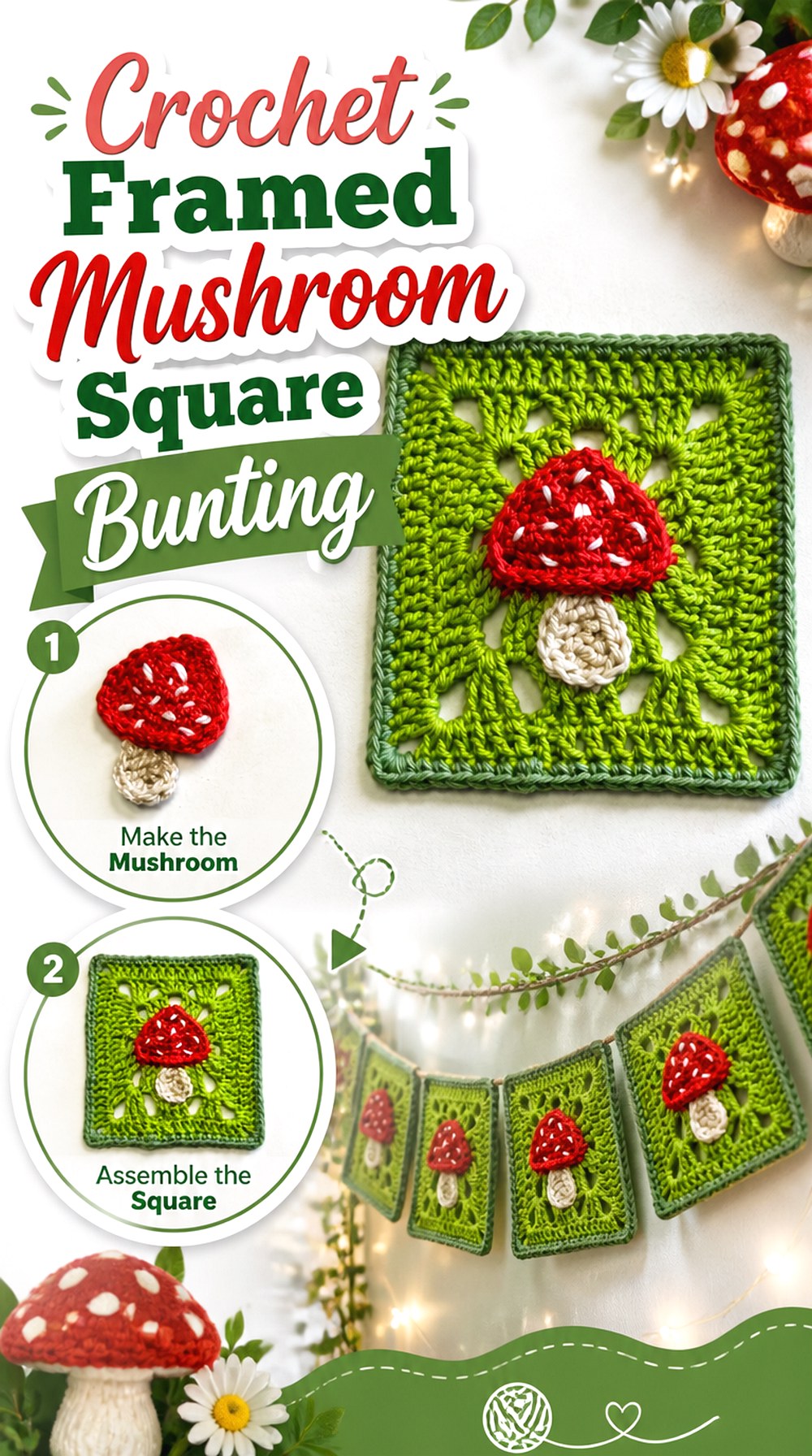
Hook & Loop Crochet Tutorials teaches a mushroom square and notes that the mushroom portion can also be used separately as an appliqué or decor element. For this garland, keep the full framed square. The background gives every mushroom a defined block of color, producing a patchwork look that is quite different from loose toadstools.
Squares work well when you want autumn colors in both the motif and the surrounding field. Instead of changing every mushroom cap, keep the fungi consistent and alternate the square backgrounds—oatmeal, olive, rust, gold, or brown—to create variation.
Background Color Controls How Busy the Bunting Feels
A mushroom motif already contains several visual elements. Adding a different high-contrast background to every square can make a long strand feel hectic.
Lay your intended background colors beside one finished motif first. Repeating two or three supporting shades usually produces a clearer rhythm than using every leftover color once.
Square Corners Need a Deliberate Attachment Plan
A square can hang from two top points, one corner, or a secondary cord connection, and each choice changes its orientation. Decide whether you want conventional horizontal blocks or diamonds before joining.
Use the same suspension method for each square unless deliberate variation is part of the design.
Pay Attention to the Tutorial’s Published Correction
The video description includes a correction related to its foundation chain, so viewers should read the creator’s notes along with watching the tutorial rather than relying only on the spoken instruction.
That is a useful general reminder for any sourced crochet project: check the current video description and pinned information before starting.
Original Tutorial and Creator Credit
Creator: Hook & Loop Crochet Tutorials
9. Crochet Soft Mushroom Drop Swag

Simply Maggie’s mushroom tutorial offers another route for building a strand around individual crochet mushrooms rather than flat framed pennants. For an autumn swag, treat each finished mushroom as a separate hanging object and give it enough room to be seen from more than one angle.
This style works particularly well when the main cord is allowed to dip between attachment points. The hanging mushrooms then occupy different vertical levels, creating a softer silhouette than a straight row of appliqués. Keep the cap palette limited if the individual forms already provide plenty of dimension.
Staggered Drop Lengths Create Depth
Attaching every mushroom at exactly the same height gives a neat baseline. Varying the short suspension lengths can create more movement without changing the mushrooms themselves.
Test the deepest drop over the actual furniture first. The lowest ornament should not constantly brush objects, cabinet doors, or frequently used surfaces.
Soft Forms Need Room to Rotate
A dimensional hanging piece will rarely face forward as reliably as an appliqué. Instead of fighting every bit of rotation, design the strand so the mushrooms still look intentional at slightly different angles.
This makes the project better suited to open shelving or doorway trim than to a location where every motif must sit perfectly flat against a wall.
Simplify the Cord When the Mushrooms Have More Volume
Dimensional motifs already cast shadows and occupy visual space. A heavily textured or multicolored cord may compete with them.
A plain chain, narrow braid, or suitable decorative cord in one neutral shade can keep the focus on the mushroom silhouettes.
Original Tutorial and Creator Credit
Creator: Simply Maggie
10. Crochet Woodland Mushroom Medley Garland

A mixed-species-inspired garland offers the strongest visual departure from repeated red toadstools. Lizfaerie Crafts’ tutorial demonstrates three mushroom styles—a brown mushroom, an amanita-inspired mushroom, and a chanterelle-style mushroom—using one overall project concept.
That variety makes it a strong source for an autumn woodland medley. Rather than relying on cap color alone, the silhouettes themselves can change across the strand. A sequence of squat brown mushrooms, red spotted caps, and golden chanterelle-inspired forms creates a collected-forest feeling that works especially well with restrained natural yarn colors.
Shape Variety Can Replace Extra Embellishment
When every mushroom silhouette differs, you do not need beads, bows, leaves, or other additions just to create interest. Start by arranging the three forms alone.
If the strand already feels balanced, leaving it mushroom-only can make the variation easier to appreciate.
Distribute Strong Shapes Instead of Repeating a Fixed Sequence
A strict three-mushroom repeat is orderly, but a more organic arrangement may better suit the woodland theme. Avoid placing every large or brightly colored form together.
Set the full collection out before joining and distribute the strongest silhouettes across the length so one end does not feel visually heavier.
Matching Scale Matters More Than Matching Every Detail
If you change yarns or colors, compare the finished mushrooms before attaching them. Different fiber behavior and tension can make two nominally similar components look noticeably different in scale.
Some variation is appropriate for a forest-inspired garland; the goal is to avoid one accidental outlier dominating the whole strand.
Original Tutorial and Creator Credit
Creator: Lizfaerie Crafts
11. Crochet Scarfed Mini Mushroom Charm Garland

For a more character-driven autumn display, Meemanan’s tutorial creates a mini mushroom doll/keychain with a scarf detail. Repeating small scarfed mushroom figures gives the garland a playful personality that the botanical and geometric options do not have.
Because each component contains more detail than a simple appliqué, this idea works better with wider spacing and fewer pieces. Autumn colors can move into the scarves as well as the caps, which gives you another way to coordinate rust, mustard, forest green, or brown without changing the mushroom body every time.
Treat the Scarf as a Small Color Accent
A tiny accessory is enough to introduce a contrasting shade. If the caps already vary, keep the scarves within a narrow palette so each figure does not become a separate color story.
You can also reverse the logic: repeat one cap color and let the scarves provide the autumn variation.
Character Motifs Need More Space Than Simple Toadstools
Faces, scarves, and dimensional shaping are easier to appreciate when the figures are not packed tightly together. Test the viewing distance before deciding how many belong on the cord.
For a short shelf or small reading nook, a handful of detailed charms may create more impact than a very long line.
Check Small Parts Before Choosing the Display Location
The source is designed as a mini mushroom doll/keychain project, so review all finishing details in the creator’s tutorial before deciding where a garland adaptation will hang.
If a version includes small detachable or rigid components, do not position it where babies, young children, or pets can pull the garland down. A decorative wall display is a different use case from a toy.
Which Crochet Mushroom Garland Style Fits Your Display?
| Garland style | Visual effect | Useful placement | Main planning issue |
|---|---|---|---|
| Flat mushroom appliqués | Light, graphic, close to the surface | Walls, shelves, mantel fronts | Keeping motifs flat and evenly oriented |
| Dimensional mushroom drops | Soft, sculptural, stronger shadows | Open shelves, wide walls, doorway trim | Weight, rotation, and cord stretch |
| Granny squares or diamonds | Bold, geometric, bunting-like | Blank walls, long shelves, party displays | Background colors and panel orientation |
| Mixed mushroom shapes | Organic woodland collection | Autumn vignettes and cottage-style decor | Balancing different silhouettes and scales |
| Character mushroom charms | Playful and detailed | Small decorative areas and themed displays | Spacing and small-part placement |
If you want the garland to disappear neatly into existing fall decor, flat appliqués are the least visually bulky. For a more noticeable handmade feature, dimensional drops or large toadstools create stronger depth. Granny diamonds are the clearest choice for traditional bunting, while the woodland medley is the better fit when repeated identical mushrooms feel too formal.
Conclusion
The most useful way to choose among these 11 crochet autumn mushroom garlands is to start with the display location. Pick flat appliqués for a strand that needs to sit close to a wall, diamonds or squares when you want obvious bunting, dimensional drops for depth, and the three-shape woodland medley when natural variation matters more than perfect repetition.
Autumn color can then support the structure rather than carrying the whole design. Rust, cream, mustard, moss, burgundy, and brown all work differently depending on the cap shape and background. Make one component, hang it where the finished garland will go, and check scale, rotation, and contrast before producing the full set. Use the original tutorials for each creator’s exact construction details.
Frequently Asked Questions
Can I combine mushroom motifs from different crochet tutorials in one autumn garland?
Yes, but compare the completed motifs before making multiples. Two designs may use different construction methods and still work together visually, yet their finished width, thickness, or overall weight may be noticeably different. Arrange one sample of each on the intended cord first. If one overwhelms the others, changing placement or using it as an occasional focal mushroom may work better than trying to force every design into an equal repeat.
Are flat or three-dimensional mushrooms better for a mantel garland?
Flat mushrooms are usually easier to keep close to the mantel face and are less likely to rotate. Three-dimensional pieces create more depth, which can be attractive on an open mantel, but they need room to hang freely. Whichever style you choose, keep yarn decorations well away from fireplaces, candles, hot surfaces, and other heat sources. Judge the garland in its actual display location before making a long strand.
How do I keep a crochet mushroom garland from looking too crowded?
Start with the finished mushroom size, not an arbitrary spacing measurement. Clip several motifs temporarily to the cord and view them from across the room. Large or detailed mushrooms usually benefit from more open space, while small appliqués can form a tighter rhythm. Remember that a swagged cord pulls neighboring pieces closer together around the lowest curve, so test the garland while hanging rather than only laid flat.
Which yarn colors make a mushroom garland look more autumnal?
Rust, brick, mustard, ochre, olive, moss, oatmeal, tan, brown, and muted burgundy are useful starting points, but contrast matters more than fitting every color into the strand. Pale stems can help dark caps remain legible, while a neutral cord can keep a mixed palette from becoming busy. Make a sample and view it against the actual wall or mantel color before committing to the full batch.
Should I use a crochet chain or separate cord to hang dimensional mushrooms?
Either can work, but consider how much weight the finished mushrooms place on the strand. Crochet chains can stretch depending on yarn, stitch structure, and load. If your sample lengthens noticeably when several dimensional pieces are attached, a more stable supporting cord may be preferable. The cord does not need to be invisible; twine-like or neutral textile cords can become part of an intentionally rustic autumn presentation.
How should I store a crochet autumn mushroom garland after the season?
Clean it only according to the care guidance for the yarns and embellishments you actually used, and make sure it is completely dry before storage. Flat appliqué garlands can often be stored loosely layered or coiled rather than sharply folded. Dimensional mushrooms need more room so their caps and stems are not permanently compressed. Remove detachable decorations if doing so prevents tangling, and keep the strand in a clean, dry storage area.