
8 Crochet Maple Leaf Bag Ideas
A maple leaf can become part of a crochet bag in more than one way. It can be worked into a flat motif, repeated across joined squares, interpreted through raised leaf texture, or simply guide the autumn color story of a larger tote. Those choices change more than the appearance—they affect structure, stretch, finishing, and how easily the design can be resized.
The tutorials below deliberately cover different bag formats and construction approaches. Several are direct leaf-bag tutorials rather than botanically exact maple-leaf patterns, so those ideas are clearly presented as maple-inspired adaptations. The final option uses an actual crochet maple leaf granny square as its starting point.
Quick List
- Crochet Fall Leaf Tote Bag in Maple Colors
- Crochet Raised Leaf Shoulder Bag with Maple-Tone Colorwork
- Crochet 3D Leaf Market Tote with a Maple Palette
- Crochet Leaf Handbag with Maple-Red Accents
- Crochet 3D Leaf Handbag with Macramé-Yarn Structure
- Crochet Four-Motif Leaf Crossbody Bag with Maple Styling
- Crochet Autumn Leaf Phone Pouch in Maple Shades
- Crochet Maple Leaf Granny Square Panel Bag
Decide How the Maple Leaf Will Appear Before Choosing the Bag
There are three useful ways to approach this theme. A built-in leaf texture makes the foliage part of the bag fabric, which creates a strong all-over effect but gives you less freedom to reposition individual leaves. A joined motif construction lets you control where the leaf imagery appears and makes it easier to test one section before committing to the whole bag. A flat maple-leaf square or appliqué gives the most literal maple look and can be paired with a simpler bag body.
Choose the method before settling on colors. A red yarn does not automatically turn a generic raised leaf into a maple leaf, so treat those designs as maple-inspired unless you are actually substituting or adding a recognizable maple motif.
Structure and Stretch Matter More Than the Seasonal Colors
Crochet bags carry their own weight before anything is placed inside them. Raised leaf stitches, joined motifs, long straps, and softer fibers can all add opportunities for stretching. That makes the intended use important when choosing among these ideas.
For a bag that needs a defined silhouette, compare yarns based on firmness and stitch definition rather than color alone. Softer yarn may produce comfortable drape but can make deeply textured leaves less distinct. A firmer yarn can improve shape retention but may make a densely worked bag feel heavier or stiffer.
Lining is worth considering when the crochet fabric has openings, joined motifs, or noticeable vertical stretch. Strap reinforcement can also be useful when a long handle is attached to a relatively heavy crochet body.
Check Leaf and Motif Scale Before Building the Whole Bag
A leaf that looks balanced on a phone pouch may look tiny on a full tote. Conversely, one large maple square can dominate a small crossbody bag.
When working with separate motifs, block or settle one sample first and measure its actual dimensions. Then place paper templates or the finished motif over the approximate bag panel area. This tells you whether a single statement leaf, a row of leaves, or repeated squares makes the most visual sense.
If combining a maple leaf motif with a bag tutorial from another creator, do not assume their stitch counts or panel dimensions are interchangeable. Match the finished dimensions and fabric behavior, not the written numbers from two unrelated patterns.
1. Crochet Fall Leaf Tote Bag in Maple Colors

This option begins with a tutorial that is already built around a finished fall-leaf bag, making it one of the closest direct matches to the seasonal idea. Instead of changing the construction, the maple interpretation can come mainly from color planning: think red, rust, gold, green, and brown rather than trying to force a different leaf shape into an integrated design.
It suits readers who want the foliage to spread across the bag rather than appear as one isolated appliqué. Because the leaf treatment is integral to the finished project, compare the visual density with the other ideas before choosing it; this is a stronger all-over autumn statement than the single-square bag later in the list.
Let the Leaf Layout Carry the Seasonal Theme
When leaves already occupy much of the bag body, adding extra appliqués can make the surface unnecessarily busy. A more controlled adaptation is to let the existing leaf layout remain the focal point and change the palette instead.
Try deciding whether you want a realistic mixed-leaf effect or a restricted two- or three-color scheme. Fewer colors can make individual shapes easier to read, while many small color changes create a more patchwork-like fall appearance.
Preserve Enough Contrast Around Every Leaf
Rust, burgundy, brown, and dark orange can look very similar once crocheted together. Before committing to a full bag, place the selected yarns beside each other in daylight.
If two neighboring shades have almost the same value, the edges of the foliage may disappear even though the skeins looked different separately. A lighter neutral or stronger dark accent can give the leaf shapes more definition without changing the underlying tutorial.
Test the Bag Scale Before Enlarging Anything
A common temptation is to enlarge a seasonal bag simply by changing yarn or hook size. That also changes the size of every leaf, the strap proportions, and potentially the feel of the fabric.
If you need a different finished scale, first decide which dimension actually needs changing. A wider everyday tote and a deeper project bag solve different problems. Follow the creator’s construction for the original design, and treat any major resizing as a separate adaptation rather than an automatic substitution.
Creator: Faith.Wisest
2. Crochet Raised Leaf Shoulder Bag with Maple Tone Colorwork

Here the leaf effect comes from pronounced surface texture rather than a flat maple silhouette. The original tutorial produces an all-over crochet leaf bag, so the maple connection works best as a seasonal reinterpretation—using changing-leaf colors while keeping the creator’s structural leaf design intact.
This route is useful when texture matters more to you than botanical accuracy. From a distance, the relief creates a strong foliage-inspired surface; up close, the dimensional stitches become the primary visual feature. Compared with the previous fall bag, this idea relies less on multiple separate color areas and more on shadows and stitch depth to create interest.
Raised Leaves Add Physical Bulk as Well as Detail
Three-dimensional crochet is not merely decorative. Extra depth can increase the amount of yarn in the fabric and can make the bag feel more substantial than a plain panel of similar dimensions.
That matters when choosing the strap and intended use. If the empty body already has considerable weight, a very long unsupported crochet strap may stretch more noticeably. Finish the bag body first, assess how it hangs, and then decide whether additional handle support would be useful.
Select Yarn That Keeps the Relief Visible
Highly fuzzy or loosely plied yarn can soften the edges of a raised motif. That may be attractive for a cozy look, but it can also make the leaves less distinct.
If your goal is crisp foliage, crochet a small sample of the textured section before buying all of the yarn. Look at it both flat and hanging vertically. A texture that appears sharply defined on a table can become subtler once gravity stretches the fabric.
Keep the Maple Palette from Becoming Too Busy
The raised surface already creates highlights and shadows, so it does not necessarily need many colors. One deep red, one warm rust, or an earthy green can make the texture easier to appreciate than constant color changes.
For a more realistic fall effect, reserve a contrasting shade for a smaller area rather than alternating colors every few stitches. The aim is to add a maple-season mood without competing with the structural leaf pattern.
Creator: Annoo and The Unruly Stitch
3. Crochet 3D Leaf Market Tote with a Maple Palette

Sirin’s Crochet offers another complete 3D leaf-bag construction, presented in a long-form tutorial divided into parts. For this roundup, it works as a roomy maple-season tote concept: keep the dimensional foliage construction while choosing a controlled autumn palette instead of claiming the source leaves are specifically maple-shaped.
This option is most useful for readers who prefer to watch a textured fabric develop gradually instead of assembling a bag from separate granny squares. The uninterrupted leaf surface also makes it feel quite different from the four-motif crossbody farther down the list. Because the texture itself does so much visual work, even a single fall color can create a strong finished bag.
Long-Format Instruction Can Help With Repeated Texture
A dimensional bag often requires more attention to stitch placement than a plain rectangle. A longer video format can be helpful because you can compare your developing texture with the creator’s fabric periodically instead of relying only on the final photograph.
Pause at natural visual checkpoints and inspect whether the leaves are forming consistently. Correcting a distorted section early is generally easier than discovering a repeated tension problem after most of the bag body is finished.
Decide About a Lining After the Crochet Fabric Settles
Do not cut lining fabric solely from an assumed bag measurement before you know how your crochet body behaves. Textured fabric can relax after handling, and its internal volume may not match its flat width perfectly.
Finish and settle the crochet body first, then measure the actual interior you need to support. A lining can reduce snagging and help control stretch, but it should fit the finished crochet rather than force the crochet into a different shape.
A Limited Palette Keeps 3D Leaves Readable
With a heavily textured surface, every ridge already catches light differently. That gives you an opportunity to use fewer colors.
A deep maple red or warm ochre body with a darker handle can look more deliberate than mixing every autumn shade at once. If using variegated yarn, examine a sample to make sure rapid color changes do not hide the larger leaf shapes. Texture and color should reinforce each other rather than compete.
Creator: Sirin’s Crochet
4. Crochet Leaf Handbag with Maple Red Accents

This idea uses a newer direct leaf-bag tutorial as the foundation and shifts the emphasis toward a coordinated fashion accessory rather than a multicolored harvest tote. Instead of covering every section with different autumn shades, use one dominant maple red, burgundy, olive, or warm neutral and let the crochet leaf surface provide the detail.
That restrained approach makes this a useful contrast to the first project. Both fit an autumn theme, but the decision is different: choose the first if you want visible seasonal color changes, and this one if you prefer a leaf-focused bag that can still work with clothing outside the fall season.
Let One Color Do More of the Visual Work
Using a single main shade can make a complicated crochet texture easier to read. Maple red is the obvious seasonal choice, but burnt orange, camel, olive, or deep wine can communicate autumn without turning the bag into literal holiday decor.
Before deciding, consider what you normally wear. A bag intended for frequent use may benefit from a shade that coordinates with several outfits rather than a very specific red-and-orange combination.
Plan the Closure Before Finishing the Opening
A decorative bag and an everyday bag do not always need the same opening. If the tutorial’s original top treatment already suits your use, keeping it is the simplest option.
If you plan to adapt the opening with a zipper, button, magnetic closure, or lining, decide before completing extra decorative edging. Added thickness along the upper edge can make later hardware installation awkward. Confirm that any modification is compatible with the actual finished construction before committing to it.
Keep Hardware Subordinate to the Leaf Surface
A leaf-textured handbag already has a strong surface treatment. Oversized rings, multiple decorative chains, tassels, and prominent closures can compete with that texture.
If you add non-crochet components, place them against the unfinished bag first. Ask whether your eye notices the leaf work or the hardware first. For a maple-inspired version, the yarn and leaf texture should remain the recognizable feature unless a statement handle is intentionally part of the design.
Creator: Mon Sac Crochet
5. Crochet 3D Leaf Handbag with Macramé Yarn Structure
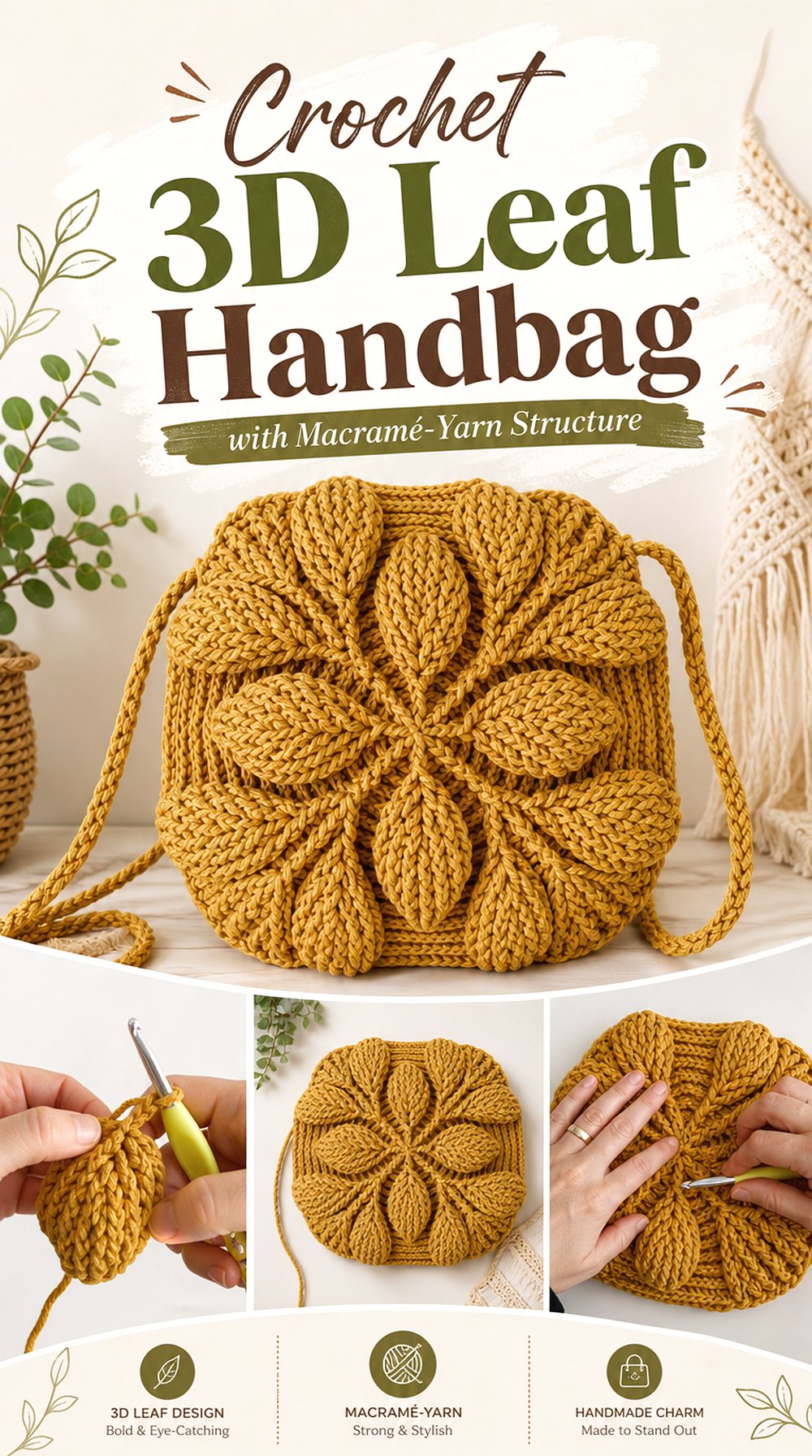
The tutorial from inci puffy approaches the dimensional leaf-bag concept using cotton macramé yarn, giving this idea a useful material distinction from softer yarn-based versions. The creator lists cotton macramé yarn for the project, so readers interested in a more structured-feeling bag have a concrete starting point to investigate.
For a maple-inspired variation, let the yarn texture and raised foliage stay central while shifting the color toward russet, dark red, mustard, or bark brown. This is a good choice when you want the bag to read as a substantial handcrafted accessory rather than a soft granny-square tote.
Macramé-Style Yarn Changes the Character of the Fabric
A firmer cord-like yarn does not behave exactly like a lofty sweater yarn. It can create stronger stitch definition and more body, but the fabric may also feel less flexible.
Do a small textured sample before assuming another yarn will produce the same result. Check whether you like the thickness between your fingers, how easily the hook moves, and whether the raised leaves remain flexible enough for the type of handbag you want.
Firmer Yarn May Change the Crocheting Experience
Dense crochet in a structured yarn can require more hand effort than a loose fabric in a soft yarn. That does not make the project unsuitable, but it is a reason to avoid dramatically tightening your tension simply to make the bag feel rigid.
Let the yarn’s natural structure contribute to the shape. If a swatch feels uncomfortable to work or produces excessively stiff fabric, reconsider the yarn-and-hook combination before starting the full bag.
Check Leaf Definition Across the Whole Body
Dimensional leaves should remain visually consistent from one section of the handbag to another. If your tension gradually tightens, later leaves can appear smaller or more compressed even when you are following the same instructions.
Set the work down periodically and view the entire surface from several feet away. Uneven motif scale is often easier to spot from a distance than while concentrating on individual stitches.
Creator: inci puffy
6. Crochet Four Motif Leaf Crossbody Bag with Maple Styling

This construction changes the scale completely. Rather than covering a large continuous tote with repeated leaf texture, the Hobisever tutorial builds a bag from four square motifs featuring leaf elements. Available information for the video also shows attention to joining, the strap, lining, and a zipper, which makes it a particularly useful reference for readers interested in a more finished crossbody-style accessory.
For a maple interpretation, keep the four-motif structure but plan the colors like fallen maple leaves: for example, one dominant background with four related warm shades. Because the construction is modular, you can judge the effect of one motif before committing to the remaining pieces.
Four Motifs Make Proportion Easier to Evaluate
A modular bag gives you a natural checkpoint after the first square. Measure the relaxed or blocked motif and compare it with the scale you want for the finished bag.
Do not assume four motifs made from a substituted yarn will create the dimensions shown by another crocheter. Even a modest difference in square size multiplies across the assembled shape. Get one motif right first; then repeat it consistently.
A Zipper Changes the Demands on the Top Edge
The available tutorial information shows a zippered, lined finish. A zipper works best when the crochet edge is stable enough to support it without becoming wavy or stretched.
If your yarn substitution produces a softer fabric, assess the opening before installation. Lining or another stabilizing approach may help, but follow the creator’s actual finishing demonstration rather than improvising from a different bag pattern with incompatible dimensions.
Lining Is Especially Useful Around Joined Motifs
Joined square constructions can have seams, openings, and changes in thickness that feel different inside the bag. A lining can create a smoother interior and help isolate everyday contents from those joins.
Before cutting fabric, finish the assembled crochet shell and measure the interior as it actually sits. This is more reliable than calculating lining dimensions from individual square measurements, because seams and joining methods can change the final usable space.
Creator: Hobisever
7. Crochet Autumn Leaf Phone Pouch in Maple Shades

A phone pouch proves that a maple-leaf bag idea does not have to become a large tote. Janet Chen Handmade Crafts has a tutorial specifically titled as an autumn leaf phone bag, giving this option a much smaller scale and a more focused purpose than the previous projects.
For a maple-inspired version, choose one clear autumn leaf treatment rather than trying to squeeze several large motifs onto the limited surface. The smaller format also makes it a practical place to experiment with a red, amber, or green palette before committing to a larger leaf bag. Because phones vary widely, however, treat your own device measurements as the important fit checkpoint.
Small Scale Makes Leaf Proportion More Important
A motif that feels moderate on a tote can consume most of a phone pouch. Before adding or substituting a separate maple leaf, compare its finished width with the usable front panel.
You do not need the leaf to fill every available inch. Leaving some plain background around a detailed motif can make its points and stem easier to recognize. This is especially useful when working with similar warm colors.
Check the Opening Against the Actual Device
Phone compatibility should never be assumed from a photograph. Measure the device you plan to carry, including the case if one is normally used, and compare those dimensions with the finished pouch.
Also consider how easily the phone needs to slide through the opening. A body that technically has enough interior room may still be inconvenient if a firm upper edge or closure creates a narrower entry point.
Keep the Strap in Proportion to the Pouch
A small phone bag can be visually overwhelmed by a very wide strap, while a narrow stretchy cord may become uncomfortable or lengthen with use. Think about the relationship between strap width, pouch weight, and how the bag will be worn.
If you alter the tutorial’s strap, test it with the empty finished pouch first and then with the intended contents. Reinforcement decisions are easier to make before repeated use stretches the handle.
Creator: janet chen Handmade Crafts
8. Crochet Maple Leaf Granny Square Panel Bag

This is the most literal maple-leaf idea in the roundup. MUSHYY’s tutorial teaches an actual maple leaf granny square rather than a generic leaf texture, making it useful when recognition of the maple silhouette matters more than recreating one of the integrated leaf-bag fabrics above.
The important limitation is that the video teaches the square, not a finished bag. Treat this as a motif-led bag concept: make and evaluate the square first, then use it only with a bag construction that accommodates its finished dimensions. It works especially well when you want one bold maple panel or a controlled grid of repeated squares rather than leaves covering the whole bag.
Block the Square Before Planning the Bag Grid
A granny square can change shape and dimensions after it is settled or blocked. That makes the finished square—not the size you expected from the hook and yarn—the useful planning unit.
As a simple example, if a finished square measured 6 inches across, two placed side by side would span roughly 12 inches before joins, edging, side depth, or seams are considered. That is planning math only, not a substitute for a bag pattern.
One Statement Square Can Be Stronger Than Repetition
You do not automatically need a wall of maple leaves. One large square centered on a plain front panel can give the leaf more visual importance while keeping the rest of the bag calmer.
Repeated squares work better when their borders join cleanly and the leaf orientation feels intentional. Lay several motifs out before joining them. Rotating a directional maple leaf accidentally can make the finished panel look less organized even when every individual square is well made.
The Tutorial Covers the Motif, Not the Bag
This distinction matters. The MUSHYY video shows how to make the maple leaf granny square and suggests its versatility, but it should not be represented as a complete maple-leaf bag tutorial.
If you turn the square into a bag, use an independently suitable bag construction and compare the actual square dimensions with that construction first. Do not merge stitch counts or assembly instructions from unrelated designs as though they were one pattern.
Creator: MUSHYY
Which Maple Leaf Bag Direction Should You Choose?
| If you want… | Start with… | Main planning issue |
|---|---|---|
| A colorful fall tote | Crochet Fall Leaf Tote Bag in Maple Colors | Keep neighboring fall shades distinct |
| Maximum raised texture | Crochet Raised Leaf Shoulder Bag | Account for bulk and strap stretch |
| A large continuous leaf surface | Crochet 3D Leaf Market Tote | Keep tension and texture consistent |
| A restrained fashion-bag look | Crochet Leaf Handbag with Maple-Red Accents | Avoid competing embellishments |
| More structural yarn character | Crochet 3D Leaf Handbag with Macramé-Yarn Structure | Test firmness before committing |
| Joined motifs plus a finished closure | Crochet Four-Motif Leaf Crossbody Bag | Match motif dimensions before assembly |
| A small functional project | Crochet Autumn Leaf Phone Pouch | Fit the actual phone and case |
| A recognizable maple silhouette | Crochet Maple Leaf Granny Square Panel Bag | Plan the bag around the finished square |
Conclusion
Choose the bag according to how literally you want the maple leaf represented. The first seven ideas are strongest when you want autumn foliage, raised leaf texture, modular leaf motifs, or maple-season colors. The eighth is the clearest route when an unmistakable maple silhouette is the priority.
For an everyday tote, pay closest attention to stretch, strap support, and lining. For a crossbody or phone pouch, motif scale and opening size become more important. If you prefer adaptable construction, joined squares give you useful checkpoints before assembly. Once you select the format, use the original tutorials for their exact construction details rather than combining unverified stitch counts from unrelated projects.
Frequently Asked Questions
Are all eight tutorials exact crochet maple leaf bag patterns?
No. Several are direct leaf-bag or autumn-leaf bag tutorials, but their foliage is not necessarily a botanically exact maple shape. They are included as maple-inspired bag constructions that can use autumn colors and related styling. The MUSHYY tutorial specifically teaches a maple leaf granny square, although that video does not teach the finished bag assembly.
Is a maple leaf appliqué or a maple leaf granny square better for a bag?
It depends on how much you want the motif to affect construction. An appliqué can be added to an otherwise simple bag panel, so it gives you more freedom over placement. A granny square becomes part of the panel itself, which means its dimensions and border need to work with the surrounding construction.
For either method, finish and measure the motif before planning the bag around it.
Why do crochet bag straps stretch?
Crochet fabric can lengthen under sustained weight, especially when the strap is long, narrow, loosely worked, or made from a very elastic yarn. A heavy textured bag body can make that effect more noticeable.
If stretch matters for your intended use, assess the finished bag and strap construction before carrying heavier contents. A suitable lining, less stretchy strap construction, or reinforcement may help depending on the design.
When should I line a crochet maple leaf bag?
Lining is particularly worth considering when the crochet fabric has visible openings, joined motifs, substantial stretch, or an interior surface likely to catch small objects. It can also help a bag hold a more predictable shape.
Complete the crochet shell first whenever possible, then base the lining on its actual interior dimensions. Do not assume dimensions from another bag will fit after you change yarn, motif size, or joining style.
How can I tell whether a maple leaf granny square will fit my bag?
Make one square in the yarn and hook combination you intend to use, finish or block it appropriately, and measure it. Then compare that real measurement with the usable bag-panel area.
Do not rely only on the number of motifs used in somebody else’s project. Joining seams, borders, side depth, and edging all affect the final size, so motif dimensions are a planning tool rather than a complete sizing formula.
Can I turn a large leaf tote into a small crossbody or phone pouch?
Possibly, but shrinking a design is not always as simple as changing to thinner yarn. The leaves, opening, strap attachment, and overall proportions all change together.
For a smaller project, it may be more reliable to begin with a construction already designed at that scale—such as the autumn leaf phone bag or four-motif crossbody—and adapt the colors or compatible motif rather than heavily reducing a large textured tote.


