11 Crochet Maple Leaf Cardigan Ideas
A crochet maple leaf cardigan does not have to follow one construction style. The leaf theme can come from a literal maple-inspired garment, an all-over leaf stitch, feature granny squares, appliqués, autumn color placement, or a decorative section added to a cardigan structure that already fits the look you want.
The ideas below deliberately cover different silhouettes, including oversized, cropped, V-neck, patchwork, hexagon, hooded, lacy, and long cardigans. Some source tutorials already feature leaf texture or a strong autumn character, while others teach cardigan bases that can be adapted with a compatible maple leaf motif. That distinction matters: always confirm motif dimensions, garment gauge, and construction before replacing squares or adding decorative leaves.
Quick List
- Oversized One-Panel Crochet Maple Leaf Cardigan
- Mini-Leaf Texture Crochet Maple Leaf Cardigan
- V-Neck Circle-Leaf Crochet Maple Leaf Cardigan
- Mosaic-Hem Crochet Maple Leaf Cardigan
- Patchwork Square Crochet Maple Leaf Cardigan
- Granny-Square Crochet Maple Leaf Cardigan
- Custom-Fit Hexagon Crochet Maple Leaf Cardigan
- Hooded Hexagon Crochet Maple Leaf Cardigan
- Boho Lace Crochet Maple Leaf Cardigan
- Long Fall Duster Crochet Maple Leaf Cardigan
- Cropped Collared Crochet Maple Leaf Cardigan
Decide What “Maple Leaf” Should Mean in Your Cardigan
There are three practical ways to interpret this theme. The most direct is a garment whose stitch pattern or overall design already resembles leaves. That keeps the botanical detail integrated into the fabric rather than attached afterward.
A modular cardigan gives you another route. Maple leaf granny squares can become feature blocks among simpler squares, provided the blocked motifs are compatible in size and edge structure.
The third option is an adaptation: make a cardigan with the shape you want first, then plan independently crocheted maple leaves as accents. This works particularly well when the base construction is more important to you than all-over leaf texture. Keep the distinction clear, because a cardigan tutorial that teaches a hexagon, duster, or collared base does not automatically provide instructions for the maple motifs themselves.
Plan Maple Leaf Scale Before You Plan the Garment
Motif size can change both fit and visual balance. Before committing to a square-based cardigan, block one maple leaf square and one intended companion square. Compare their finished width, height, edge count, thickness, and flexibility rather than assuming two squares labeled with the same general size will join cleanly.
For appliqué designs, temporarily position the finished leaves on the cardigan before permanently attaching them. A large maple leaf centered on the back creates a different visual weight from several small leaves running across a shoulder or hem.
Pay particular attention around underarms, cuffs, necklines, and button bands. Thick or raised motifs in these areas can affect movement or make an edge sit differently. Decorative placement is most successful when it follows the garment’s shape instead of fighting it.
Yarn, Drape, and Leaf Definition Need to Work Together
A sharply defined maple motif and a softly draping cardigan do not always ask for exactly the same fabric. Dense stitches and firmer yarn can make leaf points easier to see, while a softer, more fluid fabric can feel better across large body panels.
For a square cardigan, consistency usually matters more than using the exact same stitch in every block. Compare the blocked thickness and flexibility of your maple squares with the surrounding motifs.
For lace or openwork cardigans, be restrained with added leaves. Covering a lightweight fabric with many dense appliqués can alter its drape. Whatever yarn you substitute, use the tutorial or written pattern’s gauge and fiber guidance where supplied rather than assuming that yarns of the same labeled weight will produce identical fabric.
1. Oversized One Panel Crochet Maple Leaf Cardigan
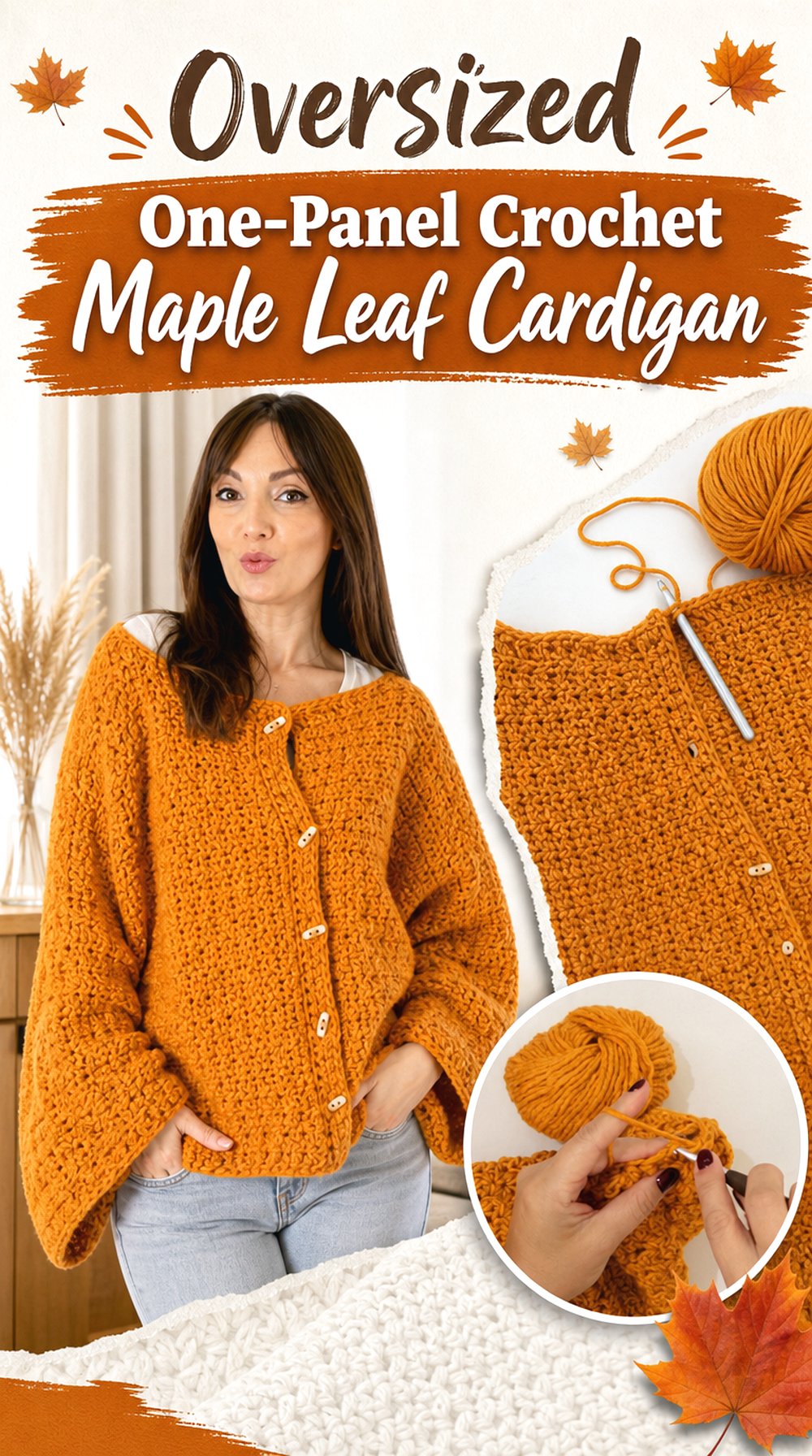
This is the most literal maple-leaf direction in the collection. La fata tuttofare’s source tutorial presents a voluminous cardigan called the “Maple Leaf” jacket and uses a horseshoe-style construction centered on a large panel. The finished shape is relaxed and dramatic rather than fitted, making the garment itself the statement instead of relying on separate appliqués.
Choose this direction when you want the autumn identity built into the cardigan from the beginning. Because so much visual impact comes from the continuous body of fabric, color choices can stay relatively simple without making the result look unfinished.
The Broad Panel Lets the Leaf Effect Read Continuously
A large uninterrupted section gives texture and color room to develop without repeatedly stopping at square joins. That is useful if you prefer a cohesive cardigan rather than an obvious patchwork look.
When planning color changes, view the whole panel rather than judging each band separately. Strong contrasts placed in the center can dominate the garment, while a more gradual autumn palette can allow the construction and texture to remain visible.
Oversized Volume Still Needs Shoulder Checkpoints
Oversized should describe the intended silhouette, not an uncontrolled fit. Check how the garment sits across the upper back and where the sleeve openings fall before adding additional length or finishing.
A heavy fabric can also behave differently after the full cardigan is assembled. If you substitute yarn, compare the developing fabric with the source garment and verify gauge information supplied by the creator rather than sizing only by the piece while it is lying flat.
Autumn Colors Work Better When They Follow the Shape
Maple red, burnt orange, ochre, brown, moss, and muted green can reinforce the theme, but the color arrangement should support the cardigan’s lines. A single striking maple tone may produce a cleaner result than trying to fit every fall shade into one garment.
For a multicolor version, repeat one or two colors in more than one area so the body and sleeves feel connected instead of looking like unrelated sections.
Creator: la fata tuttofare
2. Mini Leaf Texture Crochet Maple Leaf Cardigan
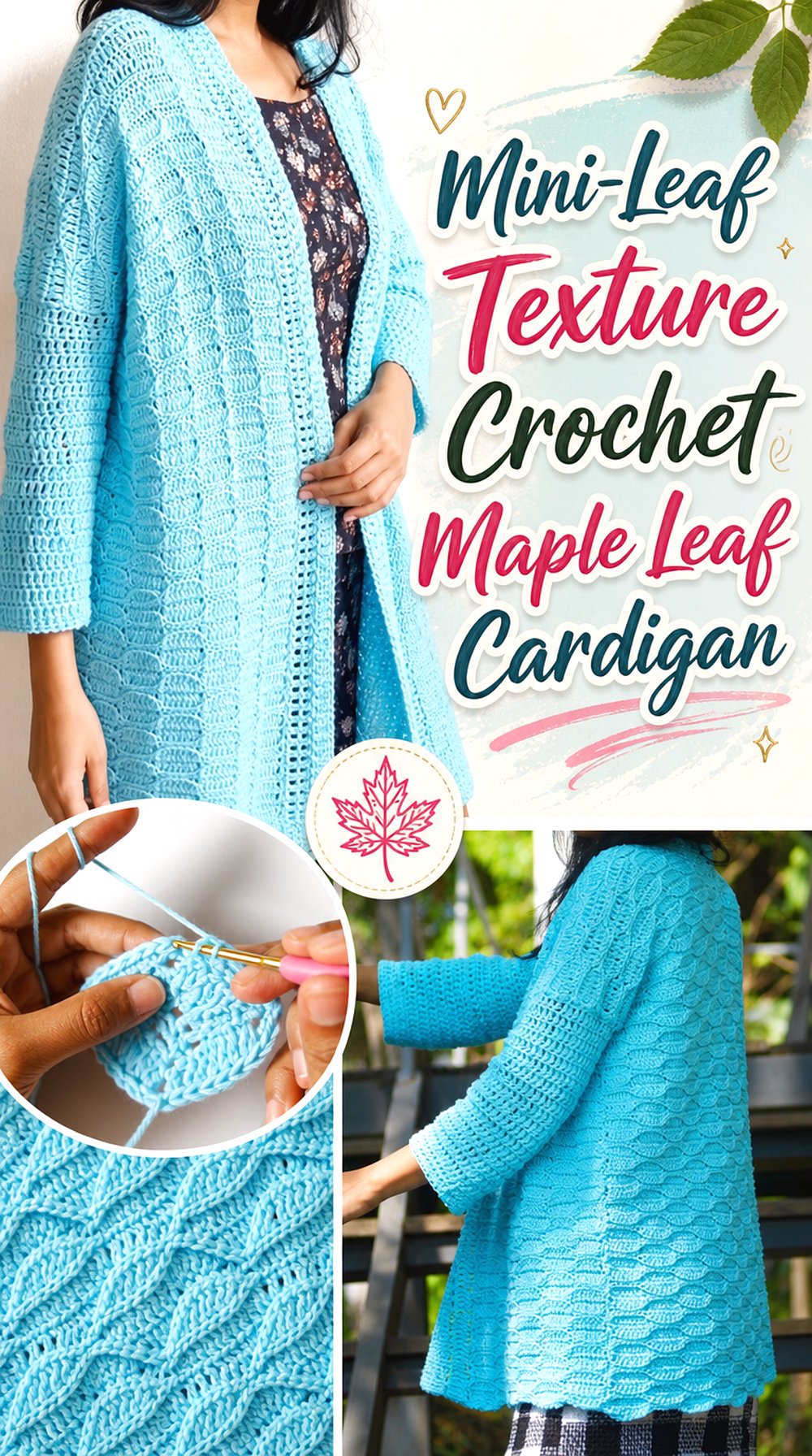
Instead of adding separate leaves, this cardigan direction builds the botanical effect into an all-over mini-leaf texture. Jennyandteddy’s cardigan is constructed from two main rectangles and uses a stitch the designer describes as a mini leaf stitch. The source also notes that yarn choice can change how light or heavy the finished fabric feels.
This makes a good alternative for readers who like maple-leaf inspiration but do not want a cardigan made from individual motifs. An autumn palette can push the small repeating texture toward a maple-season look without requiring every repeat to resemble a literal leaf.
Repeated Mini Leaves Replace Separate Motifs
All-over texture distributes the leaf idea across the cardigan, so there is no single feature square competing for attention. It can also make color planning simpler because the fabric already carries visual detail.
If you use several autumn shades, consider letting the stitch texture remain the dominant element. Very frequent high-contrast color changes may make a small raised or recessed pattern harder to read from a distance.
Two Rectangles Put More Pressure on Width Planning
A rectangle-based wearable can look uncomplicated on the work surface, but its width still determines important parts of the finished silhouette. Compare the source measurements and gauge with the amount of coverage you want before extending the panels.
Also check where the folded or joined fabric creates the arm opening. Making a rectangle substantially larger simply to add body ease can influence other areas of the cardigan, so follow the creator’s sizing logic rather than scaling every dimension equally.
Lighter Fabric Can Keep Small Texture More Visible
Jennyandteddy’s pattern discussion contrasts the lighter fabric produced by the yarn used in the sample with the heavier result that a thicker alternative could create. That trade-off matters for a repeated mini-leaf surface.
If the fabric becomes very thick, the cardigan may gain structure but lose some movement. Swatch the actual leaf texture before substituting yarn, then wash or block that swatch as appropriate for the fiber before judging definition and drape.
Creator: Jennyandteddy crochet
3. V Neck Circle Leaf Crochet Maple Leaf Cardigan
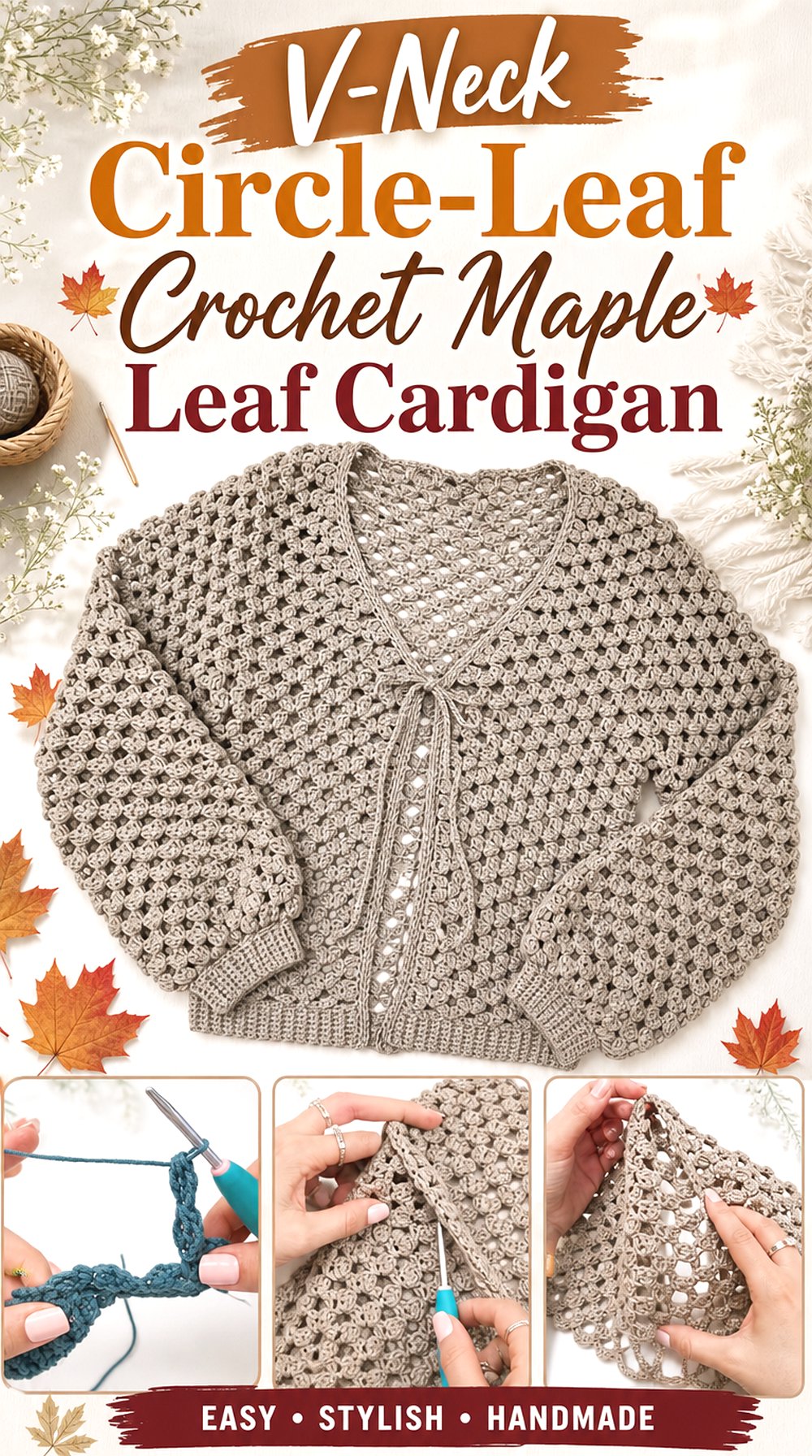
A V-neck leaf cardigan gives the botanical texture more breathing room around the upper body. Briana K’s Circle Leaf V-Neck Cardigan combines a leaf-based stitch with a V-shaped opening and a front tie. The supporting pattern information describes a bottom-up body, shoulder seams, sleeves worked from the armholes, and front trim incorporating the tie.
For a maple interpretation, use warm leaf colors while keeping the existing circle-leaf texture as the main design language. This is a more refined route than attaching large maple appliqués, and the V-neck silhouette makes it useful when you want visible layering underneath.
The V-Neck Breaks Up a Dense Botanical Surface
When a textured stitch covers most of a cardigan, an open neckline creates valuable negative space. That can prevent a highly patterned fabric from feeling visually crowded near the face.
Consider what you expect to wear underneath before choosing the final color. A warm rust or ochre cardigan over a simple neutral layer highlights the stitchwork differently from a multicolored shirt competing with the leaf texture.
Bottom-Up Construction Makes Length an Early Decision
The source design begins from the lower body and develops upward, so length is part of the project before the shoulders are completed. Follow the pattern’s sizing and gauge information instead of simply adding or removing repeats without considering shaping.
If you want a shorter maple version, compare the intended garment measurements with your preferred wardrobe proportions first. Changing length can alter where the strongest area of texture sits relative to the waist or hips.
A Tie Front Gives the Leaf Texture Two Different Looks
A tie closure lets the V-neck remain clearly defined while offering a way to draw the front edges together. When open, the cardigan emphasizes layering; when tied, the front panels become more visually connected.
If you introduce several maple-inspired colors, check how they meet near the front opening. Asymmetrical color placement may be intentional, but it will become more obvious once the two fronts are brought close together.
Creator: Briana K
4. Mosaic Hem Crochet Maple Leaf Cardigan4.
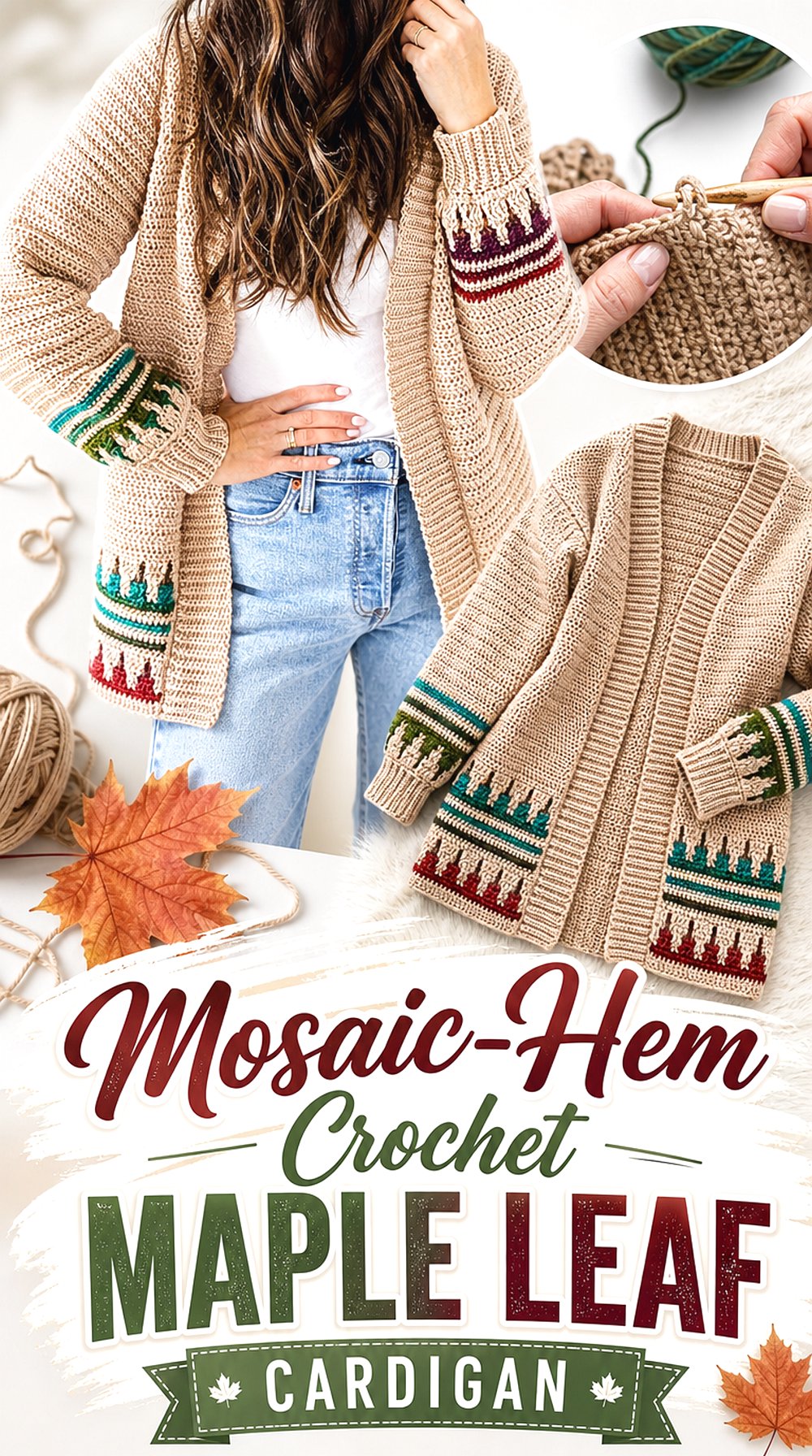
This idea uses an autumn mosaic cardigan as a construction and placement reference, not as a ready-made maple leaf pattern. MJ’s Off The Hook Designs places decorative mosaic work around the lower portion of a top-down cardigan and also carries the accent onto the sleeves. The source design can be worn open or finished with buttons.
For a maple version, the useful concept is the controlled decorative zone: instead of scattering leaves everywhere, reserve one planned band for a compatible maple-inspired chart or motif design of your own. Do not substitute graphics without checking stitch multiples, gauge, and pattern compatibility.
Keep the Maple Detail Inside a Defined Accent Zone
A lower decorative band gives the eye one clear area to read. This can be more wearable than covering the entire cardigan in large maple shapes, especially if you favor graphic colorwork.
Before adapting the motif, map its repeat against the available width. A design that fits neatly into a small swatch may not repeat evenly around a garment section. Preserve the original cardigan’s shaping requirements rather than forcing a decorative repeat into stitches needed for fit.
Top-Down Shaping Gives You an Earlier Fit Check
The original cardigan is designed from the top down. That allows the upper body to develop before the decorative lower section becomes the focus.
Use that advantage. Check shoulder placement, bust coverage, armhole comfort, and intended ease according to the creator’s sizing information before investing time in a customized motif band. Decorative work is easier to enjoy when the basic garment already sits correctly.
Open Front or Buttons Change How the Graphic Meets
The source offers both open-front and buttoned styling. A cardigan worn open keeps each front edge visually separate; fastening it brings those decorative areas closer.
If your maple motif has a strong direction, test the layout on paper or with temporary markers first. Mirrored leaves may look balanced near the opening, while identical directional motifs can create a deliberate sweeping effect.
Creator: MJ’s Off The Hook Designs
5. Patchwork Square Crochet Maple Leaf Cardigan5.
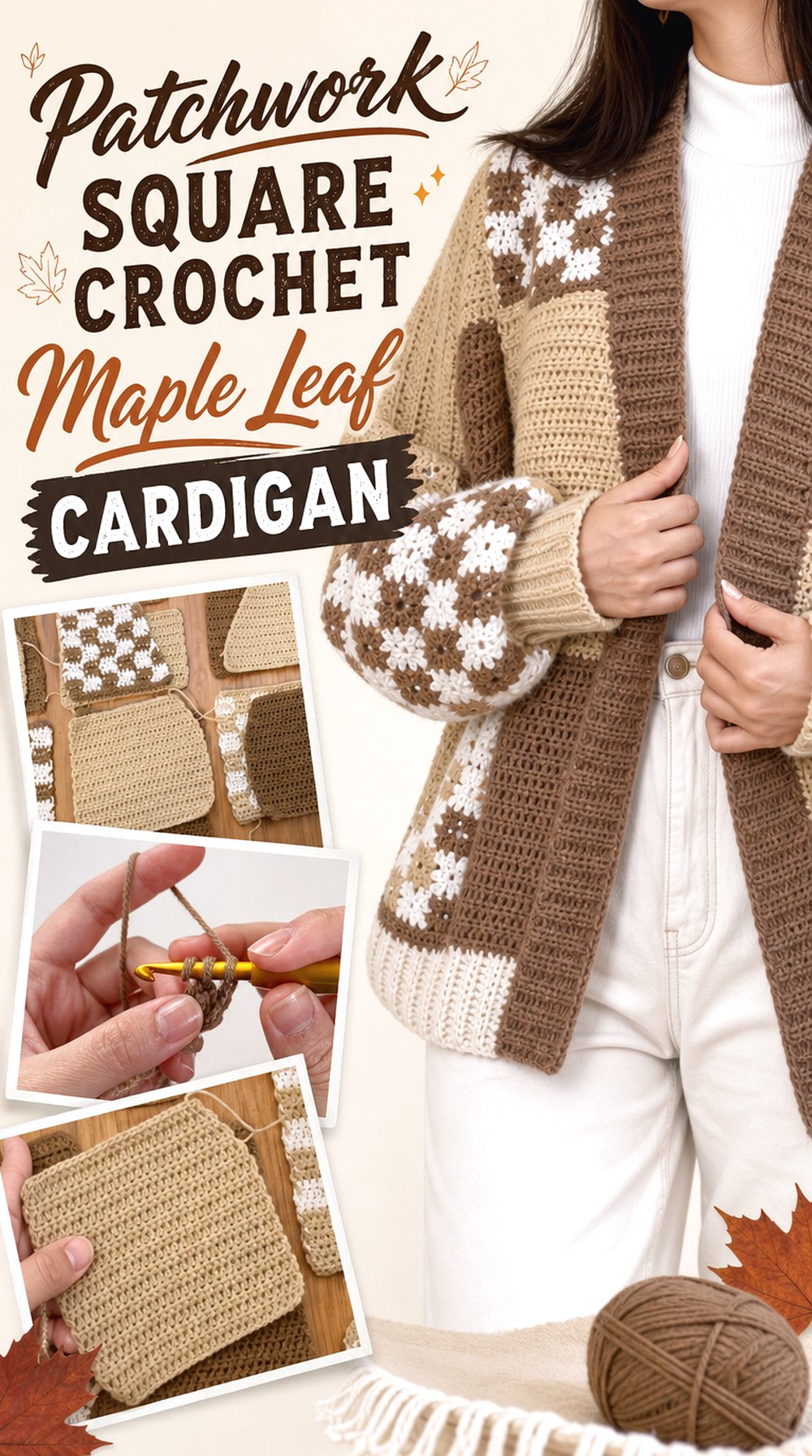
A patchwork cardigan is one of the most flexible bases for introducing actual maple leaf squares because the surface is already divided into separate blocks. Yarnalina’s brown patchwork cardigan tutorial provides the cardigan framework; the maple-leaf element would be your adaptation rather than a feature of the original source.
Instead of replacing every block, consider using maple squares as focal motifs among simpler solid or textured squares. That creates a recognizable seasonal theme without requiring the decorative motif to carry the fit and structure of the entire garment.
Maple Squares Must Match the Other Blocks After Blocking
Two crochet squares can look similar while being incompatible for a garment. Compare finished dimensions after blocking, not immediately off the hook. Also look at corner placement, edge structure, thickness, and stretch.
If the maple square finishes smaller, do not pull it outward during joining just to make the corners meet. That can distort the surrounding fabric. Adjust the motif independently until its finished footprint works with the patchwork system you plan to use.
Uneven Leaf Distribution Can Look More Like True Patchwork
A leaf on every square creates a highly repetitive surface. For a patchwork interpretation, you can instead establish several feature areas: perhaps a group on the back, one on a sleeve, and one near a front edge.
Lay every block out before joining. Photographing the arrangement can make visual imbalance easier to spot, especially when rust, green, mustard, cream, and brown are spread across many individual pieces.
Sleeve Squares Need Different Practical Attention
A striking maple square that looks perfect on the back may feel bulky when repeatedly placed around an arm. Compare flexibility as well as appearance.
If your leaf motif has raised sections, consider reserving the most dimensional squares for flatter parts of the cardigan and using simpler blocks where the arm bends. The goal is not to hide the seasonal theme but to place it where it does not unnecessarily interfere with movement.
Creator: Yarnalina
6. Granny Square Crochet Maple Leaf Cardigan
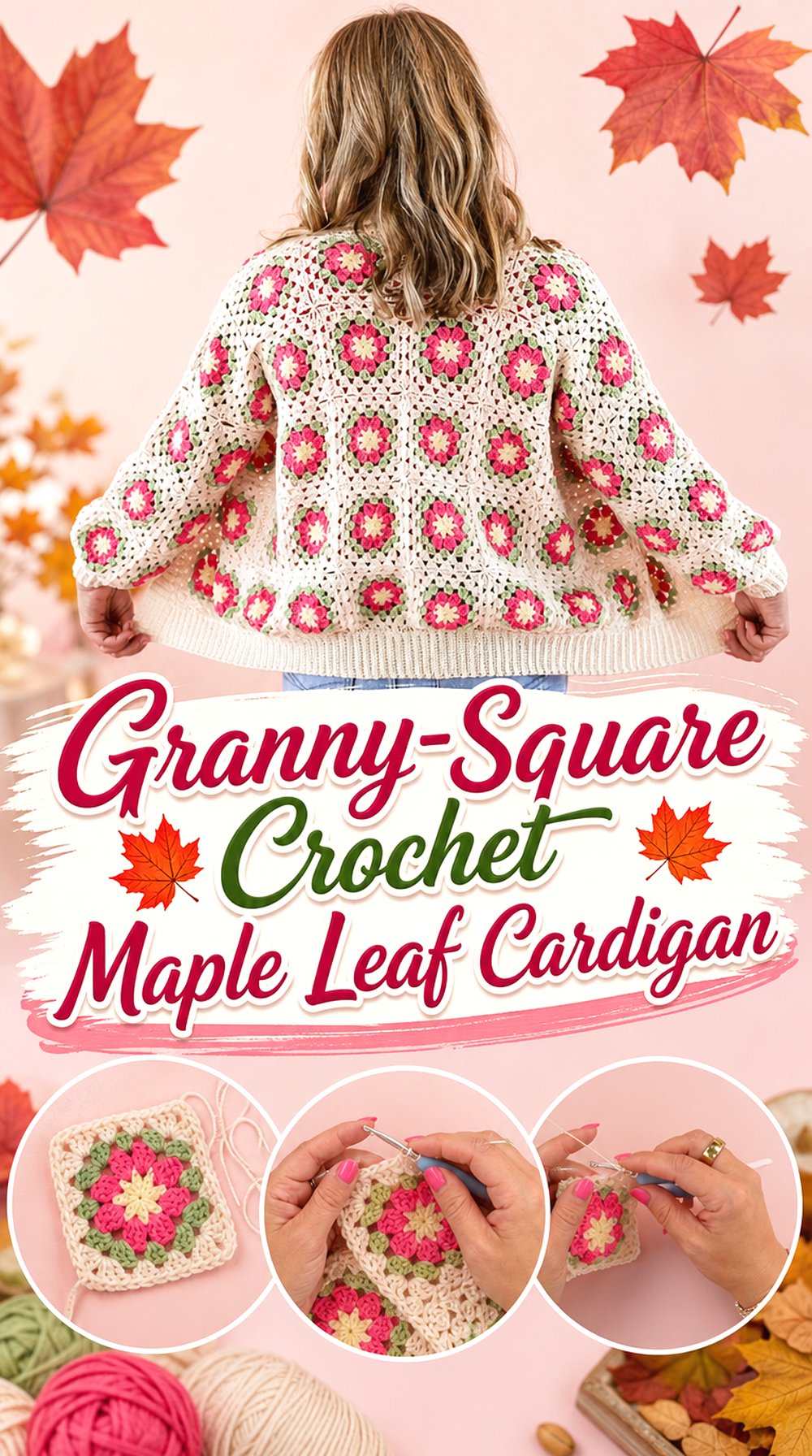
This version is more orderly than the mixed patchwork idea above. Start from a regular granny-square cardigan layout and treat compatible maple leaf squares as deliberate feature motifs within the grid. Bella Coco’s tutorial supplies the granny-square cardigan construction rather than the maple motif itself.
A repeated grid works well if you prefer symmetry: matching leaf squares can be placed across the back, mirrored at the front, or repeated down the sleeves. Because the cardigan reads as a consistent modular garment, even a limited number of maple motifs can look intentional.
A Regular Grid Makes Motif Direction More Obvious
Maple leaves usually have a recognizable top and stem direction. In a neat granny-square grid, a single rotated motif may stand out immediately.
Decide whether every leaf should point upward relative to the worn garment or whether you want a tumbling-leaves effect. Then mark orientation on the reverse of the blocks before joining. This simple planning step becomes especially helpful once dozens of similarly colored squares are spread across a work surface.
Full-Motif Sleeves Can Become Visually Heavy
Repeating feature leaves around both sleeves creates a bold result, but it can compete with a highly decorated body. One alternative is to concentrate maple squares near the upper sleeve or cuff and use simpler granny squares elsewhere.
Compare the cardigan from several feet away before joining. A layout that looks balanced one square at a time can feel much busier when the complete front, back, and sleeves are viewed together.
A Consistent Border Can Unite Different Square Designs
If your maple square and classic granny square have different internal textures, a compatible final border can help them look as though they belong in one collection.
That border still has to respect the cardigan tutorial’s assembly needs. Confirm final square dimensions after any added edging. The important measurement is the finished, blocked block that will actually be joined, not the size of the decorative center before its outer rounds or borders are complete.
Creator: Bella Coco
7. Custom Fit Hexagon Crochet Maple Leaf Cardigan
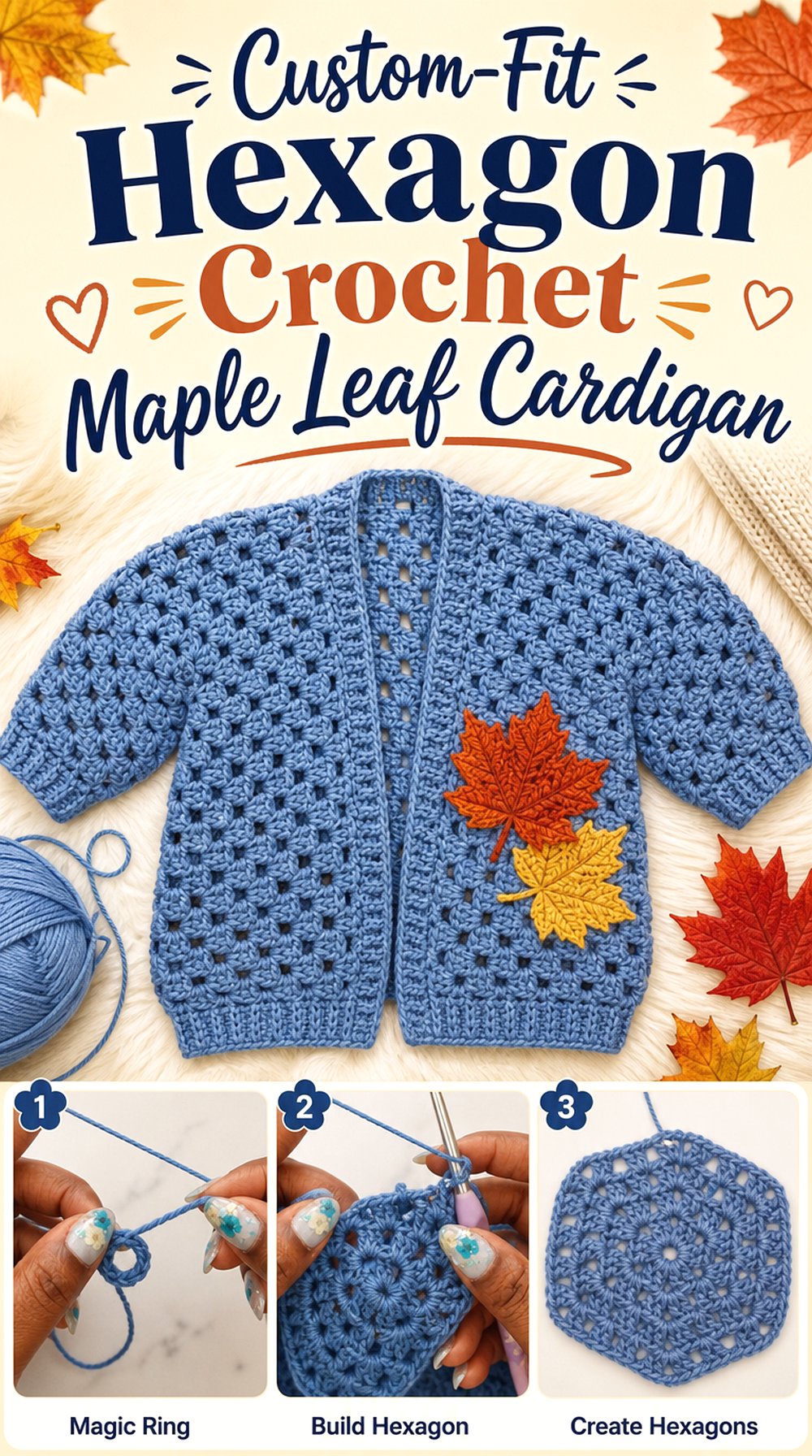
A hexagon cardigan gives the maple theme a completely different setting. Instead of inserting leaf squares into the garment structure, make the hexagon cardigan according to its own construction and plan maple motifs as surface accents afterward. TL Yarn Crafts’ source tutorial focuses on a customizable crochet hexagon cardigan.
This route suits readers who like the flowing geometry of a granny-style hexagon but still want an autumn focal point. A single leaf on the upper back, a small group near the lower front, or sparse sleeve accents can add the theme without disrupting the hexagon construction.
Finish the Main Fit Before Committing to Leaf Placement
Hexagon cardigans grow in more than one direction at once, so the apparent location of a motif can change as the garment develops. Do not choose final leaf positions while the base pieces are still far from their intended dimensions.
Complete the major fit decisions first. Once the body and sleeves are established, temporarily pin or baste sample leaves in place and try the garment on before attaching them permanently.
Avoid Covering Important Folds and Seams
The geometry that turns crocheted hexagons into a wearable creates natural fold lines and joining areas. A stiff appliqué placed directly over a high-movement seam can make the garment feel less fluid.
Map the final cardigan rather than the flat pre-assembly hexagon. The visually perfect location on a flat piece may end up underneath an arm or close to a seam once folded into shape.
One Large Back Leaf Can Replace Dozens of Small Accents
A hexagon cardigan already has strong stitch rhythm. Covering it with many additional motifs is not the only way to make the maple theme noticeable.
A single substantial leaf centered on the upper or mid back can create a clear focal point while leaving the surrounding granny texture visible. If you choose this approach, test the motif’s weight against the cardigan fabric so the back does not sag around the attachment area.
Creator: TL Yarn Crafts
8. Hooded Hexagon Crochet Maple Leaf Cardigan
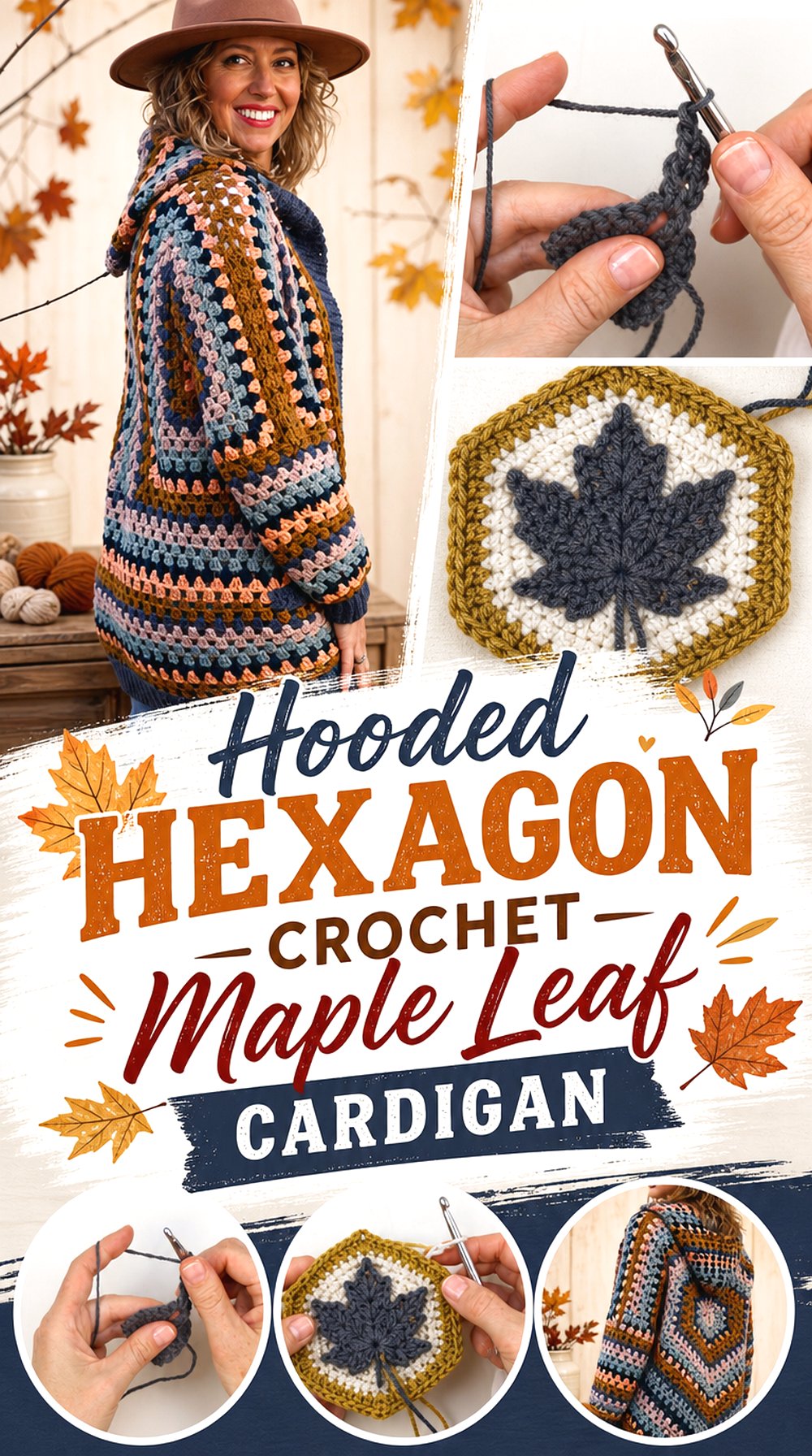
The Campfire Cardigan offers another hexagon route, but the hood gives this idea a substantially different finished character. Make & Do Crew describes the design as beginning with two granny hexagons and later adding length, sleeves, a rectangular hood, and border.
For a maple version, the hood creates a new decorative area that standard open-neck hexagon cardigans do not have. A leaf motif on the hood, autumn striping throughout the hexagons, or a restrained group of motifs around the lower edge can make it feel intentionally seasonal.
The Hood Adds Weight High on the Back
A hood changes how the cardigan hangs, especially when the yarn and stitch pattern already create a substantial fabric. Adding several dense appliqués to that same area can increase the pull.
If you want leaves on the hood, compare the motif weight with the finished hood fabric first. A small accent may preserve the shape better than covering the entire hood with thick raised pieces.
Hexagon Size Can Affect More Than Body Width
Make & Do Crew’s pattern notes discuss the relationship between expanding the hexagon and other areas of the garment, including sleeve proportions. That is an important warning against treating hexagon growth as a simple chest-width adjustment.
Use the creator’s customization guidance and try-on checkpoints. If you need extra body coverage without equally enlarging every other area, follow the documented construction options rather than continuing the hexagons without considering the consequences.
The Hood Is a Natural Place for One Statement Leaf
A centered maple leaf on the back of the hood can provide a visible motif when the hood is down while leaving the body relatively simple. Alternatively, place the strongest leaf feature on the cardigan back and keep the hood in complementary autumn colors.
Try both layouts before attaching anything. When the hood is down, it may partially cover a motif positioned high on the back panel.
Creator: Make & Do Crew
9. Boho Lace Crochet Maple Leaf Cardigan
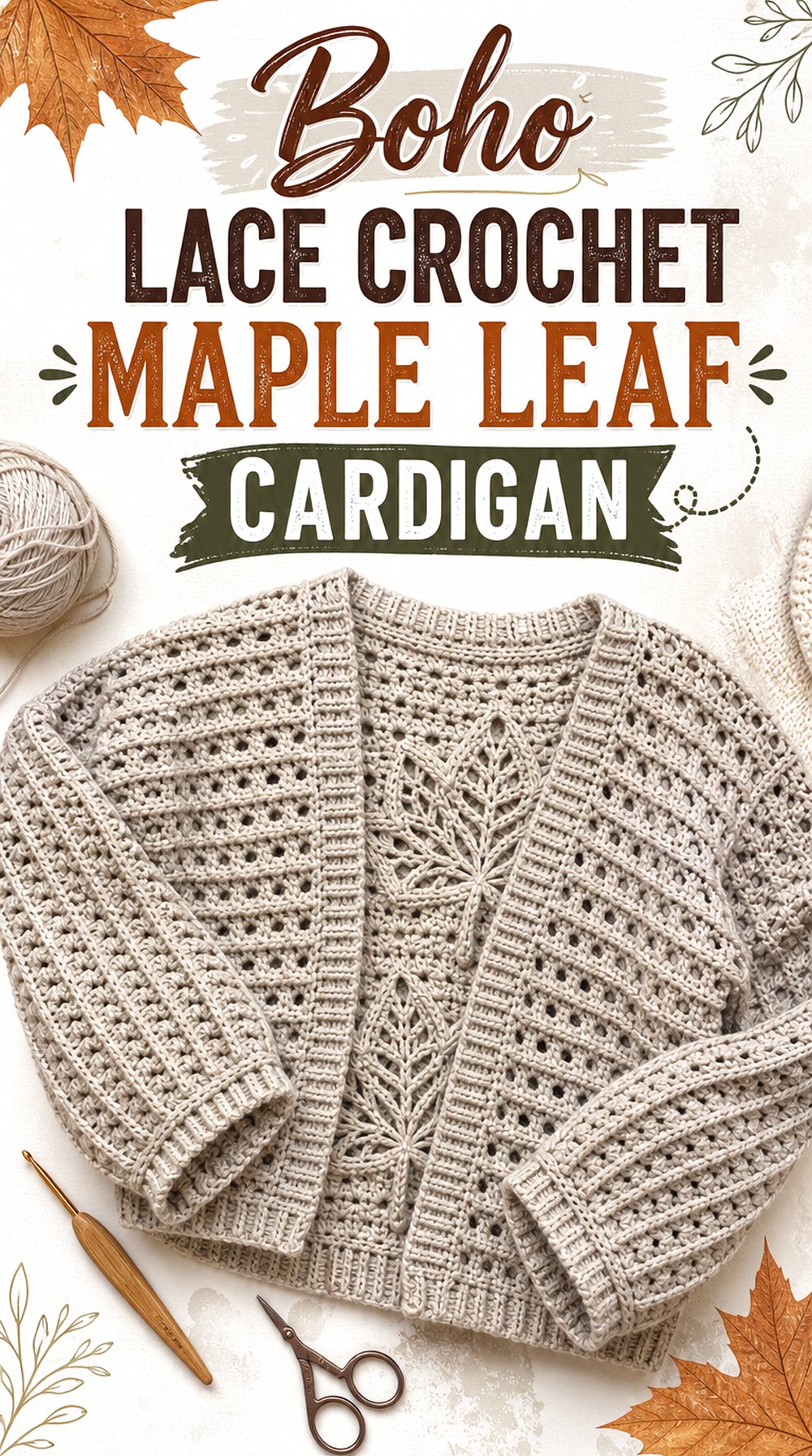
A lacy cardigan offers a lighter interpretation of the maple theme. HanJan Crochet’s Mirabilis tutorial shows a boho-style crochet cardigan designed as an open, decorative layering piece. The source is a cardigan tutorial rather than a maple-leaf pattern, so any leaf embellishment would be an independent adaptation.
The strongest version of this idea keeps the leaves sparse. Instead of covering the lace, use a few small motifs near a lower corner, along a front edge, or around the back neckline. Autumn color can carry much of the theme without making the delicate base feel overloaded.
Dense Maple Motifs Can Fight an Openwork Fabric
Lace gains much of its character from empty space. A thick appliqué changes both the visual density and physical weight of the area underneath it.
Before attaching a maple leaf, hold the cardigan up as it will be worn. If the motif pulls an open section out of shape, move it closer to an edge or more stable area, or choose a lighter motif construction that is compatible with the fabric.
Use Negative Space as Part of the Autumn Design
A maple cardigan does not need leaves touching one another. Three separated motifs can suggest drifting autumn leaves more effectively than a crowded surface.
Spacing also lets the original lace remain visible. Arrange motifs temporarily and take a photograph of the whole cardigan. The distance provided by a photo often makes it easier to judge whether the leaves read as an intentional composition or random decoration.
Tonal Color Can Keep a Boho Cardigan Sophisticated
A leaf does not have to be bright red to be recognizable. Rust on terracotta, olive on moss, or cream on camel can create a lower-contrast botanical effect.
This is particularly useful when the cardigan already contains a prominent lace pattern. Tonal motifs add dimension without creating a second equally strong pattern. If you want one brighter color, reserve it for a limited focal area rather than distributing it automatically across every edge.
Creator: HanJan Crochet
10. Long Fall Duster Crochet Maple Leaf Cardigan
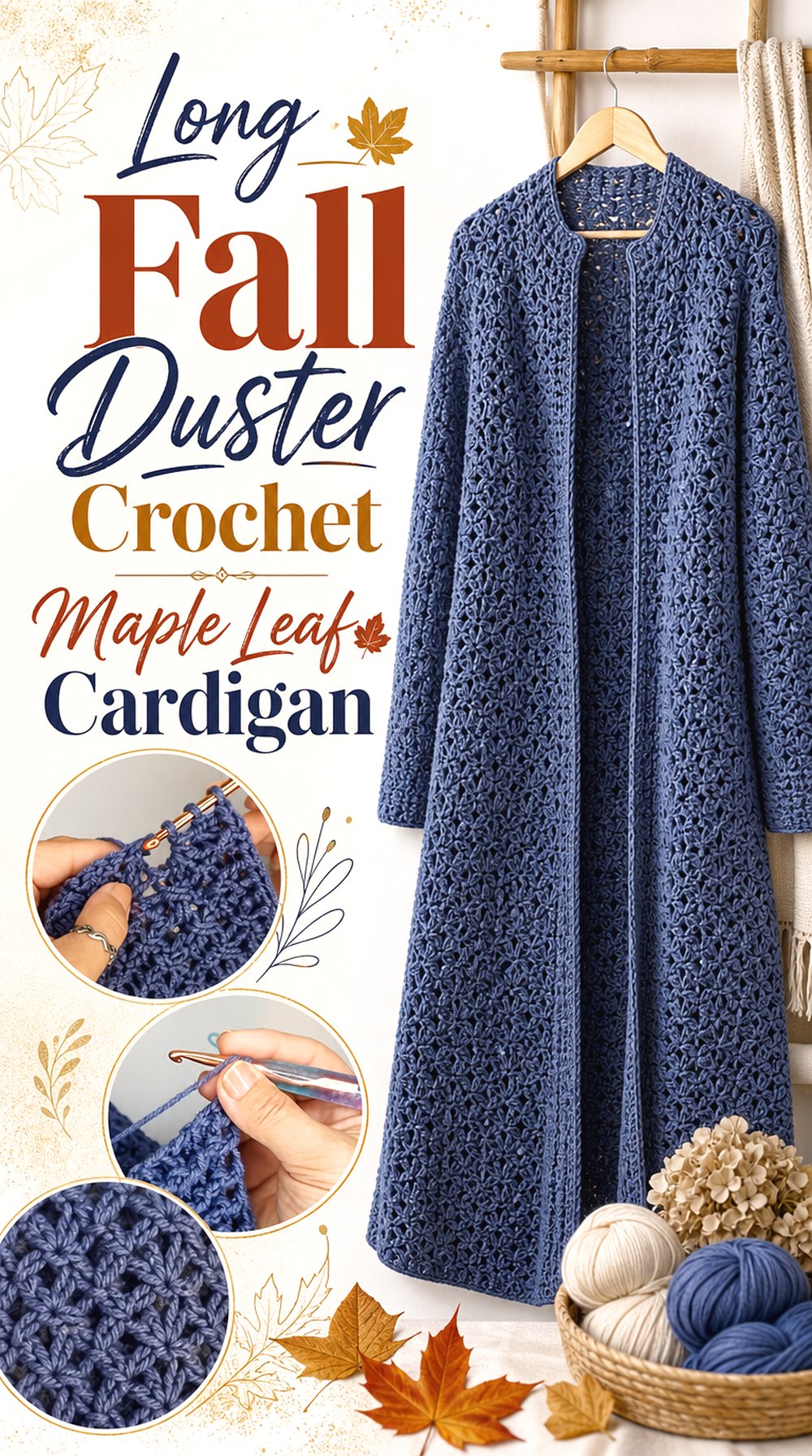
Simona Crochet’s long “Fall” cardigan offers the longest silhouette in this collection. The source tutorial shows an adult cardigan designed as a warm, extended layer rather than a cropped or waist-length piece.
That extra length creates room for a vertical maple arrangement that would not have the same effect on a short cardigan. Rather than covering the entire surface, imagine leaves gradually changing color from green near the upper body to rust and burgundy toward the hem, or place a narrow sequence of leaves down one front side.
Long Length Magnifies Fabric Weight
A swatch that feels pleasantly substantial can become much heavier once repeated over the full length of a duster. Added appliqués contribute additional weight.
Before decorating, assess the completed or nearly completed garment on a hanger and on the body. Pay attention to shoulder stretch and overall drape. If the cardigan is already substantial, use fewer maple motifs or lighter accents rather than assuming more decoration will improve the theme.
Vertical Leaf Placement Can Reinforce the Duster Shape
A long cardigan naturally directs the eye downward. Maple motifs can follow that line instead of interrupting it.
Try an asymmetrical trail of leaves down one front, a concentrated hem treatment, or a tall central arrangement on the back. Compare each option at full garment scale. A motif that looks large in your hand can appear surprisingly small against a long duster.
Keep the Hem From Becoming Too Stiff
The lower edge is tempting because it provides a broad decorative area, but attaching a dense row of thick leaves can change how the cardigan swings and hangs.
Leave space between motifs or limit the accent to selected sections. If the underlying stitch fabric has good movement, preserve some of that flexibility instead of turning the entire lower edge into a rigid decorative band.
Creator: Simona Crochet
11. Cropped Collared Crochet Maple Leaf Cardigan
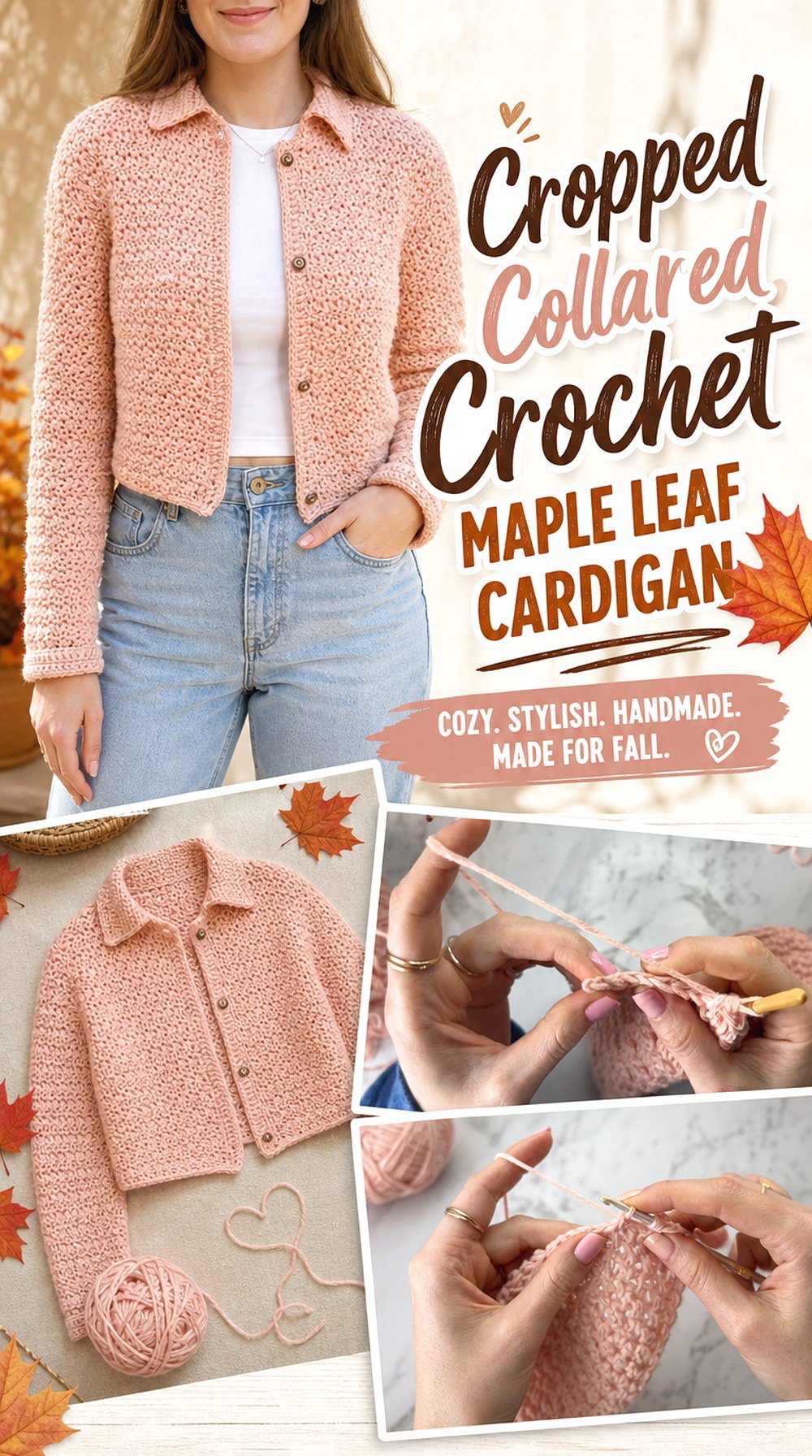
A cropped cardigan with a defined collar makes the maple theme feel more tailored than bohemian. Stephanie Tashi’s tutorial uses a cropped collared cardigan and identifies lemon peel stitch as the main surface texture. The maple leaves in this version would be an adaptation rather than part of the source design.
Because the cardigan is short, it does not need many decorative motifs. One leaf on each front, a pair at the collar points, or a small cluster across the upper back can create a stronger result than trying to fill every available area.
The Collar Is Already a Strong Focal Point
A collar frames the face and sits close to the front opening, so even a small maple detail in that area attracts attention. Keep scale under control.
Before adding motifs to both collar sides, check the cardigan while worn. Large leaves may cause the collar to flip, droop, or sit differently from the original design. A smaller accent near the collar rather than directly covering it may preserve the intended shape.
Cropped Proportions Reward Restraint
There is less uninterrupted body area on a cropped cardigan. Four large leaves can therefore occupy a much greater percentage of the visible garment than they would on a duster.
Choose a clear hierarchy: one primary feature area and perhaps one secondary accent. Leaving open fabric around the motifs gives the eye enough contrast to recognize the maple shapes.
Lemon Peel Texture Competes Differently With an Appliqué
A textured base is not as visually neutral as a smooth fabric. Before choosing a highly detailed leaf, place the motif against the finished cardigan and view it from normal wearing distance.
If the leaf edges disappear into the background, stronger color contrast may help more than increasing the motif’s size. Conversely, a very high-contrast motif will become the dominant feature, so use that effect intentionally.
Creator: Stephanie Tashi
Which Crochet Maple Leaf Cardigan Direction Fits Your Plan?
For the most integrated leaf look, start with the Oversized One-Panel, Mini-Leaf Texture, or V-Neck Circle-Leaf ideas. Their source designs already place leaf or botanical texture into the garment itself, so the theme does not depend on separate appliqués.
Choose the Patchwork Square or Granny-Square Cardigan if you specifically want recognizable maple motifs built into modular blocks. These versions give you control over how many feature leaves appear, but square compatibility is essential.
The Hexagon, Hooded, Boho, Duster, Mosaic, and Cropped Collared directions are stronger choices when silhouette comes first. Their tutorials teach useful cardigan structures, while the maple-leaf element is an adaptation you plan separately. In those designs, sparse and carefully positioned motifs usually preserve the original garment’s drape and construction more effectively than full coverage.
Conclusion
The right crochet maple leaf cardigan depends on whether you want the leaf to be the fabric, the motif, or the accent. Choose mini-leaf or circle-leaf texture for an integrated botanical surface, square construction for clearly recognizable feature motifs, or a hexagon, duster, lace, mosaic, or collared base when silhouette matters most.
Before adapting any cardigan, compare gauge, blocked motif size, fabric thickness, and final placement instead of assuming decorative pieces are interchangeable. Those checks are especially important around shoulders, sleeves, closures, and seams. Use the original tutorials for the creators’ exact garment construction details, then add the maple theme only where it remains compatible with the finished structure.
Frequently Asked Questions
Can I replace ordinary granny squares with maple leaf squares in any cardigan?
Not automatically. The maple square needs to work with the cardigan’s existing block dimensions and joining structure. Compare both designs after blocking, including width, height, corner positions, edge stitch distribution, thickness, and stretch. A square that is noticeably smaller or stiffer can distort the finished panel when forced into the same grid. Make and block samples before committing to enough motifs for the whole garment.
Should maple leaf granny squares be blocked before I plan the cardigan layout?
Yes, planning from the finished blocked dimensions is much more reliable than measuring a fresh square straight from the hook. Blocking can change the shape and size enough to affect panel width and motif alignment. Block the maple square and any companion square under comparable conditions, then measure both. If they do not match closely enough for your chosen joining method, resolve that difference before producing the full set.
How can I add maple leaves without making a cardigan feel too heavy?
Use fewer motifs and place them where the underlying fabric can support them. A single back leaf, several widely spaced hem accents, or a small shoulder arrangement can communicate the theme without covering the entire cardigan. Also compare the weight and flexibility of the appliqué yarn with the cardigan fabric. This matters most on lace, long dusters, hoods, and already-heavy textured garments.
Where should maple leaves go on cardigan sleeves?
Treat sleeves as high-movement areas. Thick motifs directly at the elbow or crowded around the underarm may affect comfort more than the same motifs placed on the back. Upper sleeves, outer forearms, and cuffs can be useful decorative zones depending on the cardigan shape. Temporarily attach the leaves and bend your arms naturally before sewing them down so you can check both appearance and movement.
What yarn qualities help crochet maple leaves stay recognizable?
Clear stitch definition generally helps pointed lobes, veins, or raised details remain visible, while very fuzzy yarn can soften those features. The cardigan itself may need more drape than the decorative leaf, however, so using the same yarn is not automatically the right choice for an appliqué adaptation. Compare fiber care, thickness, colorfastness, and washing requirements as well as appearance before combining different yarns in one wearable.
Can maple leaves be added after the cardigan is completely finished?
They can be added as separate decorative motifs if the finished fabric can support them and the attachment does not interfere with stretch, closures, or movement. A completed cardigan actually makes placement easier to evaluate because you can try it on and position the leaves in their true worn locations. Use temporary placement first, particularly around collars, shoulders, button bands, pockets, sleeve bends, and the upper back.