
14 Crochet Vampire Collar Ideas for Gothic Costumes and Dark Romantic Outfits
A crochet vampire collar can be much more than a strip of black lace around the neck. Depending on the construction, it can resemble a delicate Victorian choker, a spreading spiderweb, a sharply defined detachable collar, a gathered ruffle, a high neckpiece, or a miniature capelet that extends over the shoulders.
The 14 ideas below deliberately use different silhouettes and construction approaches, so you can choose according to the outfit rather than color alone. Some suit understated gothic clothing, while others have enough scale for Halloween costumes, theatrical styling, dark-romantic photography, or statement layering over a plain dress. The credited tutorials provide the underlying crochet construction; where a source is not specifically vampire-themed, the darker interpretation comes from styling choices such as palette, contrast, placement, and finishing rather than from changing the creator’s instructions.
Quick List
- Crochet Spiderweb Vampire Cape Collar
- Crochet Wednesday-Inspired Vampire Lace Collar
- Crochet Blood-Ruffle Vampire Statement Collar
- Crochet Crimson-Stripe Vampire Mantle Collar
- Crochet Dark Flower-Folk Vampire Collar
- Crochet Shadow Peter Pan Vampire Collar
- Crochet Fine-Lace Vampire Button Collar
- Crochet Geometric Pentagon Vampire Collar
- Crochet Vintage Lace Tie Vampire Collar
- Crochet Victorian Dream Vampire Choker
- Crochet Chunky Detachable Vampire Collar
- Crochet High-Neck Vampire Mantle Collar
- Crochet Classic Scalloped Vampire Collar
- Crochet Dramatic Vampire Capelet Collar
Choose the Neckline Before Choosing the Color
The most important difference between these collars is where the fabric sits. A close choker concentrates detail directly at the neck, while a Peter Pan or lace collar spreads outward over the upper chest. Ruffled collars add vertical and horizontal volume, and capelet-style pieces cover enough of the shoulders to become part of the costume silhouette.
Before starting, compare the intended neckline with the clothing underneath it. A broad collar can disappear over an equally detailed blouse, while a narrow choker may look disconnected from a deep neckline. For fitted designs, measure the actual wearer or the garment layer that will sit underneath the collar. Also check whether the closure requires overlap, a button loop, ties, or enough room to pass over the head. Those details affect comfort more than the decorative edging does.
Build Vampire Drama Through Structure, Not Only Black Yarn
Black is an obvious gothic choice, but structure usually creates more impact than color alone. Sharp geometric edges suggest a more severe look, open spiderweb lace creates negative space, and a gathered ruffle gives the neckline a theatrical Victorian feeling. Ivory against a black dress can also read more dramatically than an all-black collar because the silhouette remains clearly visible.
Yarn substitution changes that structure. A thicker or fuzzier yarn may soften small lace details, while a smooth finer yarn can make points, picots, and openwork easier to see. That does not mean one fiber or weight is universally better. Follow the original tutorial’s material guidance when construction depends on gauge or motif size, and swatch before making a major substitution. A vampire-inspired palette can come later without altering the creator’s underlying pattern.
Check Closure, Blocking, and Embellishment Weight
Detachable collars move differently from garment necklines because they are not always anchored to clothing. Before finishing, test whether the front or back closure holds the collar where you expect it to sit. Long ties offer adjustment but can shift, while buttons and loops need enough ease to fasten without pulling the neckline out of shape.
Open lace and pointed motifs often benefit from blocking because that can clarify the intended outline. Use a blocking method appropriate for the actual fiber rather than assuming every yarn should receive the same treatment. If you add beads, charms, chains, faux gems, or decorative buttons for vampire styling, keep their weight in mind. Heavy additions can drag fine lace downward or distort a small choker. When embellishments are not part of the original tutorial, treat them as optional styling and test their effect before attaching them permanently.
1. Crochet Spiderweb Vampire Cape Collar

Few constructions communicate gothic styling as immediately as an open spiderweb. This version can spread around the base of the neck like a webbed miniature cape, leaving large areas of negative space between the yarn. Lululoves Crochet’s source tutorial is specifically a Halloween web collar, making it one of the closest direct matches in this collection.
Black emphasizes the web effect, while ivory can create a ghostly contrast over a black dress. The piece also works when the rest of the costume is restrained because its outline provides the theme. Keep the underlying garment relatively simple so the openwork remains readable rather than competing with printed fabric or additional lace.
Decide Which Side Gets the Visual Focus
A web collar has more directional interest than a simple rounded band. Before adding other costume elements, check how the finished web sections frame the shoulders and front neckline. Lululoves notes that the collar can be worn in different orientations, so styling direction can noticeably change its appearance.
For a vampire interpretation, choose the orientation that creates the strongest silhouette against the garment you intend to wear.
Give the Web Enough Definition
Open chain spaces can look compressed straight from the hook. Appropriate blocking can help separate the web sections and make the outer points more deliberate. Pin the outline according to the intended shape rather than stretching every opening as far as possible.
If you substitute yarn, make a small test first. A fuzzy strand may create atmosphere but can visually soften the web geometry, whereas a smooth yarn usually makes negative space easier to read.
Keep Optional Sparkle Subordinate
The original Lululoves design discusses adding an optional sparkle thread alongside the main yarn. That can translate neatly into a nocturnal vampire theme, but the web should remain the focal point.
A subtle metallic companion strand can catch light without adding the weight of beads or pendants. If you prefer a more antique look, skip obvious shine and let black-on-black texture create the effect instead.
Original Tutorial and Creator Credit
Creator: Lululoves Crochet
2. Crochet Wednesday Inspired Vampire Lace Collar
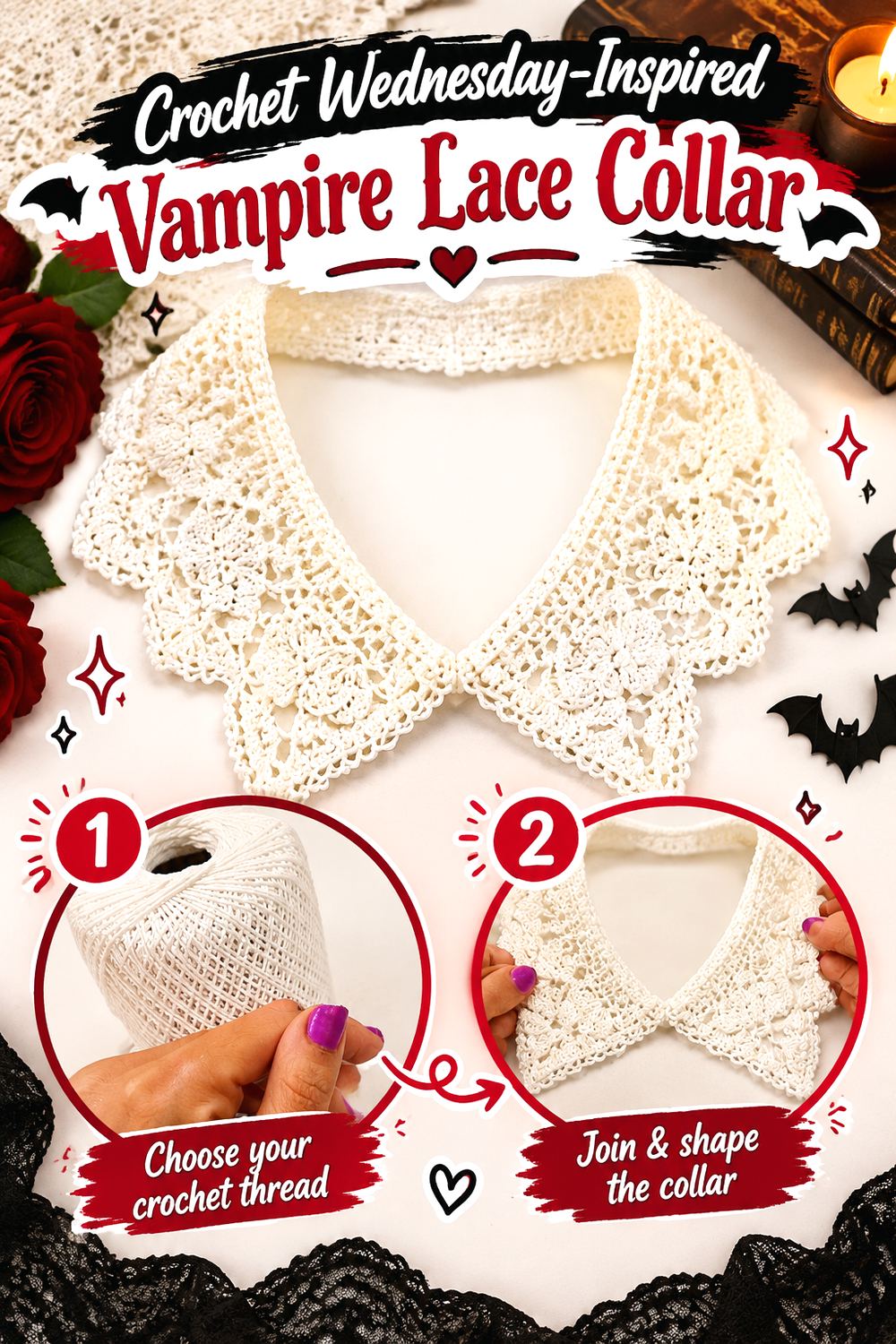
A crisp lace collar provides a different kind of vampire aesthetic: restrained, formal, and slightly severe rather than obviously costume-like. Littlejohn’s Yarn designed this source piece after the white crochet collar associated with Wednesday, and the finished form spreads across the neckline in repeating lace sections with a small closure.
For vampire styling, keeping it ivory or white over black clothing can be more striking than recoloring everything. Burgundy or black gives it a darker Victorian direction, but strong contrast makes the scalloped outline easier to see. This is a useful option for readers who want gothic character without spider, bat, or fang motifs.
Use Contrast as Part of the Silhouette
When the collar and garment are nearly identical in color, delicate openwork may disappear from normal viewing distance. That can work for subtle everyday goth styling, but costumes often benefit from clearer separation.
Before committing to yarn color, place a small swatch against the intended dress or blouse. White-on-black feels graphic; deep red-on-black feels richer but quieter; black-on-black depends much more heavily on lighting and stitch texture.
Check the Button Area Before Finishing
A small button closure makes the neck opening less adjustable than long ties. The source includes a buttoned finish, so the collar should be evaluated around the actual neckline rather than judged flat on a table.
Fasten it over the intended clothing layer and check that the edges meet without pulling. If the collar starts lifting or twisting near the closure, fit should be corrected before decorative additions are attached.
Layer Without Hiding the Lace
This shape works particularly well over a plain high-contrast neckline because most of its decorative interest lies close to the upper chest. Large necklaces, bow ties, or heavy jabots can obscure that detail.
For a vampire costume, consider treating the crochet collar as the principal neck ornament. A small brooch can add a period-inspired focal point, but verify that its weight does not make the center front droop.
Original Tutorial and Creator Credit
Creator: Littlejohn’s Yarn
3. Crochet Blood Ruffle Vampire Statement Collar

A ruffled collar creates volume rather than relying on intricate motifs. The Crochet with GG source produces a layered, frilled neck accessory that can be worn over dresses, sweaters, or simpler tops, giving this idea more theatrical presence than the flatter collars in the list.
Work the basic tutorial as designed, then use color to push it toward a vampire wardrobe: oxblood, black, deep plum, antique ivory, or a controlled two-tone combination. The ruffle can suggest period costume, romantic goth fashion, or a dramatic portrait accessory. Because the fabric occupies more visual space, this style rarely needs many additional ornaments.
Control the Ruffle Rather Than Maximizing It
More flare is not automatically better. If a ruffle becomes too full for the yarn and garment underneath it, the edge can bunch upward or compete with hair, jewelry, and coat lapels.
Evaluate the collar from the front and side after it has relaxed. For a cleaner vampire silhouette, aim for ruffles that radiate evenly instead of collapsing into a dense ring immediately under the chin.
Prioritize Neckline Softness
Ruffled pieces place more fabric near the skin than open spiderweb collars. If your yarn is noticeably rough in a hand swatch, that texture may become distracting when the collar is worn for an evening.
Use the tutorial’s material information as your starting point, and test substitutions against the neck before making the whole piece. Decorative yarn can still be used strategically at the outer edge if the main neckband needs to remain softer.
Let One Dramatic Detail Lead
This is already a high-volume collar, so elaborate pendants, multiple chains, and oversized brooches may fight with the ruffle. A single central accent usually preserves the shape better.
For costume use, compare the collar with the hairstyle and shoulder line before attaching permanent embellishments. Updos expose the ruffle differently from long hair, which can compress the back portion and change how evenly it appears.
Original Tutorial and Creator Credit
Creator: Crochet with GG
4. Crochet Crimson Stripe Vampire Mantle Collar

Ravella Design’s collar uses expanding granny-stitch strips to create a broad vintage-style piece. Instead of using many unrelated colors, a vampire version could concentrate the stripe effect into black, burgundy, deep red, muted violet, and perhaps one narrow antique-cream accent.
The widening striped structure creates considerably more shoulder presence than a narrow choker. That makes it useful over a plain fitted dress, shirt, or costume bodice where the collar itself needs to establish the upper-body shape. The repetitive horizontal bands can also echo the appearance of a miniature mantle without requiring an actual cape.
Plan Stripe Rhythm Before the First Color Change
Frequent random color changes can make the collar look busy, especially when the silhouette is already wide. Lay several yarn choices beside each other first and decide whether you want alternating contrast or a gradual dark-to-red progression.
A restrained palette often feels more gothic because the viewer sees the widening shape before noticing individual stripes. Photographing a sample arrangement in grayscale can also reveal whether the colors have enough value contrast.
Watch the Shoulder Spread
As a collar grows outward, increases determine whether it lies flat, cups upward, or develops unwanted waves. Follow the source construction rather than improvising the shaping simply to add more width.
Once the piece reaches the shoulders, place it over the actual garment. A collar that lies correctly on a thin shirt may behave differently over a jacket or structured costume bodice because the supporting surface has changed.
Use the Edge to Unify Multiple Colors
When several shades appear in the body, the last visible border can either organize the palette or make it feel more fragmented. A single dark outer edge is one way to frame a black-and-crimson vampire version without altering the basic striped concept.
If you add picots, beads, or other trim beyond the source tutorial, test a short section first. Too much extra weight at a broad outer edge can change how the mantle hangs.
Original Tutorial and Creator Credit
Creator: Ravella Design
5. Crochet Dark Flower Folk Vampire Collar

The Flower Folk Collar associated with Katie Jones and the V&A introduces motif-based construction and bold surface patterning to the collection. The V&A provides the project with a complete pattern and step-by-step video tutorial.
Its original identity is colorful rather than vampiric, which is exactly why it makes an interesting adaptation. Reworking the visual palette around black leaves, wine-red flower centers, muted plum, dark green, and bone-toned accents can create a botanical vampire aesthetic without pretending the source design was gothic. This is a strong choice for readers who prefer ornate folklore and dark florals over literal spiderweb imagery.
Keep Every Motif at a Consistent Scale
Joined motif collars expose size differences quickly. If one flower or surrounding shape is noticeably larger than the others, the neckline may ripple after assembly.
Check motifs against one another as you work rather than waiting until the joining stage. Consistent yarn, hook choice, and tension matter more here than they do in a deliberately freeform accessory because the motifs need to cooperate as one wearable shape.
Treat the Joins as Structural Elements
The joins do more than connect decorative pieces; they control how the collar curves around the neck and shoulders. Pulling them too tightly can make the motifs buckle, while loose joins can leave visible gaps or an unstable outline.
Lay out the complete motif arrangement before final assembly. That gives you a chance to check both shape and color distribution before connections become difficult to undo.
Build a Dark Botanical Palette
A vampire flower collar does not need every motif to be red. Too much saturated crimson can flatten the color story. Black, charcoal, dull green, mulberry, burgundy, and occasional pale accents can create greater depth.
Because color changes are an adaptation rather than part of the tutorial’s original aesthetic, keep construction decisions anchored to Katie Jones’s instructions while treating the palette as your own styling layer.
Original Tutorial and Creator Credit
Creator/Site: Katie Jones / Victoria and Albert Museum
6. Crochet Shadow Peter Pan Vampire Collar

A rounded Peter Pan collar is usually associated with a softer vintage look, but that familiarity can become striking when paired with severe black clothing or an unexpected dark palette. Ahuyama Crochet’s tutorial demonstrates a detachable Peter Pan collar and explicitly presents the concept as adaptable across sizes.
This option is less overtly theatrical than the web, ruffle, or capelet designs. That makes it useful for dark-academia clothing, everyday gothic outfits, or a vampire costume where other elements—makeup, sleeves, jewelry, or a cape—already supply most of the drama. A smooth solid fabric will emphasize the recognizable two-sided collar shape.
Measure for the Intended Layer
A detachable collar that fits comfortably over a thin blouse may become too close when placed over a sweater. Decide how you will actually wear it before selecting the finished neck opening.
For costume layering, measure around the clothing rather than only around bare skin. You still need comfortable ease, especially if the closure sits near the throat. Use the designer’s sizing method rather than inventing a stitch-count adjustment independently.
Use Firmness to Sharpen the Outline
A Peter Pan shape needs enough body for the rounded sections to remain recognizable. Very loose tension or a highly drapey substitution may cause the lobes to fold instead of framing the neckline.
That does not mean the fabric should be stiff. Aim for enough stability to preserve the edge while still allowing the collar to follow the shoulders. Swatching is particularly worthwhile if you move far from the yarn weight used by the tutorial.
Original Tutorial and Creator Credit
Creator: Ahuyama Crochet
7. Crochet Fine Lace Vampire Button Collar
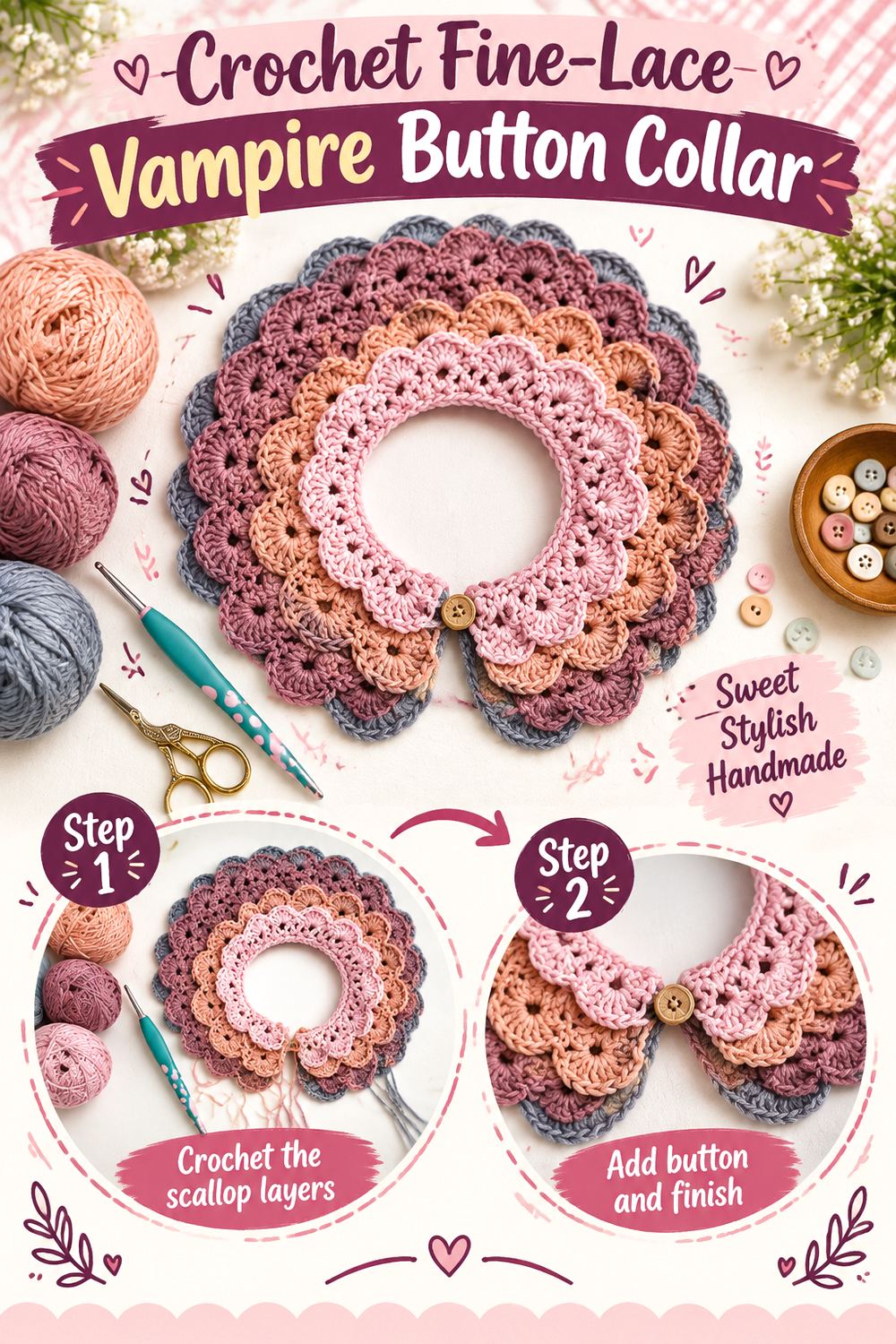
HanJan Crochet’s tutorial creates a lightweight Peter Pan-style lace collar and provides multiple size options in the original design. Compared with the more solid Shadow Peter Pan Collar above, this idea uses negative space and a more delicate decorative edge, making it better for an antique or romantic vampire aesthetic.
Try black for understated texture, burgundy for visible depth, or pale gray and ivory for a spectral contrast against dark clothing. Because the source uses a buttoned closure, the finished fit is more defined than a long tie collar. This design can also sit comfortably between costume styling and ordinary detachable-neckwear use.
Preserve the Scale of the Lace
Switching to a substantially heavier yarn can change more than the overall size. The decorative openings may become bulkier, and the collar may lose the fine edge that distinguishes it from a solid Peter Pan shape.
If you want a more dramatic color rather than a larger collar, changing shade while staying close to the recommended yarn characteristics is the safer first experiment. Verify gauge and sizing guidance in the source before altering construction.
Test the Closure Under Real Tension
A button looks small compared with the rest of the piece, but its position affects the entire neckline. Fasten the collar and check the curve before weaving in every tail or adding decorative accessories.
The closure should hold without forcing the fabric to stretch dramatically. If you plan to use a decorative vintage-style button instead of the source button, compare its weight and diameter with the intended loop before sewing it in place.
Keep Embellishment Away From Fragile Openwork
A fine collar can support a small brooch or charm visually, but heavier jewelry may pull open lace out of alignment. If you want a jeweled vampire effect, position embellishments near a structurally stronger area rather than suspending them from the most delicate loops.
Removable pins or lightweight accents also make care easier because the crochet piece can be cleaned according to its fiber without automatically exposing metal or beads to the same process.
Original Tutorial and Creator Credit
Creator: HanJan Crochet
8. Crochet Geometric Pentagon Vampire Collar

For readers who want sharper lines, a pentagon-based collar offers a useful contrast to rounded lace. Beyond Diary’s tutorial shows a collar assembled around lacy pentagonal forms, creating distinct angles and repeated geometric points.
Those angles are particularly effective for vampire styling because the silhouette can look ornate without relying on recognizable Halloween symbols. A monochrome black version emphasizes form, while alternating dark red and black sections can make the motif boundaries more visible. Because this design depends on repeated components rather than one continuous scalloped edge, consistent motif size and joining become central to the final fit.
Lay Out the Pentagons Before Joining
Repeated shapes can look balanced individually but still produce awkward color or angle distribution when assembled. Arrange the entire collar on a flat surface first, including the intended front opening.
This is also the moment to check whether every motif has approximately the same finished dimensions. Correcting a noticeably different pentagon before joining is much easier than compensating for it after the neckline has already taken shape.
Protect the Angular Silhouette
The appeal of this idea comes from visible geometry. If the outer points curl or collapse, it begins to resemble a generic lace collar.
Blocking can help clarify the angles when the chosen fiber permits it. Pin each section according to the intended finished outline rather than stretching the piece globally. The goal is consistent points and joins, not simply making the entire collar larger.
Make Color Support the Construction
Color placement can either reveal or hide the pentagons. Using one shade for every motif creates a quieter architectural effect; alternating shades makes the construction much more obvious.
For a vampire version, consider dark values with enough contrast to separate adjacent sections. Before joining, photograph the layout against the planned garment to confirm that the edges remain visible under the lighting where the piece will actually be worn.
Original Tutorial and Creator Credit
Creator: Beyond Diary
9. Crochet Vintage Lace Tie Vampire Collar

Hopeful Turns demonstrates a light vintage lace collar designed so the starting length can be adapted for different neck measurements. Its openwork has a distinctly different character from the geometric pentagon design: softer, more continuous, and closer to old-fashioned garment lace.
A black version can blend into dark clothing for subtle texture, while cream, gray, or muted silver provides a high-contrast supernatural look. This is also a practical choice if you want a vampire accessory that can move between costume use and regular vintage-inspired outfits. The relatively delicate scale means fit and finishing matter more than adding many extra motifs.
Size the Inner Edge, Not the Outer Lace
The decorative edge may spread dramatically, but comfort is controlled by the inner neckline. Take the wearer’s actual neck or garment-layer measurement and compare it with the source’s adjustment guidance before starting.
Avoid judging size by laying another finished collar on top, since different stitch patterns can create different amounts of stretch and outward flare even when the neck opening appears similar.
Open the Lace Without Overstretching It
Fine openwork often looks less impressive before shaping. Appropriate blocking can help the decorative spaces become more readable, but excessive stretching can distort repeats and create an oversized inner neckline.
Work from the center outward while shaping, checking symmetry on both sides. When the collar is dry, test it on the intended garment before deciding whether it needs any additional edging or decoration.
Original Tutorial and Creator Credit
Creator: Hopeful Turns
10. Crochet Victorian Dream Vampire Choker
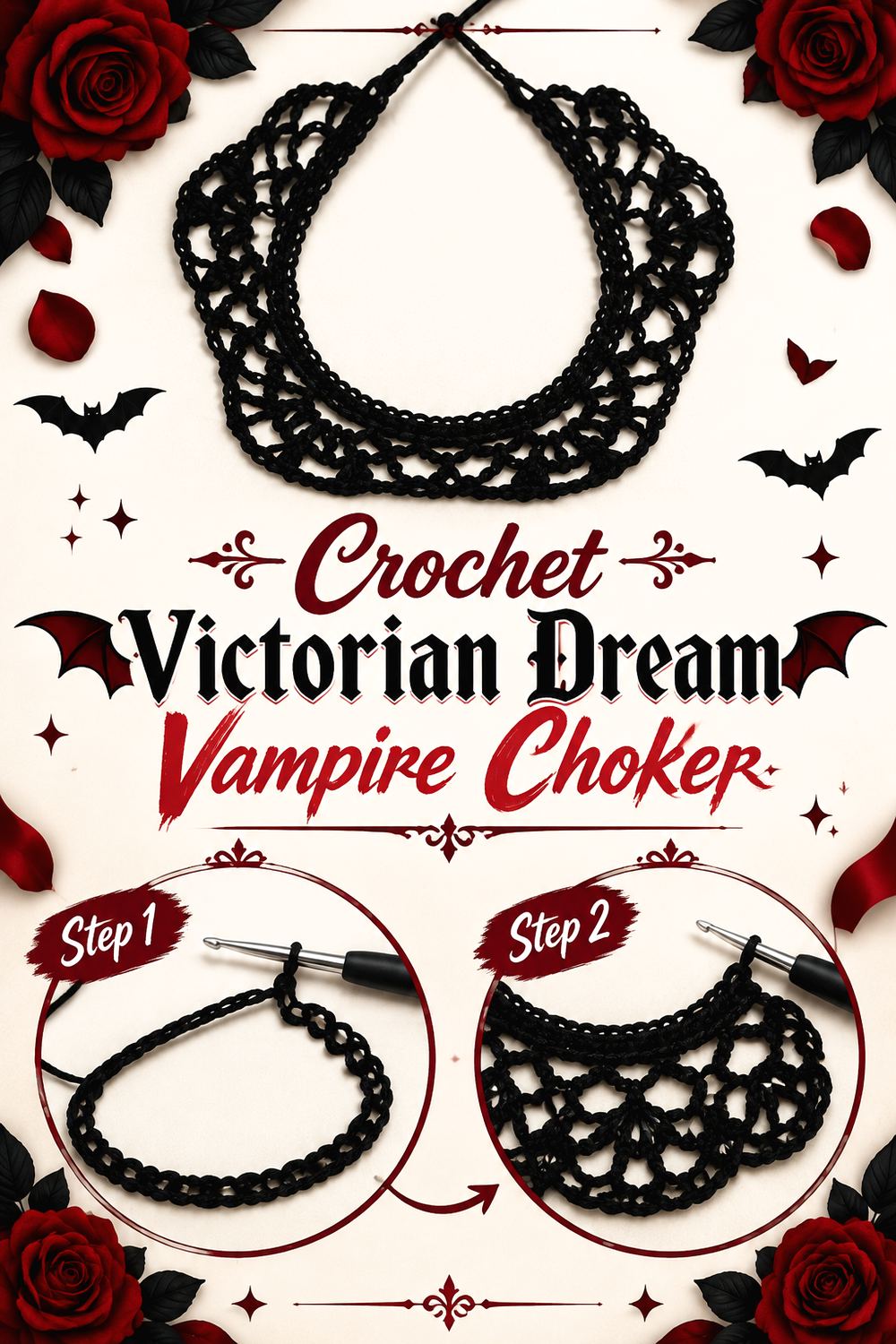
A choker changes the proportion of the entire collection. Instead of spreading across the shoulders, Littlejohn’s Yarn’s Victorian Dream design concentrates lace in a narrow band close to the neck. The original tutorial page includes both written guidance and a video tutorial.
This is one of the most natural choices for dark-romantic evening styling because it reads more like jewelry than garment trim. Black produces a classic gothic effect, while blood red or deep wine can become the only saturated color in an otherwise black outfit. Since the piece sits directly against the neck, comfort and closure fit deserve more attention than with a loose cape collar.
Give Close-Fitting Crochet Enough Ease
A choker should look fitted without feeling restrictive. Crochet fabric can also behave differently after wearing, blocking, or washing, depending on yarn and stitch structure.
Check the designer’s finished sizing information and try the piece at appropriate points in the construction rather than assuming a standard jewelry length. If you modify the closure, allow enough adjustment for comfortable movement and easy removal.
Choose Thread Detail for the Intended Distance
Fine thread can create crisp, jewelry-like lace, but tiny details may disappear in low light or from across a room. If the collar is for photography, stage, or costume use, test how it looks at the actual viewing distance.
A contrasting garment or a small central accent can make the structure clearer without changing the crochet pattern. Keep any pendant proportionate so it does not overpower the narrow neckband.
Original Tutorial and Creator Credit
Creator/Site: Littlejohn’s Yarn
11. Crochet Chunky Detachable Vampire Collar

The detachable collar tutorial published by Vivat Veritas as a guest project from Sophia of iro iro uses a more substantial DK-yarn approach rather than extremely fine lace. That makes it a useful counterpoint to the Victorian choker and delicate lace collars.
In black, charcoal, or dark red, the broader stitches can give a vampire outfit a handmade, almost storybook-gothic quality. The chunkier scale also shows clearly over coats and heavier tops where thread crochet may visually disappear. This is a good option when you want the shape of a vintage detachable collar but not the delicacy or precision of very fine crochet thread.
Match the Collar Weight to the Garment
A heavier collar can sit comfortably over a sweater or substantial dress but may overwhelm a thin slippery blouse. Before final finishing, place the work on the actual garment and see whether the neckline supports its weight.
If the collar continually migrates backward or sideways, adding more decorative weight is unlikely to fix the problem. First evaluate closure position, garment texture, and whether a discreet temporary anchor is appropriate.
Let Larger Stitches Be Part of the Style
There is no need to force a chunkier collar to imitate thread lace. Its stronger stitch scale is the feature that separates it from several other ideas here.
For a vampire interpretation, use that texture deliberately. Matte black can feel rustic and shadowy, while burgundy gives the stitches more visible definition. Avoid overly fuzzy yarn if you want the edge shape to remain crisp.
Original Tutorial and Creator Credit
Creator/Site: Vivat Veritas
12. Crochet High Neck Vampire Mantle Collar

The MYO “Idun” project moves away from flat decorative collars entirely. It is a warm neck collar worked as a denser piece around the neck, with additional fabric extending from the base. For vampire styling, that structure can be interpreted as a high-neck mantle worn under or instead of a cape.
This option works best when you want more coverage and a stronger costume silhouette. Black creates a severe profile, while deep red around the outer portion can suggest a lined cape without making a full garment. Because the source design is intended as cozy neckwear, it is considerably more substantial than the lace ideas and should be chosen with temperature and layering in mind.
Check Both Head Passage and Neck Comfort
Any collar that forms a continuous ring has two separate fit questions: can it pass on and off comfortably, and does it sit correctly once in place? Those measurements are not always identical.
The MYO tutorial discusses adjusting the collar according to measurements. Follow that construction guidance rather than tightening the ring solely to create a more dramatic vampire look. Comfortable movement should take priority over an extremely close silhouette.
Consider Costume Temperature
Dense neckwear can become warm quickly when combined with wigs, coats, capes, makeup, or indoor event spaces. That makes this better suited to cooler conditions than a thread-lace choker.
If the costume will be worn for several hours, consider the entire outfit rather than evaluating the collar alone. Fiber, thickness, room temperature, and physical activity all affect comfort, so avoid assuming a warm yarn will work for every Halloween or convention setting.
Balance Front and Back Coverage
A mantle-like collar has enough fabric to interact with shoulder seams and cape closures. Test it from the back as well as the front; hair and outerwear can push the neckline forward or bunch the upper edge.
If a separate cape will be added, put both pieces on together before final embellishment. Two bulky closures occupying the same spot at the neck can create unnecessary pressure and visual clutter.
Original Tutorial and Creator Credit
Creator/Site: Make Your Own
13. Crochet Classic Scalloped Vampire Collar

Emma Escott’s original Lululoves vintage collar pattern creates a detachable adult collar with a button-loop closure and a decorative spreading edge. The designer’s page also discusses adjusting the starting length rather than treating the sample measurement as universal.
Compared with the spiderweb design from the same creator, this collar is much more traditional and does not rely on an explicitly Halloween motif. That makes it useful for a restrained vampire wardrobe. Black gives the scallops a shadowed look, ivory makes them stand out sharply over dark clothing, and muted red creates an old-fashioned costume accent without adding extra symbols.
Keep the Scallops Visually Separate
A decorative shell or scalloped edge works best when the individual repeats remain readable. Very fuzzy yarn or excessive tension changes can blur those boundaries.
After finishing, lay the collar flat and look at the outer edge as one continuous line. If certain sections are compressed, gentle fiber-appropriate shaping may help. Avoid trying to correct major sizing issues through aggressive blocking; the neckline fit should come from the crochet construction itself.
Position the Button Loop Before Decorating
The source uses a button-loop closure, so button size and loop fit need to work together. Test that mechanism before adding a decorative brooch nearby.
A heavy antique-style button may look appropriate for a vampire theme but can pull differently from a small lightweight button. If you substitute hardware, confirm that the loop stays secure and that the added weight does not drag one side downward.
Original Tutorial and Creator Credit
Creator/Site: Lululoves Crochet
14. Crochet Dramatic Vampire Capelet Collar

A capelet sits at the far end of the scale spectrum: it is still focused around the neckline, but enough fabric extends over the shoulders that it starts functioning as part of the garment. Stitches n Scraps’ Snowdrift tutorial includes a distinct collar as part of a broader capelet construction and walks through the body, yoke, collar, and edging.
For a vampire interpretation, this can replace the expected full-length cape when you want shoulder drama without fabric trailing behind you. Black creates a compact gothic mantle; deep burgundy can suggest a traditional cape lining; contrasting collar and body shades can emphasize the high neckline.
Decide How Much Shoulder Coverage You Need
A capelet can overlap puffed sleeves, epaulets, necklaces, and coat collars, so more coverage is not always more useful. Consider the rest of the costume before selecting this silhouette.
Its strength is that it can establish a dramatic upper-body outline without relying on dangling ties or tiny jewelry details. That also makes it a useful choice for photographs where a narrow choker might not be visible from a wider framing distance.
Keep the Collar Proportional to the Capelet
When a neck section sits above a broad shoulder piece, proportion matters. An extremely loose collar can look disconnected from the yoke, while an overly tight one may pull the upper capelet upward.
Follow the source shaping and fit guidance rather than independently enlarging one section. If you change yarn, verify the consequences throughout the whole piece because the body, yoke, and collar are visually connected.
Test With Hair and Outer Layers
Long hair can cover much of a capelet’s back neckline, while a wig may add bulk precisely where the collar is intended to sit. Try the finished or nearly finished piece with the planned hairstyle before adding brooches or cape chains.
Likewise, if it will be worn over another garment, make sure the shoulder fabric can settle naturally instead of catching on raised seams, padded shoulders, or another collar underneath.
Original Tutorial and Creator Credit
Creator/Site: Stitches n Scraps
Comparing the 14 Crochet Vampire Collar Styles
| Idea | Main Silhouette | Strongest Styling Direction | Important Checkpoint |
|---|---|---|---|
| Spiderweb Vampire Cape Collar | Open web | Halloween goth | Shape and blocking |
| Wednesday-Inspired Lace Collar | Broad flat lace | Graphic gothic | Button fit |
| Blood-Ruffle Statement Collar | Full ruffle | Theatrical Victorian | Neck comfort |
| Crimson-Stripe Mantle Collar | Wide striped crescent | Folk-goth mantle | Shoulder spread |
| Dark Flower-Folk Collar | Joined motifs | Dark botanical | Motif consistency |
| Shadow Peter Pan Collar | Rounded solid collar | Dark academia | Neckline measurement |
| Fine-Lace Button Collar | Delicate open collar | Romantic vampire | Lace scale |
| Geometric Pentagon Collar | Angular motifs | Architectural goth | Joining alignment |
| Vintage Lace Tie Collar | Continuous open lace | Antique romantic | Inner-edge sizing |
| Victorian Dream Choker | Close neckband | Gothic jewelry | Comfortable ease |
| Chunky Detachable Collar | Substantial vintage shape | Storybook goth | Garment support |
| High-Neck Mantle Collar | Dense tall neckline | Cold-weather vampire | Head and neck fit |
| Classic Scalloped Collar | Traditional shells | Subtle vintage goth | Closure balance |
| Dramatic Capelet Collar | Shoulder-covering yoke | Full costume drama | Layer compatibility |
Conclusion
The strongest crochet vampire collar is the one whose shape supports the rest of the outfit. Spiderweb lace and pentagons create obvious graphic structure, while a Victorian choker or classic scalloped collar can keep the gothic reference much quieter. Ruffles and capelet constructions work when the neckline itself needs to become a major costume feature, and motif collars offer room for darker botanical or folk-inspired color stories.
Before choosing, think about where the collar will sit, how much shoulder coverage you want, and whether the finished piece needs to work over lightweight clothing or heavier layers. Use the credited original tutorials for exact construction details, then make the vampire interpretation your own through thoughtful color, contrast, finishing, and styling.
Frequently Asked Questions
What yarn is best for a crochet vampire collar?
There is no single yarn that suits every collar in this list. Fine lace and chokers usually depend on clear stitch definition, while ruffled, chunky, and high-neck styles need different amounts of body and drape. Start with the yarn characteristics specified by the original tutorial. If you substitute, make a swatch and compare size, softness, structure, and stitch visibility before committing to the full collar.
How do I size a detachable vampire collar correctly?
Measure where the collar will actually sit, including any blouse, sweater, or costume layer underneath it. Then compare that measurement with the designer’s sizing or adjustment guidance. Do not automatically reuse a stitch count from another collar because different stitch patterns stretch and flare differently. For close chokers, prioritize comfortable breathing and head movement; for broader collars, also check how the outer edge settles across the shoulders.
Can I turn a white or colorful tutorial into a black vampire collar?
Usually, color can be changed without altering the construction, but the visual result may differ substantially. Black can hide fine lace details in dim lighting, while red, ivory, or gray may reveal the stitch pattern more clearly. If color is your only change, staying close to the original yarn weight and general characteristics makes it easier to preserve the intended size and structure. Always verify any yarn-specific requirements in the source tutorial.
Do crochet vampire collars need blocking?
Many open lace, scalloped, webbed, or motif-based collars can benefit from appropriate shaping because it helps define decorative edges and repeated openings. Dense high-neck collars may need much less intervention. The correct method depends on fiber content and the creator’s guidance, so follow the yarn label and tutorial rather than applying one blocking technique to every project. Avoid stretching the inner neckline simply to make the outer lace wider.
What closure works best for a gothic crochet collar?
The best closure depends on the construction. Ties offer useful adjustment and can become part of a romantic look, while buttons and loops give a cleaner defined opening. Continuous high-neck designs must instead allow enough room for putting the collar on and taking it off. Decorative clasps can be attractive, but adding heavier metal hardware may affect fine crochet, so compare its weight with the original closure before making a substitution.
How can I add beads or gothic charms without stretching the collar?
Attach embellishments only where the crochet fabric can reasonably support them, and test the weight before sewing anything permanently. Fine open lace can distort under surprisingly small pendants, while denser neckbands tolerate more weight. Several lightweight accents may still add up. Removable brooches or pins can be practical because they let you change the look and separate metal decorations before caring for the crochet according to its yarn or fiber requirements.


