
8 Crochet Lace Bandana Ideas for Delicate, Airy Headscarves
A crochet lace bandana can look dramatically different depending on where the openwork appears. Some designs build the entire triangle from airy mesh, while others keep more fabric around the crown and reserve the lace for scallops, picots, flowers, or decorative edging. Even two triangular bandanas can behave differently once yarn thickness, center depth, tie construction, and stitch density change.
These eight ideas cover geometric diamond lace, floral openwork, granny-style spaces, delicate thread crochet, decorative borders, and larger-scale lace. The goal is not simply to choose the prettiest stitch. Use the differences to decide how much hair coverage you want, how defined you want the lace to look, and how much attention you are comfortable giving to stitch placement and finishing.
Quick List
- Crochet Diamond-Mesh Triangle Bandana
- Crochet Flowing Openwork Lace Kerchief
- Crochet Scalloped-Edge Lace Bandana
- Crochet Lace-Edged Tie Bandana
- Crochet Granny-Picot Lace Bandana
- Crochet Floral-Lace Head Kerchief
- Crochet Fine-Thread Hair Scarf Bandana
- Crochet Delicate Openwork Triangle Bandana
Choose Lace Density Before You Choose Color
The biggest visual difference between these bandanas is not color but the ratio of solid crochet to open space. Diamond and floral lace make the openwork part of the main fabric, so stitch definition and an even repeat strongly affect the finished appearance. Granny-style spaces produce a more regular, graphic texture, while scalloped or lace-edged designs let the border become the main decorative feature.
Think about hair coverage as well. Large openings create a lighter-looking head covering, whereas a denser center with decorative edging gives the bandana more visual presence over the crown. Fine-thread lace can look especially delicate because the individual stitches occupy less visual space; CloudPusher’s tutorial, for example, specifies fine cotton thread and a small hook, while The Crochet Faerie demonstrates lace at a noticeably larger yarn scale.
Plan the Fit Around Coverage, Not Just Head Circumference
A tie-on crochet bandana does not need to fit like a close-fitting hat, so circumference alone is not the most useful checkpoint. Pay attention to three areas: the width of the longest edge, the center depth of the triangle, and the amount of usable tie length. Before finishing, hold the piece where you expect the front edge to sit and check whether the triangle reaches far enough toward the back of the head without swallowing more hair than you want.
Changing yarn or hook size can alter all three dimensions even if you follow the same repeat. For an adjustable triangle, it is safer to stop according to the actual coverage you see rather than assuming another maker’s row count will produce the same fit. VivCrochets specifically designs the diamond-lace version so its overall size can be adjusted as the triangle grows.
Yarn Thickness Changes the Character of Lace
Lace does not automatically require crochet thread. A larger yarn can produce bold, casual openwork, while fine cotton can emphasize small holes and more intricate stitch shapes. The important question is whether your yarn allows the lace pattern to remain visible without making the headscarf feel too stiff for the way you plan to tie it.
If you substitute yarn, make a small sample of the main lace before committing to the whole triangle. Check whether the openings stay distinct, whether the fabric bends comfortably around the crown, and whether the edges relax rather than standing away from the head. The selected tutorials themselves show how broad the range can be: The Crochet Faerie uses worsted-weight yarn for the Lazy Lace Bandana, while CloudPusher lists 1 mm cotton yarn for a much finer hair-scarf effect.
1. Crochet Diamond-Mesh Triangle Bandana

A diamond-mesh bandana turns the body of the triangle into the main decorative feature. Instead of relying only on an ornamental border, the negative spaces form repeating geometric shapes across the head covering. The result reads clearly even in a single color because the contrast comes from solid stitches against open areas.
This is a useful choice if you want the lace pattern to be visible from a distance rather than appearing only as a delicate texture. VivCrochets’ source design also includes an optional picot treatment, allowing the geometric body and pointed edging to work together. The creator classifies the project above a basic beginner level because the diamond layout requires attention to stitch placement and counting.
Keep the Diamond Rhythm Visually Consistent
Geometric lace makes small inconsistencies easier to spot because each open section is judged against the shapes surrounding it. Rather than waiting until the entire bandana is finished, periodically lay the triangle flat and compare the developing diamonds. If one area begins to narrow or drift, finding the problem early is much easier than trying to disguise it with the border.
This also makes a high-contrast solid yarn useful when learning the layout, since the edges of each opening remain easy to see.
Size the Triangle Before Committing to the Edge
A decorative border should finish the shape, not compensate for a triangle that is already too shallow or too wide. Try the unfinished piece against your head before adding the final edging and ties. Check where the point lands at the back and whether the upper corners naturally approach the tying position.
If you change yarn from the tutorial, use that physical fit check rather than relying on another maker’s finished dimensions. VivCrochets notes that the triangle can be enlarged or stopped according to the desired size.
Picots Add Detail Without Changing the Main Motif
The picot option is useful if you like a more decorative silhouette but still want the diamond openings to remain the dominant feature. Without picots, the same basic concept reads cleaner and more geometric; with them, the outer edge gains a finer pointed texture.
Decide before finishing which effect you want. A heavily decorative edge paired with very busy yarn may compete with the diamonds, while a simple solid color allows both details to remain readable.
Creator: VivCrochets
2. Crochet Flowing Openwork Lace Kerchief

This crochet kerchief uses lace at a larger scale, giving it a softer, more relaxed personality than tightly defined thread crochet. The open fabric still provides the visual interest, but the stitches have enough presence to make the bandana feel substantial rather than miniature or doily-like.
That makes this direction worth considering if you enjoy lace but prefer a more casual handmade texture. The Crochet Faerie’s Lazy Lace Bandana tutorial demonstrates the design with worsted-weight yarn, showing that an airy headscarf does not have to depend on very fine materials.
Larger Lace Needs Enough Drape to Curve Around the Head
As yarn becomes thicker, each stitch occupies more space. An open pattern can therefore look airy while the individual strands still feel visually bold. Before extending the triangle, bend a section around your hand or head and notice whether the fabric curves easily.
If it feels rigid, changing the yarn or reconsidering hook choice may make more sense than simply making the bandana larger. More surface area will not automatically correct fabric that does not drape the way you want.
Let the Openwork Be the Statement
With large-scale lace, complicated color changes can compete with the spaces that define the pattern. A single color or gently changing yarn keeps attention on the structure. If you do want strong color variation, look at a swatch from several feet away and make sure the lace openings remain visually recognizable.
This project is a particularly different option from the fine-thread scarf later in the list: both are openwork, but their stitch scale creates very different finished personalities.
Watch How the Point Hangs at the Back
The lower point is one of the first things people notice on a triangular kerchief. Heavy or stiff fabric can make that point stick outward, while a softer fabric tends to settle closer to the hair.
Before finishing the ties, place the bandana on your head and check the back profile as well as the front. If the point behaves awkwardly, evaluate drape and triangle depth rather than trying to pull the ties excessively tight.
Creator: The Crochet Faerie
3. Crochet Scalloped-Edge Lace Bandana

A scalloped bandana shifts the focus from the center of the fabric to its outline. Rounded lobes along the edge soften the triangular shape and give the finished piece a vintage-inspired finish without requiring every inch of the bandana to be intricate lace.
This option works well when you want an immediately noticeable border. The scallops create their own rhythm around the triangle, so the eye follows the perimeter instead of concentrating only on the center stitch pattern. PassioKnit Kelsie’s tutorial is specifically built around this scalloped finish, making it a useful contrast to the pointed picots and geometric diamonds elsewhere in this collection.
Scallops Should Frame the Triangle, Not Overwhelm It
A decorative edge looks most balanced when the body still has enough area to read as a bandana. Before choosing thicker yarn for the border, consider how large each scallop will become compared with the center triangle.
If the border starts to dominate, using the same yarn throughout can keep the proportions more unified. Also lay the piece flat occasionally; uneven tension along a decorative edge can cause the outline to ripple more than intended.
Check the Corners Where the Border Meets the Ties
The transition from ornamental scallops to functional ties deserves special attention. Those corners experience pulling when the bandana is worn, so you want them to look tidy and lie comfortably rather than creating bulky bumps.
When viewing the tutorial, pay attention to how the edging finishes near each side rather than concentrating only on the prettiest center scallops. This is also a good place to compare your two corners before fastening off.
Rounded Edging Changes the Styling More Than Color Does
Scallops create a softer silhouette than picots or a plain straight border. That distinction matters if you are trying to coordinate the headscarf with a particular look. A strongly geometric outfit may contrast nicely with rounded edging, while a romantic or vintage outfit can echo the same curves.
Changing yarn color will alter the mood, but the outline remains one of the defining characteristics of the finished bandana.
Creator: PassioKnit Kelsie
4. Crochet Lace-Edged Tie Bandana

This idea puts a lacy finish around a more defined bandana base, making it useful for crocheters who like decorative openwork but do not necessarily want a fully transparent triangle. The contrast between the body and the edge gives the piece two distinct visual zones.
Ashten Stitches’ tutorial also discusses different strap treatments, which makes this project especially relevant if tie appearance matters to you as much as the lace itself. The video chapters identify both thicker and thinner strap approaches, so the finishing choices extend beyond the decorative edge.
Strap Width Changes the Look at the Sides of the Head
Thin ties keep attention on the lace triangle and can create a visually delicate finish. Wider ties have more presence and may make the transition from bandana to fastening area feel more substantial.
Neither option is automatically better. Consider how much hair will sit underneath the sides and whether you want the straps to disappear into the hairstyle or remain part of the design. Comparing both treatments before committing is one advantage of this tutorial format.
A Decorative Edge Benefits From a Calm Base
When lace is concentrated near the perimeter, the center becomes useful visual breathing room. That makes this design a good candidate for solid yarn or restrained color variation.
If the main fabric is already highly variegated, make a small section of the edging first and check whether the stitch detail remains visible. The goal is not to avoid color, but to prevent the border from disappearing into unrelated color changes.
Check for Rippling Before the Ties Are Finished
Decorative borders can introduce extra fabric around the outside of a triangle. If your tension differs from the creator’s, the edge may begin to wave or pull inward.
Lay the bandana flat once the lace section is established. A smooth perimeter is a useful checkpoint before moving on to final strap finishing. Catching the issue there gives you a better chance to reconsider tension without undoing every finishing detail.
Creator: Ashten Stitches
5. Crochet Granny-Picot Lace Bandana

A granny-picot bandana combines familiar open granny-style spaces with a smaller decorative detail around the edge. Compared with the diamond-lace option, the interior pattern has a more regular clustered rhythm; compared with the scalloped design, the points at the perimeter are smaller and sharper.
Hopeful Turns demonstrates a granny triangle finished with a picot border. The combination gives the headscarf enough open space to feel light while maintaining a clearly recognizable triangular structure. The source tutorial is presented for beginners, making it an approachable route for someone who prefers repeated granny-style construction over more complex geometric lace.
Granny Spaces Make Size Changes Easy to See
Because each new section visibly extends the triangle, you can assess coverage as the piece grows rather than discovering the final size only after finishing. Stop periodically and place the long edge across the intended part of your head.
Do not assume that a particular number of repeats is universal. Yarn thickness, hook choice, and personal tension can change the span. The physical try-on is the more useful checkpoint.
Picots Give a Different Finish From Scallops
Both picots and scallops decorate an edge, but they create different silhouettes. Picots read as small points, so they preserve more of the triangle’s angular character. Scallops create broader curves.
If you are choosing between Ideas 3 and 5, this is the main distinction to consider. Look at the finished edge from a distance rather than focusing only on the individual stitch detail.
Watch the Top Edge for Unwanted Stretch
The longest edge sits across the head and can experience repeated pulling as the ties are tightened. Before finishing, gently stretch the bandana the way you expect to wear it and see whether the upper edge changes dramatically.
If it does, remember that tying harder is not always the answer. You may prefer a slightly smaller triangle or a yarn with a fabric feel that better matches the amount of stretch you want.
Creator: Hopeful Turns
6. Crochet Floral-Lace Head Kerchief

Floral lace gives the openwork a recognizable motif rather than a purely geometric repeat. Petal-like shapes soften the triangle and provide enough detail that a single-color bandana can still look visually complex.
Carley Rose Studio’s tutorial features a lightweight lacy bandana with a floral pattern, making this one of the strongest choices in the collection when motif shape matters more than border decoration. The flowers also create a different planning challenge: you need to watch both the overall triangular outline and whether the floral forms remain easy to recognize as the piece expands.
Clear Stitch Definition Helps the Flowers Read
Floral motifs can lose their identity when the yarn is very fuzzy or heavily textured. If your priority is seeing the petal shapes, make a sample with your chosen yarn and look at it from normal viewing distance.
You do not need every stitch to look rigid, but the openings should remain distinct enough for the flower repeat to be recognizable. A beautiful yarn that hides the motif may be better saved for a simpler bandana structure.
Keep an Eye on Motif Placement Near the Edges
The center of a floral repeat often looks straightforward because there is room for complete motifs. The edges are where the design has to meet the growing triangle.
As you work, inspect both sides for visual balance. If one edge looks noticeably different from the other, verify your place in the tutorial before continuing. Symmetry is particularly noticeable when the lace itself contains recognizable shapes.
Decide Whether You Want Flowers to Lead or Support the Outfit
A floral-lace headscarf already contains a strong decorative theme. Neutral yarn makes the motif the focus, while a saturated color can turn the entire accessory into a statement piece.
Before selecting color, decide which job the bandana should do. If it needs to coordinate with many outfits, the stitch pattern can supply most of the detail. If it is intended as a focal accessory, color and motif can work together.
Creator: Carley Rose Studio
7. Crochet Fine-Thread Hair Scarf Bandana
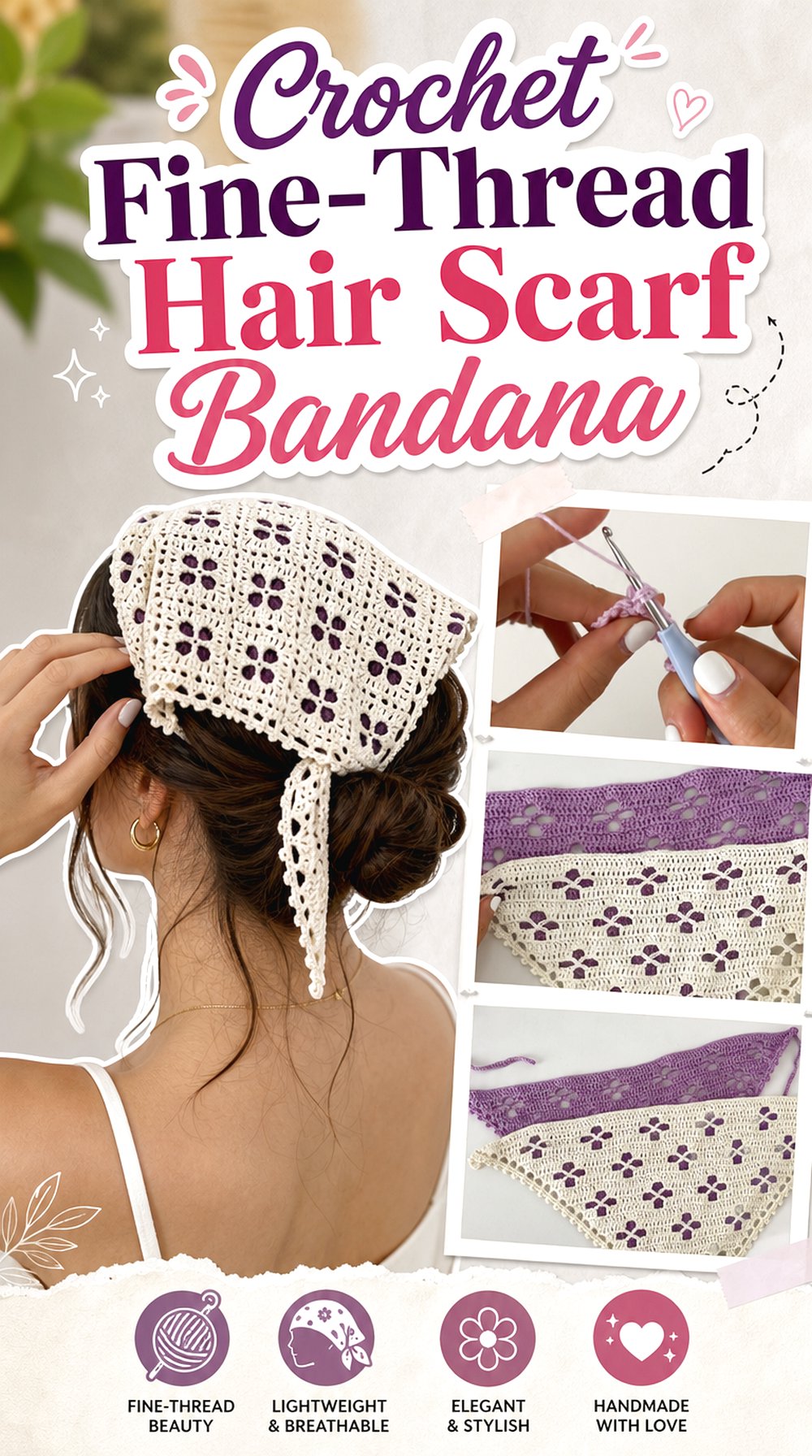
Fine crochet thread produces a noticeably different type of lace from the larger-yarn options above. The stitches themselves are smaller, allowing the overall fabric to look delicate even when the pattern contains several lines and openings.
CloudPusher’s hair-scarf video lists 1 mm cotton yarn with a 2.5 mm crochet hook, making it a useful reference for readers specifically drawn to fine-scale crochet. The video also focuses on pattern reading, so this option may appeal to someone who wants to pay close attention to the visual structure of the stitch pattern rather than simply follow a conventional narrated bandana tutorial.
Fine Yarn Magnifies Tension Differences
Small stitches can make changes in tension more noticeable across an otherwise delicate surface. After working enough fabric to see the pattern clearly, lay it flat and compare the two sides of the triangle.
You are looking for consistent shape rather than mathematical perfection. If one section seems much tighter, address the tension difference before investing more time in a fine-thread project where every row contributes relatively little physical depth.
This Style Favors Detail Over Bold Texture
A fine-thread bandana does not create the same chunky visual impact as the Lazy Lace option. Instead, its appeal comes from smaller-scale lines and openings.
That distinction helps when choosing between the two. Pick larger-scale lace when you want the crochet texture itself to look bold. Choose fine thread when you want the headscarf to appear lighter and more intricate at close range.
Allow Time for the Fabric to Settle Before Judging Size
Fine crochet may change in appearance after the fabric is gently arranged or blocked according to the yarn’s care requirements. Avoid deciding that the piece is definitely too small or too uneven while it is still curling directly from the hook.
First check the yarn label for appropriate care, then assess the fabric in a relaxed state. For any unfamiliar fiber, avoid heat unless the care information specifically supports the method you intend to use.
Creator: CloudPusher
8. Crochet Delicate Openwork Triangle Bandana
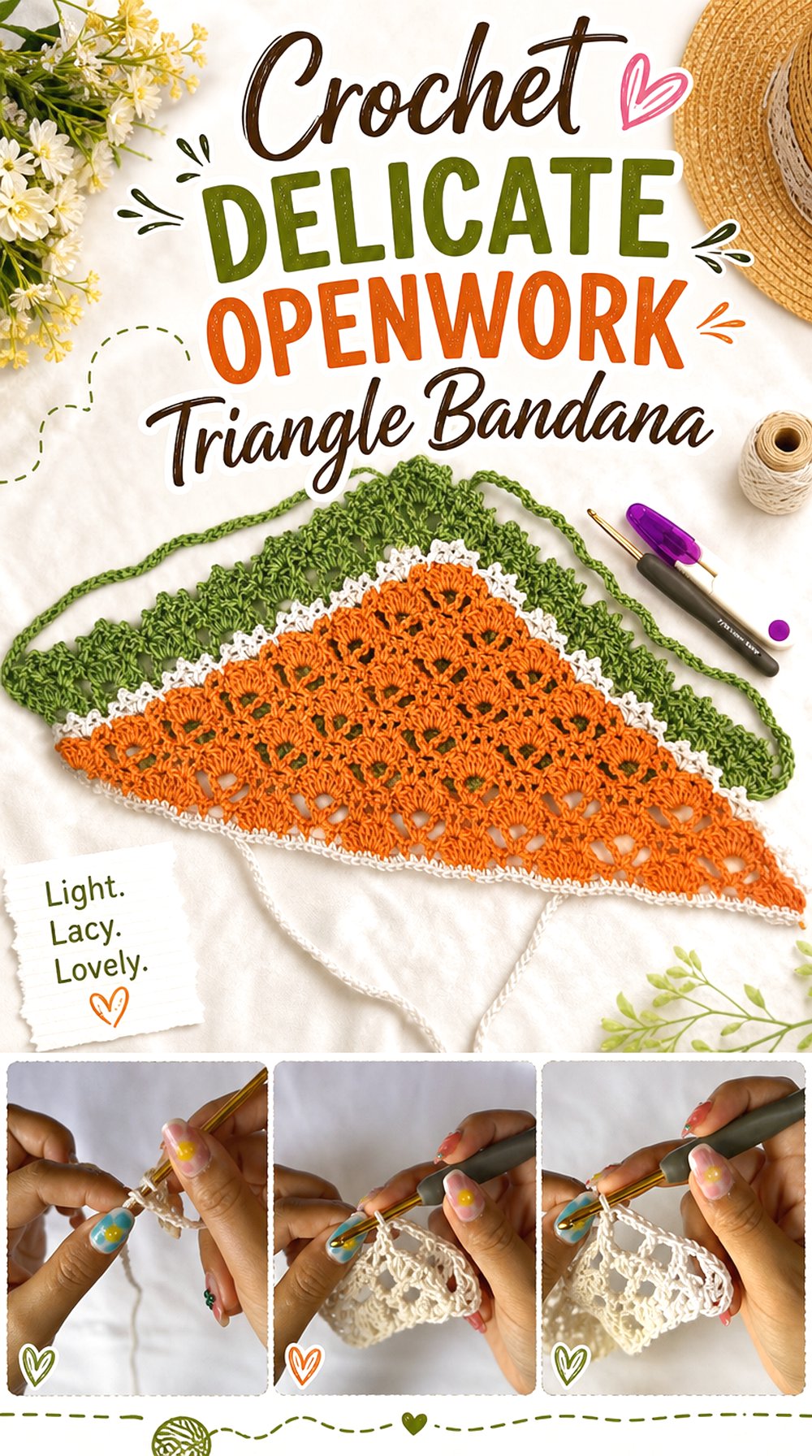
This final option is for readers who want the lace itself to feel like the main technical and visual challenge. Crochet Corner Ph presents the tutorial as an advanced crochet bandana and shows a delicate openwork fabric with a clearly lacy finish.
Compared with the granny-picot bandana, the surface appears more intricate; compared with the fine-thread scarf, the emphasis is less about tiny material scale and more about the stitch architecture. It works well as the “statement lace” choice in this group—an accessory where the crochet pattern is meant to attract attention before the color or border does.
Read the Fabric, Not Just the Current Stitch
Intricate lace becomes easier to troubleshoot when you regularly look at the shapes created several stitches or rows earlier. A missed placement may not become visually obvious until the next repeat begins.
Pause periodically and identify the major openings or lines in the fabric. If the pattern suddenly loses symmetry, return to the last point where the shapes looked correct rather than continuing and hoping the next section will disguise it.
Choose Yarn That Does Not Hide the Architecture
Highly textured or fuzzy fibers can soften lace outlines. That may be attractive for simple mesh, but it can make an intricate stitch pattern harder to appreciate.
For this project, judge yarn by more than softness or color. Work enough of the lace to see whether the openings and stitch groups remain identifiable. If they blur together, a smoother yarn may better support the design you selected.
Finishing Matters More as the Lace Becomes More Detailed
An intricate center can look unfinished if the outer edges pull unevenly. Once the main triangle is complete, inspect the upper edge, both sides, and the point before fastening everything permanently.
If blocking is appropriate for the fiber, use it to refine rather than completely reshape the bandana. Major distortion usually signals a sizing or tension issue that is better addressed before final finishing.
Creator: Crochet Corner Ph
Which Crochet Lace Bandana Style Should You Choose?
For the strongest geometric effect, start with the Crochet Diamond-Mesh Triangle Bandana. Choose the Crochet Floral-Lace Head Kerchief when recognizable motifs matter more than a sharp geometric repeat. The Crochet Fine-Thread Hair Scarf Bandana offers the smallest-scale, most delicate material look, while the Crochet Flowing Openwork Lace Kerchief takes lace in the opposite direction with larger yarn and bolder stitches.
If your priority is finishing rather than an all-over motif, compare the rounded Scalloped-Edge Lace Bandana, the more defined Lace-Edged Tie Bandana, and the pointed Granny-Picot Lace Bandana. The final Delicate Openwork Triangle Bandana is the option to investigate when you want a more intricate lace surface and are comfortable paying closer attention to stitch placement.
Conclusion
These eight crochet lace bandana ideas show why “lace bandana” can describe much more than one triangular headscarf. Diamond openings give a graphic finish, floral motifs soften the look, granny spaces create an orderly open texture, and fine thread produces a particularly delicate scale. Scallops, picots, and alternative strap treatments can also change the character of a bandana without replacing the entire body pattern.
Choose first by the amount of coverage, stitch definition, and edge style you actually want, then select yarn that supports that result. Before finishing any version, check the triangle on your own head rather than relying only on another maker’s dimensions. Use the original tutorials linked above for each creator’s exact construction details.
Frequently Asked Questions
What yarn works well for a crochet lace bandana?
There is no single required yarn because lace bandanas can be made at very different scales. Fine cotton creates smaller, more delicate stitchwork, while larger yarn can create bold openwork. The selected tutorials themselves range from fine cotton thread to worsted-weight yarn. Make a sample first and check whether the openings stay clear, the fabric bends around the head, and the yarn feels comfortable against your skin.
How do I know when a triangular lace bandana is large enough?
Try the unfinished triangle on before adding final edging or completing the ties. Check where the longest edge sits across your head, whether the side corners reach a comfortable tying position, and how far the center point extends down the back. If the pattern is designed to grow by repeating rows, stop according to the coverage you want rather than assuming somebody else’s row count will create the same size.
Should I block a crochet lace bandana?
Blocking can help open lace and refine the outline, but the appropriate method depends on the yarn. Check the fiber content and care instructions before introducing moisture, steam, or heat. The goal is to arrange the lace and even the shape, not force a badly sized triangle into entirely different dimensions. If the two sides differ significantly before finishing, check tension and stitch placement first rather than treating blocking as a repair for every shape problem.
Can I use a different yarn weight than the tutorial?
Often you can adapt an adjustable bandana, but changing yarn weight can alter stitch scale, triangle depth, width, drape, and the size of decorative borders. Do not expect the same number of repeats to create the same fit. Make a small sample, then judge the developing bandana against your own head. This is particularly important when moving between very fine thread and larger yarn because the visual scale of the lace changes substantially.
How can I keep the ties from distorting the lace edges?
Avoid using the ties to compensate for a triangle that is too large. Excessive pulling puts more tension on the corners where the fastening sections meet the lace. Before finishing, check that the bandana already sits close to the position you want with only normal tying tension. Also compare both side transitions so one tie is not attached to a noticeably tighter or looser edge than the other.
Which type of crochet lace bandana shows the stitch pattern most clearly?
Geometric diamond lace and floral lace make their motifs a major part of the main fabric, so they are strong choices when stitch pattern visibility is the priority. Fine-thread crochet can emphasize smaller details, while scalloped and lace-edged versions shift more visual attention to the perimeter. Choose according to whether you want people to notice the center motif, the overall airy texture, or the decorative border first.


