16 Crochet Spiderweb Bag Charm Ideas for Spooky Handmade Accessories
A spiderweb bag charm can be almost weightless and lacy, compact and graphic, softly textured, or paired with a dangling spider for more movement. That range matters because a web that looks striking as Halloween décor does not automatically behave well on a handbag. Scale, stiffness, attachment position, yarn texture, and open spaces all influence whether the finished charm stays recognizable or spends its time catching on zippers and straps.
These 16 ideas explore genuinely different approaches, including round and asymmetrical webs, solid-backed motifs, triangular and hexagonal shapes, a square-framed design, a tactile fidget keychain, and spider-and-web combinations. Each project points to an original creator tutorial while adding practical guidance for adapting the concept into a bag charm without replacing the creator’s construction instructions.
Quick List
- Beaded Fidget Crochet Spiderweb Bag Charm
- Asymmetrical Crochet Corner-Web Bag Charm
- Triangular Crochet Spiderweb Tag Charm
- Hexagon Crochet Surface-Web Bag Charm
- Ringed Crochet Spiderweb Medallion Charm
- Picot-Point Crochet Spiderweb Bag Charm
- Half-Web Crochet Tassel Charm
- Glitter-Stiffened Crochet Spiderweb Charm
- Soft Textured Crochet Spiderweb Bag Charm
- Minimal Round Crochet Spiderweb Clip Charm
- Adjustable-Scale Crochet Spiderweb Bag Charm
- Dangling-Accent Crochet Spiderweb Bag Charm
- Fine-Line Crochet Spiderweb Disc Charm
- Square-Framed Crochet Spiderweb Bag Charm
- Spider-and-Web Crochet Dangle Charm
- Crisp Crochet Spiderweb Appliqué Charm
Choose Scale and Yarn With the Bag in Mind
A bag charm needs a different balance from a wall decoration. Fine or lightweight yarn can preserve the open spaces that make a spiderweb recognizable while keeping the finished piece relatively light. A smooth yarn also tends to show individual spokes more clearly than a highly fuzzy fiber. Several source designs specifically use cotton, crochet thread, DK yarn, or similar smooth materials, although the exact choice varies from tutorial to tutorial.
When adapting a larger web, reducing yarn thickness and using a compatible hook can change the finished scale, but it can also change drape and firmness. Make a small sample rather than assuming every pattern will shrink proportionally. Before adding hardware, hold the finished motif against the actual handbag and check whether it overwhelms the zipper area, folds into pockets, or catches easily on neighboring straps.
Plan the Attachment Before Finishing the Web
The prettiest point on a spiderweb is not always the strongest attachment point. Open chain spaces can distort if the full weight of a charm, beads, spider, or metal clip is concentrated on one delicate loop. Whenever possible, place the connector where several stitches meet or add a separate reinforced yarn loop rather than forcing a jump ring through a fragile chain.
Also consider how the charm will move. A short attachment keeps a flat motif close to the bag, while a longer cord emphasizes movement but increases snagging. A lobster clasp or removable keyring can make seasonal charms more practical than sewing them permanently to a handbag. If you are adding metal findings, check that no sharp edge is rubbing repeatedly against the yarn.
Shape, Blocking, and Small-Part Safety Matter
Open spiderwebs often look much clearer after shaping. Several original tutorials specifically discuss blocking or stiffening because chain-heavy motifs can curl or lose their radial form before finishing. For a bag charm, however, extreme stiffness is not always desirable: a rigid web may keep its outline beautifully but can feel less flexible when pressed against the bag.
Beads, buttons, plastic spiders, safety eyes, and detachable hardware also change how the charm should be used. One keychain tutorial specifically warns that its small components are unsuitable for children under three or anyone likely to put small parts in their mouth. For a child-accessible bag, embroidered or fully crocheted details may be a better design direction than loose embellishments.
1. Beaded Fidget Crochet Spiderweb Bag Charm

This idea begins with an actual spiderweb keychain rather than converting a large décor motif. Crocheting Around My Kitchen Table, LLC. presents a fidget-style web that incorporates beads, giving the finished accessory both visual detail and something movable to interact with. The source explicitly describes it as a keychain, so it is one of the most direct starting points in this collection for a backpack or purse clip.
For a bag charm, the appeal is the combination of web structure and dimensional embellishment. It suits someone who wants more than a flat seasonal motif, although the additional components require more attention to attachment security and intended user.
Keep the Moving Parts Intentional
Beads can make a web more tactile, but too many additions may obscure the open geometry that identifies it as a spiderweb. Before attaching hardware, move every bead through its available range and check whether it catches in neighboring loops. A decorative element that works while the charm is lying flat may behave differently once it swings beside a zipper.
If you alter the bead type from the tutorial, confirm that the holes, weight, and edges work with your chosen yarn rather than assuming interchangeable results.
Check Hardware Against the Yarn
A keychain takes more abrasion than a hanging decoration. Examine the point where the crochet meets the keyring or clip and make sure the metal cannot gradually saw through a single strand. Reinforcing that connection with a compact crocheted loop can distribute stress more effectively than attaching a ring to a long decorative chain space.
Periodically checking the connection is sensible if the charm lives on an everyday bag that is handled frequently.
Treat Small Components as a Safety Issue
This source carries a small-parts warning, which is especially relevant when the design includes beads or buttons. A charm intended for an adult handbag is a different use case from one attached to a toddler’s backpack or stroller.
If the accessory could reach a young child, do not rely on decorative attachment alone. Consider avoiding beads altogether and choose a fully crocheted web design from elsewhere in this list.
Original Tutorial and Creator Credit
Creator: Crocheting Around My Kitchen Table, LLC.
2. Asymmetrical Crochet Corner Web Bag Charm
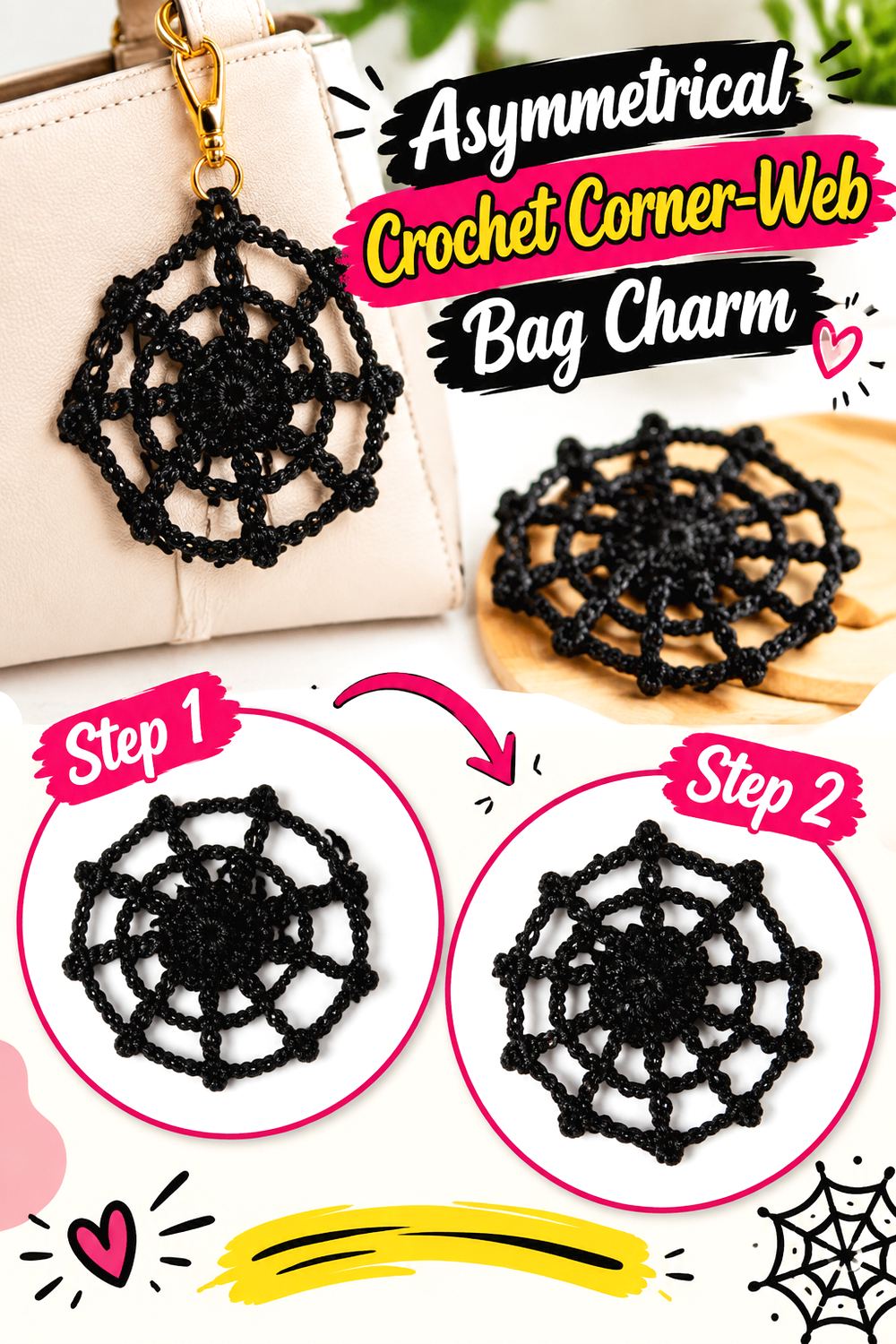
A perfectly circular web is not the only silhouette that reads clearly as a spiderweb. GoldenLucyCrafts provides both round and asymmetrical web instructions; the asymmetrical form creates a less formal outline with varied spoke lengths and is particularly suited to a charm intended to hang from one corner. The original is a small crochet-thread appliqué rather than a bag charm, so the hardware conversion is an editorial adaptation rather than part of the source tutorial.
This irregular shape can look especially effective on a structured tote or dark handbag where the open lace has enough contrast. It also avoids the medallion-like appearance of many circular designs.
Use the Irregular Edge as the Feature
Trying to force an asymmetrical web into a round outline defeats what makes this version different. Let the longer spokes determine the direction in which the charm hangs, then choose an attachment point that displays the uneven silhouette rather than rotating it sideways.
Before fastening the clip permanently, suspend the web temporarily from several outer points. One orientation may naturally look more balanced once gravity replaces the flat blocking surface.
Protect Fine Thread From Abrasion
The source uses size 10 crochet cotton and a small hook for its appliqué. Fine thread creates crisp detail, but a charm made for daily use encounters more rubbing than an appliqué sewn flat to another surface.
Keep rough metal edges away from the thread and consider attaching the web through a small crocheted connector rather than opening a jump ring directly through a delicate picot.
Preserve the Shape After Blocking
GoldenLucyCrafts specifically explains blocking and stiffening its spiderweb appliqués to establish their final appearance. If you adapt that idea for a flexible bag charm, decide how rigid you actually want the piece before applying any stiffening treatment.
A lightly shaped web may move more naturally with the bag, whereas a firmer web will hold its asymmetrical outline more consistently. Fiber and stiffener compatibility should always be checked first.
Original Tutorial and Creator Credit
Creator/Site: GoldenLucyCrafts
3. Triangular Crochet Spiderweb Tag Charm

Heather Corinne’s spiderweb design takes a different route from radial lace webs. The original coaster is built as a triangular base with contrasting web lines added across the surface, producing a graphic, solid-backed motif rather than an entirely open web. The designer also notes that the project can function as an appliqué or garland element and describes it as a useful size for gift-tag accessories.
Reduced or used at a suitable scale, that construction makes an interesting bag charm because the background provides more stability than open chain lace. It would suit someone who likes a bold web image but worries about delicate spokes snagging during everyday use.
Consider the Advantage of a Solid Base
A backed web distributes handling across the entire crochet fabric instead of asking individual web strands to support the accessory. That can make the piece less prone to collapsing visually when it brushes against a coat or bag.
The trade-off is weight and thickness. If you substitute a substantially heavier yarn, the charm may become bulkier than expected. Compare the finished sample against the intended bag before adding extra borders or embellishments.
Let Contrast Do the Work
Because the web is created over a contrasting base, color placement affects readability more strongly than it would on a freestanding lace web. High contrast makes the radial lines visible from farther away, while closely related colors create a subtler motif.
If the bag itself is patterned, hold the charm against it before committing to the final web color. A combination that looks clear on a plain work surface can disappear visually against busy fabric.
Decide Where the Triangle Should Hang
A triangular charm can hang from a point, from a top corner, or from the middle of one edge, and each produces a different visual direction. Test the balance before adding a permanent loop.
Attaching at the narrow point emphasizes a pennant-like shape. Attaching along the wider edge makes the spiderweb read more like a tag. Neither is inherently better; the bag proportions should determine the most stable orientation.
Original Tutorial and Creator Credit
Creator/Site: Heather Corinne
4. Hexagon Crochet Surface Web Bag Charm

Raffamusa Designs uses a solid hexagon as the foundation for a spiderweb coaster, then creates the web effect on the surface in a contrasting color. That combination gives the motif six clear corners and a substantial background, making it visually closer to a patch or medallion than an open doily.
As a bag-charm concept, the hexagon is useful because the outer shape remains readable even if the accessory turns or swings. It also offers several structurally substantial corners from which a connector can potentially be positioned. Keep in mind that converting the coaster to a hanging accessory is an adaptation; use the original tutorial for its actual crochet construction.
Choose the Hanging Corner First
With six corners available, it is worth deciding which one will become the top before any optional embellishment is placed. Suspend the finished hexagon temporarily and see whether the web appears centered when viewed vertically.
If you add a spider or bead afterward, that extra weight can change the balance. Test everything together before closing a permanent connector, particularly when the embellishment sits toward one side.
Watch Surface Stitch Tension
Surface crochet creates strong visual lines, but excessive tension can pull a flat backing out of shape. If the web looks puckered after finishing, check whether the decorative stitches are restricting the base rather than immediately trying to correct the hexagon with heavy blocking.
When adapting the size or yarn, maintaining relaxed surface work becomes even more important because the relationship between the base fabric and decorative line changes.
Use the Back as a Finishing Checkpoint
A charm is likely to flip over during use, so the reverse side matters more than it does for a coaster sitting on a table. Before adding the clip, inspect woven ends, knots, and any attachment tails from the back.
Secure finishing does not require making the reverse identical to the front, but loose yarn ends can catch on zipper pulls and hardware. A neat back also makes the charm look more deliberate when it rotates.
Original Tutorial and Creator Credit
Creator/Site: Raffamusa Designs
5. Ringed Crochet Spiderweb Medallion Charm

The spiderweb coaster from It’s all in a Nutshell Crochet creates a circular motif with repeated open and solid-looking rings rather than relying on only long chain arches. The source works the design in the round and finishes it with a contrasting outer treatment, giving the result a medallion-like character.
For a bag charm, that rhythm of concentric detail can feel more substantial than a very sparse web. It is a good direction for someone who wants the spiderweb theme to remain visible when the charm is viewed from a slight distance. A scaled sample is sensible before committing to hardware because changing yarn weight alters both diameter and visual density.
Balance Openness With Structure
The more open a motif becomes, the easier it is for individual spaces to catch on projecting objects. This design’s mixture of denser rounds and open sections offers a different compromise from a chain-only web.
If you scale the motif down, make sure the negative spaces remain large enough to read as webbing. A tiny version worked too tightly may visually merge into a textured circle instead of retaining the intended web character.
Treat the Outer Edge as the Frame
The contrasting outer round in the source helps define the perimeter. On a charm, that edge can become an important visual frame, especially if the web colors are similar to the handbag.
Consider the outer color alongside the hardware rather than only alongside the center. A strong border can separate the motif from the bag, while a low-contrast border creates a quieter accessory.
Check the Finished Circle Before Clipping
Round motifs reveal distortion quickly. Lay the web flat after finishing and check whether one section pulls inward or bulges outward. Minor variation may disappear when suspended, but an attachment loop can exaggerate an already uneven side.
If blocking is appropriate for your chosen fiber, shape the motif before adding metal hardware. That keeps the finishing process simpler and avoids exposing clasps or rings to unnecessary moisture.
Original Tutorial and Creator Credit
Creator/Site: It’s all in a Nutshell Crochet
6. Picot Point Crochet Spiderweb Bag Charm

Petals to Picots adds small pointed details around the perimeter of its round spiderweb pattern. Those picots break up the outer circle and make the motif look sharper and more decorative than a completely smooth edge. The original project uses a traditional radial spiderweb construction and specifically notes cotton as a material that keeps its shape well.
Used as inspiration for a bag charm, the pointed edge gives the web enough detail to stand alone without requiring a separate spider. It is especially suited to a more delicate gothic accessory, although every additional edge point is another place that can potentially snag.
Decide Whether Every Picot Needs Exposure
A decorative outer point can look excellent on a charm that hangs freely, but it may catch more readily if pressed against a fuzzy coat, knit sweater, or open-weave handbag. Consider where the bag is normally carried.
If snag resistance matters more than maximum lace detail, positioning the charm on a short connector may help keep the outer points from swinging into straps and zippers.
Cotton Changes the Visual Character
The designer notes that cotton keeps shape particularly well for this pattern. That makes sense for crisp web geometry, but a different fiber can create a softer result.
Treat substitution as an aesthetic and structural choice rather than only a color decision. A highly elastic or fuzzy yarn may soften the picot definition, while a smooth yarn generally makes small edge details easier to see.
Reinforce Without Hiding the Pointed Border
Adding hardware directly through a decorative picot could put repeated stress on a detail that was designed primarily for appearance. Instead, consider adding a separate attachment loop at a nearby structural point.
The goal is to keep the outer border visually intact while allowing the connector to absorb daily movement. Test the loop length with the actual clasp before weaving in every final end.
Original Tutorial and Creator Credit
Creator/Site: Petals to Picots
7. Half Web Crochet Tassel Charm

A half-web creates a completely different silhouette from the familiar circular spiderweb. Creativebug’s tutorial by Twinkie Chan includes both whole-web and half-web versions, with the latter spreading outward in rows rather than making a complete circle. That makes it a strong source for a fan-shaped bag charm.
The straight edge can sit close to a connector while the web arcs hang below it, creating a shape that resembles a small lace tassel without requiring fringe. This direction can work particularly well beside a zipper because the charm has an obvious top and bottom instead of rotating visually like a circular motif.
Take Advantage of the Flat Top
A half-web gives you a natural attachment side. Rather than hanging the piece from one tiny outer point, a connector can be planned around the straighter upper portion so the web remains oriented correctly.
If you want the charm to hang from a single clasp, consider how the transition from wide crochet edge to narrow attachment loop will look. A centered connector usually emphasizes the fan shape most clearly.
Test the Fan Shape Under Gravity
Blocking a half-web flat does not guarantee it will look identical once suspended. Hold the motif from the intended top point after shaping and observe whether the outer arches fold inward.
If they do, the problem may be attachment placement rather than crochet tension. Moving the hanging point slightly or shortening the connector can sometimes display the half-web more clearly without changing the motif itself.
Add Movement Without Adding Bulk
Instead of attaching a heavy pendant below the half-web, a light yarn tassel or single small crochet accent can extend the vertical line. Keep added weight modest because a heavy lower embellishment may stretch the most open sections.
This shape is already visually directional, so extra decoration is optional. Leaving the lower edge open can make the spiderweb itself the strongest element.
Original Tutorial and Creator Credit
Creator/Site: Creativebug / Twinkie Chan
8. Glitter Stiffened Crochet Spiderweb Charm

Craft Fix approaches the spiderweb as a lace decoration that benefits strongly from shaping. Its tutorial discusses thinner yarns for a more web-like appearance, shows how the motif can be extended in size, and includes a dedicated stiffening and pinning process.
That makes the design an excellent reference for a crisp, sparkly bag charm where shape retention is part of the aesthetic. Rather than letting the web collapse softly against the handbag, this version can be treated more like a miniature lace ornament. Adaptation should still be conservative: a charm needs enough flexibility to survive handling and storage.
Sample the Stiffness Before Treating the Whole Web
Fabric stiffener can make open crochet dramatically more defined, but the amount appropriate for wall décor may be more rigidity than you want on a handbag. Test your treatment on a small yarn sample first.
Look for a balance where the spokes stay open without becoming brittle. A bag charm will be bent, bumped, and occasionally compressed, so durability matters alongside the crisp blocked silhouette.
Metallic Yarn Can Change More Than Color
Craft Fix specifically discusses sparkly yarn options in its materials guidance. Metallic or glitter elements can make a tiny web more visible, but yarns containing decorative filaments may feel different from plain cotton or acrylic.
Check how comfortably your hook moves through the yarn and whether the finished strand feels abrasive against delicate bag fabric. Visual impact is useful only if the material suits the intended handbag.
Keep the Hanging Loop Separate From the Web Shape
The source includes an optional hanging loop for its decoration. For a removable bag charm, that concept can be adapted by connecting the crochet loop to appropriate hardware.
Avoid stiffening the flexible connector to the same degree as the decorative web unless that is intentional. A slightly flexible top loop allows the charm to move while the web itself remains shaped.
Original Tutorial and Creator Credit
Creator/Site: Craft Fix
9. Soft Textured Crochet Spiderweb Bag Charm
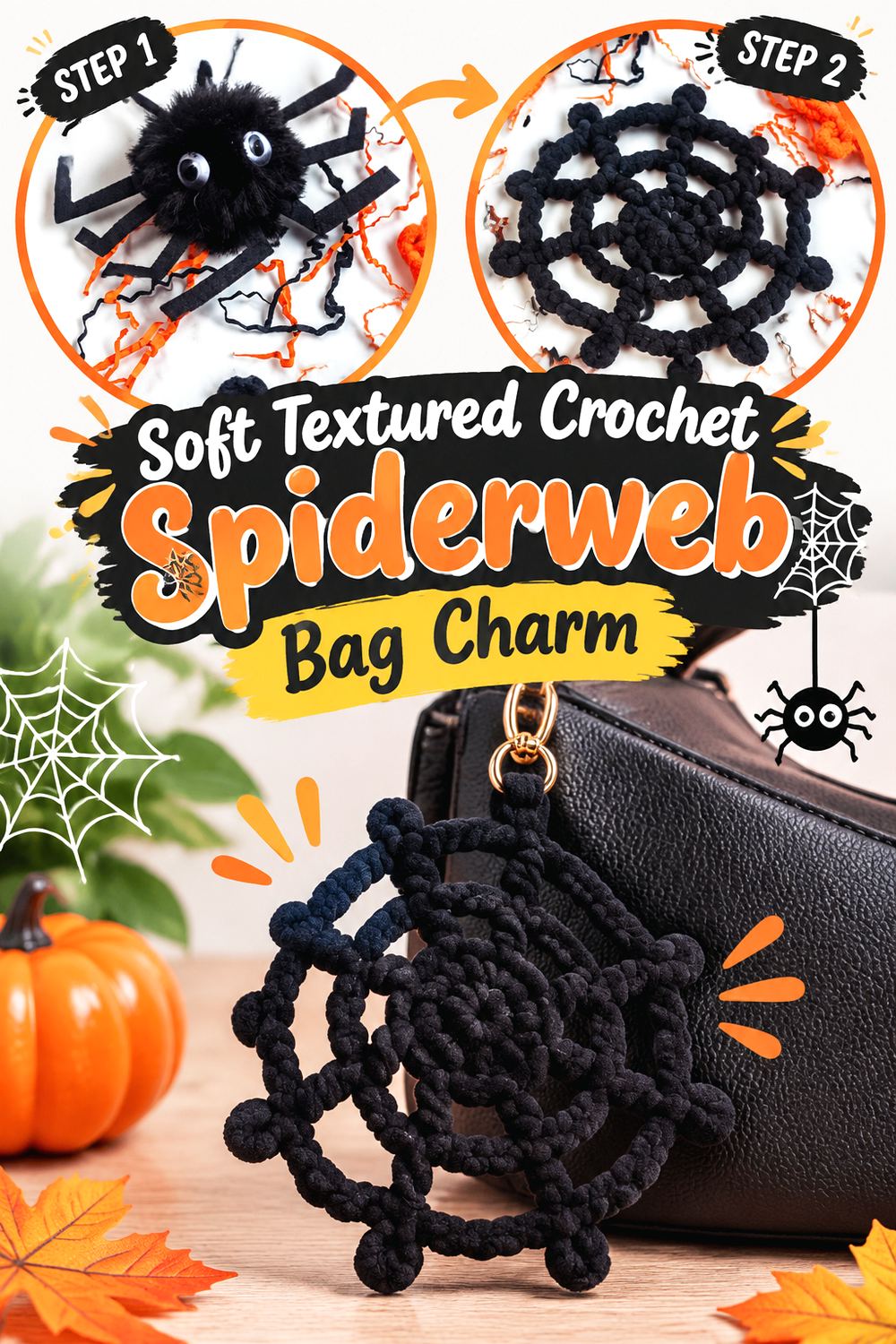
Annie Design Crochet’s version deliberately explores a chunky, soft spiderweb using super bulky yarn. The published web is much larger than a conventional bag charm, but the designer also explains that the same concept can be made with thinner yarn and a corresponding hook for a smaller, lacier result.
That flexibility makes the tutorial useful for planning a more tactile charm rather than an ultra-fine thread motif. Instead of aiming for crisp jewelry-like lace, this direction celebrates yarn texture. Scale is the critical decision: keeping the original chunky dimensions would produce a decoration, not a practical handbag accessory.
Reduce Scale Deliberately
Switching to thinner yarn is the obvious route to a charm-sized interpretation, but do not judge scale from the yarn label alone. Crochet a sample through enough of the motif to see its actual spread.
The goal is a web that still shows clear open spaces while fitting comfortably beside the bag hardware. If the first sample feels too dense, adjusting hook-to-yarn proportion may be more useful than simply choosing an even thinner yarn.
Decide How Plush You Want the Surface
A soft yarn can make the web feel more substantial and playful, but excessive fuzz may blur the spoke-and-ring structure. Look at the motif from arm’s length rather than only close up.
If the spiderweb disappears visually, consider a smoother yarn or stronger color contrast. Texture should support the shape rather than becoming the only feature a viewer notices.
Avoid Overloading a Soft Web
A tactile web does not need beads, charms, tassels, and a spider all at once. Additional weight can pull down the open portions and make a softer motif sag.
If you want one extra feature, place it close to a strong structural point and reassess the hanging shape. This version works best when the yarn texture itself remains part of the design.
Original Tutorial and Creator Credit
Creator/Site: Annie Design Crochet
10. Minimal Round Crochet Spiderweb Clip Charm

One Little Project offers a straightforward round spiderweb with evenly spaced radial lines and open rings. The source presents it as a Halloween decoration and uses a clean, uncomplicated silhouette without requiring a solid backing or extra spider.
That simplicity translates well into a minimalist bag-charm concept. Rather than adding multiple embellishments, the web itself can hang from a small removable clip. This is a useful direction for a person who wants a recognizable spiderweb without a highly gothic, beaded, or character-based look. Because the source project is décor, determine your own appropriate charm scale before choosing the final yarn.
Let Negative Space Stay Visible
The open areas are as important as the yarn itself. If you reduce the motif substantially, watch that your stitches do not crowd together until the web reads as a dense wheel.
Place the sample on both light and dark surfaces. A color that looks clear against your table may disappear against the handbag, especially when the negative spaces are small.
Use a Short Connector for a Clean Look
A minimalist motif can lose its simplicity if the hardware becomes visually dominant. A short crocheted loop, small clasp, or understated keyring generally keeps attention on the web.
This also reduces unnecessary swing. Less movement can mean fewer opportunities for an open motif to catch on adjacent zipper pulls, tassels, or bag straps.
Finish Every Tail Carefully
Sparse motifs leave nowhere to hide sloppy finishing. A loose tail or bulky woven section can be more visible than it would be on dense fabric.
Inspect both sides before adding hardware. When weaving ends, avoid pulling so firmly that the center or one outer spoke becomes distorted. The visual symmetry of the entire web depends on keeping the finishing tension neutral.
Original Tutorial and Creator Credit
Creator/Site: One Little Project
11. Adjustable Scale Crochet Spiderweb Bag Charm

Nana’s Crafty Home emphasizes that its spiderweb pattern can be continued to create the desired size. The original project shown is much larger than a handbag charm, but that customizable construction makes it a useful source for understanding how a radial web expands. The designer also recommends blocking to open the stitches and clarify the finished shape.
For a charm adaptation, the important idea is not to crochet the full décor dimensions and then try to make them work. Instead, use the creator’s tutorial to understand the motif and evaluate where a smaller version produces a visually complete web suitable for your intended bag.
Stop Based on Proportion, Not Habit
A repeating web does not need every possible round to look finished. For a bag charm, additional rounds increase both diameter and the length of unsupported chain spaces.
Pause periodically and compare the piece with the clasp and handbag. The most useful stopping point is the one that creates a balanced accessory, not necessarily the maximum size demonstrated in a décor context.
Blocking Can Reveal Tension Problems
The source recommends blocking because it helps open the spiderweb form. Before blocking, check whether individual spokes already vary noticeably in length.
Shaping can improve presentation, but it should not be expected to correct major counting or tension inconsistencies. If one segment behaves very differently, correcting the crochet while the problem is still accessible may produce a better long-term result.
Pair With a Spider Only if Scale Allows
Nana’s Crafty Home also has a coordinating crochet spider design, and the web page discusses pairing the two. On a reduced charm, however, a second motif can quickly dominate.
Compare the spider and web together before attaching them. Leaving the spider separate, placing it near an edge, or using only the web may preserve better proportions depending on your final scale.
Original Tutorial and Creator Credit
Creator/Site: Nana’s Crafty Home | Tonya Bush
12. Dangling Accent Crochet Spiderweb Bag Charm
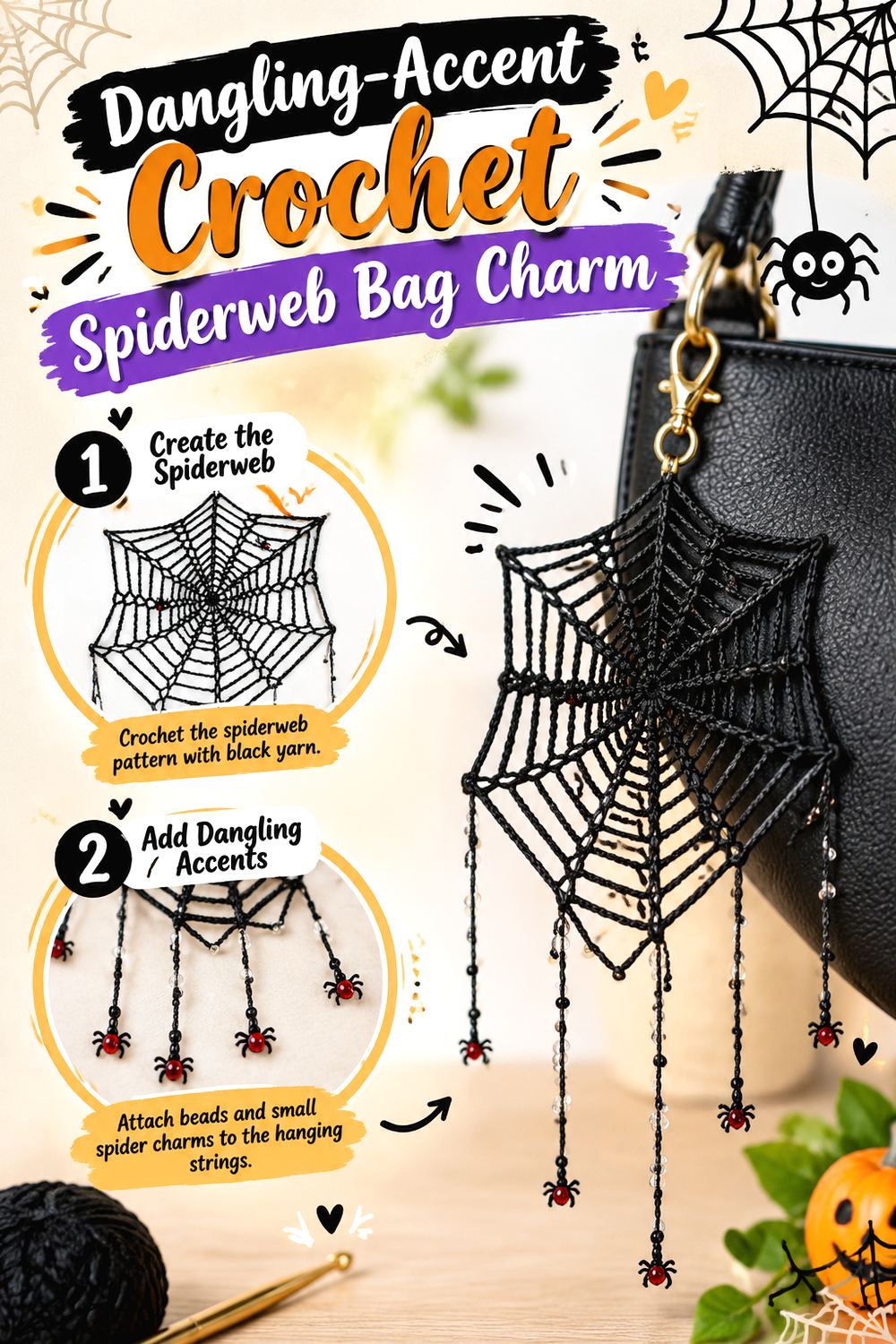
Dominique Calvillo’s Namaste & Crochet spiderweb design offers an especially useful styling idea: the finished web is shown with extra chain strands and spider decorations draped from it. The original is designed at décor scale, not as a handbag accessory, but the dangling composition suggests a distinctive charm arrangement when responsibly reduced.
Instead of making a single flat pendant, this concept can combine a central crochet web with one or two lightweight hanging accents. The result has more vertical movement than the compact medallion designs elsewhere in the list. Keep the adaptation simple enough that dangling pieces do not tangle continually around the clasp.
Limit the Number of Dangles
More hanging strands create more movement, but they also increase the chance of tangling. For a handbag, one offset spider or a small pair of short strands may be more manageable than recreating a full wall-hanging arrangement.
Test the charm by carrying the bag around the house for a while. If the dangles consistently wrap around each other or the zipper, shortening them can improve function without changing the underlying concept.
Treat the Center Web as the Anchor
Every hanging component ultimately adds load to the central web. Attach secondary pieces near stronger junctions instead of placing their full weight on long open chains.
If your chosen spider is dimensional or stuffed, compare its weight against the web before final assembly. A tiny web supporting an oversized spider may tilt or collapse rather than hanging as intended.
Sparkle Works Best With Restraint
The designer’s project uses black cotton together with a glittery silver/black yarn for a sparkling Halloween effect. That offers one approach to making a dark web visible without adding multiple colors.
For a bag charm, metallic yarn can already provide enough emphasis. Adding beads, metallic hardware, and several sparkly dangles at the same time may compete with the actual crochet.
Original Tutorial and Creator Credit
Creator/Site: Namaste & Crochet Makers / Dominique Calvillo
13. Fine Line Crochet Spiderweb Disc Charm

justMiko’s spiderweb decoration tutorial produces a round, open web that the creator describes as a spiderweb coaster for Halloween. The video materials specify comparatively fine yarn and a small hook, which contributes to the delicate linework visible in the finished motif.
As a bag-charm idea, this version belongs at the refined end of the spectrum: little extra decoration is necessary if the web itself is neat and symmetrical. Scale the concept according to the handbag rather than assuming a coaster diameter is ideal. A small disc-like web can look particularly effective on a plain backpack, structured black bag, or zipper pouch where the contrast remains clear.
Prioritize Consistent Spokes
Fine yarn makes irregular spacing easier to notice. Count and visually compare the radial sections as the motif develops instead of waiting until the entire web is finished.
If one area looks compressed, check your tension and placement before continuing. A clean disc depends less on embellishment and more on the repeated geometry remaining balanced around the center.
Keep the Edge From Folding
A delicate circular web may soften once it is handled. After whatever shaping method is appropriate for your fiber, hold the web vertically and watch the outer ring rather than judging it only while flat.
If the lower edge folds inward immediately, a slightly firmer yarn or more careful finishing may suit bag use better. Do not automatically compensate by making the web larger.
Match the Clip to the Delicate Scale
Large keychain hardware can overpower a fine motif. Lay several findings beside the finished web before selecting one, paying attention to both physical weight and visual proportion.
The clasp needs to be secure, but it does not have to become the largest object in the accessory. A compact removable connector usually lets a fine web remain the focal point.
Original Tutorial and Creator Credit
Creator: justMiko
14. Square Framed Crochet Spiderweb Bag Charm

Storybook Crochet places a spiderweb inside a granny-square structure, creating one of the most distinct silhouettes in this collection. Instead of ending with exposed circular spokes, the web is contained within a solid outer square that creates four defined corners. The tutorial specifically presents the motif as useful for projects including bags as well as other Halloween pieces.
Using a single square as a charm gives the design a graphic patch-like quality. The frame can also make it easier to coordinate with geometric handbags and backpacks. Because a granny square was not originally designed as a hanging pendant, the attachment method deserves deliberate planning.
Use the Frame as Reinforcement
The outer square offers denser attachment points than the central open web. That makes the border the logical place to evaluate hardware placement instead of piercing a delicate interior chain space.
Try hanging the square from one corner for a diamond orientation and from the center of one side for a conventional square orientation. Both use the same motif but create noticeably different final accessories.
Keep the Web Visible Inside the Border
When shrinking a granny-square motif, the surrounding frame can visually overwhelm the web. Compare border thickness with the open center before deciding that the smallest possible version is automatically the best charm.
Strong color contrast can help preserve the design. Another option is keeping the outer frame restrained so the eye moves first toward the spiderweb center.
Block for Corners, Not Just Flatness
A square charm looks most intentional when its corners are recognizable. If your fiber and tutorial guidance support blocking, check both the overall flatness and whether the four corners align evenly.
Hardware adds another pull after blocking, so suspend the finished square and reassess. A perfectly square piece on a mat may shift slightly when its full weight hangs from only one corner.
Original Tutorial and Creator Credit
Creator: Storybook Crochet
15. Spider and Web Crochet Dangle Charm

Mooeyandfriends’ SpiderWeb Bookmark combines a crochet web, a separate spider, and a long crocheted connection between them. Although designed as a bookmark, the project already demonstrates how two crochet motifs can be linked into one vertical accessory. The creator also notes that the web portion can be used decoratively outside its bookmark role.
That makes it an excellent source for a bag charm in which the web hangs near the clip and the spider sits lower on a short cord. Compared with a spider sewn directly onto a web, this arrangement gives both pieces room to move and keeps their silhouettes individually recognizable.
Shorten the Connection for Bag Use
A bookmark benefits from length because one element can remain inside a book while the other extends beyond it. A handbag charm has a different job. Too long a connector may wrap around handles or disappear into a pocket.
Determine the hanging distance by testing the two motifs against the actual bag. Shortening the visual gap can preserve the two-part design while making the accessory easier to manage.
Give the Spider Enough Visual Weight
If the spider is extremely small relative to the web, the lower motif may read as an indistinct knot from a distance. If it is too large, it can pull the web out of shape.
Rather than relying on an exact ratio, temporarily connect the completed motifs before final assembly. Their balance depends on your yarn, tension, and any change in scale from the original bookmark.
Address Curling Before Assembly
Michelle discusses blocking the web when curling becomes an issue in the original project. This is worth resolving before adding bag hardware because the hanging cord and spider introduce new directions of pull.
Shape the web first, allow it to settle, and then judge the completed dangle vertically. That sequence makes it easier to tell whether distortion comes from the web itself or from the final connection.
Original Tutorial and Creator Credit
Creator/Site: Mooeyandfriends / Michelle
16. Crisp Crochet Spiderweb Appliqué Charm

OhMeOhMyCrochet’s spiderweb tutorial focuses specifically on an appliqué. The video lists DK-weight cotton among its supplies and includes yarn stiffener as an optional finishing material, making the project a strong reference for a compact web intended to retain a clear outline.
To adapt the appliqué into a bag charm, the most important change is functional rather than decorative: instead of sewing the motif flat onto fabric, it needs an attachment loop that can take repeated movement without distorting the web. This makes a clean final option for readers who want a recognizable web without a backing, spider, beads, or long dangling pieces.
Add the Connector at a Structural Junction
An appliqué normally distributes its shape through multiple sewn attachment points. Once it becomes a charm, one small area may carry the entire load.
Choose a point where the crochet structure is comparatively substantial, or add a dedicated loop during finishing. Avoid assuming that the most decorative outer opening is automatically strong enough for metal hardware.
Decide Whether Stiffener Suits Your Bag
The source lists yarn stiffener as optional. For a handbag charm, that gives you two visual directions: a softer web that moves with the bag or a more defined motif that keeps its blocked shape.
Consider how the bag is stored. A very rigid charm may be inconvenient if the handbag is often packed tightly, while a soft motif may need occasional reshaping.
Keep the Final Version Visually Simple
This design does not need a spider to communicate the theme. A contrasting clasp, one tiny bead, or simply a strong yarn color can be enough.
Restraint also reduces weight and snag points. If the purpose is a crisp spiderweb silhouette, additional decoration should support that silhouette rather than cover the open spaces that make the appliqué recognizable.
Original Tutorial and Creator Credit
Creator: OhMeOhMyCrochet
Which Crochet Spiderweb Bag Charm Style Should You Choose?
For the most straightforward bag-ready project, the Beaded Fidget Crochet Spiderweb Bag Charm starts from an actual keychain tutorial, while the Spider-and-Web Crochet Dangle Charm already uses two connected motifs. If snag resistance is a bigger concern, the solid-backed triangular and hexagonal designs or the square-framed granny motif provide more fabric around their web details.
Choose one of the fine open webs when delicacy and visible negative space matter most. The half-web gives a strongly directional silhouette, while the asymmetrical version feels less formal than a circular motif. For texture, the scaled-down chunky concept stands apart. Whichever direction you choose, prioritize the final charm’s scale, attachment point, and behavior on the actual bag over color alone.
Conclusion
These 16 crochet spiderweb bag charm ideas show how much the same spooky motif can change through shape and construction. A web can become a tiny open medallion, a graphic solid-backed tag, a square-framed motif, a tactile keychain, or one half of a dangling spider-and-web accessory. The most practical choice depends on where the charm will hang and how much rubbing, swinging, or snagging it is likely to encounter.
Before adding hardware, check the finished scale, reinforce the attachment area where appropriate, and decide whether the web needs blocking or added firmness. For exact construction, materials, and project-specific instructions, follow the credited original tutorials near the end of each idea.
Frequently Asked Questions
What yarn works well for a crochet spiderweb bag charm?
There is no single required yarn because the original tutorials use several different fibers and weights. For a compact open web, a smooth yarn or crochet thread can make spokes and chain spaces easier to see. Softer or thicker yarn creates a more tactile result but may produce a larger motif. Always choose a hook compatible with the yarn and make a sample before assuming a décor-sized pattern will automatically become charm-sized.
How can I make a larger spiderweb tutorial small enough for a bag charm?
Using a thinner yarn and an appropriately smaller hook can reduce scale, and some source patterns also allow the maker to stop after fewer expanding rounds. However, changing materials may alter firmness and proportions as well as size. Make a partial sample and compare it directly with the handbag. The web should remain recognizable, leave useful negative space, and avoid becoming so wide that it interferes with handles or zippers.
Should I stiffen a crochet spiderweb charm?
Only when the yarn and intended use make it helpful. Stiffening can make open spokes look cleaner and help a web retain a crisp outline, and several source tutorials use blocking or optional stiffener for that reason. A softer charm, however, may tolerate everyday bending better. Test any stiffening product on the yarn first and follow its manufacturer instructions rather than assuming every fiber responds the same way.
Where should the keyring or clasp attach?
A dense stitch junction, sturdy border, or purpose-made crocheted loop is generally preferable to forcing hardware through one delicate chain. Open webs can distort when the accessory’s entire weight pulls on a fragile section. Test the charm vertically before securing the connector permanently. If one side stretches or twists, changing the attachment point may solve the problem more effectively than trying to block the finished charm into position afterward.
Can I add beads or a small spider to any spiderweb charm?
They can be useful decorative additions, but they change weight, movement, snag potential, and safety. Position embellishments temporarily before attaching them and check whether the web still hangs evenly. Small beads, buttons, eyes, and detachable pieces are not appropriate where they may become a choking hazard; the fidget keychain source specifically includes a warning about small parts. A fully crocheted or embroidered detail can be a simpler alternative.
How do I keep an open crochet web from curling?
First confirm that the stitch placement and tension are consistent because finishing cannot completely correct a structurally uneven motif. When the pattern and fiber permit it, blocking can open the chain spaces and establish a cleaner outline. Several creators in this collection specifically use or recommend blocking for their webs. Follow the yarn’s care information and the original tutorial rather than applying heat, steam, starch, or another treatment indiscriminately.