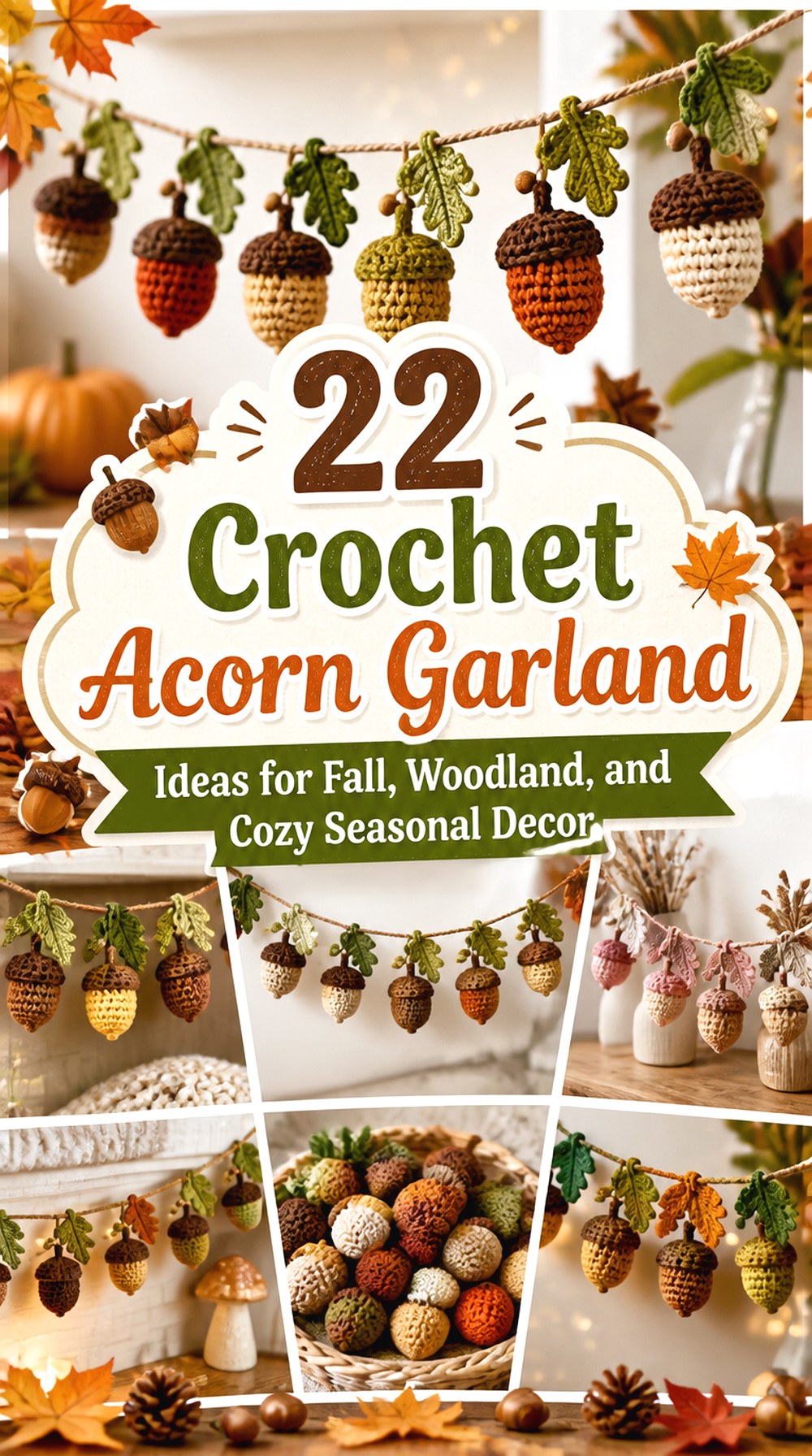
22 Crochet Acorn Garland Ideas for Fall, Woodland, and Cozy Seasonal Decor
Crochet acorn garlands can range from slim strings of tiny acorns to substantial mantel swags filled with oak leaves, pumpkins, and woodland characters. Some designs sit almost flat against a wall, while stuffed and chunky versions create deeper shadows and a more dimensional display. That difference matters when you are decorating a narrow shelf, window, doorway, fireplace mantel, or seasonal table backdrop.
The ideas below include both complete garland tutorials and individual acorn or woodland-motif tutorials that can be repeated as components for an original strand. When a source teaches the motif rather than the finished garland, the spacing, attachment method, and final layout remain your own planning decisions. Use the comparisons below to choose by silhouette, storage needs, motif density, display location, and the amount of visual weight you want.
Quick List
- Crochet Oak Leaf Cluster Mantel Garland
- Crochet Winter Solstice Acorn Garland
- Crochet Harvest Pumpkin and Acorn Garland
- Crochet Cottagecore Woodland Story Garland
- Crochet Tiny Acorn Repeat Shelf Garland
- Crochet Acorn and Oak Leaf Ornament Garland
- Crochet Classic Stuffed Acorn Window Garland
- Crochet Mixed-Size Country Acorn Garland
- Crochet Chunky Farmhouse Acorn Swag
- Crochet Compact Amigurumi Acorn Peg-Rail Garland
- Crochet Textured-Cap Acorn Garland
- Crochet Acorn-and-Leaf Pair Garland
- Crochet Round Amigurumi Acorn Banner
- Crochet Hanging-Charm Acorn Garland
- Crochet Braided-Cord Acorn Ornament Garland
- Crochet Flat Acorn Appliqué Bunting
- Crochet Puff-Cap Acorn Pennant Garland
- Crochet Small Ornament Acorn String
- Crochet Soft Amigurumi Acorn Center Garland
- Crochet Clean-Shaped Acorn Garland
- Crochet Baby Acorn and Little Oak Leaf Garland
- Crochet Boho Acorn Granny Square Banner
Decide Between Flat Bunting, Stuffed Acorns, and Mixed Motifs
Flat acorn appliqués are useful when a garland needs to hang close to a wall, cabinet, or narrow shelf. They also take up less storage space because the pieces do not have stuffed bodies. Dimensional acorns create stronger shadows and a more noticeable silhouette, but their depth can make the strand turn or lean forward if pieces are not balanced.
Mixed-motif garlands add leaves, pumpkins, mushrooms, flowers, or other woodland shapes. These work well when you want the garland itself to become a larger seasonal feature rather than a simple repeated border. Before choosing, think about viewing distance. A tiny textured cap may be noticeable on a bookshelf but disappear across a large fireplace, while a chunky acorn can dominate a small window.
Plan the Spacing Before Making a Full Batch
Make or evaluate one representative motif before committing to a long strand. Yarn substitution, hook choice, stuffing, edging, and personal tension can all change the finished scale, so a tutorial’s acorn may occupy more or less space than expected when made with different materials.
Lay several finished pieces along the intended display area before attaching them permanently. This reveals whether leaves overlap, bulky acorns crowd one another, or a mixed woodland design needs quieter gaps between statement motifs. Dimensional pieces may also need more room to hang without twisting into their neighbors.
For a mantel or open shelf, check the strand from normal viewing distance rather than only from directly above your work surface. The useful question is not whether every gap is identical; it is whether the overall rhythm looks deliberate once the garland is hanging.
Make the Acorn Shape Read Clearly Across the Strand
The cap-to-body contrast is what makes a small crochet shape read as an acorn. That contrast can come from color, texture, dimension, or a clearly defined change in surface treatment. When a garland also includes oak leaves or pumpkins, keep enough separation around each acorn for its outline to remain recognizable.
Flat motifs often benefit from blocking or other appropriate finishing so repeated pieces sit consistently. Stuffed versions need consistent shaping more than perfect mathematical uniformity. If you mix tutorials, compare the actual finished samples instead of assuming that similar yarn labels will produce compatible sizes.
Also consider your background. Highly detailed brown, gold, and rust motifs may blend into dark wood, while simpler shapes can read more clearly against a light wall or painted mantel.
1. Crochet Oak Leaf Cluster Mantel Garland
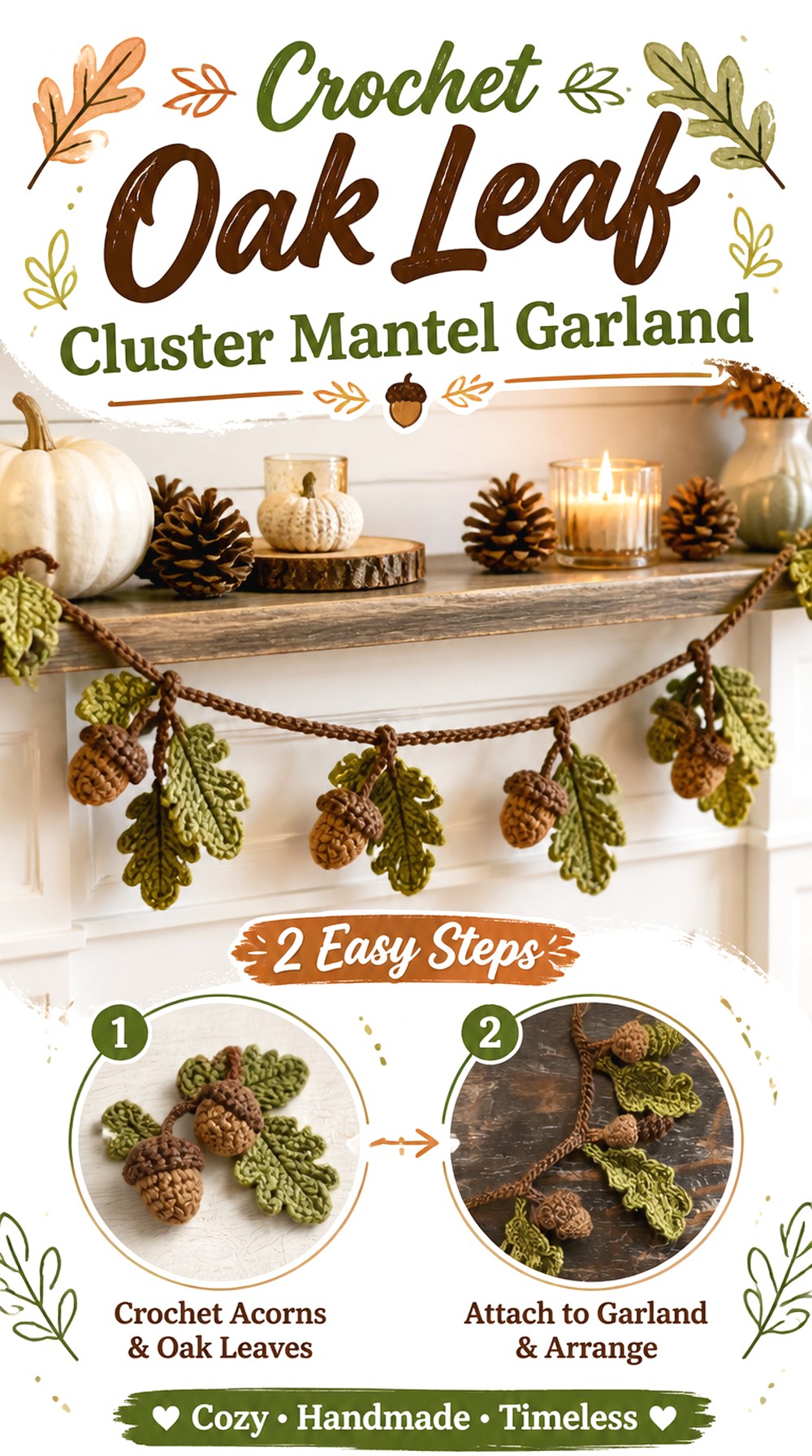
This is the most traditional fall-garland direction in the collection: recognizable crochet acorns paired with oak leaves and arranged as a coordinated strand. Jess Nicole Handmade’s tutorial is specifically presented as an acorn-and-oak-leaf garland, making it a useful source when you want the connecting composition demonstrated rather than adapting a single motif yourself.
The combination gives the strand more width than an acorn-only design. It suits mantels, shelves, and doorways where leaf shapes can spread sideways instead of every component hanging vertically.
Oak Leaves Give the Garland a Wider Silhouette
Leaves create visual width without requiring every section of the strand to contain another stuffed object. That can make an arrangement feel fuller while preserving recognizable gaps around individual acorns. When planning your own color palette, consider the leaf and acorn together rather than choosing each color independently.
If your display area is narrow, temporarily pin or lay out the leaves at their natural angle first. A strand that looks compact on a table may project farther sideways once every leaf is allowed to spread.
Cluster Spacing Controls the Visual Rhythm
A traditional woodland garland does not have to place every motif at exactly the same distance. Small clusters can create focal points, while slightly wider gaps prevent the design from becoming one continuous dense band.
Before final attachment, arrange the entire sequence on a table at approximately its intended length. Look for accidental heavy sections where several dark caps or broad leaves collect together. Moving one unit can improve the balance without changing any individual motif.
Check the Strand in Its Real Display Position
A mantel garland is usually seen from the front and slightly below, not from directly overhead. That viewing angle can hide leaf details or make dimensional acorns rotate toward the wall.
Hang a short test section first and see which pieces naturally face forward. If the orientation matters to you, solve that before making a large batch rather than trying to correct every attachment after the strand is complete.
2. Crochet Winter Solstice Acorn Garland
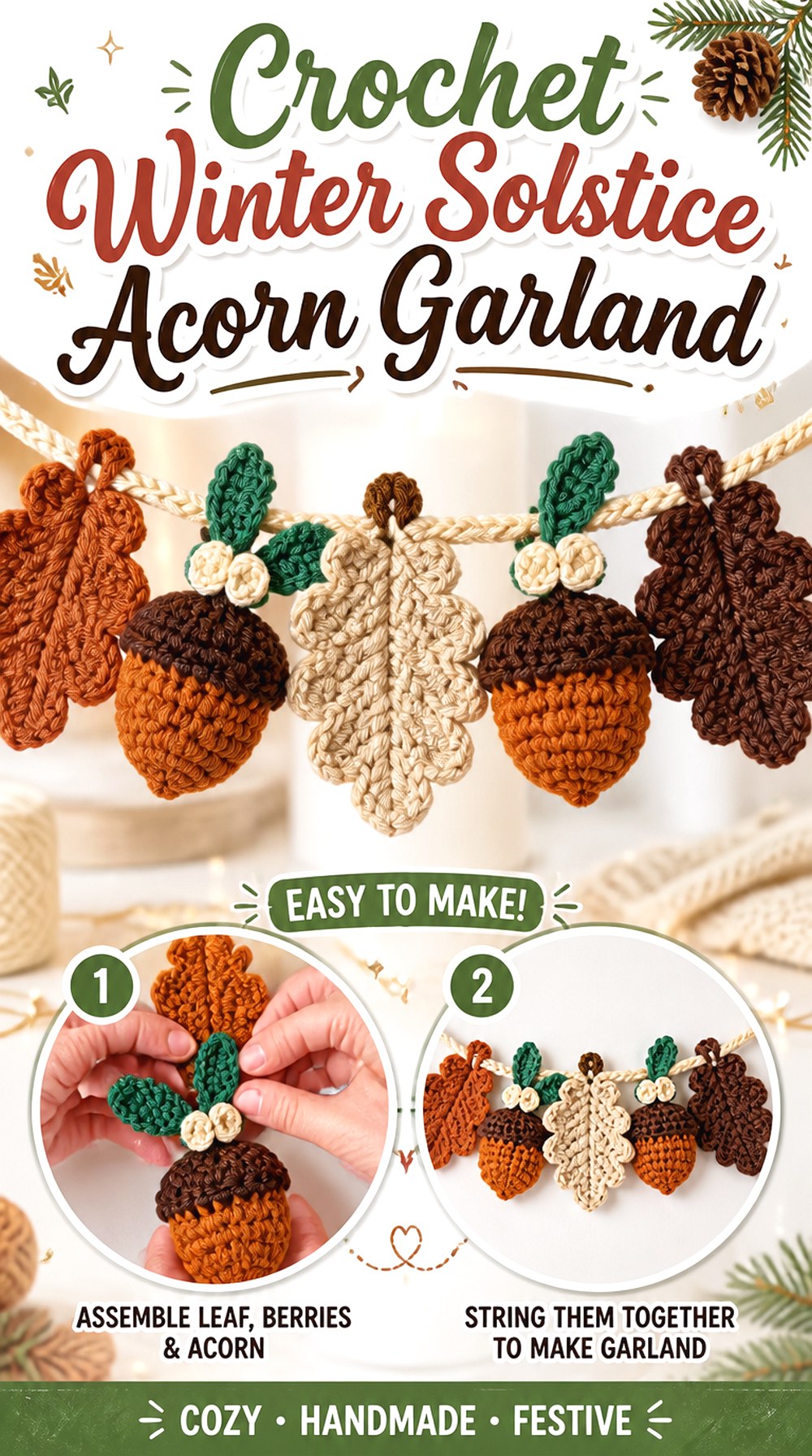
A solstice-inspired version takes the acorn beyond strictly autumn decorating. Hobbii’s Solstice Garland tutorial centers the acorn within a broader nature-themed seasonal concept, making this a useful direction for a strand you want to keep displayed as fall moves toward winter.
Instead of relying on orange-heavy harvest colors, this concept can be planned around quieter woodland tones and natural shapes. The result can work above a winter shelf, along a mirror, or as part of a nature-focused seasonal arrangement where acorns remain relevant after pumpkins have been put away.
Natural Motifs Make the Display Less Date-Specific
An acorn is strongly associated with fall, but it is also a general woodland motif. Pairing it with restrained botanical elements rather than overt Halloween or Thanksgiving symbols can extend the useful display period.
If that flexibility matters, choose colors by the room and the broader seasonal palette rather than copying a single harvest scheme. Neutral caps, muted greens, creams, or deeper forest tones can shift the visual emphasis toward woodland decor.
Mixed Shapes Need a Shared Visual Scale
When several motif types occupy one garland, the largest piece naturally becomes the focal point. Before making multiples, compare one finished acorn with one example of every companion motif.
If a secondary piece visually overwhelms the acorns, either use it less often or give it more space. The goal is not identical dimensions. It is a balanced hierarchy in which the acorn still reads as an intentional part of the design.
Give Detailed Motifs a Calm Background
Small crochet textures are easier to see against a relatively uncluttered background. A strand with several nature motifs can lose definition against busy wallpaper, open shelving full of objects, or strongly grained wood.
For a detailed solstice garland, a painted wall, simple mirror frame, or clean shelf edge lets the silhouettes do more of the work. Check your intended location before selecting very subtle color combinations.
Original Tutorial and Creator Credit
Creator: Hobbii
3. Crochet Harvest Pumpkin and Acorn Garland
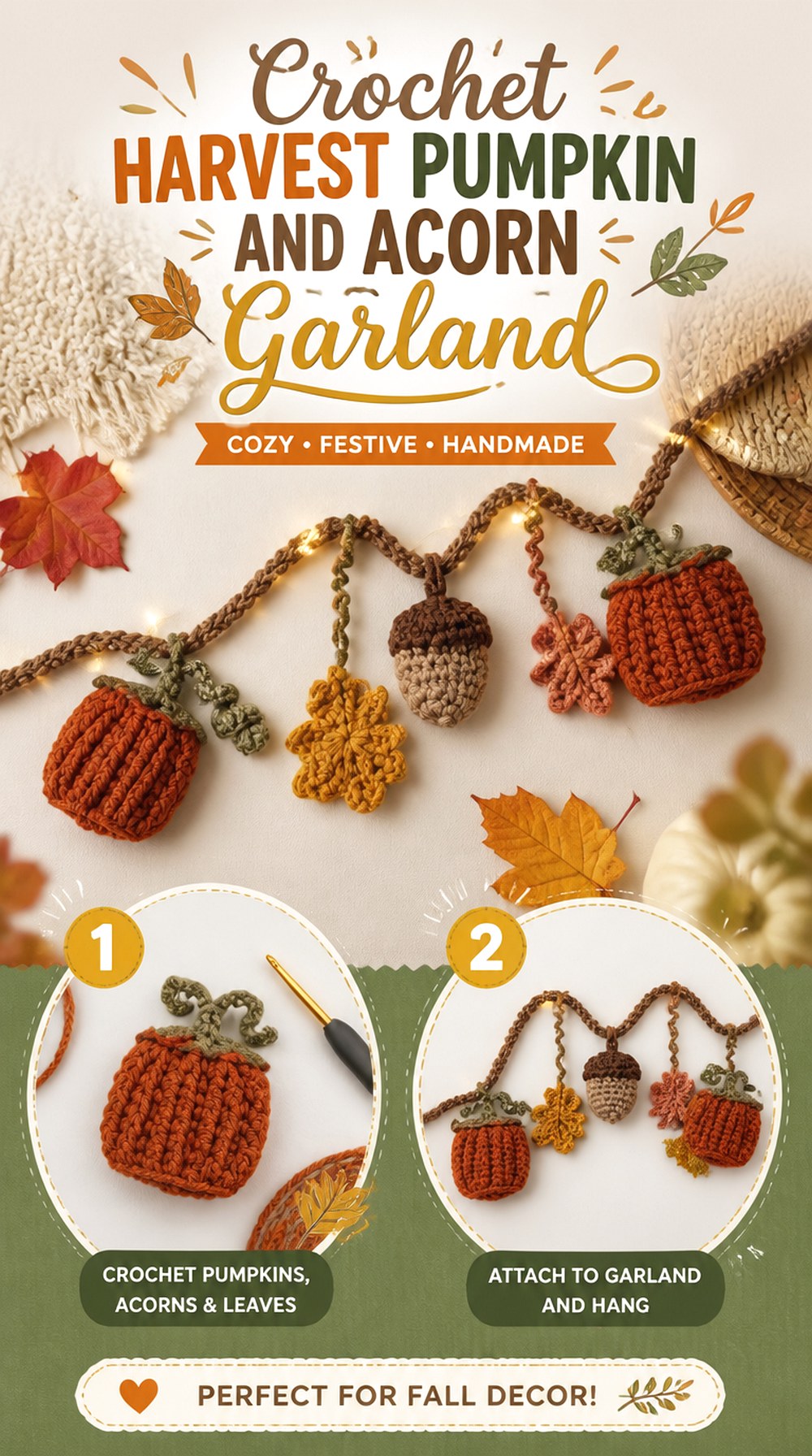
This design creates a fuller harvest display by combining acorns with pumpkins and more than one leaf form. Annie’s Attic Videos presents the Autumn Attractions Garland as a coordinated project involving leaves, an acorn, a pumpkin, and a crocheted cord, so it is particularly relevant when you want several recognizable fall symbols in one strand.
Compared with an acorn-only garland, the visual emphasis is broader and more decorative. It works well when you want one piece to supply most of the seasonal detail above a mantel or across a wall.
Keep Pumpkins From Overpowering the Acorns
Rounded pumpkin forms can appear visually larger than narrow acorns even when their measured dimensions are not dramatically different. Place one of each side by side before deciding how frequently each should repeat.
If the pumpkin dominates, use it as an occasional anchor motif rather than alternating every piece one-for-one. This keeps the acorn identity visible instead of turning the strand into primarily a pumpkin garland.
Treat the Cord as Part of the Composition
A connecting cord is not just structural. Its thickness, color, and amount of visible space between motifs affect how busy the entire garland appears.
For a motif-rich strand, a quieter cord can give the shapes more attention. A strongly contrasting cord becomes another graphic line in the design. Test both ideas against the intended background before permanently arranging the pieces.
Build the Sequence on a Table First
With pumpkins, leaves, and acorns all competing for attention, accidental repetition becomes more obvious once the full sequence is visible. Lay the motifs in their planned order and view them from several feet away.
Look for clusters of similarly shaped or similarly colored pieces. A small rearrangement often creates a more natural harvest rhythm without requiring additional crochet.
Original Tutorial and Creator Credit
Creator: Annie’s Attic Videos
4. Crochet Cottagecore Woodland Story Garland
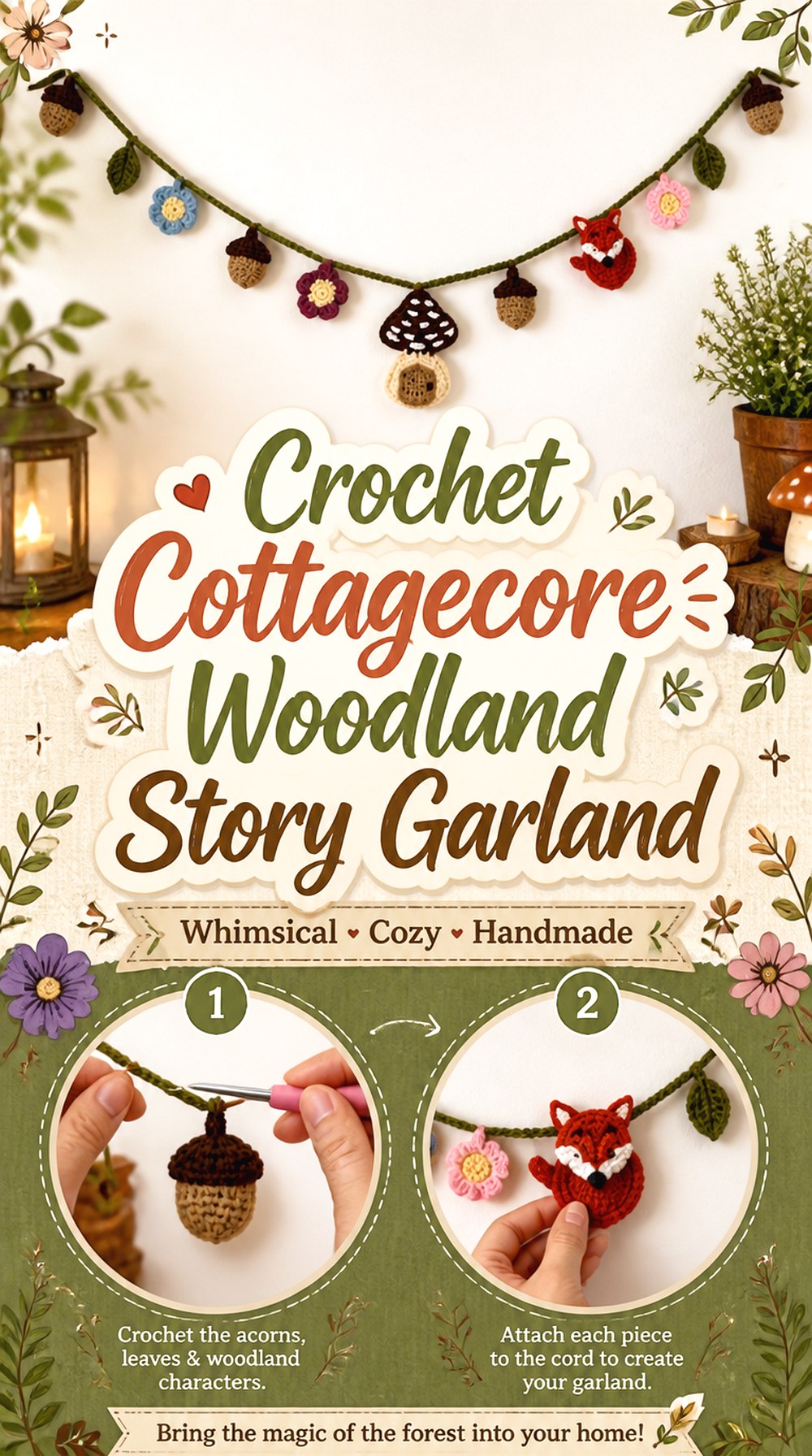
For a more whimsical display, thisfairymade’s garland combines acorns with other cottagecore woodland subjects, including a fox, toadstool house, and flowers. That makes the strand read more like a small illustrated forest scene than a repeated autumn border.
This direction suits a wall section or shelf where viewers can get relatively close to the details. It is also a useful choice if you want acorns present without making them the only subject. The stronger variety means placement matters more than it does on a simple repeating strand.
Let the Story Motifs Become Focal Points
A fox or toadstool naturally attracts more attention than a small repeated acorn. Rather than fighting that hierarchy, use the acorns as visual connectors between larger story elements.
This creates a calmer sequence and gives each recognizable character enough room to be read. If every detailed motif touches the next one, the strand can look crowded even when the individual pieces are charming on their own.
Uneven Spacing Can Work Better Here
A narrative-style garland does not need strict repetition. A pair of smaller acorns can sit closer together while a larger motif receives a wider gap around it.
Lay the design out according to visual weight instead of counting identical spaces. This is especially useful when the woodland components differ substantially in shape, because mathematically equal spacing can still look visually uneven.
Choose a Location Where Small Details Can Be Seen
A highly detailed strand may lose much of its character if hung very high or across a large room. Reserve this style for a bookshelf, reading nook, low mantel, or wall area where the individual motifs remain legible.
If the intended display is far away, a simpler acorn silhouette or larger chunky design elsewhere in this list may create more impact.
Original Tutorial and Creator Credit
Creator: thisfairymade
5. Crochet Tiny Acorn Repeat Shelf Garland
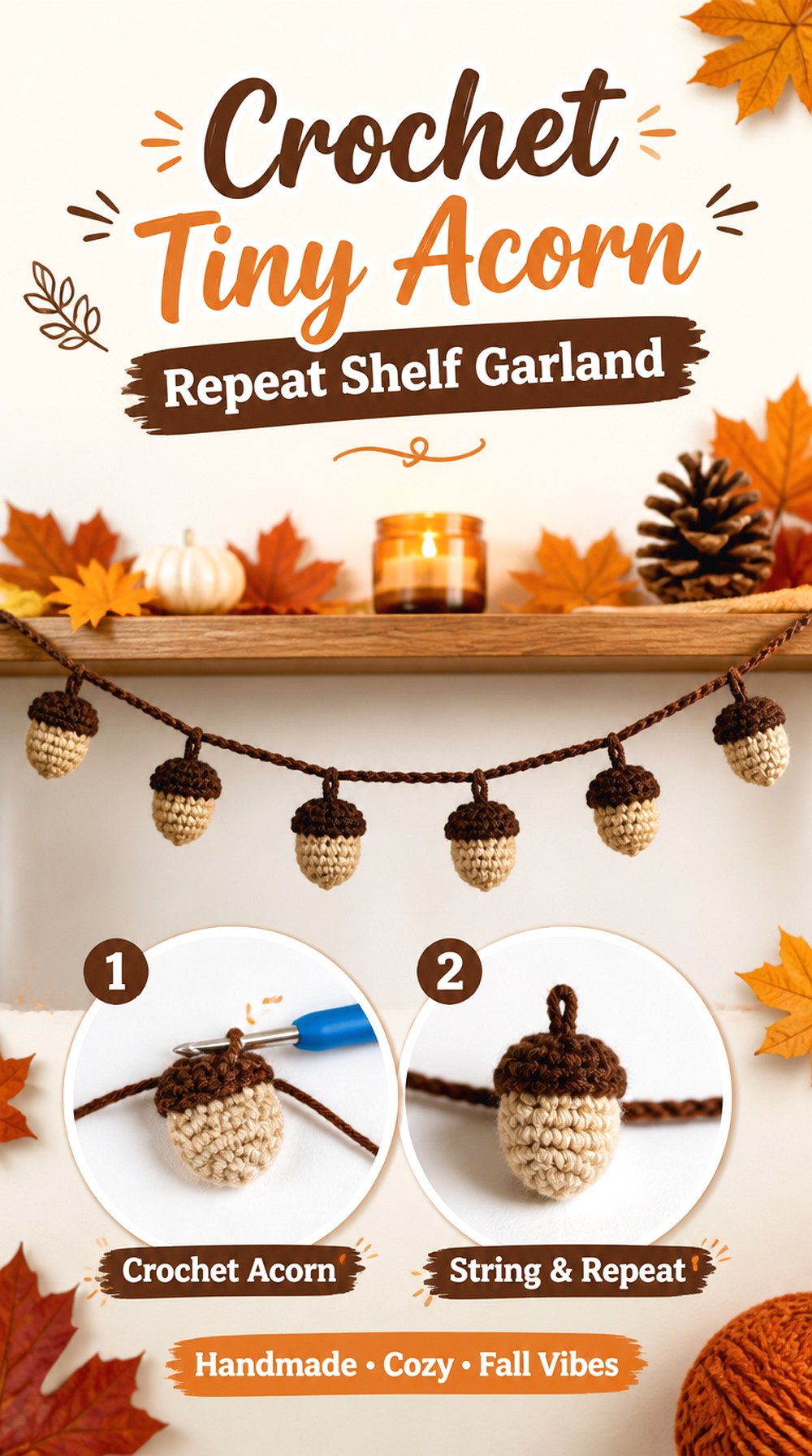
Winding Road Crochet’s tutorial focuses on an individual crochet acorn rather than a complete garland. Repeating that compact motif creates a quieter strand suited to shelf edges, small windows, tiered displays, or narrow decorative areas where larger leaves and pumpkins could feel crowded.
The appeal here comes from repetition. Instead of adding many motif types, you can vary the spacing or alternate body colors while preserving one consistent silhouette. Because the source teaches the acorn component, the finished garland length, connecting cord, and attachment arrangement are decisions to plan independently.
Repetition Makes Small Acorns Look Intentional
A tiny motif can disappear when used only once, but repeated forms create a clear visual line. Before committing to many pieces, place a few finished acorns against the real background and step away.
If their shapes become difficult to recognize at viewing distance, stronger cap contrast or slightly wider gaps may help more than simply adding extra motifs.
Narrow Shelves Favor Controlled Drops
On a shallow shelf, long dangling pieces can compete with objects below or brush against doors and drawers. A compact acorn repeat lets you keep the decorative line close to the shelf edge.
Temporarily tape or pin a sample section in place before deciding how low the motifs should hang. This is a display-planning choice rather than a detail dictated by the acorn tutorial.
Original Tutorial and Creator Credit
Creator: Winding Road Crochet
6. Crochet Acorn and Oak Leaf Ornament Garland
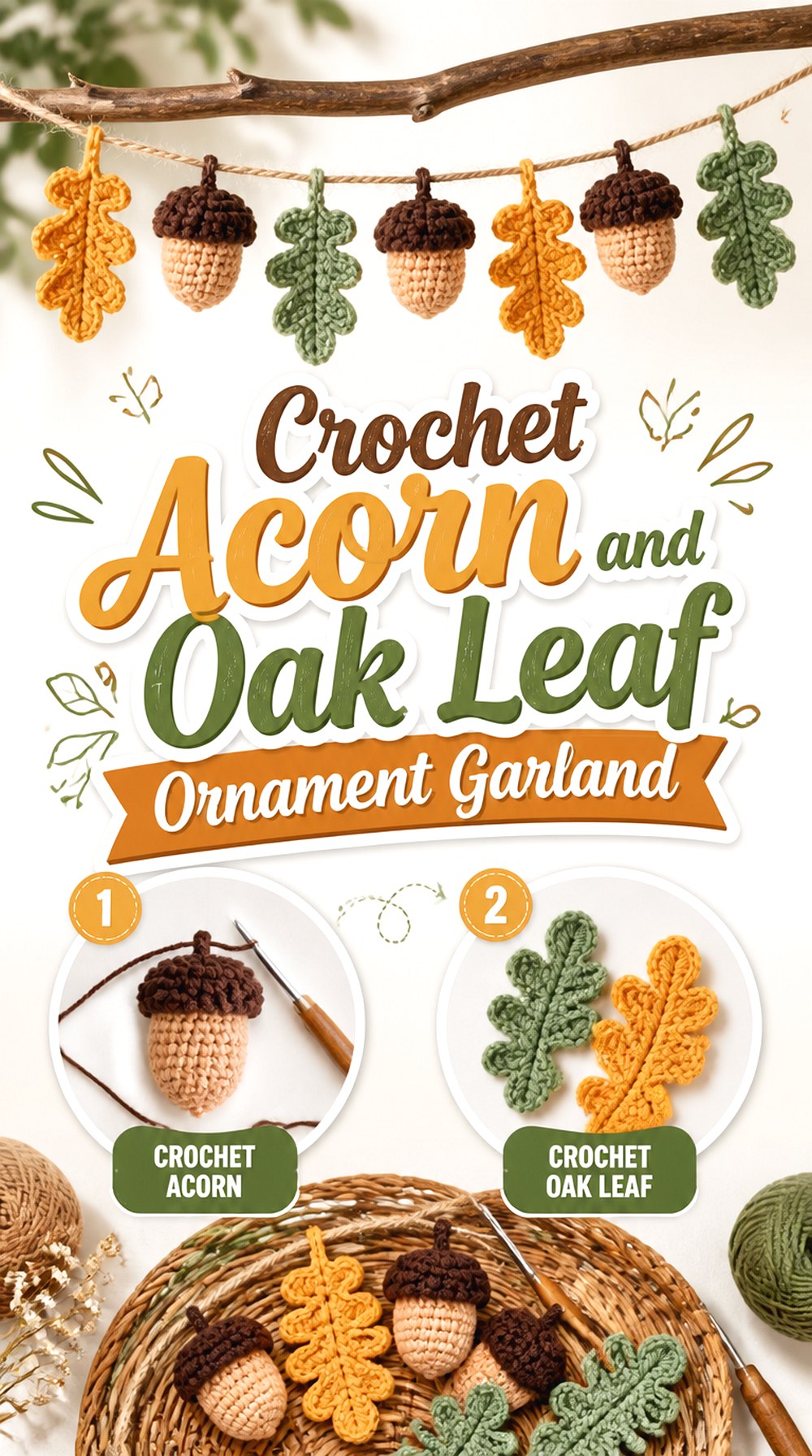
Laia Crochet pairs an acorn with an oak leaf in one tutorial, giving you two naturally compatible components to repeat along a strand. Unlike the fuller clustered garland at the beginning of this list, this version can be arranged as separated ornament-like units with more open space between them.
That makes it a strong option for a window, mirror, or narrow console where you want an obvious woodland theme without creating a dense band of crochet. Alternate acorns and leaves, or treat each pair as one hanging unit depending on how much movement and negative space you prefer.
Oak Leaves Add Width Without Another Stuffed Shape
A leaf can fill a visual gap while remaining flatter than a second dimensional acorn. This is useful when you want the strand to look substantial but do not want every section projecting forward.
Before attachment, rotate the leaves in different directions. Repeating them at the same angle can look very formal, while alternating their orientation produces a looser woodland effect.
Check Which Side Faces the Viewer
Hanging components can rotate once suspended, particularly if an attachment point is slightly off center. That matters more when one side of a leaf or acorn has the clearer finished appearance.
Test one complete hanging unit on the intended cord. If it consistently turns sideways, reconsider the attachment position or accept a more relaxed three-dimensional look before assembling the rest.
Original Tutorial and Creator Credit
Creator: Laia Crochet
7. Crochet Classic Stuffed Acorn Window Garland
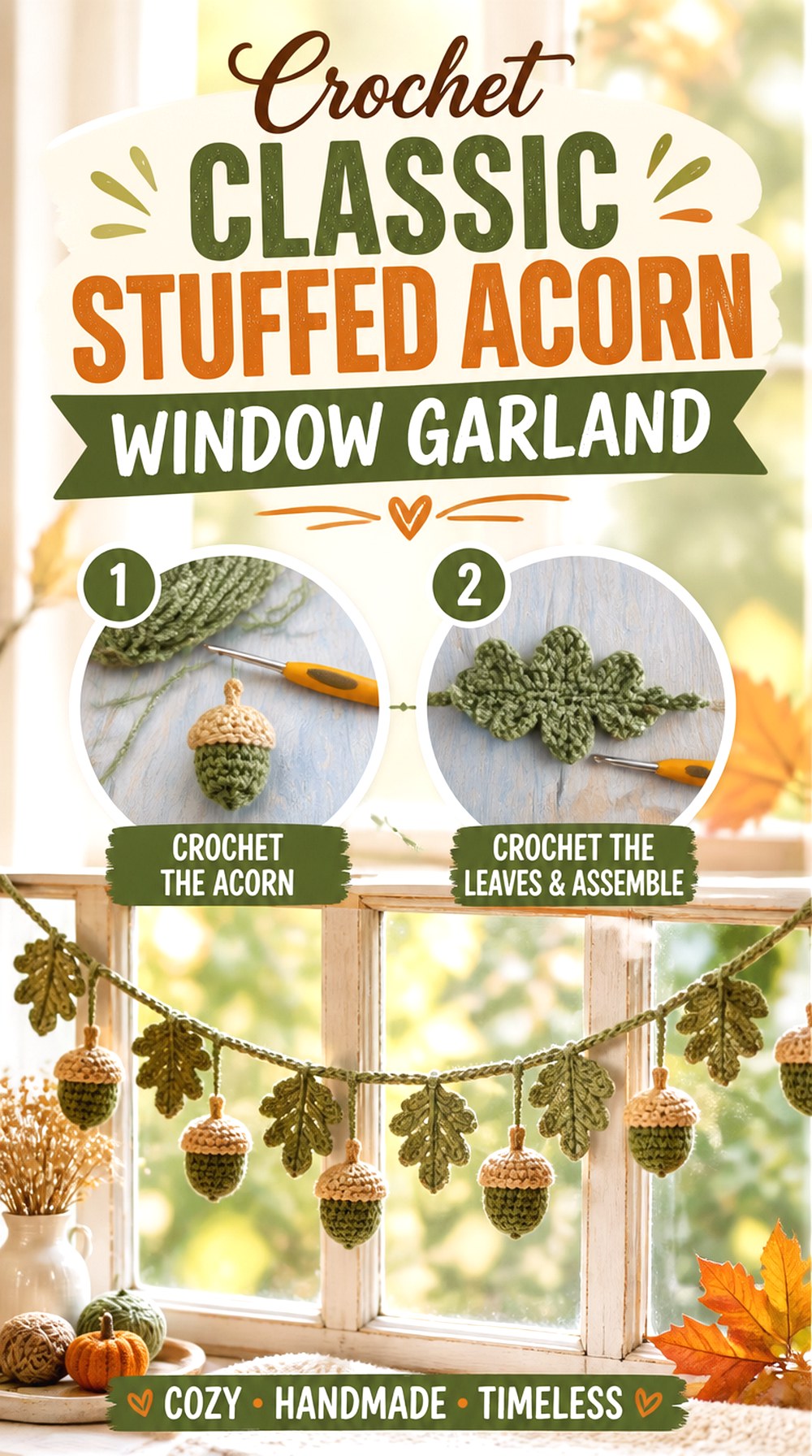
HappyBerry Crochet’s “How to Crochet an Acorn” offers a recognizable dimensional acorn that can be repeated for a simple hanging strand. Instead of adding leaves or pumpkins, this idea keeps the entire composition focused on one stuffed shape.
That simplicity works especially well across a window or plain wall where the silhouettes are visible against an uncluttered background. You can create rhythm through spacing and restrained color changes rather than through extra motif types. Because the source is an individual acorn tutorial, plan the connecting strand and hanging arrangement separately.
A Single Silhouette Creates a Cleaner Border
Repeating only acorns gives the eye one shape to follow. This can suit rooms where the surrounding decor already contains plenty of texture or pattern.
Before producing the full set, decide whether the cap color will remain constant. Keeping one element consistent while varying the body can preserve the acorn identity more clearly than changing every part of every motif.
Window Light Changes How Stuffed Pieces Read
Dimensional crochet has highlights and shadows that flat motifs do not. In a window, strong backlighting may emphasize the outline while making subtle yarn-color differences harder to see.
Hold one finished acorn in the intended spot during daylight. If the cap and body merge visually, stronger contrast may improve the design more effectively than extra decorative details.
Original Tutorial and Creator Credit
Creator: HappyBerry Crochet
8. Crochet Mixed Size Country Acorn Garland
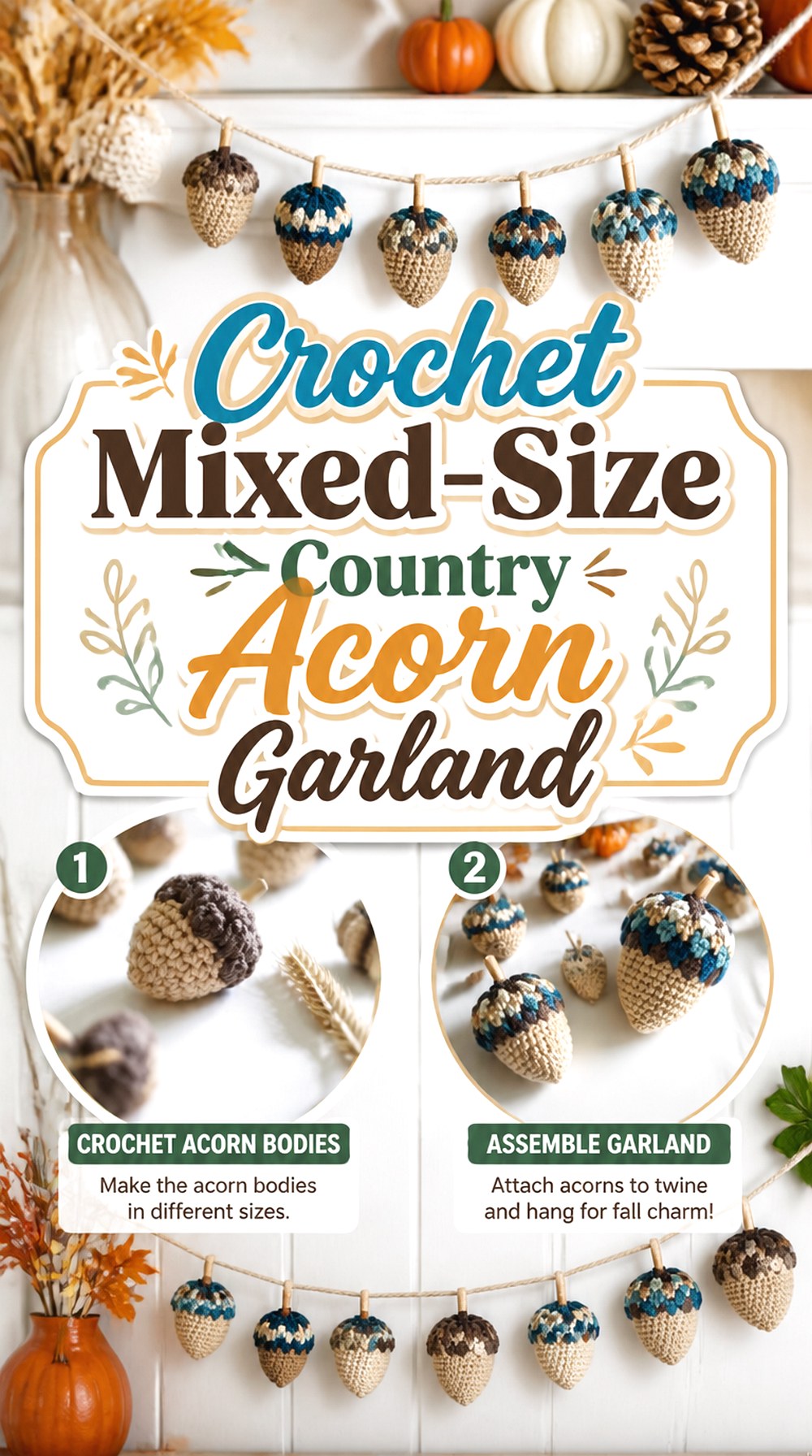
Pretty Darn Adorable Crochet Tutorials demonstrates an acorn project with multiple size options, giving this garland concept a natural way to create rhythm without switching to unrelated motifs. A strand that alternates visually larger and smaller acorns can feel more collected and informal than a perfectly uniform repeat.
This is useful for country, farmhouse, or casual fall decorating where slight scale changes support the handmade look. Keep the connecting strand comparatively simple so the size variation remains the main feature rather than competing with leaves, bows, or additional ornaments.
Size Changes Need Deliberate Placement
Random scale can look accidental if several larger acorns collect at one end. Arrange all finished pieces on the floor or a long table before attaching them.
A simple large-small-small rhythm is one possibility, but there is no need to force strict repetition. The important checkpoint is whether the visual weight feels reasonably balanced from one end of the strand to the other.
Keep One Feature Consistent Across the Set
When size varies, another repeated feature can hold the collection together. That might be the same cap family, a restrained body palette, or one connecting cord.
Too many simultaneous changes—scale, texture, cap treatment, color, and spacing—can make a small garland feel fragmented. Choose which difference should be noticed first and simplify the rest accordingly.
Original Tutorial and Creator Credit
Creator: Pretty Darn Adorable Crochet Tutorials
9. Crochet Chunky Farmhouse Acorn Swag
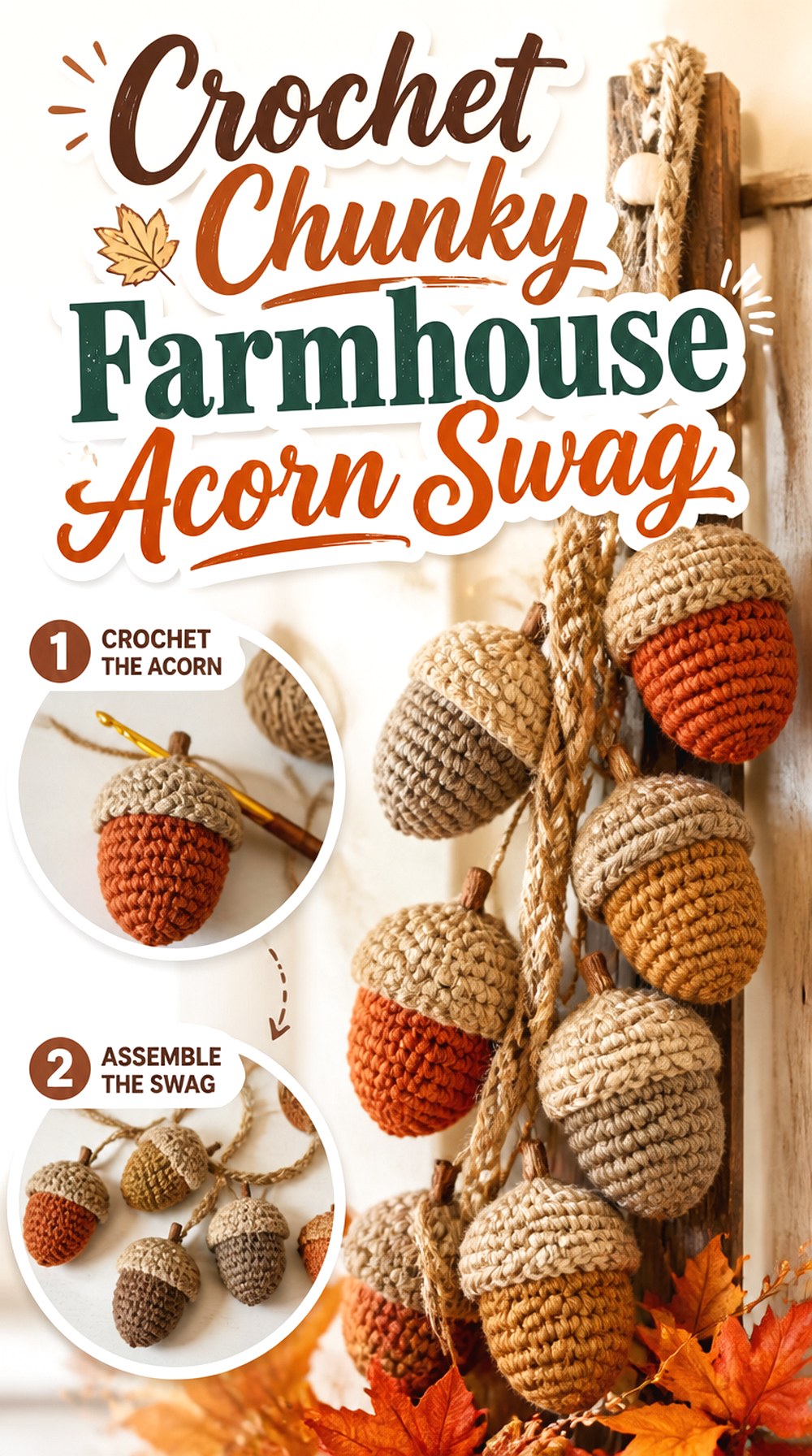
MJ’s Off The Hook Designs presents rustic farmhouse crochet acorns with a bulky, substantial look. That makes them better suited to a statement swag than a delicate little bunting. Instead of filling a strand with many pieces, a smaller number of visually large acorns can create enough impact for a fireplace, broad shelf, or substantial wall hook.
This version is about scale and texture rather than intricate motif variety. Give the acorns room to hang independently so their dimensional shape remains clear instead of compressing them into one heavy-looking cluster.
Larger Acorns Need More Breathing Room
A bulky motif occupies more visual space than a small ornament, even before considering its actual weight. Place sample acorns at different intervals along the intended cord and view the strand from across the room.
If the pieces touch or overlap constantly, increasing the gaps can make the design look more intentional while reducing the number of motifs needed for the display.
Check the Support Before Hanging a Full Swag
Any dimensional garland becomes heavier as more yarn, stuffing, and decorative pieces are added. Avoid assuming that a lightweight adhesive hook or delicate shelf object can support a finished strand.
Assess the completed garland and use an attachment method appropriate for both the surface and the actual finished weight. The tutorial demonstrates the acorn; the final installation still requires your own judgment.
Texture Works Best When It Can Be Seen
Chunky crochet creates strong stitch definition from farther away than very small motifs. That makes this concept a useful option for a deeper mantel or larger room.
Avoid placing an already substantial swag against a background packed with other heavily textured fall decorations. A little empty wall or shelf space around it can make the acorn forms easier to read.
Original Tutorial and Creator Credit
Creator: MJ’s Off The Hook Designs
10. Crochet Compact Amigurumi Acorn Peg Rail Garland
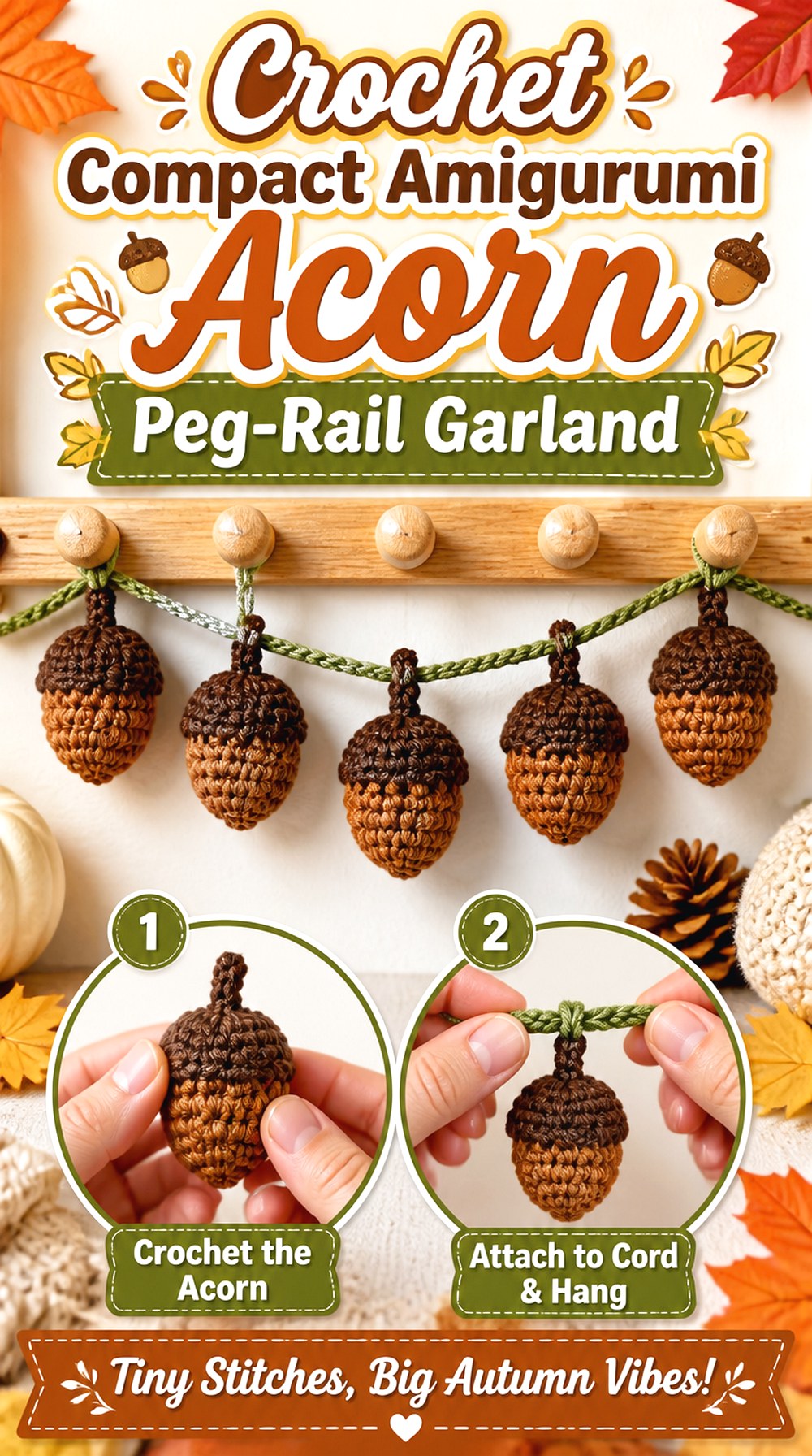
Club Crochet’s amigurumi acorn tutorial provides another dimensional option, but this idea keeps the finished arrangement compact and orderly. Rather than stretching a garland across an entire room, use a short sequence above a peg rail, small shelf, narrow entryway wall, or compact seasonal display.
The concentrated arrangement lets the individual acorns remain noticeable without needing pumpkins or leaves for extra volume. It is also a practical route when you like the depth of amigurumi but have less display space than a traditional mantel provides.
Short Garlands Benefit From Strong Repetition
On a compact strand, every motif occupies a large percentage of the overall composition. Strong consistency in shape can therefore look more deliberate than introducing several unrelated accents.
Set the finished acorns next to each other before attaching them. If one differs noticeably in stuffing or shape, decide whether to embrace that variation or place it where it will not unintentionally become the focal point.
Peg Rails Create Their Own Spacing Pattern
Hooks and pegs can dictate where a garland naturally rises, dips, or crosses behind another object. Test the strand around those fixed points before deciding how many acorns to attach.
A layout that looks balanced on a straight table may change once the cord forms arcs between pegs. Plan for the actual hanging geometry rather than treating the display as a perfectly straight line.
Original Tutorial and Creator Credit
Creator: Club Crochet
11. Crochet Textured Cap Acorn Garland
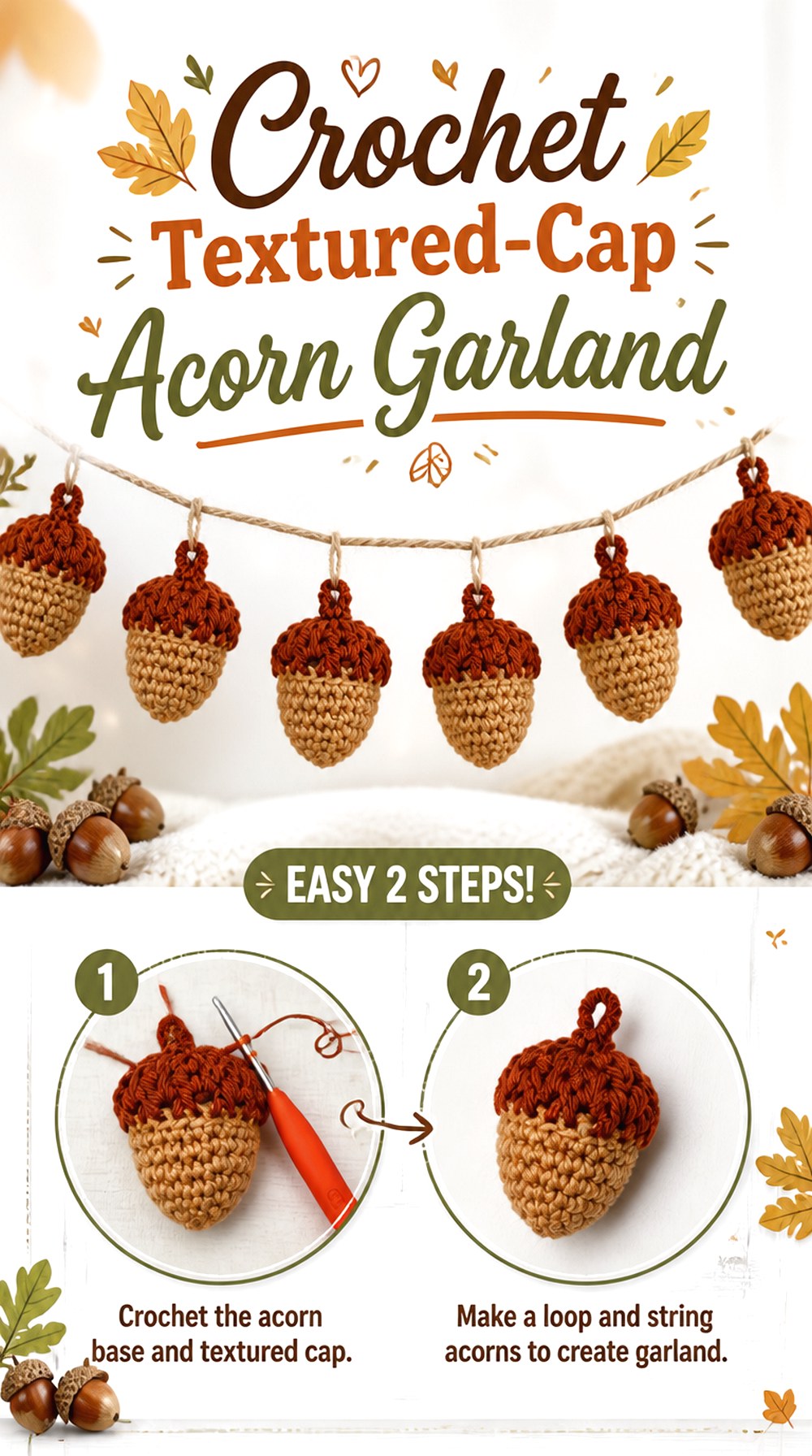
Amanda Saladin’s love.life.yarn. tutorial emphasizes a quick crochet acorn with a visibly textured cap, giving this strand a surface detail that can replace the need for extra motif types. The idea works well when you want an acorn-only garland that still has more visual interest than a completely smooth repeated form.
Because texture can disappear from a distance, this version is especially suitable for a bookcase, entry table, kitchen shelf, or low mantel where the cap detail remains visible.
Let the Cap Texture Do the Decorative Work
When the cap already has a pronounced surface, adding bows, beads, leaves, and several colors can compete with its strongest feature. Consider keeping the body simpler so the texture becomes the recognizable repeat.
Make one sample in your intended yarn and look at it from the normal viewing distance. A texture that appears dramatic in your hand may become much subtler once the garland is hanging.
Yarn Definition Changes the Surface Effect
Two yarns can create noticeably different visual texture even when used for the same general motif. A fuzzy surface can soften small stitch details, while a smoother yarn can make raised texture easier to read.
This is not a reason to avoid substitution, but it is a reason to sample first. Judge the finished cap rather than assuming a different fiber will reproduce the same visual result.
Original Tutorial and Creator Credit
Creator: love.life.yarn. by Amanda Saladin
12. Crochet Acorn and Leaf Pair Garland
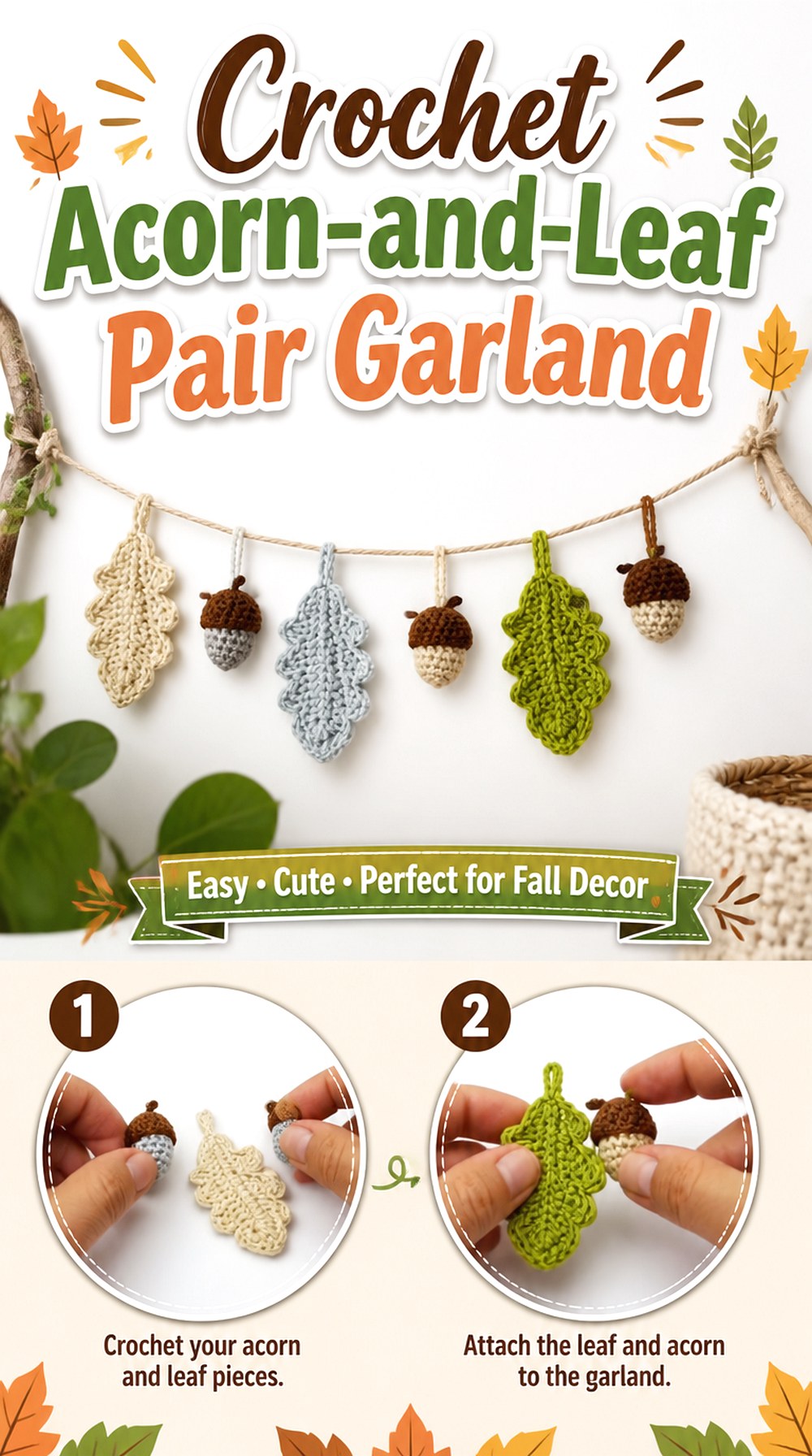
PetersCrochetArt teaches both a crochet acorn and its leaf, giving this concept a natural paired-unit structure. The video is presented with English subtitles, which may also help readers who prefer following visual demonstrations with translated text support.
Instead of alternating single motifs across the cord, treat each acorn-and-leaf combination as one small botanical unit. Repeating those pairs can make a strand feel more organized and slightly more formal than a loose woodland mix. It works particularly well when you want the botanical relationship between acorn and foliage to remain obvious.
Pairing the Motifs Creates Natural Focal Units
An acorn next to a leaf reads as one small composition, which means you can leave larger spaces between pairs without making the garland look unfinished.
Experiment with a few pair orientations before committing. Mirrored pairs can produce a more symmetrical look, while alternating the direction of the leaves can create a looser, more natural rhythm along the strand.
Keep the Leaf From Hiding the Acorn Body
A broad leaf placed directly behind a small acorn can obscure the acorn’s outline from the front. Arrange the components so each silhouette remains readable.
Photograph or view the sample from straight ahead rather than judging only while holding it. If the leaf dominates, rotate it slightly or separate the two pieces enough for both forms to remain distinct.
Original Tutorial and Creator Credit
Creator: PetersCrochetArt
13. Crochet Round Amigurumi Acorn Banner
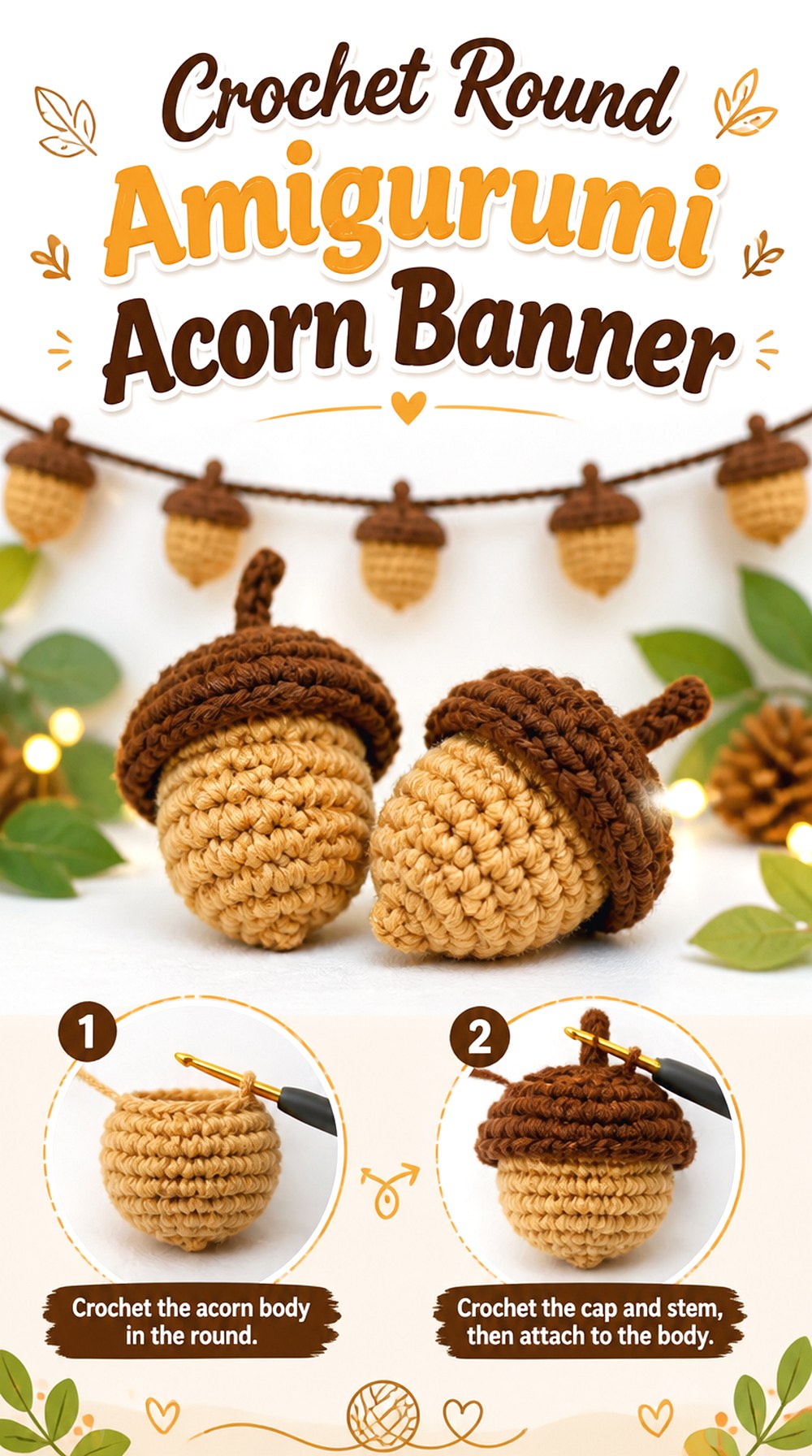
YARNutopia’s acorn tutorial gives you a rounded amigurumi form that can be repeated as a dimensional banner. This version works well when you want each acorn to read almost like a miniature hanging soft sculpture rather than a flat autumn symbol.
Keep the strand itself understated and allow the rounded forms to hang below it with visible separation. The dimensional bodies make this better for a shelf edge or wall where there is enough clearance in front of the surface for the pieces to sit naturally.
Rounded Forms Need Front Clearance
A dimensional acorn does not lie flush against the wall. If the strand is wedged behind picture frames or shelf accessories, the bodies may tilt or become partially hidden.
Before making many pieces, hang one sample where the finished banner will go. Check whether there is enough physical and visual clearance for the rounded shape to remain recognizable.
Balance Stuffing Consistency Across Repeats
For a repeated amigurumi banner, variations in shaping become noticeable when the pieces sit side by side. Aim for a similar feel and silhouette across the set rather than chasing exact measurements.
If one piece becomes noticeably fuller, consider placing it near the center as an intentional focal point instead of hiding it randomly within a uniform sequence.
Original Tutorial and Creator Credit
Creator: Fuad Azmat / YARNutopia by Nadia
14. Crochet Hanging Charm Acorn Garland
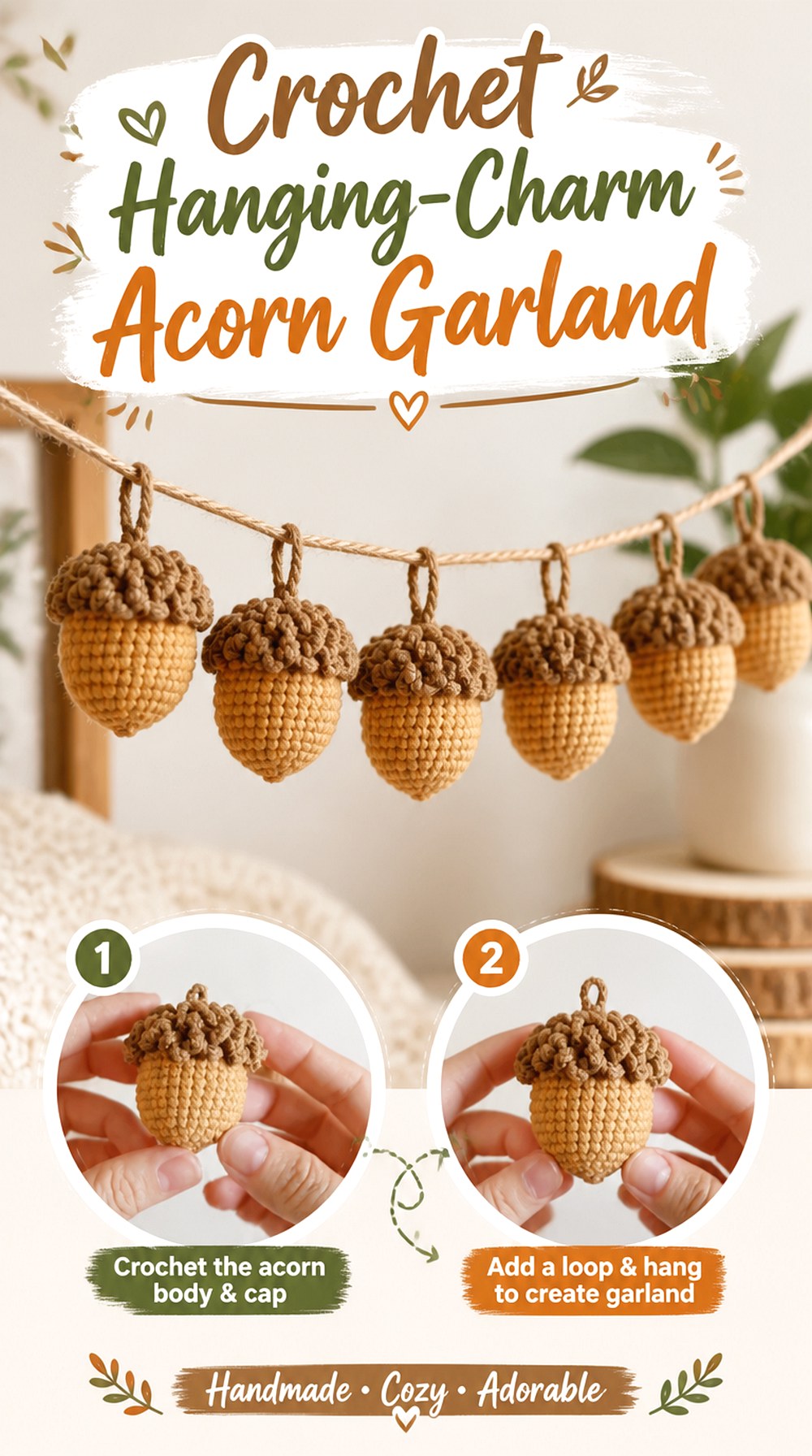
Knot So Hard’s acorn keychain tutorial offers a motif designed around hanging use, which makes it a useful starting point for a charm-style garland. Instead of mounting each acorn directly against the main cord, preserve the feeling of individual hanging charms with a little vertical separation.
This can work especially well on a narrow branch-style hanger, a small wall rail, or a decorative cord where every acorn is meant to move independently. The keychain tutorial teaches the acorn component; the final garland hardware and support arrangement should be chosen separately for your display.
Attachment Points Become Part of the Design
A charm-style garland visibly emphasizes the point where each acorn joins the strand. That gives you a choice between hiding the connection or making the repeated loops part of the visual rhythm.
Test one attachment before assembling the full strand. Check whether the acorn hangs upright, rotates sideways, or pulls the main cord downward more than expected.
Movement Calls for Extra Space Between Pieces
Individual charms can swing or rotate when a door opens, a fan runs, or the strand is bumped. Crowding them tightly may cause the motifs to overlap rather than hang independently.
Give the sample strand a gentle movement test in its intended position. If neighboring acorns continually collide, wider spacing may produce a cleaner result.
Original Tutorial and Creator Credit
Creator: Knot So Hard
15. Crochet Braided Cord Acorn Ornament Garland
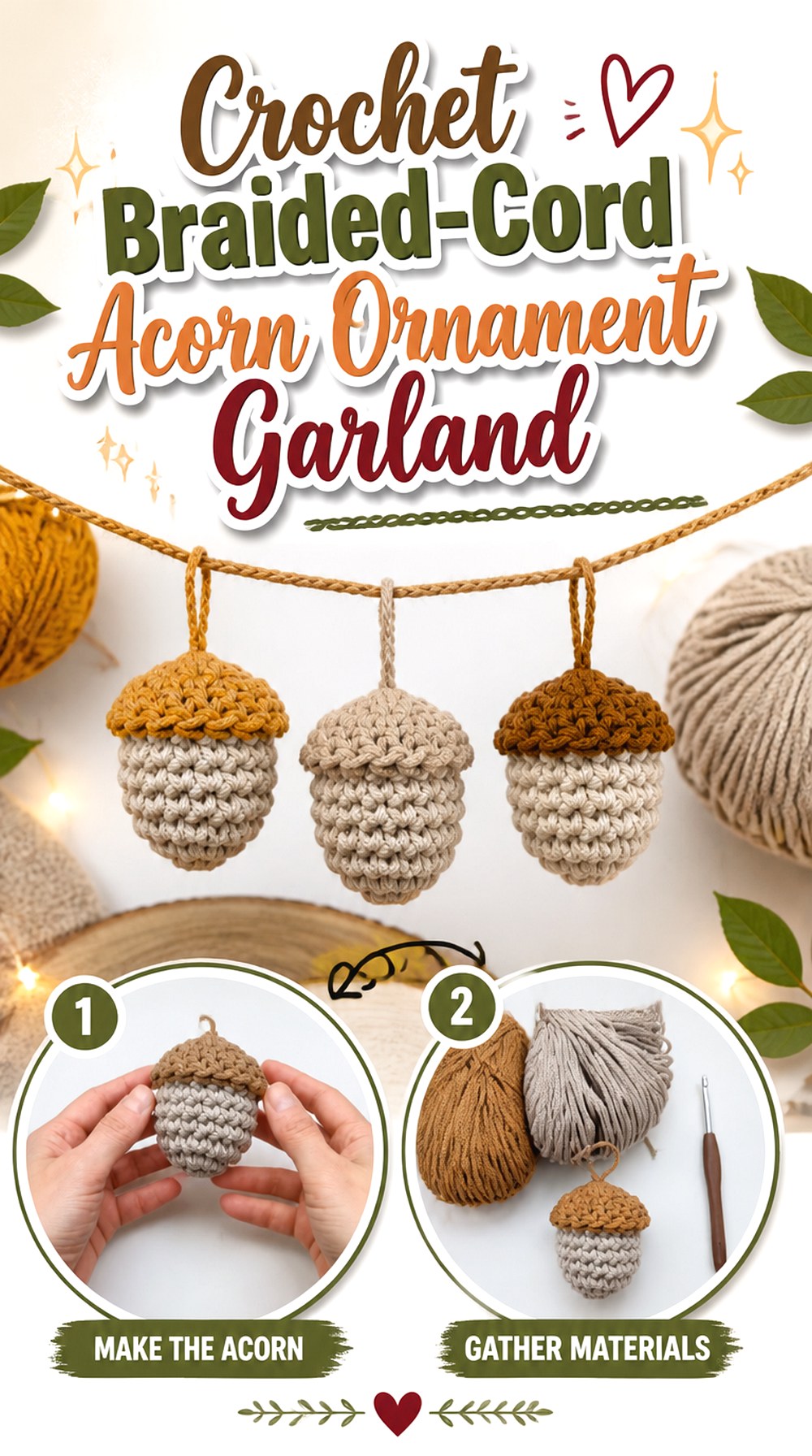
Floral Feather Fiber Art’s acorn ornament tutorial uses braided cord, giving this concept a firmer, more graphic material presence than many soft-yarn amigurumi versions. Repeating ornament-style acorns on a plain strand can create a crisp rustic display for a doorway, mirror, or seasonal branch.
Because cord can behave differently from softer yarn, make a full sample before deciding how many motifs you need. The finished stiffness, hanging angle, and visual scale may influence spacing more strongly than they would with a softer stuffed acorn.
Firmer Material Can Sharpen the Outline
A more structured material may help an acorn keep a clear silhouette, which is useful when the garland is viewed from several feet away. The trade-off is that the piece may not drape or compress like soft yarn.
Check how the finished ornament rests against the display surface. If it projects strongly forward, give neighboring pieces enough room rather than forcing them into dense clusters.
Ornament Loops Can Create a Modular Strand
Individual hanging ornaments offer flexibility because the pieces can potentially be arranged, moved, or displayed separately depending on how you construct the final garland.
If modularity matters, choose a connecting system that does not require permanently sewing every motif into one fixed sequence. Make sure any clips, rings, or other hardware you add are appropriate for the intended indoor display and actual finished weight.
Original Tutorial and Creator Credit
Creator: Floral Feather Fiber Art
16. Crochet Flat Acorn Appliqué Bunting
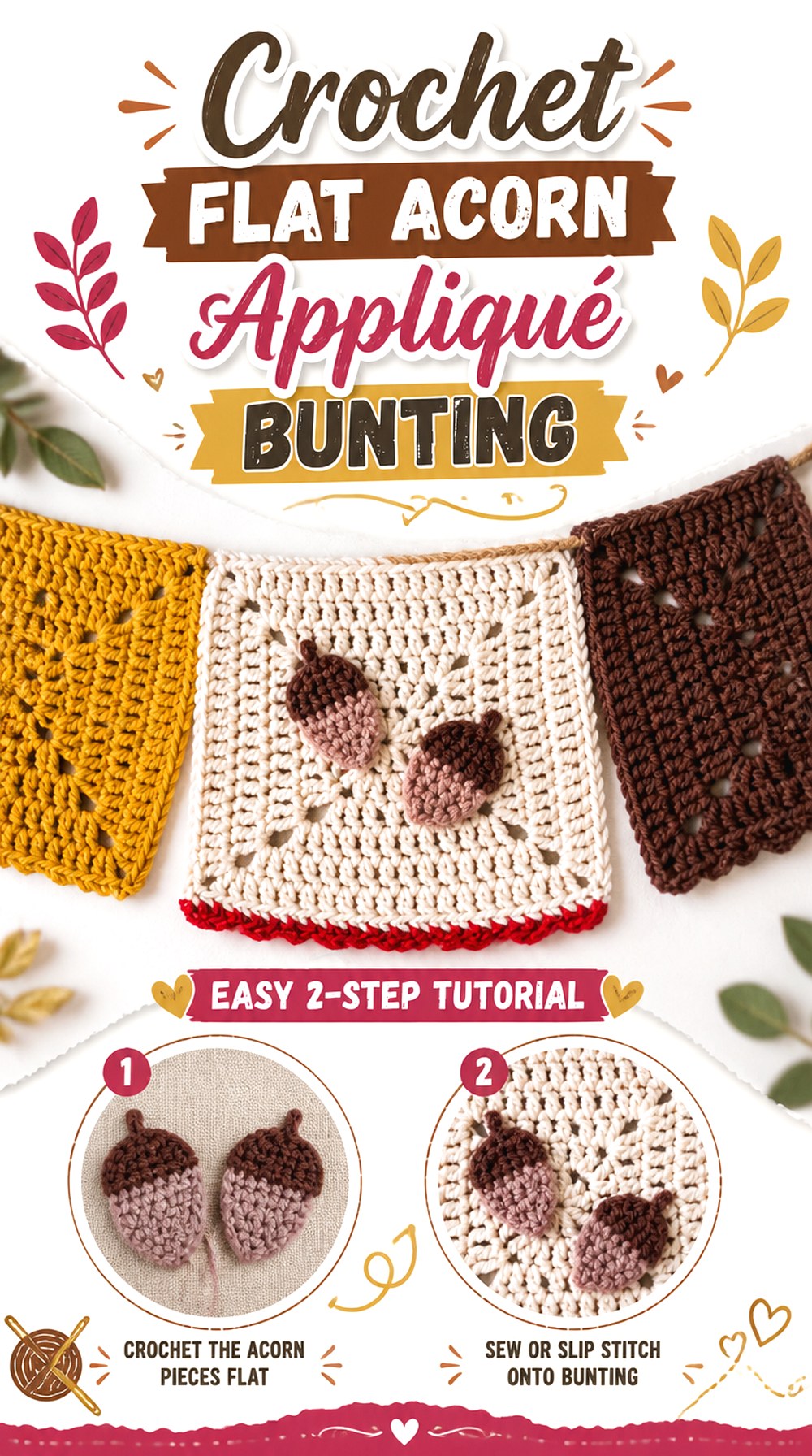
Maria’s Blue Crayon teaches a flat crochet acorn appliqué, making this one of the most space-efficient garland concepts in the collection. Instead of stuffed pieces projecting from the wall, the motifs can form a low-profile bunting that suits narrow hallways, cabinet fronts, mirrors, or other places where dimensional ornaments may get bumped.
The flat format also changes the planning priority: orientation and edge finishing become more noticeable because each acorn is viewed almost like a small graphic shape.
Flat Motifs Work Well Against a Wall
An appliqué garland does not need front clearance for stuffing, making it practical for locations where furniture or foot traffic is close to the display surface.
Pin a few motifs temporarily before building the complete strand. Check whether the acorns sit flat enough for the intended look and whether the connecting cord pulls their upper edges out of alignment.
Consistent Finishing Matters More in a Bunting
When flat motifs are arranged in one row, small differences in edge shape can become visible. Appropriate blocking or careful finishing may help repeated pieces look more coordinated, depending on the yarn used.
Compare the motifs after they are fully finished, not straight from the hook. If they respond differently, correct the shape before permanently attaching them to the strand.
Original Tutorial and Creator Credit
Creator: Maria’s Blue Crayon
17. Crochet Puff Cap Acorn Pennant Garland
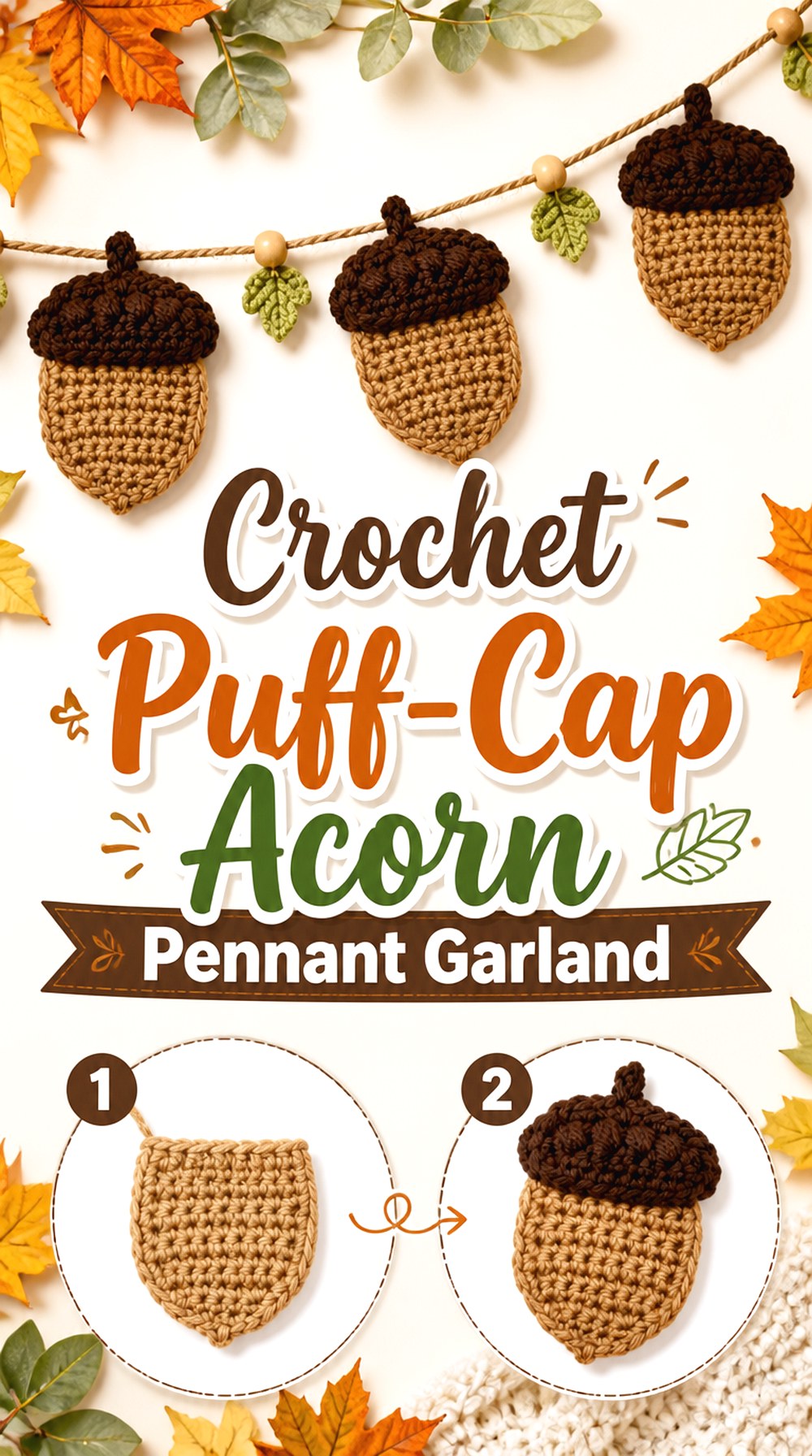
Jess Crafting’s acorn appliqué uses a prominent textured cap, giving a flat motif more dimension without turning it into a fully stuffed object. The accompanying project information also presents the motif as suitable for autumn decoration and garland use.
That makes this a useful middle ground between a simple flat bunting and a three-dimensional acorn string. The body can remain close to the wall while the cap texture adds shadow and tactile interest. Use repeated motifs as small pennants across a shelf, sideboard, or seasonal wall arrangement.
Raised Caps Give Flat Pieces More Depth
Surface texture can keep an appliqué from looking visually thin, especially when the body is simple. Arrange the motifs where side light can catch the cap texture if you want that detail to be noticeable.
If the garland will hang in a dim corner, test one sample first. Texture alone may not read clearly from a distance without enough contrast between the cap and body.
Pennant Alignment Changes the Finished Look
Flat acorns can look orderly when every stem and body points in the same direction, but they can also twist if their attachment points are uneven.
Lay the complete set along the connecting strand before sewing or fastening it. Check the top edge as one continuous line rather than assessing each motif individually.
Original Tutorial and Creator Credit
Creator: Jess Crafting
18. Crochet Small Ornament Acorn String
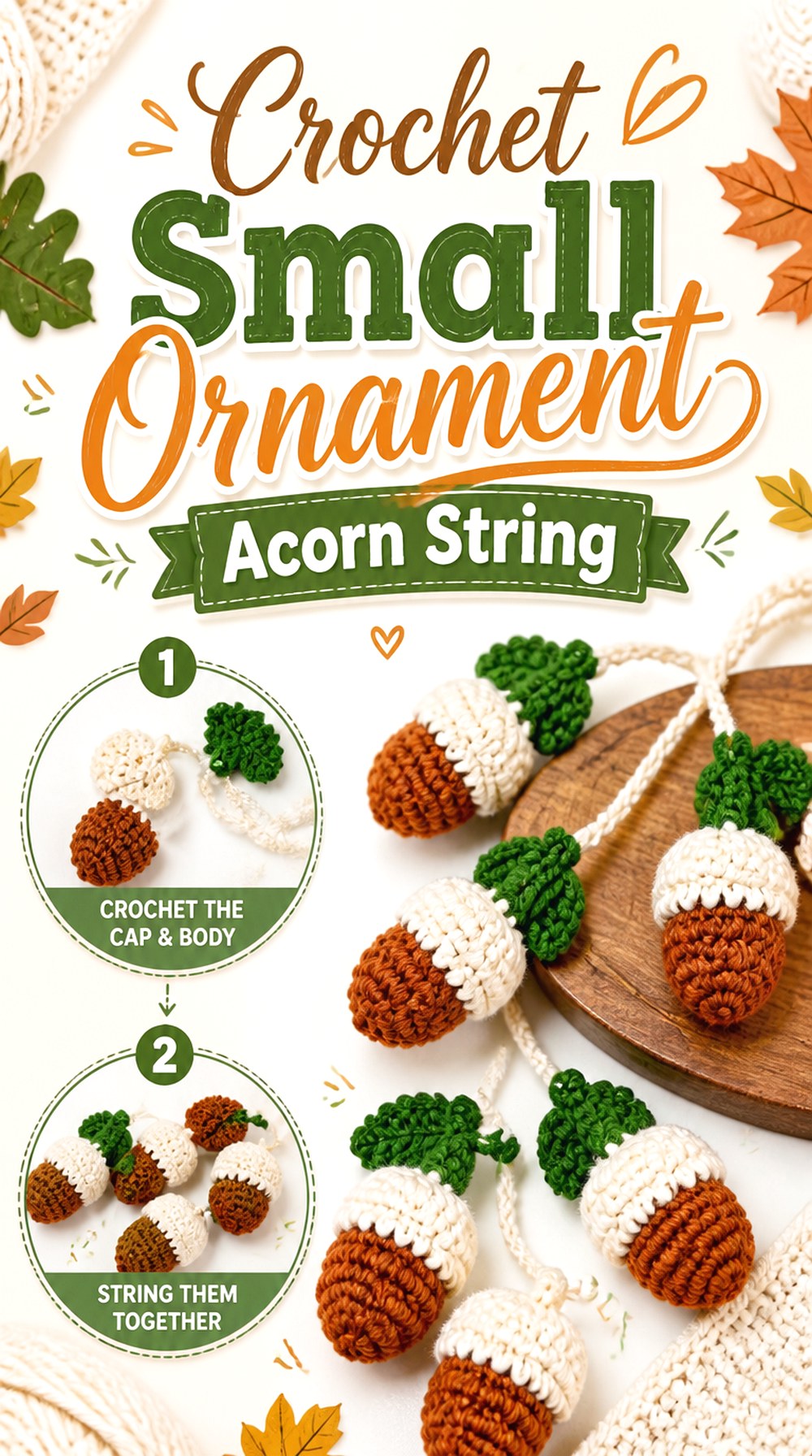
Scrochette’s acorn ornament tutorial provides a small hanging form that can be repeated along a light decorative string. Compared with a chunky farmhouse swag, this direction is visually lighter and better suited to compact displays, small branches, narrow windows, or layered seasonal arrangements.
Keep the number of companion decorations limited so the acorn shape remains clear. Because each piece begins as an ornament, you can also design the garland to be dismantled later if you prefer storing the acorns individually rather than as one long strand.
Small Ornaments Need Enough Contrast
A tiny acorn may look clearly defined in your hand but merge into the background once displayed. Before making a full set, hold one sample against the actual wall, curtain, or shelf.
If the body and cap disappear from normal viewing distance, stronger value contrast may help. Adding more tiny details is less useful when the basic silhouette is already difficult to see.
Removable Pieces Can Simplify Seasonal Storage
If each acorn retains an independent hanging loop, the motifs can be removed from the main cord instead of storing the entire garland as one tangled piece.
That flexibility is useful when storage space is limited or when you might reuse individual acorns elsewhere. Choose a simple attachment method that you can operate without stretching or damaging the crochet.
Original Tutorial and Creator Credit
Creator: Scrochette
19. Crochet Soft Amigurumi Acorn Center Garland
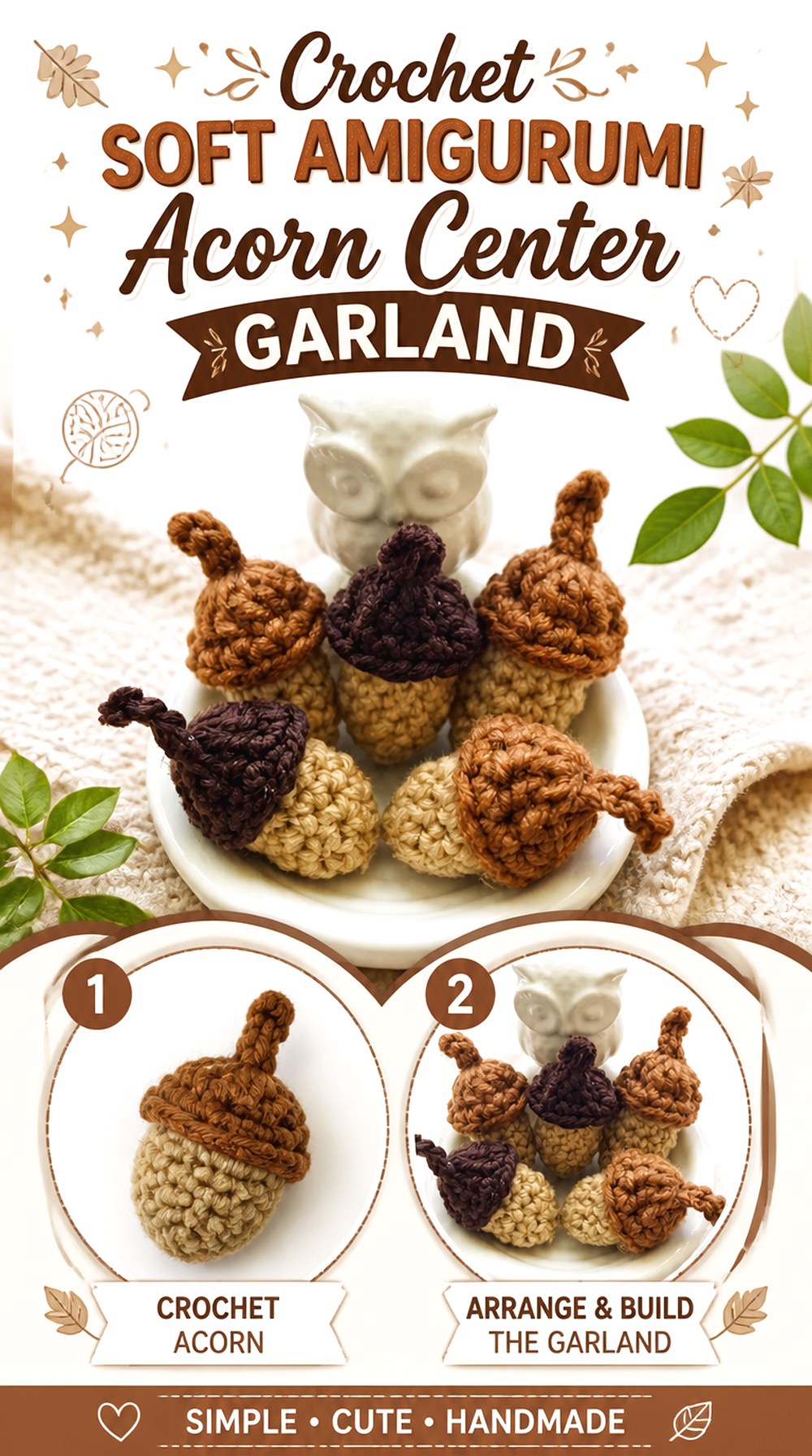
Katia Creates demonstrates a fall-themed amigurumi acorn, which can become the repeated centerpiece of a soft dimensional garland. Rather than distributing many different shapes along the full length, this idea concentrates the acorns toward the center and gradually increases the empty space toward the ends.
That arrangement works particularly well over a small table, mirror, or shelf where you want a decorative center without filling every inch of the cord. The source provides the acorn motif; the graduated placement is an independent garland-layout choice.
A Center-Weighted Layout Creates a Natural Focal Point
Not every garland needs an identical motif from end to end. Grouping more visual weight near the center can make the strand feel intentional while keeping the ends light.
Lay the cord in its expected hanging curve and position the acorns before attachment. A centered arrangement on a straight tabletop may shift visually once the strand forms a deeper arc.
Leave Enough Room for Rounded Bodies
Soft dimensional motifs need physical space as well as visual spacing. If several stuffed acorns are pressed tightly together, their individual outlines can merge into one central mass.
Start with slightly wider gaps and reduce them only if the grouping feels too sparse. It is easier to tighten a loose draft layout than to judge crowded shapes that overlap one another.
Original Tutorial and Creator Credit
Creator: Katia Creates
20. Crochet Clean Shaped Acorn Garland
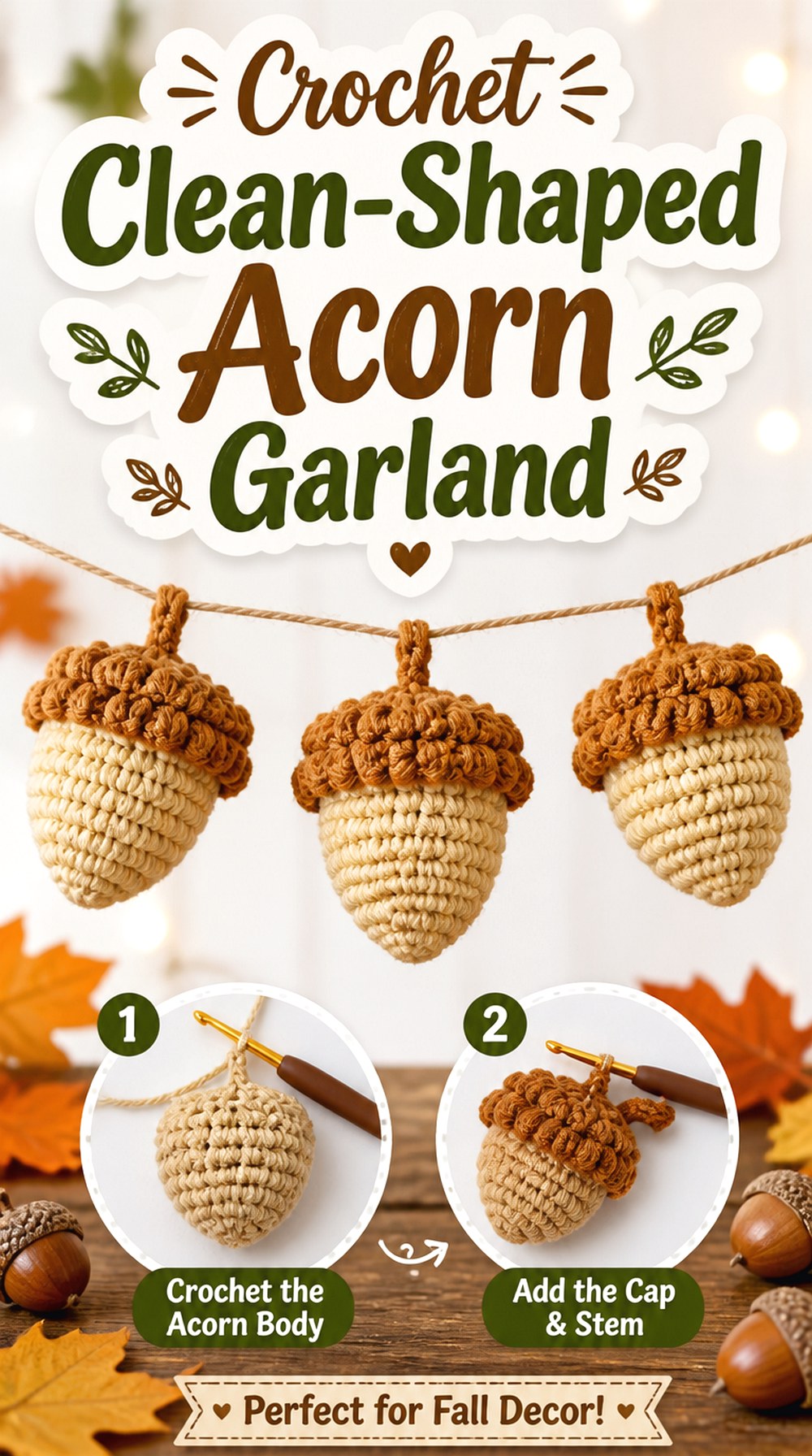
Susan’s Crochet offers a straightforward acorn tutorial that can support a clean, uniform repeated garland. Instead of emphasizing exaggerated texture, mixed sizes, or additional forest motifs, this idea relies on a recognizable acorn silhouette and orderly repetition.
That restrained approach suits modern-rustic rooms, kitchen shelves, or displays where you already have pumpkins, foliage, or patterned textiles nearby. Keeping the crochet component visually simple prevents the seasonal arrangement from becoming overloaded.
Uniform Shapes Suit a More Ordered Display
If you want a neat repeat, make the first finished acorn your visual reference for the rest. Compare shape and firmness as you work rather than waiting until every motif is complete.
Minor handmade variation is normal, but one noticeably larger or fuller piece can interrupt an otherwise orderly sequence. Place it deliberately if you prefer to keep it rather than treating the difference as a mistake.
Color Placement Can Replace Extra Decoration
A simple motif gives you room to create rhythm with restrained color changes. For example, you might keep the caps visually related while changing only the bodies, or use one accent acorn within an otherwise consistent sequence.
Limit the number of competing decisions. The cleaner the silhouette, the more noticeable each color change becomes across the full strand.
Original Tutorial and Creator Credit
Creator: Susan’s Crochet
21. Crochet Baby Acorn and Little Oak Leaf Garland
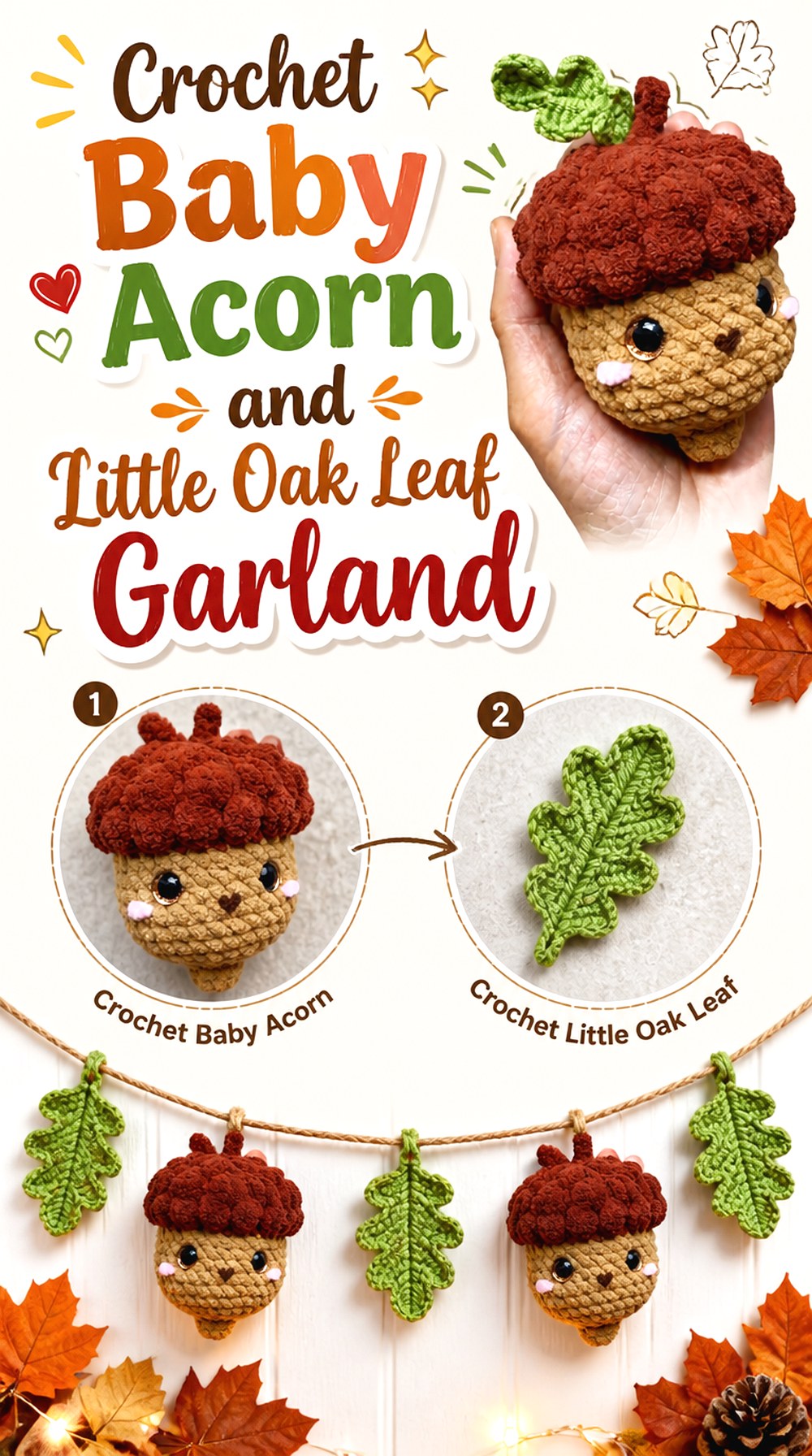
Sophie Tinie’s tutorial combines a small acorn with a little oak leaf and emphasizes a no-sew acorn construction. This makes a charming basis for a miniature woodland strand, especially when you want the acorns and leaves to feel intentionally petite rather than simply using fewer motifs.
For a nursery or child’s room, however, treat the garland as decorative wall decor rather than a toy. Placement and embellishment safety matter more than the cute scale. Keep hanging cords and small detachable features securely out of reach of babies, young children, and pets.
Small Scale Works Well in a Gentle Woodland Display
Tiny acorns and little leaves can suit a compact picture ledge, framed woodland vignette, or high wall shelf where large autumn ornaments would dominate the area.
Before committing to subtle colors, view a sample from the floor or doorway. Very small motifs need adequate contrast if they are expected to remain recognizable from normal room distance.
Nursery Placement Requires Extra Caution
Garlands contain cords, and small crochet decorations may also include separate embellishments. Do not position such decor where a baby or young child can reach, pull, or become entangled with it.
If a tutorial offers optional facial or decorative details, independently assess whether those additions are appropriate for your intended environment. For child-focused spaces, secure placement is more important than creating an interactive decoration.
Let Leaves Break Up the Acorn Repetition
Little oak leaves provide a natural visual pause between rounded acorns. You can use them singly between motifs or create occasional acorn-and-leaf pairs.
Before attachment, compare how the leaves hang next to the dimensional bodies. A small leaf that disappears behind an acorn may need a different angle or slightly more separation to remain visible.
Original Tutorial and Creator Credit
Creator: Sophie Tinie
22. Crochet Boho Acorn Granny Square Banner
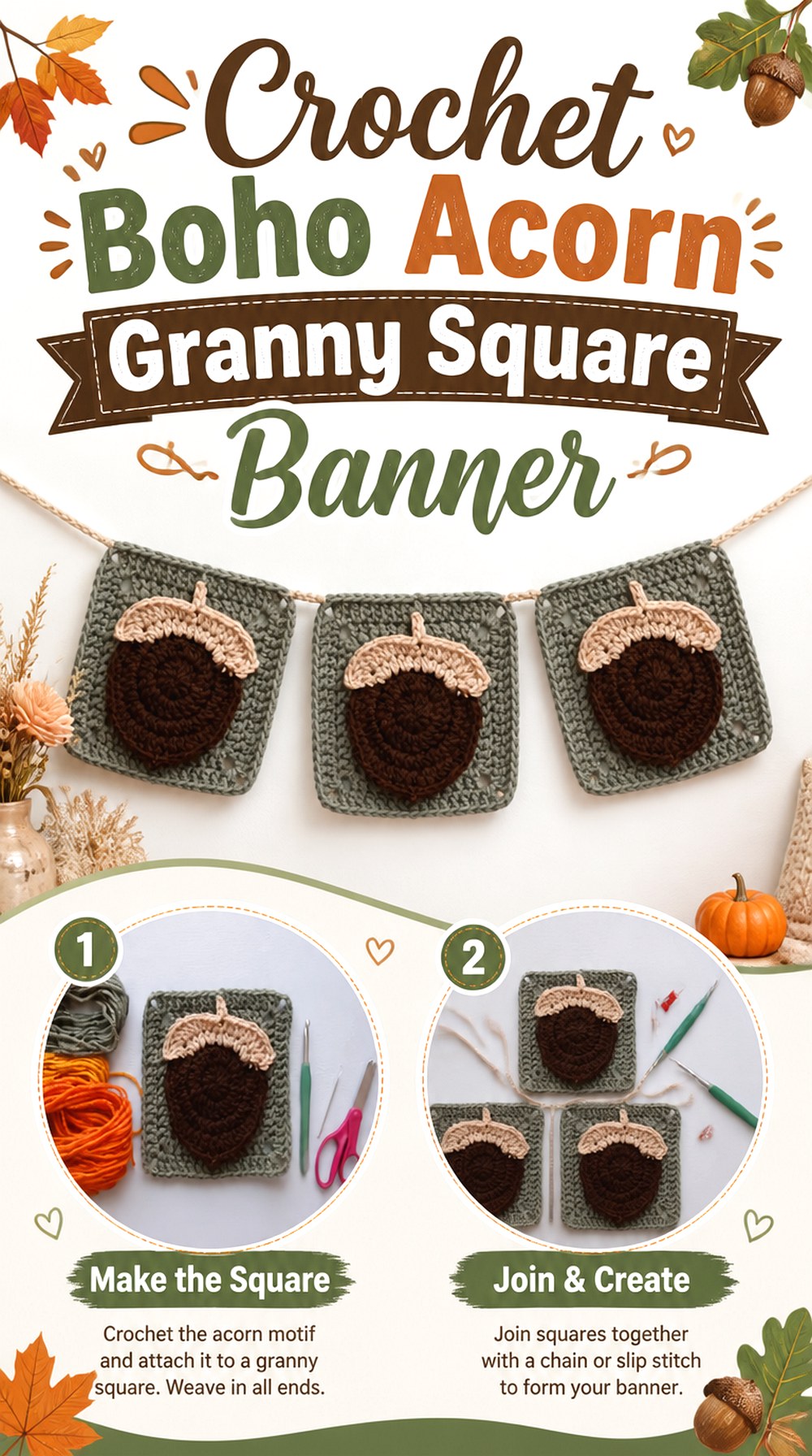
Jayda InStitches takes the acorn in a completely different direction by incorporating a dimensional acorn motif into a granny-square format. Instead of dangling individual acorns, join or suspend several finished squares as banner panels so the strand reads more like textile wall art.
This is the strongest option here for readers who want broad, flat visual coverage. The square background gives each acorn its own frame and creates a larger color field, making the design easier to see from farther away than many miniature ornaments.
Square Panels Create Much More Visual Coverage
A granny-square banner fills wall space with both the acorn and its background. That makes it useful above a console, along a broad wall, or anywhere tiny hanging acorns would look undersized.
Before making several panels, finish one complete square and hold it in the intended location. Its blocked dimensions—not assumptions based on the motif alone—should guide how many panels your display can accommodate.
Panel Orientation Needs to Stay Consistent
Because each square behaves like a framed motif, a slightly rotated or unevenly hanging panel can be more noticeable than a turned stuffed acorn.
Lay the panels in sequence and decide how the top edges will be supported. If you combine different background colors, also check the order from a distance so one side of the banner does not become visually heavier.
The Acorn Should Remain the Focal Motif
A highly contrasting square background can compete with the dimensional acorn in the center. Compare the motif and background as one finished panel before choosing colors for the remaining squares.
If the acorn disappears visually, adjusting contrast may be more effective than adding more embellishment. The frame should support the motif rather than becoming the only feature viewers notice.
Which Crochet Acorn Garland Style Fits Your Space?
| If you want… | Strong options | Why they fit |
|---|---|---|
| A traditional autumn mantel | Oak Leaf Cluster, Acorn-and-Leaf Pair, Harvest Pumpkin and Acorn | Familiar fall shapes create a fuller seasonal composition. |
| A small or narrow-space display | Tiny Acorn Repeat, Compact Amigurumi, Flat Appliqué | These options can stay visually controlled without filling much wall depth. |
| A bold statement piece | Chunky Farmhouse Swag, Boho Acorn Granny Square Banner | Larger forms or broad panels remain visible from farther away. |
| A detailed woodland scene | Cottagecore Woodland Story, Baby Acorn and Little Oak Leaf | Multiple forest motifs make the strand more illustrative. |
| Easier seasonal storage | Flat Acorn Appliqué, Puff-Cap Pennant, Removable Ornament String | Flatter or detachable pieces can be simpler to pack than a dense stuffed swag. |
| Decor that can extend beyond peak fall | Winter Solstice Acorn Garland, Braided-Cord Ornament Garland | A nature-focused presentation can feel less tied to pumpkins or harvest imagery. |
Conclusion
The right crochet acorn garland depends more on its finished form than on the acorn theme itself. Choose flat appliqués or granny-square panels when wall space is shallow, compact amigurumi for smaller shelves, and chunky acorns when the strand needs to read clearly from across a room. Oak leaves make a traditional botanical pairing, while pumpkins and woodland characters turn the garland into a fuller seasonal feature.
Before making multiples, finish one representative motif and test its scale, orientation, and contrast in the actual display location. That single check can prevent an entire strand from feeling too dense or too small. Use the original tutorials linked with each idea for their exact construction details, then plan your garland spacing and arrangement around your own space.
Frequently Asked Questions
Can I use a single crochet acorn tutorial to make a garland?
Yes. Several tutorials in this collection teach the acorn itself rather than a complete connected strand. You can repeat that finished motif and design your own spacing and arrangement, but the garland cord, attachment method, and total length are then separate planning decisions. Make one or two acorns first and test how they hang before producing a full batch, especially if the motifs are dimensional.
Are flat or stuffed acorns better for a mantel garland?
Neither is universally better. Flat appliqués sit closer to the mantel or wall and generally create a lighter visual profile. Stuffed acorns give stronger depth and shadows, which can make them easier to notice across a room. A shallow mantel filled with framed art may favor flat motifs, while a broad, relatively empty mantel can provide enough space for larger dimensional pieces.
How can I keep crochet acorns from twisting sideways on the strand?
Test the attachment point on one finished acorn before assembling the entire garland. A dimensional motif’s center of gravity can cause it to rotate once suspended. Moving the attachment position, giving the motif a slightly different hanging loop, or allowing more space around it may improve its orientation. Check the result while the strand is actually hanging rather than judging it only on a flat work surface.
Can I mix acorns made from different crochet tutorials?
You can, but compare the actual finished motifs first. Different construction styles, yarn choices, hook sizes, textures, and stuffing can create pieces that look mismatched even when they are all called crochet acorns. Make one sample from each source and compare scale, visual weight, cap proportion, and dimensional depth. If the forms differ greatly, use the contrast intentionally rather than trying to pass them off as a uniform set.
What colors make an acorn garland look less strictly autumnal?
Move away from a palette dominated by bright orange and other harvest-specific accents. Browns, creams, muted greens, deeper forest shades, and other room-compatible neutrals can emphasize the woodland character of an acorn rather than a particular holiday. Color alone does not determine seasonality, though; companion motifs matter too. Oak leaves and natural forms generally feel more flexible than pumpkins or Halloween-specific decorations.
Is a crochet acorn garland appropriate for a nursery?
It can be used as decorative wall decor when installed securely and completely out of a child’s reach, but a hanging garland should not be treated as a crib toy. Cords can present an entanglement hazard, and small detachable embellishments may create additional risks. Avoid placing a garland on or within reach of a crib, changing area, or play space, and independently assess any buttons, beads, safety eyes, or other attached pieces.