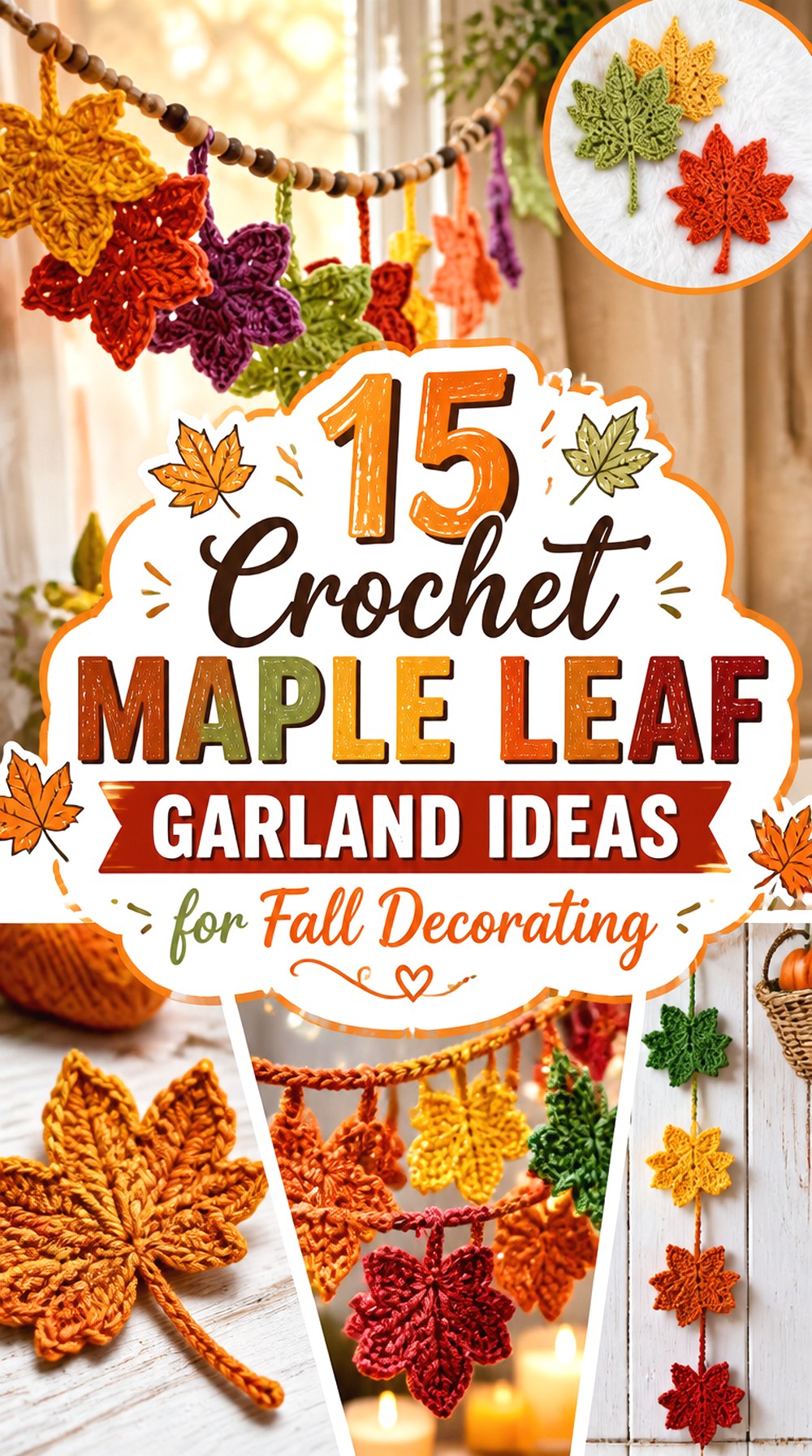
15 Crochet Maple Leaf Garland Ideas for Fall Decorating
Crochet maple leaf garlands can range from delicate strings of small appliqués to bold banners made with large, deeply pointed leaves. The biggest differences are not simply color. Leaf scale, yarn thickness, stiffness, lobe shape, spacing, texture, and the way each motif hangs can completely change how a finished strand works over a mantel, window, doorway, shelf, or fall table.
The tutorials below focus primarily on crocheting individual maple leaves, with several creators specifically suggesting garlands or other fall displays. The garland arrangements are independent adaptation ideas rather than replacements for the creators’ instructions. Use each original tutorial for the exact leaf construction, then plan your strand around the finished size and behavior of your own motifs.
Quick List
- Crochet Classic Pointed Maple Leaf Mantel Garland
- Crochet Wire-Shaped Maple Leaf Window Garland
- Crochet Mixed-Scale Maple Leaf Swag
- Crochet Scrap-Yarn Maple Leaf Garland
- Crochet Graphic Maple Leaf Motif Banner
- Crochet Clean-Outline Maple Leaf Garland
- Crochet Brioche-Texture Maple Leaf Garland
- Crochet Soft Coaster-Style Maple Leaf Garland
- Crochet Compact Maple Leaf Appliqué Garland
- Crochet Cord-Yarn Statement Maple Leaf Garland
- Crochet Diagram-Friendly Maple Leaf Garland
- Crochet Pin-Back Maple Leaf Garland
- Crochet Dwarf Japanese Maple Leaf Garland
- Crochet Beginner Maple Leaf Fall Swag
- Crochet Canadian Maple Leaf Banner Garland
Plan Leaf Scale Before You Make a Whole Garland
A maple leaf that looks balanced as a single appliqué may feel crowded once several are placed on one strand. Make and finish one leaf first, then judge its width, height, stem direction, and how much open space its pointed lobes need. If you plan to mix tutorials, compare the finished motifs after any blocking or shaping rather than assuming that similar yarn labels will create compatible dimensions.
Large leaves generally make more sense with wider gaps and fewer motifs. Small leaves can create a denser rhythm without taking over the wall or mantel. For a mixed-scale strand, arrange the finished leaves on a flat surface before attaching anything. That simple layout check makes it easier to spot sections that feel visually heavy.
Yarn Choice Changes Shape as Much as Color
Maple leaves depend on recognizable points and indentations, so yarn behavior matters. A yarn that produces a soft, flexible fabric may create a relaxed hanging leaf, while a firmer fabric can make the lobes read more clearly from a distance. Neither effect is automatically better; it depends on whether you want a soft swag or a crisp decorative banner.
Thickness also affects scale and weight. If you change the yarn or hook from a tutorial, do not assume the finished leaf will remain the same size. Crochet With Tiffany specifically demonstrates maple leaves with different yarn weights and notes that dimensions depend on the yarn and hook combination. Make one sample before committing a large amount of yarn to repeated motifs.
Keep the Strand Balanced, Flat, and Easy to Store
Before joining leaves, decide whether you want them hanging from their stems, attached across their upper edges, or distributed along a separate crocheted cord. The choice changes how freely they rotate. A motif with most of its weight below one attachment point may naturally hang straighter than one connected off-center.
Storage matters for seasonal crochet too. Flexible leaves can usually be layered more easily, while wired, corded, or highly structured versions deserve more room so their points are not crushed. If leaves curl after storage, reshape them using a method appropriate for the fiber rather than applying heat or moisture without checking yarn-care information first.
1. Crochet Classic Pointed Maple Leaf Mantel Garland
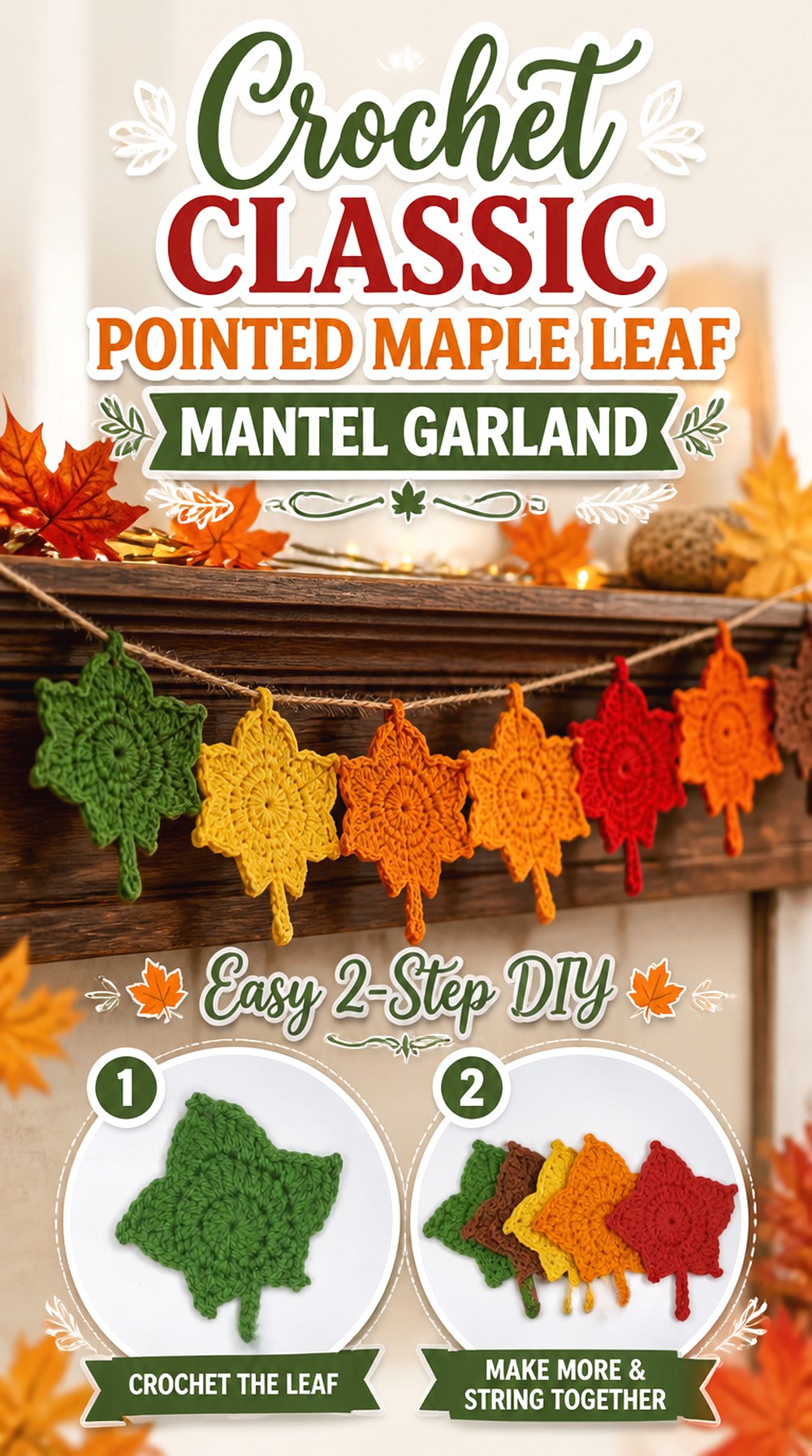
This version starts with one of the clearest garland-ready sources in the collection. Hopeful Turns demonstrates a recognizable pointed maple leaf and specifically suggests using the finished motif for an autumn garland or wreath.
For a mantel display, repeat the same silhouette in several fall shades instead of changing the construction from leaf to leaf. Consistent shapes give the strand continuity, while color variation keeps it from looking overly uniform. This is especially useful when the garland will share space with pumpkins, candles, framed art, or other seasonal decorations.
A Crisp Silhouette Reads Clearly Across a Mantel
Mantel decor is usually viewed from several feet away, so the outer contour matters more than tiny stitch details. Before producing a complete set, place one finished leaf where the garland will hang and check whether its points remain easy to recognize at normal viewing distance. If the silhouette disappears, changing scale may help more than adding additional colors or embellishments.
Alternate Leaf Direction Before Final Attachment
A row of motifs angled identically can make the garland look unexpectedly rigid. Arrange the completed leaves first and experiment with stems pointing slightly left, right, or downward. Keep the changes controlled rather than random. The goal is to create natural movement without causing neighboring lobes to overlap so heavily that the maple shape becomes difficult to read.
2. Crochet Wire Shaped Maple Leaf Window Garland
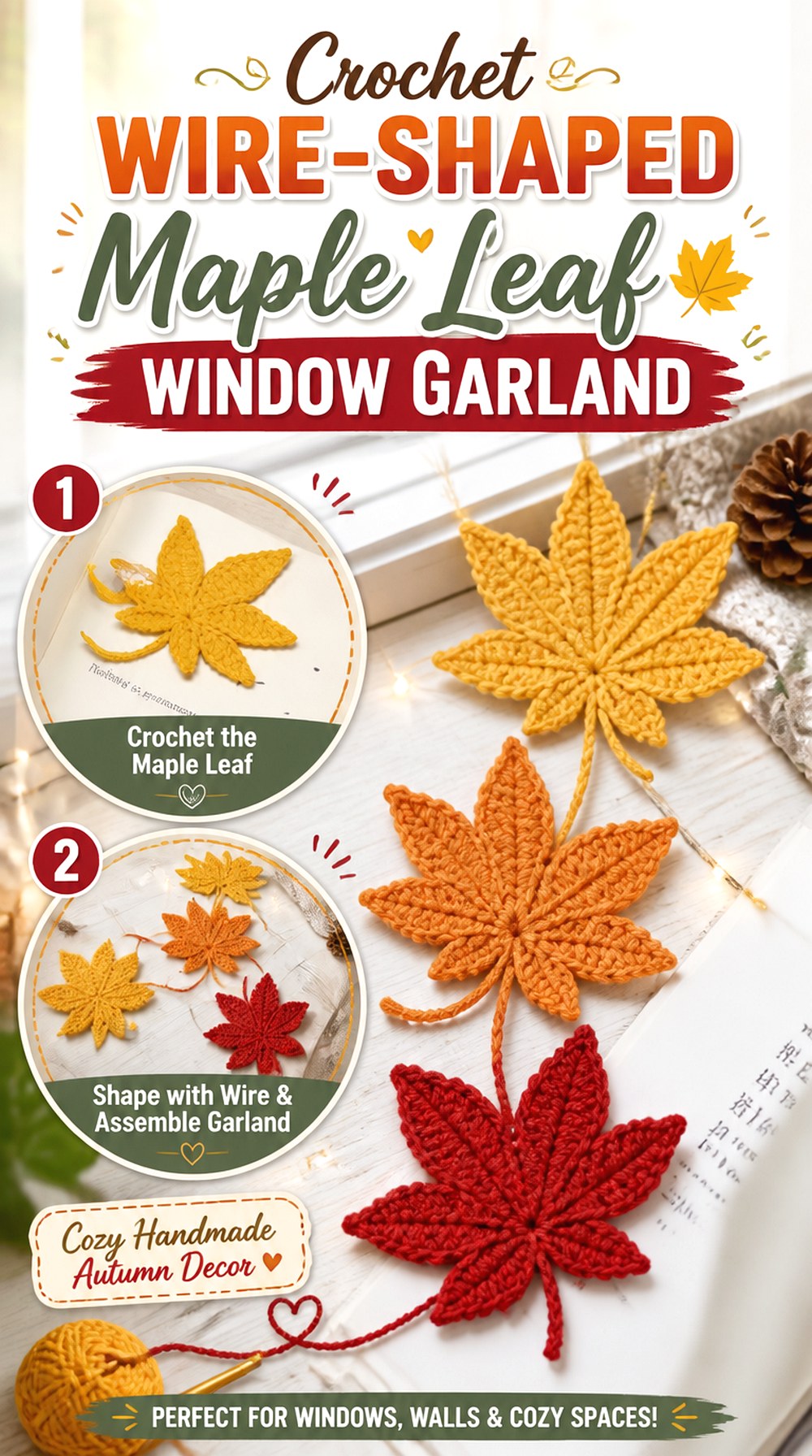
For a garland where individual leaves need a more controlled outline, the vvw.studio tutorial offers an interesting direction. Its materials include soft wire, and the video includes guidance related to preventing the finished leaf from rolling.
That makes this concept different from a completely flexible yarn-only strand. A structured maple leaf can work especially well in a window or against a plain wall where distinct lobes are part of the visual effect. Because the leaf itself has added shaping material, keep the connecting strand visually simple so the maple silhouettes remain the focus.
Soft Wire Can Help the Lobes Stay Open
When a detailed leaf continually folds into itself, some of the shape disappears. A structured version can make the points easier to see, especially when the garland hangs vertically or moves slightly near a window. Follow the creator’s method rather than improvising wire placement, and evaluate one completed motif before committing to a whole strand.
Give Structured Leaves More Breathing Room
A flexible leaf can overlap a neighbor and still drape naturally. A shaped leaf is less forgiving because crossing points may look cluttered. Lay your finished motifs side by side and gradually increase the distance until each outline can be read independently. There is no universal spacing measurement because the correct gap depends on your actual finished leaf width.
Handle Internal Wire With Care
If you use wire, make sure no sharp end remains exposed where it could catch curtains, hands, clothing, or other textiles. This style is better treated as decorative household crochet than as a strand intended for unsupervised child or pet access. Check the creator’s materials and shaping directions before substituting a different type of wire.
Original Tutorial and Creator Credit
Creator: vvw.studio
3. Crochet Mixed Scale Maple Leaf Swag
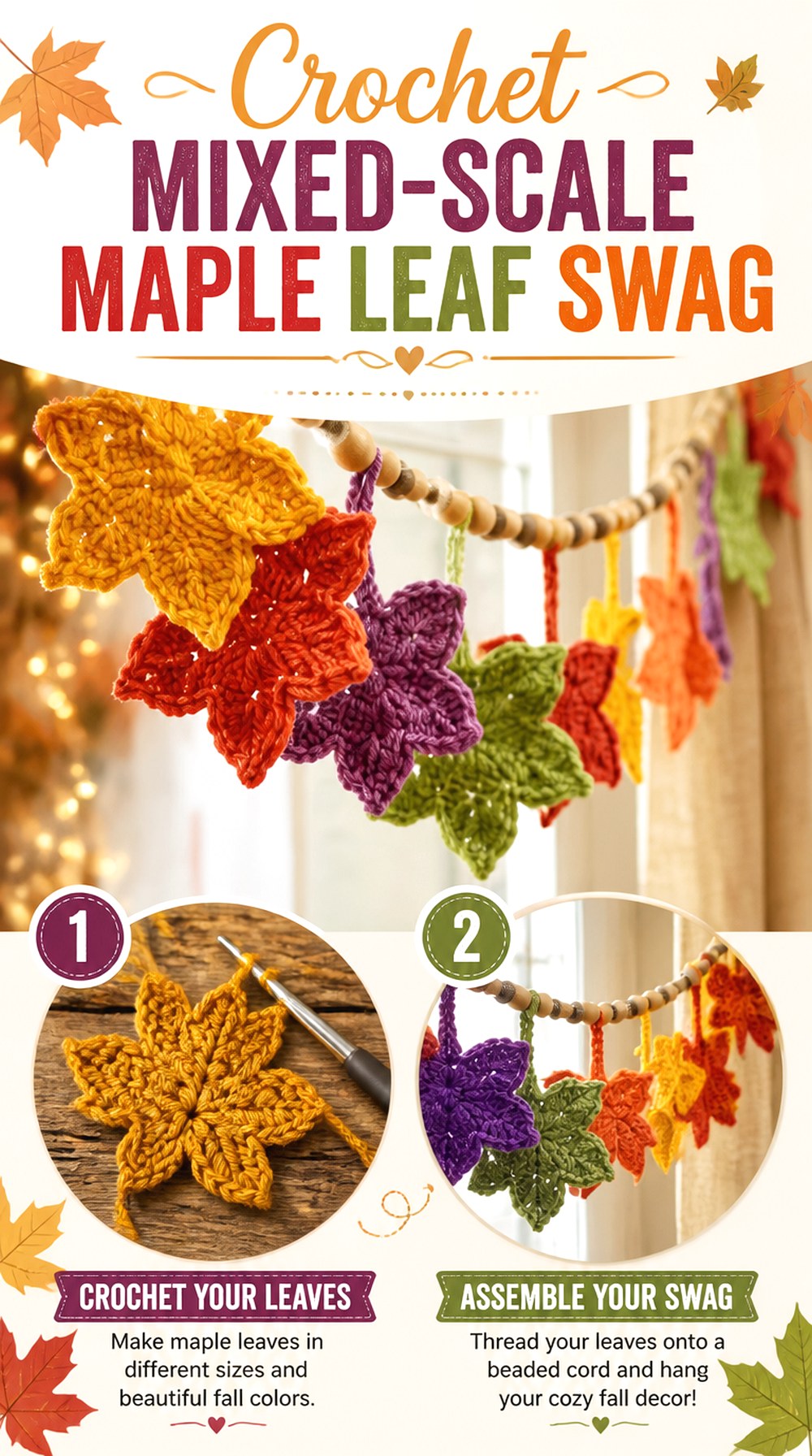
Crochet With Tiffany demonstrates the same maple-leaf idea with more than one yarn weight and explains that the final dimensions change with yarn and hook size. That makes this source useful for planning a garland built intentionally around several leaf scales.
Instead of placing every size in a strict alternating sequence, try concentrating the largest leaves near the center and gradually moving toward smaller motifs near the ends. The result can feel more like a swag than a repeating banner. Keep color distribution restrained so both size and color are not competing for attention at every position.
Use One Leaf Design to Create Scale Variation
Changing scale while keeping the underlying leaf design consistent can create more unity than combining several unrelated motifs. Make sample leaves with the yarn-and-hook combinations you are considering, then compare their finished dimensions directly. Yarn labels alone are not enough to predict how dramatic the scale difference will be in your own tension.
Compare Finished Leaves Before Building the Sequence
Do not decide the order while motifs are still unfinished. A leaf may relax, flatten, or spread differently after finishing. Once every sample is ready, arrange them on the floor or table in the approximate length of the future garland. This makes it much easier to see whether one large motif overwhelms the smaller leaves beside it.
Original Tutorial and Creator Credit
Creator: Crochet With Tiffany
4. Crochet Scrap Yarn Maple Leaf Garland
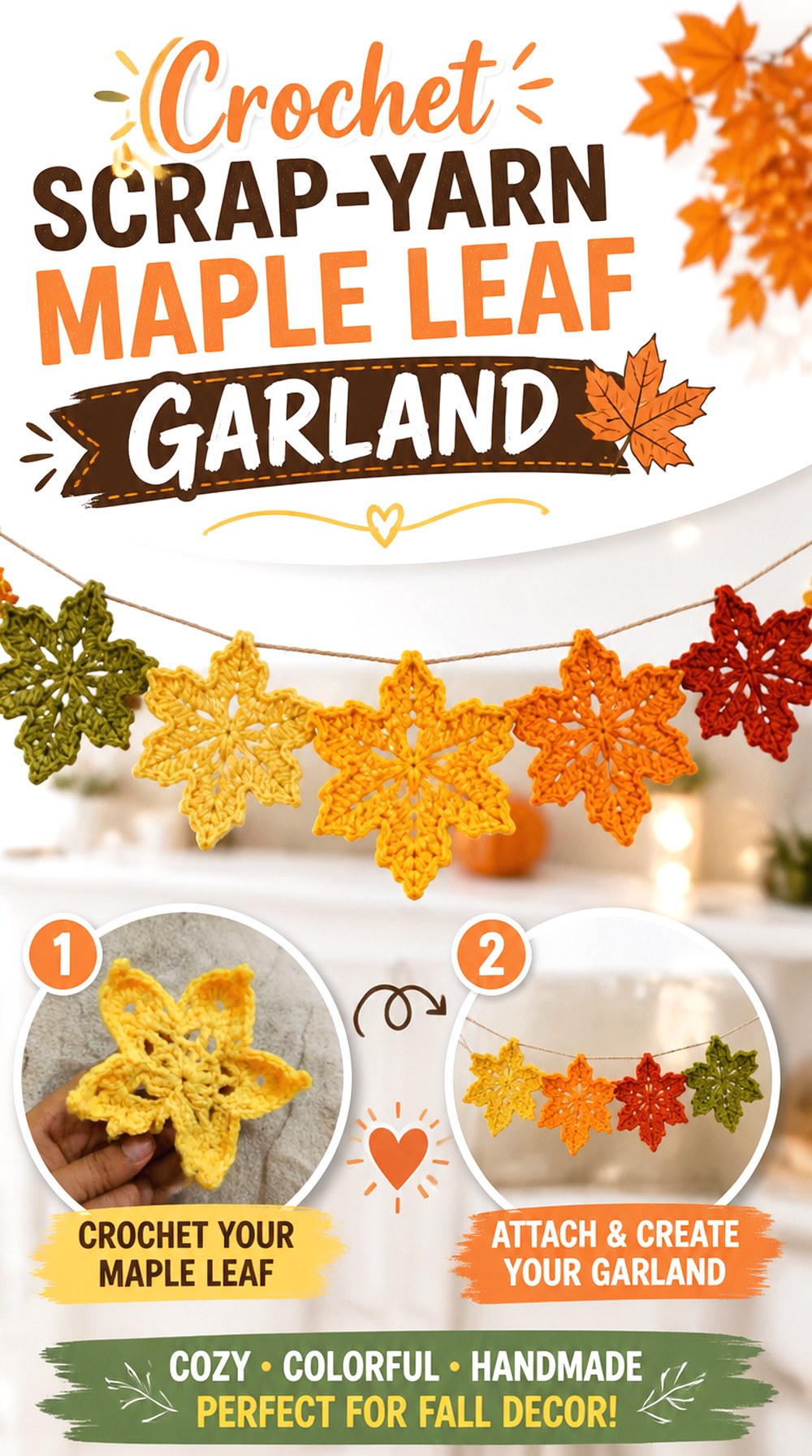
A multicolor strand is a practical place to use smaller quantities of autumn yarn, and happyloops&yarn specifically lists the maple leaf as suitable for garlands and scrap-yarn projects. The concept works best when the leftover yarns are compatible enough to produce leaves with a reasonably consistent presence.
Think beyond the obvious red-orange-yellow sequence. Rust, ochre, muted green, cream, deep burgundy, and brown can create a more gradual late-season palette. The important distinction from the mixed-scale garland is that this version uses color variation as the main feature while trying to keep overall motif size controlled.
Sort Leftovers by Thickness Before Sorting by Shade
Two yarns can look perfect together but create noticeably different leaves if their thickness or behavior varies. Make a small comparison swatch or sample motif when a leftover yarn is uncertain. If one produces a significantly larger leaf, either save it for another project or make the scale difference look deliberate rather than accidental.
Control Color Rhythm Instead of Attaching Randomly
True random placement can produce clusters such as three dark leaves followed by several pale ones. Arrange all finished motifs before joining them and spread strong colors across the strand. You can still keep the garland informal without letting one section become visually heavier than the rest.
Original Tutorial and Creator Credit
Creator: happyloops&yarn
5. Crochet Graphic Maple Leaf Motif Banner
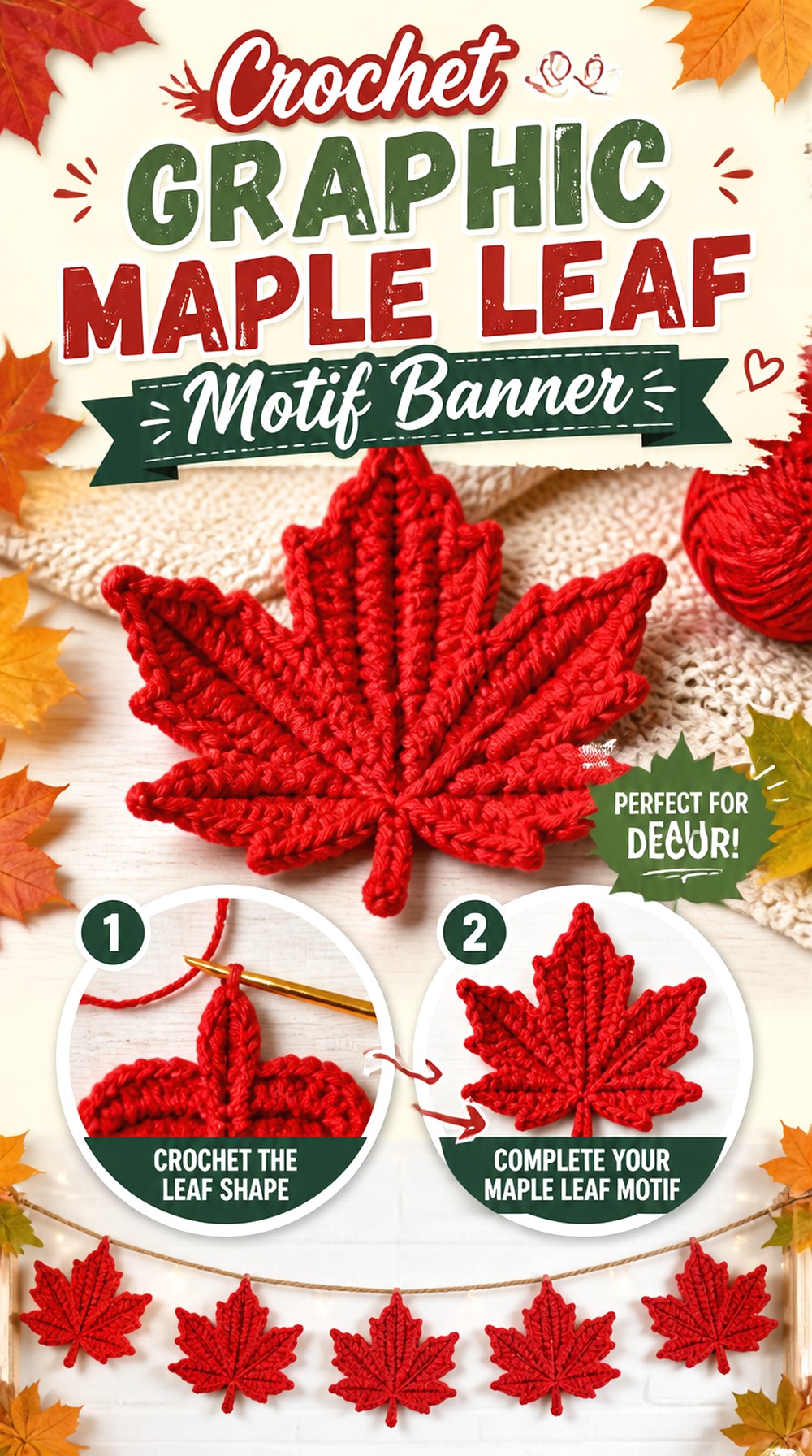
Kokakiko’s tutorial demonstrates a maple leaf motif based on Yarnspirations’ Lily Sugar’n Cream Oh Canada Crochet Dishcloth design and notes garlands among its possible uses. Its broader motif character lends itself to a banner where the leaves are treated as individual statement shapes rather than tiny repeated accents.
For this approach, fewer motifs may create a stronger composition. Place the leaves across a plain crocheted cord and give each one enough empty space to show its outline. A single-color version can feel graphic and clean, while several coordinated colors push the result toward traditional autumn decor.
Broader Motifs Need More Empty Space
Increasing the number of motifs does not always improve a garland. When each leaf already covers a relatively large visual area, closely packing them can hide the edges that make the maple shape recognizable. Test the layout at the same viewing distance you expect in the room rather than judging the strand only from a tabletop.
Fewer Leaves Can Create a Stronger Banner Effect
This concept works well when the connecting line and leaves read as separate design elements. Consider an odd-numbered arrangement with a clear central motif, or distribute leaves symmetrically if the strand will hang above a centered piece of furniture. These are layout ideas rather than instructions from the source tutorial.
Check the Teaching Language Before Starting a Batch
Kokakiko explains that the English-language Yarnspirations pattern is translated into Japanese for the tutorial. If you do not follow Japanese comfortably, preview the video before choosing it for a large batch and decide whether the visual demonstration plus the referenced written pattern suits your learning style.
Original Tutorial and Creator Credit
Creator: kokakiko
6. Crochet Clean Outline Maple Leaf Garland
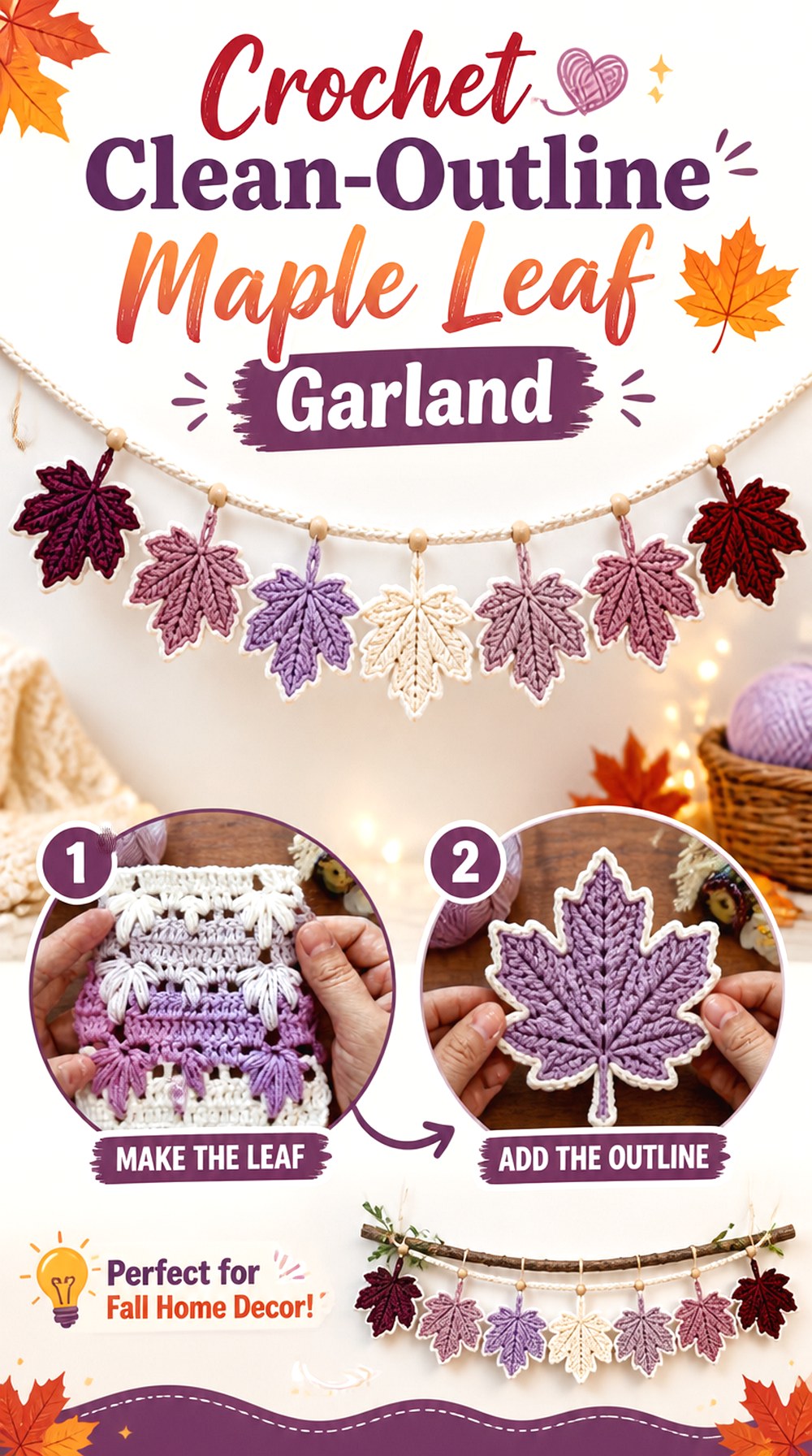
The nix crochet tutorial focuses specifically on a maple leaf motif. For this garland concept, keep the treatment deliberately simple: one repeated leaf silhouette, one uncomplicated hanging cord, and limited embellishment.
This is a good route when your priority is repetition rather than building several extra decorative components. Before making a full set, watch enough of the tutorial to confirm that the motif’s proportions, finished appearance, and teaching format match what you want. The available video description does not provide extensive material details, so those are worth checking directly before batch-making.
Let the Repeated Outline Carry the Design
When a leaf already has a distinctive perimeter, tassels, beads, bows, and additional motifs can compete with it. Try arranging several completed leaves by themselves first. If the strand already has enough rhythm, keeping the supporting cord quiet can make the finished garland cleaner and easier to place with other seasonal decor.
Confirm Materials Before Making Multiples
A single motif is forgiving if you need to restart with a different yarn or hook. Fifteen repeated leaves are not. Because the available source information is limited, check the actual tutorial and description for the creator’s current material guidance before buying yarn specifically for a large strand.
Original Tutorial and Creator Credit
Creator: nix crochet
7. Crochet Brioche Texture Maple Leaf Garland
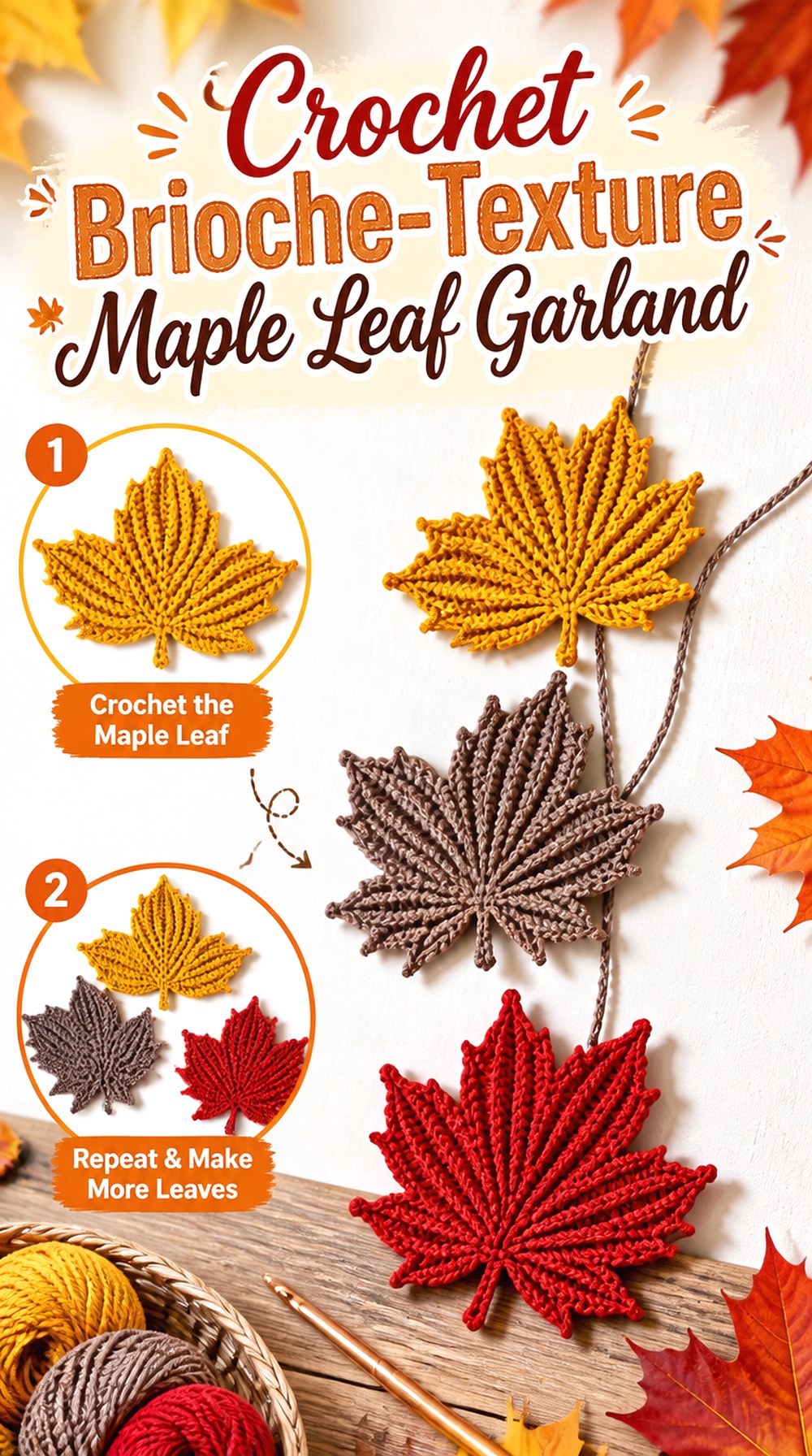
For a strand with noticeably different surface texture, @forgiocreations demonstrates an autumn maple leaf using crochet brioche techniques and short-row shaping. That immediately separates this idea from flatter appliqué-style leaves.
Texture gives the individual motifs more visual presence, so this garland does not need complicated color changes to feel detailed. A narrow palette of two or three autumn shades can keep the construction visible. It may work particularly well on a plain wall or uncomplicated mantel where the raised texture will not compete with a heavily patterned background.
Brioche Texture Turns Each Leaf Into a Feature
When the fabric itself has strong texture, close motif spacing can make the strand visually dense. Finish one leaf, place it against the intended background, and judge how much space it needs before deciding the repeat. A texture that looks subtle in your hand can become much more noticeable once several motifs are aligned.
Practice Short-Row Shaping Before Production
The creator specifically describes brioche work and short rows in this design. If those techniques are unfamiliar, make the first leaf a learning sample rather than immediately cutting yarn for an entire matching set. Once you understand how the finished shape behaves, you can decide whether the extra texture is worth repeating across the full garland.
Keep the Suspension Point From Distorting the Leaf
A textured motif may have areas that are thicker than others. Before attaching your hanging cord permanently, temporarily suspend one finished leaf and see where it sits naturally. The visually centered position is not always the same as the point where the motif balances without pulling to one side.
Original Tutorial and Creator Credit
Creator: @forgiocreations
8. Crochet Soft Coaster Style Maple Leaf Garland
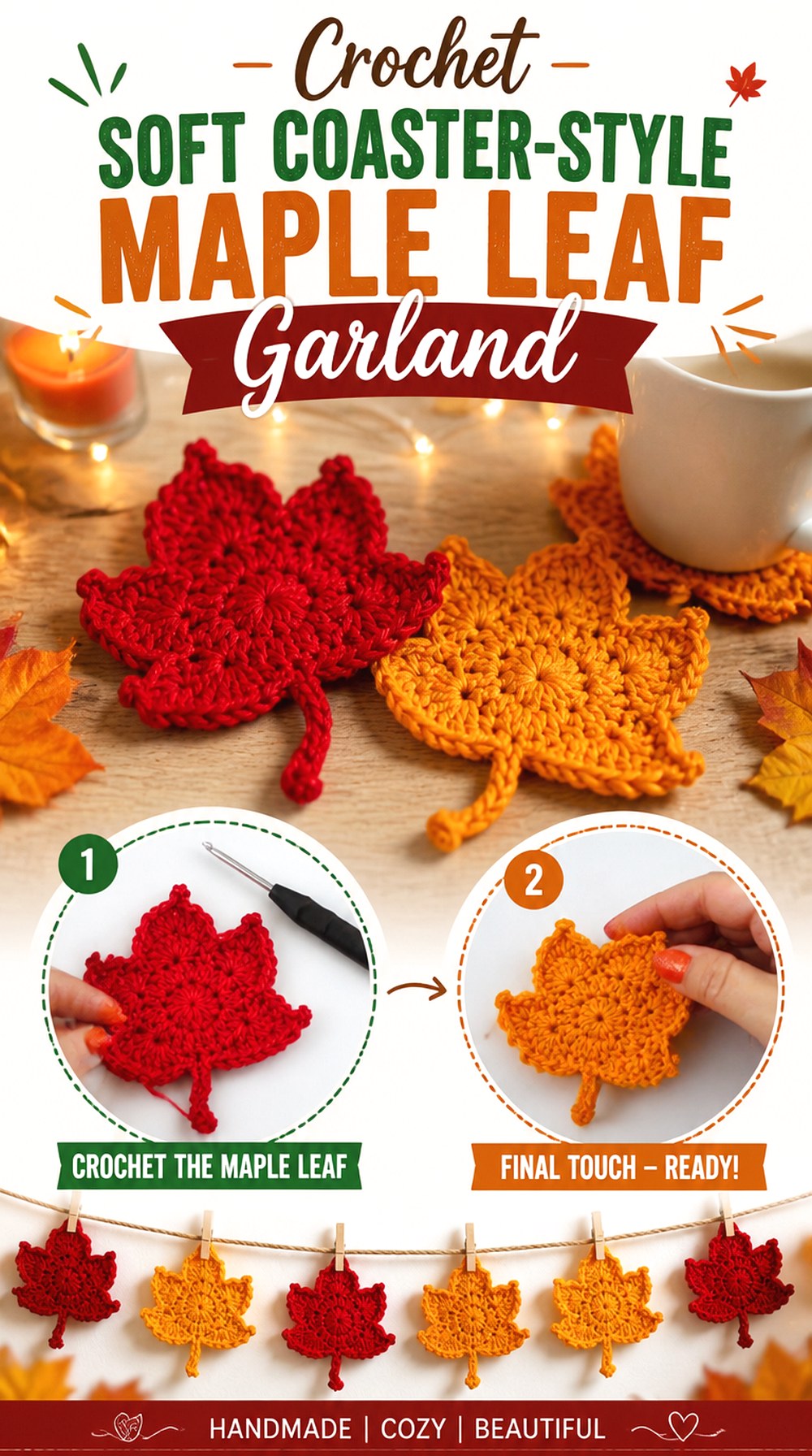
Sylvie Rasch presents a crocheted maple leaf that can function as decor, a coaster, or a reusable makeup-removal pad. For garland planning, that multipurpose form suggests a softer, substantial motif rather than an extremely tiny appliqué.
A strand made from this style can suit a shelf, kitchen display, or cozy breakfast-nook setting where soft textile shapes feel more appropriate than rigid decorations. Keep the cord flexible as well so the whole piece shares the same relaxed character.
A Softer Motif Creates a Relaxed Hanging Line
Not every garland needs sharply fixed leaf points. A flexible motif can create gentle movement and slightly different angles along the strand. If that is the effect you want, avoid over-correcting every leaf into an identical rigid position. Instead, focus on consistent attachment points so the variation looks intentional.
Choose Fiber With Both Display and Care in Mind
A motif demonstrated for several practical uses may inspire a washable garland, but fiber-care rules still depend on the actual yarn you select. Check the label before deciding how you will clean or reshape the decoration. A seasonal piece that will be stored for much of the year benefits from yarn that you are comfortable maintaining.
Original Tutorial and Creator Credit
Creator: Sylvie Rasch – CraSy creative things
9. Crochet Compact Maple Leaf Appliqué Garland
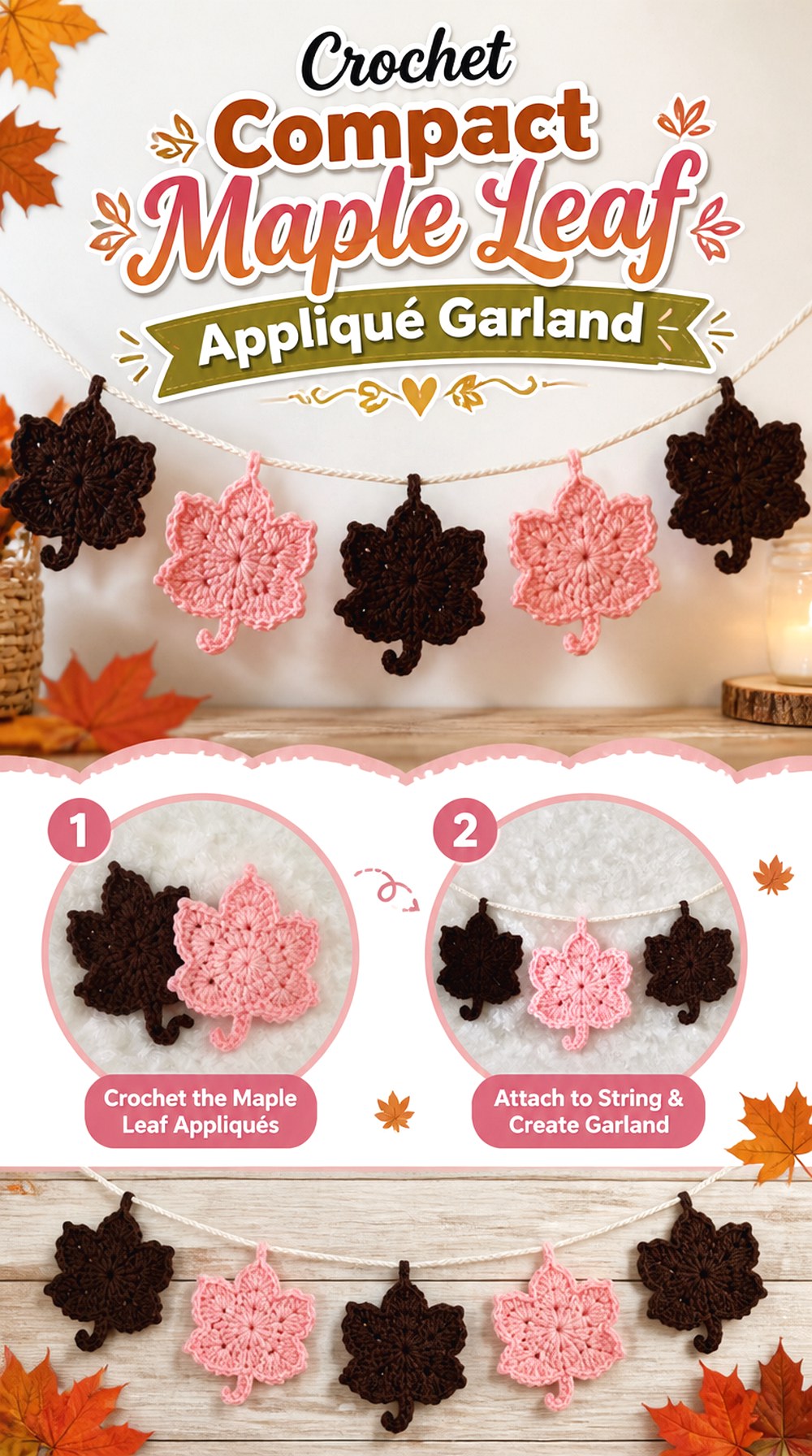
Handmade By Mei’s tutorial is specifically presented as a maple leaf appliqué that can also be used as a coaster or seasonal decoration. That makes it a useful starting point for a compact garland where the leaves remain distinct but do not dominate a small display area.
Try this format across the front edge of a shelf, small entry table, or narrow section of wall rather than automatically making a room-spanning strand. The strength of a compact garland is that it can introduce the maple-leaf theme without requiring a large installation.
Small Display Areas Need Controlled Motif Density
A short shelf does not necessarily need fewer decorative details, but it does need scale control. Arrange your finished leaves directly in the target space before joining. If points overlap enough to hide the individual silhouettes, either increase spacing or reduce the number of leaves rather than shrinking the connecting cord alone.
Repetition Consistency Matters More on a Short Strand
When only a handful of motifs are visible, differences in leaf size or orientation can stand out quickly. Compare each finished leaf with your first satisfactory sample as you work. Small variations are normal in handmade crochet, but large differences may change the balance of a compact display more than they would on a loose, oversized garland.
Original Tutorial and Creator Credit
Creator: Handmade By Mei
10. Crochet Cord Yarn Statement Maple Leaf Garland
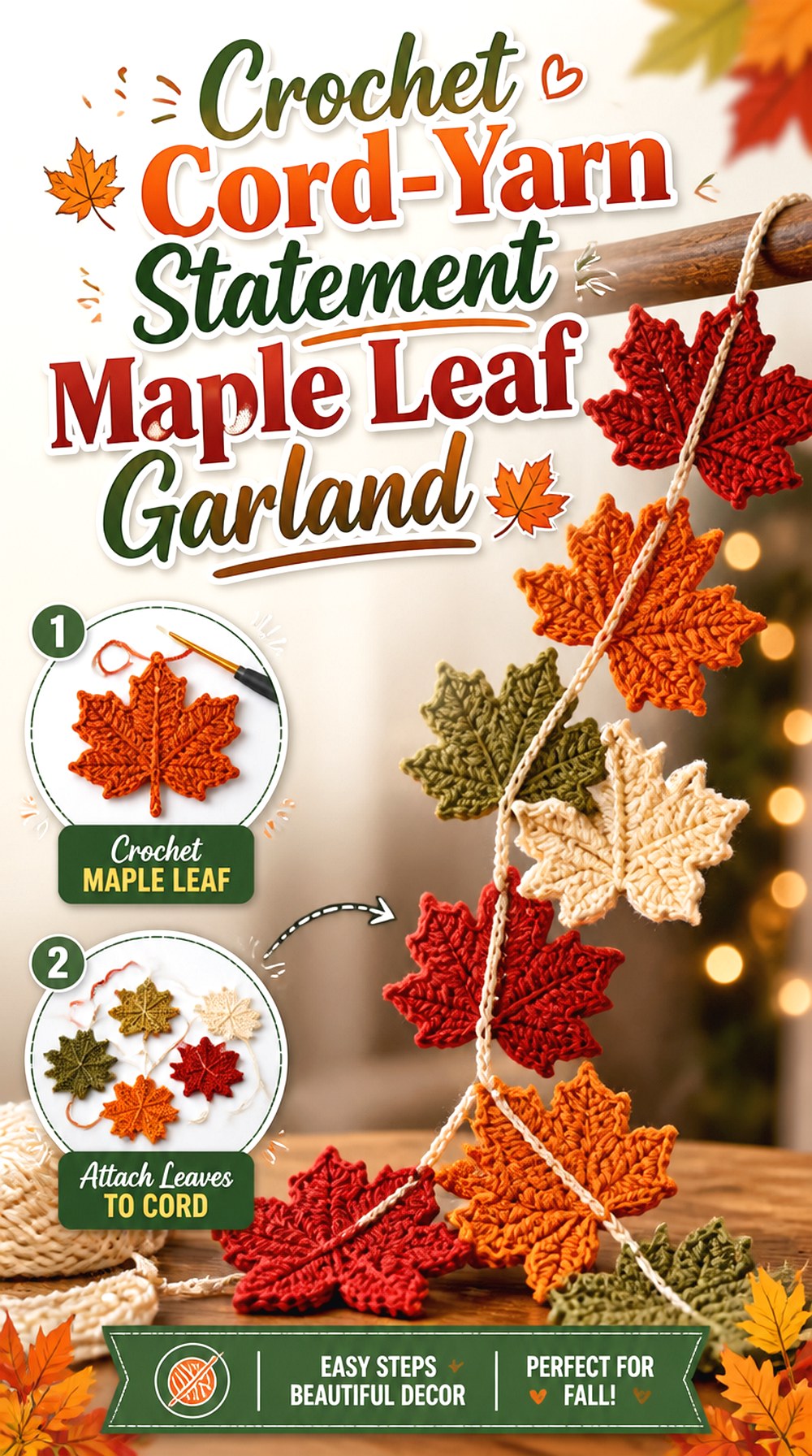
Вязание с Мариной Метель demonstrates a maple leaf whose scale can change dramatically with the material used. The creator discusses versions ranging from thin decorative pieces to much more substantial pieces made with cord, and the demonstration uses polyester cord.
For a garland, the most interesting adaptation is not to reproduce the largest possible leaf but to deliberately move toward a heavier, more architectural motif. A few substantial leaves can create a statement banner over a wide mantel or console without requiring dozens of repetitions.
Cord Changes Both Presence and Hanging Behavior
A cord-based leaf is not simply a normal leaf made bigger. Greater thickness can change how the motif bends, how its points hold their shape, and how much support the strand needs. Complete one leaf first and suspend it from the material you plan to use as the garland line before making more.
Reduce Motif Count as Individual Leaves Become Heavier
If each motif becomes more substantial, closely repeating them may overload the visual composition and place more demand on the supporting cord. Use fewer leaves and larger intervals to preserve the statement quality. Do not assume any yarn cord or household hook can support a particular load without checking the actual materials involved.
Match the Hanging Method to the Display Surface
A heavier textile decoration needs more careful placement than a lightweight appliqué strand. Choose an attachment method appropriate for the wall, mantel, or furniture surface and the finished weight you actually measure. Avoid relying on decorative adhesives or hardware simply because they worked for a lighter garland.
Original Tutorial and Creator Credit
Creator: Вязание с Мариной Метель
11. Crochet Diagram Friendly Maple Leaf Garland
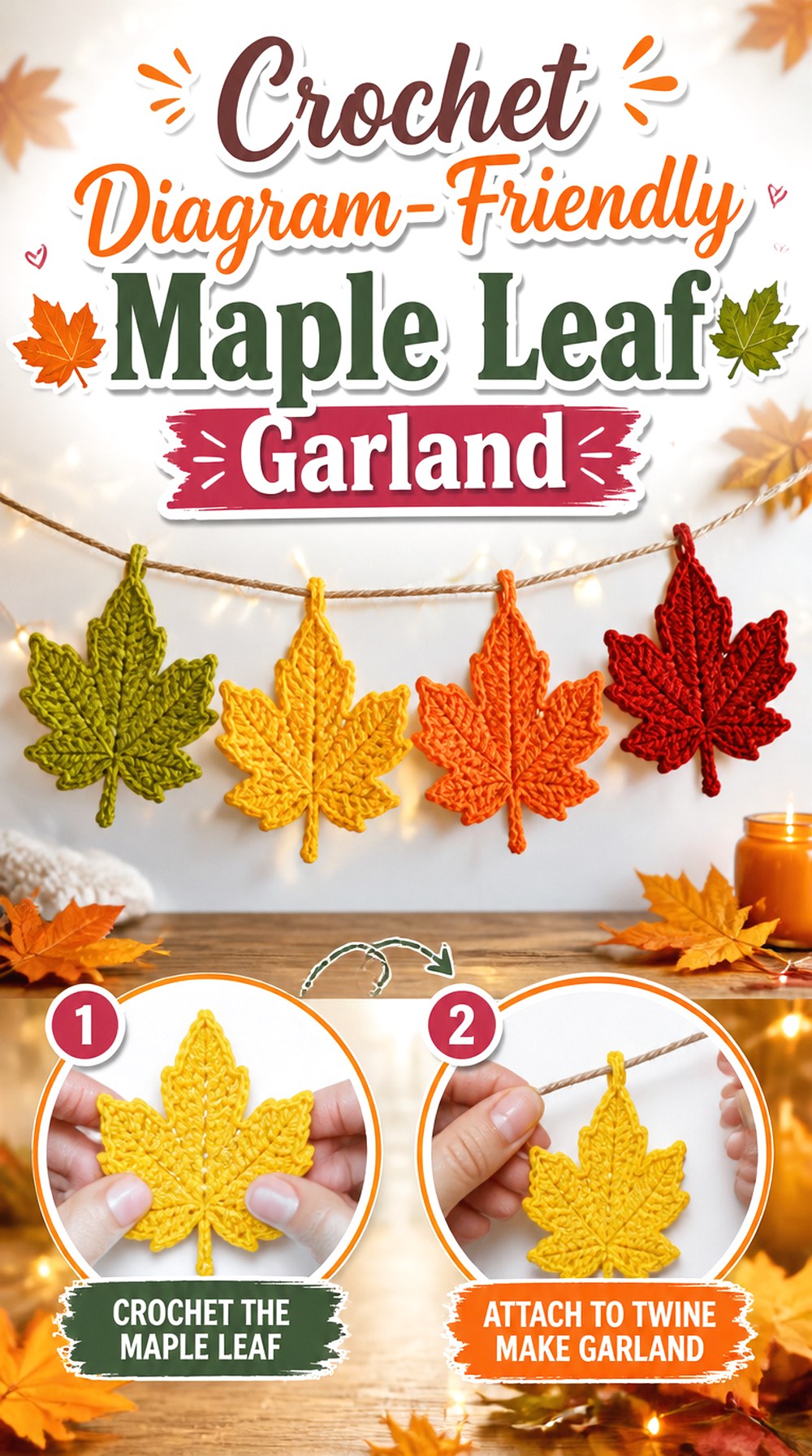
The tutorial from Наталья Ач is presented as a step-by-step maple-leaf master class and notes a diagram in the description. That makes it worth considering when you prefer to combine video demonstration with a visual pattern reference.
For a garland, a diagram-supported motif can be convenient when you need to repeat the same leaf many times without constantly relocating the same portion of a long video. Use the source exactly as provided rather than reconstructing its pattern elsewhere, and check that the teaching language and diagram conventions are comfortable for you before starting.
A Visual Reference Can Help With Repetition
Repeated motifs become easier when you can quickly confirm where you are without re-learning the shape each time. Before beginning a batch, understand how the creator’s diagram corresponds to the finished leaf. If the symbols or language are unfamiliar, watching the video alongside it may be more useful than relying on the diagram alone.
Mark Orientation Before Joining the Garland
Once several similar maple leaves are stacked together, it is surprisingly easy to attach one facing differently than intended. Arrange every finished motif right-side up before joining and decide whether stems will all point downward or vary deliberately. This simple planning step is especially helpful when the leaf has a clearly defined front and back.
Original Tutorial and Creator Credit
Creator: Наталья Ач
12. Crochet Pin Back Maple Leaf Garland
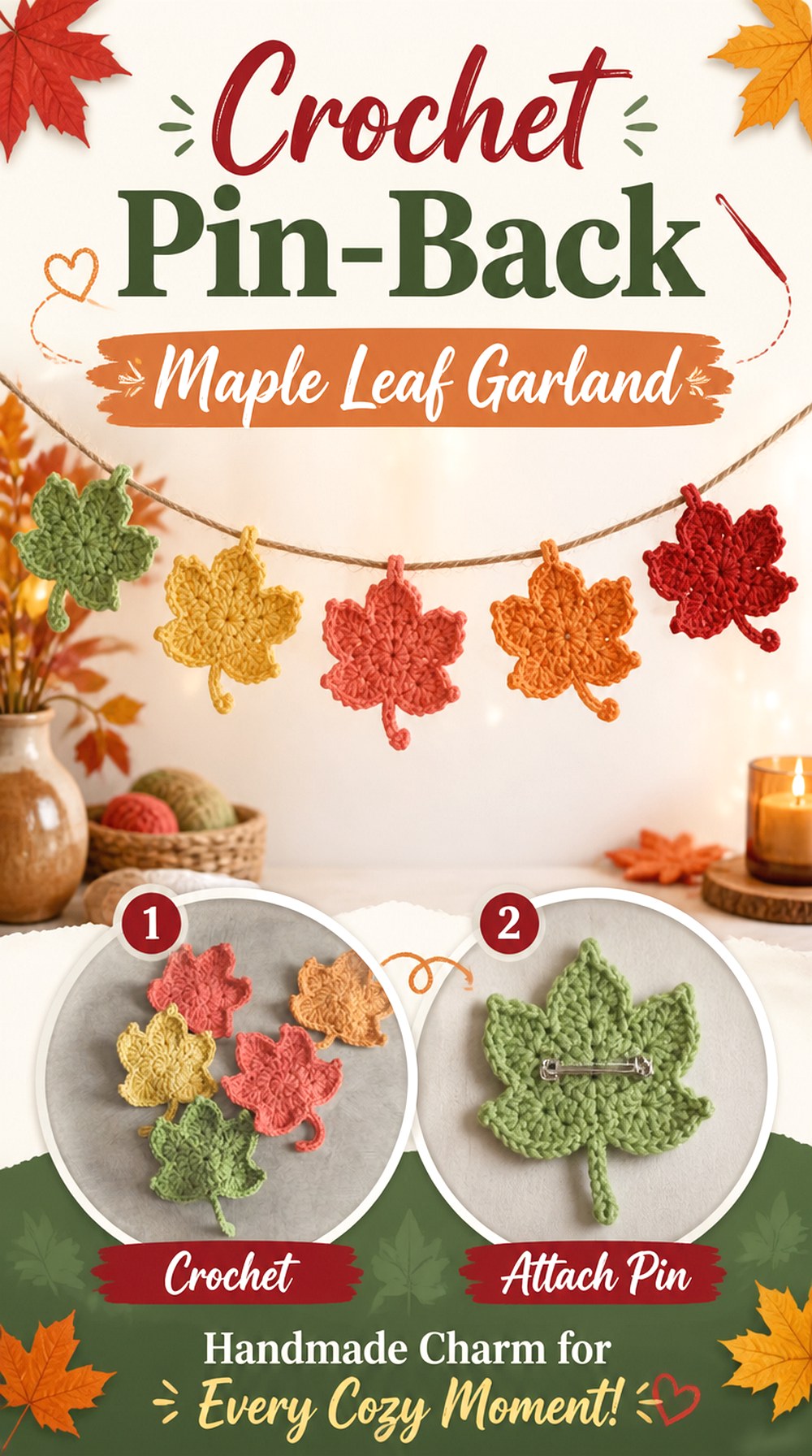
RaLee Hands presents a crochet maple leaf that can be used as either an appliqué or a garland piece, with the description also mentioning the option of adding a safety pin. That opens the door to a more flexible seasonal display where leaves do not necessarily have to remain permanently attached to one strand.
A removable arrangement could be useful if you like changing the color order during the season or reusing selected leaves elsewhere. Keep the actual attachment system simple, however, so the backs of the motifs do not become bulky.
Removable Leaves Make Rearranging Easier
Instead of committing to one permanent sequence, you can plan the garland around detachable motifs. Lay out the color order, attach the leaves, then change the arrangement later without remaking the crocheted pieces. Any removable attachment should still hold the motif securely enough that it does not continually rotate or fall from the supporting strand.
Use Sharp Fasteners Deliberately
Safety pins are practical craft hardware, but they are not appropriate everywhere. If you use them, close them fully and position the garland where children or pets cannot pull at the leaves. A sewn textile loop or another non-sharp attachment concept may be preferable when the decoration will be handled frequently.
Original Tutorial and Creator Credit
Creator: RaLee Hands, 라리핸즈
13. Crochet Dwarf Japanese Maple Leaf Garland
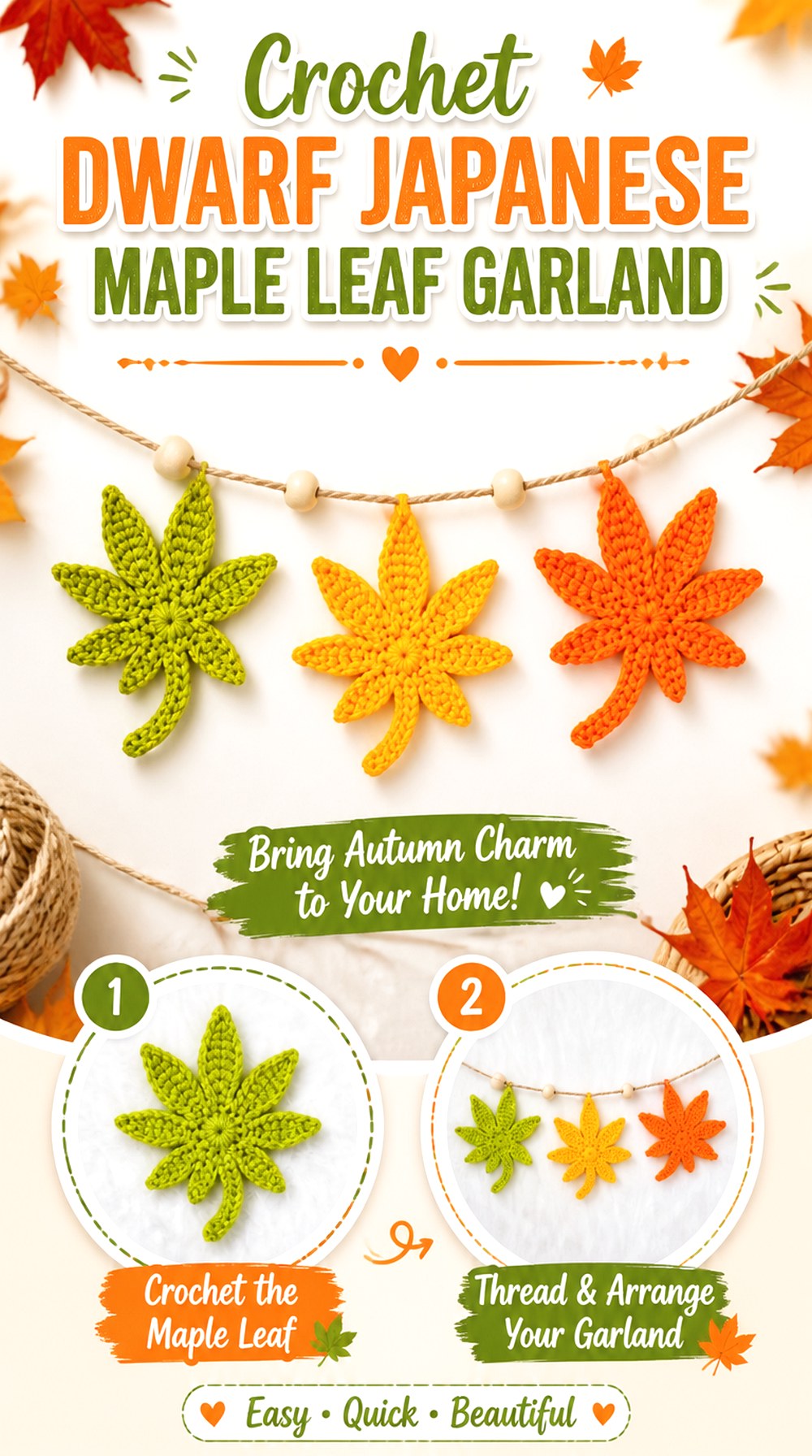
Pora Pora Crochet specifically identifies the demonstrated motif as a dwarf Japanese maple leaf and suggests fall garlands among its possible uses. Its different botanical character gives this strand a more delicate look than the broader Canadian-style silhouettes elsewhere in the collection.
Use that difference intentionally. Narrower-looking points and a more refined outline work well when several leaves need to fit into a lighter visual composition. This could suit a window, open shelving, or a vertical drop where an oversized solid motif would feel too heavy.
Finer Points Need Enough Separation to Stay Visible
Delicate lobes can disappear when neighboring leaves overlap. Arrange the strand while it is lying flat and check where each outline crosses the next. Increase the gap where needed rather than forcing a strict mathematical repeat. The finished leaf dimensions from your own yarn and tension should determine the spacing.
A Consistent Fiber Helps the Strand Hang More Evenly
If you want the delicate silhouettes to behave similarly, using one yarn type across the entire garland is often simpler than combining fibers with very different stiffness or elasticity. You can still change colors within the same yarn family to create autumn variation without introducing another major structural variable.
Keep the Botanical Difference Obvious
This project earns its place because it does not look exactly like the broad maple motifs around it. Avoid burying that distinction under bulky tassels or closely packed secondary decorations. Giving each leaf a little visual space lets its narrower outline provide the variety.
Original Tutorial and Creator Credit
Creator: Pora Pora Crochet
14. Crochet Beginner Maple Leaf Fall Swag
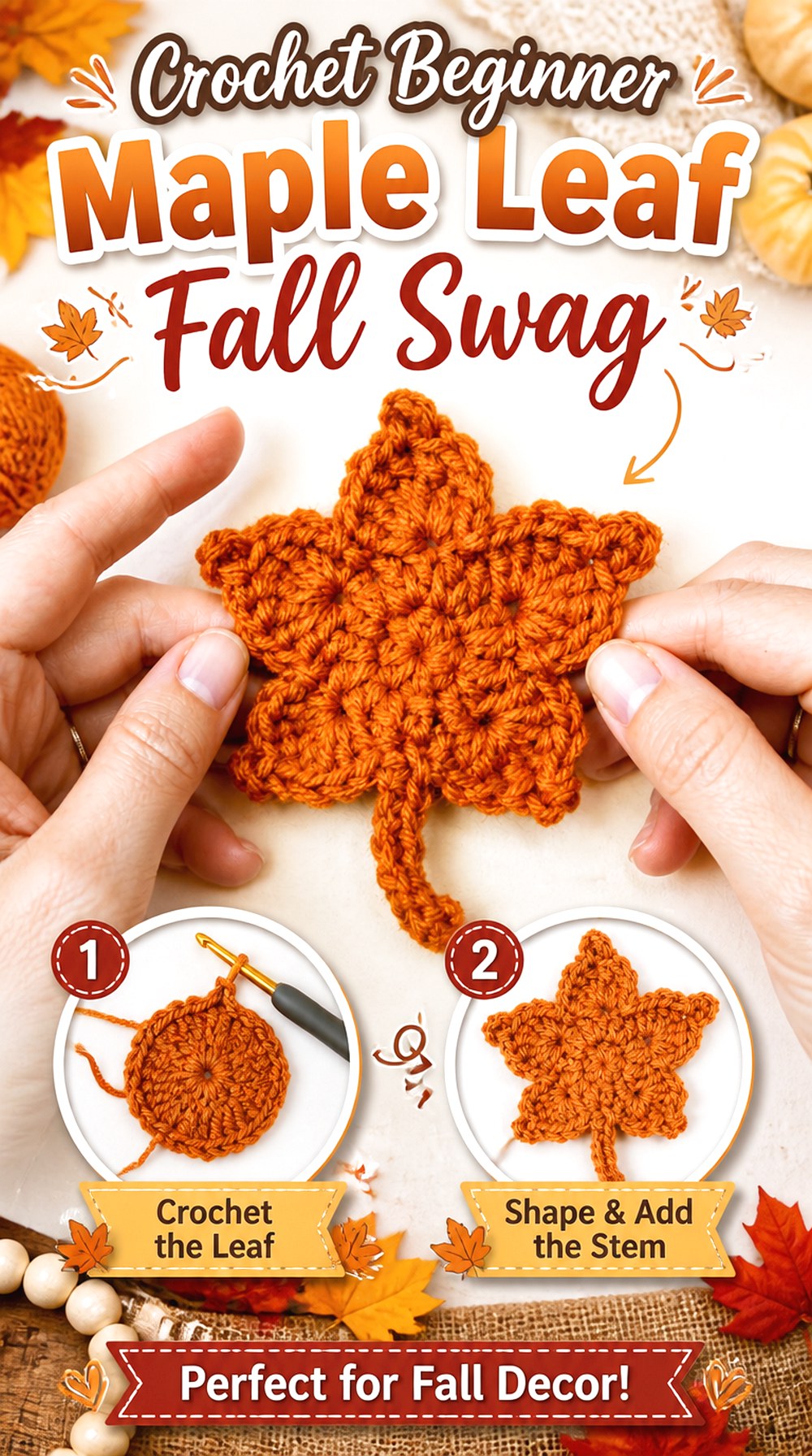
Crochet Jewel presents this maple leaf as a beginner-focused, step-by-step project intended for fall decoration. For someone making their first repeated seasonal strand, a short swag is a practical way to use the motif without committing to a room-length garland.
Start with enough leaves to decorate one small area, such as the center of a mantel or a narrow wall hook arrangement. Once you see how the finished leaves behave together, you can decide whether extending the strand will improve the display or simply make it more repetitive.
Repetition Quickly Reveals Size Drift
Even when a single leaf looks fine, repeated motifs placed next to one another make tension differences easier to see. Compare new leaves periodically with the first finished sample. If they begin becoming noticeably larger or smaller, correcting your consistency early is easier than trying to disguise several mismatched motifs during assembly.
A Short Swag Limits the First Round of Decisions
A compact project lets you evaluate yarn behavior, color balance, joining position, and storage without producing a large number of leaves first. That makes the format useful for learning what you actually like about maple-leaf garlands before scaling the concept across a doorway or wide mantel.
Original Tutorial and Creator Credit
Creator: Crochet Jewel
15. Crochet Canadian Maple Leaf Banner Garland
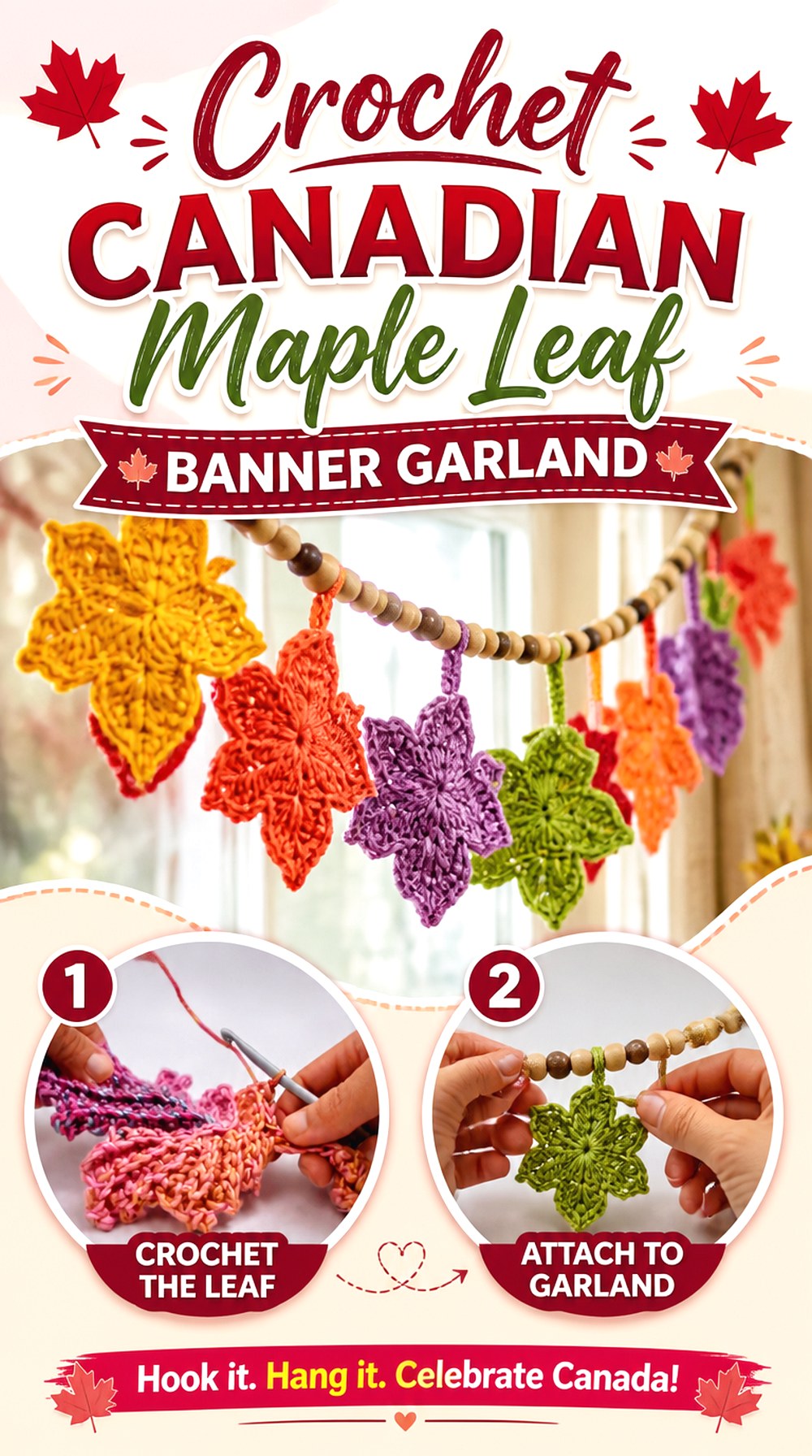
The Crochet Crowd’s tutorial focuses on the classic Canadian maple-leaf motif and suggests decorative uses including wreath accents. The video is also closed-captioned, with captioning available in multiple languages.
For a banner-style garland, use the strong maple silhouette as the main visual statement. One option is to place a prominent leaf at the center and use additional motifs with wider spacing toward the sides. This creates a more emblematic arrangement than a loose woodland-style garland and works particularly well where symmetry matters.
A Recognizable Center Motif Can Anchor the Whole Strand
Instead of treating every leaf equally, build the composition around the middle. Place your first completed motif at the intended center point, then test additional leaves outward from it. This is particularly effective over centered furniture, a fireplace, or a doorway where an obviously balanced arrangement looks more deliberate.
Leave Space Around the Strongest Silhouette
A bold maple leaf does not need to touch its neighbors to create impact. Wider intervals can make the individual points easier to see and prevent the center of the banner from becoming one dense mass of yarn. Judge the spacing from across the room before making the final attachment.
Caption Options May Help With Technique Review
The Crochet Crowd notes that the video includes closed captions and that captioning is available in several languages. That can be useful when you want to pause and review terminology while making repeated leaves, especially if listening to the tutorial continuously is not convenient.
Which Crochet Maple Leaf Garland Style Should You Choose?
Choose the Classic Pointed Mantel Garland, Scrap-Yarn Garland, or Beginner Fall Swag if you mainly want a familiar fall decoration built around repeated leaves.
For more structural interest, the Wire-Shaped Garland keeps the outline controlled, while the Cord-Yarn Statement Garland moves in the opposite direction by making fewer, more substantial motifs the focus.
The Mixed-Scale Swag is useful when size variation matters more than texture. Choose the Brioche-Texture Garland when surface detail should stand out, or the Dwarf Japanese Maple Leaf Garland when you prefer a finer botanical silhouette.
For flexible arrangement, the Pin-Back Garland allows a more changeable display. The Graphic Motif Banner and Canadian Maple Leaf Banner Garland are stronger options when you want fewer, more prominent leaf shapes.
Conclusion
The right crochet maple leaf garland depends on where it will hang and what you want the leaves themselves to contribute. Small appliqué-style leaves work well for compact shelves and dense strands, while larger graphic or cord-based motifs need more space. Wire shaping can keep detailed lobes open, brioche texture adds depth, and mixed yarn weights can create intentional scale changes without switching to an entirely different leaf design.
Before making a full set, finish one sample and evaluate its size, weight, flexibility, and silhouette in the actual display location. Once you choose a direction, use the original tutorials for the creators’ exact construction details and build your garland layout around the finished motifs.
Frequently Asked Questions
Can any crochet maple leaf motif be turned into a garland?
Many flat crochet maple leaves can be adapted for hanging, but not every motif will behave the same way. A large or heavy leaf may need a stronger supporting strand and wider spacing, while a small appliqué can usually be repeated more densely. Finish one leaf first and test how it hangs from the point where you intend to attach it before making the rest.
Should I block crochet maple leaves before assembling the garland?
Blocking can be useful when the yarn and pattern respond well to it, particularly if the points curl or several motifs need more consistent dimensions. However, the correct method depends on the fiber. Check your yarn-care information before introducing heat, steam, or moisture. Assemble the garland only after any shaping process is complete so you are comparing the motifs in their final form.
What yarn weight works best for a crochet maple leaf garland?
There is no universal best weight. Lighter yarn can produce smaller, less visually heavy leaves, while thicker yarn can create larger motifs with more presence. Crochet With Tiffany’s tutorial is a useful example because the creator demonstrates different yarn weights and notes that the leaf dimensions change with the yarn and hook combination. Always make a sample before planning the strand length.
How do I stop maple leaves from overlapping too much?
Determine spacing with the finished motifs rather than choosing a fixed number of inches in advance. Lay several leaves in a row, then increase or decrease the gaps until the pointed lobes remain readable. Larger, stiffer, or highly textured leaves typically need more visual space than very small flexible appliqués. Also check the garland while it is hanging because gravity can change the position you saw on the table.
Why does my crochet maple leaf garland twist after hanging?
Twisting can happen when leaves are attached off-center, when the supporting cord itself twists, or when individual motifs have uneven weight distribution. Temporarily attach a few leaves and hang the strand before completing the entire project. Adjust attachment positions one at a time rather than trying to correct the problem after every motif has already been permanently joined.
Are wire or safety-pin attachments suitable for every maple leaf garland?
No. Wire can help shape a decorative leaf, and removable pins can make rearranging motifs convenient, but both introduce hard or potentially sharp components. Keep exposed wire ends fully covered and close pins securely. Avoid placing these versions where children or pets can pull at them. For frequently handled decorations, an all-textile sewn or crocheted attachment may be a more appropriate choice.