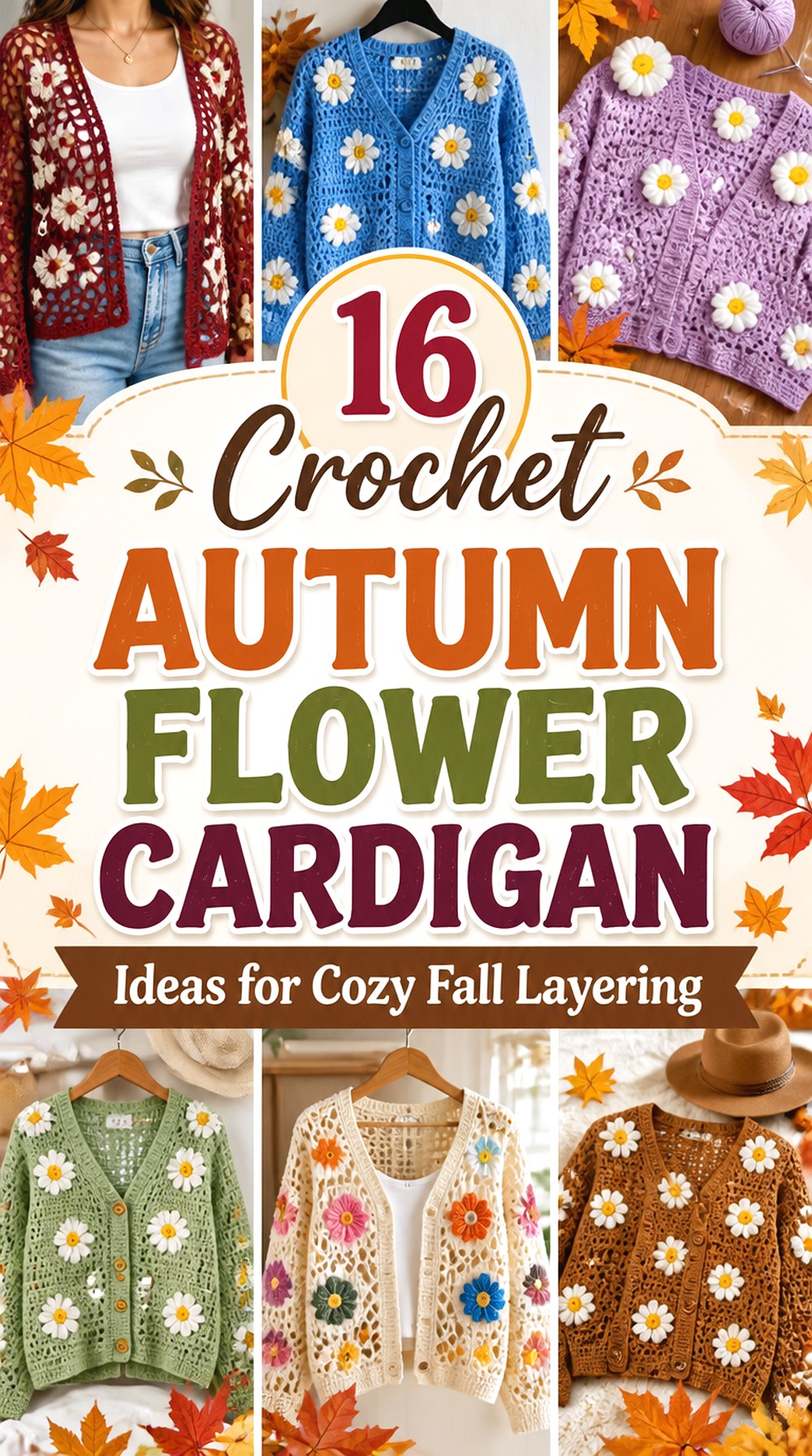
16 Crochet Autumn Flower Cardigan Ideas for Cozy Fall Layering
Flower cardigans do not have to feel like spring projects. Change the construction, flower scale, yarn character, and color balance, and the same floral idea can become a practical autumn layer. These 16 options range from flat daisy granny squares and long sunflower coats to raised roses, puff-flower appliqués, floral lace, pockets, ribbed collars, and a zip-front adaptation.
The differences matter because a chunky flower square behaves very differently from lace or a flat motif. Some cardigans create their entire fabric from flowers, while others use floral details over a simpler garment base. This guide helps you compare those choices, plan fit and motif placement, and identify what you should confirm in each original tutorial before committing yarn to a full wearable.
Quick List
- Crochet Moss-Stitch Daisy Cardigan
- Crochet Chunky Daisy Granny Cardigan with Ribbed Collar
- Crochet Continuous-Join Floral Granny Square Cardigan
- Crochet Hooded Sunflower Duster Cardigan
- Crochet Buttoned Sunflower Granny Square Cardigan
- Crochet Open-Front Flower Square Cardigan
- Crochet Graphic Daisy Panel Cardigan
- Crochet Sunflower Cardigan with Mesh Sleeves
- Crochet 3D Rose Granny Square Cardigan
- Crochet Stash-Style Rose Granny Cardigan
- Crochet Retro Daisy Grid Cardigan
- Crochet No-Sew Daisy Cardigan with Pockets
- Crochet Puffy Flower Motif Cardigan
- Crochet Cropped Puff-Flower Appliqué Cardigan
- Crochet Autumn Floral Lace Tie-Front Cardigan
- Crochet Zippered Autumn Flower Granny Cardigan
Match the Flower Motif to the Cardigan Before You Join Anything
A flower square is not interchangeable with every other granny square simply because both are square. Raised petals, extra rounds, dense centers, and different border structures can change blocked dimensions and thickness. Before planning a full cardigan, block a sample motif using the yarn and hook combination you intend to use, then compare its finished width with the construction shown in the chosen tutorial.
For example, if a blocked motif measures 5 inches across, four placed side by side span about 20 inches before joins, edging, and intended garment ease are considered. That is planning math rather than a universal sizing formula. Blocked square dimensions, ease, shoulder stretch, drape, motif direction, and edging tension are especially important in motif wearables.
Autumn Color Does Not Automatically Mean Autumn Fabric
Rust, mustard, olive, burgundy, and brown can make almost any flower read as autumnal, but color does not determine how the cardigan hangs. A bulky daisy square may create a substantial layer, while a fine floral-lace fabric can remain light even in dark seasonal colors.
Think first about when you expect to wear the cardigan. A loose layer over dresses needs different drape from a cardigan intended to sit beneath a coat. Raised flowers and dense granny-square seams can also add weight, particularly around shoulders and sleeves. If you substitute yarn, do not assume that matching color is enough. Compare fiber behavior, yarn thickness, the creator’s gauge information when provided, and your own blocked sample before planning the finished garment.
Plan Flower Placement Around Shoulders, Sleeves, and Front Edges
The most eye-catching flower does not always belong everywhere. Large sunflowers can dominate a narrow front panel, while dimensional roses or puff flowers can feel bulky when concentrated around an already heavy shoulder seam. Flat daisies are usually easier to repeat across an entire grid because they interfere less with layering.
Lay finished motifs on a table before joining and view the arrangement from several feet away. Check whether flowers appear balanced across the two front panels and whether directional motifs face the way you intended. For appliqué cardigans, try the plain cardigan on before permanently attaching flowers. That lets you see where the fabric folds, where a bag strap may rub, and where raised petals could become uncomfortable.
1. Crochet Moss Stitch Daisy Cardigan
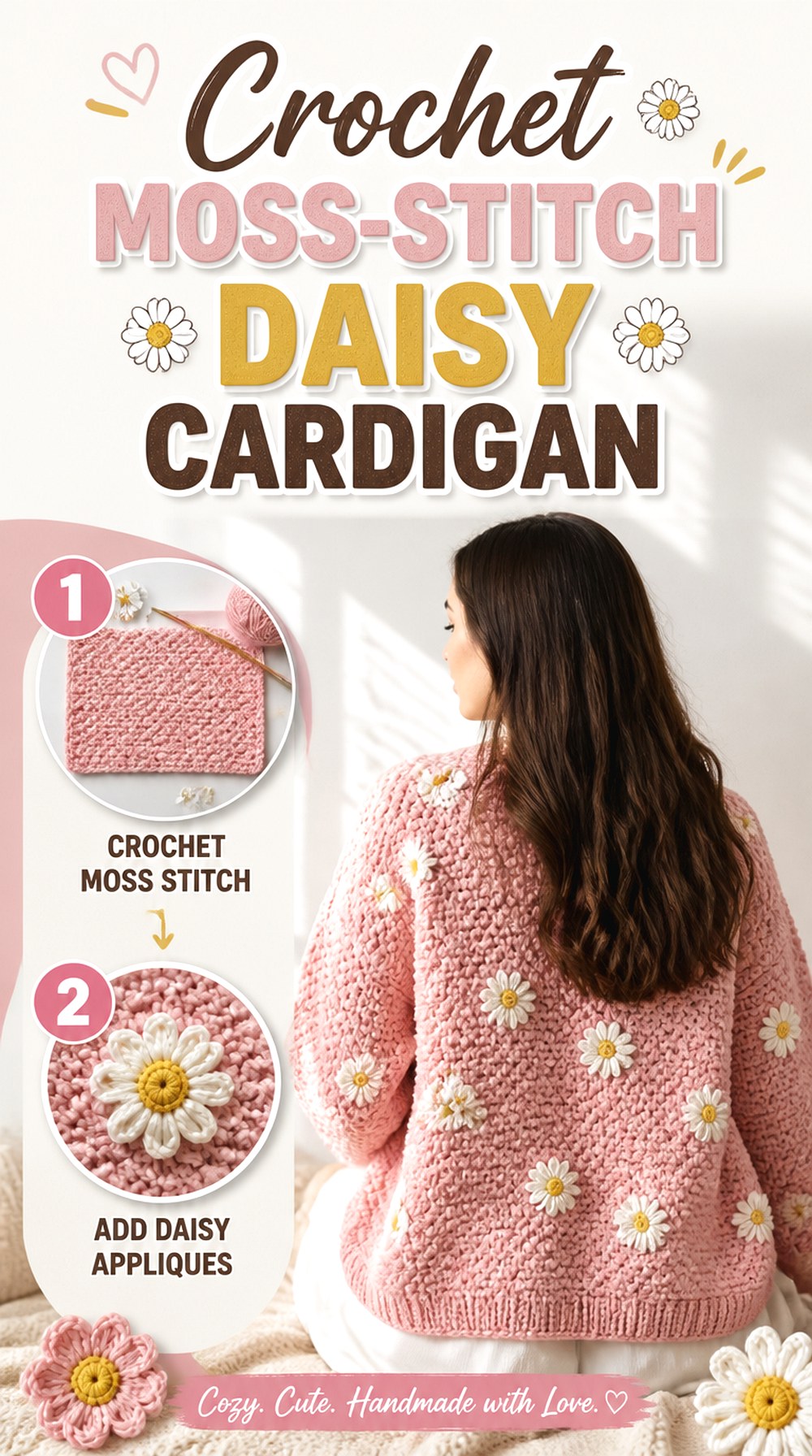
This daisy cardigan takes a different route from the heavily seamed granny-square designs later in the collection. Elif Hobi identifies linen or moss stitch as the stitch pattern used for the cardigan, so the floral theme sits within a more continuous garment surface rather than depending entirely on a grid of individual blocks.
For an autumn interpretation, this construction suits a darker uninterrupted background with daisies used as the visual focus. Think deep olive, espresso, charcoal, or burgundy behind cream, ochre, or muted golden flowers. The continuous fabric can also appeal to readers who like floral crochet but do not want every section divided by obvious granny-square joins.
A Continuous Body Changes the Visual Rhythm
Granny-square cardigans naturally create a checkerboard. Moss-stitch fabric gives the eye more uninterrupted space, so the flower placement becomes more noticeable. Before changing the palette, decide whether you want isolated flowers to remain the main feature or whether the background should have enough contrast to become part of the design.
This matters especially with autumn colors, where several medium-dark shades can blend together. Place the proposed flower colors beside the body yarn before starting and check that petals and centers remain readable.
Watch the Fabric Where the Cardigan Bends
A continuous crochet fabric can drape differently from joined motifs. Check how the source cardigan behaves at the elbows, shoulders, and front opening rather than assuming it will feel like a square-based jacket.
If you substitute a denser yarn, make a useful-sized swatch and move it in your hands after blocking. A fabric that looks beautiful flat may become too stiff for sleeves. If it feels rigid, reconsider the yarn choice before investing in the whole body.
Keep Autumn Flowers Clear Rather Than Muddy
A seasonal palette works better when the flower still has visual separation. Pumpkin petals on a rust background, for example, may lose their outline even though both colors feel autumnal.
Try separating similar warm shades with cream, muted gold, dark brown, or another contrasting center. The goal is not maximum contrast; it is enough distinction for the floral motif to remain visible from normal viewing distance.
2. Crochet Chunky Daisy Granny Cardigan with Ribbed Collar
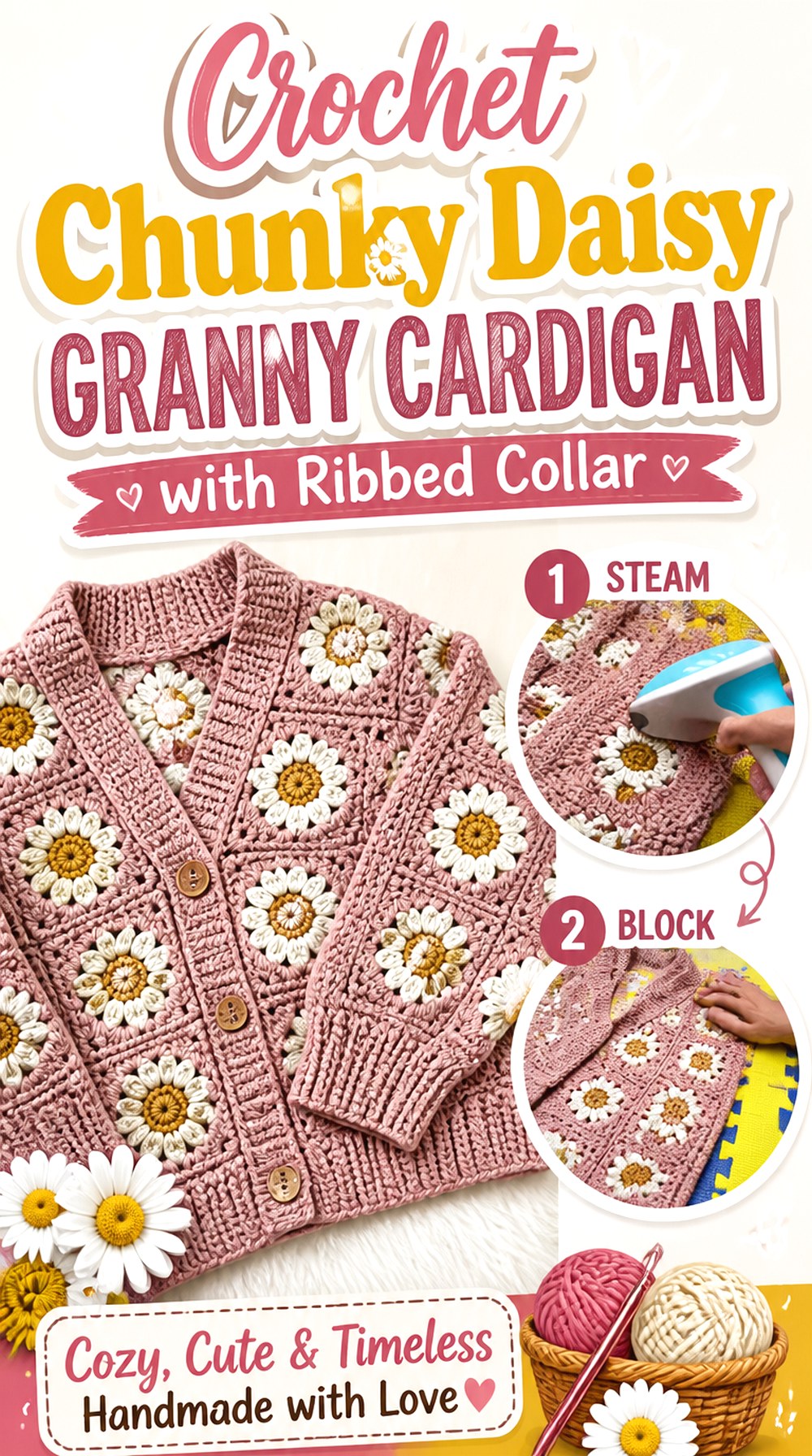
AllAboutAmi’s Cozy Days Daisy Cardigan combines daisy granny squares with substantial ribbing, cuffs, and a defined collar. The creator uses bulky yarn in the original project, which makes this one of the more substantial-looking flower cardigans in the collection.
That structure translates naturally to autumn because the ribbed edges visually anchor the repeated flowers. An earthy version could keep the petals light while using cinnamon, mustard, olive, or warm taupe for the surrounding squares. Compared with a loose floral-lace cardigan, this style reads more like a statement outer layer, so consider how much room you want for a shirt or thin sweater underneath.
The Collar Gives the Flowers a Strong Frame
A wide finished collar changes how the motif field meets the face and neckline. Instead of flowers running straight to the edge, the ribbing creates a visual boundary.
If you alter colors, decide whether the collar should blend with the square background or act as a contrasting frame. Repeating one square color in the collar usually creates a calmer result, while a contrasting band makes the outline of the cardigan more prominent.
Bulky Squares Can Add Shoulder Weight
Thicker yarn, multiple seams, and repeated motifs can produce more fabric weight than an airy cardigan. That does not automatically make the garment unsuitable, but it makes shoulder fit more important.
Before completing every square, assemble enough of the upper body to judge the developing weight. If the cardigan already feels heavy on the shoulder line, adding longer sleeves or extra body length will add more material. Use the creator’s sizing information rather than compensating by guesswork.
Ribbing Can Change the Finished Silhouette
Cuffs, lower ribbing, and front edging do more than decorate the cardigan. They can visually pull a loose motif body into a cleaner outline.
When comparing this idea with a simple open granny-square jacket, decide whether you prefer that finished, framed appearance. Also check your edging tension carefully. Ribbing that is attached too tightly can draw in the flower panels and make the hem or opening ripple.
Original Tutorial and Creator Credit
Creator: AllAboutAmi
3. Crochet Continuous Join Floral Granny Square Cardigan
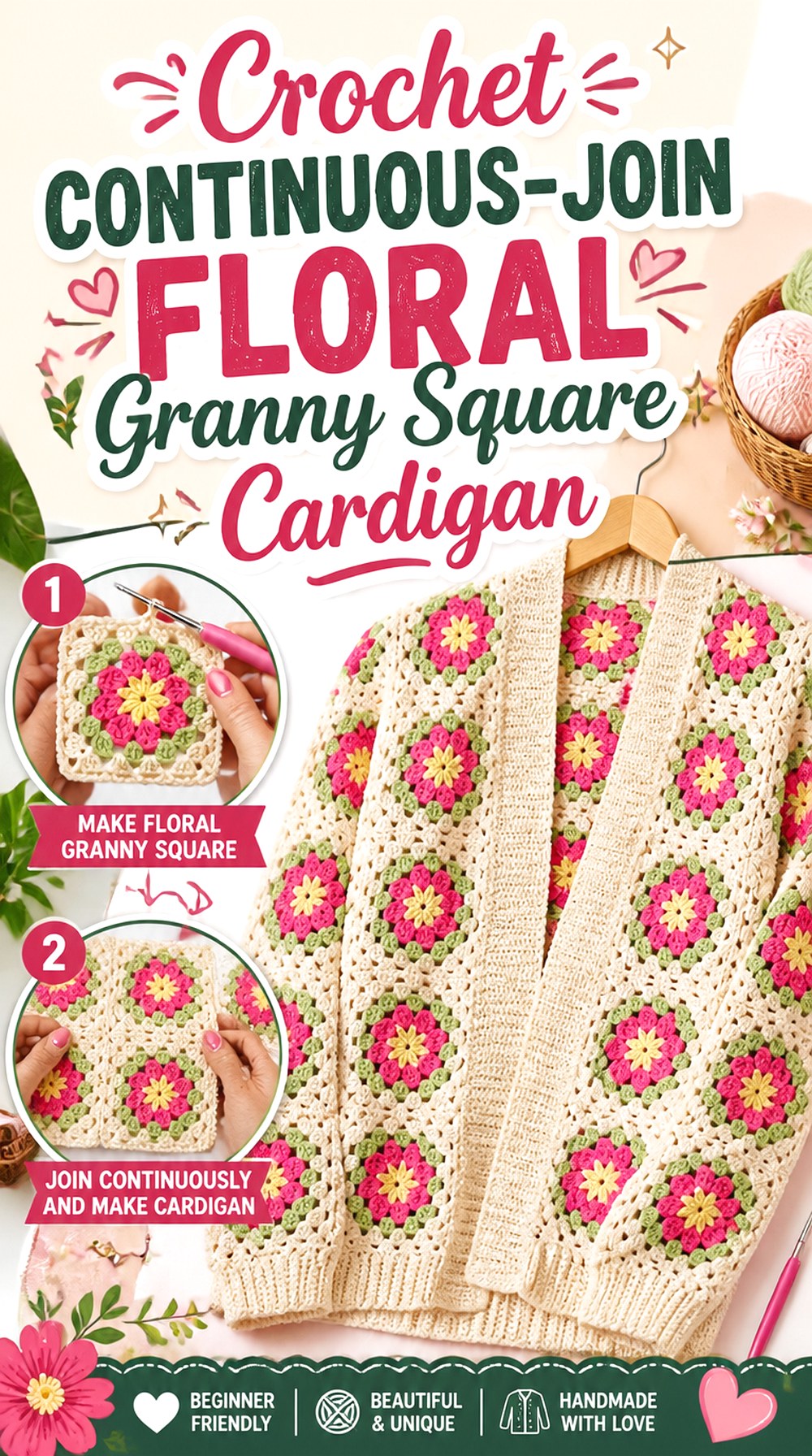
Bella Coco’s floral granny-square cardigan is worth comparing for its joining approach. The tutorial demonstrates the floral squares and uses a continuous join-as-you-go method as part of the cardigan construction, followed by ribbed finishing around key edges.
For an autumn version, the floral center can stay recognizable while the outer rounds move into subdued seasonal shades. This is a useful option for someone who likes a traditional square-based cardigan but wants the joining to become part of the planning rather than leaving a large pile of motifs for a separate seaming stage.
Continuous Joining Rewards Careful Layout Planning
A join-as-you-go method reduces the ability to rearrange motifs after they are connected. That makes the layout decision more important before the joining stage begins.
Arrange every color combination first, photograph the layout, and check the balance of the two front panels against the back. If you are using several rust, moss, mustard, and cream variations, the photo gives you a reference when loose squares begin moving around your workspace.
Gauge Matters Before Repetition Multiplies the Error
A small difference in one flower square can become a much larger fit difference once several squares span the body. The tutorial specifically includes measuring and gauge discussion in its workflow.
Make and block the sample square before producing the full set. If your blocked motif differs from the dimensions required by the pattern or sizing instructions you are following, correct the issue at the motif stage instead of hoping edging will fix the complete cardigan.
Use the Border Color to Control Visual Busyness
A multicolor flower in every block can become visually dense. One way to calm an autumn version is to repeat the same outer-round or joining color across most squares.
Deep brown, oatmeal, olive, or charcoal can make the separate flowers feel like one coordinated fabric. If you instead use a different border around every motif, preview the complete arrangement before joining so the front does not become unintentionally busier than the back.
Original Tutorial and Creator Credit
Creator: Bella Coco
4. Crochet Hooded Sunflower Duster Cardigan
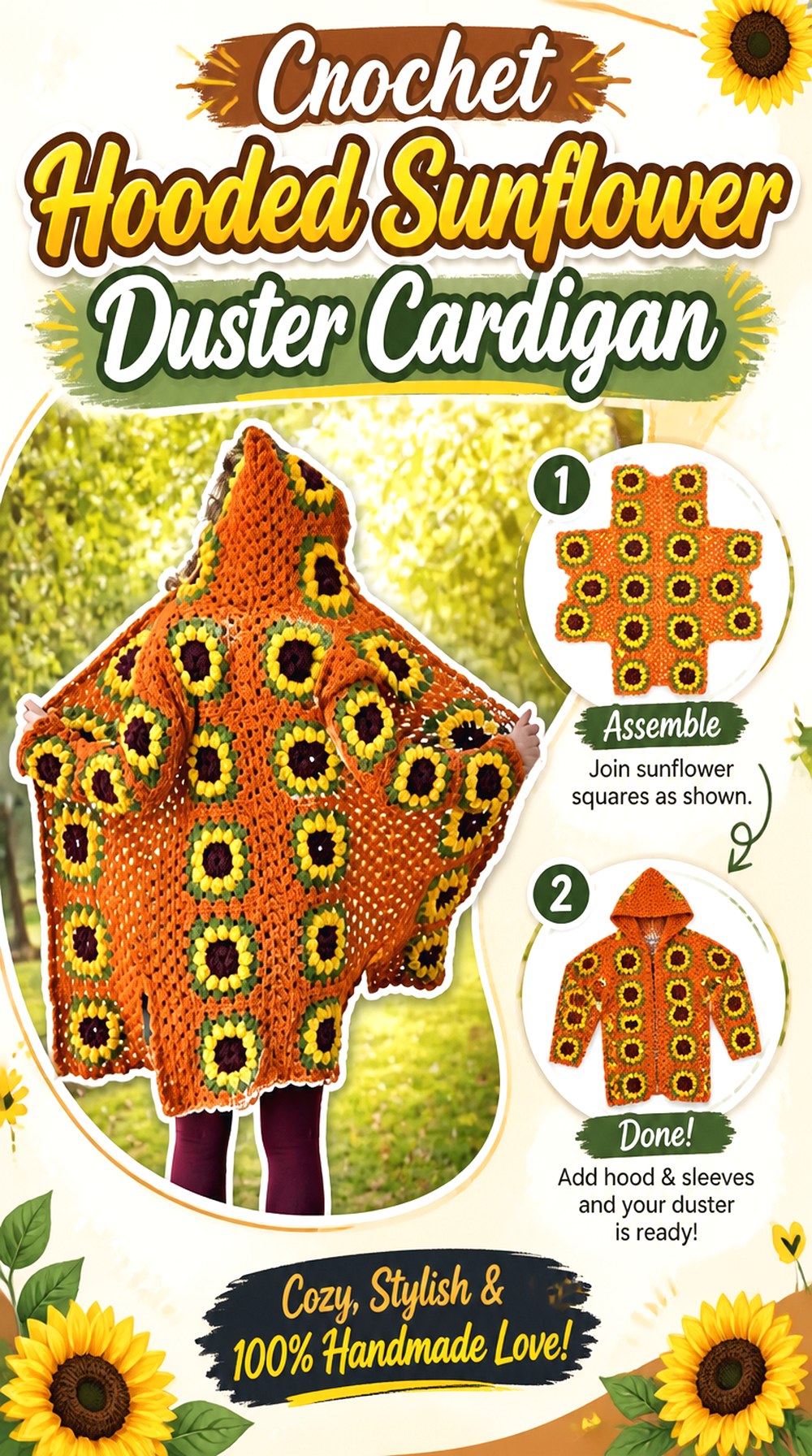
This sunflower design from Colour Ceilidh Crochet moves well beyond the usual waist-length granny cardigan. The source describes a long sunflower granny-square coat with side slits and a hood, giving it a stronger outer-layer silhouette and a noticeably different scale from the cropped flower options.
The length makes autumn color especially effective because a rust, bark-brown, moss, or muted gold background can cover a large visual area. It is also a project where garment weight deserves early attention. Longer panels, a hood, sleeves, and motif seams all contribute material, so this is better chosen for the shape itself rather than simply because you like sunflowers.
Length Changes More Than Styling
Adding body length increases both coverage and total fabric weight. A long cardigan may hang beautifully from the shoulders, but that same vertical pull can change how the upper squares and seams feel after wearing.
If you plan to modify length, evaluate the partially assembled cardigan before automatically extending it. The original tutorial already uses a long-coat format, so study its proportions and side slits before deciding whether your own version needs further length.
Side Slits Help a Long Motif Garment Move
Side slits visually break up the long lower edge and can give a duster-style cardigan more freedom around the hips and legs. They also mean the lower front and back panels are not connected exactly like a shorter closed-side cardigan.
When adapting colors or motif scale, preserve an understanding of where those openings sit. Do not treat the bottom half as one uninterrupted tube unless you intentionally redesign the construction.
A Hood Needs Its Own Color Decision
A sunflower cardigan already has a strong motif. Adding a multicolor hood can either continue the statement or make the neckline feel very busy.
Consider using the dominant background color for most of the hood if you want the sunflower field to remain the focal point. If you continue flowers into the hood, lay the motifs out first and check which direction they face when the hood is worn down as well as when it is up.
Original Tutorial and Creator Credit
Creator: Colour Ceilidh Crochet
5. Crochet Buttoned Sunflower Granny Square Cardigan
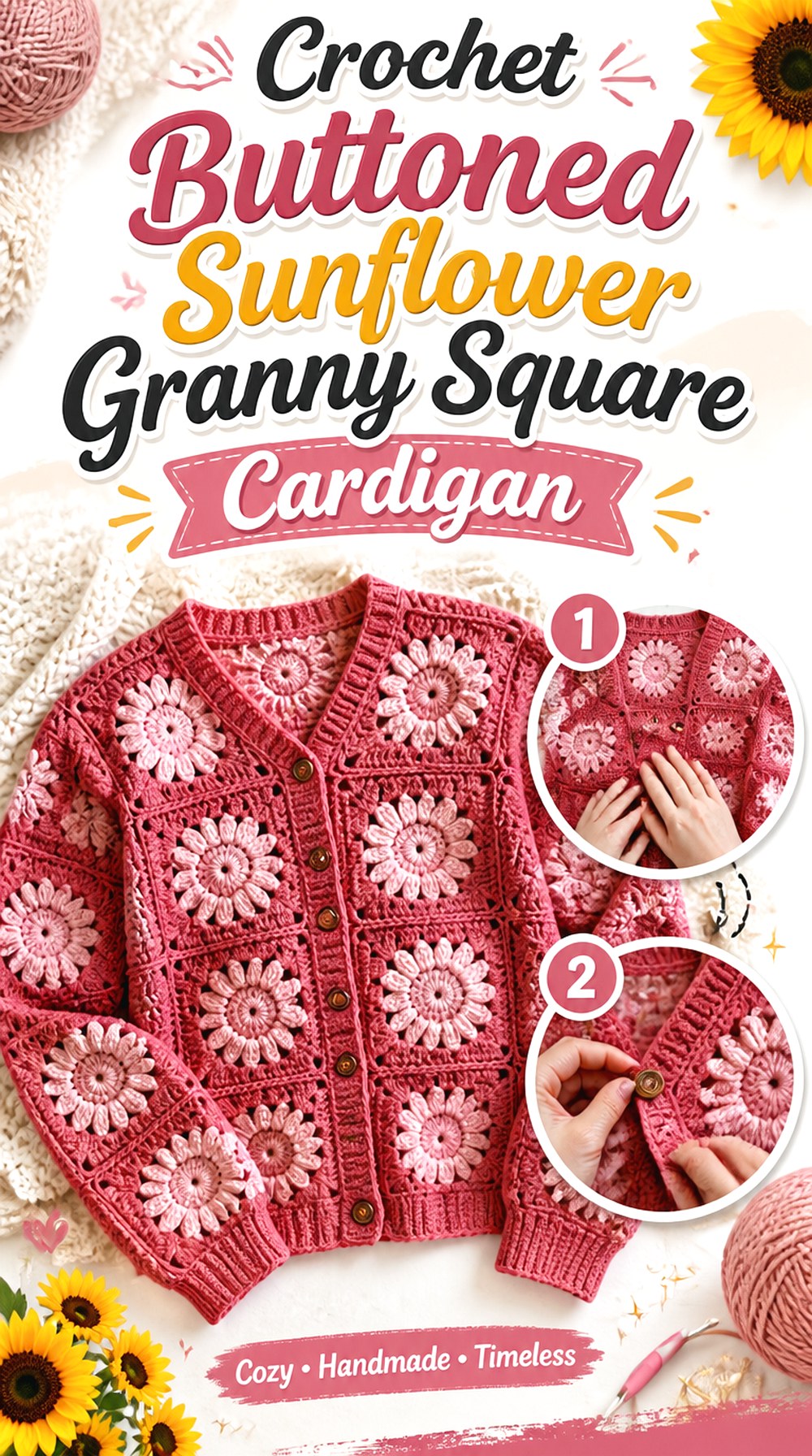
Emilie Reigneau’s sunflower granny-square cardigan offers a more conventional wearable scale than the long hooded duster while adding a buttoned front. The tutorial also includes discussion of sizing, square layout, joining, blocking, and finishing, making it useful when you want to understand how the motifs become a complete garment rather than stopping at the square itself.
For autumn, sunflower centers already provide a natural route into brown and gold. You can deepen the surrounding colors with olive, burgundy, warm cream, or charcoal without losing the recognizable flower. The buttoned opening is the feature to compare most carefully against open-front versions.
Buttons Require a Stable Front Edge
A button does not only close the cardigan; it pulls against the front band each time it is used. Motif edges that feel fine on an open cardigan may need more stability when they support closures.
Follow the creator’s construction for the button area and check whether your substituted yarn creates a similarly firm edge. If the band stretches noticeably under light hand tension, resolve that before attaching closures rather than expecting the buttons to correct the shape.
Sunflower Scale Controls the Whole Look
Repeated large sunflower squares create a bolder garment than small flowers scattered across plain fabric. Before committing to the full set, hold several completed squares together and view them at body distance.
If the result feels too visually heavy, an autumn palette with quieter outer rounds can reduce the effect without changing the flower itself. Conversely, high-contrast petals and centers keep every sunflower prominent.
Use the Layout Stage as a Fit Checkpoint
The creator includes layout and sizing discussion near the end of the tutorial. That is a reminder not to treat motif production and garment fitting as separate jobs.
Once enough squares are finished, place them in the planned body arrangement and compare the span with the measurements and sizing information supplied by the source. It is far easier to correct motif count or scale before permanent joining.
Original Tutorial and Creator Credit
Creator: Emilie Reigneau
6. Crochet Open Front Flower Square Cardigan
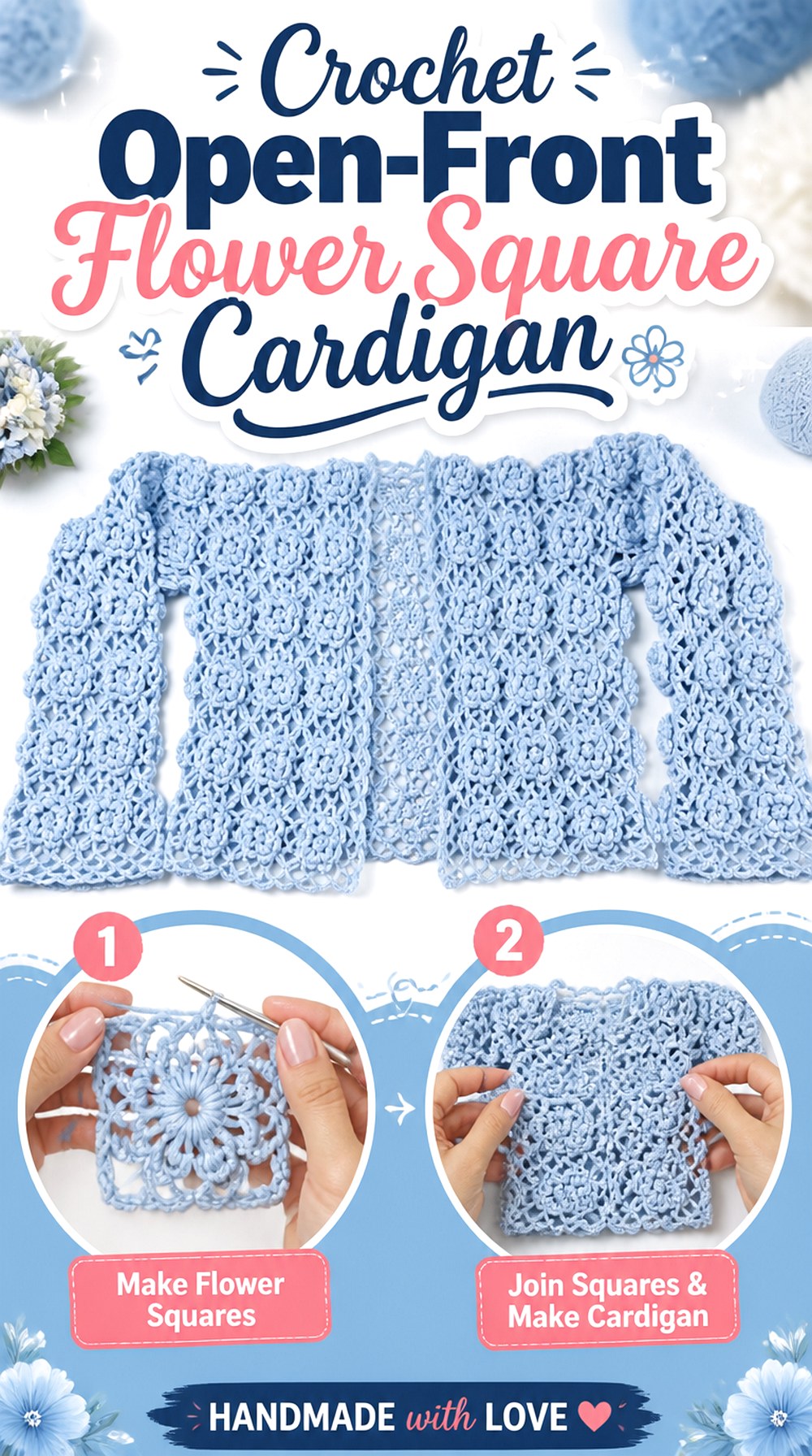
Chenda DIY’s flower-square cardigan uses repeated floral blocks for the body and sleeves, then finishes the garment around the open edges. The main cardigan tutorial also points viewers to a separate flower-square lesson, so it is a good option when you prefer to understand the motif independently before moving into garment assembly.
This shape works well for autumn layering because an open front leaves room for the shirt, blouse, or dress beneath it to remain part of the outfit. Rather than automatically choosing a dark flower center, consider using the darkest color around the square edge; that can create a stronger frame across the finished cardigan.
An Open Front Keeps Fit More Forgiving
A cardigan without a zipper or button closure does not need the two front edges to meet in exactly the same way. That can make the silhouette more flexible for layering, although the shoulders, armholes, and overall width still need to fit correctly.
Decide whether you want the fronts to hang narrowly beside the torso or provide more coverage. Use the source construction and your actual body measurements instead of simply adding an extra motif because the cardigan looks small while lying flat.
Edge Finishing Can Expose Uneven Squares
The front border runs past many separate motifs, so differences in square size can become more obvious once one continuous edge is added.
Before finishing the opening, compare neighboring squares and correct any significant blocking or joining inconsistencies. A clean border cannot completely disguise a panel that alternates between wider and narrower motifs.
Keep Sleeve Flowers Comfortable at the Underarm
A floral block that feels decorative on the back can become bulky where sleeve and body layers meet. This is particularly relevant if you adapt the design with a more dimensional flower.
Before permanent assembly, pin or temporarily place the upper sleeve motifs beside the armhole and move your arm. If raised petals or thick seams bunch under the arm, use a flatter compatible motif in that area or rethink the adaptation.
Original Tutorial and Creator Credit
Creator: Chenda DIY
7. Crochet Graphic Daisy Panel Cardigan
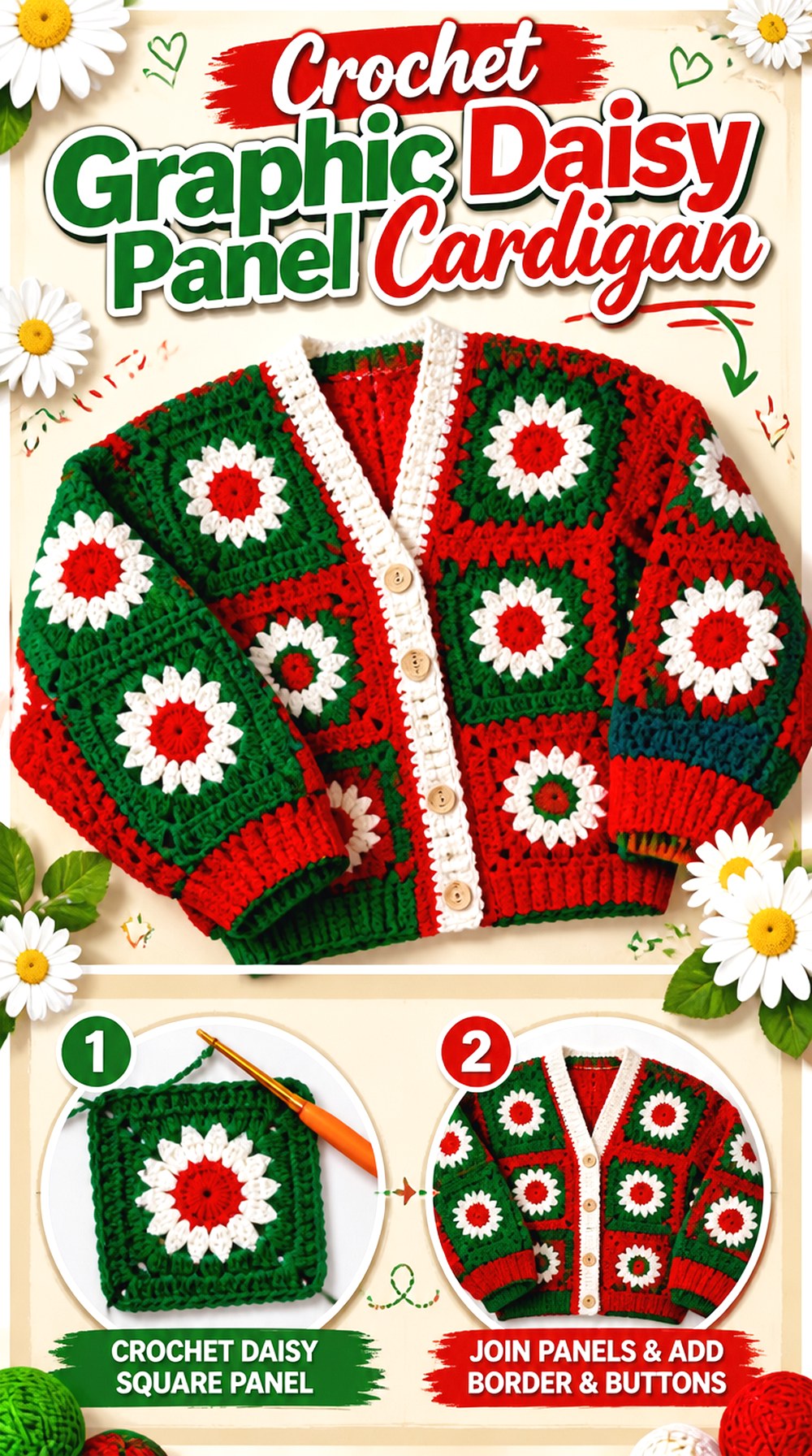
CraftedComfort’s cardigan uses daisy granny squares and shows the joining, panel assembly, sleeves, and edging in one tutorial. The source sample uses a limited set of strongly contrasting yarn colors, which makes the flower blocks read as a clear graphic pattern rather than a softly blended floral surface.
That approach can translate nicely into autumn without requiring many shades. A three-color combination such as dark brown, warm cream, and rust can look more deliberate than a large stash palette. This is worth considering if you like flower cardigans but find multicolor patchwork too busy.
A Limited Palette Makes Repetition More Obvious
When every square uses the same few colors, small inconsistencies in flower placement or square size can be easier to notice. The upside is a cleaner overall design.
Block motifs to the same dimensions before joining, and keep their orientation consistent. If you intentionally rotate certain colors or flowers, establish the repeat on the floor or table first rather than improvising one square at a time.
Panel Assembly Is the Moment to Check Proportion
A stack of finished daisies gives little information about cardigan fit until those squares are arranged into front, back, and sleeve shapes.
At the panel stage, compare width and length with the sizing information you are following. Do not rely on the source sample’s stated size if your yarn, hook, tension, or body measurements differ. Your blocked square is the useful planning unit.
Dark Backgrounds Need Enough Petal Contrast
Autumn palettes often move toward brown, rust, and olive, which can make a daisy look sophisticated rather than springlike. But the center and petals still need separation from the square background.
Place one test flower against the intended surrounding round and photograph it in ordinary indoor light. If the flower disappears unless viewed close up, increase contrast before making the full batch.
Original Tutorial and Creator Credit
Creator: CraftedComfort
8. Crochet Sunflower Cardigan with Mesh Sleeves
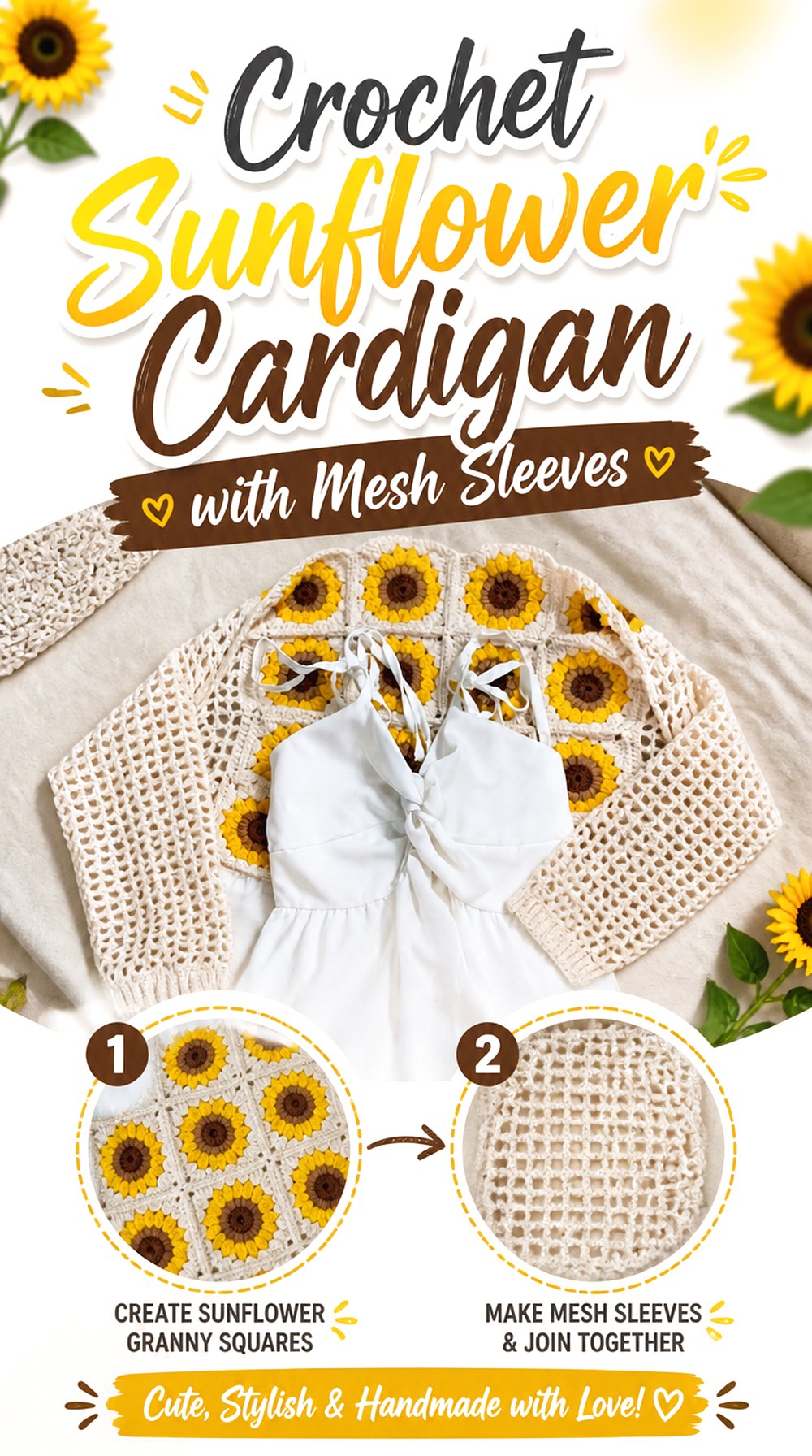
CNPCO cluffy puffy’s sunflower cardigan differs from the denser all-over granny designs because the source specifically incorporates mesh stitch into the project. The tutorial covers sunflower squares, connecting them, sleeves, and sleeve cuffs.
That contrast between solid floral motifs and more open fabric is useful for transitional autumn weather. The flowers can provide the visual weight while the sleeves keep the overall cardigan from feeling like a solid block of crochet. It is a good option for someone who likes sunflowers but does not necessarily want the long, heavier duster silhouette.
Mesh Makes Yarn Choice More Visible
Open stitches reveal the space between strands, so the appearance of the yarn itself matters. A fuzzy fiber can visually soften the holes, while a smooth yarn emphasizes the mesh structure.
Swatch the mesh as well as the sunflower motif if you plan to substitute materials. You need both sections to feel compatible when they meet, especially if one portion stretches much more readily than the other.
Solid Motifs and Open Sleeves Stretch Differently
A sunflower granny square may be relatively stable while mesh fabric can expand more easily under its own weight. That difference becomes important where the sleeve connects to the body.
Before final finishing, let the assembled cardigan hang for a while and check sleeve length again. If your chosen yarn relaxes significantly, make adjustments using the tutorial’s construction logic rather than adding cuff length automatically.
Let the Sunflowers Carry the Seasonal Color
Because the mesh already creates visual texture, it does not need a complicated color sequence. A single olive, brown, oatmeal, or wine-colored mesh can give the sunflower squares a calmer frame.
This also reduces the number of color changes competing with the flower. Compare a test arrangement before deciding whether the sleeve should match the darkest square color or one of the lighter background shades.
Original Tutorial and Creator Credit
Creator: CNPCO cluffy puffy
9. Crochet 3D Rose Granny Square Cardigan
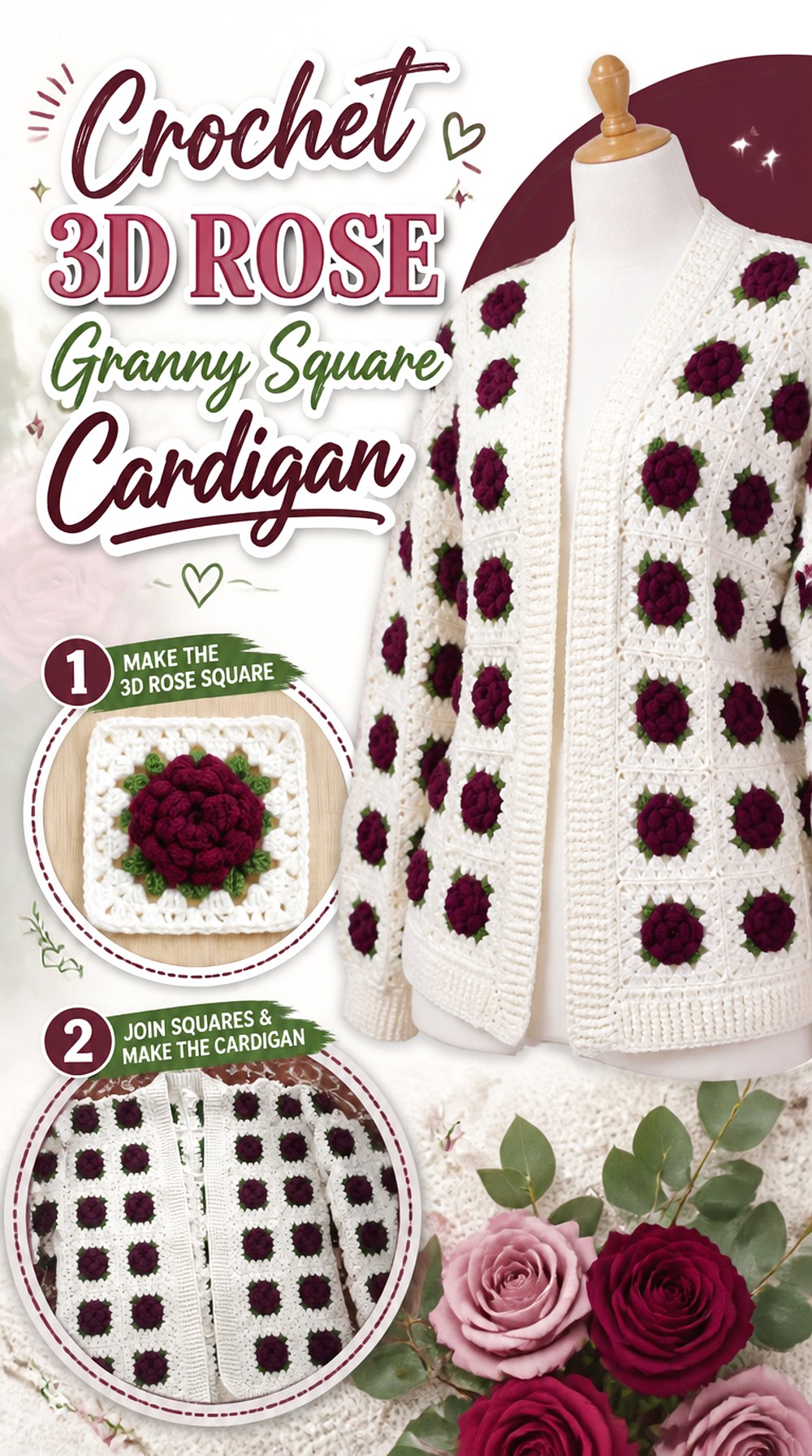
Crochet With Hayat’s cardigan uses a raised rose inside the granny-square structure, creating considerably more surface dimension than a flat daisy or sunflower motif. The tutorial is presented around the flower square, joining, cardigan construction, and raised floral details.
A 3D rose is a strong choice when you want the flowers themselves to be the dominant feature. Autumn colors can make that texture feel richer: burgundy roses with warm brown surrounds, pumpkin roses on olive squares, or cream flowers against deep rust are all planning directions rather than requirements.
Raised Roses Need Room Around High-Friction Areas
Dimensional petals can brush against bag straps, coat linings, chair backs, and neighboring crochet fabric. Before placing the same rose everywhere, think about how the cardigan will actually be worn.
If you adapt the motif layout, consider flatter treatment near the underarms or other high-friction zones. Any replacement motif still needs compatible blocked dimensions and edge structure before it can be substituted successfully.
Three-Dimensional Motifs Increase Surface Weight
A raised flower contains more yarn and structure than a flat color change that merely creates the image of a flower. Repeating it across a full cardigan can therefore affect both weight and drape.
Make several motifs, not just one, before judging the fabric. Hold a small joined group vertically so gravity acts on it. That gives a better preview of garment behavior than viewing a single rose square flat on a blocking mat.
Give the Rose Enough Background Space
A complicated rose can lose definition if the surrounding square is equally busy. Autumn colors offer many beautiful choices, but using every seasonal shade in each block can overwhelm the dimensional center.
Try letting the rose carry two or three colors while keeping the outer square quieter. That creates a clearer focal point and makes the three-dimensional petals easier to read.
Original Tutorial and Creator Credit
Creator: Crochet With Hayat
10. Crochet Stash Style Rose Granny Cardigan
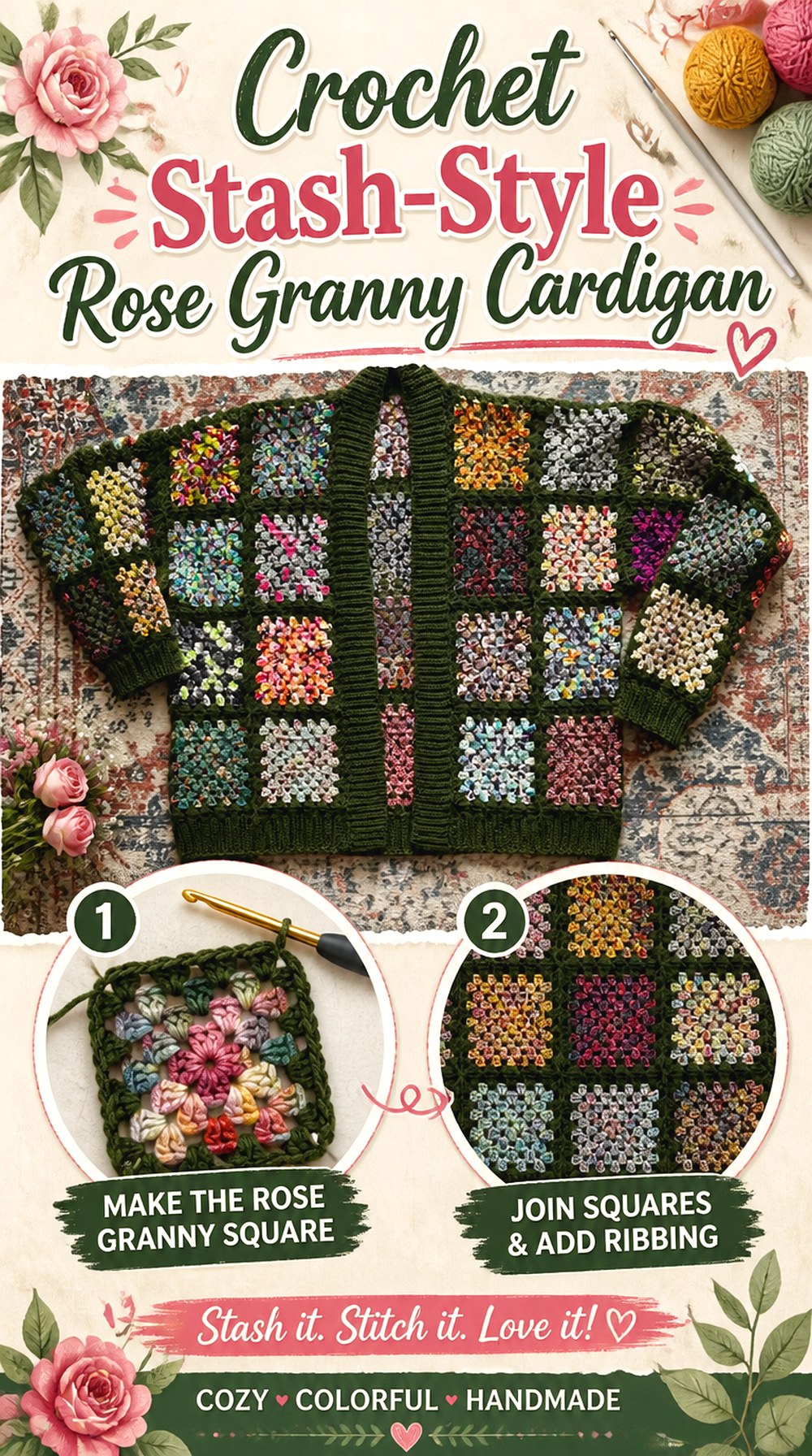
TL Yarn Crafts’ Rose Cardigan centers the garment around rose granny squares and presents the project as a crochet-along style cardigan build. The creator also connects viewers with the accompanying Rose Cardigan method and additional granny-square resources.
This concept suits an autumn stash project particularly well because the roses do not have to share one rigid color combination. A controlled collection of muted reds, golds, forest greens, creams, and browns can produce variety while still feeling seasonal. The important distinction from a random scrap cardigan is intentional repetition.
Build a Color Rule Before Raiding the Stash
Stash crochet can become chaotic when every attractive leftover skein enters the project. Create a simple rule first, such as one shared border color or a limited family of flower centers.
Then spread a group of completed roses out together. If one bright shade pulls attention away from every other square, decide whether to repeat it elsewhere or remove it from the garment rather than hoping joining will make it disappear.
The Back Panel Is Your Best Balance Check
The back provides a larger uninterrupted motif field than either front panel. Use it to judge whether the rose distribution feels balanced.
Arrange the back first, photograph it, then split the remaining color combinations between the fronts and sleeves. This reduces the chance of accidentally concentrating all dark or high-contrast squares on one side of the finished cardigan.
Stash Yarn Still Needs Compatible Fabric Behavior
Similar color does not mean similar yarn. Two skeins can have noticeably different thickness, elasticity, or fiber behavior even if their labels place them in the same broad category.
Crochet and block test motifs when introducing an unfamiliar yarn. If one square consistently finishes larger or denser, use another yarn rather than forcing mismatched motifs into the same garment grid.
Original Tutorial and Creator Credit
Creator: TL Yarn Crafts
11. Crochet Retro Daisy Grid Cardigan
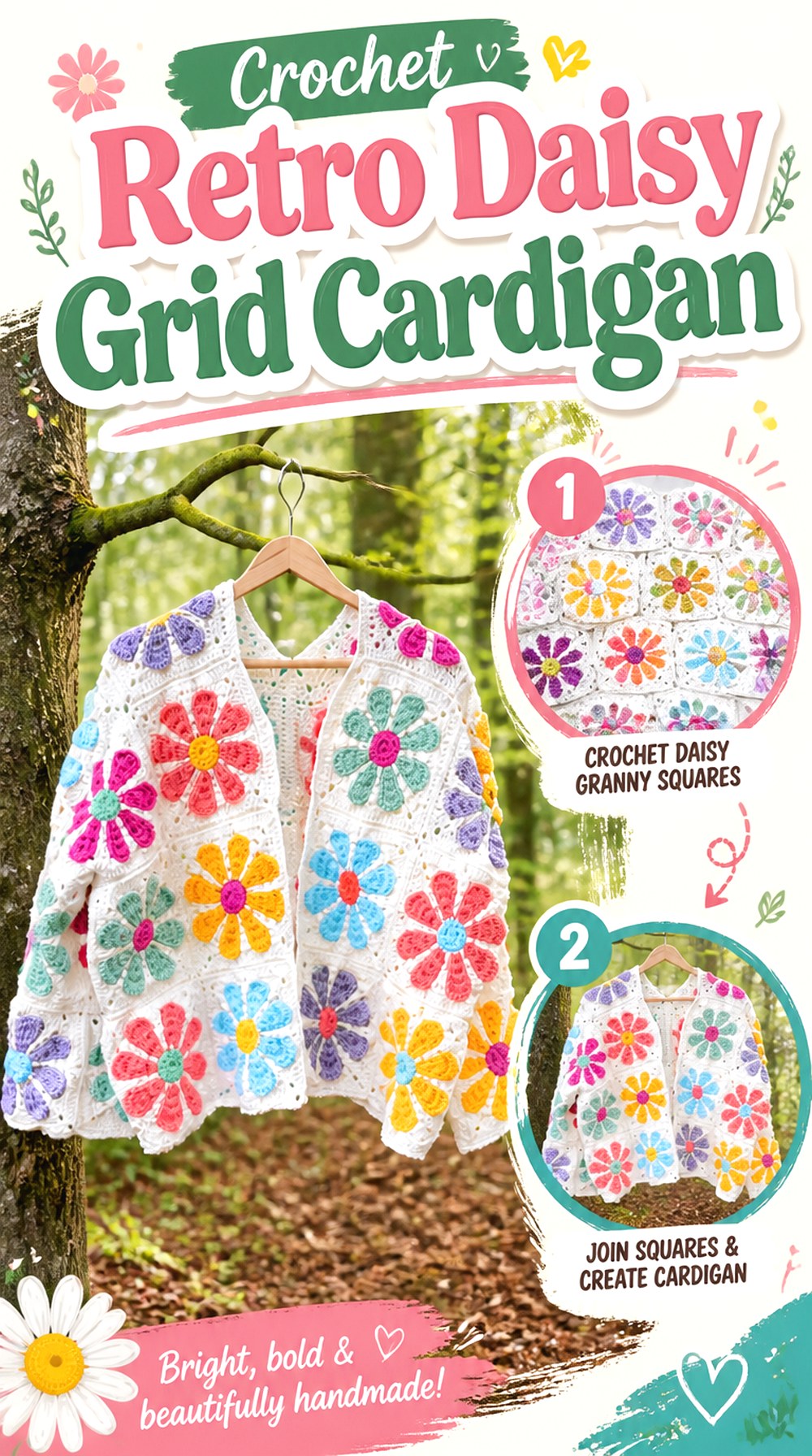
Frisian Knitting tutorials’ retro cardigan is based on repeated daisy granny squares and includes a garment schema in the video. That layout emphasis is valuable for readers who understand individual motifs easily but struggle to visualize how a stack of squares becomes sleeves, fronts, and a back.
The retro mood also adapts naturally to autumn. Instead of relying on bright vintage shades, you can keep the same flower repetition while shifting toward antique cream, ochre, brick red, olive, dusty peach, or cocoa. The square grid stays recognizable even when the palette becomes quieter.
A Layout Diagram Reduces Assembly Guesswork
Garment schemas help you check where each motif belongs before committing to seams or joins. Use the source diagram together with the sizing information supplied by the creator rather than assuming your square count should match someone else’s cardigan.
If your blocked motif dimensions differ, the same grid can produce a different garment width or length. Solve scale questions before joining.
Retro Does Not Require Bright Primary Colors
The vintage quality comes partly from repeated flower squares and the overall cardigan shape, not just from one exact palette. That makes this a good project for a more restrained autumn interpretation.
Try building contrast through value rather than saturation: a dark outer square, medium-tone petals, and a lighter center can keep the daisy legible while avoiding a rainbow effect.
Repetition Makes Inconsistent Blocking Noticeable
A highly regular grid acts almost like graph paper. If one motif is visibly narrower or taller, the surrounding straight lines can make the difference more obvious.
Block squares to consistent dimensions and compare them in rows before joining. If a few motifs remain significantly different, remake or adjust them before they reach the center of a prominent front panel.
Original Tutorial and Creator Credit
Creator: Frisian Knitting tutorials
12. Crochet No Sew Daisy Cardigan with Pockets
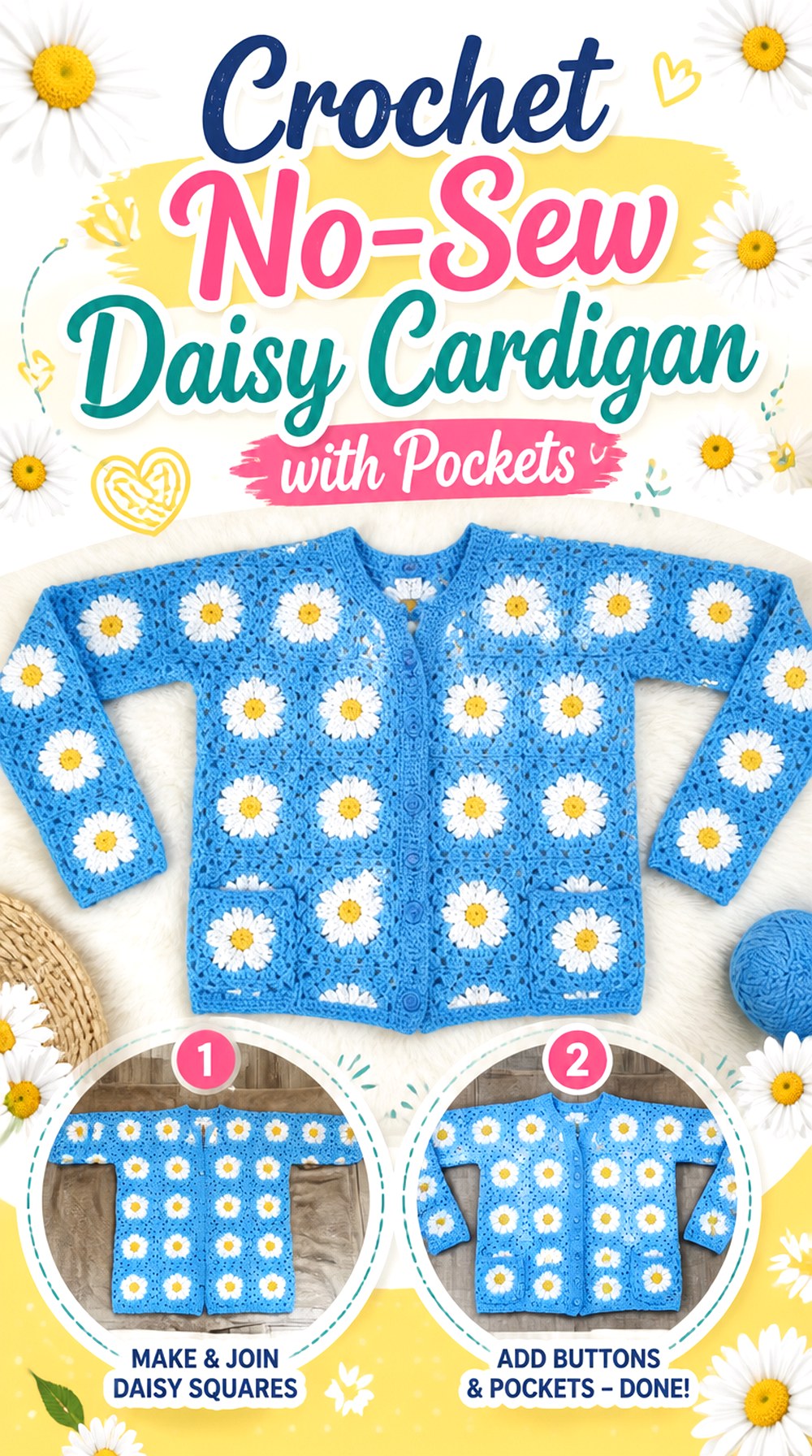
Cute Crochet’s daisy cardigan adds two practical differences to the collection: the title presents a no-sew construction approach, and the video’s chapter information includes pockets. That makes it worth comparing against cardigans where every square is assembled through a separate sewing stage.
Pockets also change the front visually. On an autumn cardigan, they can become intentional feature areas rather than disappearing into the flower grid. Keep them in the same background color for a quieter look, or let a carefully positioned daisy make the pocket part of the motif arrangement.
Pockets Add Weight to the Front Panels
Even empty crochet pockets add another layer of fabric. Once something is placed inside, the front can pull downward or outward depending on the pocket structure and garment fabric.
Check the tutorial’s pocket placement carefully and treat the pockets as light-use features unless the source specifically supports heavier loads. If your substituted yarn is especially stretchy, that consideration becomes more important.
No-Sew Construction Still Needs Accurate Motifs
Reducing sewing does not remove the need for consistent square size. In fact, joining motifs as part of the crochet process can make corrections inconvenient once several blocks are connected.
Measure and block sample squares first. Lay each new motif beside previously completed ones as you work so a tension change does not quietly propagate through an entire panel.
Keep Pocket Flowers Symmetrical Only If You Want Them To Be
Two identical front pockets can create a very orderly cardigan, while mismatched autumn flowers give the garment a more patchwork feeling.
Choose deliberately. If you want symmetry, place the pocket motifs and surrounding squares as a pair before attaching anything. If you prefer an irregular layout, make sure the imbalance looks intentional across the whole front rather than accidental at pocket level.
Original Tutorial and Creator Credit
Creator: Cute Crochet
13. Crochet Puffy Flower Motif Cardigan
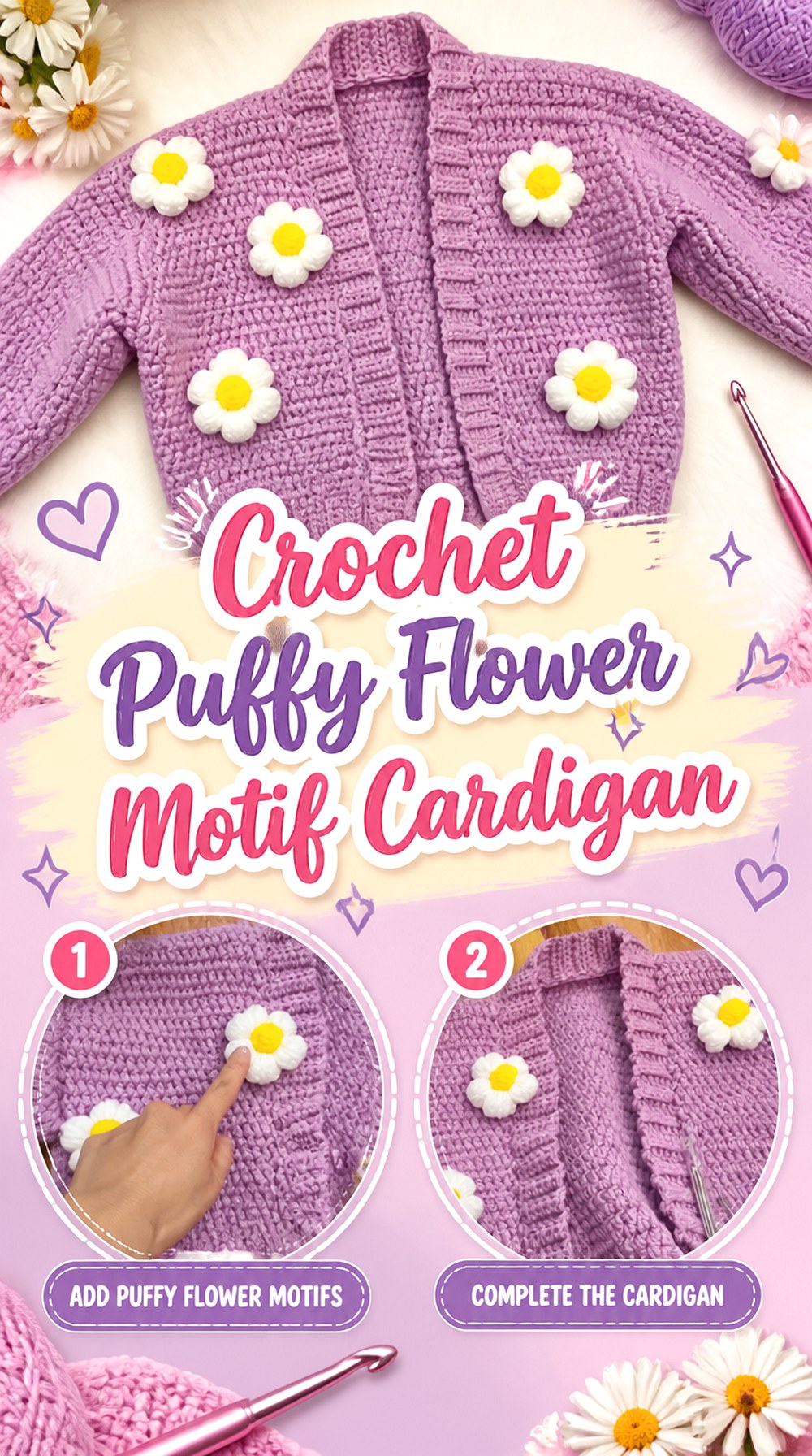
NoteswNat’s puffy flower cardigan shifts the floral theme away from flat graphic squares and toward a visibly soft, dimensional surface. The tutorial is specifically dedicated to a puffy or fluffy flower cardigan, making it a useful contrast with the rose squares and daisy grids elsewhere in this article.
For autumn, this texture can carry muted colors beautifully because the shadows between petals provide definition even when the palette is restrained. Cinnamon, oatmeal, mustard, faded peach, brown, and moss could create a softer seasonal result than the high-contrast sunflower styles.
Puffy Flowers Create Their Own Drape
A garment made from thick floral motifs does not behave exactly like ordinary flat fabric. The joins and raised petals create many small changes in thickness.
Before scaling the project up or substituting yarn, join several sample flowers and hold the section vertically. You want to know how the connected motifs stretch and whether the surface feels comfortable against neighboring clothing.
Watch the Gaps Between Motifs
Connected flower constructions may leave more open space than conventional granny squares. That can be attractive, but it changes warmth, coverage, and what will show beneath the cardigan.
If you want this as a true autumn layer, decide whether you are comfortable with the openness of the source construction. A long-sleeved base layer can solve a styling issue, but changing the motif join itself may affect the design and should not be improvised without understanding the tutorial.
Dimensional Texture Needs Gentle Styling Choices
When flowers already cover much of the surface, elaborate edging, many extra colors, or additional embellishments can compete with the texture.
For a more wearable autumn version, consider limiting the palette and letting the puffy structure provide the interest. This also makes it easier to notice whether motif size remains consistent throughout the garment.
Original Tutorial and Creator Credit
Creator: NoteswNat
14. Crochet Cropped Puff Flower Appliqué Cardigan
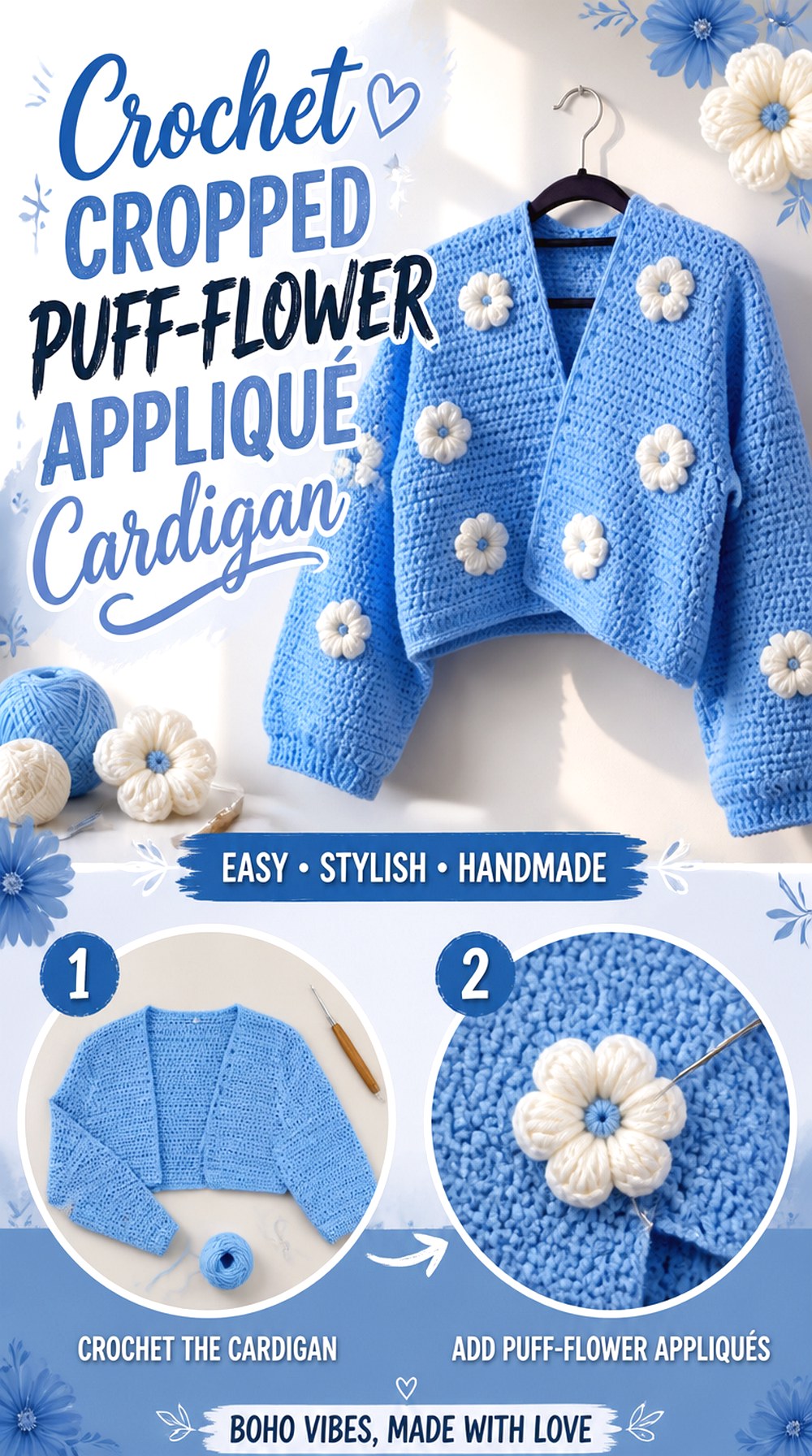
Selina Veronique Crochet’s Bella Cardigan takes another approach to dimensional flowers. Instead of making the complete garment from joined puffy motifs, the design builds a slightly cropped cardigan and adds chunky puff flowers as appliqués. The source also explains that the body can be made longer if desired.
That separation between garment and decoration creates useful flexibility. You can finish the base cardigan, try it on, and then decide exactly where autumn-colored flowers should sit. It is therefore a good option if you want floral texture without making every inch of the fabric floral.
Try the Plain Cardigan On Before Placing Flowers
Appliqués give you a valuable opportunity to make placement decisions on the actual finished garment. Pin or temporarily position them while wearing the cardigan over the type of top you expect to pair with it.
Check the shoulders, bust, sleeve fronts, and areas where the cardigan naturally folds. Flowers that look evenly spaced on a flat table may move closer together when the garment is worn.
Cropped and Lengthened Versions Need Different Flower Balance
The creator describes the design as slightly cropped while also allowing length customization. A longer body gives you more blank space, but simply adding more flowers may make the design crowded.
If you lengthen the cardigan, first decide whether the original floral concentration should remain mostly around the upper body or extend downward. Use temporary placement to compare both looks.
Appliqués Make Future Repairs More Localized
A separately attached flower is easier to inspect individually than a flower structurally integrated into the garment fabric. Secure each appliqué according to the tutorial and check the attachment periodically, especially on sleeves where petals encounter more friction.
For a cardigan expected to sit beneath coats or bags, flatter placement on high-contact areas may be more practical than maximum surface texture everywhere.
Original Tutorial and Creator Credit
Creator: Selina Veronique Crochet
15. Crochet Autumn Floral Lace Tie Front Cardigan
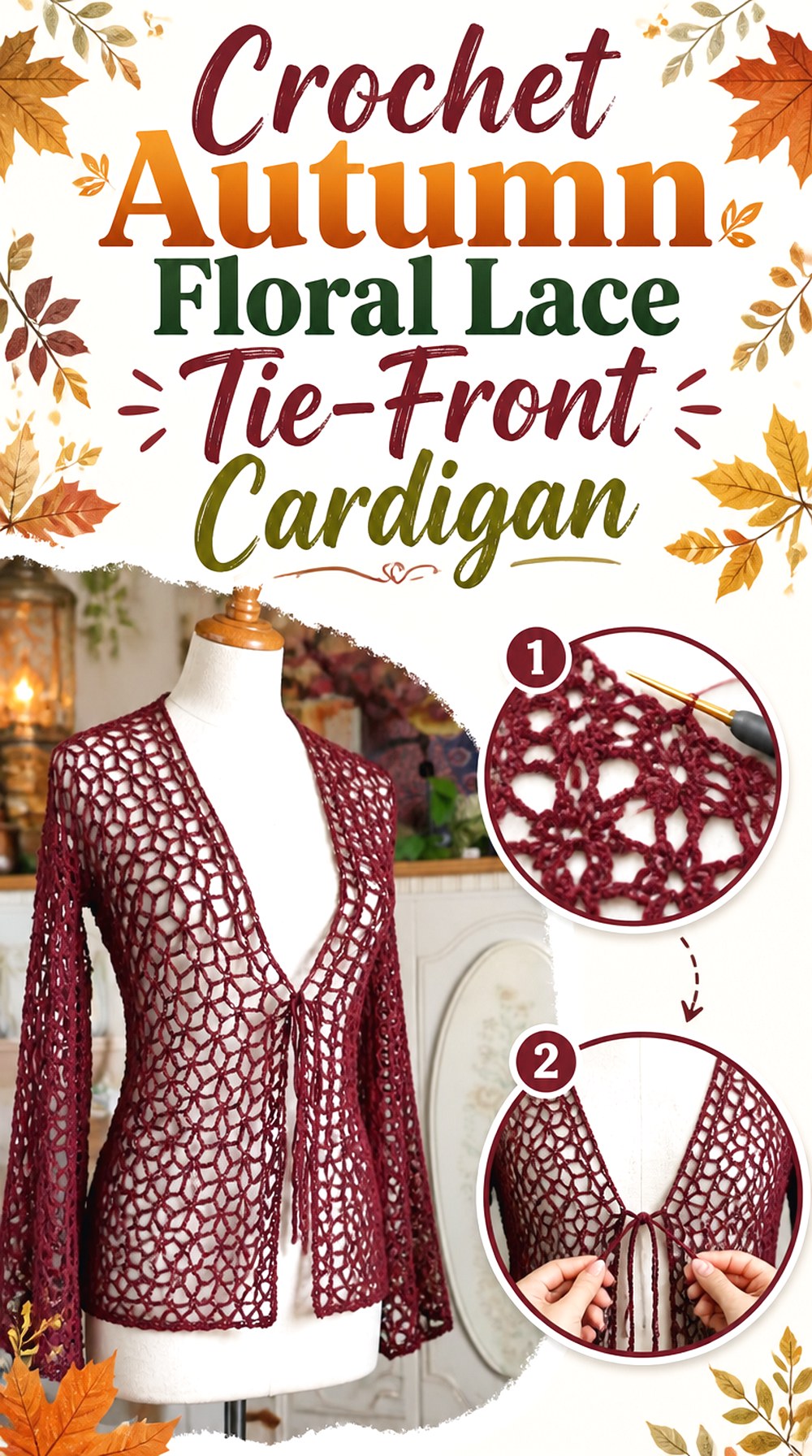
Hannah Drapinski’s floral cardigan uses a lace-like repeating flower pattern instead of individual granny squares. The tutorial covers the flower pattern, measurements, cardigan assembly, and a front tie, giving this project a noticeably lighter and more fluid character than the bulky flower-motif jackets.
This is one of the strongest choices for early autumn or indoor layering. Deep brown, wine, forest green, rust, or muted plum can make the open floral fabric feel seasonal without turning it into a heavy coat. The tie-front closure also keeps the silhouette visually softer than a button band or zipper.
Floral Lace Makes the Layer Underneath Part of the Design
Open fabric reveals the clothing beneath it, so a lace cardigan cannot be planned in isolation. A cream camisole under dark brown lace gives a very different effect from a similarly colored top that visually blends into the stitches.
Before choosing yarn color, hold a sample against several tops already in your wardrobe. That simple check can tell you whether you want strong lace contrast or a more tonal layered look.
Fine Fabric Needs a Different Fit Check
An airy floral repeat can stretch and drape differently from a dense granny square. The tutorial includes a measurement stage, which is especially relevant if you change yarn or want a different layering fit.
Measure the fabric while it is behaving as it will in the finished garment, not only immediately after crocheting. Blocking and gravity can alter how an open stitch pattern hangs.
The Tie Front Keeps the Opening Light
A narrow tie creates a very different front from a rigid button band or zipper. It allows most of the floral edge to remain visually open.
If you want to wear the cardigan under a coat, check where the tied section sits and whether the ends feel comfortable beneath another layer. If secure full-front closure is important, choose one of the buttoned or zip-front projects instead.
Original Tutorial and Creator Credit
Creator: Hannah Drapinski
16. Crochet Zippered Autumn Flower Granny Cardigan
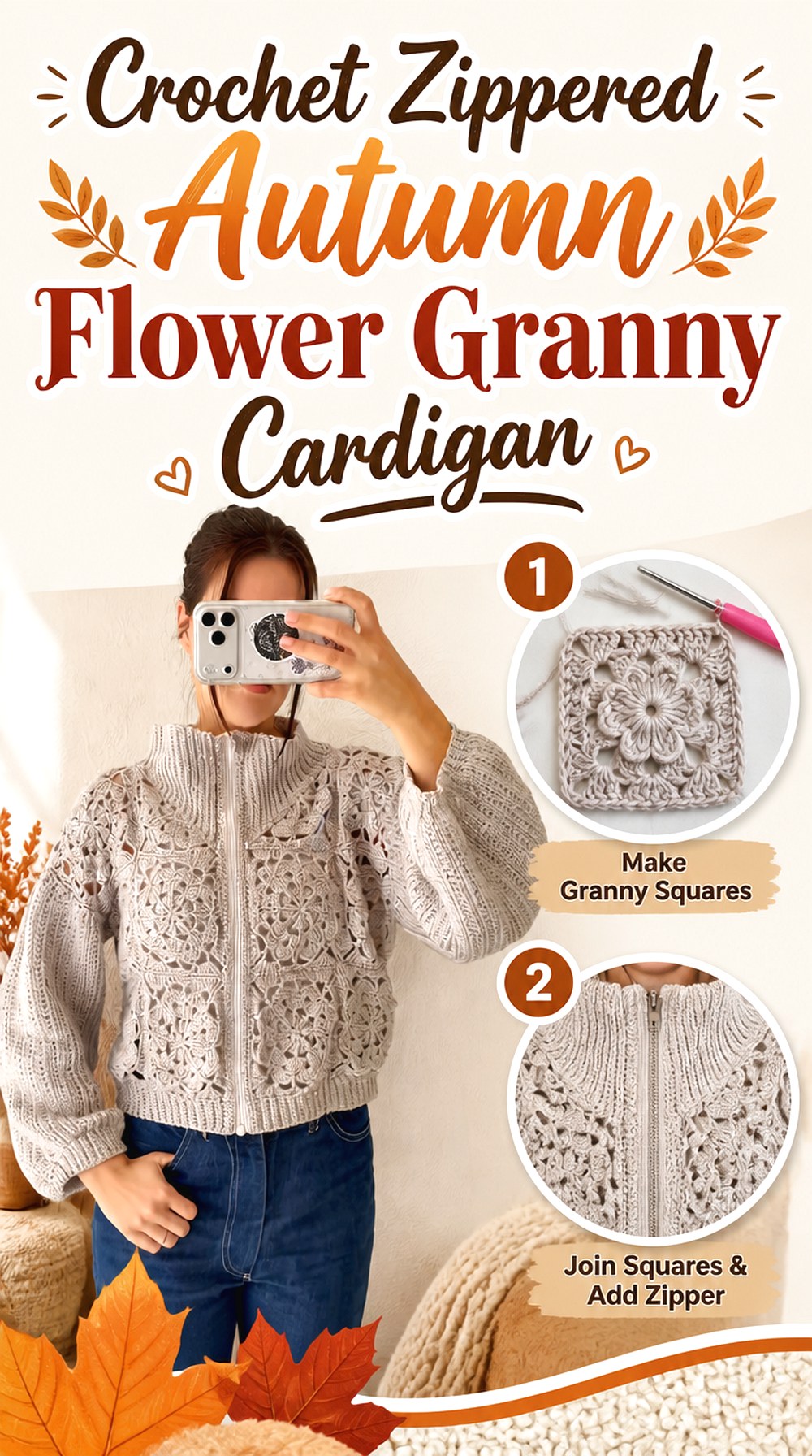
A zipper changes a granny cardigan from a loose open layer into a more defined jacket-like garment. Nora Moon’s tutorial demonstrates a granny-square cardigan that can use a zipper or buttons and includes square and triangle construction, joining, collar, sleeves, bottom ribbing, a zipper base, and zipper installation.
The source cardigan itself is not presented as a flower cardigan, so this idea is specifically an adaptation route. Use it only if your chosen autumn flower square can be made compatible with the tutorial’s required square dimensions and construction pieces. Do not assume a daisy, rose, or sunflower square can be swapped in without checking.
Match the Flower Square Before Planning the Zipper
The zipper depends on the two front edges aligning properly. If an adapted flower square changes panel width, the zipper opening may no longer behave like the source garment.
First compare blocked dimensions, border structure, and how your flower motif connects to any triangle pieces the tutorial requires. If those elements do not align cleanly, choose another cardigan construction rather than forcing the floral substitution.
A Zipper Highlights Uneven Front Bands
An open-front cardigan can hide a small difference between the left and right edges. A zipper places those edges directly beside one another.
Before installing it, lay the cardigan flat without stretching and check that both fronts are the same finished length. Correct edging or blocking issues before attaching the zipper so the closure does not introduce waves or pulling.
Keep Raised Flowers Away From the Zipper Path
Flat daisy or sunflower motifs are easier to place near a zipper than highly raised roses or puff flowers. Dimensional petals can crowd the opening or interfere with the pull.
If you want 3D flowers, consider concentrating them farther from the center front while using flatter compatible motifs beside the zipper band. That preserves the autumn floral theme without sacrificing closure function.
How These Crochet Autumn Flower Cardigans Compare
For maximum floral impact, the 3D rose and puffy-flower cardigans make the flowers part of the surface texture rather than simply part of the color pattern. The daisy and sunflower granny cardigans create a more regular grid, making them easier to plan visually before joining.
The long hooded sunflower design provides the most coat-like silhouette, while the floral lace tie-front cardigan sits at the lighter end of the range. Pockets add function to the no-sew daisy option, the ribbed chunky daisy cardigan gives the motifs a more structured frame, and the zip-front adaptation creates the most defined closure. If minimizing bulk matters, start with flat daisies or lace before considering raised roses and puff flowers.
Conclusion
Choosing an autumn flower cardigan becomes easier once you decide what the flowers should actually do. For a bold outer layer, compare the hooded sunflower duster or chunky daisy cardigan. For texture, look at the 3D roses and puff-flower options. If you prefer lighter layering, the floral-lace design or mesh-sleeve sunflower cardigan leaves more visual space.
Flat granny-square flowers are usually the simplest route when layout flexibility matters, while appliqués let you decide flower placement after the base garment is complete. Whatever style you choose, measure blocked motifs and check the developing garment before repeating dozens of pieces. Use the original tutorials near the end of your planning process for their exact construction, sizing, joining, and finishing details.
Frequently Asked Questions
Can I turn a spring flower cardigan tutorial into an autumn cardigan?
Usually, yes, if the garment itself suits the type of layering you want. Changing white, pink, or pastel flowers to rust, mustard, olive, burgundy, brown, or warm cream can shift the visual mood without changing the construction.
Do not assume a heavier-looking color requires heavier yarn, though. Keeping the yarn weight and gauge required by the source is generally safer than changing both color and material structure at the same time.
Should flower granny squares be blocked before I plan the cardigan layout?
Blocking is very useful when the yarn and project instructions support it because you need a realistic finished square size before estimating panel dimensions. An unblocked square may change width, shape, or edge behavior after finishing.
Block your sample using an appropriate method for the fiber, measure it after it has settled, and compare several completed motifs. Consistency matters more than making every square match an arbitrary measurement that does not belong to your chosen tutorial.
Can I replace a daisy square with a sunflower or rose square?
Only when the substitute motif can meet the construction requirements of the cardigan. Compare blocked width, edge shape, thickness, and the way the square is meant to join. A raised rose may also add substantially more surface bulk than a flat daisy.
If two motifs finish at different dimensions, adding an extra border may sometimes help with compatibility, but that is an adaptation you need to sample rather than assume will work.
How can I stop a flower cardigan from becoming too heavy at the shoulders?
Start by considering yarn weight, motif density, sleeve length, and the amount of raised texture. Several individually light motifs can create a substantial garment once dozens are joined.
Assemble enough of the upper body to judge the developing weight before completing every remaining motif. If you are designing your own adaptation, concentrating dimensional flowers away from the shoulder line can also reduce bulk there, provided the replacement areas remain construction-compatible.
Are flat flowers or 3D flowers better for an everyday cardigan?
Flat daisies, sunflowers, and graphic flower squares are generally easier to layer because there are fewer raised petals to catch on bags, coats, furniture, or neighboring crochet fabric. Dimensional roses and puff flowers create stronger texture and may be preferable when the cardigan itself is the statement layer.
Neither approach is universally better. Choose according to how often the garment will rub against other surfaces and how much texture you want to maintain.
Can I add a zipper to any flower granny-square cardigan?
Not automatically. A zipper needs stable, evenly matched front edges and a construction that leaves a suitable opening. Raised flowers can also interfere with the zipper path.
The zip-front tutorial included above demonstrates one granny-square zipper construction, but a floral substitution needs compatible motif dimensions and edge structure. If the adapted panels distort or the two fronts do not align cleanly, use a different closure rather than forcing the zipper.