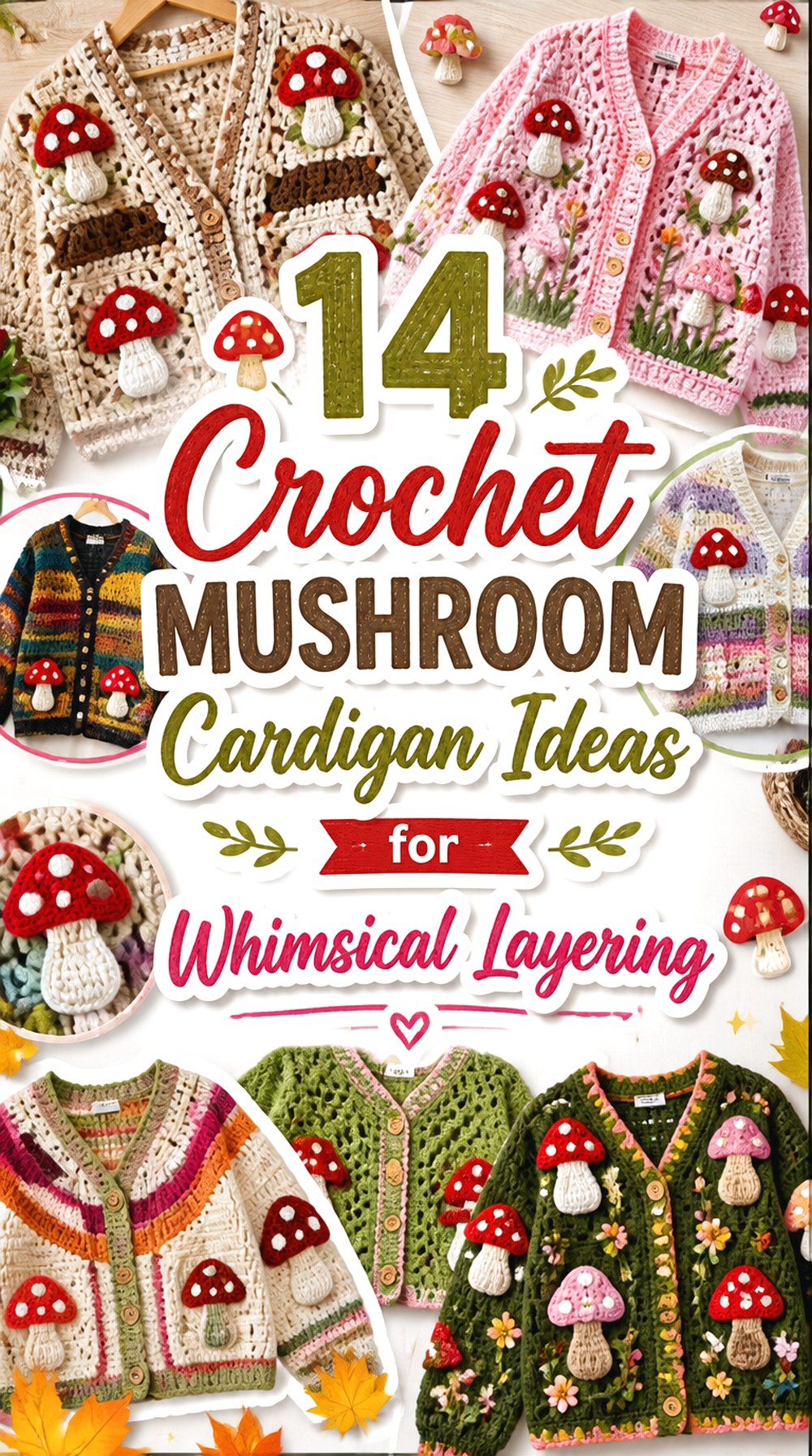
14 Crochet Mushroom Cardigan Ideas for Whimsical Layering
A crochet mushroom cardigan can range from an all-over granny square statement piece to a much quieter cardigan with two or three woodland motifs. That difference matters. Repeating mushroom squares across an entire garment affects weight and layout, while appliqués let you add the theme after checking the finished fit. Cropped, mesh, hexagon, raglan, chunky, and longline constructions also behave very differently when motifs are added.
The ideas below cover those different routes rather than repeating one cardigan fourteen times. One featured tutorial is specifically mushroom-themed; the remaining videos are verified cardigan tutorials that provide strong construction bases for compatible mushroom squares, appliqués, or woodland color planning. When adapting a tutorial, keep the creator’s original sizing and construction guidance intact and confirm that any replacement motif matches the space you intend to fill.
Quick List
- Crochet Mushroom Granny Square Shrug Cardigan
- Crochet Mushroom Motif Granny Square Cardigan
- Crochet Woodland Mesh Mushroom Cardigan
- Crochet Mushroom Cocoon Cardigan
- Crochet Mushroom Patchwork Cardigan
- Crochet Mushroom Top-Down Raglan Cardigan
- Crochet Mushroom Hexagon Cardigan
- Crochet Cropped Mushroom Accent Cardigan
- Crochet Button-Front Mushroom Cardigan
- Crochet Lacy Mushroom Summer Cardigan
- Crochet Chunky Mushroom Pocket Cardigan
- Crochet Granny-Stitch Mushroom Cardigan
- Crochet Long Mushroom Granny Square Cardigan
- Crochet Chunky V-Neck Mushroom Cardigan
Choose Mushroom Granny Squares or Appliqués Before Planning the Cardigan
A mushroom granny square makes the motif part of the garment structure. That works especially well for patchwork, classic granny square, and mixed-media cardigans, but the mushroom square must finish close to the dimensions of the surrounding squares. A noticeably smaller or larger blocked motif can pull seams out of alignment.
Appliqués offer more freedom because the cardigan can be fitted first. They suit raglan, mesh, chunky, button-front, and solid-panel designs where replacing structural fabric with a motif square would change the construction. Before sewing an appliqué permanently, pin or baste it in place and look at the garment while it is hanging naturally. A motif that seems perfectly positioned on a flat panel can shift visually once the cardigan is on the body.
Plan Mushroom Placement Around the Finished Fit
Treat mushroom placement as part of garment planning rather than decoration added randomly at the end. Large motifs near both shoulders can add visual bulk high on the garment, while a single back motif creates a clearer focal point. Front motifs need extra thought on buttoned cardigans because the opening divides the composition.
For granny square garments, compare the blocked dimensions of every motif before joining. As a non-pattern planning example, if a blocked mushroom square measures 5 inches across, four squares arranged side by side span about 20 inches before joins, edging, garment ease, and any shaping are considered. That calculation helps with layout, but it does not replace the sizing instructions in the cardigan tutorial. Sleeve motifs also deserve restraint because dense or raised designs can make a sleeve feel heavier than its matching body panel.
Yarn Weight and Drape Can Change the Mushroom Effect
Mushroom motifs are naturally graphic, so yarn thickness changes more than warmth. A bulky mushroom appliqué placed on a lightweight cardigan may sag or pull the underlying fabric. A very dense mushroom square mixed with loose granny squares can create uneven drape even when the outside dimensions appear to match.
For a cardigan built from motifs, using compatible yarn weights and similar fabric density makes joining easier. For an appliqué cardigan, a lighter embellishment is usually easier to position without distorting the base fabric. Mesh deserves particular caution: instead of attaching a heavy motif in the middle of large openings, use sturdier borders, cuffs, pockets, or denser sections as attachment points. Always follow the original tutorial’s yarn and gauge guidance for the garment itself before deciding how much decorative weight it can comfortably carry.
1. Crochet Mushroom Granny Square Shrug Cardigan
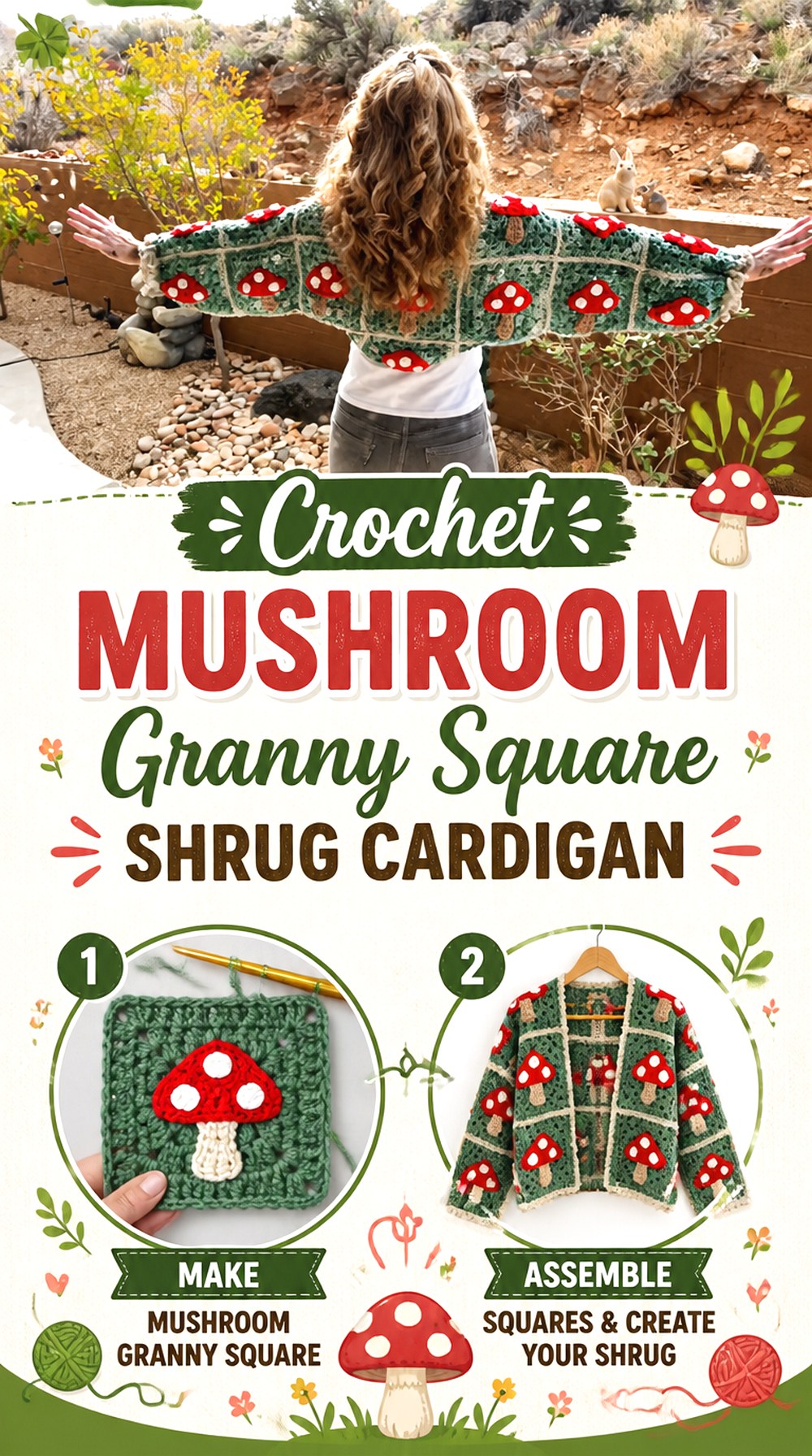
This option puts mushrooms at the center of the construction instead of treating them as an afterthought. The relaxed shrug shape keeps the focus on a grid of granny squares across the back, while the sleeves extend the piece into a practical layering garment. Melody Yarn Tinka’s source is the closest direct match in this collection because the finished project itself uses mushroom granny square styling.
Choose this route if you want the woodland theme to dominate the cardigan. Because the garment is planned around squares, it also makes more sense for someone who wants repeated mushrooms rather than one isolated appliqué.
Back-Square Width Controls the Relaxed Shape
The source tutorial is made to measure and uses the square arrangement to establish the back fit. That makes blocked square dimensions especially important. Measure completed motifs rather than relying on how large they look straight from the hook.
If several mushroom squares differ, correct the discrepancy before permanent assembly. Blocking may help small differences, but it should not be expected to turn substantially different motifs into matching structural units.
Adjustable Sleeves Change the Styling
The tutorial discusses different sleeve-length possibilities and drawstring-style cuff treatment, giving this construction more flexibility than a basic square vest. A shorter sleeve keeps the mushroom-covered back visually dominant, while a longer sleeve makes the piece read more like a full cardigan.
If you add extra mushroom embellishment to the sleeves, place the garment on a hanger first. Heavy dimensional caps near the cuff may make the lower sleeve hang differently from the body.
Scalloped Finishing Suits a Woodland Theme
A decorative edge can reinforce the cottagecore feel without adding another large mushroom motif. This is useful when the square layout is already visually busy.
Keep finishing yarn compatible with the body fabric so the border does not become noticeably heavier or tighter. Pay particular attention to the back opening and cuff edges, where overly firm edging can reduce the relaxed fit that defines the shrug shape.
2. Crochet Mushroom Motif Granny Square Cardigan
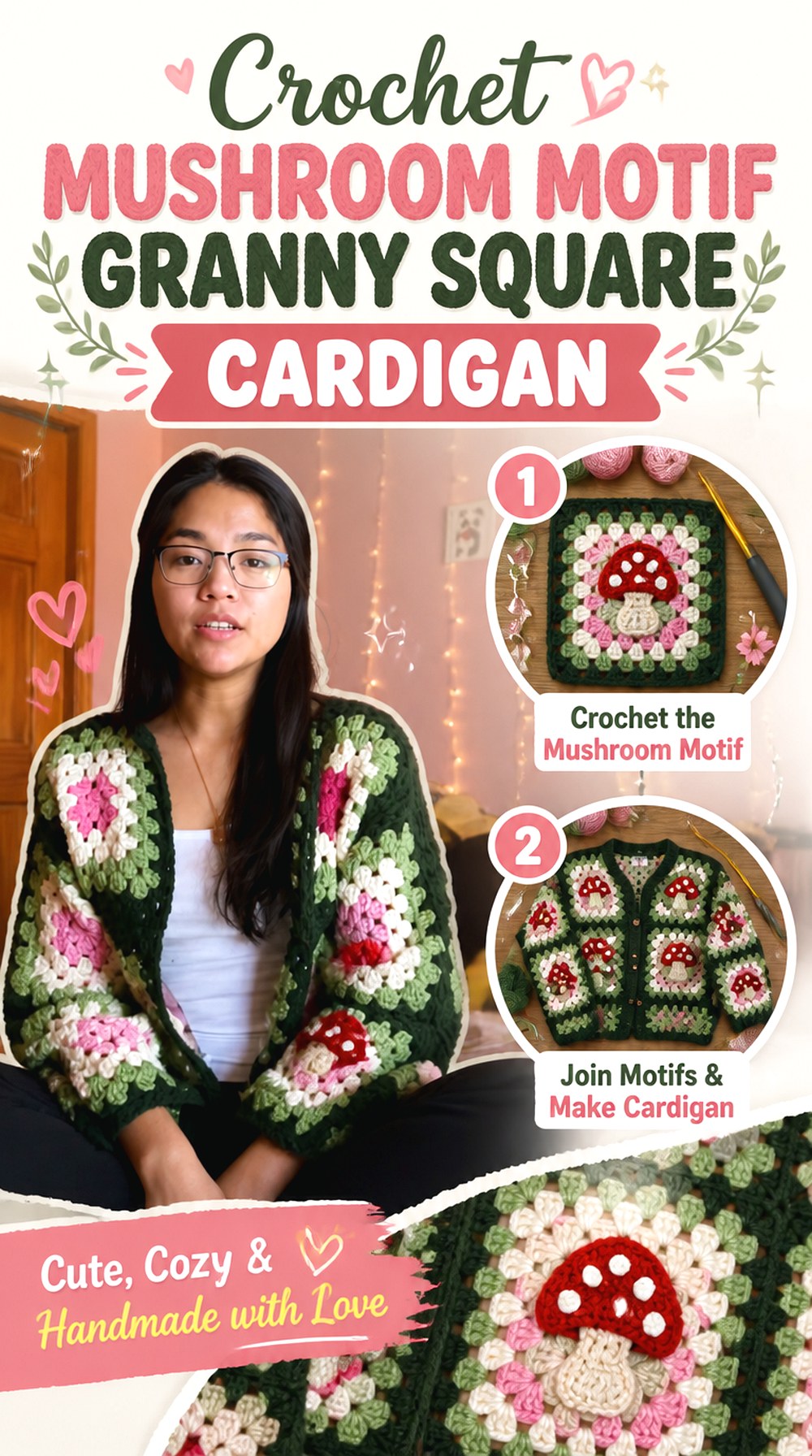
A traditional granny square cardigan provides one of the cleanest frameworks for building mushrooms directly into selected blocks. Instead of filling every position with the same design, use mushroom squares as focal pieces and simpler coordinating squares as visual breathing room.
This approach creates more of a classic cardigan silhouette than the shrug above. It is also useful when you want the mushrooms to appear intentionally spaced rather than repeated across every available section. Danielle Villanueva’s cardigan tutorial focuses on square construction, sizing, layout, joining, and a tie, making the project a practical base for planning compatible mushroom motifs.
Replace Squares Only After Comparing Blocked Dimensions
Do not assume two granny square patterns are interchangeable simply because both are called squares. Stitch density, border rounds, and motif shaping can all change the finished dimensions.
Make one mushroom square and one square from the cardigan construction, block both as intended, then compare them. If the dimensions or edge stitch distribution differ noticeably, adapt the decorative concept rather than forcing incompatible pieces into the same seam.
Use Mushrooms as Anchors in the Layout
One mushroom square on each front can create symmetry, while a cluster across the upper or center back produces a stronger focal point. Repeating them everywhere gives a denser, more graphic result.
Lay the entire cardigan grid out before joining. This catches situations where several bright caps accidentally collect on one side or a front mushroom disappears beneath the arm when the garment is worn.
A Tie Front Leaves the Motifs Uninterrupted
A tie closure can be useful for a highly decorative cardigan because it avoids a long line of buttons competing with the square arrangement. It also leaves more of the front motifs visible.
If you move mushroom squares close to the front edge, check where the tie sits when closed. A stem or cap placed directly under the closure can look visually crowded.
Original Tutorial and Creator Credit
Creator: Danielle Villanueva
3. Crochet Woodland Mesh Mushroom Cardigan
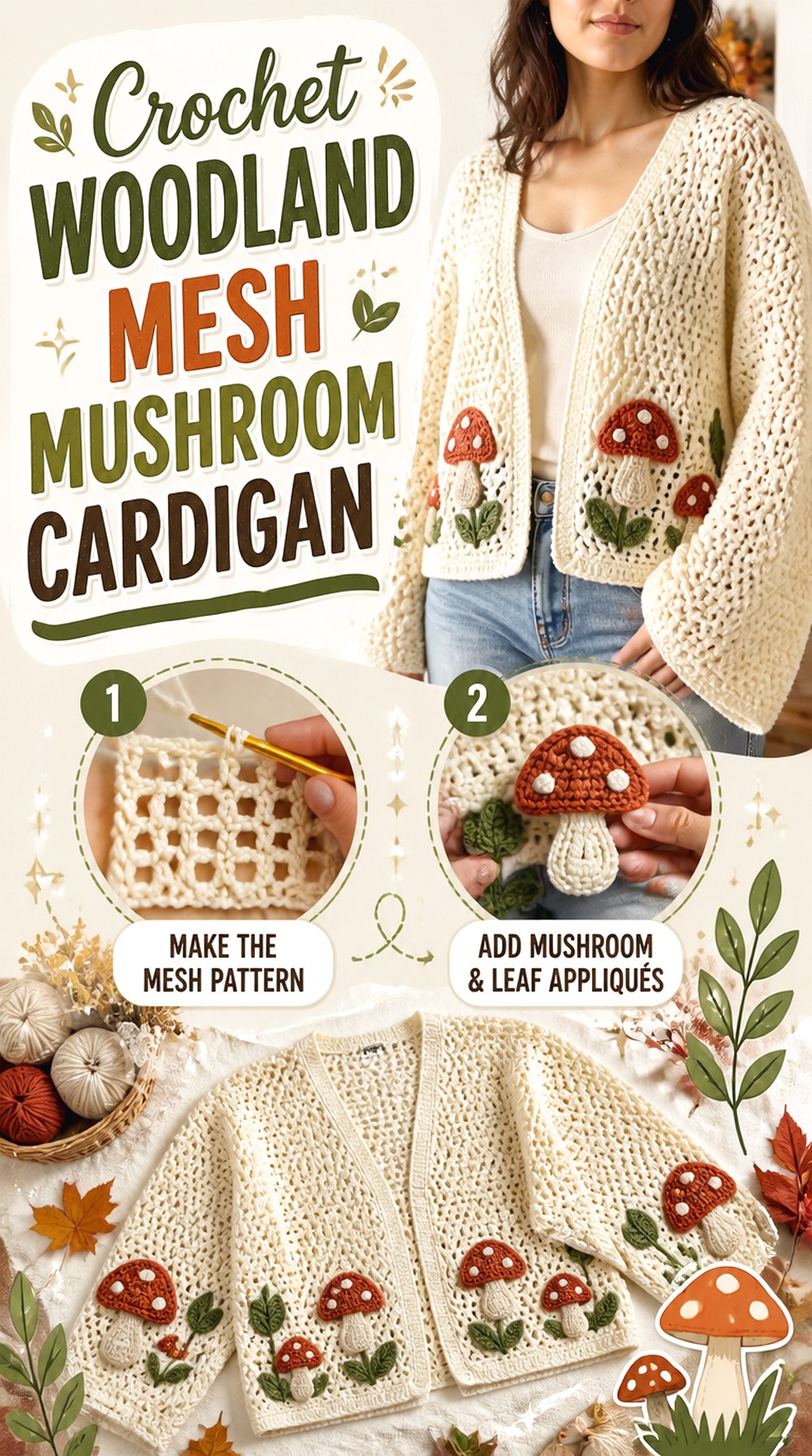
A mesh cardigan offers the lightest-looking interpretation in this collection. Instead of replacing open fabric with heavy mushroom squares, keep the body airy and concentrate woodland details on stronger areas such as the front edging, sleeve cuffs, or deliberately added solid patches.
The contrast can be striking: open negative space keeps the cardigan visually light while a few red, rust, cream, or brown mushrooms carry the theme. VivCrochets’ tutorial creates a breathable cardigan from separate pieces, giving you a clear garment structure to complete before testing decorative placement.
Open Mesh Needs Lightweight Mushroom Details
Large dense appliqués can overpower open crochet and may pull the surrounding fabric downward. If you want embellishment, smaller and flatter motifs are the safer visual direction.
Pin the proposed mushroom in place and hang the cardigan for a while before sewing. If the mesh stretches significantly below the motif, move it to a denser edge or use the woodland palette without attaching that particular appliqué.
Keep the Back Airy for Better Drape
A large statement mushroom centered on the back sounds appealing, but it can change the way an otherwise fluid mesh panel falls. An alternative is to place several small motifs near the lower edging or use mushroom-inspired colors around the neckline.
The goal is contrast rather than complete coverage. This cardigan earns its place in the collection because it can express the theme without becoming another heavy motif garment.
Three-Piece Construction Makes Placement Easier to Preview
The source cardigan is assembled from three crocheted pieces. That gives you a useful checkpoint: finish the garment body first, then judge embellishment after the shoulder and sleeve relationships are visible.
Decorating separate flat pieces too early can create placement that appears balanced on a table but moves unexpectedly once the pieces are sewn into a wearable shape.
Original Tutorial and Creator Credit
Creator: VivCrochets
4. Crochet Mushroom Cocoon Cardigan
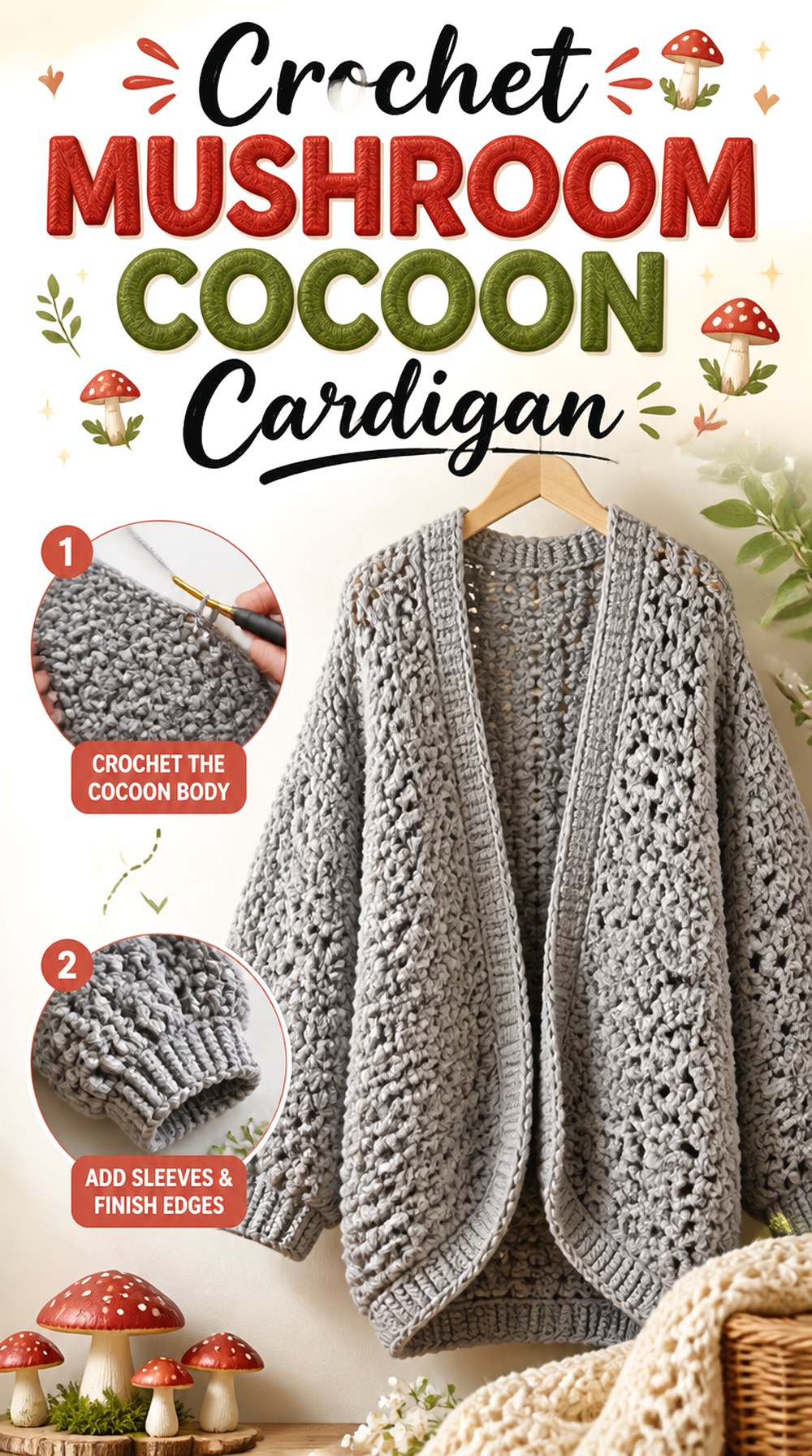
A cocoon cardigan creates a broad uninterrupted back area, making it a strong choice for one statement mushroom rather than dozens of small motifs. The rounded, folded silhouette feels more like a wearable blanket than a fitted jacket, so a central fly-agaric-inspired appliqué or a low woodland border can become the main design feature.
Unique stitch designs demonstrates a rectangle-based cocoon construction. The shape is intentionally relaxed, which makes this option very different from a structured button-front or raglan cardigan.
The Back Panel Is the Natural Focal Area
Because cocoon cardigans wrap around the shoulders from a broad rectangle, the back carries much of the visible surface. One oversized flat mushroom motif can therefore have more impact than a scattered layout.
Mark the center after the cardigan has been folded into shape rather than using the center of the original flat rectangle automatically. The visible center can shift once the arm openings and edging are established.
Deep Edging Can Help the Cardigan Stay in Place
The creator specifically discusses the relationship between the rectangular shape, shoulder stability, and deeper ribbing. That matters for embellishment because a cardigan already inclined to slide off the shoulders should not be loaded with unnecessary weight at the back.
Keep mushroom decorations relatively flat, and treat the edging as part of the structure rather than merely decorative trim.
Original Tutorial and Creator Credit
Creator: Unique stitch designs
5. Crochet Mushroom Patchwork Cardigan
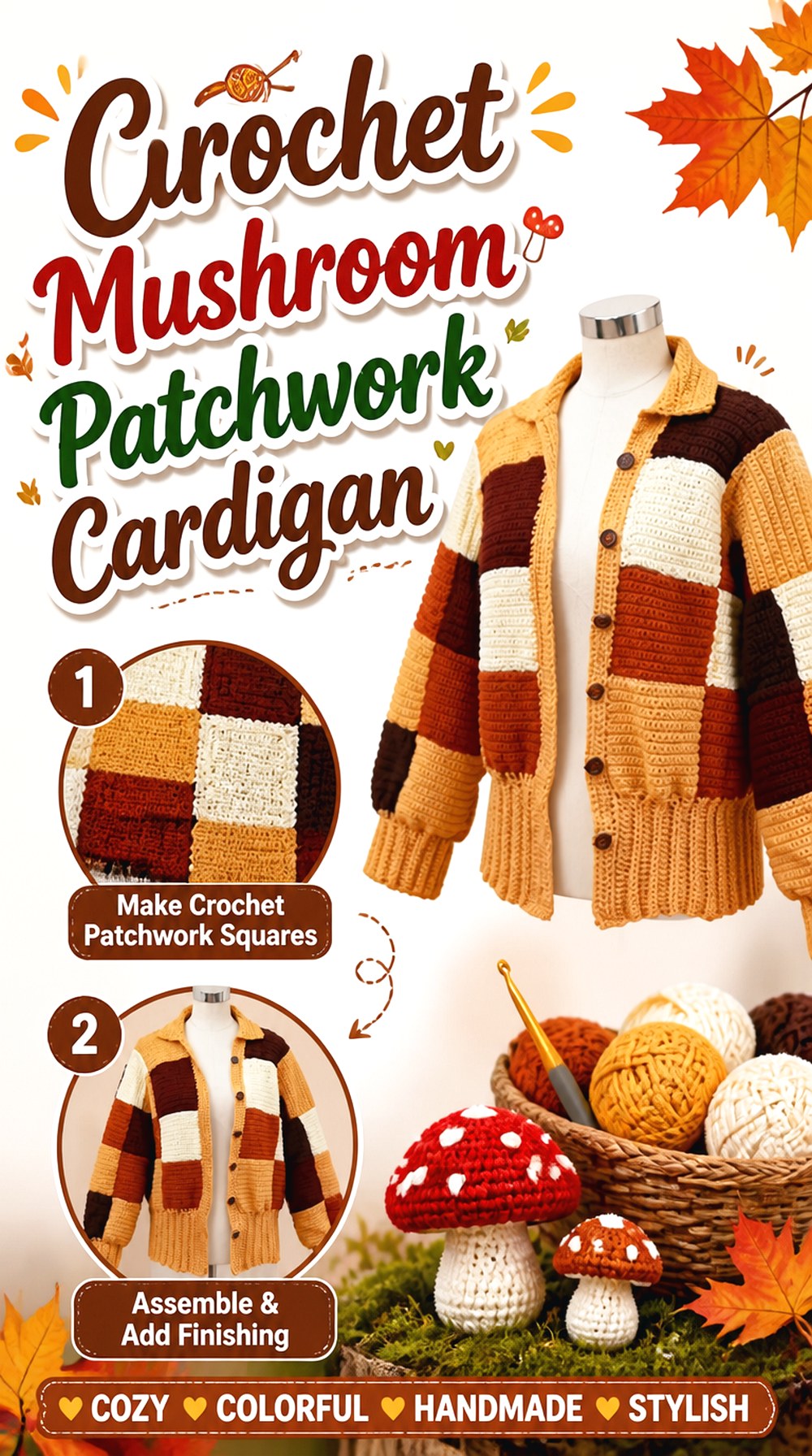
Patchwork gives you the most obvious place to combine mushroom imagery with solid blocks, checks, or earthy colors. Instead of making every patch a mushroom, reserve a few spaces for motif squares and let rust, cream, moss, bark brown, and muted red blocks connect the theme.
MODHAN’s cardigan tutorial uses a patchwork construction with individual sections assembled into the garment. That framework makes the mushroom adaptation easy to understand visually, although replacement motifs still need to match the dimensions and edge behavior of the original patches.
Treat Mushroom Squares as Feature Patches
A mushroom patch is most effective when nearby squares are simpler. Surrounding every motif with another detailed motif can make the overall surface hard to read.
Try arranging the mushrooms diagonally across the body, on opposite front and back corners, or as a small cluster near one shoulder. Photograph the unjoined layout from above; a photo often reveals balance problems more clearly than looking at the pieces close up.
Keep Sleeve Patchwork Lighter Than the Body
Full motif coverage on sleeves can increase visual and physical weight. A useful compromise is to keep mushrooms primarily on the torso and use simpler patch colors down the arms.
This also makes fitting easier. If a sleeve needs adjustment, you are less likely to disturb the main statement motifs or discover that a mushroom cap lands exactly on an elbow bend.
Seams Become Part of the Mushroom Design
Patchwork seams form a visible grid, so mushroom placement should respect that geometry. A mushroom motif with important details crowding the outer edge may visually merge with the seam.
Before joining, check that caps, stems, and spots remain readable once seam allowance or joining stitches bring neighboring patches closer together.
Original Tutorial and Creator Credit
Creator: MODHAN
6. Crochet Mushroom Top Down Raglan Cardigan
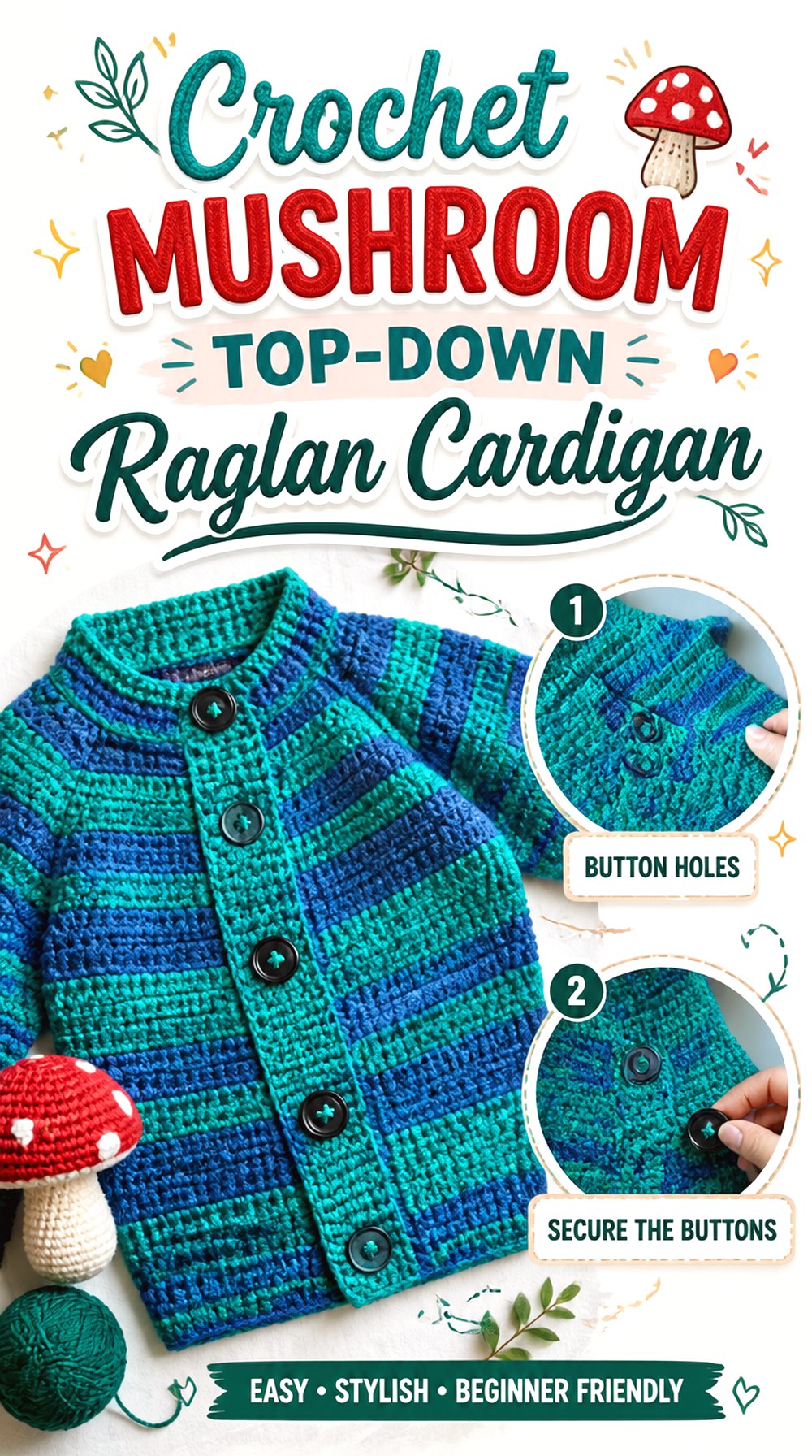
A top-down raglan lets you establish the neckline, shoulders, body, and sleeves before committing to mushroom placement. That makes it an appealing route if fit is more important to you than building the garment from decorative squares.
Instead of changing the structural fabric, finish the cardigan and add mushrooms afterward. A small group near one front hem, a single upper-back motif, or matching cuff accents can create the theme without interfering with the raglan shaping. The tutorial from by Kristine works from the top down and avoids sewing for the main body, so the construction is fundamentally different from patchwork or seamed-panel cardigans.
Raglan Lines Already Create Strong Visual Direction
The diagonal lines from neckline to underarm naturally draw the eye toward the shoulders. Large mushroom motifs placed directly over those lines can make the design look crowded.
Keep major appliqués below the yoke or place one centrally on the back after the sleeve separation. Smaller motifs can sit closer to the neckline if they do not obscure the garment’s shaping.
Fit the Cardigan Before Adding the Forest
Top-down construction offers a valuable advantage: the developing garment can be assessed before decoration is permanent. Use that opportunity.
Once the cardigan reaches its intended body and sleeve proportions, pin mushroom accents on while wearing or displaying it. Check front opening balance, shoulder position, and whether a motif gets hidden under the arm.
Buttons Need Space Around Front Motifs
The source includes buttonhole finishing, so front decoration should be planned around the closure. Leave enough visual space that caps and stems do not become chopped up by buttons.
If you want a symmetrical front, use two modest motifs rather than forcing one large mushroom to straddle the opening.
Original Tutorial and Creator Credit
Creator: by Kristine
7. Crochet Mushroom Hexagon Cardigan
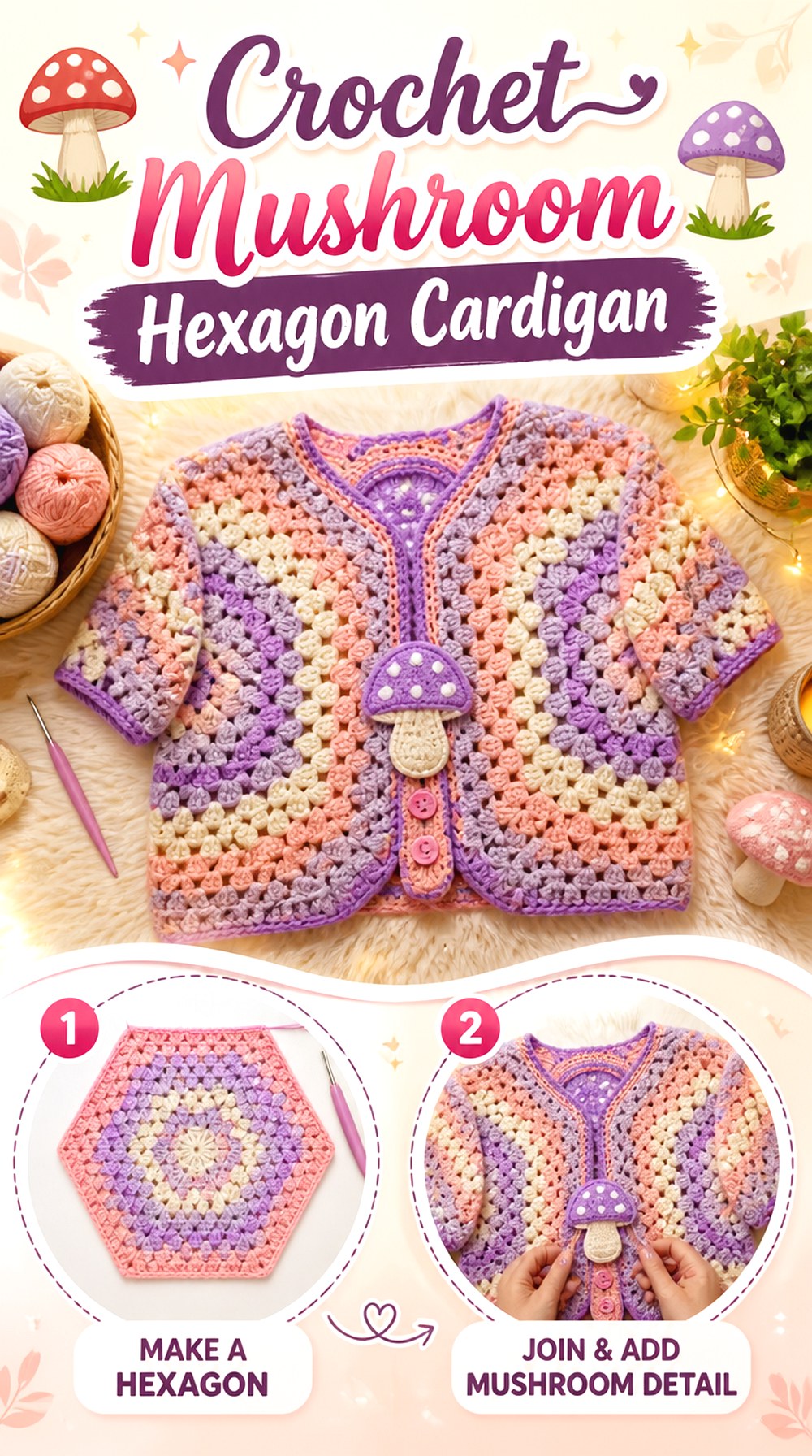
The hexagon cardigan offers recognizable granny texture without requiring a grid of separate squares. Two expanding hexagons form the core of the garment, producing built-in sleeves and a relaxed open-front silhouette.
That gives mushroom lovers two adaptation routes: work the cardigan in forest-inspired stripes and add appliqués afterward, or keep the hexagons mostly neutral so a mushroom feature on the back stands out. PassioKnit Kelsie’s tutorial is a particularly useful construction reference because it focuses on the hexagon method, joining, sleeve length, back width, bottom length, and borders.
Hexagon Growth Affects Width and Length Together
A key difference from rectangular panels is that expanding a hexagon changes multiple garment dimensions at once. Do not keep adding rounds purely because you want a longer body without checking the resulting sleeve and torso proportions.
Use the tutorial’s measuring guidance for construction. Add decorative mushrooms only after the basic shape is working, rather than using motif placement to distract from an oversized or undersized hexagon.
Use the Center Back Seam as a Design Axis
Once the two halves join, the center back provides a natural reference line. A mushroom placed beside that line can intentionally create asymmetry, while two mirrored motifs can emphasize the cardigan’s two-part construction.
If you prefer one large mushroom centered over the seam, make sure the appliqué lies smoothly across the joined area and does not pull the seam to one side.
Granny Texture Already Carries Plenty of Detail
Hexagon cardigans have strong cluster texture. Highly dimensional mushroom caps, many spots, and multiple color changes can make the surface excessively busy.
A flatter appliqué or limited mushroom placement generally allows both the hexagon structure and the woodland theme to remain visible.
Original Tutorial and Creator Credit
Creator: PassioKnit Kelsie
8. Crochet Cropped Mushroom Accent Cardigan
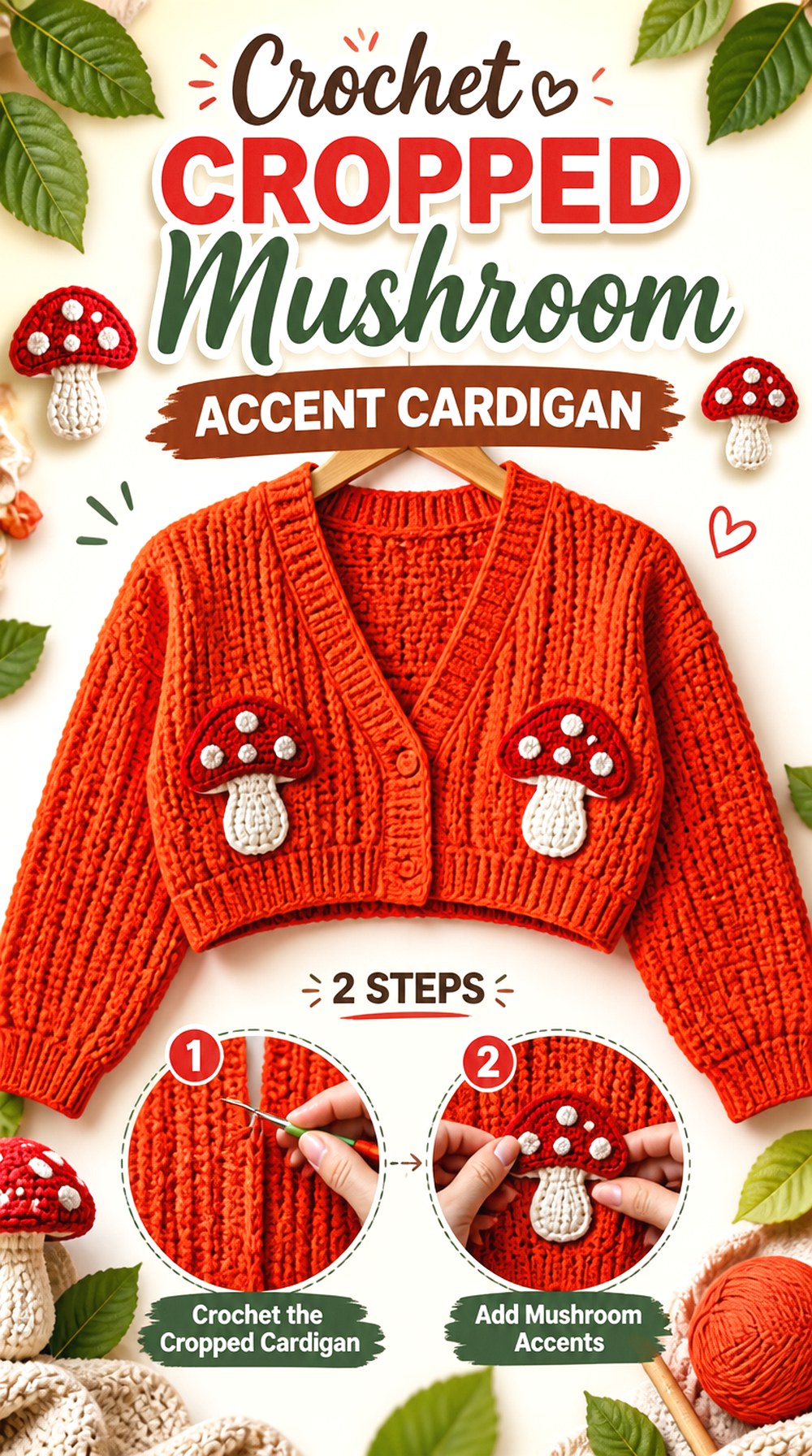
A cropped cardigan concentrates the entire design into a smaller visual area, so mushroom placement has to be deliberate. TCDDIY’s source has a short buttoned silhouette with decorative lower-edge treatment, creating a useful base for an autumn or cottagecore adaptation.
Instead of trying to reconstruct the source’s decorative border as mushrooms, keep the cardigan construction intact and add compatible mushroom appliqués afterward. A small cap-and-stem motif on each front or one statement mushroom on the back can give the shortened silhouette a clear woodland identity without overloading it.
Cropped Length Makes Lower Motifs More Prominent
On a long cardigan, a hem motif may sit well below the main line of sight. On a cropped version it can become a central feature.
Pin proposed mushrooms after confirming the final body length. If the motif reaches too close to the hem, edging can visually cut into it and make the stem appear shortened.
Buttons Can Become Part of the Color Story
A button-front cardigan already has repeated focal points down the center. Rather than crowding those with extra crochet details, use the buttons as part of the woodland palette and move mushrooms outward onto the front panels.
Check that appliqués do not overlap buttonholes or create bulk where the two fronts meet.
Original Tutorial and Creator Credit
Creator: TCDDIY
9. Crochet Button Front Mushroom Cardigan
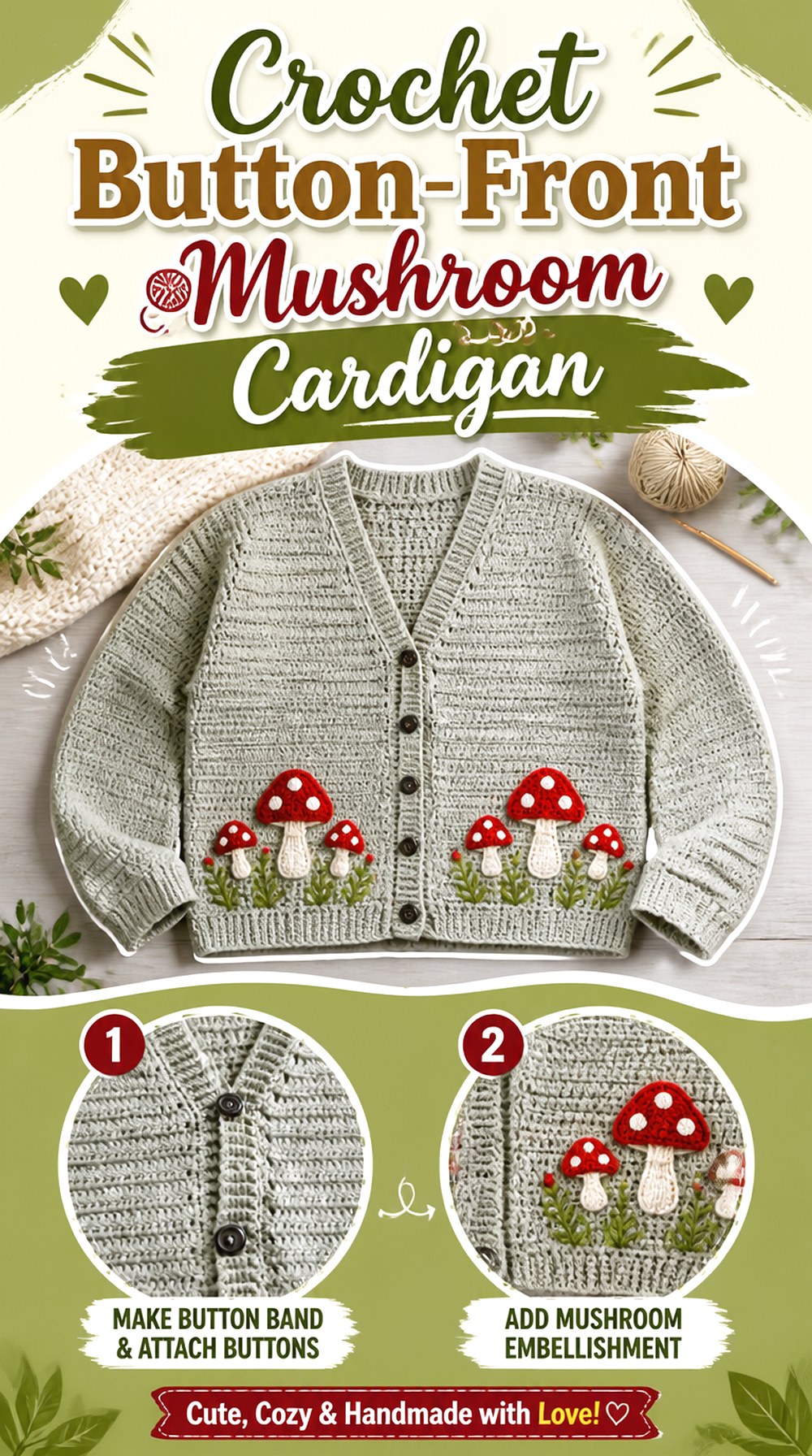
For a more traditional everyday shape, start with a V-neck button cardigan and use mushrooms as restrained accents. This option works particularly well with one motif above a pocket area, two small motifs near the lower fronts, or a larger design centered on the back.
Hey Carrie’s tutorial uses separate front, back, and sleeve pieces with ribbed finishing and buttons. Because the shape is less visually busy than a granny square cardigan, even a small mushroom can read clearly. This makes it a useful choice for someone who likes woodland crochet but does not necessarily want a novelty garment from every angle.
The V-Neck Leaves Space for Front Decoration
A V opening creates a broad area below the neckline where small motifs can sit without competing with a collar. Keep them far enough from the button band that the cap remains visible when the cardigan is closed.
For an asymmetrical look, one front mushroom can work better than forcing mirrored motifs into spaces that are not visually identical once buttoned.
Ribbing Gives the Cardigan a Strong Frame
Ribbed hem, cuffs, and front edging visually contain the body fabric. That makes mushroom accents feel more intentional because they sit inside a defined frame.
Avoid sewing a thick appliqué across the ribbing itself. The ribbed area stretches differently from the main fabric and should remain free enough to perform its intended finishing role.
Check the Back Before Choosing Motif Scale
A plain back can support a larger statement mushroom than either front panel. However, the motif still needs space around the shoulder seams and hem.
Pin a paper template or finished appliqué to the cardigan first. View it from several feet away to judge whether it looks like a focal point or simply an oversized patch.
Original Tutorial and Creator Credit
Creator: Hey Carrie
10. Crochet Lacy Mushroom Summer Cardigan
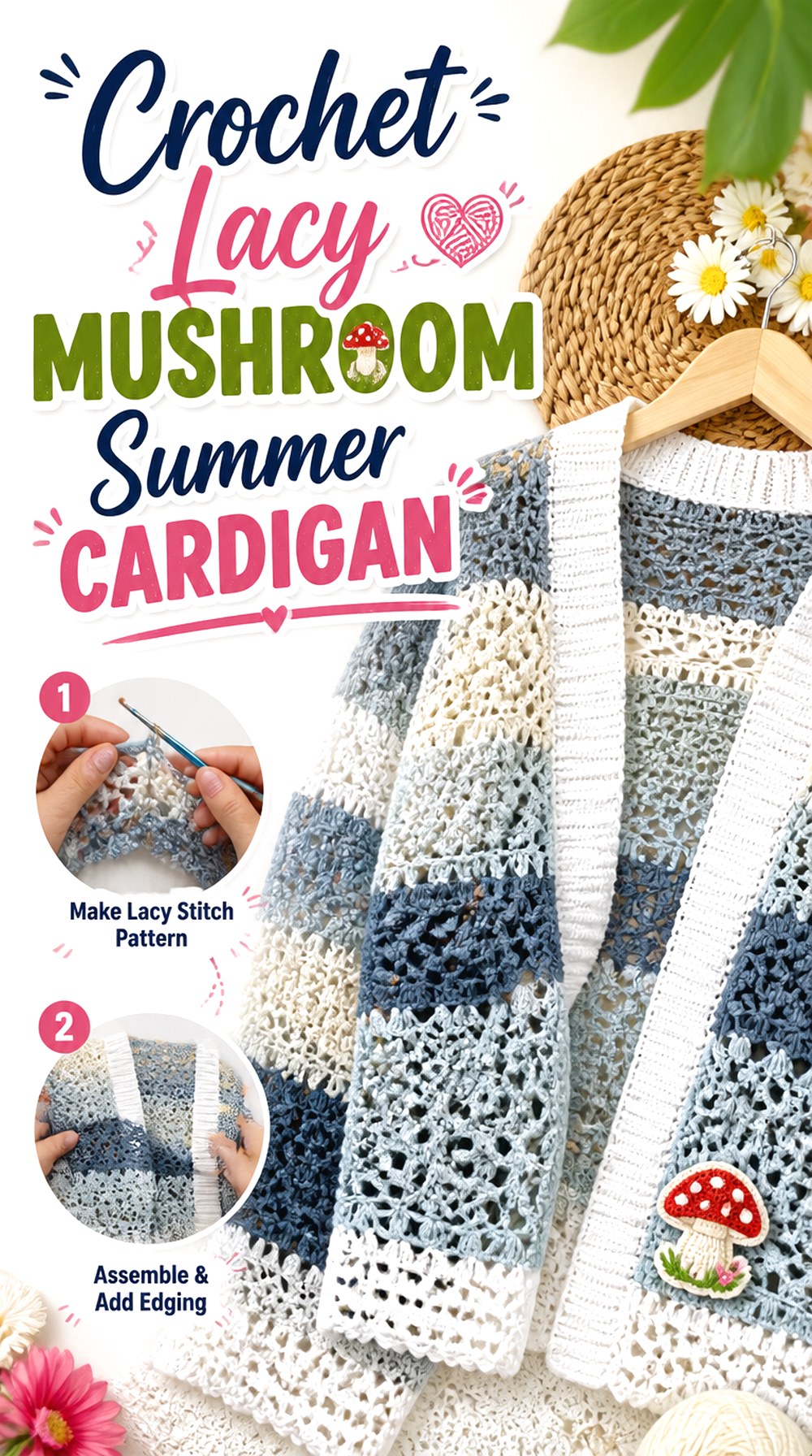
A summer mushroom cardigan does not need the dense fabric associated with autumn crochet. Yarnalina’s lacy cardigan uses multiple open stitch textures to create a lighter garment, giving you a useful alternative to thick granny squares and chunky appliqués.
For this version, let woodland colors do some of the work. Muted sage, cream, pale brown, or soft red sections can suggest the theme, while one or two small mushroom accents keep the garment recognizable without covering the lace. It is a more delicate interpretation suited to readers who want a mushroom design they can layer in warmer conditions.
Let the Lace Remain the Main Texture
The source cardigan combines several lacy stitch patterns. Covering those sections with numerous appliqués would hide the feature that makes this cardigan different.
Place mushroom details on a relatively stable section, near solid ribbing, or in a deliberately selected panel. If the embellishment makes the surrounding stitches collapse, it is too heavy for that location.
Color Blocking Can Carry the Theme Without Added Weight
A mushroom palette can be effective even when the garment contains very few literal mushrooms. Cream for stems, rusty red for caps, and green or brown accents can create a woodland mood through the cardigan’s existing stitch blocks.
This is especially useful if you want the finished piece to remain versatile rather than reading as costume-like.
Test Decorative Edges After Blocking
Lacy crochet can change noticeably with blocking. Attach permanent decorative details only after the main cardigan has been finished according to the tutorial’s care and blocking guidance.
That prevents a motif positioned perfectly on an unblocked panel from shifting after the fabric opens and settles.
Original Tutorial and Creator Credit
Creator: Yarnalina
11. Crochet Chunky Mushroom Pocket Cardigan
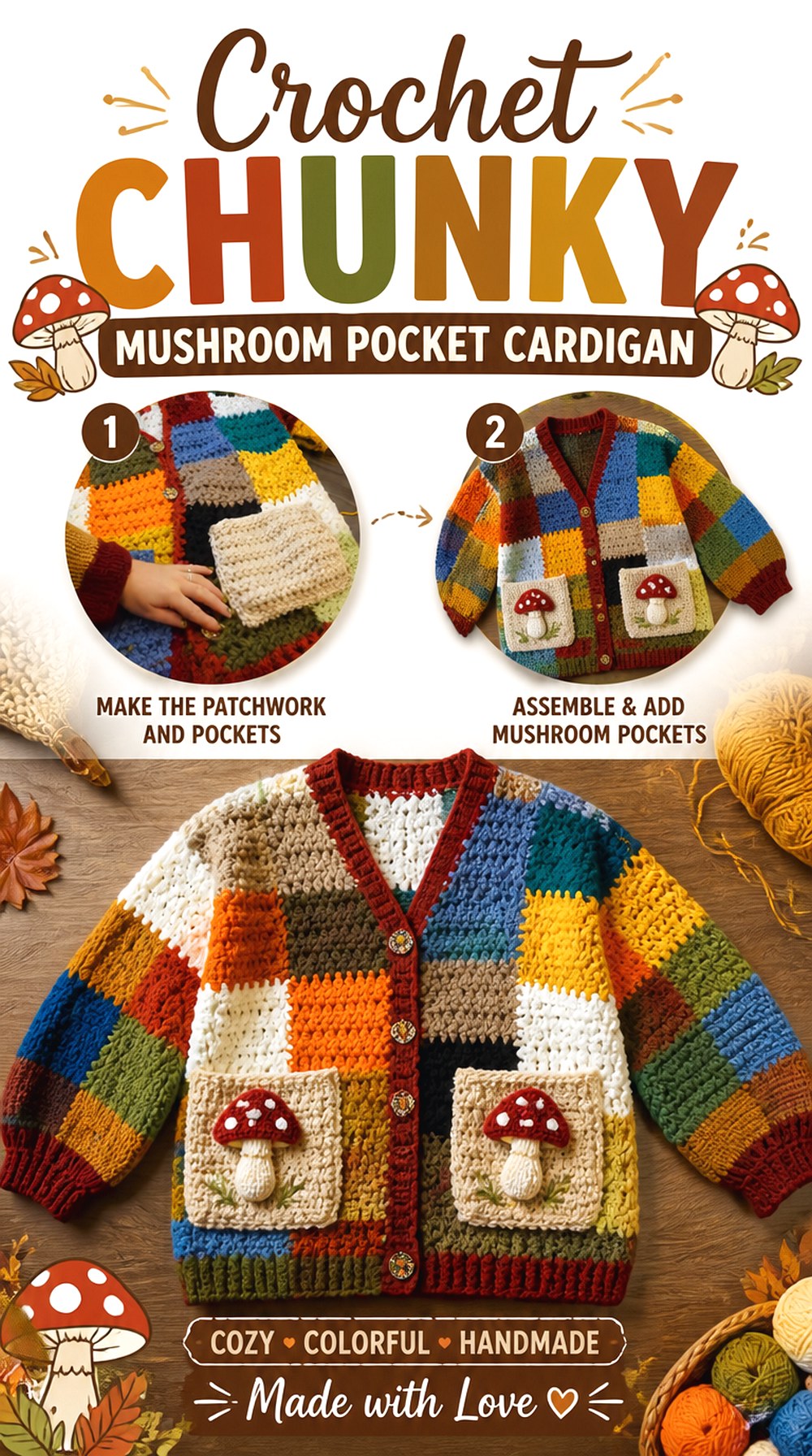
Chunky yarn creates enough visual scale for larger mushroom details, but it also increases garment weight quickly. Brunaticality’s cardigan includes an oversized shape, substantial yarn, buttons, and pockets, making it a strong base for a cozy mushroom cardigan designed around bold rather than tiny embellishment.
The pockets are particularly useful. Instead of sewing mushrooms across the entire body, they can become the main woodland feature: one mushroom on each pocket keeps the composition controlled and places the extra layers on areas already designed as added fabric.
Pockets Provide Built-In Motif Zones
A pocket gives a mushroom appliqué a clear boundary. Centering the motif there prevents it from appearing randomly placed across a large solid cardigan.
Complete and attach the pockets as the tutorial intends before deciding the mushroom size. A motif that looks proportional to an unattached pocket can feel too large once the pocket sits on the full garment.
Chunky Fabric Needs Simple Mushroom Shapes
Highly detailed caps and stems can become bulky when made at the same scale as a chunky cardigan. A simpler, flatter mushroom silhouette may read more clearly.
You can also use a lighter compatible yarn for the appliqué if the visual effect works, but test it against the cardigan first rather than assuming a thinner embellishment will automatically behave well.
Balance Buttons, Pockets, and Mushrooms
This cardigan already has several visible design features. If the buttons contrast strongly and both pockets contain mushroom motifs, the rest of the body may not need decoration.
Stand back from the finished cardigan before adding more. Stopping after two strong pocket mushrooms can produce a clearer result than covering every available panel.
Original Tutorial and Creator Credit
Creator: Brunaticality
12. Crochet Granny Stitch Mushroom Cardigan
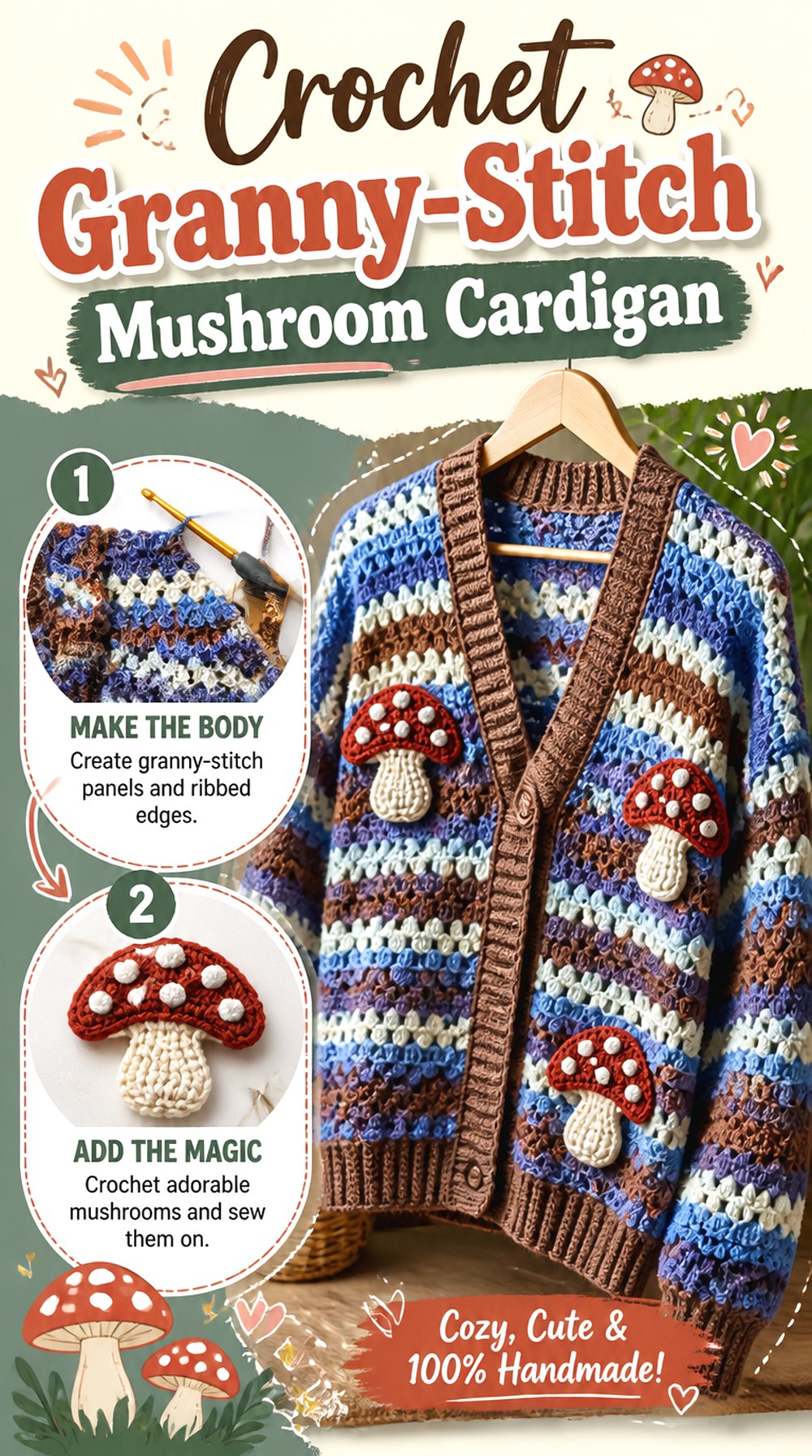
A top-down granny-stitch cardigan combines the texture of traditional granny crochet with the smoother fit planning of a raglan garment. MJ’s Off The Hook Designs demonstrates a seamless top-down approach, so this option avoids the large grid of individually joined squares while still keeping the familiar cluster look.
For mushroom styling, use appliqués after the main garment is complete or work a deliberate woodland color sequence through the granny rows. The result can feel more continuous and less patchwork-heavy than a square-based mushroom cardigan.
Granny Rows Create Horizontal Visual Rhythm
Repeated granny clusters form strong lines around the garment. A mushroom appliqué placed without considering those lines can look as though it is floating between stripes.
Align the base of a motif with a natural row or position several mushrooms at deliberately different heights. Either approach looks more considered than near-alignment that appears accidental.
Top-Down Construction Helps With Motif Height
Because the body grows downward from the yoke, you can determine where the bust, waist, and hem actually fall before embellishment.
That is valuable for mushrooms. A motif intended for the lower front may move much higher visually if the cardigan is shorter than expected. Complete the body length first and decorate second.
Keep the Yoke Clear if the Texture Is Already Busy
The upper yoke contains both garment shaping and granny texture. Leaving it relatively undecorated allows the structure to remain visible.
A mushroom cluster near the lower back or front corners gives the eye a destination without obscuring the neckline and shoulder transitions.
Original Tutorial and Creator Credit
Creator: MJ’s Off The Hook Designs
13. Crochet Long Mushroom Granny Square Cardigan
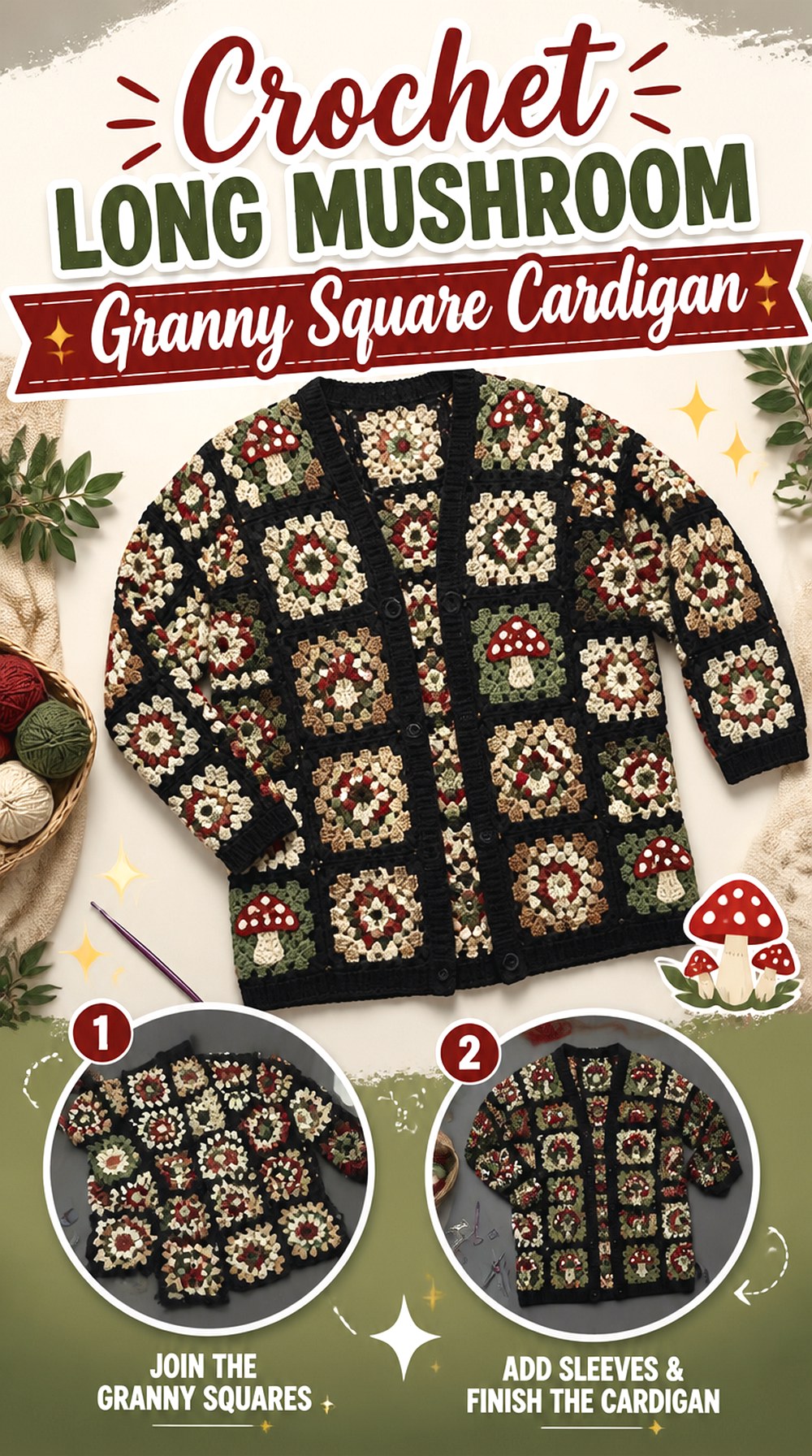
A long cardigan creates enough surface area for mushrooms to feel like part of a larger composition rather than the only thing happening on the garment. The YARNutopia tutorial demonstrates a long mixed-media granny square cardigan with front and sleeve motifs combined with a different back treatment.
That construction idea suits a mushroom adaptation especially well. Mushroom squares can appear in selected front or sleeve positions while a simpler back panel prevents the finished piece from becoming excessively dense. The longer silhouette also gives you more room to space motifs vertically.
A Mixed Back Can Reduce Garment Bulk
Using a simpler back treatment instead of covering the entire garment with individual mushroom squares can reduce both visual repetition and joining work.
It also allows the mushrooms on the front and sleeves to stand out. Before adapting the construction, verify how your mushroom square dimensions relate to the source’s granny square sections rather than assuming any motif will slot into the same arrangement.
Long Vertical Space Changes Motif Spacing
On a longer cardigan, mushroom squares concentrated only near the shoulders may make the lower half look disconnected. Spreading feature motifs through different heights creates a more balanced vertical composition.
You do not need equal spacing. A deliberate cluster near the upper body and another lower accent can feel more organic than a strict checkerboard.
Side Slits and Open Areas Need Breathing Room
The source design includes distinctive long-cardigan details, so mushroom additions should not compete with every construction feature.
Keep decorative squares away from places where shaping, openings, or seams already create visual activity. A motif is easier to read when surrounded by at least some simpler fabric.
Original Tutorial and Creator Credit
Creator: Fuad Azmat / YARNutopia by Nadia
14. Crochet Chunky V Neck Mushroom Cardigan
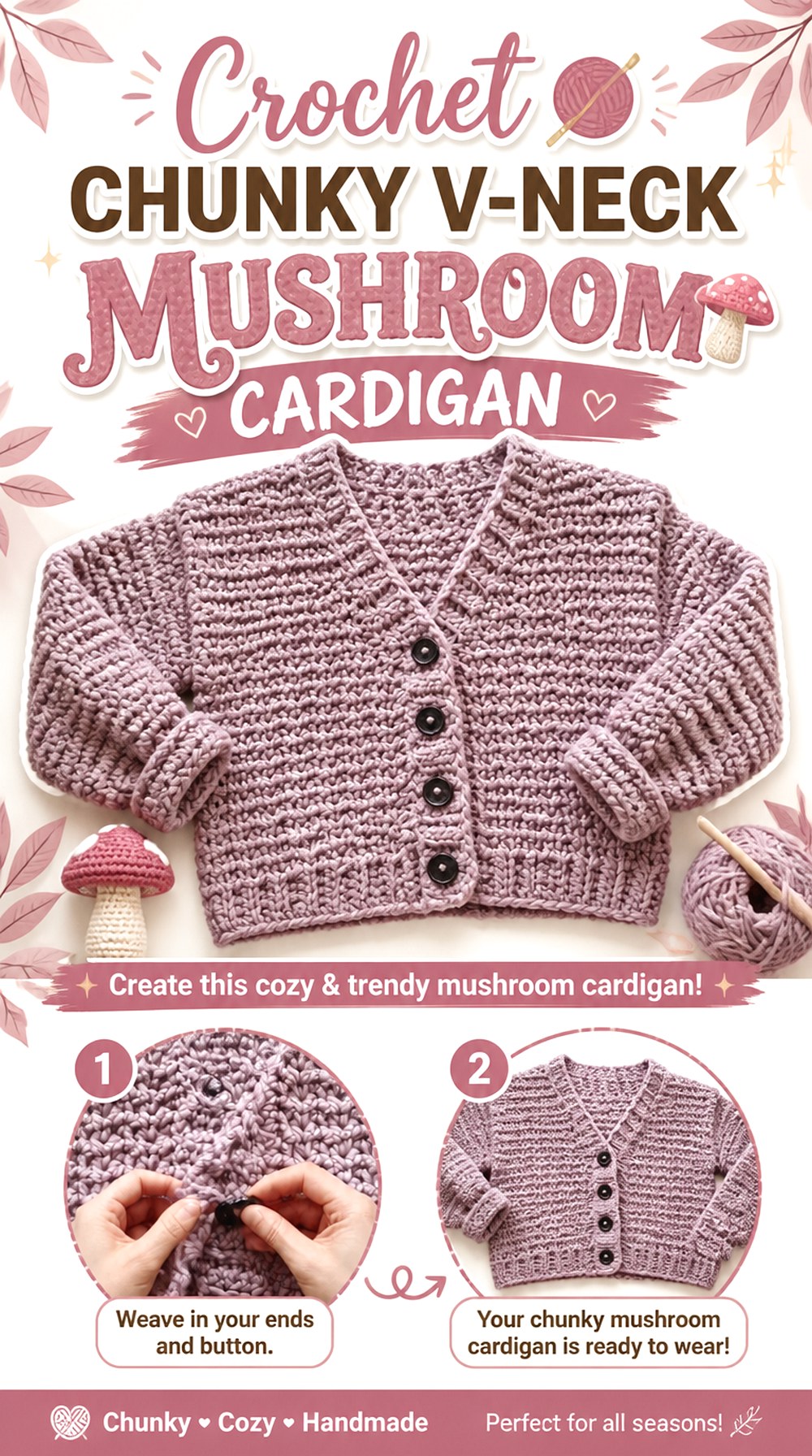
This final option combines a cropped boxy silhouette, chunky texture, a V-neck, and buttons. Those features give it a jacket-like presence, making it a good base for a small number of bold mushroom accents instead of intricate repeated motifs.
The forthefrills tutorial focuses on a textured chunky cardigan with front and back loop stitches and buttonhole ribbing. For a mushroom version, consider one large back appliqué or two front motifs positioned below the V. Because both the texture and yarn are substantial, the decorative design should remain relatively simple.
The V-Neck Creates a Strong Center Shape
A V-neck already points toward the center front. Mushrooms placed too close to that diagonal edge can make the neckline look visually cramped.
Position front motifs lower or farther outward. Pin both sides before sewing so you can see how the cardigan looks buttoned and open; the apparent spacing changes between the two.
Chunky Texture Can Compete With Tiny Details
Small spots, narrow stems, and miniature embellishments may disappear against thick textured stitches. Scale the mushroom design so its silhouette is readable from a normal viewing distance.
That does not mean adding more layers. A clean red cap and contrasting stem can communicate the idea more effectively than a complicated three-dimensional motif.
Buttons Should Remain Functional
Do not allow mushroom edges to overlap the button band or buttonholes. Decorative bulk in this area can make fastening awkward and may distort the front edge.
Finish the cardigan, sew the buttons as directed by the tutorial, and then decide where the mushroom details fit around the working closure.
Original Tutorial and Creator Credit
Creator: forthefrills
Which Mushroom Cardigan Style Should You Choose?
Choose the mushroom granny square shrug or classic granny square cardigan when you want the mushrooms built directly into the garment. The patchwork and long mixed-media versions give you similar motif freedom with more opportunities to break up repetition.
For easier decoration after fitting, the raglan, button-front, chunky pocket, granny-stitch, and V-neck cardigans are stronger choices because the base garment can be completed before mushroom placement becomes permanent. The mesh and lacy versions are best when you want a lighter interpretation and are willing to keep embellishments restrained.
If silhouette matters most, the cocoon gives the broadest relaxed back, the hexagon creates recognizable granny texture with fewer separate pieces, and cropped designs concentrate the mushroom theme into a smaller statement area.
Conclusion
The most effective crochet mushroom cardigan is not necessarily the one with the most mushrooms. If you want the motif to control the construction, start with the mushroom shrug, granny square, patchwork, or long mixed-media options. If fit and everyday wear matter more, a raglan, button-front, chunky pocket, or granny-stitch cardigan lets you finish the garment first and decide exactly where the woodland details belong.
For lighter layering, the mesh and lacy cardigans keep the theme from becoming visually heavy, while cocoon and hexagon shapes create relaxed alternatives to conventional panels. Whichever route you choose, compare motif dimensions, garment weight, closure placement, and blocked fit before permanent embellishment. Use the original tutorials for the creators’ exact construction details.
Frequently Asked Questions
Can I turn any crochet cardigan tutorial into a mushroom cardigan?
Many cardigans can be adapted, but the safest method depends on the construction. Solid-panel, raglan, chunky, and button-front cardigans can often receive appliqués after the garment is finished. Granny square and patchwork cardigans require more planning because a mushroom square may become part of the structure. Always compare dimensions, fabric density, and edge behavior before substituting one structural motif for another.
Do mushroom granny squares need to be exactly the same size as the other cardigan squares?
They should be close enough in blocked dimensions and compatible enough at the edges to join without pulling or buckling. Matching the outer measurements matters more than assuming two designs will work together because they use the same yarn weight. Make sample squares first, block them as intended, and compare them before producing enough motifs for an entire cardigan.
Where should mushroom motifs go on a cardigan?
The best placement depends on the silhouette. Large uninterrupted back panels can support one statement motif, while patchwork cardigans naturally suit multiple mushroom squares. On button-front designs, keep motifs clear of closures. Sleeves usually benefit from lighter decoration because repeated dense motifs can add weight. Pin or baste the mushrooms first and view the cardigan hanging and worn before sewing them permanently.
Should I block mushroom squares before planning the cardigan layout?
Yes, when blocking is appropriate for the yarn and project. The dimensions of an unblocked square may change once the fabric settles, and even modest differences can accumulate across a garment made from many motifs. Block your sample mushroom and filler squares in the same manner, then measure them. Use the creator’s garment sizing and joining guidance rather than relying only on raw square dimensions.
How can I make a mushroom cardigan look less visually heavy?
Limit the literal mushrooms and let color carry part of the theme. A cream cardigan with rust, moss, brown, and muted red accents can feel woodland-inspired even with only two or three mushroom motifs. Open-front, mesh, or lacy constructions also create more negative space. On square-based garments, alternate detailed mushroom blocks with simpler filler squares instead of repeating the same motif everywhere.
Can I add mushroom appliqués after the cardigan is completely finished?
For many solid or granny-stitch constructions, finishing the cardigan first is actually useful because you can judge the real fit and motif placement before sewing. Pin the appliqués where you think they belong, put the garment on or display it on a hanger, and check whether the fabric sags or the motifs disappear under the arms. Keep embellishments away from working buttonholes and other areas that need to stretch freely.