
13 Crochet Autumn Patchwork Sweater Ideas
Patchwork crochet sweaters can take very different forms. Some are assembled from traditional granny squares, while others use solid blocks, oversized motifs, checkerboard layouts, floral centers, or fewer large sections. The shape matters just as much as the colors: a cropped pullover behaves differently from a roomy cardigan, and a hood or zipper changes both the construction and the finished weight.
These 13 crochet autumn patchwork sweater ideas are organized around those practical differences. You’ll find open cardigans, closed pullovers, oversized shapes, cropped silhouettes, statement motifs, and alternatives for using a coordinated fall palette or assorted leftover yarn. Before choosing one, compare the tutorial’s construction with the fit, fabric density, seams, and amount of patch repetition you actually want in the finished garment.
Quick List
- Crochet Oversized Monochrome Granny Patch Cardigan
- Crochet Brown Checkerboard Patchwork Cardigan
- Crochet Sunflower Patchwork Cardigan
- Crochet Zip-Front Granny Square Cardigan
- Crochet Hooded Granny Patchwork Cardigan
- Crochet Chunky Granny Patch Cardigan
- Crochet Closed-Front Patchwork Pullover Sweater
- Crochet Four-Square Granny Sweater
- Crochet Cropped Granny Patchwork Sweater
- Crochet Cozy Oversized Granny Patchwork Pullover
- Crochet Cropped Turtleneck Granny Patchwork Sweater
- Crochet Bold Block Patchwork Cardigan
- Crochet Heart Patchwork Cardigan
Plan Patch Size and Sweater Fit Before Choosing Colors
Patch dimensions become garment dimensions surprisingly quickly. For a motif-based sweater, block a representative square before committing to a full stack, then compare its actual width with the tutorial’s panel arrangement and your preferred garment measurements. Sweater guidance from established crochet designers likewise emphasizes checking measurements, gauge, and fit rather than assuming a yarn substitution will reproduce the original dimensions.
As a planning example, four blocked squares measuring 5 inches across would span about 20 inches before allowing for joins, edging, garment ease, or other construction details. That does not create a universal sweater formula; it simply shows why a small change in one square can multiply across a whole panel. Patchwork pullovers also need enough room at the neckline, while open cardigans give more flexibility through the center front.
Yarn Weight, Drape, and Seams Change the Finished Sweater
Patchwork puts more attention on the relationship between fabric and seams than a plain one-piece sweater does. Thick or firm squares can create a strongly structured garment, but that structure may also make joined areas feel substantial. Softer fabric can hang more fluidly, although very stretchy yarn may allow longer panels and sleeves to relax under their own weight.
Stay reasonably close to the tutorial’s intended yarn behavior unless you are prepared to swatch and recalculate. Crochet sweater guidance commonly recommends matching the specified yarn weight and checking gauge when fit matters.
For an autumn sweater, also decide whether you want dense warmth or visible granny-square openings. A cardigan meant for layering can tolerate more openness than a pullover you expect to wear as the main cold-weather layer.
Build an Autumn Palette Without Losing the Patchwork Effect
Rust, caramel, chocolate, mustard, moss, cream, charcoal, muted plum, and deep red all lend themselves to an autumn palette, but putting every fall shade into one sweater can flatten the design if neighboring patches are too similar in value. Separating your yarn into lighter, middle, and darker groups makes it easier to see where one patch will end and another begins.
One useful color-planning method is to photograph the yarn and temporarily view the image in black and white. If two colors become almost indistinguishable, they may not create much patch-to-patch contrast even though their hues differ. Make & Do Crew recommends a similar light-versus-dark check when planning a crochet patchwork cardigan.
You can also repeat one grounding shade through ribbing or borders to make a large assortment of autumn colors feel intentional rather than random.
1. Crochet Oversized Monochrome Granny Patch Cardigan

An oversized granny-square cardigan is a useful starting point when you like the geometry of patchwork but do not want an extremely busy color story. Selina Veronique Crochet’s tutorial shows a classic granny-square cardigan with an oversized silhouette and a restrained dark palette, making the square layout more important than bright color changes. The tutorial lists black alongside the Black Dove colorway used for the granny squares.
For an autumn version, think charcoal, oatmeal, espresso, taupe, or another narrow neutral range. Keeping the colors related lets the openings, seams, and repeated square shapes supply most of the visual texture.
An Oversized Shape Needs Shoulder Planning
Extra width can look relaxed, but where that width lands matters. Before making every square, compare the tutorial’s finished arrangement with the shoulder width and sleeve position you prefer. A drop farther down the upper arm changes both the silhouette and where the sleeve begins.
If you adapt the square size, check the body and sleeve layout together rather than enlarging only the torso. Otherwise, a comfortable body width can be paired with an armhole or sleeve proportion that no longer matches cleanly.
Monochrome Squares Put More Attention on Joining
When color differences are subtle, the join lines and borders can become a major part of the finished design. Decide whether you want those joins to blend into neighboring patches or create a stronger grid.
Block representative motifs before final assembly so mismatched square dimensions do not become obvious as waviness through a mostly neutral garment. This is especially useful when one shade comes from a different yarn line or fiber blend, since similar-looking yarns do not necessarily create identical fabric.
Use Neutral Contrast Instead of Adding More Colors
A fall sweater does not require six or seven autumn shades. A limited combination such as cream with brown, charcoal with gray, or olive with oatmeal can still create visible patchwork when the values differ enough.
Lay the planned squares out under normal daylight before joining. If the cardigan looks visually flat, changing the placement of the lightest and darkest motifs may add enough definition without introducing another yarn.
Creator: Selina Veronique Crochet
2. Crochet Brown Checkerboard Patchwork Cardigan

A brown checkerboard cardigan leans naturally into autumn without relying on leaf appliqués or seasonal decorations. Yarnalina’s tutorial centers on a brown patchwork cardigan and specifically features a checkered pattern within the design.
This is a strong choice when you want the sweater to feel more graphic than a classic multicolor granny-square cardigan. Warm brown, tan, cream, camel, rust, and near-black can create a vintage-looking palette while the repeated checker arrangement keeps the garment orderly. Because the individual sections read as solid patches rather than open floral motifs, pay close attention to how dense you want the finished fabric to feel before changing yarn.
Checker Placement Works Best as a Whole-Garment Decision
Do not plan the front in isolation. A checkerboard that looks balanced across one panel can become visually crowded when sleeves and back are added.
Sketch blocks for the front, back, and sleeves before crocheting the full set. You do not need a detailed pattern chart; a simple color map is enough to spot accidental clusters of the same shade and decide whether the strongest contrast should sit at the center, shoulders, cuffs, or hem.
Brown Does Not Have to Mean Low Contrast
Chocolate and camel may look clearly different in the skein but become much closer once crocheted. Pairing several medium-value browns can therefore soften the checkerboard more than expected.
If you want distinct patches, include at least some noticeably lighter or darker sections. For a quieter result, use neighboring earth tones with less contrast and let the seams define the grid instead.
Watch the Fabric at Cuffs and Bands
A structured patch fabric and stretchy ribbing can behave differently. Before finishing the cuffs, hem, or front edge, compare how much each section stretches and whether the transition is gathering more than intended.
A small amount of contraction can create a neat finish, but excessive difference between the patchwork body and edging can pull the garment out of shape. Follow the tutorial’s finishing construction rather than assuming every ribbing method will behave identically.
Creator: Yarnalina
3. Crochet Sunflower Patchwork Cardigan

Sunflower centers turn a patchwork cardigan into a motif-led sweater, with every square carrying its own focal point. The tutorial from by Kristine is specifically devoted to a sunflower granny-square crochet cardigan and covers the finished cardigan rather than just the individual flower motif.
For an autumn version, the obvious yellow-and-brown combination can be expanded with pumpkin, olive, cream, burgundy, or muted gold in the surrounding rounds. The main design challenge is restraint: when every square already contains a recognizable flower, too many competing border colors can make the finished sweater look much busier than expected.
Flower Centers Need Deliberate Orientation
A sunflower square has a stronger visual center than a plain granny motif. Lay out the full front and back before joining so spacing between flower centers looks balanced across seams.
Pay special attention around the neckline and front opening, where partial visual rows can make one side seem heavier than the other. Photographing the layout before assembly gives you a reference if squares get moved while joining.
Border Colors Can Calm a Repeated Motif
Repeating one background or outer-round color is an effective way to connect many flower squares. For a fall palette, cream, deep brown, charcoal, or muted olive can function as a visual frame while the flower centers remain the brighter feature.
If every outer round changes color, assess the sweater from several feet away before joining. What looks varied and interesting square by square may appear much denser once dozens of edges meet.
Compare Blocked Flower Squares Before Assembly
Dimensional flower centers can influence how a motif settles compared with a plain flat square. The important checkpoint is the blocked outer dimension, not how large the center looks.
Place several finished motifs side by side on a flat surface. If their outer edges differ, correct the size issue before permanent joining. Consistent outside measurements make it much easier for the flower centers to line up as a deliberate patchwork grid.
Creator: by Kristine
4. Crochet Zip Front Granny Square Cardigan
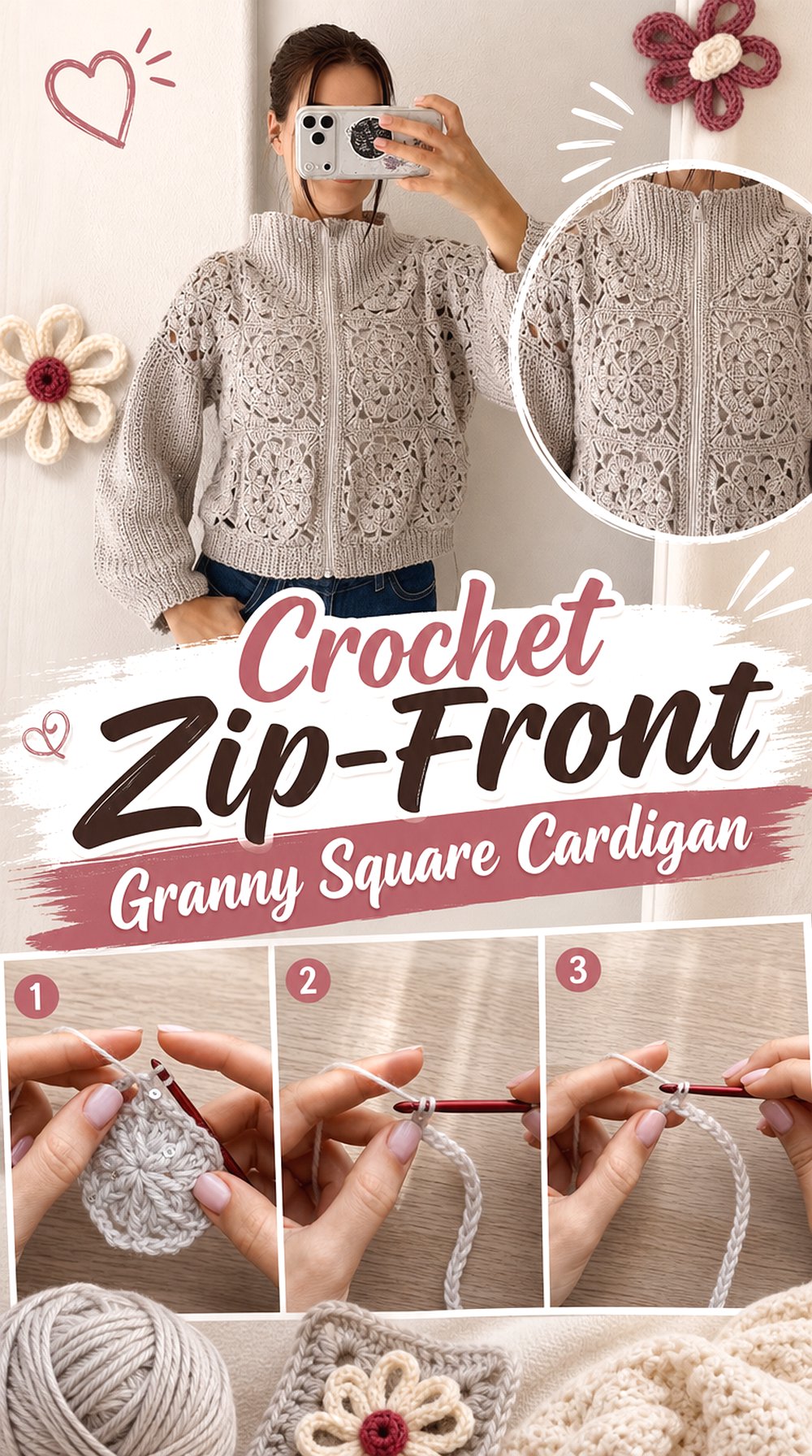
A zipper changes the character of a granny-square cardigan immediately. Instead of a loose open front, you get a cardigan that can close completely and function more like a casual crochet jacket. Nora Moon’s tutorial demonstrates a granny-square cardigan with a zipper and also notes buttons as an alternative closure.
For autumn styling, this construction works well with a controlled patch palette—think olive, cream, rust, brown, and charcoal—because the zipper already adds a strong vertical line. This idea is especially worth considering if open cardigan fronts tend to shift while you wear them or if you simply prefer a more defined center opening.
A Zipper Needs Two Stable Front Edges
A zipper can expose unevenness that is easy to overlook on an open cardigan. Before attaching any closure, compare the two front edges with the garment laid flat and confirm they are the same usable length.
If your yarn or tension created wavy edges, address that before installation rather than expecting the zipper to straighten the crochet. For adaptations, also check that your chosen zipper length suits the actual finished cardigan, not the planned measurement from before blocking.
Patch Placement Frames the Center Opening
Because the zipper creates a visual divide, the squares immediately beside it become especially noticeable. Decide whether you want those patches mirrored, alternating, or deliberately mismatched.
For a quieter autumn jacket, repeating the same border color along both fronts can tie the zipper into the design. For a stronger patchwork look, use contrasting adjacent squares but keep their finished dimensions consistent so the closure does not twist.
Decide Between Zipper and Buttons Before Final Edging
The tutorial presents zipper or button closure options, but those closures do not make identical demands on the front edge.
If you are adapting the design, choose your closure early enough that the front finishing supports it. Buttons need suitable placement and buttonholes; a zipper benefits from stable, even edges. Treat the closure as part of the cardigan structure rather than a decorative item added after every other decision has been made.
Creator: Nora Moon – handmade clothes with love
5. Crochet Hooded Granny Patchwork Cardigan

Adding a hood gives a granny-square cardigan a noticeably more casual, jacket-like silhouette. LaDenser Crochets has a dedicated tutorial for a granny-square patchwork cardigan with a hood, making this a clearer reference than trying to add a hood to an unrelated cardigan after the fact.
This format suits earthy autumn colors particularly well because the hood provides another large area for continuing—or deliberately simplifying—the patch arrangement. It also changes how the cardigan hangs. Extra crochet fabric at the back neckline can affect balance, so this option deserves more attention around the shoulders than a basic open-front square cardigan.
The Hood Adds Weight at the Back Neck
Hoods are not visually or structurally neutral. The extra fabric hangs from the neckline even when the hood is not being worn.
When substituting yarn, avoid judging only by softness or color. Compare the weight and density of your swatch with the tutorial fabric, especially if you plan to lengthen the cardigan too. A heavier body combined with a heavy hood can create a different shoulder feel from the original project.
Continue the Patch Grid—or Give the Hood a Break
You do not have to treat the hood as another busy patchwork panel. Continuing the same motifs creates a fully integrated look, while a mostly solid hood can give the eye a resting point.
For an autumn palette containing several strong shades, a quieter hood may help the front and sleeves remain the focus. Decide this before making your entire motif batch so you do not end up with an unsuitable mix of squares.
Check the Neckline Before Committing to Hood Size
The hood attaches around an area already shaped by the two fronts and back neckline. If you change the body layout, square dimensions, or edging substantially, confirm that the resulting neckline still suits the hood construction shown in the tutorial.
This checkpoint is more useful than assuming a hood can simply be scaled by adding extra patches. A hood needs to sit comfortably when down and have enough space for its intended use when raised.
Creator: LaDenser Crochets
6. Crochet Chunky Granny Patch Cardigan

Chunky patchwork creates a different visual scale from a cardigan made from finer motifs. Emma Warrender’s tutorial specifically presents a chunky granny-square patchwork cardigan and notes that the cardigan concept can be made with different granny-square styles.
That makes this idea useful when you want bold patches and substantial texture rather than a delicate grid. For fall, larger areas of pumpkin, moss, cream, brown, mustard, or burgundy can read almost like quilt blocks. The trade-off is that thick yarn and chunky seams can produce a more substantial garment, so shape and fit deserve attention before you enlarge the project for an extra-oversized look.
Chunky Yarn Magnifies Every Patch
A small number of large, thick squares can dominate the silhouette more than many finer motifs. Test one completed patch against your torso or an existing sweater to understand the scale before repeating it.
If the square already spans a large portion of the shoulder or body, even a one-round size change may have a noticeable effect once several patches are joined. Base layout decisions on the actual finished motif rather than the number of rounds alone.
Give Bulky Seams Room to Settle
Joining thick crochet fabric can create pronounced ridges depending on the method used. Before assembling the whole cardigan, join two sample patches and inspect the seam from both sides.
If the seam feels unusually rigid compared with the patch fabric, verify that you are following the intended joining approach and tension. This matters especially around the underarm, shoulder, and cuff, where multiple layers or intersections may meet.
Bigger Patches Reward Simpler Color Planning
Chunky squares already create strong visual blocks, so a limited autumn palette can be enough. Consider repeating three or four main shades instead of trying to include every scrap in the stash.
Lay the largest contrast areas where you want attention. A bright mustard patch at the shoulder will have more visual impact in a chunky layout than the same color appearing as a narrow round in a small traditional granny square.
Creator: Emma Warrender
7. Crochet Closed Front Patchwork Pullover Sweater

Not every patchwork sweater needs a cardigan opening. Cherilyn Q’s tutorial focuses on a patchwork pullover, giving this idea a continuous closed front and a different balance from the open cardigans elsewhere in the list.
A pullover lets the front patch layout read as one uninterrupted composition, which is useful if you want an autumn color story that travels across the chest rather than being divided by button bands or a zipper. It is also a good format for using rectangular blocks or solid crochet patches where the geometry resembles a quilt more than a traditional granny-square garment.
The Neck Opening Becomes a Fit Checkpoint
With no center opening, the neckline must work as part of the pullover itself. If you alter the body width or patch dimensions, do not automatically scale the neck opening by the same amount.
Before finishing the neckline, compare the opening with a sweater you find comfortable and review the tutorial’s construction. It should accommodate dressing comfortably while still giving the shape you want when worn.
Use the Front Panel as One Color Composition
A continuous pullover front is ideal for deliberate asymmetry. You might place a dark chocolate section low on one side, move through rust and camel, and bring a lighter cream patch toward the opposite shoulder.
Photograph the layout before joining or changing colors. This helps preserve the planned distribution and makes it easier to check that sleeves do not accidentally repeat the same sequence in a way that feels overly uniform.
Pullover Drape Matters Across the Whole Torso
Because there is no open front to release the fabric, the completed panel needs to hang comfortably across the chest and waist. A very stiff patchwork fabric may create a boxier look; softer fabric will settle closer to the body.
Neither is automatically wrong. Decide which silhouette you want, then use the tutorial’s fabric as the reference when choosing yarn rather than substituting purely because two yarns share a similar color.
Creator: Cherilyn Q
8. Crochet Four Square Granny Sweater

Fiber Flux takes the granny-square sweater idea in a much larger-scale direction with a pullover built around four granny squares. The tutorial’s finished result shows how a small number of large motifs can create a sweater rather than assembling a grid of many small patches.
This approach can be appealing if you enjoy color changes but do not want dozens of separate motifs to organize. Each square becomes a major design surface, so an autumn palette can be developed gradually through rings of cream, rust, mustard, burgundy, brown, and olive rather than through many independent squares.
Four Large Motifs Make Color Order More Visible
When a granny square grows large, each new round contributes to a broad concentric composition. Color order therefore has more influence on the finished garment than it would in a pile of small motifs.
Make a rough sequence before starting. If a dark shade is repeated at the same point in every large square, it may create strong bands across the finished sweater. Alternating the order can produce more variation while preserving the same limited palette.
Large Squares Reduce Layout Decisions but Raise Scale Stakes
Fewer motifs mean fewer individual pieces to arrange, but each motif has a much larger effect on fit. Check the square against the intended body area as it grows rather than relying on a planned round count.
Once a large square is significantly too wide or too long for the construction, correcting the proportion can be more disruptive than adjusting a small patch in a conventional grid.
Keep the Granny Fabric Consistent Across All Four Pieces
Large open motifs reveal tension differences clearly. Compare the squares periodically rather than finishing all four independently and discovering at assembly that one relaxed more than the others.
Use the same blocking method for the matching pieces and measure the outside edges after they have settled. The goal is not merely identical round counts, but compatible finished dimensions.
Creator: Fiber Flux
9. Crochet Cropped Granny Patchwork Sweater

A cropped patchwork sweater concentrates the motif work into a shorter silhouette. Gabrielle Ariana’s tutorial is specifically for a cropped granny-square sweater, giving readers a clearer reference than shortening a full-length sweater without knowing how that change will affect the overall proportions.
This format works well when you want patchwork to sit above high-waisted jeans, skirts, or layered dresses during mild autumn weather. Cropping also changes the visual ratio between body and sleeves: full-length sleeves can become a stronger feature when the torso ends sooner, so sleeve colors and width deserve as much planning as the front panel.
Decide the Hem Position From a Garment You Already Wear
“Cropped” can mean very different lengths. Rather than choosing the hem based on the tutorial image alone, measure a sweater or top whose length you already like and compare that with the construction you plan to follow.
If the tutorial’s patch arrangement produces a different length, determine whether altering motif dimensions would also affect width. Sometimes changing the number or placement of sections is more practical than scaling every square.
Sleeve Proportion Becomes More Noticeable
A short body paired with roomy sleeves creates a strong silhouette. If your autumn yarn is heavy or particularly stretchy, sleeves may relax differently after wear than the cropped torso.
Check sleeve length before final cuffs and after the fabric has been allowed to settle. If you modify the tutorial, remember that cuff depth also contributes to the finished sleeve length.
Put the Strongest Motifs Where They Will Remain Visible
A cropped sweater may be partly covered by a coat or high-waisted bottom, so decide which patch areas you most want to feature. Contrasting squares near the chest, shoulders, or upper sleeves are more likely to remain visible than a subtle motif placed directly at the hem.
This is particularly useful with a fall palette where several browns or earthy shades can otherwise blend together.
Creator: Gabrielle Ariana
10. Crochet Cozy Oversized Granny Patchwork Pullover
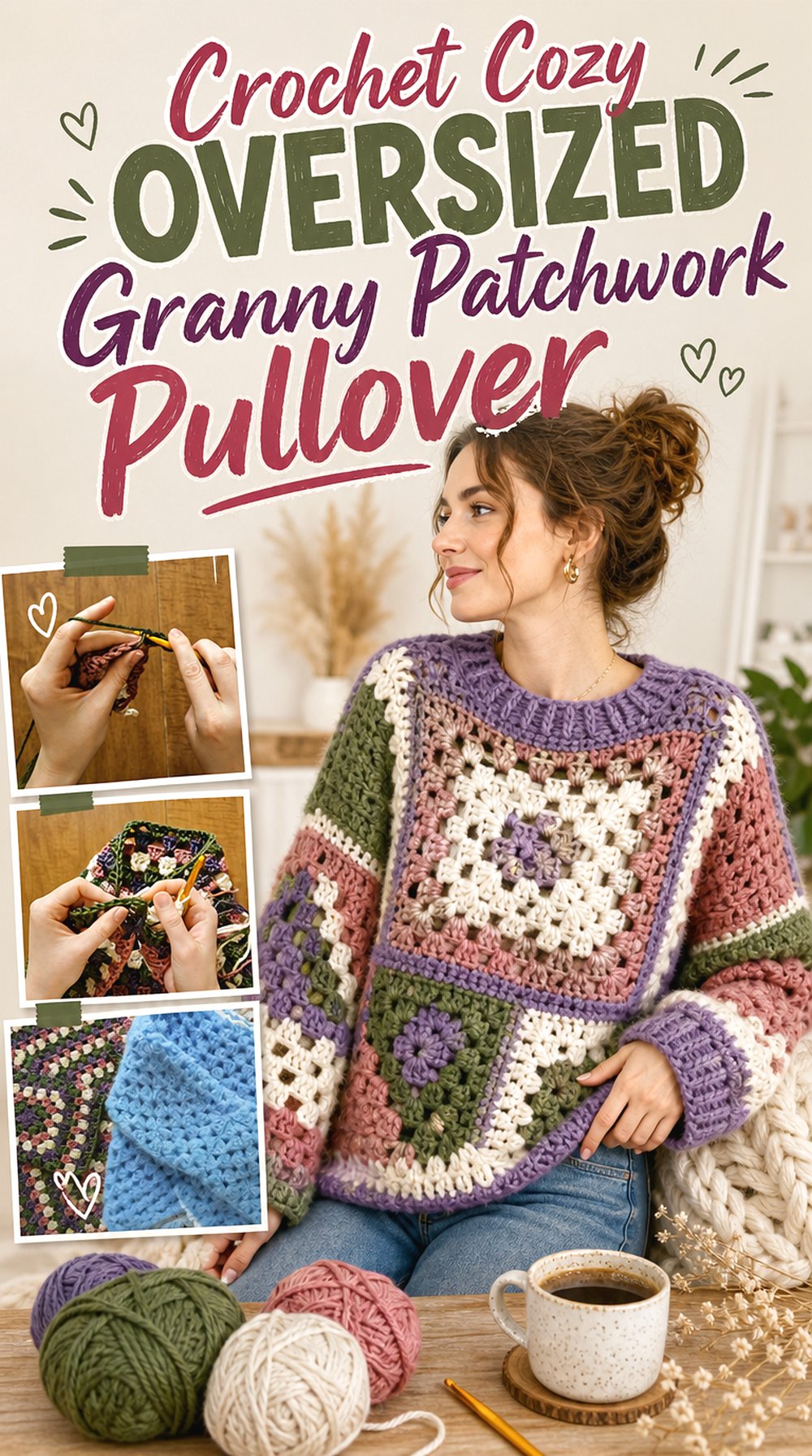
HayHay Crochet’s cozy granny-square sweater offers another closed-front option, but its design is notably different from a uniform grid of equal little squares. The supporting pattern shows larger granny sections through the main body with separate sleeve motifs, creating a broad, relaxed pullover composition.
That larger-scale arrangement gives autumn colors room to spread rather than breaking them into tiny fragments. A moss-and-cream body with rust, plum, or brown carried through the sleeves could keep the sweater seasonal without becoming visually crowded. Because the tutorial is presented as highly customizable, use your own fabric and fit checks rather than assuming every yarn substitution will hang the same way.
Large Body Motifs Create a Strong Drop-Shoulder Look
When the main body is built from broad granny sections, the relationship between body width and shoulder placement becomes especially visible. Hold or pin the developing fabric against your torso to see where the shoulder line is likely to fall.
If you want less drop at the shoulder, simply making everything smaller may also shorten the sweater. Compare width and length separately before deciding how to adapt the motif.
Sleeve Squares Can Carry the Busier Colors
A large front motif already makes a strong statement, so the sleeves are a good place to concentrate smaller color changes. This can create autumn variety without disrupting the body with too many competing sections.
Repeat at least one body color in the sleeves to connect the pieces visually. If every sleeve square introduces a completely new shade, the arms may appear unrelated to the torso once assembled.
Open Granny Fabric Benefits From Layering Plans
Classic granny construction creates visible spaces in the fabric. Decide whether you intend to wear the sweater over a tee, camisole, long-sleeve top, or another layer before choosing how airy you want your version to be.
Changing yarn or hook size solely to close the gaps can also alter drape and dimensions. If more coverage is important, choose a tutorial or motif structure that naturally gives the fabric you prefer rather than forcing a major gauge change.
Creator: HayHay Crochet
11. Crochet Cropped Turtleneck Granny Patchwork Sweater
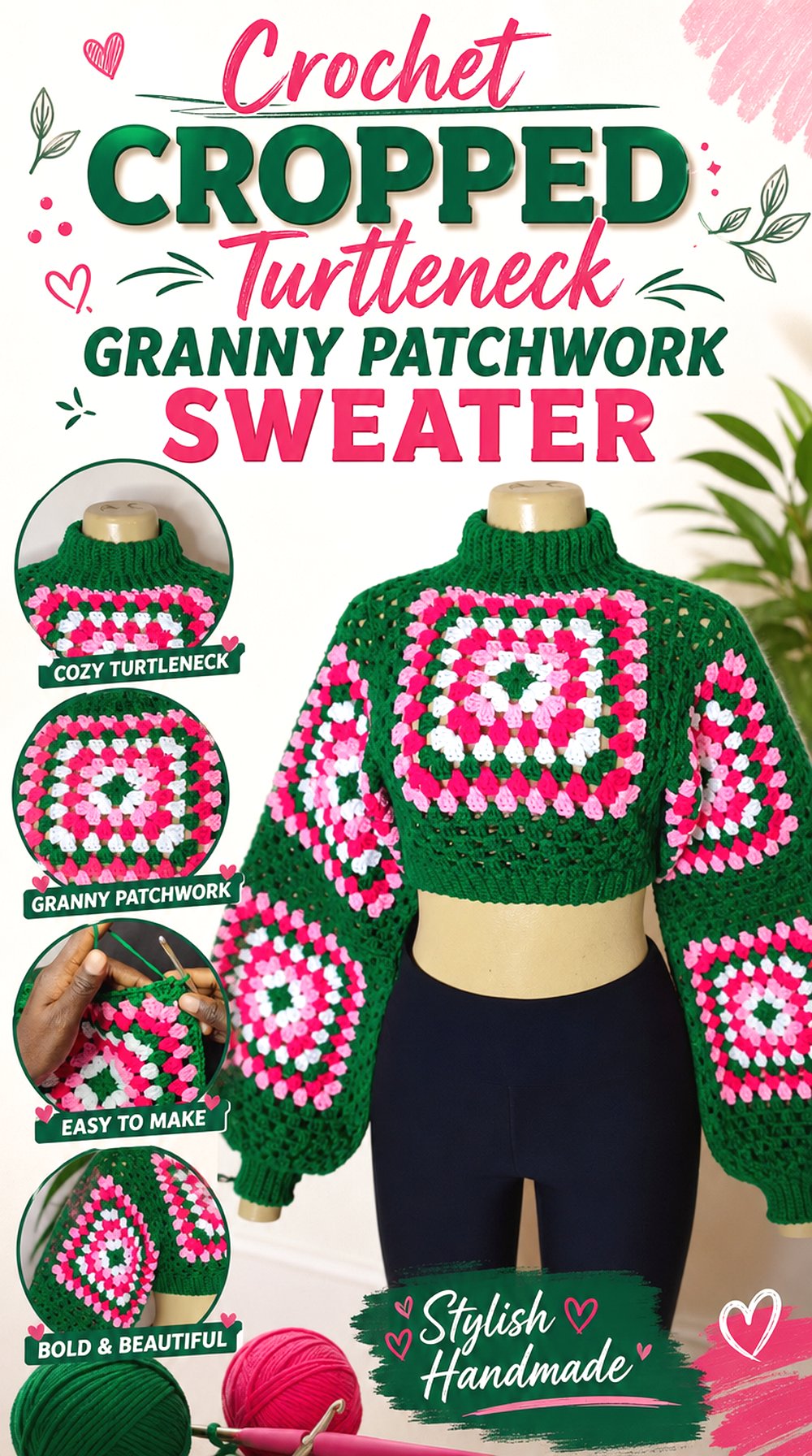
A turtleneck turns a cropped granny-square sweater into a much more autumn-specific silhouette. Ascarcrochets’ tutorial combines a cropped granny-square sweater with a turtleneck, giving this idea a closed neck as well as a shorter body.
That contrast can be visually effective: the torso remains compact while the neckline adds coverage and height. For color planning, the turtleneck can either continue the patch colors or become a solid framing shade such as espresso, cream, burgundy, or olive. Because the neck sits directly against the skin, fiber feel deserves more attention here than it might on an open cardigan worn over another layer.
Neck Comfort Is More Important Than a Perfect Color Match
A yarn that feels acceptable on a cardigan body may feel less comfortable around the neck. If you substitute yarn, test a swatch directly against the skin before committing to a deep collar.
Also check stretch. The turtleneck must work with the tutorial’s neckline construction and still allow the sweater to be put on comfortably. Do not tighten the collar simply because you prefer a more fitted appearance.
A Solid Collar Can Anchor Busy Granny Squares
If your body and sleeves contain many autumn shades, continuing every color into the turtleneck can make the upper portion visually dense. Using one repeated dark or neutral shade at the neck can frame the face and link to cuffs or hem.
Try placing the yarn skeins beside the completed torso before choosing the collar color. This gives a more accurate impression than selecting the shade at the beginning of the project.
Cropped Length and High Neck Create Opposing Proportions
The short torso draws the eye upward while the taller neckline extends the sweater vertically. Keep that proportion in mind when deciding sleeve volume and patch size.
If you lengthen the body substantially, the sweater may read more like a conventional turtleneck pullover. If maintaining the cropped effect matters, establish the preferred hem position before modifying the motif layout.
Creator: Ascarcrochets
12. Crochet Bold Block Patchwork Cardigan

For a patchwork look that feels more like a crocheted quilt than a traditional floral-granny garment, Dexterous Dorothy’s cardigan tutorial is a useful reference. The creator describes the project as a patchwork cardigan inspired by the well-known Harry Styles cardigan, giving it a block-based, high-contrast direction rather than relying on one repeated classic granny motif.
An autumn adaptation could replace brighter colors with burnt orange, forest green, mustard, cream, burgundy, chocolate, and muted blue. Because block patchwork can mix several visual textures or color treatments, decide whether the overall sweater should feel deliberately irregular or organized around a repeating palette.
Treat Each Block Like Part of a Quilt
Bold patchwork becomes easier to control when you stop judging individual squares in isolation. Lay sections together and look for balance in color value, texture, and visual weight.
If one patch is dramatically darker or more detailed than the others, avoid accidentally placing several equally dominant blocks in the same area. A quick phone photo of the full arrangement often makes uneven distribution easier to notice.
Keep Patch Dimensions Compatible Despite Visual Variety
Different-looking blocks still need to meet cleanly at their edges. If you adapt the design by introducing another stitch texture or motif, make a sample and compare its blocked dimensions with the existing patch.
Do not rely on the same starting chain or stitch count to guarantee the same final measurement. Different stitch structures can produce different widths, heights, and stretch.
Ribbing Can Turn Eclectic Blocks Into One Garment
A consistent cuff, hem, and front band can visually contain a highly varied patchwork layout. Choose the framing color after you have arranged the major blocks rather than automatically using whichever yarn you have most of.
Dark brown, cream, charcoal, or another repeated sweater color can work as a frame. The key is to see the edging as part of the composition, not only as functional finishing.
Creator: Dexterous Dorothy
13. Crochet Heart Patchwork Cardigan
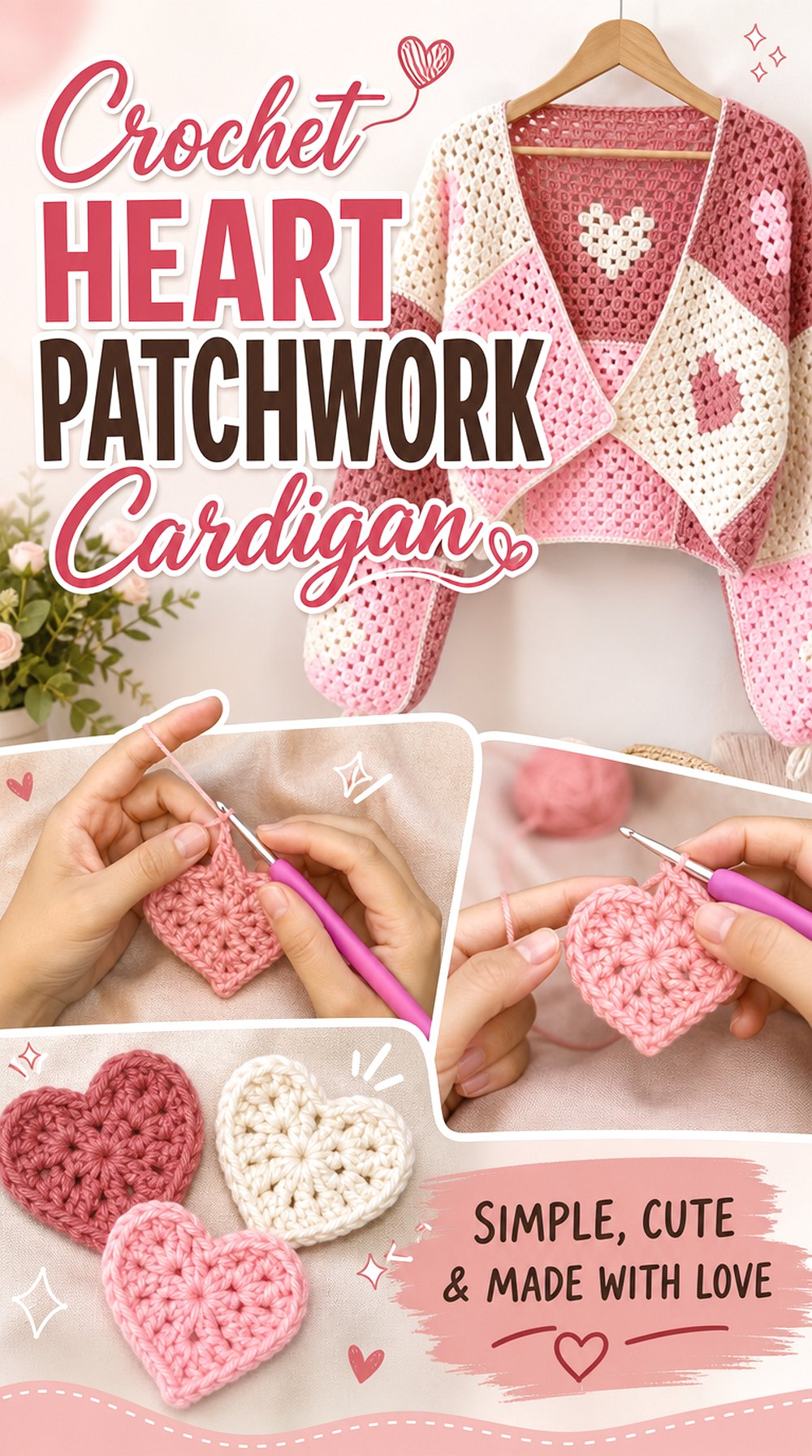
Heart motifs give the final sweater a recognizable graphic element while still preserving the repeated-block logic of patchwork. Hexa Crochet’s tutorial is specifically for a heart patchwork crochet cardigan, so the motif is part of the garment design rather than an appliqué added afterward.
For autumn, hearts do not have to be pink or red. Try rust against cream, mustard against brown, burgundy against oatmeal, or olive against camel for a softer seasonal interpretation. Because a heart has a clear top and bottom, this project also introduces a layout concern that does not exist with many rotationally symmetrical granny squares: every patch needs to face the intended direction before joining.
Directional Hearts Make Layout Mistakes More Visible
Arrange all heart blocks right side up before beginning permanent assembly. Check the front, back, and sleeves separately, then check the garment as one composition.
If you intentionally rotate any hearts, make the repetition obvious enough that it reads as a design choice. One accidentally inverted motif in an otherwise consistent layout will attract more attention than a similar rotation in a plain granny square.
Give the Motif Enough Contrast to Read
A heart can disappear into its background when the two yarn colors have similar values. If a recognizable motif is the reason you chose this sweater, crochet one complete sample and view it from several feet away.
For softer autumn colors, contrast does not have to be extreme. Cream against caramel or rust against deep brown can remain seasonal while providing enough separation for the heart shape to stay visible.
Keep Statement Patches Away From Crowded Intersections
Motif placement near underarms, heavy seams, or areas that fold frequently may make a graphic less visible. Decide which hearts you most want to showcase and place them on flatter, more prominent sections of the garment where the tutorial layout allows.
The front upper body, upper back, and outer sleeves generally provide clearer viewing surfaces than tightly folded areas. Use the creator’s garment construction as the boundary for any layout changes rather than altering structural pieces casually.
Creator: Hexa Crochet
Which Autumn Patchwork Sweater Style Should You Choose?
Choose the oversized monochrome or brown checkerboard cardigan if you want autumn color without a highly decorative motif. The sunflower and heart designs make the patches themselves the focal point, while the zip-front and hooded cardigans add practical garment features that change the finished structure.
For fewer, larger visual sections, the four-square and cozy oversized granny pullovers avoid the look of a dense small-square grid. The cropped sweater emphasizes proportion and sleeves, while the cropped turtleneck adds more neck coverage. If you want a traditional quilt-like patchwork effect rather than repeated granny motifs, the bold block cardigan or closed-front patchwork pullover is the more natural direction.
Conclusion
The right crochet autumn patchwork sweater depends on more than the prettiest color combination. Start with the silhouette you will actually wear: an open oversized cardigan for layering, a closed pullover for uninterrupted patchwork, a cropped shape for a shorter proportion, or a hooded, zipped, or turtleneck version when those details matter to you.
Then compare patch scale. Small repeated motifs create a busier grid, while large granny sections and chunky blocks make each color choice more prominent. Floral and heart designs add another layer of layout planning because the motif itself needs visual balance. Once you have chosen the structure, use the original tutorials for exact construction details and verify measurements, yarn requirements, and finishing before beginning.
Frequently Asked Questions
What yarn colors work well for a crochet autumn patchwork sweater?
Autumn palettes can include rust, caramel, mustard, brown, cream, olive, burgundy, charcoal, muted plum, and deep red, but you do not need all of them in one sweater. A smaller palette often makes the patchwork easier to read. Compare both hue and value: if several yarns are equally dark or equally light, their boundaries may become less noticeable once crocheted. Repeating one neutral through borders, cuffs, or ribbing can also connect otherwise varied patches.
Should I block granny squares before planning the sweater layout?
Blocking representative motifs before committing to the entire garment is useful because the finished outer dimensions determine how the squares will combine into panels. If several motifs are already complete, compare them on a flat surface before joining. Correcting inconsistent square sizes early is generally easier than trying to flatten a wavy panel afterward. Follow the tutorial and the yarn’s care guidance when choosing an appropriate blocking method.
Can I substitute a different granny square in a patchwork sweater tutorial?
Possibly, but appearance is not the only issue. The replacement motif needs compatible blocked dimensions, fabric thickness, stretch, and suitable edge structure for the joining method. Emma Warrender’s patchwork cardigan tutorial, for example, explicitly presents different granny-square styles as an option. For other tutorials, make and block one substitute square first and compare it directly with the project’s intended patch before producing a full set.
How do I make a patchwork sweater look autumnal without making it too busy?
Choose one design feature to dominate. If the sweater contains sunflower or heart motifs, keep the surrounding palette relatively controlled. If the patches are plain, you can use a wider range of autumn colors. Repeating a background, border, or ribbing shade creates continuity. It also helps to arrange all patches before joining and photograph them from a distance, where uneven concentrations of bright or dark colors are easier to spot.
What is the biggest fit mistake to avoid with granny-square sweaters?
Do not assume that a square that is only slightly larger or smaller than the tutorial motif will make only a slight difference to the garment. That difference is multiplied across every motif in a panel. Check blocked motif dimensions, panel width, shoulder placement, intended ease, sleeve length, and neckline before final joining. Standard crochet sweater guidance likewise emphasizes body measurements, gauge, and checking fit during construction.
Are open granny-square sweaters warm enough for autumn?
That depends on the motif density, yarn, weather, and how you plan to wear the sweater. Traditional granny fabric can contain noticeable openings, so many designs work naturally as layering pieces. A tee, fitted long-sleeve top, or turtleneck underneath can provide additional coverage without changing the crochet. If you want a denser main layer, consider the solid-block patchwork, checkerboard, or other less-open constructions in this collection instead of tightening a granny-square pattern beyond its intended fabric.


