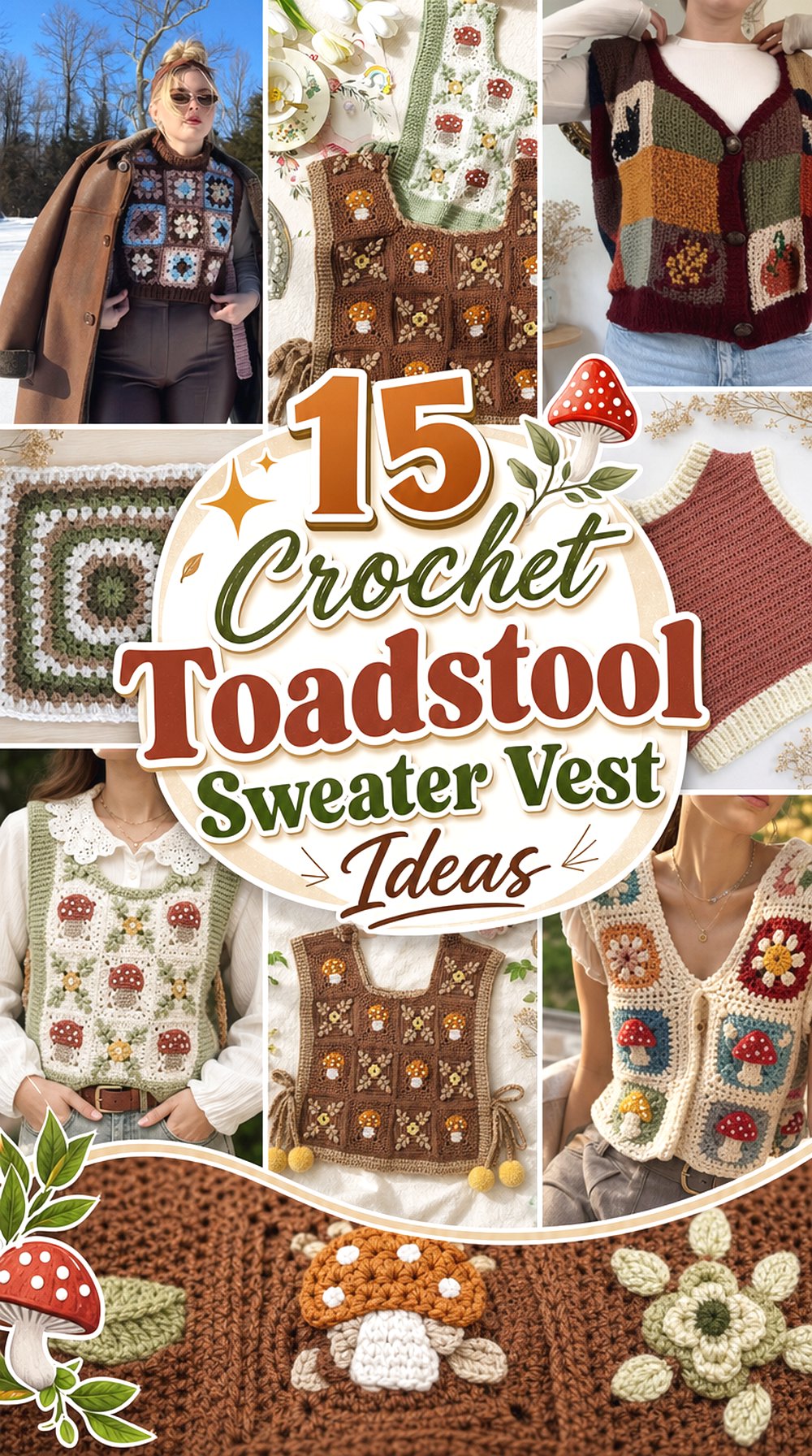
15 Crochet Toadstool Sweater Vest Ideas
A crochet toadstool sweater vest can range from a full mushroom-motif patchwork garment to a quiet everyday vest with one carefully placed woodland detail. The biggest differences are not just color. Neckline, side construction, square layout, garment length, pockets, ties, and motif density all affect how the finished vest looks and layers.
The tutorial collection below reflects that range. Susan’s Family provides a direct mushroom patchwork vest tutorial, while the other videos teach distinct vest constructions that can serve as bases for a compatible toadstool motif, appliqué, colorwork idea, or granny-square substitution. The goal is to help you choose a garment structure first, then plan mushroom placement without guessing about fit or disguising an adaptation as an exact tutorial match.
Quick List
- Crochet Side-Tie Toadstool Patchwork Sweater Vest
- Crochet Vintage Toadstool Patchwork Button Vest
- Crochet V-Neck Statement Toadstool Sweater Vest
- Crochet Checker-Patch Toadstool Sweater Vest
- Crochet Woodland Tie-Up Toadstool Vest
- Crochet Toadstool Pocket Sleeveless Cardigan Vest
- Crochet Textured Meadow Toadstool Sweater Vest
- Crochet Giant Back-Motif Toadstool Sweater Vest
- Crochet Toadstool Hem-Band Sweater Vest
- Crochet Cropped Checker Toadstool Sweater Vest
- Crochet Hooded Forest Toadstool Vest
- Crochet Front-Tie Toadstool Border Vest
- Crochet Oversized Gothic Toadstool Checker Vest
- Crochet 1970s Toadstool Granny Square Vest
- Crochet Mixed-Motif Toadstool Granny Square Sweater Vest
Plan the Toadstool Motif Before You Plan the Vest
A mushroom detail can be built into a square, added as surface decoration, incorporated through color changes, or attached later as an appliqué. Those approaches are not interchangeable. A built-in motif affects the dimensions and density of the fabric itself, while an added motif can increase thickness only where it is attached.
For granny-square or patchwork garments, compare the blocked dimensions of a mushroom square with every filler square before deciding the layout. Even a small mismatch multiplies across several joined motifs. For a solid vest, decide where the mushroom belongs before assembling the garment. Large motifs usually need uninterrupted fabric, while smaller mushrooms can work along hems, pockets, shoulders, or borders. Treat the garment and the decoration as one composition instead of finishing the vest and hoping there is enough space afterward.
Fit, Yarn Weight, and Motif Density Work Together
Sweater vest fit depends on more than bust width. Shoulder width, armhole depth, garment length, neckline shape, intended ease, and the stretch of the fabric all affect how comfortably the vest layers. A heavy motif arrangement can also change how a garment hangs, especially when many dense squares or sewn decorations are concentrated in one area.
When adapting a tutorial, keep the original garment measurements or sizing method as your primary reference. If you change yarn weight, stitch density, or square design, recheck the resulting fabric rather than assuming the original dimensions will remain unchanged. Softer fabric generally emphasizes drape; denser fabric emphasizes structure. Neither is automatically better for a toadstool vest. The useful question is whether you want a fluid layering piece, a substantial patchwork garment, or something between those two.
Choose Between Statement Mushrooms and Repeated Woodland Motifs
A single oversized toadstool creates a focal point and works especially well on plain front or back panels. Repeated mushrooms create more obvious cottagecore or woodland styling, but they also introduce more color changes, joins, ends, and visual density.
For a wearable, repetition needs a stopping point. One practical approach is to designate a few “feature zones”—such as the lower front, one back panel, pockets, or alternate granny squares—and allow the remaining fabric to stay simpler. That gives the mushroom shapes room to read clearly from a distance.
If you are combining an independently sourced mushroom motif with one of the vest tutorials below, make a sample first. Confirm its blocked scale, flexibility, and compatibility with the garment fabric before committing to a full layout.
1. Crochet Side Tie Toadstool Patchwork Sweater Vest
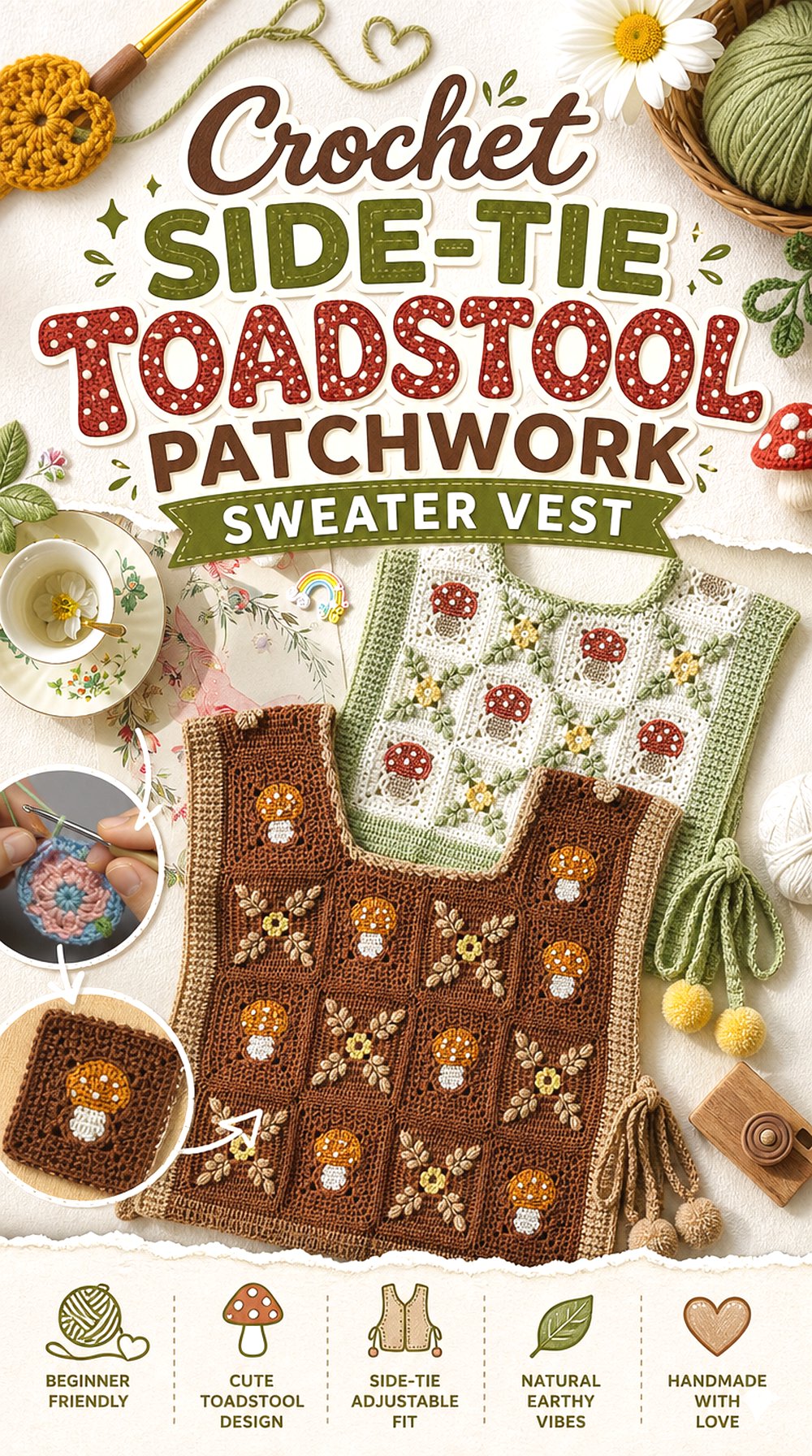
This is the closest direct match to the toadstool sweater vest theme. Susan’s Family’s vest uses mushroom and floral motifs to create separate front and back pieces, with ties joining the sides rather than completely closed side seams. That construction makes the motif layout a major part of the finished silhouette instead of a small decorative afterthought.
For a classic woodland interpretation, let red-capped mushrooms carry the focal areas and use quieter floral or geometric fillers between them. The open sides also make this direction visually lighter than an equally dense fully seamed patchwork vest.
Side Ties Make Fit More Flexible
A side-tie structure gives you another fit variable besides panel width. The gap between the front and back pieces and the way the ties are secured both affect how closely the vest sits over a blouse, dress, or lightweight sweater.
That does not remove the need to measure the panels. Confirm that each panel gives the coverage you want before relying on the ties to compensate for a piece that is too narrow.
Keep Mushroom Motifs Aligned Across Both Panels
A patchwork garment looks more intentional when the front and back feel related. Before joining anything, arrange all completed motifs flat and check their direction. Upright toadstools can look unexpectedly rotated once squares move from a tabletop grid onto shoulders and side areas.
Photographing the planned arrangement is a simple way to preserve the layout while the motifs are being joined.
Use Filler Motifs to Control Visual Weight
Not every square needs to contain a mushroom. Plain, floral, or lower-contrast motifs give the eye a place to rest and can also reduce the amount of dense colorwork concentrated on the garment.
If your toadstool square is noticeably heavier than the filler design, distribute those heavier squares rather than clustering all of them on one side.
Creator: Susan’s Family 蘇蘇姐家
2. Crochet Vintage Toadstool Patchwork Button Vest2.
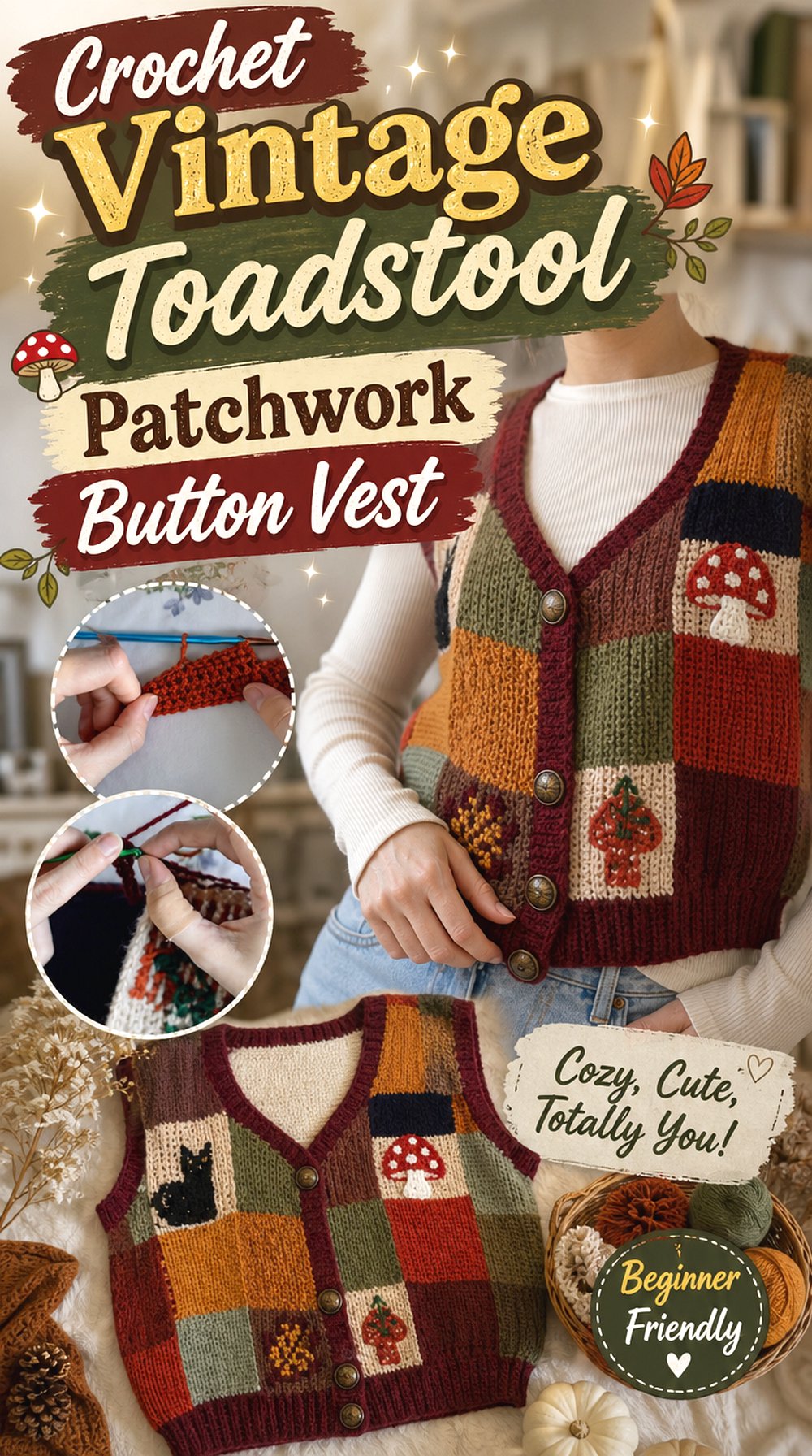
A vintage patchwork vest gives the toadstool theme a more structured, old-fashioned wardrobe feel. The thisfairymade tutorial demonstrates a grandma-style patchwork sweater vest and includes discussion of measurements, square planning, joining, ribbing, buttonholes, and decorative cross-stitch elements.
Instead of reproducing the tutorial’s pumpkin theme, use the construction as a framework for a separate compatible mushroom graphic. Small cross-stitch-style toadstools scattered across selected solid patches could keep the garment readable while preserving the patchwork character. This route suits readers who want woodland imagery without making every square a full crochet mushroom motif.
Cross-Stitch Motifs Need a Calm Background
Surface decoration shows most clearly when the underlying crochet fabric does not already contain several competing colors. Reserve a few comparatively plain patches for mushroom graphics and let neighboring patches provide the pattern and color variation.
Before decorating, check how much the base fabric stretches. A design placed on fabric under tension may look different when the vest is worn.
Button Placement Changes the Front Balance
When a vest has a visible front opening, the closure becomes part of the composition. Avoid placing two detailed mushrooms directly against a button band unless you intentionally want the center to feel very busy.
Lay the finished front sections side by side before adding decoration so the left and right motifs relate to the opening rather than appearing randomly positioned.
Patch Dimensions Must Stay Consistent
Switching from a simple square to a square carrying colorwork or surface stitching can alter its behavior. Block and compare your patches before permanent joining.
If one design repeatedly finishes larger or smaller, solve that mismatch at the motif stage rather than forcing it into the garment and creating rippled seams.
Creator: thisfairymade
3. Crochet V Neck Statement Toadstool Sweater Vest
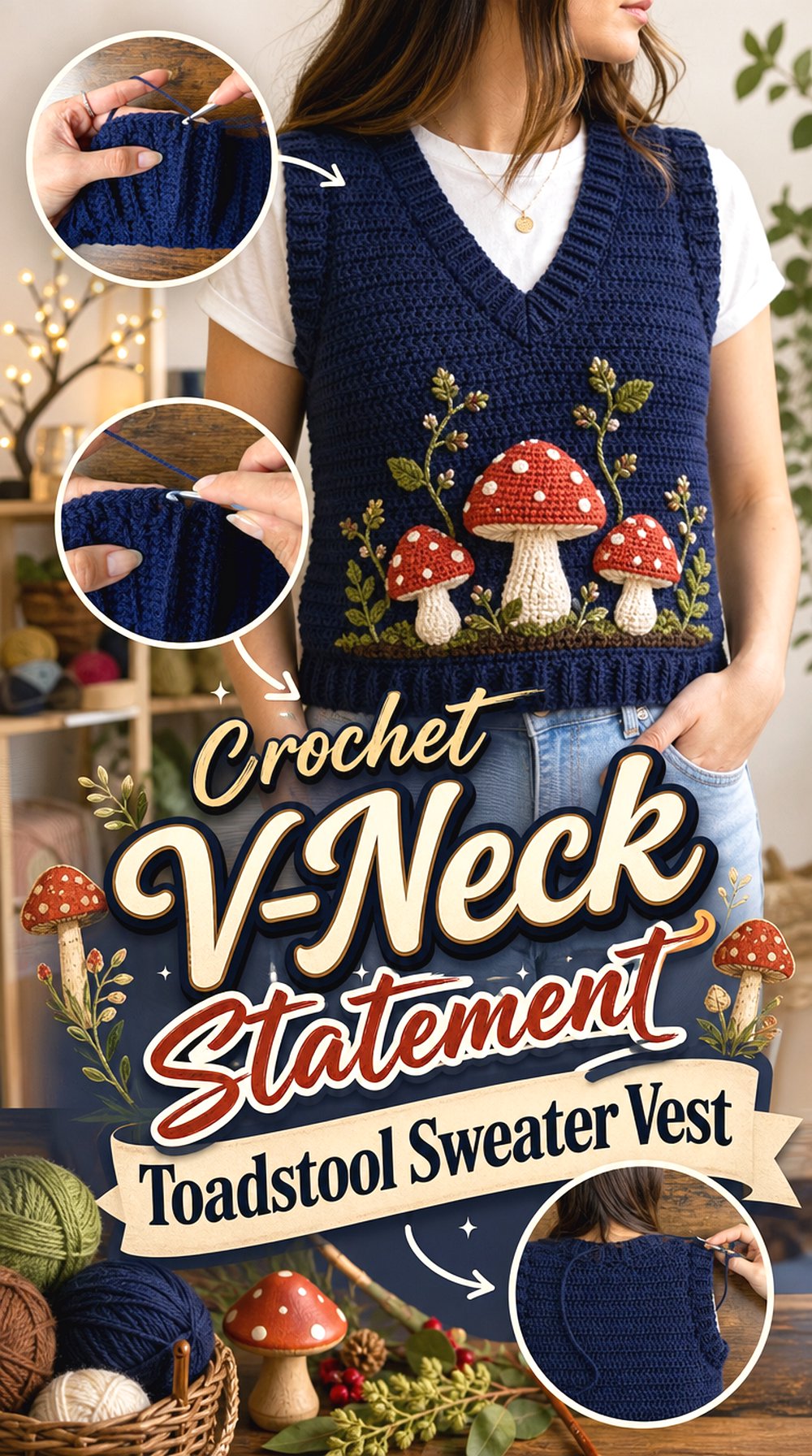
A plain V-neck vest is a strong choice when you want one mushroom to become the unmistakable focal point. VivCrochets’ tutorial teaches a classic V-neck sweater vest rather than a mushroom garment, providing a comparatively quiet base for an independent toadstool design.
One large motif centered on the lower front can create a storybook look without turning the whole garment into patchwork. Another option is to leave the front plain and position a statement mushroom on the back. Either way, preserve enough empty fabric around the motif so its cap and stem remain recognizable.
Center the Toadstool Below the V, Not Inside It
The V-neck already creates a strong visual line. A large mushroom pushed too close to that shaping can make the upper front look crowded and may interfere with neckline finishing.
Instead, temporarily mark the finished neckline area and position the motif lower on the body panel. View the full panel from several feet away before attaching anything.
A Plain Back Keeps the Front Motif Dominant
If the mushroom is large and detailed on the front, repeating another equally dominant motif on the back can make the vest feel heavier visually.
Use the reverse approach when you want surprise detail: keep the front nearly solid, then reserve the large mushroom for the back panel. The vest construction works with either composition.
Test Neckline Depth Before Adding Decoration
Garment fit should be settled before decorative placement. Try on or temporarily assemble the vest according to the tutorial’s fitting process, then assess where the V actually falls on your body.
A motif planned from a flat schematic alone can end up sitting higher or lower than expected once the fabric is worn.
Creator: VivCrochets
4. Crochet Checker Patch Toadstool Sweater Vest
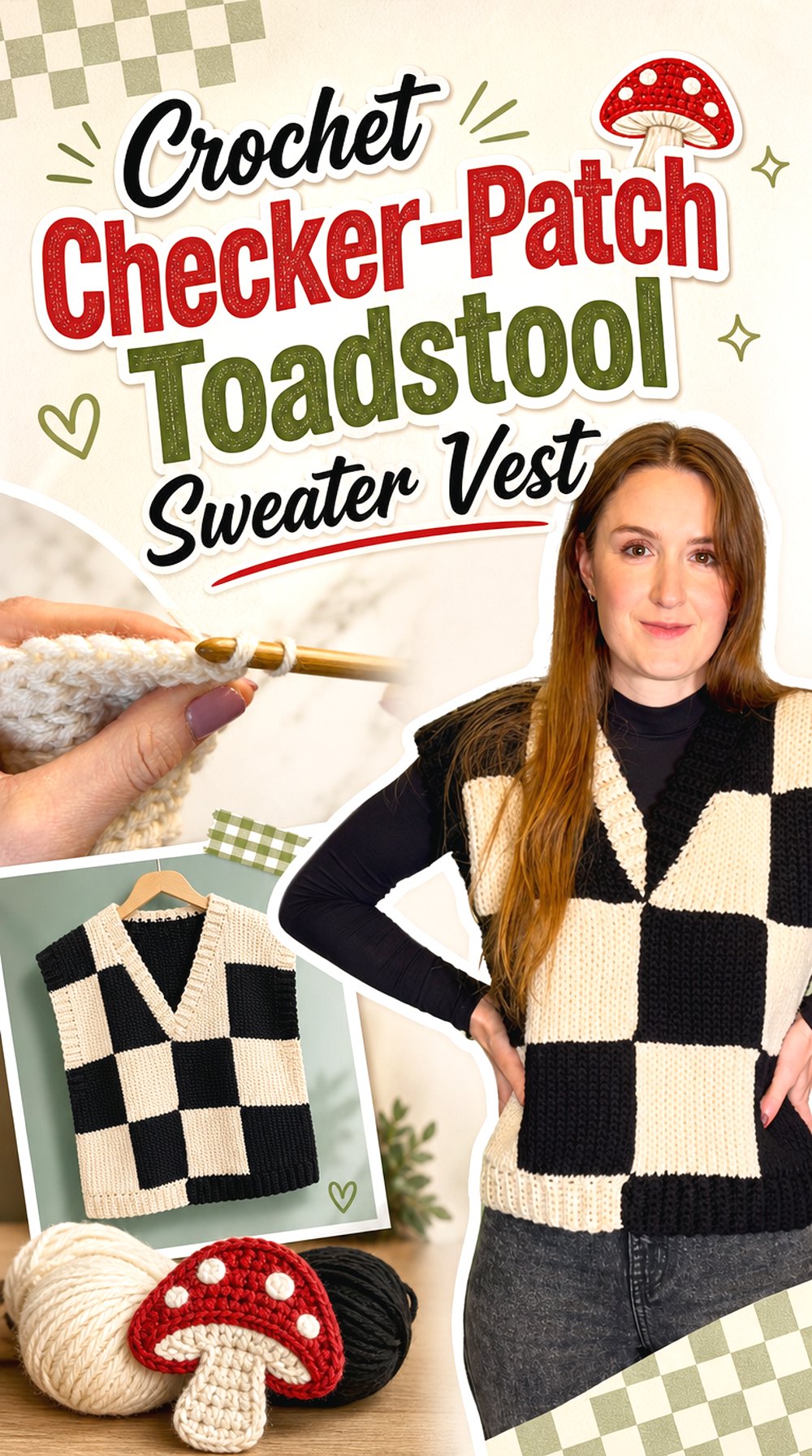
A checker-patch vest offers an easy visual grid for planning mushroom color. Stephanie Tashi’s tutorial builds a checkerboard vest from individual patches, so the garment naturally breaks into defined spaces rather than one continuous field.
For a toadstool adaptation, think beyond simply replacing one checker color with red. Some patches can represent mushroom caps, some stems or woodland neutrals, and a few can contain separate mushroom imagery. The main advantage is control: you can rearrange patches on a table and adjust the visual rhythm before committing to final assembly.
Turn the Checker Grid Into Cap-and-Stem Rhythm
Red, cream, brown, moss, and muted neutral patches can suggest a forest palette without requiring a literal mushroom in every square. This lets the checker structure support the theme rather than compete with it.
Place a few unmistakable toadstool motifs among simpler color blocks so readers see the mushroom concept immediately but the vest still has breathing room.
Patch Seams Become Part of the Design
Individual pieces create visible structural lines across the vest. Those lines can frame mushroom motifs nicely, but mismatched joins become more noticeable when color blocks are high contrast.
Arrange the entire front and back before joining. Check that important mushroom shapes are not accidentally split by an awkward seam or hidden near an armhole.
Avoid Making Every Square a Mushroom
Repeated detailed squares can make a checker vest look visually dense and increase finishing work considerably. Alternating feature patches with plain blocks gives the toadstools more impact.
A restrained layout also makes it easier to replace one motif later if its finished dimensions do not match the surrounding pieces.
Creator: Stephanie Tashi
5. Crochet Woodland Tie Up Toadstool Vest
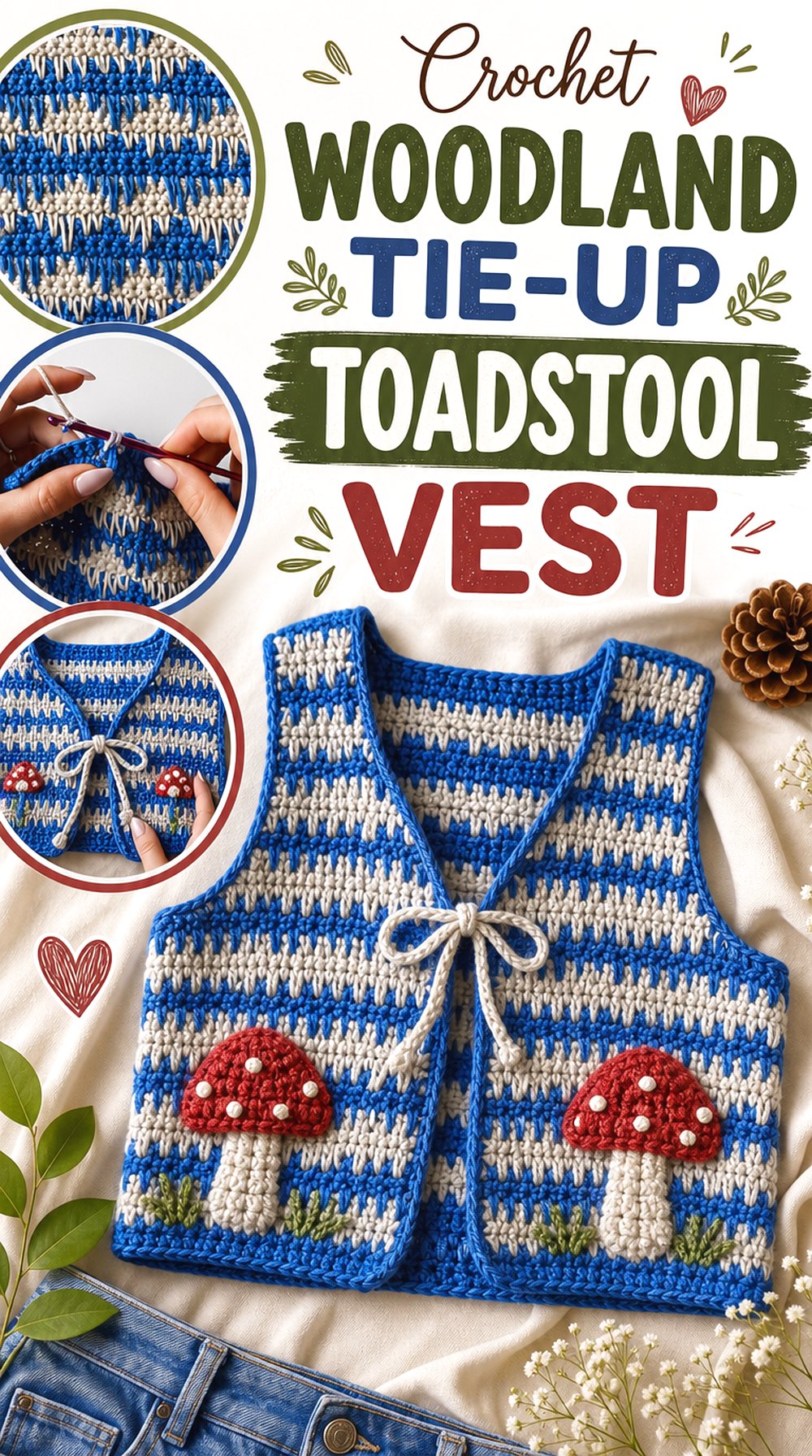
A tie-up vest creates more negative space than a standard pullover, making it useful when you want woodland motifs without the weight of a completely covered torso. Kenikse Crochet’s made-to-measure tie vest tutorial provides the garment framework; the mushroom treatment would be your own adaptation.
Consider using one toadstool motif on each front section or placing mushrooms near the lower corners while keeping the center opening quiet. The ties themselves become a strong feature, so the vest does not need dense decoration to feel complete. This construction can also layer over garments of different thicknesses more readily than a fixed closed front.
Side Openings Give the Motif Room to Breathe
Open areas naturally interrupt the crochet surface, so treat each garment panel as its own composition. A mushroom placed close to an opening needs enough surrounding fabric that the cap does not appear visually cut off.
Pin or baste paper representations of your motifs onto the completed panels before adding the real crochet pieces.
Tie Length Should Match the Layering Plan
A vest worn over a thin shirt and one worn over a bulky sweater can sit differently. Follow the tutorial’s fitting logic, then test the closure with the type of layer you expect to wear underneath.
Avoid using the ties as a substitute for correctly sized body panels. They should adjust the closure, not pull an undersized vest into shape.
Reinforce Motifs Near Tie Anchors
The areas where ties attach experience more movement than the center of a quiet panel. If a mushroom appliqué overlaps that region, extra thickness can complicate the way the tie sits.
Keep elaborate motifs slightly away from the attachment point unless you have checked that the added fabric does not interfere with the closure.
Creator: Kenikse Crochet
6. Crochet Toadstool Pocket Sleeveless Cardigan Vest
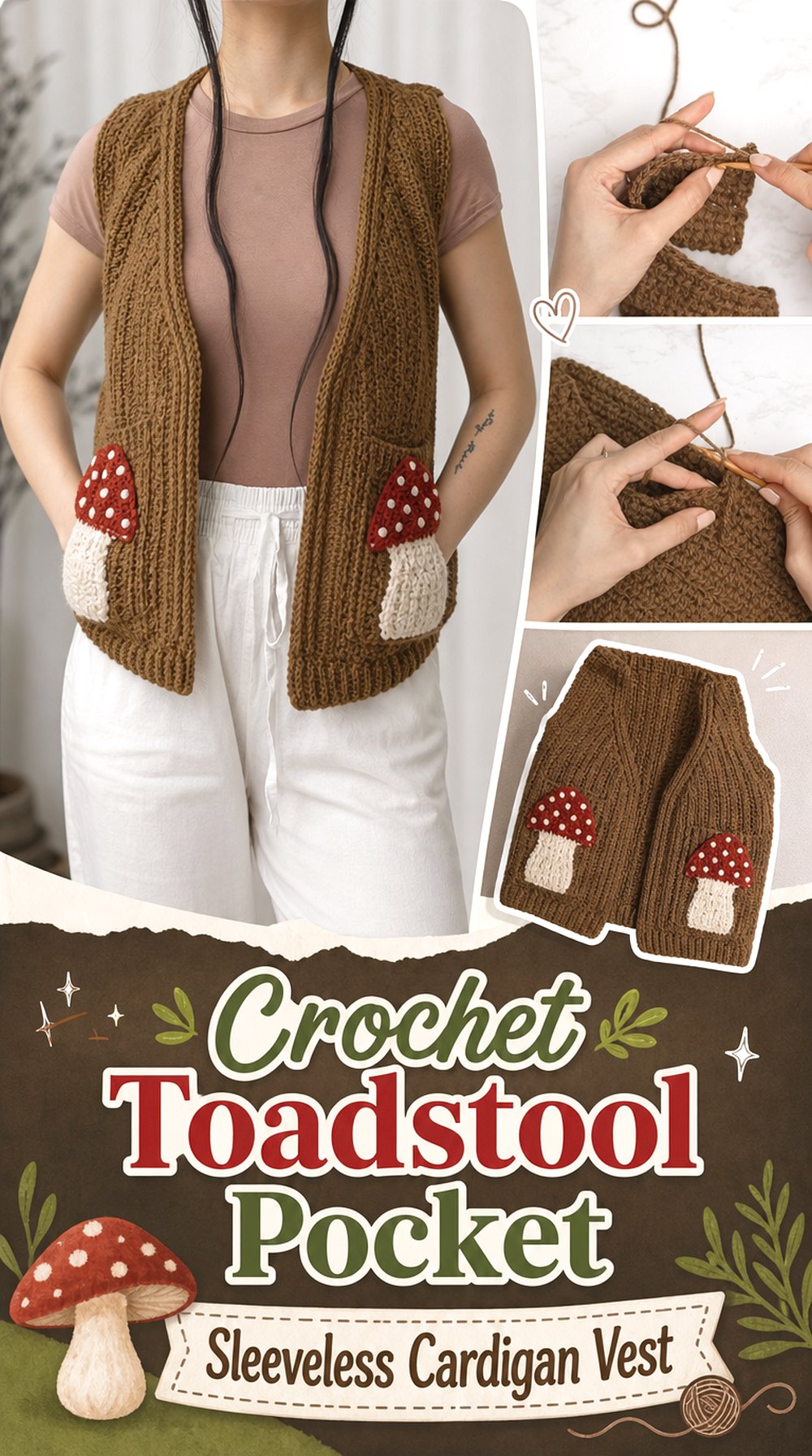
Pockets offer a practical way to introduce mushrooms without altering the main garment panels. TCDDIY’s tutorial covers a classic sleeveless cardigan-style vest with pockets, creating a different silhouette from the closed sweater vests elsewhere in this collection.
One small mushroom on each pocket could create a mirrored design, while mismatched mushrooms can give the vest a more playful forest-floor look. Because the body itself can remain neutral, this is also one of the easiest ideas to restyle later: changing pocket decoration does not require redesigning an entire motif grid.
Pockets Are Natural Homes for Small Toadstools
A pocket creates its own frame, so even a relatively small mushroom can read as intentional. Keep the design comfortably inside the pocket boundaries instead of letting the cap disappear into an edge or seam.
If you plan to use the pockets regularly, assess the motif from both an aesthetic and functional standpoint before attaching dimensional decoration.
Open Fronts Need Motif Balance on Both Sides
An open vest is visually divided down the center. Identical pocket motifs give a symmetrical result, while different mushrooms can look more organic.
Whichever direction you choose, lay both front pieces together before finishing them. It is much easier to correct a lopsided arrangement before the decorative work becomes permanent.
Pocket Fabric Should Not Sag Under Decoration
Large, dense appliqués add more material to a pocket front. If the pocket already has soft drape, an oversized decoration may pull it forward.
Choose a motif scale appropriate to the pocket and check its behavior while the vest is hanging, not only while the piece is flat on a table.
Creator: TCDDIY
7. Crochet Textured Meadow Toadstool Sweater Vest
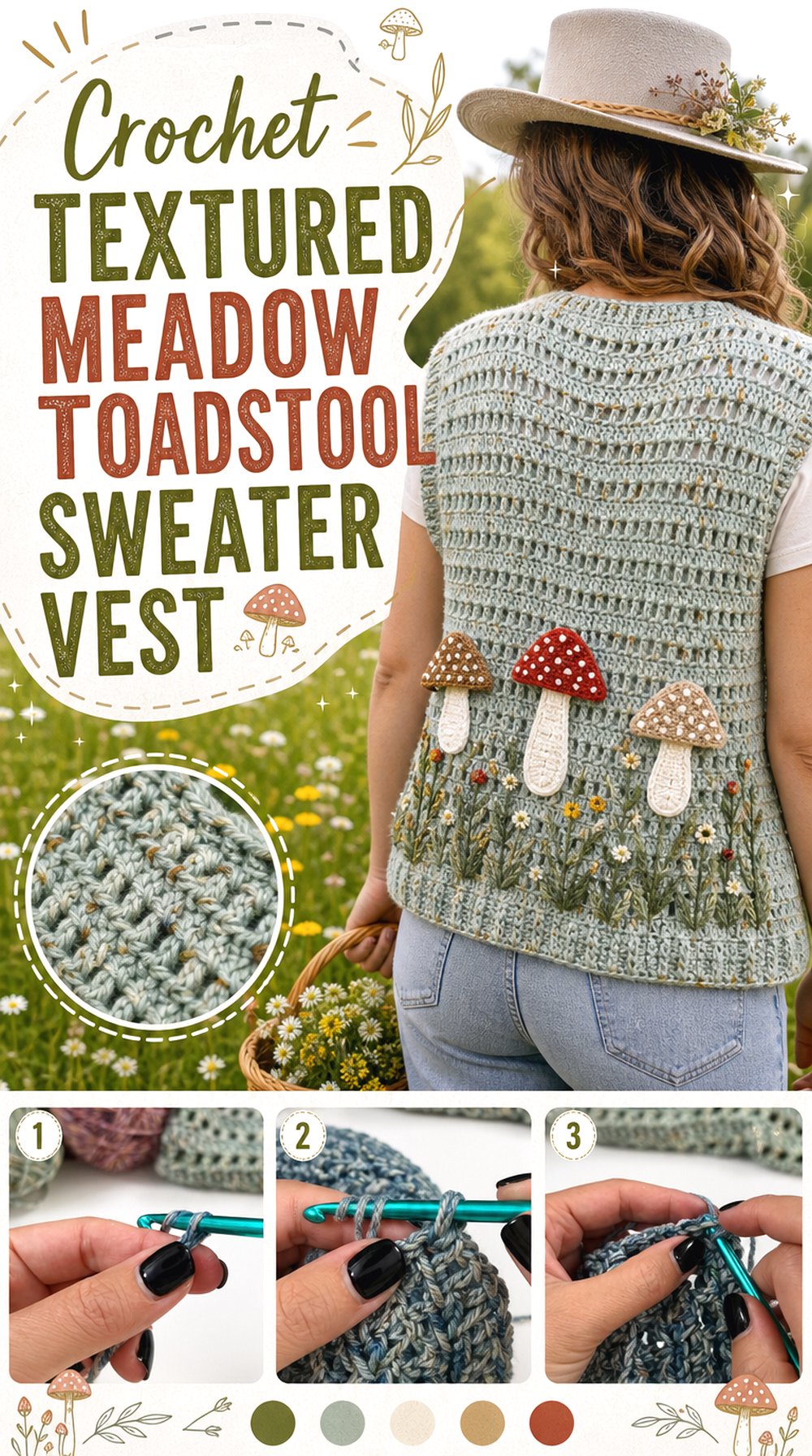
A textured vest can evoke woodland ground, moss, and bark without relying on literal imagery across the entire garment. Ophelia Talks Crochet’s Greenway Sweater Vest is presented as a classic vest with noticeable texture and drape, giving you a more understated base for sparse mushroom accents.
Instead of covering the surface, use just a few toadstools near the lower front or along one side, almost like mushrooms growing through a textured meadow. This idea works best when the background stitch remains visible, because the texture is one of the garment’s defining features.
Texture Can Compete With Detailed Mushroom Shapes
A detailed motif is easiest to read against relatively calm fabric. When the base already has strong stitch texture, very intricate mushroom outlines may become visually lost.
Test one sample against the actual vest fabric. A simpler cap-and-stem silhouette may communicate the theme more clearly than an appliqué containing many tiny details.
Use Toadstools as Sparse Meadow Accents
A few mushrooms placed near the lower edge can create a landscape effect without obscuring the texture above them. Varying placement is often more convincing than creating a perfectly straight row.
Keep enough distance from the hem finishing that the motifs look integrated with the body rather than trapped between two strong borders.
Check Drape Before Committing to Dense Appliqués
Texture, yarn, and decoration all influence how a vest hangs. Attach sample motifs temporarily and hold the garment vertically to see whether the fabric begins to pull.
If the decorated side hangs differently, reduce motif size, number, or thickness rather than compensating after all the pieces are sewn on.
Creator: Ophelia Talks Crochet
8. Crochet Giant Back Motif Toadstool Sweater Vest
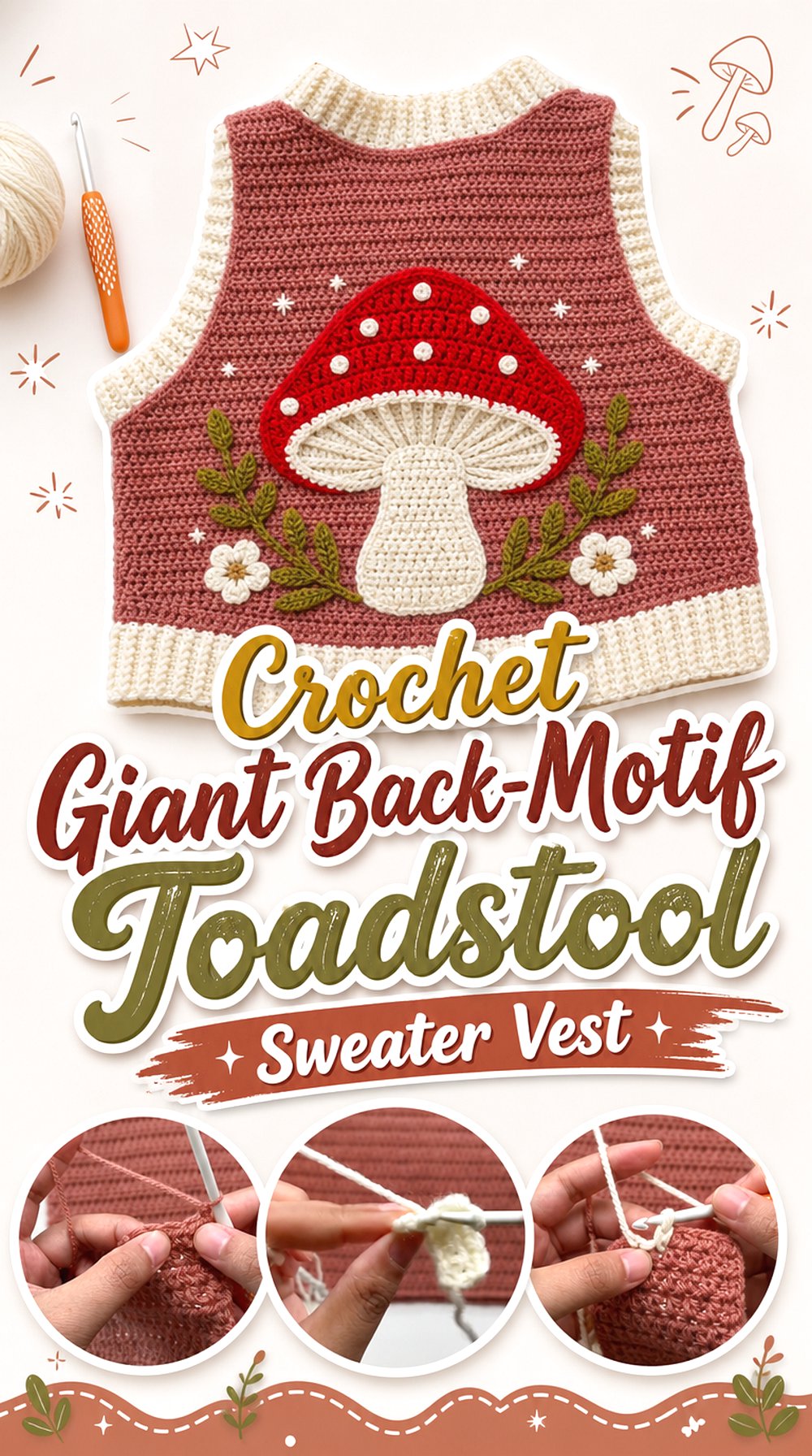
A simple sweater vest gives a large mushroom plenty of uninterrupted space. CROCHET BY BEV’s tutorial uses a straightforward sweater-vest construction, making it a useful base when the decoration—not the underlying stitch pattern—is meant to be the star.
Place an oversized toadstool on the back and leave the front almost plain for a vest that looks restrained from one angle and highly decorative from another. This is especially useful when your favorite mushroom motif is too large to fit comfortably into a granny-square grid.
A Large Back Motif Needs Breathing Room
Do not size the mushroom simply to fill every available inch. Leave visible background around the cap, stem, and lower edge so the silhouette remains easy to recognize.
Mark the shoulder seams and armhole boundaries before deciding the final scale. A motif that looks centered on an unfinished rectangle may shift visually after shaping and assembly.
Keep the Front Quiet for a Two-Sided Styling Effect
A plain front can make the vest more versatile and prevents the garment from becoming visually heavy. One tiny mushroom near the hem or chest can hint at the larger design on the back without repeating it.
This front-versus-back contrast is particularly effective when the back appliqué already uses several colors.
Support Large Appliqués Across a Broad Area
An oversized crochet appliqué should sit flat rather than hang from only a few attachment points. Before permanent finishing, spread the motif across the panel and check that its weight does not distort the fabric.
If the vest stretches visibly beneath it, reconsider the motif’s density or size.
Creator: CROCHET BY BEV
9. Crochet Toadstool Hem Band Sweater Vest
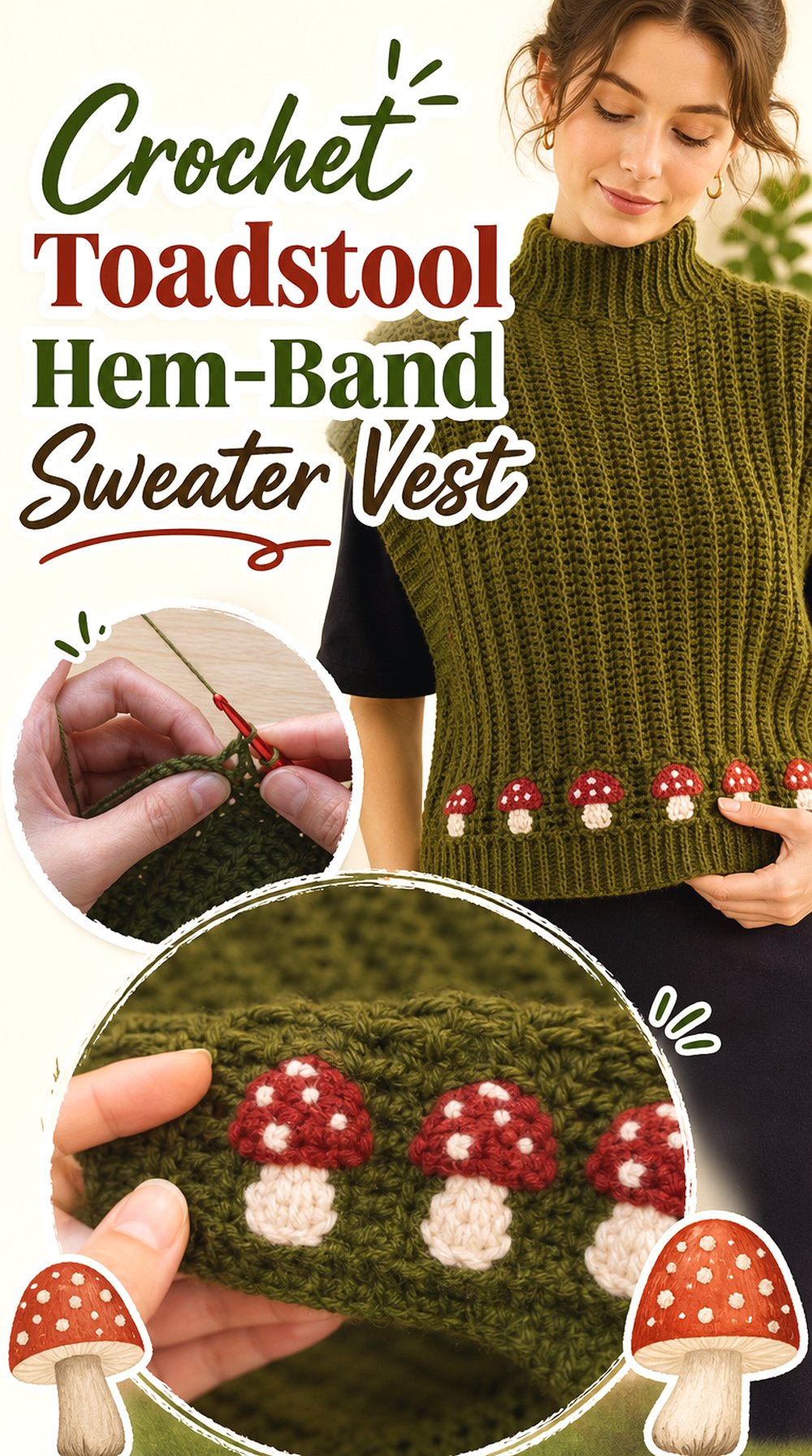
Instead of centering mushrooms on the chest, turn the lower edge into a woodland border. The passtschon sweater vest tutorial provides the underlying garment construction, while the mushroom hem treatment remains an adaptation to plan separately.
A row of spaced mushrooms can create a clear thematic detail without interfering with neckline or armhole shaping. This format also lets you keep the upper vest relatively neutral, which may be preferable if you want the garment to layer under jackets or coats without a heavily textured chest.
A Hem Band Creates a Clean Woodland Border
Treat the bottom section as a defined design zone. Establish where the final hem or ribbing will sit, then keep the mushroom caps and stems comfortably above that line.
Leaving some plain background between motifs usually gives each toadstool more clarity than connecting them into one continuous mass of color.
Repeat Motifs Without Crowding the Armholes
A border that climbs too high can collide visually with armhole shaping. Keep most of the decoration in the lower body and allow the upper section to remain comparatively quiet.
If you want mushrooms to rise at the sides, check their placement while the vest is worn so they do not disappear beneath the arms.
Keep Fiber Changes Compatible With the Garment
If your toadstool motifs use a different yarn from the vest body, compare how both fabrics stretch and respond to care. A stiff motif on a much softer background can behave differently after wearing or washing.
When possible, make and wash a small sample combination before committing to the entire border.
Creator: passtschon
10. Crochet Cropped Checker Toadstool Sweater Vest
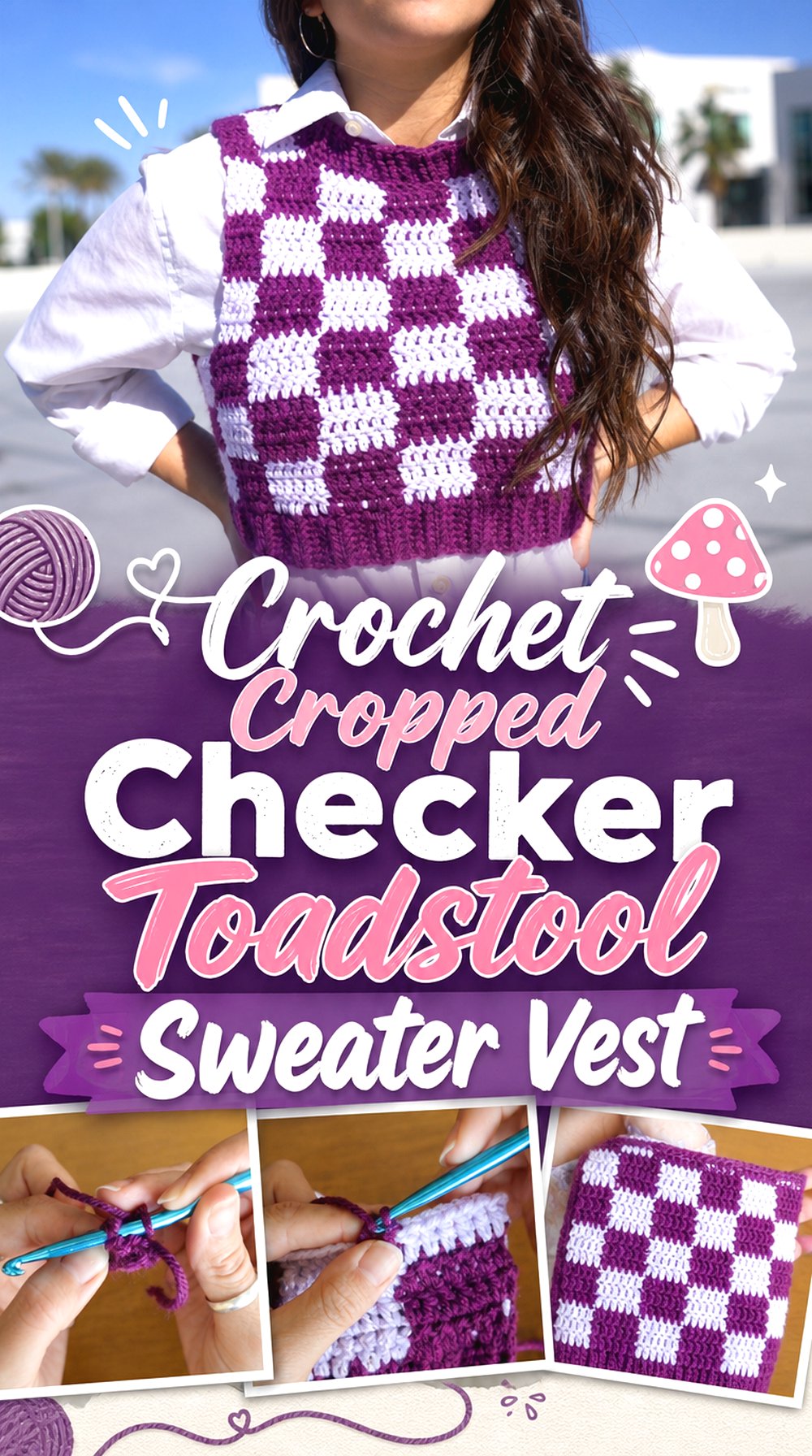
A cropped checker vest puts nearly all of its visual information into a compact area. The it’s erin b. tutorial shows a cropped checkered crochet vest and notes that its length can be changed, providing a useful base for a short mushroom-inspired color-block garment.
Rather than inserting detailed mushrooms everywhere, let cream checker sections suggest stems and red sections suggest caps, then add one or two unmistakable mushroom motifs as anchors. The shorter silhouette can make a bold palette feel more deliberate, but it also means motif placement has less vertical room for error.
Cropped Proportions Make Placement More Important
On a short vest, a motif that sits only slightly too low can be interrupted by the hem. Likewise, a design placed too high can compete with the neckline.
Finish the main shaping first whenever possible, then mock up the mushroom placement on the actual cropped dimensions rather than a longer theoretical panel.
Let the Checker Pattern Suggest Mushroom Spots
Small cream dots or contrasting details inside selected red blocks can reference the classic spotted cap without converting every checker into a separate full mushroom.
This keeps the original geometric rhythm visible while giving the fabric a recognizable toadstool cue.
Watch the Lower Edge After Color Changes
Strong checker patterns draw attention to horizontal alignment. Any distortion or unevenness near the cropped hem is therefore more visible than it might be on a solid-color garment.
Block the finished panels according to the yarn’s care requirements and evaluate the lower edge before adding extra decorative weight.
Creator: it’s erin b.
11. Crochet Hooded Forest Toadstool Vest
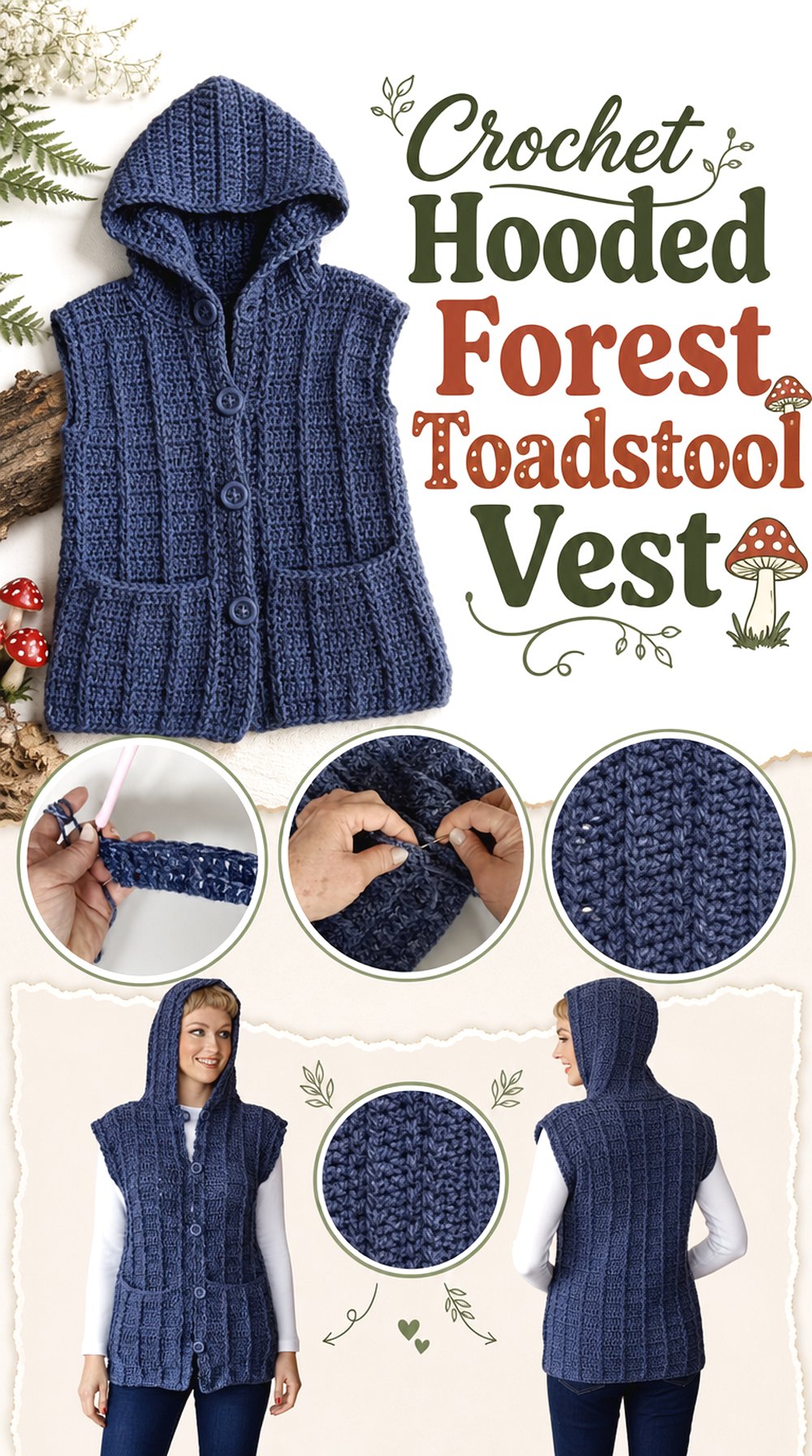
A hood immediately moves the design away from a traditional academic sweater vest and toward a more playful forest-layering piece. Yüksel’le Örgüler’s tutorial demonstrates a hooded crochet vest, creating a structure that can carry mushroom details on the hood as well as the torso.
Use small mushrooms around the lower hood edge, place a large woodland motif on the back, or keep the hood plain and concentrate decoration near the pockets or hem if those areas suit your chosen construction. The extra fabric at the neck makes weight distribution more important than it is on a standard sleeveless pullover.
The Hood Can Carry the Woodland Theme
Small toadstools scattered near the back or lower edge of the hood can make the theme visible even when the vest is viewed from behind.
Before attaching anything dimensional, put the hood on and check where the motifs fall. Decorations that look perfectly positioned while the hood lies flat may rotate toward the sides when worn.
Keep Toadstools Away From High-Friction Armhole Edges
Raised motifs positioned directly beside an armhole can rub against sleeves and experience repeated movement. Keeping detailed appliqués a little farther onto the body panel protects the design visually and reduces bulk at the edge.
Flat colorwork is less intrusive if you want the mushroom imagery closer to the armhole.
Balance Hood Weight Against the Back Panel
A hood already places additional fabric at the upper back. A dense, oversized crochet mushroom immediately below it can make that same area even heavier.
If you want a statement back motif, compare the garment’s hang before and after temporarily pinning the decoration in place.
Creator: Yüksel’le Örgüler
12. Crochet Front Tie Toadstool Border Vest
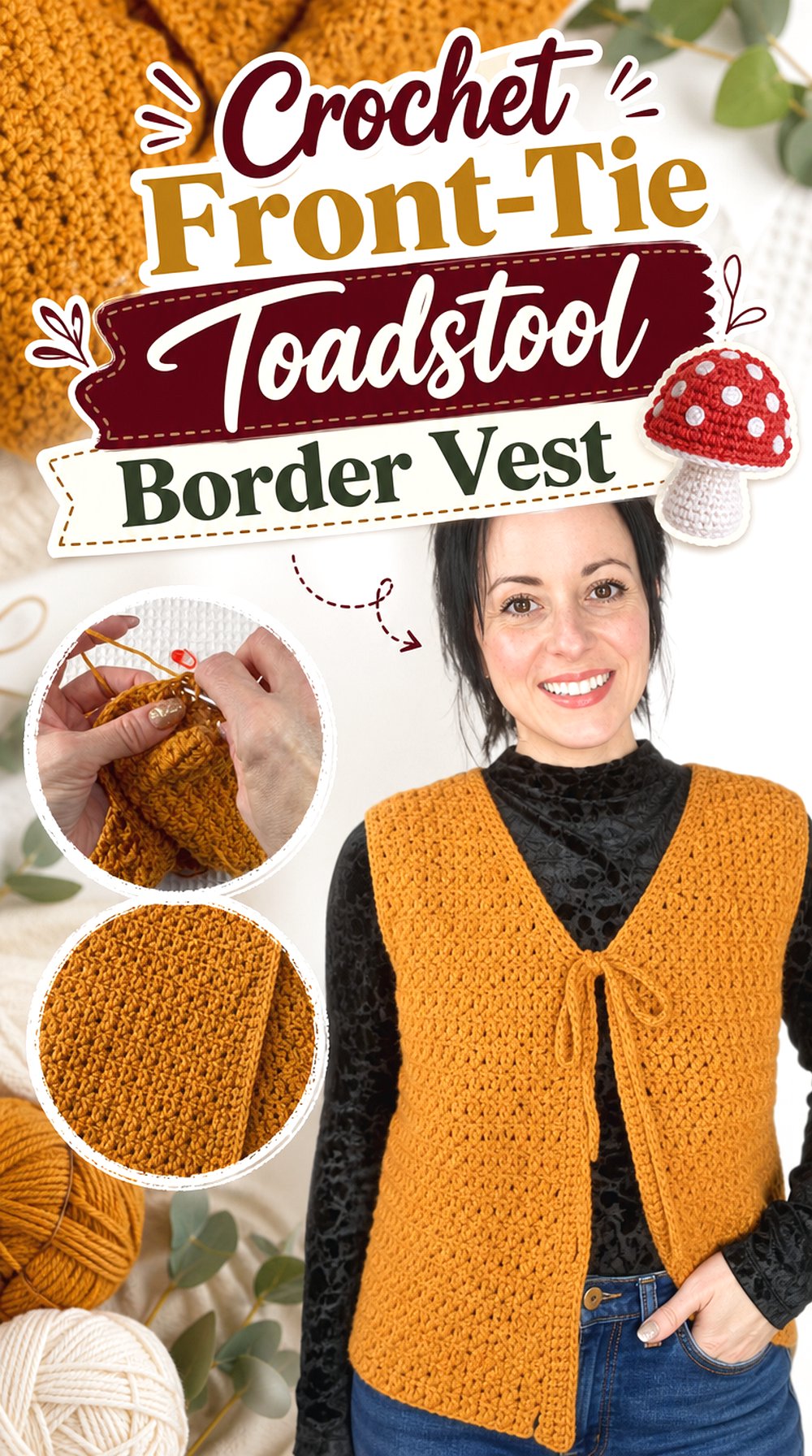
A front-tie vest leaves the center of the garment open, giving the toadstool theme a lighter warm-weather interpretation. Premier Yarns’ Front Tie Vest is a V-neck design worked in pieces and seamed, with ties forming the closure.
For this adaptation, keep the ties and opening visually clean and place small mushrooms around the lower edges instead. The result can read as a woodland border framing the body rather than a traditional sweater vest covered with motifs. It is a useful option when you like toadstools but do not want a thick or highly enclosed garment.
Front Ties Need a Clear Center Line
The tie closure is already the strongest feature in the center. Large mushrooms immediately beside each tie can crowd that area and obscure the shape of the opening.
Keep the decorative emphasis lower or farther toward the side seams so the closure remains easy to see and use.
Border Motifs Work Better Than a Crowded Chest
Small mushrooms repeated along the lower edge can create a cohesive theme without covering the whole front. Varying the spacing slightly can make the border feel more organic.
Test the arrangement with the vest tied, because the two front edges will move closer together than they appear when laid flat.
Choose Yarn With the Ties in Mind
Crochet ties experience repeated pulling and can lengthen if the chosen stitch-and-fiber combination is particularly stretchy. Follow the source tutorial for the intended construction and assess any substitution before making all of the ties.
If the vest body and mushroom motifs use different fibers, also confirm that their care requirements are compatible.
Creator: Premier Yarns
13. Crochet Oversized Gothic Toadstool Checker Vest
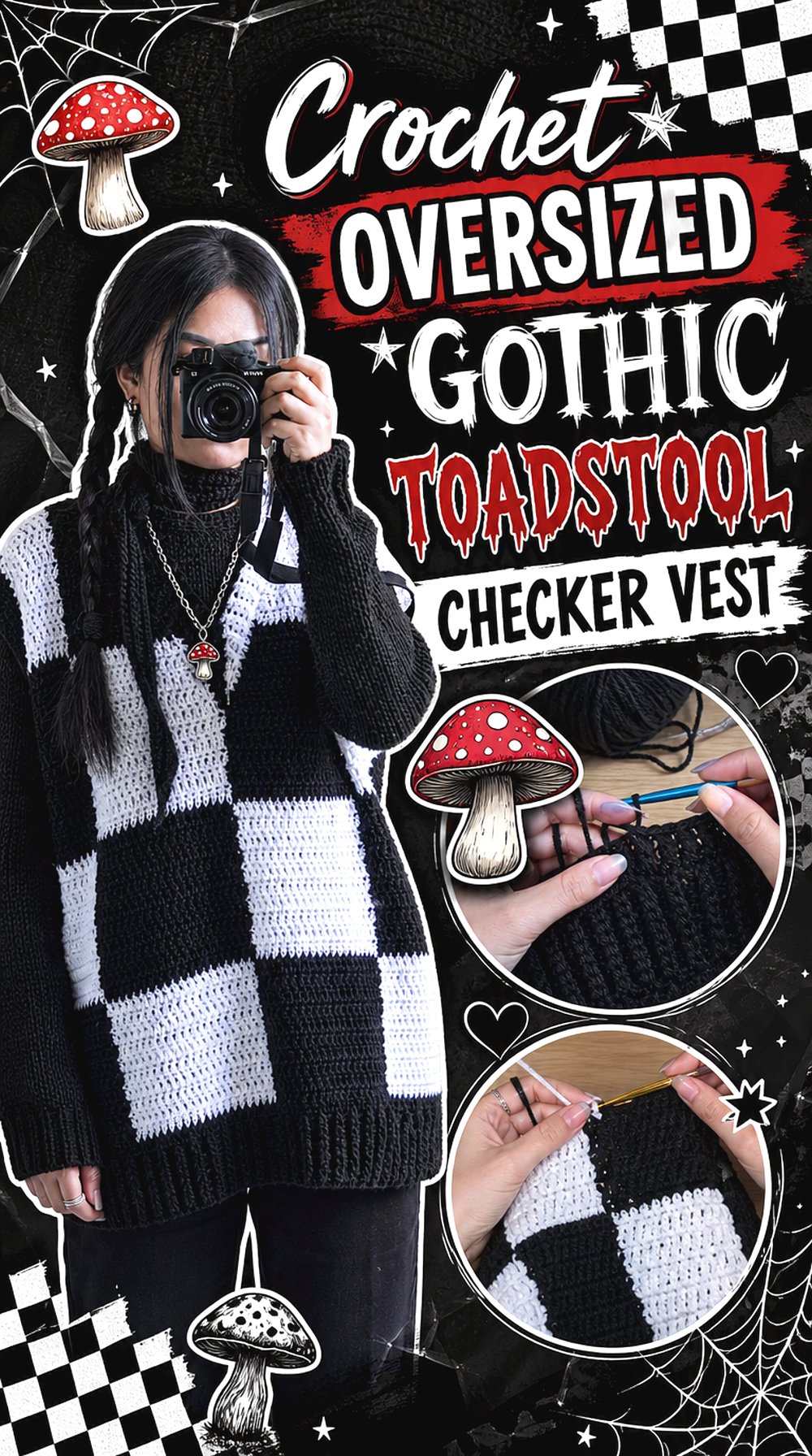
The oversized checkered vest from Cherilyn Q offers more visual scale than a close-fitting checker design. The source is Wednesday-inspired and deliberately oversized, so its proportions can support bolder woodland graphics without every motif feeling cramped.
A dark background with cream and deep red toadstool elements could shift the mood toward gothic cottagecore rather than bright fairycore. Large mushrooms can occupy entire checker zones, while smaller cap spots can echo the grid. This direction works best when you decide whether the checker pattern or the mushroom imagery is the primary feature and let the other play a supporting role.
Oversized Scale Can Handle Larger Motifs
More fabric creates more uninterrupted design space, but that does not mean every section needs decoration. One oversized mushroom across the back can be more effective than many small motifs competing with a bold checker pattern.
Mock up the image at full scale before starting the decorative work.
Dark Checker Fields Make Red Caps Read Strongly
Deep neutral backgrounds can create sharp contrast with a classic red mushroom cap. Cream or muted beige stems keep the palette connected to the checker geometry.
If you use several saturated colors in addition to red, the mushroom shape can become harder to identify, so prioritize silhouette over color variety.
Check Shoulder Drop Before Positioning a Back Mushroom
Oversized garments can place shoulder seams and armholes differently from a fitted vest. Complete enough of the construction to identify those boundaries before deciding where a large back motif should sit.
The visual center of a flat panel is not always the visual center of an oversized garment once it drapes on the body.
Creator: Cherilyn Q
14. Crochet 1970s Toadstool Granny Square Vest
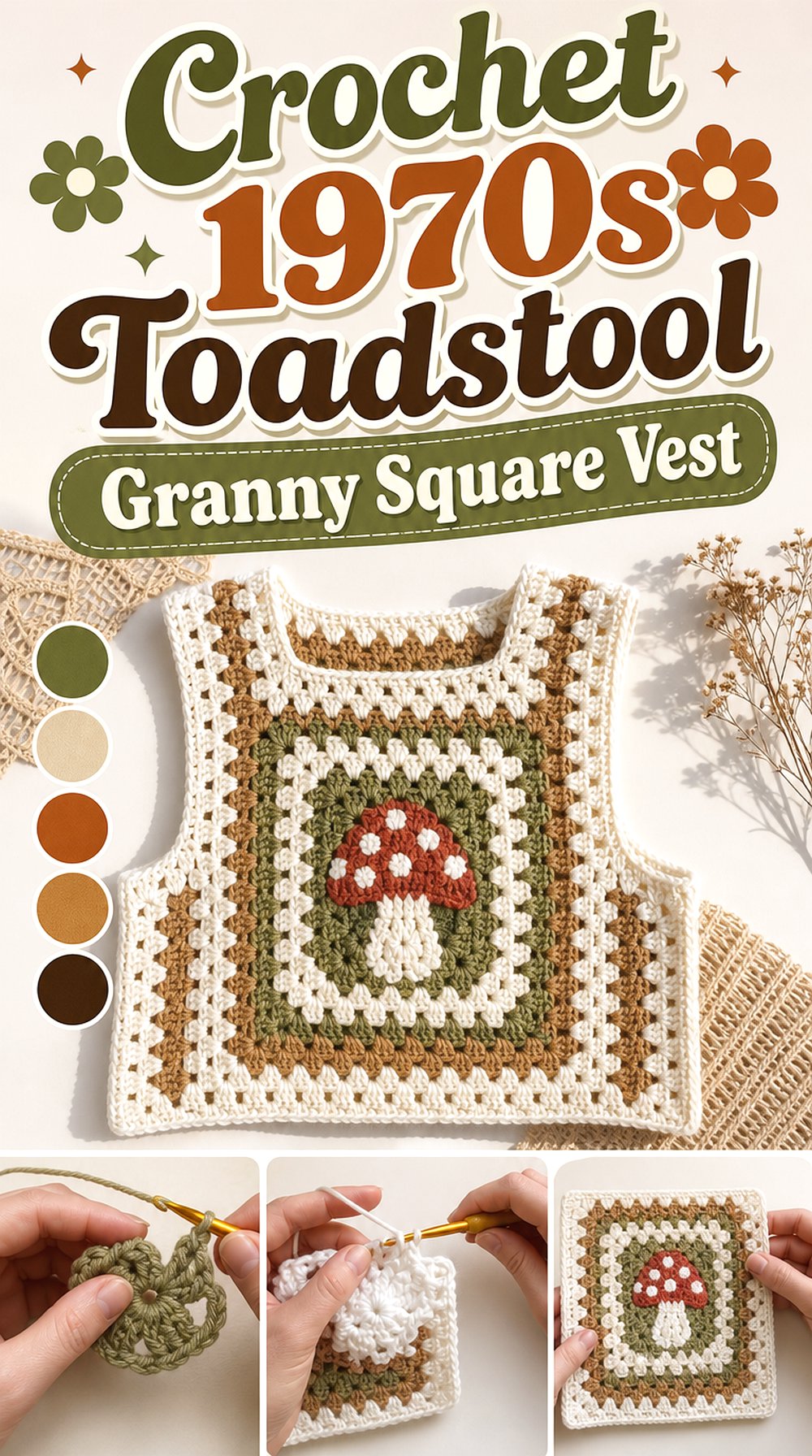
A 1970s-inspired granny-square vest is a natural home for warm woodland colors. HayHay Crochet’s tutorial provides a retro granny-square vest construction that can be adapted by substituting compatible mushroom squares for selected standard motifs.
Rust, ochre, olive, cream, and brown can frame classic red toadstools without making the garment look like a costume. Keep some traditional granny squares in the layout rather than replacing every motif. That mix preserves the retro patchwork character and makes the mushroom squares feel like discoveries within the vest.
Retro Granny Squares Suit Alternating Woodland Motifs
Alternate detailed mushroom squares with simpler rings of color or plain granny motifs. The contrast gives the toadstools greater importance and reduces the amount of complicated motif work.
Before joining, photograph several arrangements. Moving a single bright square can substantially change the visual balance of a small vest.
Motif Borders Need Matching Blocked Dimensions
A mushroom square and a classic granny square can have different stitch density even when they contain a similar number of rounds.
Block one sample of each using the intended yarn and compare their dimensions. If the edges do not align comfortably, solve the compatibility issue before producing the full set.
A Limited Palette Keeps the 1970s Look Cohesive
Toadstools already introduce strong imagery. Restricting the surrounding palette helps connect mushroom squares to more abstract granny motifs.
You do not have to use traditional red and white either. A muted brick cap or golden woodland mushroom can preserve the theme while blending more naturally with a retro color scheme.
Creator: HayHay Crochet
15. Crochet Mixed Motif Toadstool Granny Square Sweater Vest
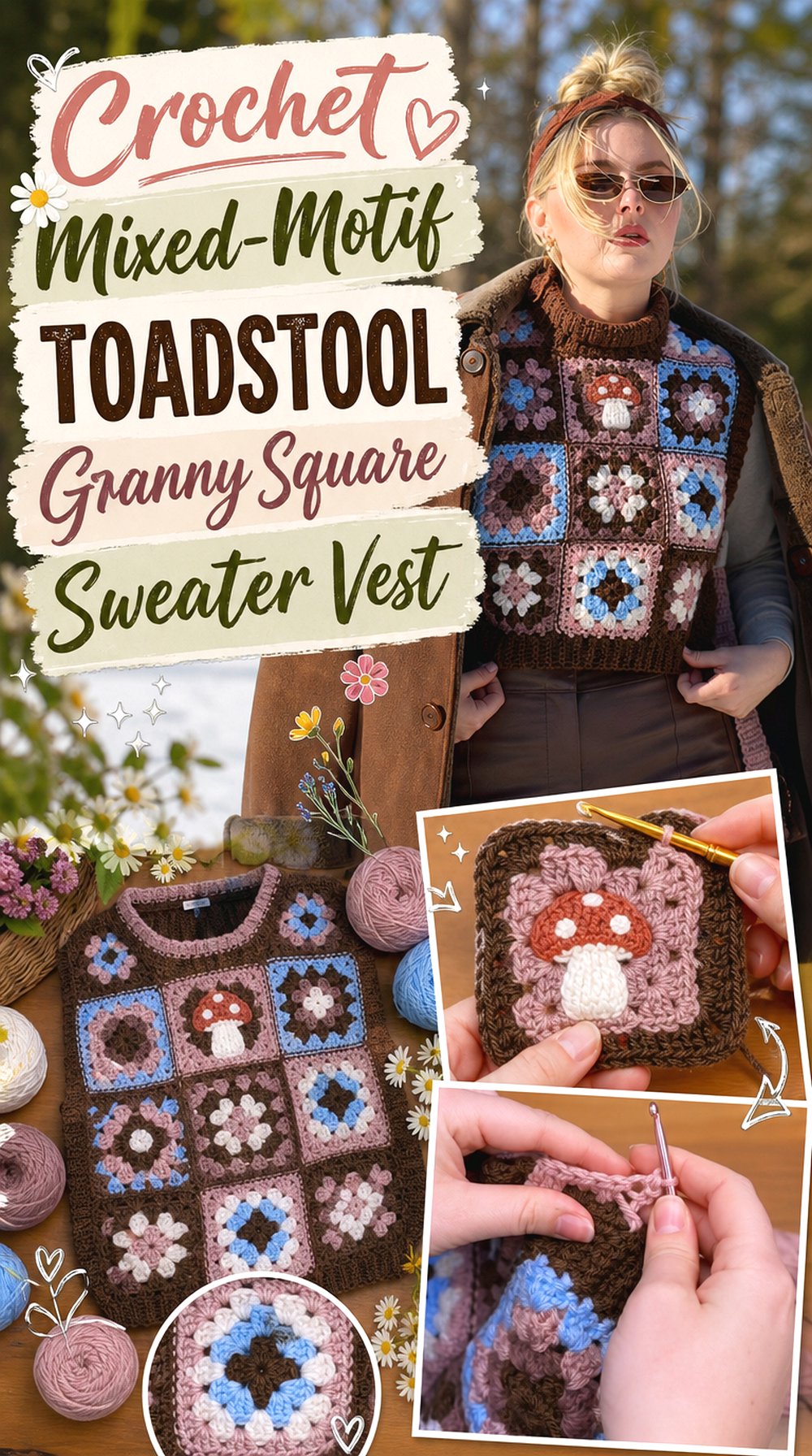
A traditional granny-square sweater vest offers one of the most flexible routes for mixing mushrooms with other woodland imagery. Off The Clock’s tutorial teaches a granny-square sweater vest, giving you a grid that can be reinterpreted with compatible motif squares.
Instead of making every square identical, reserve mushrooms for the front corners, center back, or selected rows. Fill the remaining spaces with simple squares, small flowers, leaves, or solid motifs that share the same finished dimensions. This produces a collected woodland look while keeping the toadstools recognizable as focal motifs.
Mix Toadstool Squares With Simpler Fillers
A full vest made exclusively from detailed mushroom squares can feel visually busy. Simple filler motifs create rhythm and can make a particularly good toadstool square stand out more strongly.
Choose fillers based on blocked size and fabric behavior first. Matching colors alone will not solve a structural mismatch between two motif designs.
Map the Front and Back Before Joining
Draw a basic grid or arrange the finished squares physically. Mark neckline, side, and shoulder positions so motifs do not end up upside down or partly hidden after construction.
This is especially important for mushrooms because their orientation is obvious; a rotated abstract granny square is far less noticeable.
Use Shoulder Squares as Fit Checkpoints
The squares crossing the shoulders influence both the width of that area and the way the vest falls toward the armholes. Check the planned square dimensions against the tutorial’s garment framework before making dozens of motifs.
If the mushroom square is too large for that location, use a compatible simpler square on the shoulder and move the toadstool lower.
Creator: Off The Clock
Which Toadstool Vest Direction Fits Your Plan?
Choose the side-tie mushroom patchwork vest if you want the motif to define the entire garment. The V-neck, textured, hem-band, and large-back-motif vests are stronger choices when you prefer a conventional sweater-vest silhouette with more restrained mushroom decoration.
For obvious patchwork, the checker, 1970s granny, and mixed-motif granny vests give you clear units that can be rearranged before joining. The pocket vest concentrates decoration in practical focal areas, while the front-tie vest keeps the center airy. A hooded vest has the most overt forest-fantasy character, and an oversized checker vest provides enough scale for dramatic mushrooms and darker woodland palettes.
Whatever structure you choose, resolve fit and motif scale separately before combining them.
Conclusion
The most successful crochet toadstool sweater vest idea is the one where the mushroom treatment fits the garment instead of being added as an afterthought. Choose side-tie or granny-square patchwork when you want mushrooms repeated throughout the construction; choose a V-neck, textured, cropped, or simple pullover when one strong motif should carry the design. Pocketed, front-tie, and hooded vests offer still different places for woodland details.
Before making multiples, check the blocked size, weight, orientation, and placement of one sample motif against the planned garment. Use the original tutorials linked above for their exact construction details, then adapt only where the new mushroom design remains compatible.
Frequently Asked Questions
Can I add a crochet toadstool appliqué to any sweater vest?
Not automatically. A small lightweight appliqué is easier to add than a large dense one, but the vest fabric still needs to support it without sagging or becoming uncomfortably stiff. Place the motif temporarily first and hold or wear the garment vertically. Also check whether the decoration will interfere with ribbing, armholes, ties, buttons, or pockets before sewing it down.
How do I know whether a mushroom granny square will fit a vest tutorial?
Compare the blocked finished dimensions of the mushroom square with the square used by the vest construction. Shape matters too: both motifs need compatible edges and corners for clean joining. Do not assume that using the same yarn weight or number of rounds guarantees equal dimensions. Make one mushroom square and one intended filler square first, block both, and compare them directly.
Should crochet toadstool squares be blocked before I plan the vest layout?
Yes, blocking before layout is useful because the dimensions you need for garment planning are the dimensions of the finished, settled motifs—not uneven squares straight off the hook. Once the squares are blocked, arrange them according to the vest’s front, back, shoulder, and side structure. That also gives you a chance to catch size differences or orientation problems before permanent joining.
Where should a large toadstool motif go on a sweater vest?
A large motif needs uninterrupted fabric and enough empty space around its outline. The center or lower area of a plain back panel is often easier to work with than a heavily shaped neckline or armhole section. On the front, position it only after you know where the neckline, hem, and any closure will sit. Pin a paper or yarn mock-up in place and assess the garment from a normal viewing distance.
What yarn qualities matter most for a motif-heavy toadstool vest?
Think about weight, stitch definition, stretch, and drape rather than choosing by color alone. A yarn that produces very dense mushroom motifs may make a full patchwork vest heavier and more structured, while a softer fabric may move more easily but stretch under added decoration. When mixing yarns, also check that their care requirements are compatible so the vest and motifs can be maintained together.
How can I keep a full mushroom vest from looking too visually busy?
Use contrast strategically. Let detailed toadstool squares alternate with simpler granny motifs, solid patches, flowers, or quieter background sections. On a plain vest, choose one feature zone such as the back, lower front, hem, or pockets instead of filling every available area. A limited palette also helps: repeating a small group of woodland colors can unify different mushroom shapes without making the garment feel crowded.