16 Crochet Candy Corn Coaster Ideas for Fall and Halloween Tables
Candy corn coasters can take more forms than the familiar yellow, orange, and white triangle. Some tutorials build the candy shape directly, while others use circles, textured fabric, C2C colorwork, appliqués, hearts, or square motifs that can inspire a more unusual coaster.
This collection starts with direct candy corn coaster tutorials and then moves into adaptation ideas based on candy corn motifs and compatible coaster constructions. That distinction matters: when a source was designed as an appliqué or decorative motif rather than a drink coaster, check its finished scale, thickness, stability, and ability to lie flat before adapting it. The comparisons below focus on those practical differences so you can choose a construction that suits an actual tabletop as well as your preferred Halloween style.
Quick List
- Crochet Classic Flat Candy Corn Coaster
- Crochet Garland-Style Candy Corn Wedge Coaster
- Crochet Candy Corn Appliqué Coaster
- Crochet Narrow-Point Candy Corn Coaster
- Crochet Textured Round Candy Corn Coaster
- Crochet Broad Candy Corn Wedge Coaster
- Crochet Candy Corn Face Coaster
- Crochet C2C Candy Corn Heart Coaster
- Crochet Small-Scale Candy Corn Motif Coaster
- Crochet Tapered Candy Corn Motif Coaster
- Crochet Tunisian Candy Corn Coaster
- Crochet Flat Candy Corn Character Coaster
- Crochet Scrap-Yarn Candy Corn Coaster
- Crochet Candy Corn Granny Square Coaster
- Crochet Candy Corn Heart-Shaped Coaster
- Crochet Candy Corn Spiral Coaster
Choose the Construction Before You Choose the Colors
Traditional candy corn striping can appear on very different coaster structures. A tapered triangle gives the strongest candy silhouette, but its narrow tip contributes little usable cup area. A round coaster puts more fabric beneath a mug while treating the yellow-orange-white combination as the main candy-corn cue. Square and C2C versions can be easier to mix with ordinary coaster sets because their outer shape stays conventional.
Also notice how the color changes are incorporated. Horizontal bands emphasize the recognizable candy shape, while a centered appliqué lets the background become part of the design. For a coordinated set, decide first whether every coaster should have the same outline or whether you prefer several different silhouettes tied together by the same three-color palette.
Flatness and Yarn Matter Under a Mug
For a functional coaster, the center needs to remain reasonably level. Thick surface embellishments, bulky joins, raised facial pieces, or loose decorative elements may make a project more suitable for display than for supporting a cup. If a tutorial was originally designed as an appliqué, block or flatten the finished motif and test it with the type of mug you intend to use before making a full set.
Fiber choice also changes function. Cotton is a practical option when absorption and a firm fabric are priorities, while other fibers may behave differently with moisture and heat. Do not assume that a yarn is suitable for hot surfaces simply because it looks dense. Check the yarn manufacturer’s care and temperature guidance, especially if the coaster will regularly sit beneath very hot drinkware.
Turning a Candy Corn Motif Into a Coaster
Several ideas later in this collection start with flat candy corn motifs rather than dedicated coaster patterns. Those are adaptation projects, not substitutes for the creator’s original instructions. The easiest checkpoint is finished coverage: place your usual mug over the completed motif and see whether enough fabric extends beyond the base to protect the tabletop.
If the motif is too small, changing yarn weight or hook size may change its scale, but it can also change stiffness and stitch definition. Another option is attaching a small candy corn motif to a separate flat coaster background. Keep any join smooth, secure, and away from the area where the mug needs to sit level.
1. Crochet Classic Flat Candy Corn Coaster
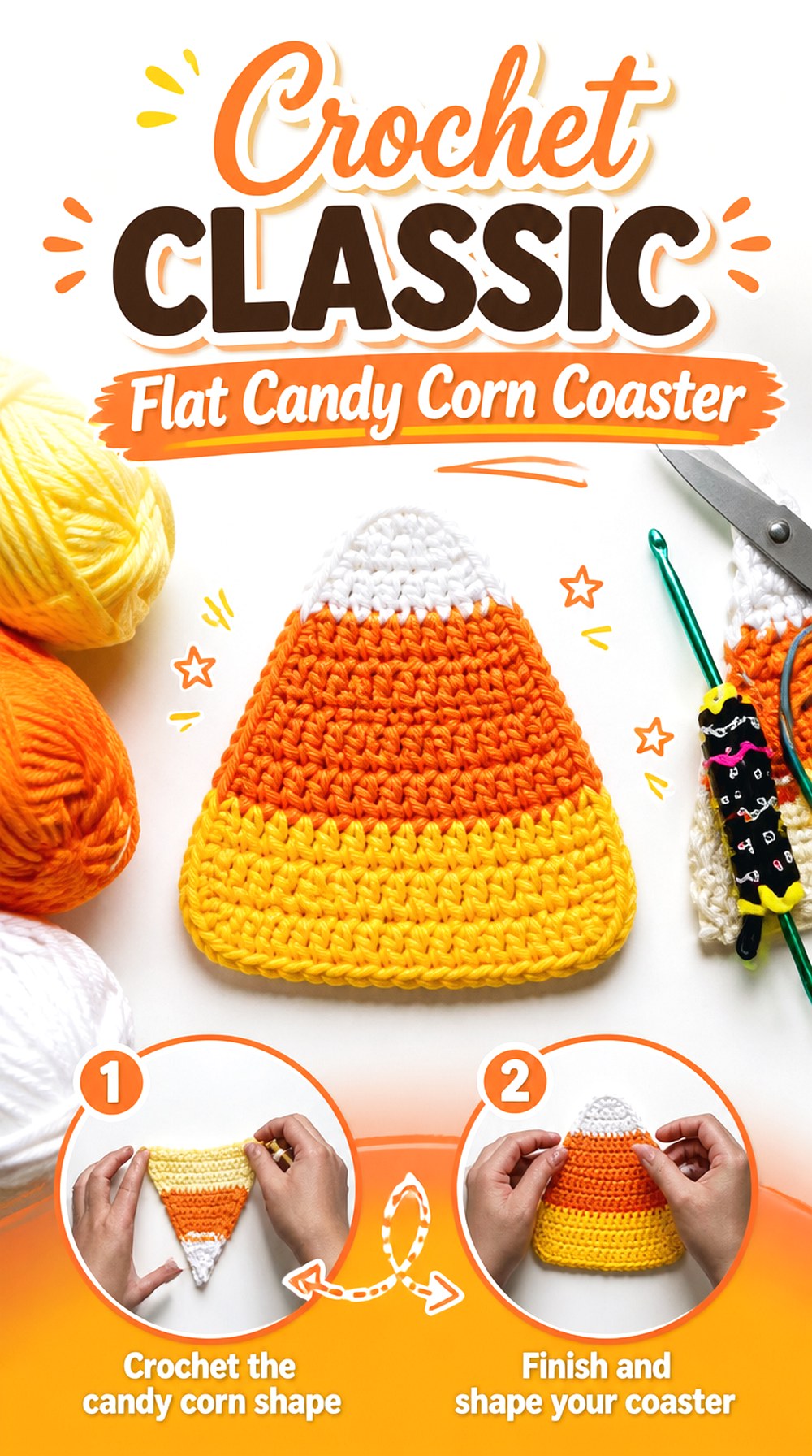
This classic version keeps the project immediately recognizable: a flat triangular body divided into yellow, orange, and white sections. RonariCrochet’s tutorial is specifically presented as a candy corn coaster and uses medium-weight cotton yarn, making it a useful starting point when you want the coaster itself—not an added motif—to create the Halloween shape.
The clean silhouette also makes this style easy to coordinate with pumpkin mugs, fall table runners, or neutral place settings. Before making several, check how your favorite cup sits across the tapered body; wider mugs need enough coverage across the coaster’s lower section.
The Wide Base Does Most of the Practical Work
A triangular coaster naturally has more usable surface near its base than its tip. When judging the finished size, focus on how much of the mug bottom rests over the wider yellow and orange sections. A beautiful point is decorative, but it should not distract from checking whether the main cup base is adequately supported.
Crisp Color Breaks Strengthen the Candy Shape
Because there is no complicated surface decoration competing for attention, clean transitions between the three traditional colors become the main visual feature. If you substitute colors, keep enough contrast between neighboring bands that the tapered shape still reads clearly from a distance. Muted mustard, rust, and cream can produce a softer fall version.
2. Crochet Garland Style Candy Corn Wedge Coaster

Heather Corinne Crochets presents a flat candy corn that can serve as a coaster, appliqué, or garland element. The piece is worked as a tapered shape and finished with an outer border, so the edge becomes a visible part of the finished object rather than simply the end of the rows.
That versatility makes this option particularly useful if you want one repeated motif across a Halloween table. Some pieces can sit under cups while matching pieces can be used elsewhere as décor, giving the setting a more deliberate look without requiring a completely different design.
The Border Helps Define an Irregular Outline
A separate edge treatment can visually clean up the sides of a tapered piece, especially where several color sections meet. Pay attention to whether your edging tension pulls the sides inward or causes them to wave. The coaster should still rest flat after the border is complete.
One Motif Can Coordinate Several Decorations
The source explicitly presents the candy corn for more than one use. That gives you a simple way to repeat the same shape on a table without making every piece a coaster. Keep drink coasters free of hanging cords or other garland attachments, and reserve those additions for pieces intended only for display.
Original Tutorial and Creator Credit
Creator: Heather Corinne Crochets
3. Crochet Candy Corn Appliqué Coaster

Crochet With Samra describes this project specifically as an appliqué/coaster, giving it a useful middle ground between decorative motif and tabletop piece. The tutorial uses a flat candy corn form with the familiar three-color separation rather than a stuffed construction.
This style works well if you prefer a relatively lightweight seasonal accent that can potentially be repurposed after Halloween. The most important functional check is scale. An appliqué can look perfectly proportioned by itself yet still be smaller than the base of a wide mug, so compare the finished piece with your drinkware before committing to a full coaster set.
Decide Whether It Is Primarily Décor or Table Protection
A dual-purpose motif gives you flexibility, but the two uses have different priorities. For an appliqué, compact scale may be desirable. For a coaster, coverage matters more. If yours finishes too small for the cups you use, treat it as decoration instead of assuming that every flat motif automatically works beneath a mug.
Keep the Point From Curling Upward
The narrow upper section of a candy corn shape can be more prone to lifting than the broad base. Smooth finishing and appropriate blocking can help the piece lie evenly. Check the tip after the coaster dries rather than only while it is damp or pinned.
Original Tutorial and Creator Credit
Creator: Crochet With Samra
4. Crochet Narrow Point Candy Corn Coaster
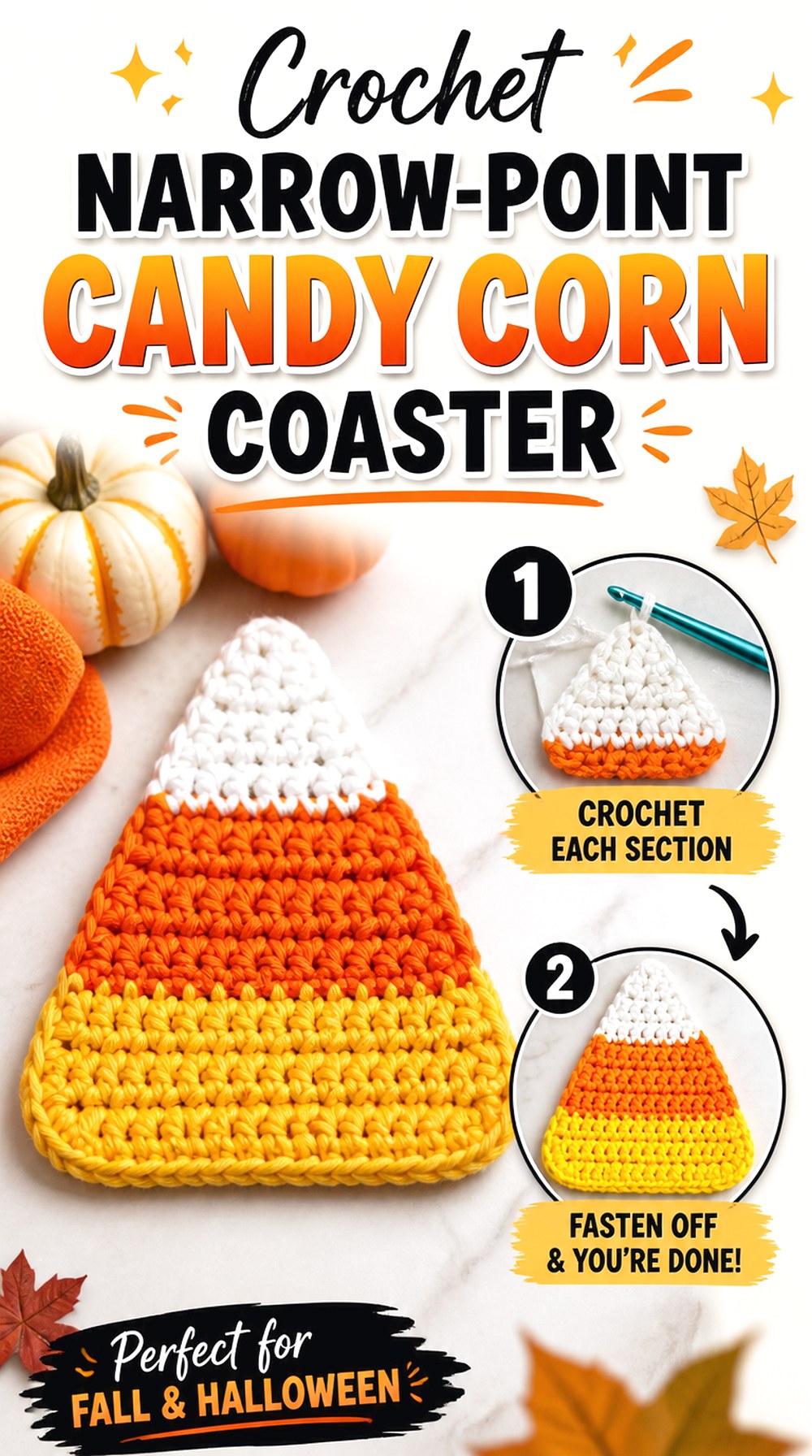
The candy corn coaster from crochet with katie 🧶 uses a strongly tapered silhouette and the familiar three-band palette. The video is presented as a step-by-step candy corn coaster tutorial, making this another direct option rather than a motif adaptation.
Its narrow top creates a graphic candy outline that reads clearly in a mixed Halloween table arrangement. That strong taper also means cup placement matters more than it would on a round coaster. If your mugs have broad bases, position one on the completed piece before making duplicates so you can decide whether you prefer the decorative silhouette or a design with more even coverage.
A Sharper Taper Makes the Shape More Decorative
The stronger the narrowing toward the white tip, the more obvious the candy shape becomes. The trade-off is reduced surface area at one end. This works nicely when the coaster will remain visible beside a mug, but very wide cups may hide much of the design while still extending beyond the upper edges.
Three Bands Need Proportion, Not Perfect Symmetry
Candy corn is recognizable because of the ordered bands as well as the outline. When substituting yarns, pay attention to how much visual space each color occupies. A very dominant middle color or tiny white tip can change the character of the finished piece even when the stitch construction remains unchanged.
Original Tutorial and Creator Credit
Creator: crochet with katie 🧶
5. Crochet Textured Round Candy Corn Coaster

The Purple Poncho takes the candy corn theme in a noticeably different direction. Its coaster is worked in the round and uses white, pumpkin-orange, and yellow sections with textural stitch changes, so the familiar palette carries the theme without relying on the classic triangular outline.
A circular shape gives a mug a more evenly distributed area to rest on, which can make this format practical for everyday use. It is also a good choice when you want a Halloween set that coordinates with ordinary round coasters rather than looking like a collection of appliqués.
Round Coverage Suits Wide Mug Bases
Unlike a pointed candy corn wedge, a circular coaster offers useful fabric around the entire drink. That can make it easier to pair with larger cups. Before changing the yarn or hook, remember that altering either may change both the diameter and how firmly the textured fabric sits.
Texture Adds Interest Without an Extra Motif
The source incorporates textural stitch work into the coaster itself. That is useful when you want more visual detail but do not want to sew a separate candy corn appliqué onto a background. Keep raised texture moderate around the central cup area so your drinkware still rests securely.
Original Tutorial and Creator Credit
Creator: The Purple Poncho
6. Crochet Broad Candy Corn Wedge Coaster

Crochet, Garden, Repeat offers another direct candy corn coaster tutorial, but it is worth treating this as a separate planning option rather than simply another color duplicate. A broader wedge can place more of the striped fabric beneath the cup while preserving the traditional candy shape. The tutorial is described as slow-paced and aimed at demonstrating the complete coaster.
This is a useful direction if you like the triangular format but want to prioritize an easy-to-read silhouette and generous lower section. Compare the finished width with the other wedge designs before deciding which construction suits your mugs.
Broad Proportions Can Improve Cup Placement
Two triangular coasters can look similar in photos yet behave differently beneath a cup. The width of the lower half has the greatest effect on usable surface. When comparing tutorials, look at the finished piece beside the creator’s hands or drinkware rather than judging only from a close-up.
Slow Demonstration Can Help With Shaping
Repeated tapering and color changes are visually simple but can become confusing if the edges begin to drift. A slower tutorial format can make it easier to see where the silhouette starts changing. Use the creator’s video for the exact construction rather than trying to reconstruct the shaping from a finished photo.
Original Tutorial and Creator Credit
Creator: Crochet, Garden, Repeat
7. Crochet Candy Corn Face Coaster

Sara Sach Crochet Designs adds a playful character option to the candy corn coaster idea. The tutorial presents candy corn coasters that can include a face, giving the flat striped shape more personality without turning it into a stuffed toy. The project can also be used decoratively as bunting.
This is a good choice for party tables or novelty sets where the coaster is meant to remain visible. If you add facial details, keep the cup-resting area in mind. Anything dimensional should be positioned so it does not create an unstable spot beneath the mug.
Facial Details Change the Functional Surface
A simple embroidered expression has a different effect from glued or raised components. Before adding optional features, place the intended cup over the coaster and identify which areas remain visible. Decorative elements positioned outside the main mug footprint preserve more of the flat central surface.
One Character Can Become a Mixed Set
The source encourages playful variations, so you do not necessarily need sixteen identical faces around a table. Keeping the basic candy corn shape and palette consistent while changing expressions can create variety without losing cohesion. Avoid loose embellishments where they may detach or interfere with drinkware.
Original Tutorial and Creator Credit
Creator: Sara Sach Crochet Designs
8. Crochet C2C Candy Corn Heart Coaster

This Povyazuli tutorial changes both the silhouette and the construction. Instead of a traditional wedge, it demonstrates a C2C cup coaster featuring a Halloween candy corn heart. That makes it one of the clearest choices in this collection for readers who want graphic colorwork rather than a literal candy-shaped edge.
A block-based C2C surface also gives the project a more conventional coaster footprint. The candy corn theme appears inside the design, so the outer edge can remain practical under a cup. This is particularly useful when you want seasonal imagery that still mixes easily with square or geometric household textiles.
C2C Turns the Candy Theme Into Graphic Colorwork
The candy corn idea is carried by the internal design instead of the outside shape. That keeps the motif recognizable while allowing the coaster to behave more like a standard cup mat. Pay attention to how color changes are managed because loose or bulky transitions can affect the reverse side.
Check the Finished Square Before Making a Set
C2C dimensions depend on yarn, hook, and individual tension. Make the first coaster as a sample and compare it with your usual mug before repeating the design. If it is meant for a coordinated table setting, consistency between finished squares will matter more than matching a theoretical measurement.
Original Tutorial and Creator Credit
Creator: Povyazuli
9. Crochet Small Scale Candy Corn Motif Coaster

Cloud 9 Knots Crochet’s September Monthly Mini tutorial demonstrates a small candy corn project rather than a dedicated coaster. For coaster use, treat it as a scale-and-shape starting point and confirm that your finished version is flat and large enough for your drinkware before using it on a table.
This idea is most useful when you prefer a compact candy shape and are comfortable adapting materials. A thicker yarn may enlarge a small motif, but it also changes fabric thickness and stiffness, so make one sample before assuming the altered version will behave like a coaster.
Scale Up Carefully Instead of Guessing
Switching to heavier yarn can enlarge a motif, but the result does not scale in a perfectly predictable way. Crochet one complete sample and measure it against the actual mug base. If the motif remains too small, use it as decoration rather than forcing it into a functional role.
Preserve a Flat Back Surface
A coaster should not rock beneath a cup. If the original mini project includes finishing intended for decoration rather than flat tabletop use, adapt only what keeps the piece level. Skip added bulk that would turn the center into a raised surface.
Original Tutorial and Creator Credit
Creator: Cloud 9 Knots Crochet
10. Crochet Tapered Candy Corn Motif Coaster

WeiWei Wei’s tutorial demonstrates a crochet candy corn designed as an appliqué. That makes this an adaptation-led coaster idea: the source gives you the flat seasonal motif, while your job is to decide whether the finished dimensions provide enough coverage for a mug.
This direction suits readers who want a clean, tapered candy shape without committing to a coaster-specific pattern. It can also work as the visual centerpiece of a larger plain coaster if the motif itself is too small. In that case, keep the attachment smooth and avoid creating a raised ridge beneath the cup.
A Background Can Solve a Small-Motif Problem
If the finished candy corn does not extend beyond your mug base, consider treating it as the decorative element rather than the entire coaster. A flat square or circular background can supply the needed coverage while the candy corn remains centered and visible.
Attachment Should Not Create a Lump
When mounting an appliqué onto another crochet surface, the seam itself can become noticeable beneath a cup. Keep joins neat and distribute them around the motif rather than concentrating bulk in the middle. Test the assembled piece on a hard tabletop before making multiples.
Original Tutorial and Creator Credit
Creator: WeiWei Wei
11. Crochet Tunisian Candy Corn Coaster

The bitknits tutorial introduces Tunisian crochet through a candy corn appliqué, giving this idea a noticeably different surface from the standard row-built wedges. Because the source is an appliqué tutorial, finished size and suitability as a coaster need to be checked rather than assumed.
Tunisian fabric can have a distinctive visual texture, which makes this a strong option for someone who wants the familiar three-color theme but a different crochet experience. Pay particular attention to curling: a decorative appliqué can tolerate some edge movement, while a coaster needs to settle flat enough for stable drinkware.
Curling Is the First Functional Check
Some Tunisian fabrics naturally want to curl depending on stitch choice and tension. Finish the motif completely and evaluate it on a hard surface before calling it a coaster. Blocking may help, but persistent curl is a sign that the piece is better used as an appliqué.
Texture Can Replace Extra Decoration
The Tunisian surface already gives this candy corn a different appearance, so additional borders, faces, or embellishments may not be necessary. Keeping the design simpler also helps preserve a level surface under the cup.
Original Tutorial and Creator Credit
Creator: bitknits
12. Crochet Flat Candy Corn Character Coaster
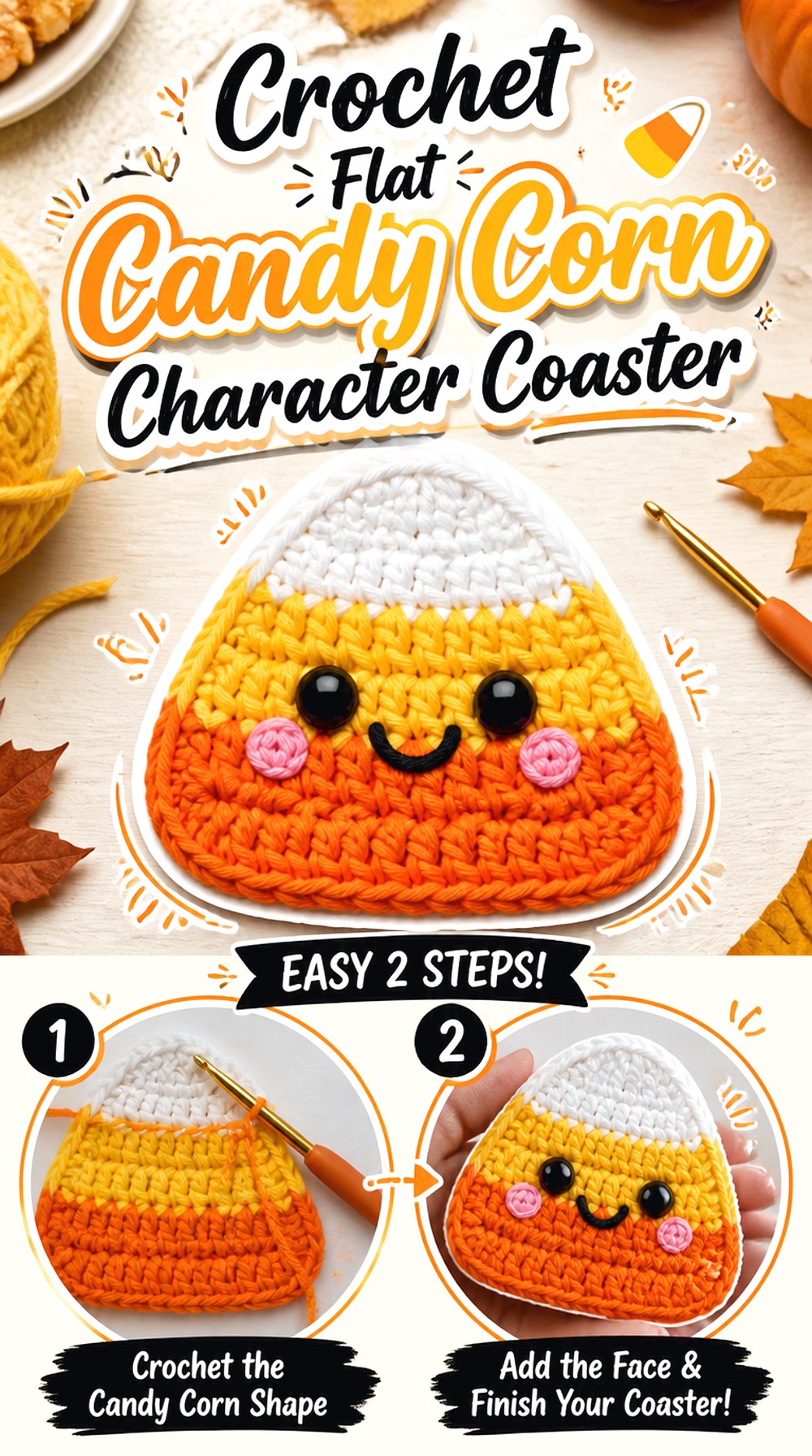
K.Bella Jolie LLC Designs presents a candy corn concept that can move from appliqué toward amigurumi. For a coaster adaptation, the key is to stop while the project is still a flat surface rather than continuing into a stuffed form. The tutorial title itself identifies that appliqué-to-amigurumi relationship.
That makes this idea useful for readers interested in character styling but still wanting a table-friendly version. Facial embroidery can add personality while keeping the piece comparatively flat. Avoid stuffing, thick protruding parts, or other dimensional details in the area where the mug needs to rest.
Stop Before the Project Becomes Three-Dimensional
A stuffed candy corn makes seasonal décor, not a practical coaster. Use the flat phase as the adaptation point and evaluate its size before adding anything dimensional. This preserves the recognizable character while keeping the project aligned with tabletop use.
Embroidery Is Flatter Than Raised Features
If you want eyes or a mouth, embroidered details generally interfere less with a mug than bulky attached pieces. Keep knots and yarn tails tidy on the reverse side as well; a flat front does not help if large finishing bumps make the coaster wobble.
Original Tutorial and Creator Credit
Creator: K.Bella Jolie LLC Designs
13. Crochet Scrap Yarn Candy Corn Coaster

Tangle with Yarn’s candy corn tutorial is presented as a quick appliqué and yarn-scrap project. That makes it attractive for using short lengths of seasonal colors, but it is still an adaptation rather than a purpose-designed coaster.
The strongest way to use this idea is to crochet one motif first and decide whether it has enough width and density for your mug. If not, the motif can sit on a larger plain coaster background. This approach also lets you use small candy corns as accents without dramatically increasing the amount of orange, yellow, and white yarn required.
Scrap Yarn Still Needs Compatible Behavior
Leftovers are convenient, but combining yarns with very different thicknesses or fiber behavior can distort a small geometric shape. For clean stripes, choose scraps that are reasonably compatible and judge the finished fabric rather than relying only on the yarn labels.
A Plain Base Can Make the Motif More Functional
A small appliqué does not have to be abandoned when it misses coaster scale. Centering it on a simple background can give the mug enough coverage while keeping the candy corn as the focal point. Make sure the added motif does not create an unstable central mound.
Original Tutorial and Creator Credit
Creator: Tangle with Yarn
14. Crochet Candy Corn Granny Square Coaster

Maria’s Blue Crayon demonstrates a flat candy corn created for a Halloween blanket project, and the accompanying project material pairs candy corn appliqués with granny-square backgrounds. That combination makes a natural coaster adaptation: use the candy corn as the visual center and let a square background provide the usable cup area.
A square format also solves one practical weakness of narrow candy corn silhouettes. Instead of relying on the triangle alone to support the drink, the surrounding fabric extends beneath the full mug base. Keep the appliqué attachment flat so the decorative center does not become a bump.
The Square Background Carries the Cup
This design works because the outer square can handle coverage while the candy corn remains decorative. Before joining the motif, place the mug on the background by itself. If the square is already too small, correct that before adding the seasonal detail.
Motif Placement Should Look Centered Under a Mug
A candy corn placed too close to one edge can make the finished coaster feel visually unbalanced. Temporarily pin or position the motif first, then check it both with and without a cup on top before sewing it down permanently.
Original Tutorial and Creator Credit
Creator: Maria’s Blue Crayon
15. Crochet Candy Corn Heart Shaped Coaster

GoldenLucyCrafts turns the familiar candy corn palette into a heart rather than a triangle. The tutorial is specifically for a crochet candy corn heart, so this idea should be treated as a novelty coaster only after you confirm the finished heart is large and flat enough for your mug.
The heart silhouette gives a softer alternative to sharp Halloween shapes and could work well for fall gifts or a playful coffee station. Because the upper indentation divides the usable surface, a heart coaster is particularly dependent on scale: a small version may be charming décor but offer limited support beneath a broad mug.
The Heart Notch Reduces Central Coverage
A heart looks wider than a triangle, but its upper notch removes fabric from part of the cup area. Test the completed shape with your actual mug instead of judging suitability by overall width alone. Larger drinkware may need a background layer.
Let the Color Bands Carry the Candy-Corn Identity
Once the silhouette becomes a heart, the yellow-orange-white arrangement is what keeps the candy corn reference clear. Strong color separation matters more here than on a literal candy-shaped wedge, so avoid three shades that blend together.
Original Tutorial and Creator Credit
Creator: GoldenLucyCrafts
16. Crochet Candy Corn Spiral Coaster

For the final idea, the candy corn theme comes from the palette rather than a literal candy motif. AshtenStitches demonstrates a Halloween spiral coaster with a decorative edge; adapting that construction in yellow, orange, and white creates a candy-corn-inspired round option without reproducing another triangular wedge.
This is the strongest choice for readers who want a functional coaster silhouette first and seasonal color second. Because the source construction is already designed as a coaster, the main adaptation decision is how to distribute the three colors so the spiral remains readable instead of turning into indistinct variegation.
Use Color Placement to Emphasize the Spiral
If the three shades change too frequently, the eye may read the surface as random striping. Larger areas of yellow, orange, and white make the candy-corn connection clearer while allowing the spiral construction to remain visible.
The Round Shape Makes This an Easy Mixer
A circular coaster can sit comfortably beside ordinary solid-color coasters or other Halloween rounds. That makes this idea useful when you want only part of a set to be overtly themed. Keep the decorative edge flat enough that the coaster does not cup upward.
Which Candy Corn Coaster Style Should You Pick?
Choose a direct triangular coaster if the recognizable candy silhouette is your priority. The round Purple Poncho option or spiral adaptation gives more evenly distributed coverage beneath a mug, while the C2C design is useful if you prefer graphic colorwork inside a conventional outer shape.
For something playful, the face coaster stands out. If you enjoy Tunisian crochet, the appliqué adaptation offers a different texture, while the granny-square approach is practical when a small candy motif needs a larger background. Motif-based ideas require the most judgment because they were not all designed as coasters; always confirm size, flatness, and cup stability before making a complete set.
Conclusion
The main choice is between a coaster shaped like candy corn and a standard coaster shape decorated with the candy corn idea. Wedge designs give you the strongest Halloween silhouette, while round, square, C2C, heart, and spiral versions offer different amounts of usable cup area and different ways to handle color.
If function matters most, start with a direct coaster tutorial and test your first finished piece with the mug you use most often. If customization matters more, an appliqué, Tunisian motif, heart, or granny-square adaptation leaves more room to experiment. Use the original tutorials linked above for their exact construction details, then make only the sizing and decorative changes that suit your intended tabletop use.
Frequently Asked Questions
What yarn is most practical for a crochet candy corn coaster?
Cotton is a common practical choice when you want absorbency and a relatively firm fabric, and some direct candy corn coaster tutorials use cotton. Other fibers can also produce attractive coasters, but check the manufacturer’s care guidance and consider how the yarn behaves with moisture and heat. A coaster should not be treated as a potholder unless the materials and design are specifically intended for that use.
Can I turn any crochet candy corn appliqué into a coaster?
Not automatically. An appliqué may be too small, too flexible, or shaped in a way that leaves much of the mug base unsupported. Finish one motif first, place your usual cup over it, and check coverage and stability. If the motif is undersized, using it as decoration on a larger flat square or circular coaster is often more practical than simply calling the appliqué a coaster.
How can I stop a triangular candy corn coaster from curling?
Uneven tension, tight edging, and unblocked fabric can all affect how a small shaped piece lies. Complete the entire project before judging it, because borders and finishing can change the outline. If the yarn allows it, appropriate blocking may help settle the fabric. If the edge still curls significantly after finishing, address that problem before repeating the coaster for a full set.
Do candy corn coasters have to use bright yellow, orange, and white?
No. The classic colors make the reference immediately recognizable, but the same layout can work with softer fall shades such as mustard, rust, and cream. The important visual consideration is contrast: if all three shades are very similar in value, the separate bands may disappear and the design will read less clearly as candy corn.
Is a round or triangular candy corn coaster more functional?
That depends on the mug and finished dimensions. A round coaster distributes fabric around the entire cup base, while a triangle devotes part of its area to a decorative point. A sufficiently broad triangle can still work well, but it is worth comparing the finished coaster with your actual mug. Shape alone cannot tell you whether coverage will be adequate.
Should I add a backing to a crochet candy corn coaster?
A backing is optional and depends on the fabric you create. It can add structure or provide a cleaner reverse side, especially for an appliqué-based design, but it can also increase thickness. If you add one, keep the layers smooth and securely attached, and check that the finished coaster still lies flat rather than developing ridges or a raised center.