20 Crochet Doily Tote Bag Ideas With Original Tutorials
Crochet doily tote bags can move in several directions. Some turn a large mandala or radial motif into the actual bag panel, while others get the same ornamental effect from flowers, bobbles, post stitches, embroidery, or concentric texture. You can also choose between soft cotton circles, crisp raffia, rugged jute, structured linings, zippered openings, and more relaxed bohemian finishes.
That variety matters because the prettiest motif is not automatically the most practical bag. Open stitches affect containment, circular panels can distort under weight, and decorative outer rounds may not be the best place to anchor handles. The 20 ideas below pair different doily-inspired looks with original crochet tutorials so you can compare construction, structure, finishing, and carrying style before choosing a direction.
Quick List
- Crochet Clustered Doily Circle Tote
- Crochet Floral Capri Doily Tote
- Crochet Bobble-Ring Doily Tote
- Crochet Textured Sonoma Doily Tote
- Crochet Jute Doily Market Tote
- Crochet Puff-Stitch Soleil Doily Tote
- Crochet Structured Harvest Doily Tote
- Crochet Chunky Bobble Doily Zip Tote
- Crochet Raffia Doily Summer Tote
- Crochet Embroidered Doily Festival Tote
- Crochet Half-Circle Garden Doily Tote
- Crochet Camel-Stitch Boho Doily Tote
- Crochet Wired-Rim Sunburst Doily Tote
- Crochet Raffia Gusset Doily Tote
- Crochet Raised-Flower Doily Handled Tote
- Crochet Beaded-Texture Doily Shoulder Tote
- Crochet Spoked Lunaria Doily Tote
- Crochet Layered-Mandala Doily Tote
- Crochet Sunflower Doily Circle Tote
- Crochet Mandala Motif Doily Tote
Decide How Much of the Doily Should Be Structural
A doily-inspired bag does not need to be open lace from center to edge. In fact, combining ornamental rounds with denser sections can make the finished tote easier to use. Large chain spaces and delicate arches emphasize the traditional doily appearance, but they also expose the contents and can stretch noticeably when the bag is loaded.
A denser outer border gives handle attachments and seams a more predictable foundation. Another option is a solid back paired with a decorative front, or a fabric lining behind two open motifs.
Think about what the bag will carry before choosing the amount of negative space. A lightweight accessory can tolerate more decorative openness than a tote intended for books, bottles, or other concentrated loads. When adapting a motif, judge both its appearance and its behavior after it reaches full bag size.
Match Yarn Behavior to the Look You Want
Fiber and yarn construction can change a radial design substantially. Soft yarn lets shells, clusters, and floral rounds drape, while raffia, tape yarn, jute, and thicker cords tend to make circular geometry look firmer and more architectural.
Neither effect is automatically better. A crisp material can make every increase and uneven edge more visible, while a flexible yarn may make a beautifully flat motif sag after assembly. If you substitute yarn, make a representative sample and compare how easily it stretches, whether the stitches remain clearly defined, and how the material feels where a handle will attach.
Blocking may help refine a motif’s shape, but it should not be treated as a cure for severe cupping or ruffling. Two panels that will be joined together should lie similarly before assembly.
Plan Handles, Openings, and Lining Early
Round panels leave less obvious space for handles and closures than rectangular totes. A strap attached to a highly open decorative round can concentrate tension into just a few loops, while an oversized handle may hide the most interesting part of the motif.
Mark prospective attachment points before finishing the border. For a zipper, check that the opening remains sufficiently straight and stable for the closure method you intend to use. A button or magnetic closure usually needs less uninterrupted edge space but still benefits from firm fabric.
Lining is particularly useful when the doily openings are large or when you want the exterior motif to keep a controlled silhouette. Remember that lining fabric also becomes part of the visual design: a high-contrast fabric highlights every opening, while a closely matched fabric makes the lace effect quieter.
1. Crochet Clustered Doily Circle Tote

This idea uses a full circular panel with alternating solid and open-looking radial sections, creating the impression of an enlarged traditional doily without making the entire bag transparent. The balanced circle makes a strong centerpiece, while a simple strap and restrained edging keep attention on the motif.
It is a useful direction when you want the classic round doily silhouette but still expect the bag to function as more than a decorative accessory. Two matched circles create a straightforward body, although that means panel consistency matters. Compare both pieces before joining them; differences in diameter or edge shape become much harder to disguise once the sides are connected.
Protect the Decorative Outer Round
The prettiest final round is not always the strongest place for a strap. If the perimeter contains chains or decorative loops, consider how much tension the carry points will place there. A denser joining round can preserve the visual edge while giving the strap a firmer connection.
Also check the circle while it hangs vertically. A motif that looks perfectly symmetrical on a table may elongate slightly once its weight is suspended.
Fringe Changes More Than the Style
Fringe can reinforce the bohemian character of a circular doily tote, but it also adds movement and visual weight around the lower edge. A heavily fringed version may make a small round bag appear longer than it actually is.
If the central motif already contains many clusters and openings, compare the bag with and without fringe before committing. A cleaner lower edge can make intricate stitch work easier to read, while fringe works best when you deliberately want a more relaxed festival-style finish.
Original Tutorial and Creator Credit
Creator/Site: Make & Do Crew
2. Crochet Floral Capri Doily Tote

For a larger statement bag, use the doily concept at a broader scale. A roomy circular panel gives radial stitch work more visual breathing room and makes even relatively simple rounds feel decorative. The result reads less like a small medallion purse and more like an oversized crochet accessory.
This style works well when you like the symmetry of a doily but prefer a cleaner surface instead of highly open lace. Concentrating embellishment or floral interest toward the center can create the same focal-point effect without weakening every part of the panel. The increased diameter makes flatness particularly important, because even a modest ripple becomes obvious across a large circle.
Large Circles Need Frequent Shape Checks
Do not wait until the panel is complete to decide whether it lies properly. Set it on a flat surface periodically and look for persistent cupping or waves along the perimeter.
Small variations can result from yarn and tension and may improve during appropriate finishing, but severe distortion usually indicates that the circle itself needs attention. Matching two equally shaped panels is more valuable than trying to force unequal pieces together with a tight seam.
Keep the Carry Points in Proportion
A broad circle can visually overpower very narrow handles. Conversely, bulky straps can cover enough of the upper motif to weaken the doily effect.
Temporarily position the planned handles against the finished panel before attaching them. This simple comparison helps you assess width, placement, and how much of the central design remains visible when the bag is carried instead of lying flat.
Original Tutorial and Creator Credit
Creator/Site: Two of Wands
3. Crochet Bobble Ring Doily Tote
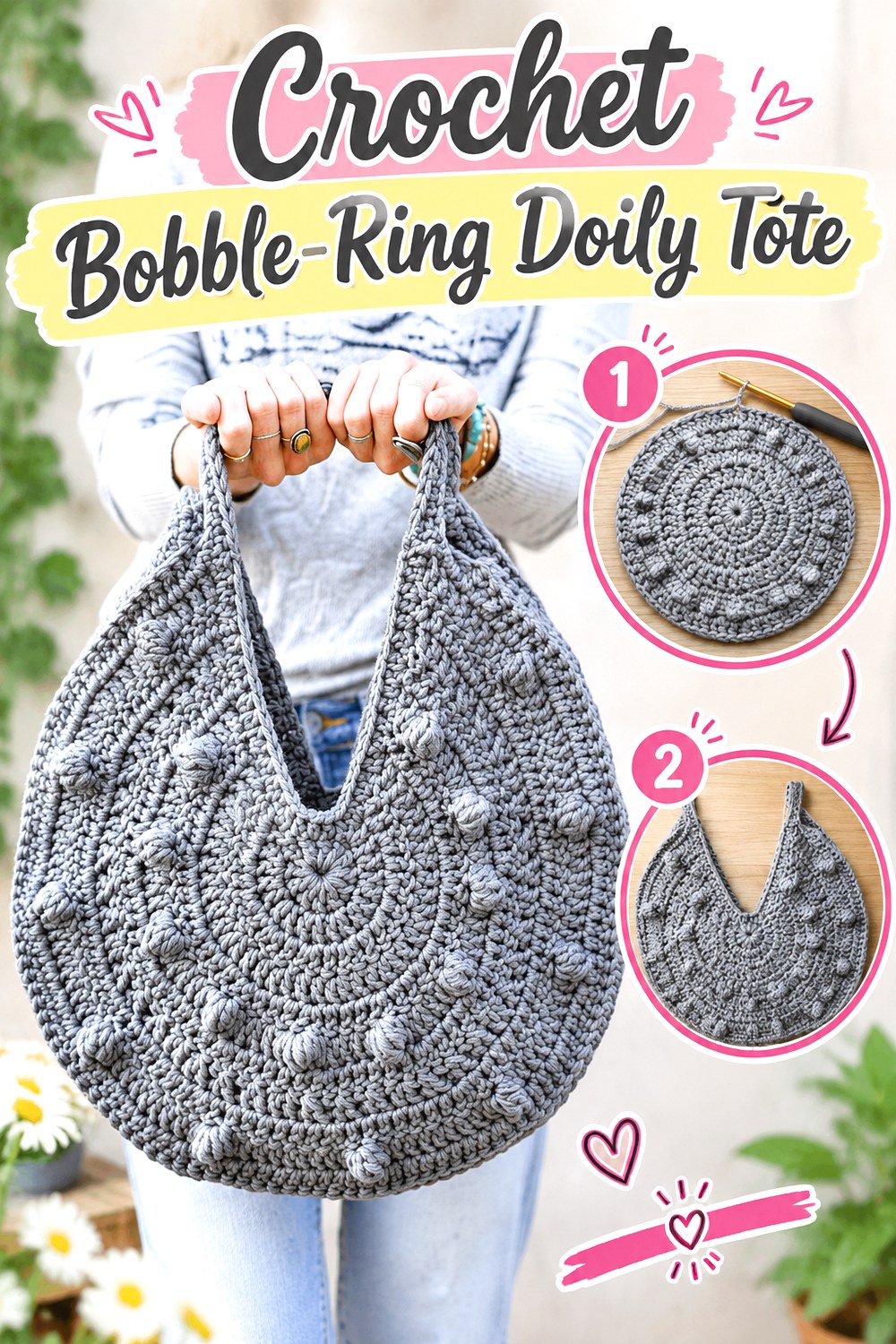
A doily does not have to rely on holes for decoration. Raised bobbles arranged around a circular bag create repeating rings of texture, giving the surface a dimensional floral quality while keeping much more of the fabric visually closed.
This direction suits a tote where texture matters more than transparency. It can also work well with a limited color palette because shadow and relief supply much of the pattern. Bobble fabric is more substantial than fine lace, however, so the finished panel may behave differently at the seam and handle area. Judge the completed fabric before choosing heavy additional trim or oversized hardware.
Dimensional Stitches Add Thickness
Raised stitches change both the appearance and physical depth of a bag. If the bobbles are prominent, joining two textured panels can produce a thicker edge than joining ordinary flat crochet.
Keep that in mind if you intend to add a lining, stiffener, or separate strap hardware. Too many structural layers can make a medium-sized tote feel unnecessarily rigid. Let the texture provide some of the visual substance before adding more components.
Give the Bobble Pattern Room to Read
A decorative circle looks strongest when the rings remain recognizable rather than disappearing beneath handles, large tassels, or contrasting appliqués.
Once the front panel is finished, view it from several feet away. Decide where the eye naturally lands, then position attachments away from the strongest part of the radial arrangement whenever the construction allows it.
Original Tutorial and Creator Credit
Creator/Site: Mama In A Stitch
4. Crochet Textured Sonoma Doily Tote

This version replaces delicate lace with pronounced post-stitch texture. The repeated lines radiating across a large circular surface can resemble the spokes and sculpted rounds found in heavier vintage doilies while giving the bag a more substantial appearance.
A textured circle also offers an alternative for readers who like ornamental crochet but do not want the contents showing through large openings. Because raised stitches influence thickness and flexibility, the body may feel firmer than a similarly sized plain-crochet circle. That can help the shape read clearly, but it makes handle choice and joining tension worth checking carefully.
Radial Texture Exposes Uneven Tension
Lines that travel outward from the center act almost like visual rulers. If one section pulls more tightly than another, the difference can become noticeable because the spokes no longer radiate evenly.
Rotate the work frequently as you inspect it. Rather than judging only the outside circumference, compare the spacing of the textured lines and make sure the center remains visually centered within the finished circle.
Separate Handles Can Become a Design Feature
A large textured tote can support visually distinct handles because the panel itself remains relatively clean. Leather-look handles, rigid handles, or another contrasting material can give the crochet a more finished handbag character.
Before attaching them, make sure the weight will be distributed across enough stable stitches. A decorative handle is most useful when it complements the texture without creating narrow stress points at the top edge.
Original Tutorial and Creator Credit
Creator/Site: One Dog Woof
5. Crochet Jute Doily Market Tote

Jute gives the round doily concept a markedly different personality. Instead of soft heirloom lace, the same circular geometry becomes rustic, firm, and almost basket-like. A relatively simple motif is usually enough because the natural material contributes substantial surface character on its own.
This is a strong choice when you want a doily-inspired tote that feels structured rather than drapey. The trade-off is handling: stiff plant-based material can behave quite differently from standard yarn and may make highly intricate stitch patterns uncomfortable or visually crowded. A broad radial design with clearly defined sections usually allows the material to remain part of the finished aesthetic.
Do Not Overcomplicate a Strong Material
When the yarn or cord is visually assertive, every additional texture competes for attention. Complex shells, dimensional flowers, fringe, and unusual handles do not all need to appear on the same bag.
Try letting the circle itself provide the doily reference. Simple concentric bands or subtle ridges can be enough to suggest a decorative medallion while retaining the clean, natural character of the jute.
Structure Still Needs an Opening Plan
A stiff circle can hold its outline well, but two rigid panels joined together may create an opening that feels narrower than expected.
Before permanently finishing the upper edge, hold the panels in their intended assembled position and test the access space. Decide whether your tote should remain open, use a button-style closure, or incorporate another solution compatible with the firmness of the material.
Original Tutorial and Creator Credit
Creator/Site: Megmade with Love
6. Crochet Puff Stitch Soleil Doily Tote

Puff stitches can make a compact circle resemble a padded flower or sunburst medallion. Instead of depending on an elaborate lace repeat, the center gains visual depth from repeated raised stitches, making this an appealing choice for a smaller tote or handbag-scale project.
The design works particularly well when you want the motif to remain recognizable even in a single color. Shadow defines the pattern naturally. Keep the surrounding finishing relatively restrained so the raised center remains the focus. Because puff stitches consume more visual and physical space than flatter crochet, check whether the final panel still has enough calm fabric near the opening for joining and handles.
Use Color Changes to Clarify the Rings
A puff-stitch motif does not need many colors, but strategic contrast can separate the center, textured ring, and outer border.
If using several shades, decide whether you want the finished bag to read as one large flower or as a series of concentric doily rounds. Repeating too many unrelated colors can obscure the radial construction, especially on a smaller panel where each band occupies only a limited area.
Keep a Compact Bag Functionally Simple
Smaller round bags have less room for multiple finishing features. A large closure, oversized tassel, bulky handle, and thick puff texture may compete within the same limited space.
Choose the feature that matters most. If the puffed medallion is the focal point, quieter finishing usually produces a more coherent result and leaves more usable room around the opening.
Original Tutorial and Creator Credit
Creator/Site: MI Handmade Home
7. Crochet Structured Harvest Doily Tote

A doily-inspired bag can retain its decorative circular face while gaining substantially more structure inside. This version is ideal for readers who want the motif to stay visually crisp rather than collapsing around whatever the bag contains.
The outer crochet can remain the decorative layer while lining, mesh, or another interior support handles more of the shaping work. That separation opens the door to slightly more delicate radial stitch arrangements because the motif does not need to provide every bit of stiffness. Still, the outer fabric experiences abrasion and strap tension, so stability should complement the crochet rather than compensate for a fundamentally fragile panel.
Decide on Support Before Final Assembly
Interior structure affects seam allowances, edge thickness, and sometimes the apparent size of the finished bag. It is easier to plan those relationships before joining the crochet than after the opening has already been finished.
Place potential lining or reinforcing material behind a completed panel and check whether it changes the drape too much. The goal is support appropriate to your intended use, not maximum stiffness.
Let the Lining Improve the Motif
A visible lining behind decorative openings can make the doily pattern easier to see. Tone-on-tone fabric produces a quieter surface; strong contrast makes every opening part of the graphic design.
Test fabric behind the actual crochet rather than selecting it from the bolt alone. Yarn color, stitch shadows, and opening size can make the same fabric look surprisingly different once it sits beneath the panel.
Original Tutorial and Creator Credit
Creator/Site: YarnThrift
8. Crochet Chunky Bobble Doily Zip Tote

For a heavier, more dimensional interpretation, turn the circular doily surface into a chunky field of bobbles and add a defined zippered opening. The contrast is appealing: the face looks soft and sculptural while the zipper creates a precise, functional boundary at the top.
This format suits a bag intended to feel more like a finished handbag than an expandable market tote. It also demonstrates how decorative crochet and non-crochet components can share structural responsibilities. Since the bobble panels, lining, zipper area, and strap attachments all contribute thickness, planning the layers before sewing helps prevent an overly bulky perimeter.
Treat the Zipper as Part of the Architecture
A zipper requires a predictable opening. Highly scalloped or deeply open doily edging immediately beside the zipper can make installation and alignment awkward.
Reserve a quieter band of fabric at the top, even if the rest of the circle is heavily textured. That visual pause can make the zipper look intentional and gives the ornamental panel a clean boundary.
Check Hardware Against the Finished Thickness
Triangle rings, clasps, chain straps, or similar hardware should suit the actual assembled edge rather than the yarn alone.
A chunky panel plus interfacing and lining can become substantially thicker than expected. Before permanent attachment, test whether the hardware sits comfortably without squeezing or distorting the crochet around the connection point.
Original Tutorial and Creator Credit
Creator/Site: The Loopy Lamb
9. Crochet Raffia Doily Summer Tote

Raffia transforms a simple round panel into a warm-weather tote with crisp stitch definition. The circular expansion remains reminiscent of a doily, but the firmer material gives the finished bag a woven, structured appearance rather than the softness associated with thread crochet.
This is a good direction if you prefer clean concentric geometry over complicated motifs. Decorative interest can come from the shape, occasional texture changes, a tassel, or the natural surface of the raffia. Because the material may resist lying flat as easily as soft yarn, pay close attention to how the circle develops instead of assuming every ripple will disappear during finishing.
Blocking Depends on the Material
Do not automatically use the same blocking process you would use for cotton thread. Raffia and similar materials can respond differently to moisture and heat.
Follow the yarn manufacturer’s care guidance and the designer’s recommendations. The practical goal is to refine the panel’s shape without damaging, flattening, or permanently changing the material.
Long Handles Need Stable Foundations
A long shoulder or crossbody strap applies leverage to a circular panel whenever the bag is loaded.
Make sure the transition between strap and body is broad enough for the chosen material. If adapting the project into a shorter-handled tote, test the proportions first; a change in handle length can significantly alter how a large circle hangs against the body.
Original Tutorial and Creator Credit
Creator/Site: Handy Little Me
10. Crochet Embroidered Doily Festival Tote
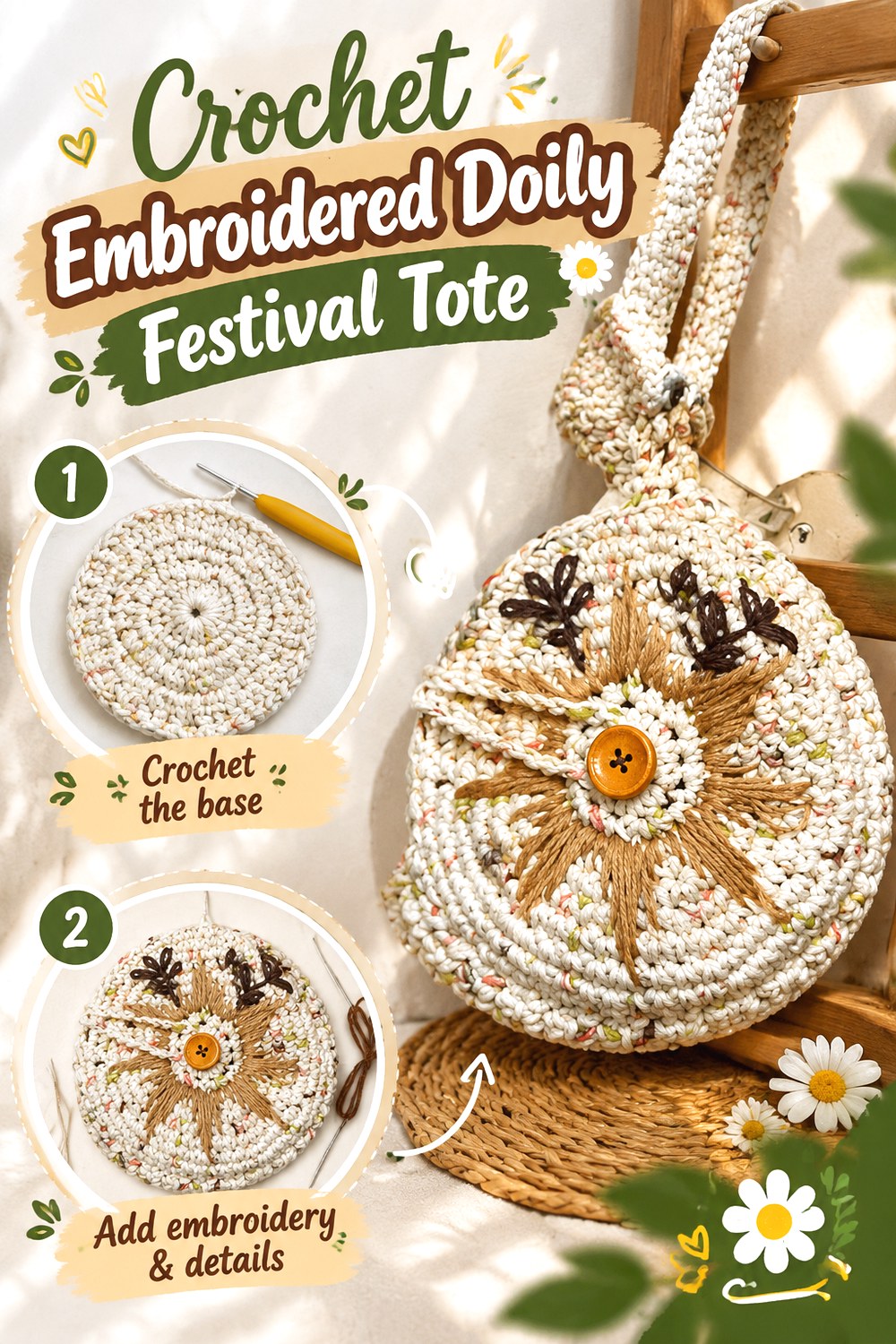
Embroidery offers another way to turn a relatively simple crochet circle into a doily-like focal panel. Instead of building every decorative detail during crochet, the finished surface can receive additional floral or geometric embellishment afterward.
That makes this direction useful if you enjoy plain structural crochet but want more control over the final ornamentation. You can evaluate the completed bag shape first, then decide exactly where the decoration belongs. This is especially helpful on a carried accessory because the visual center of a hanging bag may differ slightly from the center of a panel lying flat.
Embroider After You Understand the Final Shape
A motif placed perfectly on a flat circle can appear too low or too close to the opening once the bag is assembled.
Temporarily join or arrange the panels first. Mark the visible front area while the bag is upright, then use those reference points when planning the embroidery. This keeps the decoration connected to how the finished object will actually be viewed.
Keep Decorative Threads Practical
Embroidery sitting on the outside of a tote is exposed to more rubbing than embroidery on framed decor.
Long floats, loose loops, and raised details may snag more readily during use. Choose embellishment placement and technique with the bag’s intended role in mind, especially if it will regularly brush against clothing or furniture.
Original Tutorial and Creator Credit
Creator/Site: Designs by Diligence
11. Crochet Half Circle Garden Doily Tote

Not every doily-inspired tote needs a complete circle. A half-circle body can retain radiating crochet lines while creating a straighter upper opening, which may simplify carrying and make the finished silhouette feel less like a canteen bag.
The change in geometry also makes this option stand apart visually. Decorative stitches can spread outward like a folding fan or semicircular table doily, while the top edge acts as a strong horizontal frame. This construction can be particularly attractive when a complete round motif feels too wide for the way you want the bag to sit against the body.
A Straight Top Can Simplify Finishing
One challenge of a round tote is deciding where the opening should interrupt the circle. A semicircular design solves part of that problem by supplying an obvious top edge.
That does not remove the need for reinforcement, but it creates a more predictable location for handles and closures. Keep decorative increases concentrated below rather than allowing the upper edge to become excessively stretchy.
Charts Reward Careful Shape Checking
When a design relies heavily on charted increases and open spaces, the visual pattern itself can help reveal mistakes. Compare the symmetry of both sides regularly rather than checking only the total width at the end.
If you alter the motif, preserve the relationship between the radiating pattern and the outer curve. Randomly adding width can interrupt the fan-like balance that makes a half-doily silhouette successful.
Original Tutorial and Creator Credit
Creator/Site: DROPS Design
12. Crochet Camel Stitch Boho Doily Tote

Camel stitch introduces a subtle ridged, knit-like surface to a round bag. Used in concentric circles, those ridges resemble the repeated bands of a minimalist doily while keeping the body visually more solid than shell or mesh crochet.
The understated texture makes this idea particularly suitable if you prefer the geometry of a doily without a highly floral appearance. It also pairs naturally with a restrained closure and simple handle. Because thick T-shirt-style yarn can create a substantial circle quickly, proportion becomes important: a very heavy body paired with an extremely thin strap may look visually disconnected.
Use the Ridge Direction Intentionally
Concentric ridges naturally draw attention toward the center. That can make a plain circle surprisingly graphic.
Before adding additional decoration, decide whether the ridged surface already supplies enough interest. A simple central button, minimal tassel, or clean outer edge may be more effective than covering the directional texture with another motif.
Twisted Handles Need Attachment Space
A twisted or corded handle can complement a dense circular body because both elements feel substantial.
Do not place the attachment directly through delicate decorative loops added solely for appearance. Give the handle a stable section of crochet or appropriate hardware, and check the finished orientation before securing both sides so the handle does not twist the top of the bag inward.
Original Tutorial and Creator Credit
Creator/Site: Knitz n Purlz
13. Crochet Wired Rim Sunburst Doily Tote

A large doily-inspired circle can look striking while empty yet lose definition once gravity and contents start pulling on it. One response is to introduce structural support around the silhouette, allowing the radial crochet to remain visually prominent.
This idea is best for readers who want the bag to preserve a crisp, almost architectural round outline. The support should work with the crochet rather than becoming visible through it. It also changes care and finishing considerations, since a bag containing additional structural material should not automatically be treated like an ordinary all-yarn accessory.
Support the Outline, Not Every Stitch
A structural edge is most effective when it reinforces the silhouette without flattening all the natural character from the crochet.
Before adding support, determine which part of the shape actually needs help. If the center and panels already behave well, concentrating reinforcement around the perimeter may preserve more of the doily’s texture and flexibility.
Remember That Added Materials Affect Care
Once wire, hardware, lining, or similar components are introduced, the yarn label alone no longer determines how the complete bag should be cleaned.
Check guidance for every component and avoid assuming the assembled item can tolerate the same treatment as an unconstructed swatch. Removable accessories can sometimes make future care simpler.
Original Tutorial and Creator Credit
Creator/Site: Life Is Cozy
14. Crochet Raffia Gusset Doily Tote
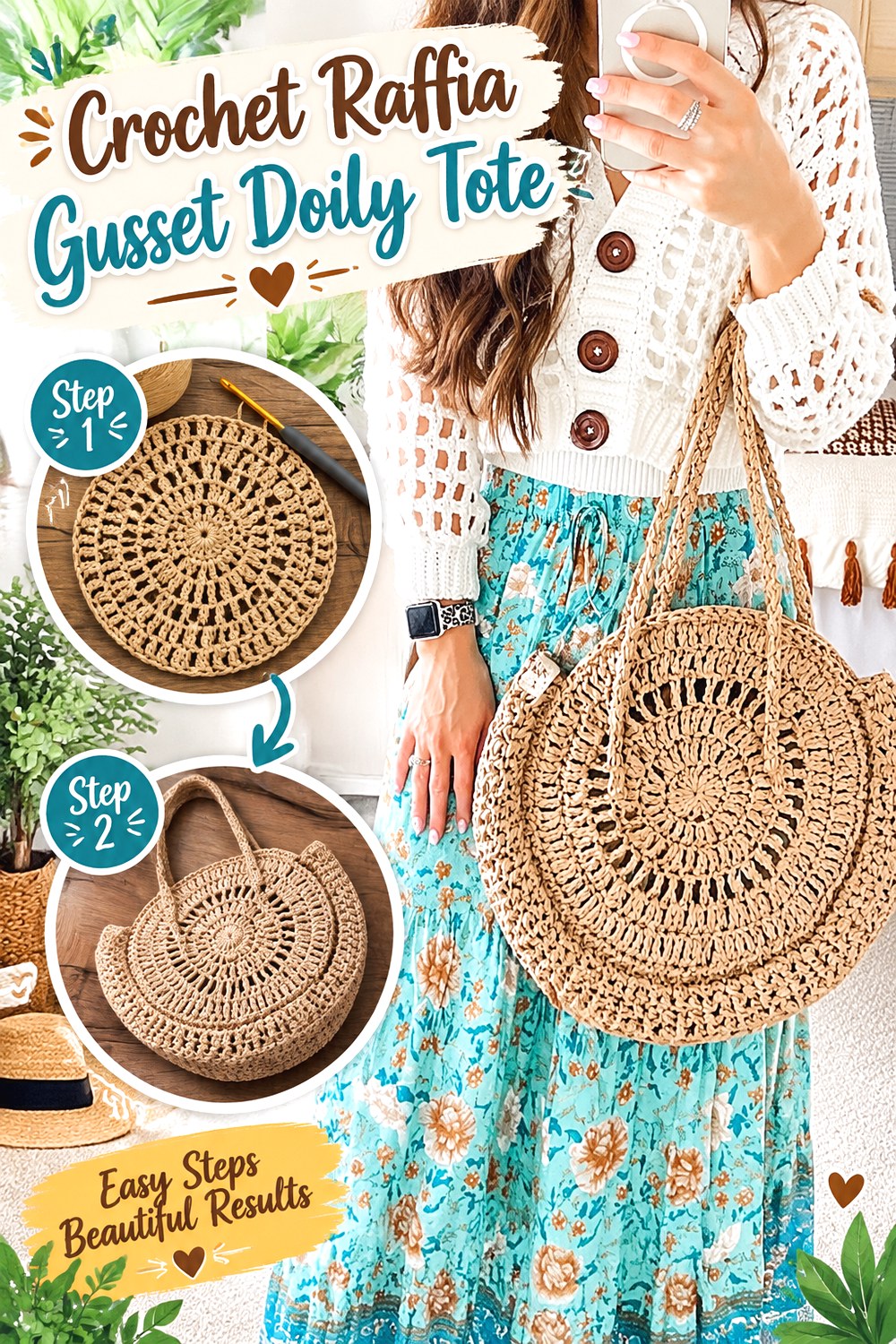
Two decorative circles do not have to be sewn directly together. Adding a gusset gives the bag depth and creates a more defined interior, turning the flat medallion idea into a roomier tote-like form.
This approach is especially useful with raffia because the material and added side depth can work together to create a more structured summer bag. It also creates separate zones for decoration and function: the round panels can carry the visual theme while the gusset handles much of the volume. The challenge is alignment, since the circumference of the panel and length of the connecting section need to cooperate cleanly.
A Gusset Changes Capacity and Silhouette
Even a modest side section can make a circular bag feel much more spacious than two flat panels joined edge to edge.
Decide whether that depth supports the doily look you want. A narrow gusset keeps the bag close to a classic round profile, while a deeper one makes it look more like a structured handbag viewed from the side.
Strap Construction Deserves Equal Attention
A carefully made motif can still be undermined by a strap that stretches noticeably or appears too light for the body.
Evaluate the strap as a structural component rather than a final decoration. Its width, material, attachment area, and construction should suit the weight and firmness of the completed bag instead of being chosen from appearance alone.
Original Tutorial and Creator Credit
Creator/Site: MJ’s Off The Hook Designs
15. Crochet Raised Flower Doily Handled Tote

Make the center of the doily unmistakably floral by using raised post stitches to form a large flower directly in the circular panel. Unlike a separate appliqué, the flower becomes part of the bag’s structural crochet, creating a cohesive medallion effect.
This style suits readers who want the bag to read immediately as floral without assembling many individual motifs. Solid surrounding rounds can provide a quieter frame and a stable area for handles. Since the flower creates relief, inspect how far it projects and whether its petals or ridges will remain comfortable when the bag rests against the body.
Frame the Flower With a Calm Border
An elaborate flower needs visual space around it. Continuing equally complex texture all the way to the edge can make the circle feel crowded and leave no obvious place for handles.
A simpler outer band acts much like the border on a traditional doily. It contains the focal motif while also providing a practical joining and attachment zone.
Check the Motif From Hanging Position
Dimensional flowers cast different shadows depending on how the bag hangs. Lift the finished panel vertically before deciding whether it needs additional blocking or shaping.
This is also the right time to choose which side should face outward if your two panels differ slightly. Put the best-centered and most visually balanced flower where it will be seen most often.
Original Tutorial and Creator Credit
Creator/Site: The Lazy Hobbyhopper
16. Crochet Beaded Texture Doily Shoulder Tote

A modified bead-style texture can give a circular bag the appearance of tiny raised dots or decorative seeds distributed around the surface. That creates a quieter doily effect than large bobbles while still adding enough relief to keep a single-color panel interesting.
Pairing this texture with a lining and separate shoulder strap can move the project toward a polished everyday bag. The exterior motif supplies handmade character, while the lining controls the contents and gives the circle additional support. This is a practical direction if you like decorative crochet but do not want large lace holes throughout the entire body.
Small Texture Benefits From Good Contrast
Fine raised texture can disappear when the yarn is very fuzzy or when the stitches are worked too loosely.
Before committing to the full panel, look at a small sample in normal daylight and from ordinary viewing distance. The detail should remain visible without depending on extreme close-up photography.
Let the Lining Do More Than Hide Holes
Lining can help a round bag keep its shape and can also separate small contents from the crocheted exterior.
Fit is important. A lining that is substantially smaller may pull the crochet inward, while an oversized lining can bunch inside. Use the finished bag—not assumed measurements—as the basis for planning an adapted lining.
Original Tutorial and Creator Credit
Creator/Site: Maria’s Blue Crayon
17. Crochet Spoked Lunaria Doily Tote

Spoke-like post stitches are one of the most natural bridges between a modern round bag and a traditional doily. They radiate visibly from the center and organize the entire surface without requiring a highly open lace pattern.
The Lunaria-inspired direction works well when structure is a priority. Holding yarn more substantially and supporting the interior creates a round bag that emphasizes geometry while remaining relatively controlled. The spokes themselves become a built-in design guide: if they remain evenly spaced and the circle lies properly, the motif reads cleanly from a distance.
Spokes Make Symmetry Easy to Judge
Use the radial lines as checkpoints while crocheting. Compare the spaces between them and watch whether the center appears to drift to one side.
An uneven outer circumference can sometimes be obvious before measurements reveal it because the spokes start looking crowded in one section and widely spaced in another. Catching that imbalance early makes correction easier.
A Firm Interior Can Protect the Circle
A circular shell can distort when individual objects press against it from inside. Interior support creates a buffer between those contents and the decorative outer surface.
If adapting the concept, choose an interior method appropriate to what you expect to carry. Extremely rigid reinforcement may be unnecessary for a light accessory, while a frequently used bag may benefit from more support.
Original Tutorial and Creator Credit
Creator/Site: Naztazia
18. Crochet Layered Mandala Doily Tote

A true mandala bag brings the doily concept closest to its ornamental roots. Here, the front and back can become distinct decorative compositions rather than identical plain circles. A layered flower option creates dimensional interest, while circular stripes provide a calmer alternative.
Mixing the two sides is an especially useful design strategy. The front can act as the statement panel while the back remains simpler against the body. That gives you substantial visual variety without requiring every surface to compete. A defined zipper and optional lining further separate the decorative crochet from the bag’s containment function.
Front and Back Do Not Have to Match
Matching panels provide perfect symmetry, but different coordinated mandalas can make the bag more interesting and help control the amount of texture.
If combining designs, make sure their finished circumferences are compatible. Two attractive motifs are not automatically suitable partners if one blocks noticeably larger or produces a very different edge structure.
Use the Closure as a Visual Boundary
A zipper introduces a crisp horizontal element into an otherwise radial design. Rather than hiding that contrast, let it define where the ornamental panel stops and the functional opening begins.
Avoid pushing dimensional flower elements right against the closure area. A small amount of calmer fabric makes operation easier and prevents the upper motif from feeling visually crowded.
Original Tutorial and Creator Credit
Creator/Site: Stitches n Scraps
19. Crochet Sunflower Doily Circle Tote
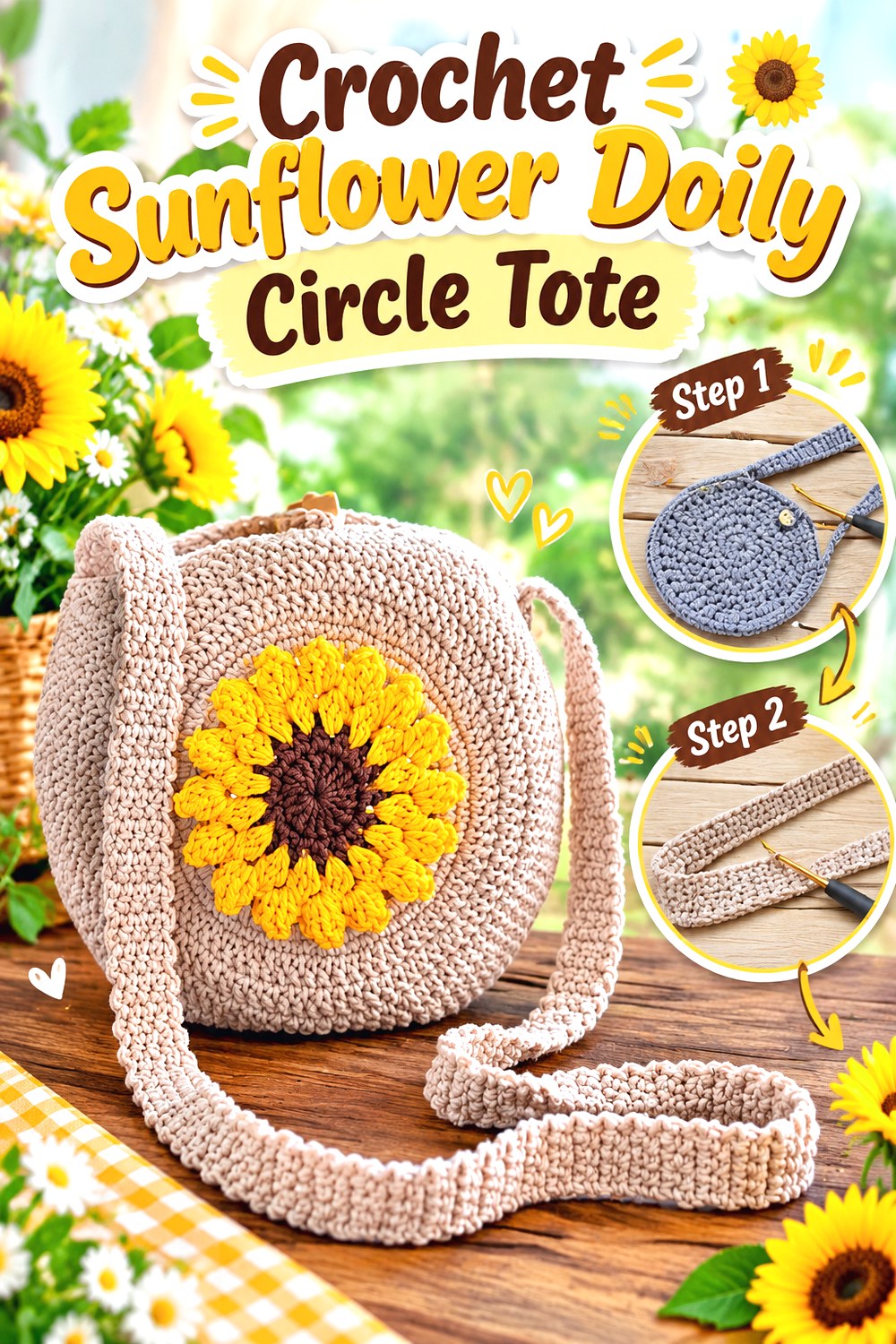
A sunflower converts the radial logic of a doily into an instantly recognizable botanical motif. The central disk naturally anchors the circle, while petals create the decorative transition into the surrounding bag panel.
This direction gives you strong visual impact without needing an all-over lace repeat. The flower can dominate the full face of the tote, leaving the outer circumference relatively simple for assembly and strap placement. That structural separation is useful: decorative petals remain protected inside the panel while the perimeter handles more of the bag’s functional work.
Keep Petals Away From Stress Points
Raised petals and handle attachments perform very different jobs. Avoid asking decorative loops to carry the strap simply because they happen to sit near the top.
A calmer outer round can provide a safer transition between flower and hardware. It also helps the sunflower remain visually complete rather than appearing interrupted by the carrying system.
Decide How Bold the Center Should Be
A high-contrast flower center makes the tote immediately read as a sunflower. Closer values create a softer, more doily-like medallion.
Lay the intended colors together before crocheting the full panel. Because the center occupies a relatively small area, even one very dark or saturated shade can become the dominant visual point of the entire bag.
Original Tutorial and Creator Credit
Creator: Chompu Handicrafts
20. Crochet Mandala Motif Doily Tote

This version treats the mandala not merely as decoration but as the architectural starting point of an actual tote. Two substantial motifs form the front and back, while added side and bottom sections turn the flat circles into a dimensional carrying shape.
It is one of the strongest choices for readers who want a genuine doily appearance without ending up with a very flat purse. The gusset creates usable depth, and the ornamental motifs remain fully visible as front and back panels. An optional lining can sit behind the lace, making the design practical even when the motif contains noticeable openings.
Tabs and Gussets Preserve the Mandala
Trying to stretch an ornate motif into a rectangular tote can distort the very geometry that makes it attractive. Adding separate structural sections lets the mandala remain closer to its intended shape.
This is a useful principle for adaptations too: preserve the decorative motif and build the functional geometry around it rather than forcing the motif itself to solve every dimensional requirement.
Block Before Judging the Final Proportions
Mandala motifs often look noticeably different after appropriate blocking. Since two panels must ultimately align, finish and compare both before beginning final assembly.
Check the overall width, corner or tab placement, and the way the decorative rounds meet the added structural sections. Small inconsistencies are easier to address before the lining and strap are installed.
Original Tutorial and Creator Credit
Creator/Site: Kristin Omdahl
Comparing the Main Crochet Doily Tote Styles
| Style | Visual Character | Structure | Best Planning Focus |
|---|---|---|---|
| Open or mandala circles | Closest to a traditional doily | Soft to moderate | Lining, motif flatness, stable strap points |
| Bobble and puff circles | Dimensional and floral | Moderate to substantial | Thickness, hardware, uncluttered edging |
| Raffia or jute circles | Crisp and architectural | Firmer | Flat shaping, handle attachment, care |
| Gusseted circle totes | Decorative front with added depth | Moderate to structured | Panel-to-gusset alignment |
| Lined or reinforced circles | Polished and controlled | More structured | Lining fit, opening, overall thickness |
| Half-circle designs | Fan-like radial appearance | Variable | Straight upper edge and symmetrical shaping |
If you want the clearest traditional doily look, start with the mandala-based options. Bobbles, puffs, and post stitches are better when you prefer a more closed exterior, while raffia and jute produce a firmer summer-bag effect. Gusseted and lined versions make sense when practicality matters as much as the decorative front.
Conclusion
The strongest crochet doily tote bag ideas use ornament and structure deliberately rather than expecting one delicate motif to perform every job. A mandala can become the entire face of a tote, a sunflower can create the radial centerpiece, bobbles and post stitches can replace open lace, and raffia or jute can turn familiar doily geometry into something much firmer.
Before choosing, think about the intended contents, opening, handle placement, transparency, and how much shape you expect the bag to retain. Those decisions will quickly narrow the list. Once you have selected a construction that suits your use, follow the credited original tutorial for its exact stitch work, measurements, assembly, and project-specific finishing details.
Frequently Asked Questions
Can I turn an ordinary crochet doily into a tote bag panel?
Sometimes, but compatibility depends on the motif. A decorative doily may have an irregular scalloped perimeter, very fine thread, or large open sections that were never intended to carry tension. If you want to adapt one, evaluate its blocked size, edge stability, and where handles or seams could attach. A safer approach can be mounting the doily on a denser crochet or fabric panel so it acts as decoration rather than the primary structural wall.
Should a crochet doily tote bag always have a lining?
No. Lining depends on the stitch density, intended contents, and amount of structure you want. Large lace openings make lining more useful for containing keys and other small items, while dense bobble, post-stitch, jute, or raffia designs may function well without one for certain uses. A lining can also control stretch and change the exterior appearance, so test fabric behind the crochet before deciding on color and opacity.
What yarn works well for a doily-inspired tote?
There is no single best yarn because the desired effect varies. Cotton and other relatively defined yarns can show ornamental stitches clearly, while raffia, tape yarn, cord, and jute create firmer, more architectural circles. Softer yarn produces more drape but may allow a large panel or long strap to stretch. When substituting yarn, compare the resulting fabric rather than relying only on the yarn-weight label.
How can I stop a circular tote from becoming wavy?
Frequent shape checks are more useful than trying to repair a severely distorted panel at the end. Lay the circle flat as it grows and watch for persistent ruffling or cupping. Tension, yarn choice, hook size, and the motif’s increase structure can all affect the result. Some materials can be refined through appropriate blocking, but always follow the fiber’s care guidance and the original designer’s project instructions rather than assuming aggressive blocking will solve every shaping problem.
Where should handles attach on an open doily motif?
Look for a stable part of the perimeter rather than simply choosing the visually highest point. Large chain spaces, picot-style loops, or delicate scallops may not be ideal places to concentrate carrying tension. A denser border, side tab, gusset, or separate reinforced attachment section can protect the ornamental edge. Temporarily mark both handle positions and lift the empty bag before permanently attaching them to check balance.
Can I make a doily tote larger by adding extra motif rounds?
Possibly, but adding rounds changes more than diameter. A designer’s increase pattern controls whether the motif remains flat, and continuing an ornamental repeat without the correct expansion can cause cupping or ruffling. A larger panel also changes the amount of yarn, the necessary opening width, handle proportions, lining size, and potentially the structural behavior of the bag. Check whether the original tutorial provides resizing advice before extending the motif independently.