
15 Crochet Fall Suncatcher Ideas for Windows, Hoops, and Spinners
Fall suncatchers do not have to be limited to glass or acrylic ornaments. Crochet can create its own window-friendly effect through open lace, framed motifs, dangling silhouettes, spirals, and small seasonal shapes that become especially noticeable when daylight outlines the stitches.
The 15 ideas below range from maple leaves and acorns to pumpkins, mushrooms, spiderwebs, stars, and a Tree of Life. Some of the original tutorials already teach a hoop, dreamcatcher, or wind-spinner construction. Others teach a verified seasonal motif that can become the focal crochet element in a separate window hanging. That distinction matters: the ideas here are inspiration and planning guidance rather than substitutes for the designers’ instructions. Use the comparison points to decide whether you want a flat framed piece, a vertical drop, a moving spinner, or a more dimensional seasonal display.
Quick List
- Crochet Maple Leaf Hoop Suncatcher
- Crochet Pumpkin Spiral Suncatcher
- Crochet Sunflower Medallion Suncatcher
- Crochet Oak Leaf and Acorn Drop Suncatcher
- Crochet Woodland Mushroom Ladder Suncatcher
- Crochet Apple and Leaf Drop Suncatcher
- Crochet Owl Silhouette Hoop Suncatcher
- Crochet Spiderweb Hoop Suncatcher
- Crochet Ghost Drop Suncatcher
- Crochet Autumn Tree of Life Suncatcher
- Crochet Petite Floral Prism Suncatcher
- Crochet Lacy Mandala Hoop Suncatcher
- Crochet Autumn Star Constellation Suncatcher
- Crochet Candy Corn Cascade Suncatcher
- Crochet Turkey Feather-Fan Suncatcher
Decide What “Suncatcher” Means for Your Crochet Display
Crochet itself does not refract sunlight in the way a faceted crystal does. Its strength is different: open stitches, silhouetted motifs, and suspended shapes become more defined when light passes around or through them. A lace mandala can therefore work as a fiber suncatcher without any reflective component, while a small prism or translucent bead can be added separately when actual rainbow reflections are part of the goal.
Decide which effect you want before choosing a project. Dense pumpkins, ghosts, apples, and mushrooms work mainly as silhouettes. Spiderwebs, mandalas, and dreamcatcher-style designs make better use of negative space. Long wind spinners introduce movement instead. If you add crystals or beads to a tutorial that did not originally include them, treat that as your own adaptation and make sure the hanging structure can safely support the extra weight.
Choose Between a Hoop, Vertical Drop, or Spinner
A hoop gives a flat motif a defined boundary and helps it read clearly against a busy outdoor view. It is particularly useful for leaves, webs, flowers, and circular lace. Before framing a motif, compare its finished dimensions with the inner opening of the intended ring rather than assuming that changing yarn alone will produce the right fit.
Vertical drops make better use of multiple small pieces. Acorns, mushrooms, stars, apples, and candy corn can be spaced along one or several strands without forcing them into a circle. Keep the visual weight balanced so the hanging does not constantly lean to one side.
Spinners are different again. Their appeal comes from three-dimensional curling and movement, so crowding them with extra motifs can interfere with the silhouette. If the original designer provides a hanging method, follow that construction rather than improvising from an applique pattern.
Plan Window Placement and Small Parts Carefully
Window decorations are exposed to light, repeated movement, and sometimes curious hands or pets. Secure every attachment point, especially when the design includes beads, crystals, safety eyes, stuffed pieces, or separate appliques. Small detachable components are not appropriate where babies or young children can reach them, and long hanging cords also deserve extra caution.
Direct sun can gradually affect some yarn colors, while moisture or outdoor exposure may change how fibers behave. Follow the yarn manufacturer’s care guidance and any care notes supplied by the project designer instead of assuming every finished piece can be washed or left outdoors.
For framed pieces, check the hoop and hanger before display. For long drops or spinners, periodically inspect the upper connection because that point carries the entire project. Keep fiber decorations away from candles, flames, and other high-heat sources.
1. Crochet Maple Leaf Hoop Suncatcher

A single maple leaf makes a strong fall focal point because its lobed outline remains recognizable even when viewed as a window silhouette. Zamiguz’s tutorial creates a shaped maple leaf with pronounced points and a stem, giving you a useful crochet element for a minimalist seasonal hanging.
For a suncatcher interpretation, center one leaf inside a plain hoop rather than filling every inch of the ring. That unused space is what allows the outline to stand out against daylight. One large leaf feels graphic and contemporary; several small leaves would create a busier mobile instead. Before choosing yarn or a frame, make the tutorial motif first so you know its actual size at your tension.
Let Negative Space Frame the Leaf
A maple leaf already contains a complex perimeter, so it does not need an elaborate surrounding border. Leaving clear space between the pointed lobes and the hoop gives sunlight room to outline each section. If the leaf nearly fills the ring, the silhouette can start to merge with the frame.
Consider attaching the leaf at several structurally sensible points rather than pulling hard on only the stem. Any mounting method beyond the tutorial should support the motif without noticeably distorting its lobes.
Shape the Points Before You Hang It
Pointed crochet motifs can curl or look uneven immediately after finishing. The Zamiguz project includes a distinctly shaped leaf, so take time to evaluate the final outline before turning it into window decor.
If your yarn is suitable for blocking, gentle shaping can help define the lobes. Always use a blocking or care method appropriate for the actual fiber. A badly distorted leaf will be more noticeable in strong backlighting than it would be lying flat on a table.
Original Tutorial and Creator Credit
Creator/Site: Zamiguz
2. Crochet Pumpkin Spiral Suncatcher

This choice replaces a static hoop with a hanging shape that moves. Start Crochet’s original pumpkin wind-spinner tutorial combines a curling vertical body with a three-dimensional pumpkin and additional seasonal detailing, so it already functions as a complete hanging decoration rather than merely supplying an applique.
Hung near a bright window, the spiral gives you changing lines and shadows as air movement turns the piece. It suits readers who want a more substantial fall statement than a small ring. Because the source includes stuffed and projecting elements, this design is visually heavier than the lace projects later in the list. Resist the urge to add numerous crystals or charms unless you have first checked how additional weight affects the hanging point and movement.
Let the Spiral Supply the Motion
The curled body is the defining difference here. Adding several extra strands around it may make the spinner visually crowded and can obscure the continuous twist that gives the project its character.
Choose a window or sheltered hanging location with enough clearance for the decoration to turn without rubbing against blinds, curtains, plants, or glass. If you display it outdoors, confirm the designer’s material and care guidance rather than assuming that any yarn will tolerate prolonged weather exposure.
Keep the Pumpkin in Proportion
A dimensional pumpkin creates a much stronger visual mass than a flat applique. The source intentionally combines the pumpkin with the spinner, so following its intended relationship will give you a more coherent result than randomly enlarging one element.
If you substitute yarn, remember that changes in fiber, hook choice, and tension may affect both the size and weight of the embellishment. Check the relationship between the pumpkin and spiral before completing any optional additions.
Inspect the Hanging Point
Movement repeatedly loads the top connection, so this is a project where finishing matters as much as appearance. Tug gently on the completed hanging loop before putting it over a window, porch, or walkway.
If you add hardware that is not part of the source, make sure it is appropriate for the finished weight. A moving decoration should not depend on a loosely tied yarn tail or an adhesive hook that is not rated for its use.
Original Tutorial and Creator Credit
Creator/Site: Start Crochet
3. Crochet Sunflower Medallion Suncatcher

A sunflower sits naturally between late summer and fall, making it useful for decor that goes up before pumpkins and Halloween motifs take over. EyeLoveKnots’ tutorial teaches a sunflower applique with a noticeably textured center and defined petals.
For a window piece, treat that flower as a central medallion. It could sit within an open hoop, hang from a short loop, or anchor the top of a simple vertical drop. Unlike the maple leaf, the sunflower is radially balanced, so it works well when centered. Strong backlighting will emphasize the petal perimeter more than interior color, making the texture and clean shaping especially important. Make the flower first, then select a ring or hanging method that gives the petals breathing room.
Make the Center the Visual Anchor
The source design features a textured flower center, which distinguishes it from flatter sunflower motifs. In window decor, that dense middle can act as the visual weight that stabilizes the more open petal edge.
If you introduce a prism, hang it below the flower rather than covering the center unless you deliberately want the crochet to become secondary. Too many competing focal points can make a compact suncatcher look cluttered.
Give the Petals Clear Edges
Petal shapes are easiest to read when they are not pressed against an equally busy frame. If you mount the sunflower inside a hoop, compare the flower’s actual diameter with the usable opening after it is finished.
Avoid stretching petals aggressively just to make them touch the ring. That can alter the flower’s proportions. A slightly floating appearance often works better because daylight remains visible around the entire circumference.
Original Tutorial and Creator Credit
Creator: Yarn Crafts | EyeLoveKnots | Cre8tion Crochet
4. Crochet Oak Leaf and Acorn Drop Suncatcher

This woodland option uses two different forms instead of one repeated motif. The Crochet Circle’s original tutorial includes both oak leaves and dimensional acorns, providing natural contrast between flat foliage and small three-dimensional elements.
For a suncatcher-style window drop, arrange one or two leaves higher on the hanging and let the acorns provide weight lower down. That produces an asymmetrical branch-like silhouette rather than a circular composition. It also gives you a distinctly autumnal project without relying on orange pumpkins. Because the acorns are dimensional, consider where the finished piece will hang; repeated contact with window glass may be more noticeable than with an entirely flat decoration.
Balance Flat Leaves with Dimensional Acorns
Combining flat and stuffed pieces creates depth, but it can also make a vertical hanging rotate unevenly. Before permanently securing the motifs, temporarily suspend the arrangement and see which side naturally pulls downward.
A balanced design does not have to be perfectly symmetrical. It simply needs enough control that the intended oak-leaf silhouette remains visible instead of constantly twisting into a bundle.
Protect the Vertical Line from Twisting
A long single strand can rotate more than a framed piece. Leave enough space between the oak elements so the leaves do not continuously catch on the acorns.
If you incorporate beads as spacers, consider them an adaptation rather than part of the tutorial unless the source specifically includes them. Keep any small components securely attached and out of the reach of young children and pets.
Original Tutorial and Creator Credit
Creator/Site: The Crochet Circle
5. Crochet Woodland Mushroom Ladder Suncatcher
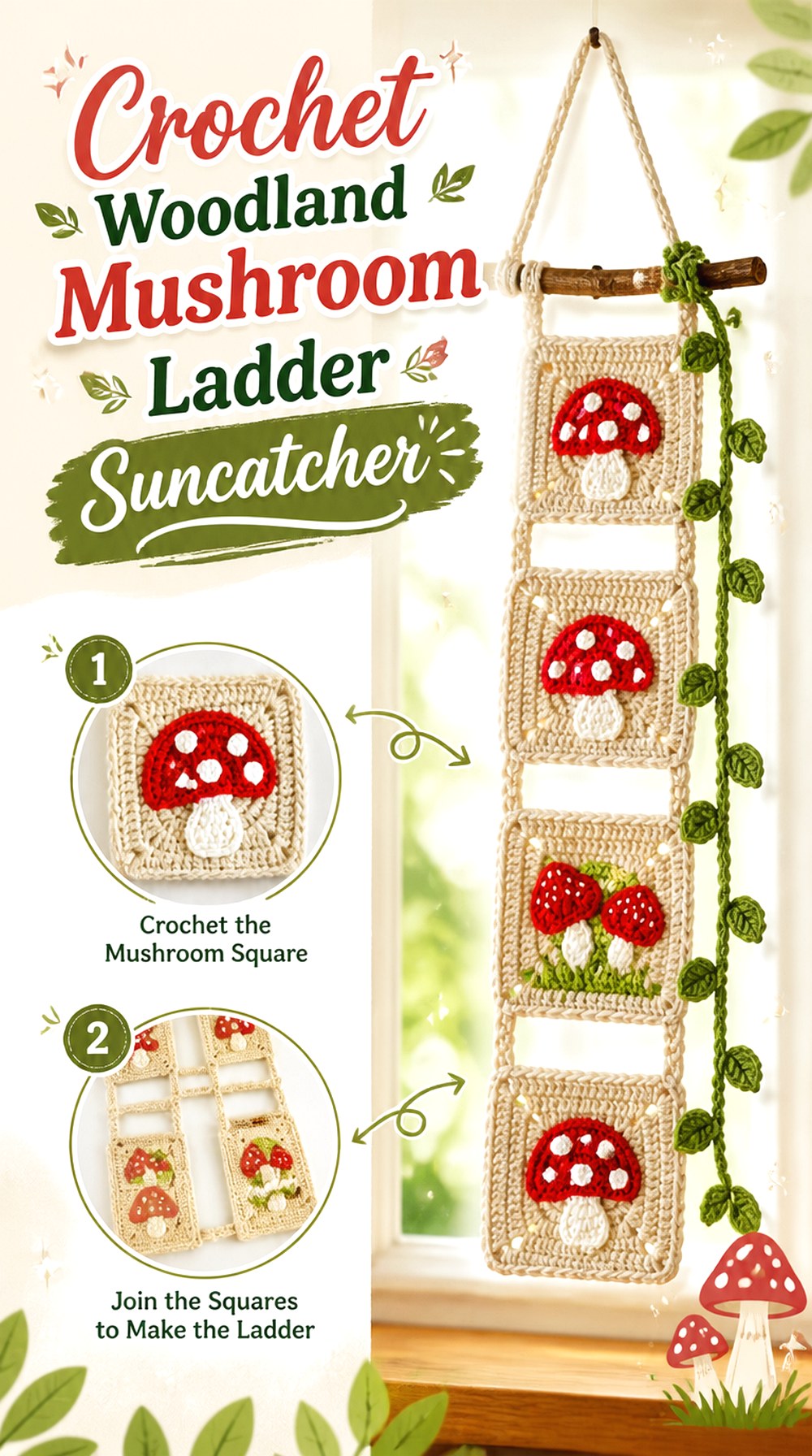
Instead of arranging motifs around a hoop, this idea stacks mushrooms vertically like a small ladder or botanical specimen display. RaffamusaDesigns provides an original tutorial for crochet mushroom appliques in two sizes, giving you a built-in way to vary scale without changing the subject.
Three mushrooms separated by open sections of cord can form a narrow suncatcher for a side window, kitchen window, or other place where a broad hoop would feel crowded. Keeping the caps in different autumnal or woodland shades can add variety, but the stronger design difference comes from alternating size and orientation. Since the tutorial produces appliques, the ladder assembly itself is your adaptation; plan the attachment so each mushroom hangs flat rather than folding around the cord.
Use Scale Changes Instead of More Motifs
The source includes more than one mushroom size, so you can create movement simply by alternating larger and smaller shapes. A graduated sequence is often clearer than filling the hanging with many nearly identical pieces.
Try evaluating the arrangement on a table before attaching anything. If the eye cannot distinguish the individual caps and stems at a glance, increase the spacing rather than adding another decorative element.
Keep the Silhouettes Flat Near Glass
Flat mushrooms are better suited to a narrow window space than heavily stuffed amigurumi because they are less likely to project into blinds or curtains. Even so, appliques can curl depending on yarn and tension.
If shaping is needed, follow care guidance appropriate for the yarn. Do not assume that heat or aggressive steaming is safe for every fiber. Secure the stem area carefully so the motif does not flip upside down when the hanging moves.
Original Tutorial and Creator Credit
Creator/Site: RaffamusaDesigns
6. Crochet Apple and Leaf Drop Suncatcher
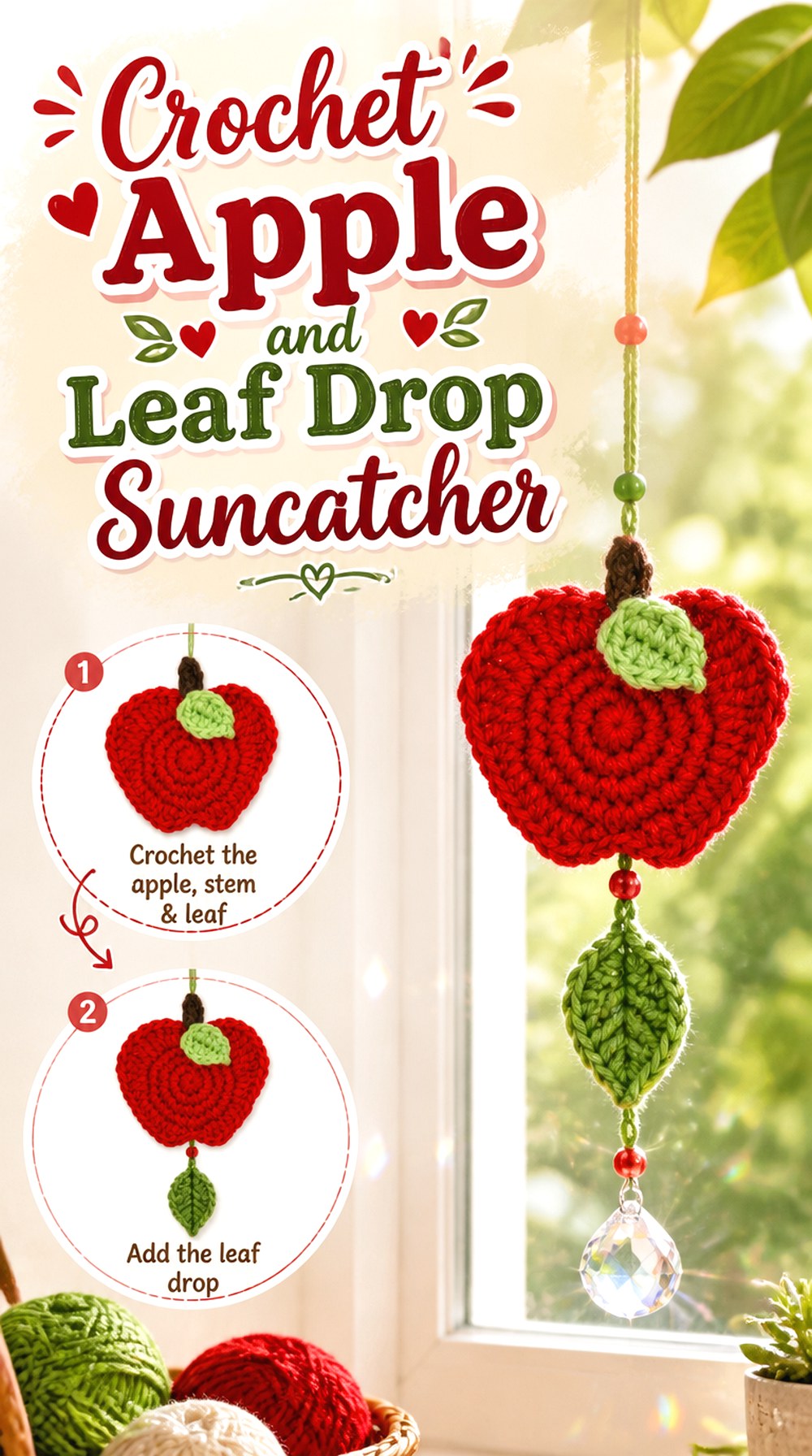
Apples bring a harvest and back-to-school note to fall decor without looking specifically Halloween-themed. Jess Crafting’s original apple applique includes the recognizable fruit shape with its stem and leaf, making it a compact focal piece for a narrow window hanging.
Instead of framing the apple in a hoop, let it hang as the lowest element of a short drop, with additional open space or a simple secondary leaf above it. This arrangement gives the rounded apple room to read clearly against daylight. Red is the obvious choice, but the silhouette is more important than color when the piece is strongly backlit. The source teaches the applique itself; any added cords, beads, or prism components should be planned independently and not attributed to the designer.
Use the Leaf as a Directional Accent
The small leaf breaks the symmetry of the apple and gives the motif a clear top. When you suspend it, orient that detail intentionally instead of allowing the entire applique to rotate sideways.
If you add a second leaf higher in the hanging, avoid placing it directly over the apple. A slight offset can make the composition feel more like a falling harvest branch while preserving clear space around both shapes.
Leave Breathing Room Around the Fruit
Rounded motifs can look visually heavier than thin leaves or lace. Avoid surrounding the apple with a dense fringe that competes with its outline.
A simple top loop, one open connector, and the apple can be enough for a small window. If you want a longer hanging, repeat negative space between components rather than packing the strand continuously with yarn.
Original Tutorial and Creator Credit
Creator/Site: Jess Crafting
7. Crochet Owl Silhouette Hoop Suncatcher

An owl provides a more figurative woodland theme and changes the visual language of the list completely. Kerri’s Crochet teaches an owl applique made from several recognizable facial and body components. For a fall suncatcher, place the finished owl inside or just below a simple hoop rather than surrounding it with many additional animals.
The face becomes the primary focal point, so this project suits a window where viewers can stand fairly close rather than a high exterior display. Warm brown, rust, cream, or muted green can reinforce the fall feeling, but you do not need to alter the designer’s construction to create seasonal styling. Since the source is an applique tutorial, any hoop mounting is a separate finishing choice.
Frame the Face, Not Every Feather
An owl already has several internal details, which means an elaborate crocheted frame can make the design difficult to read. A plain wrapped hoop or minimal suspension line allows the eyes and body outline to remain dominant.
When choosing hoop size, assess the actual finished applique rather than relying on a generic measurement. The goal is not to stretch the owl to the ring but to give its silhouette a quiet boundary.
Secure Facial Details for the Display Location
Applique eyes and other small pieces deserve extra attention in a hanging decoration. Check every sewn component before display, particularly if the finished piece could be reached by a child or pet.
For decor intended around very young children, avoid loose or detachable embellishments. Follow the tutorial for the original assembly, and make any safety-driven substitutions only when you understand how they will change the appearance and construction.
Original Tutorial and Creator Credit
Creator: Kerri’s Crochet
8. Crochet Spiderweb Hoop Suncatcher

Few crochet motifs are as naturally suited to a window as a spiderweb. The open radial structure is designed around negative space, and Craft Fix’s tutorial specifically teaches a crochet web that can be adjusted in size and shaped after crocheting.
Mounting the web in a circular ring creates a Halloween suncatcher without needing a dense centerpiece. Morning or afternoon light can outline the spokes and spaces, while the hoop keeps the overall shape crisp. A tiny crochet spider is optional rather than necessary; the web alone has enough visual identity. Because the source discusses shaping and stiffening, it is a stronger choice than simply stretching an unrelated doily into a frame.
Match the Web to the Ring
The source allows the web to be made at different sizes, which is useful when you already own a particular ring or hoop. Still, crochet tension can vary, so stop periodically and compare your work with the intended frame rather than relying only on theoretical sizing.
A web that is too small may become distorted when stretched. One that is too large may sag. Aim for even tension around the perimeter rather than maximum tightness.
Stiffening Changes the Finished Character
Craft Fix demonstrates shaping and the use of stiffener for the web. A firmer web will generally hold its geometry more consistently, while an untreated one may have a softer textile appearance.
Use only a product and method appropriate for your chosen yarn and intended location. Test unfamiliar finishes on scrap yarn first when possible, particularly if color or texture changes would be noticeable in strong daylight.
Keep Halloween Decor Away from Flame
Spiderwebs are often displayed alongside candles and lanterns, but yarn decorations should not be placed close to open flames or other high-heat sources. A bright window gives this design all the contrast it needs.
If you add a dangling spider or bead, inspect the attachment before each season. Storing a hoop flat or protected from crushing can also reduce the amount of reshaping required next fall.
Original Tutorial and Creator Credit
Creator: Craft Fix knitting & crochet
9. Crochet Spiderweb Hoop Suncatcher

For a playful Halloween window piece, a ghost creates a clean silhouette with fewer interior details than an owl or turkey. Winding Road Crochet’s original pattern provides crochet ghost appliques in two sizes and discusses using the finished motifs in several types of decor.
That makes the design well suited to a short vertical drop: suspend one larger ghost as the focus or combine differently sized ghosts with generous spacing between them. The white shape will read strongly against a darker outdoor view, although any seasonal color scheme can work if the outline stays clear. Avoid surrounding each ghost with thick fringe, which can blur the recognizable lower edge. Any window suspension system is an adaptation beyond the applique tutorial.
Choose One Large Ghost or a Small Group
Using one larger motif produces a cleaner graphic result, while multiple smaller ghosts create movement. Decide which effect fits the window before making several pieces.
If you use both source sizes, position the largest low enough to visually anchor the hanging. Do not assume you need perfectly even spacing; a slightly staggered arrangement can look more animated as long as the motifs do not overlap.
Keep the Face from Becoming the Weak Point
A ghost only needs minimal facial detail to remain recognizable. Secure any sewn or attached features carefully, especially when the decoration will move or be packed away after the season.
If the display is accessible to children, avoid small detachable components. Embroidered features may be worth considering when compatible with the designer’s construction, but any alteration should be made with awareness that it is your adaptation rather than part of the original instructions.
Original Tutorial and Creator Credit
Creator/Site: Winding Road Crochet
10. Crochet Autumn Tree of Life Suncatcher

The Tree of Life is one of the strongest direct matches for a crochet suncatcher because the design already relies on open space inside a hoop. Crochetez avec Nadège’s tutorial teaches a crocheted Tree of Life as a dreamcatcher and shows two approaches to the design.
For fall, the seasonal character can come from the foliage colors rather than from changing the construction. Rust, ochre, muted green, burgundy, and brown can suggest a tree in transition while the trunk and branching structure remain the visual center. This option is more architectural than a simple applique: branch placement and hoop tension both influence the final silhouette. It suits a prominent window where the complete ring can be seen.
Branch Tension Controls the Silhouette
Tree motifs depend on the relationship between trunk, branches, and outer ring. If one side is pulled much tighter than the other, the tree may appear visually tilted even when the hoop itself is level.
Follow the tutorial’s attachment approach rather than treating the crochet as a loose applique. As you work, step back occasionally and look at the whole branching shape instead of focusing only on individual stitches.
Choose One Dominant Autumn Accent
The source demonstrates alternatives involving color and beads. For a fall window piece, consider allowing either the autumn yarn palette or the added embellishment to be dominant rather than making both equally busy.
A quieter trunk with a concentrated band of leaf color can emphasize the tree shape. If you use beads, secure them carefully and avoid locations where small parts are accessible to children or pets.
Check the Ring Connection Before Display
Unlike a dangling applique, the entire tree is visually dependent on its perimeter. Inspect the attachment around the ring for consistent tension and secure finishing.
If the hoop will hang in a frequently opened window, consider whether repeated movement could cause rubbing or distortion. A protected indoor window may preserve the branch arrangement better than an exposed outdoor location unless the tutorial and materials are intended for that use.
Original Tutorial and Creator Credit
Creator: crochetezavecnadege “Crochetez avec Nadège”
11. Crochet Petite Floral Prism Suncatcher

Sweet Softies’ Petite Floral Dreamcatcher offers a much smaller alternative to the large Tree of Life and mandala projects. The original tutorial centers a puff-stitch flower within a mini dreamcatcher-style design and incorporates bead possibilities into the decorative concept.
For fall, replace springlike styling with muted mustard, rust, deep plum, olive, or warm cream while retaining the compact floral construction. If you specifically want prismatic light, a small faceted hanging element can be added only if your attachment method is secure and compatible with the finished piece. The mini scale makes this one well suited to narrow windows, groups of two or three, or locations where a large hoop would dominate the view.
Small Scale Works in Awkward Windows
A petite hanging can fit beside plants, between window sections, or in a narrow vertical pane where a large ring would block too much of the view. That makes scale part of the function rather than simply a style preference.
Before making multiples, finish one and hold it in the intended location. Several small pieces can quickly feel busier than one medium design, particularly when beads and fringe are also involved.
Add Shine Without Hiding the Crochet
If the goal is true refracted light, position a crystal or prism so it complements rather than covers the flower. The center motif should remain readable when seen from across the room.
Extra hardware adds weight. Test the complete hanging vertically before installing it at a window, and use a connection suitable for the component you add. Do not rely on an ornamental bead strand to carry more weight than it was designed for.
Check Every Bead Connection
The source embraces bead combinations as part of its customization possibilities. In a moving window hanging, however, decorative pieces need secure attachment.
Inspect knots and joins after the first few days of hanging and again whenever the piece comes out of seasonal storage. Keep bead-heavy decor out of reach of babies and young children because detached components can create a hazard.
Original Tutorial and Creator Credit
Creator: Sweet Softies
12. Crochet Lacy Mandala Hoop Suncatcher

A full mandala gives you the most lace-focused design in this collection. Wizard of Loops’ tutorial teaches a circular crochet mandala and demonstrates attaching it to a metal hoop, so the primary framed construction is already part of the original project.
For fall, use color placement to create depth: a darker perimeter can visually frame lighter gold, copper, cream, or muted berry sections without changing the pattern itself. This style works especially well where direct daylight can pass through the stitch spaces. Compared with the Tree of Life, the mandala is more geometric and evenly radial; compared with the spiderweb, it offers denser decorative detail. Choose it when you want the crochet itself, rather than a recognizable seasonal object, to be the main attraction.
Treat the Hoop as a Tension Check
The mandala needs to meet the hoop evenly if you want the circular geometry to look balanced. Wizard of Loops specifically includes attachment to the metal ring in the tutorial.
As you attach the piece, compare opposite sides rather than completing one quadrant at maximum tension and correcting later. Uneven pulling can distort the center, which becomes particularly obvious when the piece is silhouetted by a bright window.
Use Autumn Color Placement for Depth
A mandala lets you create a fall mood without literal leaves or pumpkins. Instead of scattering many colors randomly, consider assigning dark, medium, and light values to different structural areas.
Backlighting can mute subtle color differences, so contrast matters more than it would on a tabletop project. Lay the yarn choices next to the actual window before starting if color separation is important to your plan.
Preserve Some Open Areas
A suncatcher benefits from visible negative space. If you add extra tassels, leaves, crystals, or fringe around an already detailed mandala, you can lose the light-and-lace quality that makes the framed piece effective.
Finish the tutorial construction first and view it in the intended window. Add optional embellishment only after deciding that the composition genuinely needs another focal element.
Original Tutorial and Creator Credit
Creator: Wizard of Loops
13. Crochet Autumn Star Constellation Suncatcher

Stars offer a fall-evening theme that can stay up after Halloween and Thanksgiving decor comes down. Creggy’s Crochet teaches a star applique in five sizes, giving you a particularly useful foundation for a graduated constellation-style hanging.
Arrange three to five stars at different heights beneath a small branch, ring, or top connector, leaving enough empty space for each five-point shape to remain distinct. Bronze, gold, cream, rust, or deep plum can make the group feel autumnal without turning it into a Christmas decoration. Because the source teaches the stars rather than the finished suncatcher, the hanging layout is an editorial adaptation. Make the stars first so their real sizes can guide spacing and strand length.
Mix Sizes to Create Rhythm
Using several source sizes lets you avoid a repetitive row of identical stars. Try one larger visual anchor with smaller stars offset around it instead of arranging everything from largest to smallest in a rigid line.
Before sewing the components to cords, tape paper approximations in the window or temporarily pin the crochet pieces to a backing. This helps you judge spacing without repeatedly undoing permanent joins.
Avoid an Overweighted Bottom Tail
It can be tempting to add a heavy prism beneath the lowest star. If you do, confirm that the upper connector and every intermediate attachment can carry the additional load.
A lighter hanging may move more naturally and place less strain on the crochet. If the stars stretch vertically when suspended, reconsider the connection point rather than assuming the distortion will disappear after hanging.
Original Tutorial and Creator Credit
Creator: Creggy’s Crochet
14. Crochet Candy Corn Cascade Suncatcher
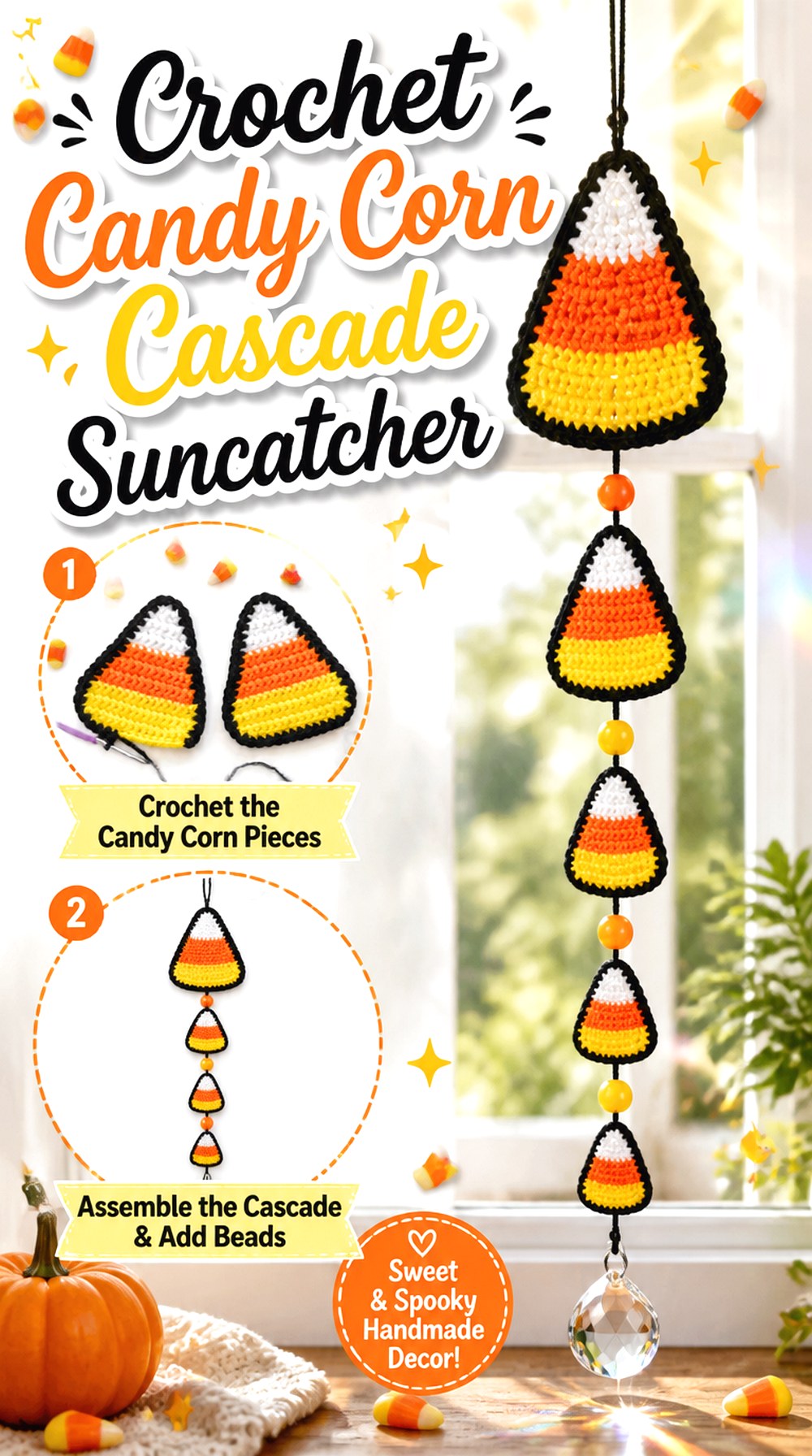
Candy corn creates a distinctly Halloween-oriented hanging through shape as well as color. Lovable Loops’ original applique is a flat triangular candy-corn motif with the familiar striped arrangement, intended for seasonal decorative uses.
For a window cascade, repeat the triangle two or three times at offset heights instead of turning the shapes into a dense garland. The tapering silhouettes naturally point downward, giving the hanging a clear direction. This idea works particularly well when you want something playful but flatter than the pumpkin spinner. Strong backlighting may reduce the visual impact of subtle yarn tones, so the white-orange-yellow separation should remain easy to distinguish in the actual window where it will hang.
Repeat the Triangle Without Making It Busy
Three candy-corn shapes can establish a theme more effectively than a dozen crowded together. Vary the vertical position or leave a wider gap before the lowest piece to create rhythm.
If every applique touches the next one, the individual triangles may disappear into a single block of yarn. Check the hanging against daylight, not only against a solid tabletop, because the background changes how strongly each edge reads.
Keep the Stripes Clear in Backlight
The motif’s identity depends heavily on the division between its three sections. If your yarn values are very similar, the shape will still read as a triangle but may lose the candy-corn effect from a distance.
Hold possible yarn choices up to the window together before committing. You do not need the brightest colors available, but enough contrast between sections helps the design remain legible when sunlight is behind it.
Original Tutorial and Creator Credit
Creator/Site: Lovable Loops
15. Crochet Turkey Feather Fan Suncatcher

A turkey offers the strongest Thanksgiving-specific option in the collection. Maria’s Blue Crayon’s original applique uses a central turkey body surrounded by separate colorful feather shapes, creating a naturally fan-like silhouette.
That radial feather arrangement makes the applique especially suitable for a window: the outer feathers can form the broad decorative edge while the body provides a compact center. Instead of adding another elaborate hoop border, suspend the completed turkey from a simple top loop or place it within a generously sized ring. This is a more detailed, assembled motif than the apple or candy corn, so allow enough time for finishing and keep the surrounding decoration restrained.
Let the Feather Fan Define the Shape
The source’s separate feathers already create width and rhythm around the turkey body. Adding thick fringe around the same area can hide that feature and make the silhouette less recognizable.
If you use a hoop, choose one that leaves clear space beyond the feather tips. The frame should outline the composition rather than compressing it.
Reduce Bulk at the Center
Several assembled pieces meet around the turkey body, so neat joining is important. Check that tails and seams are secure without forming a thick lump that forces the applique to tilt away from the window.
When adapting it as a hanging, place the suspension point where the finished turkey balances vertically. Do not assume the visually centered point will always be the physical balance point once all feathers are attached.
Make Seasonal Removal Easy
A Thanksgiving-specific piece may only be displayed for part of fall. A removable top loop or independent hanging hook can make storage easier than permanently attaching the applique to a larger seasonal installation.
Store the turkey so the feather shapes are not folded sharply. When it comes out again, inspect sewn joins and reshape as appropriate for the yarn before rehanging.
Original Tutorial and Creator Credit
Creator/Site: Maria’s Blue Crayon
Which Crochet Fall Suncatcher Style Should You Choose?
For the most light-through-crochet effect, the Spiderweb Hoop, Tree of Life, and Lacy Mandala Hoop make the strongest use of negative space. Choose the Pumpkin Spiral if movement matters more than an open center.
The Maple Leaf, Sunflower, and Owl work well when you want one dominant framed motif. Narrow windows are better suited to the Oak Leaf and Acorn Drop, Mushroom Ladder, Apple Drop, Ghost Drop, Star Constellation, or Candy Corn Cascade because these designs use vertical space.
For decor tied closely to one moment in the season, the Turkey Feather-Fan is the most Thanksgiving-specific and the Candy Corn, Ghost, and Spiderweb options lean toward Halloween. The Tree of Life, maple leaf, woodland motifs, sunflower, and mandala can remain on display through a broader stretch of fall.
Conclusion
The most effective crochet fall suncatcher is not necessarily the one with the most embellishment. Open webs and mandalas make sunlight part of the design, framed leaves and flowers create strong silhouettes, while spinners and vertical drops add movement without requiring a large hoop.
Choose according to the window first: consider available width, movement, background light, and how securely the finished piece can be hung. Then decide whether you want a literal seasonal motif such as a pumpkin or turkey, or a more subtle autumn palette in a mandala, star group, or Tree of Life. When you are ready to make a design, use the credited original tutorials for the creators’ exact construction details rather than trying to reconstruct the pattern from this roundup.
Frequently Asked Questions
Can I add a crystal prism to any crochet fall suncatcher?
You can sometimes add a prism as your own adaptation, but first consider weight and attachment. A project designed only as a flat applique may not provide a load-bearing point for a heavy crystal. Secure the prism independently when appropriate rather than placing excessive strain on decorative crochet stitches. Be especially careful with glass, beads, and other small components around children or pets. The original tutorial should remain your reference for the crochet construction itself.
What yarn works best for a crochet window hanging?
There is no single fiber that is automatically best for every design. A crisp open web may benefit from a yarn that holds definition, while a wind spinner or dimensional motif has different structural needs. Follow the original designer’s yarn guidance first. If substituting, consider how the new yarn changes size, stretch, weight, texture, and blocking behavior. Also check the yarn label for care instructions and remember that prolonged sunlight can affect some colors.
Should I block crochet motifs before putting them in a hoop?
Blocking can be helpful for leaves, stars, webs, and other shapes where defined points or even edges matter, but the correct method depends on the fiber and project. Some tutorials provide specific shaping guidance, while others do not. Finish the motif first and inspect its outline. If it needs adjustment, use a method suitable for that yarn rather than automatically applying heat or steam. A hoop should support the finished shape, not compensate for severe distortion.
How do I resize an applique to fit a suncatcher hoop?
Start by checking whether the original designer provides alternate sizes or resizing guidance. Avoid inventing stitch-count changes when the tutorial does not support them. Changing yarn weight and hook size may alter dimensions, but it can also change stiffness, stitch definition, and overall proportions. A safer planning method is often to crochet the motif as designed, measure your actual finished result, and then choose a hoop that leaves an intentional margin around it.
Are crochet suncatchers suitable for outdoor display?
Only when the materials and construction are appropriate for that location. Outdoor sun, wind, rain, and humidity can affect yarn, stuffing, beads, hardware, and color. Some wind-spinner tutorials specifically discuss outdoor hanging, while an applique intended for indoor decor may not. Check the original tutorial and yarn-care information before exposing a piece to weather. A protected porch or indoor window is generally a different environment from an uncovered garden location.
How can I keep a long crochet window hanging from twisting?
Twisting is influenced by weight distribution, suspension method, yarn, and the number of projecting motifs. Space pieces so they do not constantly catch on each other, and check the balance of the complete hanging before permanently securing every element. A small amount of movement may be part of the design, especially with spinners, but a motif that repeatedly flips backward may need a different attachment point rather than simply more weight at the bottom.


