
21 Crochet Maple Leaf Shawl Ideas for Autumn-Inspired Wraps
A crochet maple leaf shawl can take several very different forms. Some designs turn the whole wrap into a field of connected leaves, while others use leaf-shaped lace, dimensional embellishments, filet motifs, or a botanical border around a simpler shawl body. The shape matters just as much: this collection includes classic triangles, long rectangular wraps, scarf-like pieces, softly rounded shawls, and motif-based constructions.
The 21 ideas below are linked to original designer pages or full creator tutorials so you can compare the finished forms before choosing one. Pay particular attention to how much of the project depends on open lace, separate leaves, color changes, blocking, or specialty techniques such as Tunisian crochet. Those differences affect not only appearance but also drape, finishing time, portability, and how easily you can alter the final size.
Quick List
- Crochet Ombré Maple Leaf Scarf-Shawl
- Crochet Botanical Maple Leaf Triangle Shawl
- Crochet Pearl-Lace Maple Triangle Shawl
- Crochet Starburst Autumn Leaf Shawl
- Crochet Wavy Leaf Lace Triangle Shawl
- Crochet Two-Texture Leaf Shawl
- Crochet Tunisian-Leaf Trim Triangle Shawl
- Crochet One-Skein Tunisian Autumn Shawl
- Crochet Falling-Leaves Repeat Triangle Shawl
- Crochet Filet Falling-Leaves Wrap Shawl
- Crochet Rectangular Leaf Lace Shawl
- Crochet Drifting-Leaves Lace-Panel Wrap
- Crochet Autumn Leaf Pointed Shawl
- Crochet Fresh-Leaves Filet Rectangle Shawl
- Crochet Rounded Leaf-Border Shawl
- Crochet Join-As-You-Go Fall Leaf Wrap
- Crochet Beaded Leaf-Lace Triangle Shawl
- Crochet Lacey Leaf Motif Wrap Shawl
- Crochet 3D Leaf Texture Shawl
- Crochet Continuous-Leaf Gradient Shawl
- Crochet Graduated Leaves Triangle Shawl
Choose Between Literal Maple Leaves and Leaf-Inspired Lace
A literal leaf construction gives the strongest maple-tree effect, especially when individual motifs have visible lobes, veins, or dimensional edges. The trade-off is finishing: separate leaves may need joining, positioning, or careful attachment so the finished shawl hangs evenly. Projects built around leaf-shaped stitch repeats are generally more continuous and can feel less assembly-heavy.
Also decide how strongly you want the seasonal theme to read. Rust, scarlet, gold, and moss make almost any botanical stitch pattern feel autumnal, but a neutral or single-color leaf-lace shawl can work well beyond fall. If you want the maple theme to remain obvious without depending on color, prioritize projects with actual leaf silhouettes, pronounced pointed sections, or an unmistakable leafy border.
Yarn, Drape, and Leaf Definition
Leaf designs often ask the yarn to perform two competing jobs: drape attractively around the shoulders while keeping enough definition for the motif to remain visible. An extremely limp fabric may soften dimensional leaves, while a dense fabric can reduce the openness of lace.
Before substituting yarn, compare the designer’s construction with the effect you want. A long scarf-style shawl can tolerate a different drape from a highly shaped triangle. Separate motifs also behave differently from continuous lace because every join contributes structure.
For gradient yarns, consider where the color transition will appear. Continuous rows tend to display gradual shifts naturally. A motif-based project may break a gradient into separate color moments instead. When size, yarn quantity, hook size, or blocking is important to the design, confirm those details in the linked original tutorial rather than assuming one substitution will behave like another.
Blocking, Joining, and Wearability
Blocking can be especially important where openwork needs to reveal leaf shapes, but it should never be treated as an automatic finishing method for every fiber or three-dimensional construction. Follow the designer’s instructions and the care information for your yarn. A project with intentionally raised or curled leaves may need very different finishing from flat filet lace.
For shawls built from separate leaves, inspect attachment points as you work. A beautiful collection of motifs can still hang unevenly if joins are inconsistent or one section becomes substantially heavier than another. With triangles and long rectangular wraps, periodically hold the project around the shoulders rather than judging it only while flat.
Finally, think about how you expect to wear it. A narrow piece behaves more like a scarf, while a deep triangle or rounded shawl provides considerably more shoulder coverage. That distinction may matter more than the motif itself.
1. Crochet Ombré Maple Leaf Scarf Shawl

This long, relatively narrow design is a useful choice when you want maple-leaf inspiration without the volume of a deep triangular shawl. Haak Maar Raak’s original Maple Leaf Shawl is worked as an elongated wrap and is shown in gradient yarn, allowing the changing color to provide much of the autumn atmosphere. Its proportions make it practical for wrapping more closely around the neck as well as wearing across the shoulders. The source also includes a crochet chart, which makes this particularly interesting for readers who like comparing written instructions with a visual stitch layout.
Think About Scarf Versus Shawl Styling
A long, narrow wrap is generally easier to tuck into outerwear than a very deep triangle, but it will not provide the same back coverage. Before altering the dimensions, decide whether your priority is neck wrapping or shoulder coverage. Making it wider changes not only the look but also the amount of fabric that gathers when it is wrapped scarf-style.
Let the Gradient Support the Leaves
A gradual color change works especially well when you want autumn variation without managing many separate yarn ends. If you substitute a self-striping or highly contrasting yarn, first consider whether short color changes will compete with the stitch pattern. For the clearest botanical effect, you generally want enough visual separation for the leaf-like texture to remain readable.
Original Tutorial and Creator Credit
Creator/Site: Haak Maar Raak
2. Crochet Botanical Maple Leaf Triangle Shawl

For a more immediately recognizable maple theme, Susan’s Family presents a full shawl tutorial with a defined main section, edging, decorative work, and final assembly. The finished piece reads as a botanical statement rather than simply an autumn-colored triangle, making it a strong option when the motif itself needs to carry the concept. Because decoration and sewing appear as distinct portions of the tutorial, this is also useful for crocheters who enjoy adding visual detail after the primary fabric has been established.
Plan Decorative Weight Deliberately
Applied decoration changes the way a shawl hangs. If you substitute heavier yarn for the embellishments, the decorated edge or focal section can pull more strongly than expected. Keeping the embellishment yarn reasonably compatible with the base fabric usually makes it easier to preserve balanced drape.
Check Placement Before Permanent Assembly
When a project includes separate decorative components, arrange them before securing everything permanently. Look at the shawl both flat and draped over the shoulders. Even technically even spacing can look different once gravity acts on a triangular fabric, especially near the point and outer edges.
Original Tutorial and Creator Credit
Creator: Susan’s Family 蘇蘇姐家
3. Crochet Pearl Lace Maple Triangle Shawl

Atelier LJJ Creation’s Maple Shawl offers a different interpretation of the theme: instead of covering the wrap with separate leaves, it uses an airy pearl-lace treatment in a traditional triangular silhouette. That makes it a good inspiration source for crocheters who like the name and autumn styling of a maple shawl but prefer continuous fabric over motif assembly. The triangle expands into a broad wearable shape, while the open texture keeps the design visually lighter than a densely stitched cold-weather wrap.
Use Openwork to Control Visual Weight
A large triangle can look substantial even when the fabric itself is light. Open lace breaks up that visual mass, which can make a generous shawl easier to pair with dresses or indoor outfits. If you change yarn weight, watch whether the open spaces become so large that the fabric loses the balance visible in the tutorial.
Keep the Center Line Consistent
Triangular shawls quickly reveal irregular increases because the center line and two wings provide obvious visual references. Periodically spread the shawl flat and check that both sides are developing symmetrically. Catching a missed increase early is far less disruptive than trying to disguise an uneven wing near the end.
Original Tutorial and Creator Credit
Creator: Atelier LJJ Creation
4. Crochet Starburst Autumn Leaf Shawl

Fiber Spider’s Autumn Leaf Shawl develops from a combination of leaf inspiration and star-style shaping, giving the finished wrap a strongly pointed, radiating silhouette. Rather than using small appliqués across a conventional base, the broader geometry becomes part of the leaf effect. The creator also describes the project as adjustable in size, so this is worth considering when you prefer a dramatic lower edge and do not want to be locked into one standard shawl depth.
Watch the Points as the Shawl Grows
Pointed shawls depend on consistent increase placement. Lay the work out periodically and check whether the points remain clearly separated rather than beginning to curl into one another. A small counting mistake repeated across several rows can alter the overall leaf-like silhouette considerably.
Decide How Dramatic You Want the Wings
Increasing the size intensifies both the coverage and the visual effect of the pointed sections. Before extending the shawl significantly, drape the work over your shoulders and assess where the longest point falls. More fabric is useful only if the expanded proportions still suit how you intend to wear it.
Original Tutorial and Creator Credit
Creator: Fiber Spider
5. Crochet Wavy Leaf Lace Triangle Shawl

Küma Tutorials’ leaf lace shawl creates its botanical effect through repeated waves that read visually as leaves across a triangle. This gives you a continuous fabric with plenty of texture but avoids the finishing workload associated with sewing on dozens of motifs. The design works especially well when the leaves need to be visible across the entire shawl rather than concentrated at the border. Its repeated rhythm also makes this a useful reference for readers interested in an allover lace treatment.
Preserve the Rhythm of the Leaf Rows
Allover lace depends heavily on alignment. Once a leaf repeat shifts, the error can remain visible for several rows. Marking important repeat points can make it easier to confirm that the waves continue in the intended positions without reproducing the creator’s pattern outside the tutorial.
Consider a Quieter Yarn
A strongly variegated yarn can be attractive, but fast color changes may visually interrupt the repeated leaf forms. Solid, tonal, or slowly changing yarn often allows sculptural stitch patterns to show more clearly. That is an aesthetic trade-off rather than a rule, so compare a small swatch before committing.
Original Tutorial and Creator Credit
Creator: Küma Tutorials
6. Crochet Two Texture Leaf Shawl
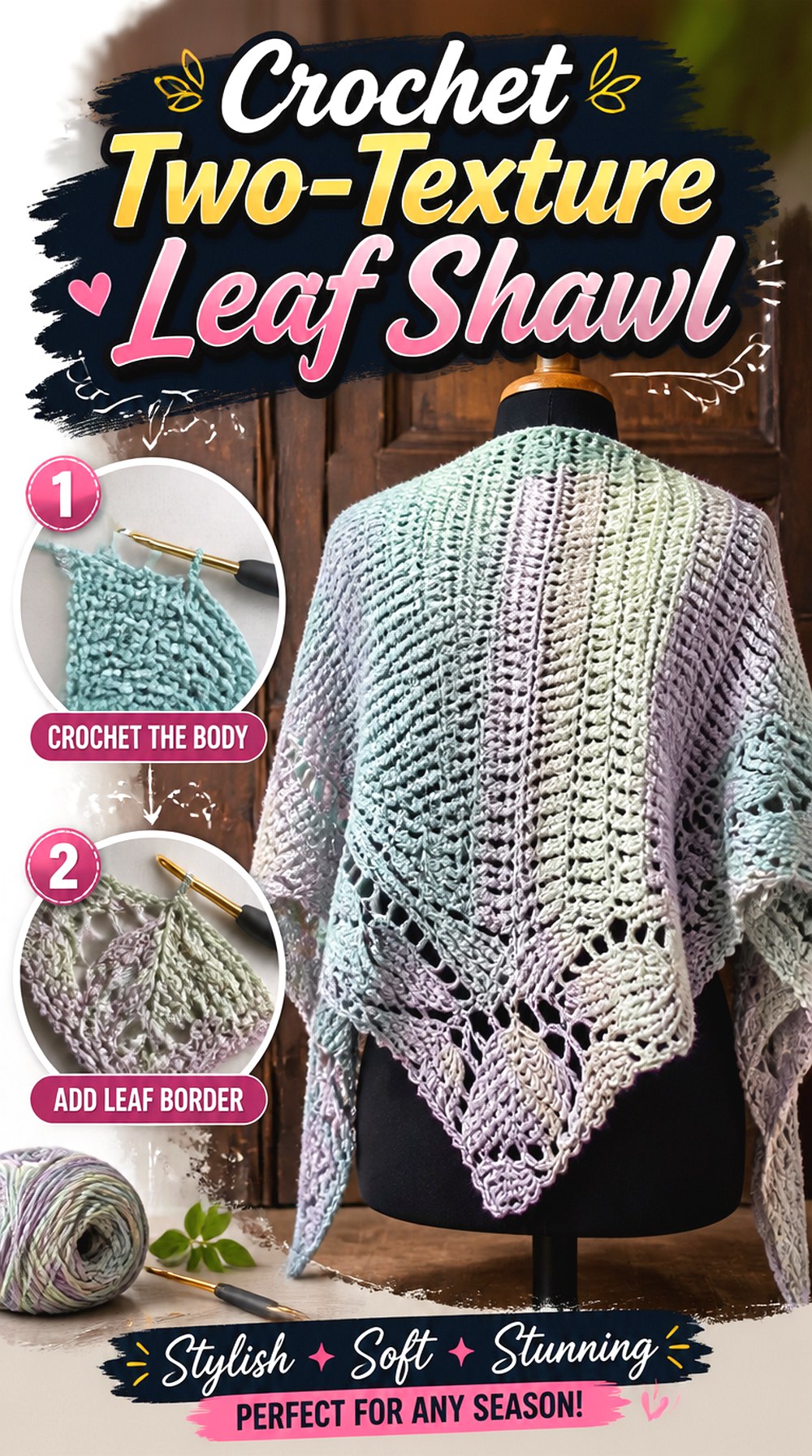
Oana’s leaf shawl combines two crochet textures rather than relying on a single repeated surface. That contrast gives the wrap more visual movement and makes it a useful option when you want the leafy section to stand out against a supporting texture. The finished project remains recognizably shawl-like instead of looking like a collection of appliqués, so it sits between highly literal maple-leaf designs and more abstract botanical lace.
Use Texture Contrast Intentionally
When two stitch patterns share the same shawl, one should not unintentionally overpower the other. A fuzzy yarn can blur the transition between sections, while a smoother yarn usually emphasizes texture changes more clearly. Think about whether you want the leaf detail to be obvious at a distance or appreciated mainly up close.
Check the Transition Rows Carefully
The point where one stitch treatment changes into another is often where tension differences become noticeable. If one section draws inward or spreads substantially wider, pause before progressing. Adjustments should follow the tutorial’s construction rather than improvising stitch counts that may disrupt later shaping.
Original Tutorial and Creator Credit
Creator: oana boutique crochet &knitting
7. Crochet Tunisian Leaf Trim Triangle Shawl

This Tejiendo Perú project separates the main shawl from its most obvious leaf feature. The triangular body uses repeated rows combining different surface effects, while crocheted leaves made with Tunisian crochet decorate the finished piece. That creates a practical compromise: the body can remain relatively regular, while the leaf embellishment provides the stronger autumn identity. The creator also explains that the triangle can be customized by working more or fewer rows.
Treat the Leaves as a Finishing Feature
Because the leaves are decorative rather than the entire structural fabric, you have more freedom over how prominently they appear. Before adding many, temporarily position several along the shawl and decide whether you prefer a sparse botanical accent or a fuller autumn edge.
Match Embellishment Scale to the Shawl
A small shawl with oversized leaves can become visually bottom-heavy, while tiny leaves may disappear on an expanded wrap. If you change yarn or shawl size, check the proportion of the embellishments against the finished body before making the complete set.
Original Tutorial and Creator Credit
Creator: Esperanza y Ana Celia Rosas (Tejiendo Perú)
8. Crochet One Skein Tunisian Autumn Shawl

Joy of Motion Crochet’s Autumn Leaves Shawl is a Tunisian crochet project with an asymmetrical-looking expanding form rather than literal maple-leaf appliqués. The designer uses the autumn-leaves theme through both the project name and the warm variegated sample, while the simple expanding construction keeps the visual focus on drape and color. The original pattern also explains that size can be altered by changing the number of rows, making this one of the more straightforward options for readers concerned about finished dimensions.
Let Color Do More of the Seasonal Work
This design demonstrates that a maple or autumn mood does not require a literal five-lobed leaf in every repeat. A warm gradient can carry much of the seasonal effect. This is useful if you prefer cleaner fabric but still want the finished shawl to coordinate with fall wardrobes.
Understand Tunisian Drape Before Substituting
Tunisian crochet can produce a fabric with different density and behavior from standard crochet. If you change yarn or hook, make a useful-sized swatch rather than judging from a few stitches. The goal is to preserve a shawl-like drape rather than accidentally creating a rigid triangular panel.
Original Tutorial and Creator Credit
Creator/Site: Joy of Motion Crochet
9. Crochet Falling Leaves Repeat Triangle Shawl

Fiber Spider’s Falling Leaves Shawl offers a more regular triangular outline than the creator’s pointed Autumn Leaf version. Repeated openwork develops across the widening body, producing a leaf-inspired surface that can be worn as a conventional triangle. This makes it a useful alternative when you like botanical lace but want predictable wings and a central point rather than multiple pronounced leaf-shaped tips.
Compare This Shape With the Pointed Version
Both Fiber Spider designs fit an autumn-leaf theme, but their silhouettes serve different styling goals. This triangle is visually calmer and may be easier to layer beneath outerwear. The starburst-inspired option earlier in the list is more dramatic along the lower edge.
Protect the Repeat From Gradual Errors
A long lace repeat can look correct for several rows even when one space has shifted. Count at logical checkpoints instead of waiting until the full row looks obviously uneven. Stitch markers at the center and repeat boundaries can reduce the amount of work you need to undo after a mistake.
Original Tutorial and Creator Credit
Creator: Fiber Spider
10. Crochet Filet Falling Leaves Wrap Shawl

Sara Sach’s Falling Leaves Wrap Scarf moves away from the deep triangle entirely. The creator describes it as wider than a typical scarf but narrower than many wraps, with an open filet-style stitch pattern designed to resemble leaves. That in-between width is practical if you want an accessory that can move between scarf and shoulder-wrap use without producing a large amount of fabric at the back.
Use Width as a Styling Decision
Adding width does not automatically improve a wrap. A narrow piece is easier to loop around the neck, while additional width improves shoulder coverage but creates more bulk when worn scarf-style. Decide which use will be primary before altering the proportions.
Filet Benefits From Clear Negative Space
Leaf-like filet motifs rely on the relationship between solid stitches and open spaces. Very fuzzy yarn can visually close those openings, while highly contrasting variegation may distract from the motif. A swatch lets you judge the leaf image from several feet away instead of only examining individual stitches.
Original Tutorial and Creator Credit
Creator: Sara Sach Crochet Designs
11. Crochet Rectangular Leaf Lace Shawl

Yarn Craftee’s Leaf Lace Shawl uses a rectangular form filled with repeating lace rather than triangular shaping. This changes the way the project sits on the body and gives the leaf design a more fabric-like appearance from end to end. The original pattern also shows fringe as an optional finish, giving readers another way to emphasize length and movement without altering the core lace.
Rectangles Reward Accurate Starting Width
Unlike a center-out triangle, a rectangular shawl establishes much of its width at the beginning. If you want to alter the dimensions, confirm the pattern repeat before changing the foundation. A small error at the starting edge can affect motif alignment throughout the entire piece.
Fringe Changes More Than the Finish
Fringe adds movement but also changes the visual length and care requirements. If you plan to wear the shawl frequently under a coat, consider whether long fringe will be convenient. For a cleaner or more formal finish, leaving the edge unfringed may allow the leaf lace itself to remain the focal detail.
Original Tutorial and Creator Credit
Creator/Site: Yarn Craftee
12. Crochet Drifting Leaves Lace Panel Wrap

The Drifting Leaves Shawl by Made by Gootie combines a relatively simple rectangular body with a more elaborate leafy lace section. Instead of making every row equally decorative, the design concentrates visual detail where it will have greater impact. That makes it a useful choice when you like intricate leaves but do not necessarily want to work complex lace across the entire shawl. The designer also describes ways the width and height of the different portions can be adjusted according to the pattern notes.
Decide Where You Want the Visual Weight
A concentrated leaf panel naturally draws the eye toward one portion of the shawl. Consider how that section will fall when the wrap is draped over your shoulders. Increasing the decorative area substantially may change the balanced contrast between the calmer body and lace.
Adapt the Plain and Lace Sections Separately
One advantage of a sectional design is that you may have more control over proportions than with an allover repeat. However, the lace still depends on a stitch multiple. Make dimensional adjustments only in ways supported by the designer’s notes so that the leaf pattern arrives at the edges cleanly.
Original Tutorial and Creator Credit
Creator/Site: Made by Gootie
13. Crochet Autumn Leaf Pointed Shawl

Crochet with GG’s Autumn Leaf Shawl emphasizes a strong leaf-shaped or pointed visual effect rather than a delicate botanical border. The result feels graphic and sculptural, especially when worked in fall colors. This is worth considering when you want the silhouette itself to suggest an autumn leaf instead of relying only on surface lace.
Prioritize Clean Point Definition
Whenever the outline contributes strongly to the motif, uneven tension becomes more noticeable around tips and valleys. Spread the work flat periodically and check that corresponding points have similar depth. Gentle finishing can help the outline, but it should not be expected to correct major structural inconsistencies.
Use Color Without Hiding the Shape
Several autumn shades can enhance the concept, but constant rapid color changes may make the outline harder to read. A solid color, tonal yarn, or slow gradient can keep the pointed geometry visible while still giving the shawl seasonal character.
Original Tutorial and Creator Credit
Creator: Crochet with GG
14. Crochet Fresh Leaves Filet Rectangle Shawl

A Spoonful of Yarn’s Fresh Leaves Shawl brings leaf imagery into a long rectangular wrap using filet crochet. The design is inspired by new seasonal foliage rather than autumn specifically, making it useful for readers who want maple-leaf-adjacent botanical styling that can transition into spring colors as well. The original designer notes that altering the width is not straightforward because the charted point and repeat layout are interdependent, an important limitation to understand before customizing.
Respect Designs That Resist Width Changes
Not every rectangle is automatically simple to resize. When motifs converge into a charted point or directional section, changing the repeat count can affect the entire composition. In that situation, altering length is often less disruptive than improvising a new width.
Chart Reading Is Part of the Project
This pattern relies strongly on charts. If charts are unfamiliar, use the designer’s accompanying explanation rather than attempting to convert the entire pattern yourself. Reading the visual structure directly can actually make a repeating filet design easier to understand once the symbols become familiar.
Original Tutorial and Creator Credit
Creator/Site: A Spoonful of Yarn
15. Crochet Rounded Leaf Border Shawl
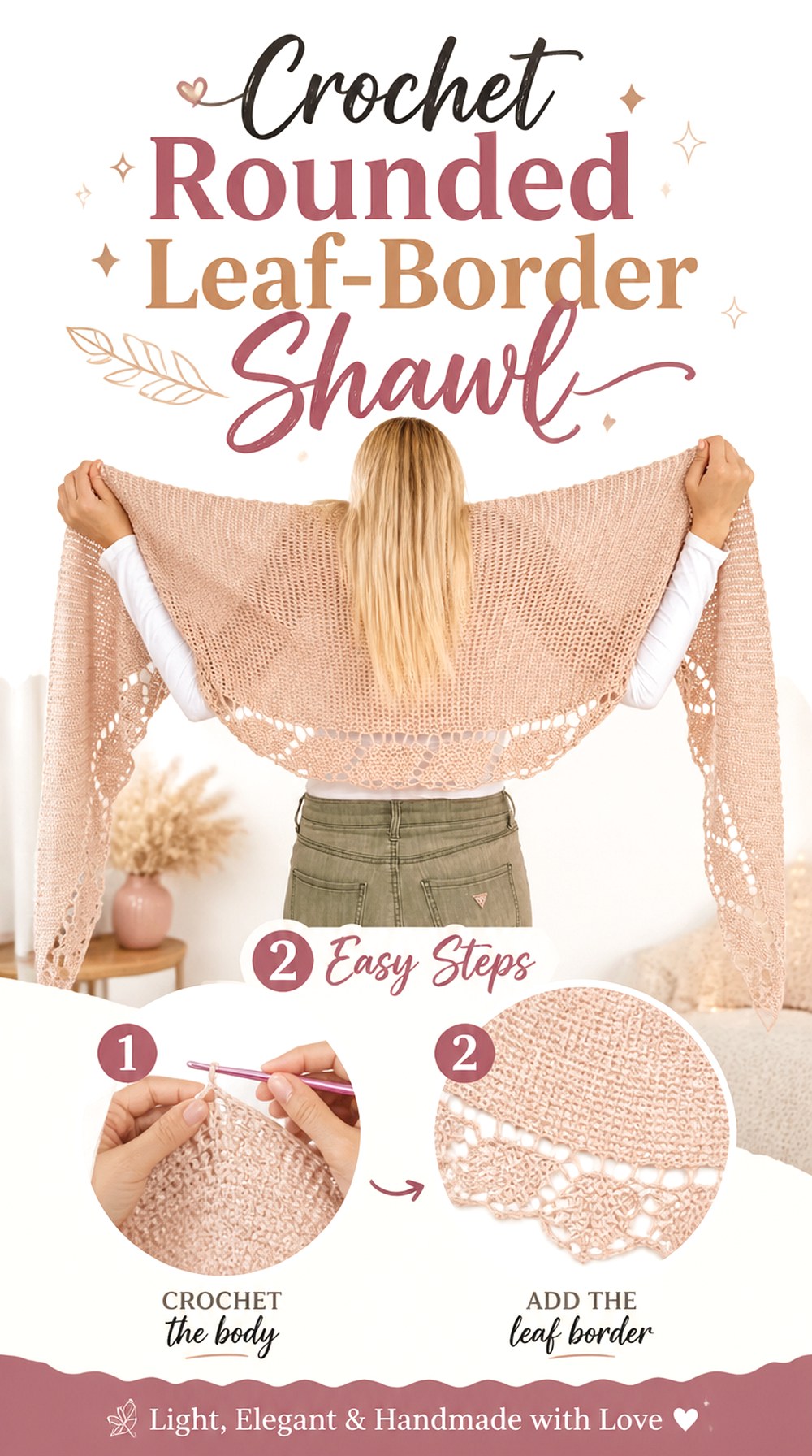
Wilmade’s Vibrant Virginia Shawl keeps the central fabric intentionally simple and saves the botanical interest for a pronounced leaf border along the lower edge. The body is worked side to side with shaping that produces a softly rounded form rather than a sharp triangular point. That combination makes this a useful choice when you want leaves to frame the shawl without covering the entire surface. The designer provides both the written pattern and a video tutorial.
A Border Can Carry the Whole Theme
If you like minimalist clothing, a shawl with a plain body and decorative edge can be easier to style than dense allover leaf lace. The calmer center also allows the border to remain visible even in a single color.
Keep the Curved Body Balanced
Side-to-side shaping requires attention to increases and decreases because those changes determine the final curve. Do not judge the shape from only a few rows. Periodically spread the work out and confirm that the first half and decreasing half are developing as complementary sections.
Original Tutorial and Creator Credit
Creator/Site: Wilmade
16. Crochet Join As You Go Fall Leaf Wrap

Jessie At Home’s Fall Leaves Wrap is one of the most literal leaf projects in this collection. Individual leaves become the fabric rather than merely decorating a conventional shawl, and the designer uses a join-as-you-go method to connect them. The source also offers single-color and two-color leaf options and incorporates optional bead detailing along the veins. The resulting piece has a very different visual density from an allover lace shawl and is particularly suited to readers who want the leaf silhouettes themselves to dominate the finished wrap.
Arrange Color Before Joining
With many separate leaves, random color placement can look very different from a deliberately balanced gradient. Before joining a large group permanently, lay several motifs out together and check the distribution of light, dark, warm, and cool values.
Joining Is Part of the Structure
Motif attachment affects both appearance and durability. Uneven joins may create gaps or pull neighboring leaves into distorted positions. Follow the designer’s joining method rather than treating attachment as an afterthought, especially if you plan to wear the finished wrap frequently.
Optional Beads Affect Care
Beads add sparkle and emphasize leaf veins, but they introduce weight and may change washing and storage requirements. If you include them, consider how the yarn and bead material will be cared for together rather than relying only on the yarn label.
Original Tutorial and Creator Credit
Creator/Site: Jessie At Home
17. Crochet Beaded Leaf Lace Triangle Shawl

Fall Sparkles Shawl takes a more traditional triangle and works leaf imagery directly into the lace while adding beads throughout the fabric. This provides a different balance from the previous motif wrap: the leaves remain integrated into a continuous shawl, and the beads add light-catching detail rather than creating the structure. Jessie At Home’s updated source includes a video tutorial alongside the written design information.
Decide Whether Beads Support Your Use Case
A beaded shawl can work beautifully for dinners, events, and decorative layering, but it may be less convenient for frequent stuffing into bags or wearing beneath rough outerwear. If your main goal is an everyday fall accessory, consider whether the leaf lace alone gives you enough detail.
Watch the Weight Distribution
A few beads may have little practical effect, but embellishment weight accumulates across a large shawl. Keep placement consistent with the tutorial so the fabric remains balanced. Substituting substantially heavier beads can change the way the lower portion hangs.
Original Tutorial and Creator Credit
Creator/Site: Jessie At Home
18. Crochet Lacey Leaf Motif Wrap Shawl

Disley Sisterz demonstrates a lacey leaf motif that is joined to neighboring motifs, giving readers another modular route to a botanical shawl. Unlike an allover rectangular stitch repeat, this approach allows each leaf unit to remain visually distinct. The tutorial explicitly covers the motif and joining process and discusses ways the motifs can be used, including the shawl context.
Make Consistent Motifs Before Joining Many
Modular lace exposes tension differences. If one leaf is noticeably larger, it can force neighboring motifs to stretch or bunch once joined. Compare the first several pieces before committing to a large batch, and correct tension differences while the project is still easy to adjust.
Test the Fabric as a Group
A single motif may look delicate and flexible, yet dozens of joined units can produce a surprisingly different fabric. Connect a small section and drape it over your hand or shoulder to assess how the joins behave before deciding on the final width.
Original Tutorial and Creator Credit
Creator: Disley Sisterz Knitting Podcast
19. Crochet 3D Leaf Texture Shawl

Crochet with GG’s 3D Leaf Shawl pushes the botanical idea into raised texture. Instead of creating the leaf effect mainly through empty lace spaces, the fabric develops a more sculptural surface. That distinction can make the shawl feel visually richer even in a single yarn color and provides an option for readers who want tactile leaves rather than flat filet imagery.
Raised Texture Needs Enough Definition
Fuzzy or heavily haloed yarn may soften the contours that give a 3D leaf its effect. A smoother yarn generally makes relief work easier to see, although the ideal choice still depends on the tutorial and the finished feel you prefer.
Avoid Over-Blocking Sculptural Details
Blocking that is appropriate for flat lace may flatten relief texture if used too aggressively. Follow the yarn’s care information and the creator’s finishing guidance. The goal is to neaten the overall shawl while preserving the dimensional quality that distinguishes this design from ordinary lace.
Original Tutorial and Creator Credit
Creator: Crochet with GG
20. Crochet D Leaf Texture Shawl

Mijo Crochet’s Lovely Leaves Shawl uses a continuous leaf pattern and combines it with gradient-friendly construction. The designer provides information on sizing customization, yarn amounts, photo tutorials, stitch counts, and multiple language versions. Visually, this sits between literal motif shawls and abstract lace: the leaves are clearly present, but the fabric remains continuous and flowing rather than assembled from individual pieces.
Use Gradient Placement as Part of the Design
A long color transition can make successive leaf sections appear to change with the season while preserving one uninterrupted fabric. Before combining multiple gradients, consider where abrupt color transitions could land. Too many competing shifts may reduce the clarity of the repeating leaves.
Customize Size Through the Pattern’s Framework
The designer specifically provides guidance for changing the shawl’s dimensions and related yarn requirements. Use that framework rather than adding arbitrary repeats. Leaf patterns often depend on predictable multiples, and a supported adjustment keeps the edges and final motif placement cleaner.
Original Tutorial and Creator Credit
Creator/Site: Mijo Crochet
21. Crochet Graduated Leaves Triangle Shawl
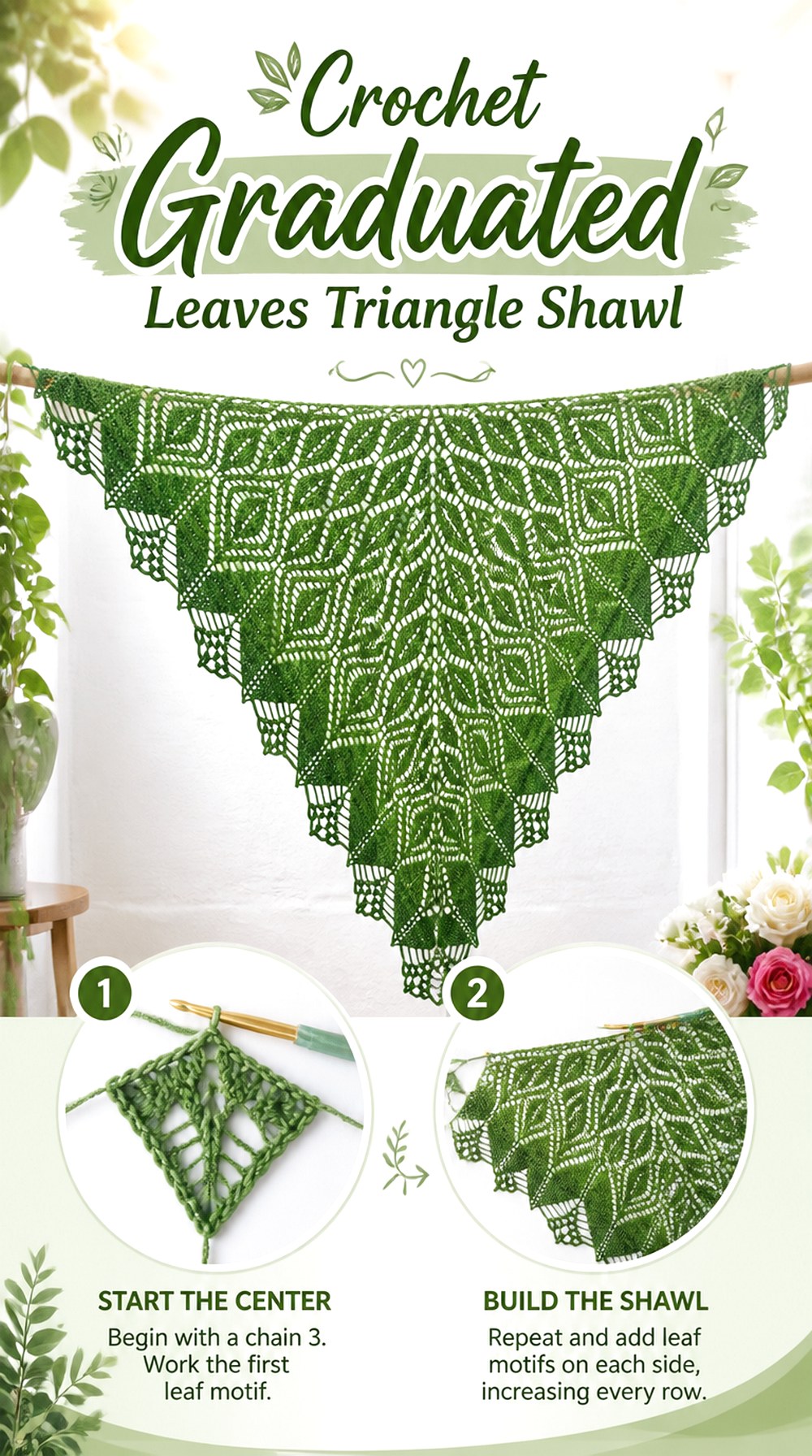
Lily Go’s Gathering Leaves design offers one of the most elaborate leaf progressions in this list. The top-down triangular shawl begins with smaller leaf motifs, transitions into larger leaves, and eventually moves into another floral element near the edge. That changing scale creates a botanical composition rather than a single repeat copied uniformly across the entire shawl. The designer also explains that the shawl can be made larger or smaller by changing the repeated smaller-leaf portion and that different yarn weights can be considered with corresponding hook adjustments.
Changing Motif Scale Adds Visual Direction
Small leaves near one part of the shawl and larger leaves elsewhere naturally lead the eye toward the lower edge. This works especially well on a triangle because the increasing physical size of the shawl reinforces the expanding botanical pattern.
Alter Size in the Supported Repeat Area
When a design transitions between several motif stages, not every section is equally suitable for customization. Follow the designer’s indicated repeat area if you need extra coverage. Extending the wrong section could interfere with the planned transition from smaller leaves to larger motifs.
Give Detailed Lace Room to Open
A shawl with several changing lace motifs benefits from careful finishing because compressed stitches can hide the visual progression. How much shaping or blocking is appropriate depends on the fiber and the designer’s guidance, so avoid applying one aggressive method automatically to every yarn.
Original Tutorial and Creator Credit
Creator/Site: LilyGo
How to Choose Among These Maple Leaf Shawl Styles
The biggest difference is not color; it is how the leaf idea is built into the shawl.
| Style | Strongest Feature | Main Consideration |
|---|---|---|
| Separate leaf motifs | Most literal botanical appearance | More joining and placement decisions |
| Leaf borders | Decorative leaves without an allover pattern | Border weight and attachment |
| Filet leaf lace | Clear leaf imagery in flat fabric | Motif alignment and blocking |
| Continuous textured leaves | Strong surface detail with fewer separate pieces | Maintaining repeat accuracy |
| Tunisian shawls | Distinctive fabric and color presentation | Tunisian hook technique and drape |
| 3D leaves | Sculptural botanical effect | Preserving raised texture |
| Beaded leaf shawls | Dressier finish and extra sparkle | Added weight and care considerations |
| Long rectangular wraps | Flexible scarf-or-shawl styling | Less back coverage than deep triangles |
If your priority is an unmistakable maple-leaf statement, start with the joined-leaf, appliqué, or 3D options. If you want something easier to integrate into an everyday wardrobe, a continuous leaf-lace triangle, rectangular wrap, or simple body with a leaf border can give you the theme without making every inch highly decorative.
Conclusion
These 21 crochet maple leaf shawl ideas show how broad a leaf-inspired wrap can be. A shawl can use individual leaves as its entire structure, place them only around the edge, translate foliage into filet lace, build raised 3D texture, or let gradient color carry much of the autumn mood. Shape also changes the experience: long rectangles are easy to style as scarves, while triangles and rounded shawls provide more shoulder coverage.
Choose first by construction rather than by color. That will tell you much more about the amount of joining, lace concentration, dimensional finishing, and size flexibility involved. Once you have a favorite form, autumn reds, amber, gold, brown, moss, or even nontraditional neutrals can personalize the result. Use the linked original tutorials for the creator’s exact construction details before making substitutions or structural changes.
Frequently Asked Questions
What yarn works well for a crochet maple leaf shawl?
There is no single best yarn because these projects use very different constructions. Open filet lace, raised 3D leaves, Tunisian crochet, and separate motifs do not necessarily behave well in the same fiber or weight. Start with the yarn characteristics recommended by the original designer. When substituting, compare thickness, fiber behavior, stitch definition, and drape rather than matching color alone. A swatch is particularly useful when the leaf motif depends heavily on open spaces or relief.
Can I make a maple leaf shawl in colors other than red and orange?
Yes. The botanical effect can come from shape and stitch pattern rather than autumn color alone. Forest green can suggest fresh maple foliage, cream or gray can emphasize the structure of lace, and a single saturated color may make intricate leaves easier to see than a busy variegated yarn. If the project uses literal maple-shaped motifs, the leaf theme will generally remain clear even when you move completely outside a traditional fall palette.
Are motif-based maple leaf shawls harder to resize?
They can actually offer useful sizing flexibility because additional motifs may increase coverage, but resizing still requires planning. Adding leaves changes both dimensions and weight, and the outline may depend on a particular motif arrangement. Do not assume that attaching one more row will preserve the designer’s original silhouette. Check the original tutorial for supported size changes, then lay motifs out before joining them permanently so you can assess width, depth, and balance.
Do all leaf-lace shawls need blocking?
No universal finishing method is appropriate for every leaf shawl. Flat lace often benefits from shaping that opens the stitch pattern, but dimensional leaves may be intended to retain raised, curved, or textured areas. Fiber content also changes what finishing methods are appropriate. Follow the yarn label and the original designer’s instructions. If you have substituted yarn, test your proposed method on a swatch before applying moisture, heat, or strong tension to the finished shawl.
Which shape is easiest to wear as both a shawl and scarf?
Long rectangular and narrow scarf-shawl designs tend to provide the most straightforward transition between the two uses because they can wrap around the neck without creating a large triangular point at the back. A shallow asymmetric or narrow triangle can also work well. Deep triangles generally provide better shoulder and upper-back coverage, but they create more bulk when repeatedly wrapped around the neck.
How can I keep crochet leaf motifs from looking uneven?
Consistency matters more than making each motif quickly. Compare your first few leaves before producing the entire set, paying attention to overall dimensions, edge shape, and tension. If the project uses joined motifs, connect a small sample group to see how the units influence one another. Small size differences that seem insignificant while the leaves are separate can become obvious once several motifs are aligned in rows or attached along a shawl edge.
Can I add maple leaves to a plain crochet shawl?
Decorative leaves can sometimes be added to a simpler shawl, but treat that as a design adaptation rather than assuming any leaf will work with any base. Consider motif scale, yarn weight, attachment method, total added weight, and whether the finished edge will stretch. A few strategically placed leaves usually change the balance less than a dense border. For a predictable result, a source designed specifically with leaf embellishments—such as the Tunisian-leaf trim or leaf-border examples above—is a safer starting point.


