
18 Crochet Acorn Coaster Ideas for a Woodland Fall Table
Acorn crochet projects range from small pieces designed specifically to sit under a drink to much larger dishcloths, hot pads, tapestry squares, and granny motifs that work better as mug mats or decorative tabletop accents. That difference matters: a coaster needs a flat, stable area beneath the cup, while an oversized mat gives you room for a mug, spoon, snack, or seasonal centerpiece.
The 18 ideas below explore shaped acorns, textured caps, C2C graphics, tapestry colorwork, granny-square formats, dimensional motifs, and pixel construction. Each idea is paired with an original tutorial source, while the planning notes focus on practical choices such as scale, flatness, yarn behavior, blocking, and cup stability. That makes it easier to choose a project that suits the way you actually want to use it rather than treating every acorn-shaped crochet piece as interchangeable.
Quick List
- Crochet No-Sew Acorn Drink Coaster
- Crochet Puff-Cap Acorn Coaster
- Crochet Classic Two-Stitch Acorn Coaster
- Crochet Pocket-Cap Acorn Mug Mat
- Crochet Oversized Acorn Table Coaster
- Crochet C2C Acorn Colorwork Coaster
- Crochet Rustic C2C Acorn Mug Mat
- Crochet Square-or-Diamond Acorn Coaster
- Crochet Chubby Acorn Granny Coaster
- Crochet 3D Boho Acorn Mug Mat
- Crochet Tapestry Acorn Square Coaster
- Crochet Acorn-and-Leaves Tapestry Coaster
- Crochet Bud-Texture Acorn-Inspired Mug Mat
- Crochet Bobble-Cap Acorn Table Coaster
- Crochet Large Acorn Dishcloth Mug Mat
- Crochet Character Acorn Granny Table Mat
- Crochet Tiny-Acorn Coffee Cup C2C Mug Mat
- Crochet Pixel Acorn Patchwork Table Mat
Choose Between a Drink Coaster and an Oversized Mug Mat
A compact coaster should provide enough level fabric for the entire base of your cup without forcing the cup onto a stem, pointed edge, thick seam, or raised embellishment. Several tutorials in this collection were designed specifically as coasters, while others were originally washcloths, potholders, granny squares, or larger decorative panels.
Those bigger designs still make useful tabletop projects, but their best role may be a mug mat rather than a conventional coaster. An 8- or 10-inch piece, for example, gives room for a mug plus a teaspoon or small snack. Before resizing any larger tutorial, consider whether reducing the yarn or hook will preserve the acorn motif and fabric density. Crochet proportions can change along with scale, so a sample is more reliable than assuming every large square will shrink cleanly.
Yarn, Flatness, and Heat-Safety Checks
Many kitchen-oriented acorn tutorials use cotton, which is a common choice for washable home crochet and can provide clear stitch definition. Decorative designs may use other fibers. A substitution can change thickness, absorbency, stretch, drape, and the amount of texture beneath the cup, so check the original tutorial and yarn label before changing materials.
Flatness deserves just as much attention. Puff stitches, popcorns, raised post stitches, sewn facial details, and dimensional motifs can make a project visually interesting while creating an uneven cup surface. Test the intended cup on the finished piece before relying on it as a coaster.
A drink coaster should also never automatically be treated as a trivet or potholder. For contact with hot cookware, follow a tutorial specifically designed for that purpose and use materials suitable for the intended heat exposure rather than assuming any crochet fabric is protective.
Scaling Acorn Motifs Without Losing Their Shape
Changing yarn thickness and hook size can alter the finished scale of an acorn project, but it can also change stiffness, stitch definition, edge behavior, and the clarity of a colorwork motif. This is particularly noticeable with C2C graphs, tapestry squares, and granny-square designs where the acorn depends on a grid or carefully proportioned background.
If you want to adapt a larger square into a smaller mug mat, first make enough of the fabric to judge density and motif readability. Check whether the cup still has a broad, level area and whether the edge lies flat. With shaped acorns, pay particular attention to the transition between cap and body. Rather than inventing new stitch counts, use the designer’s construction guidance and treat yarn or gauge changes as experiments that need checking as you work.
1. Crochet No Sew Acorn Drink Coaster

This compact shaped coaster from Speedy Crochet is one of the closest matches to a traditional drink coaster in the collection. The finished design has a rounded nut body, pointed lower tip, contrasting cap, and small stem, with the cap incorporated into the main piece instead of being sewn on afterward. The source lists an approximate finished size of 5.5 inches long by 4 inches wide, keeping it closer to ordinary cup-coaster territory than the larger dishcloth and hot-pad options later in the list.
It suits readers who want a recognizable acorn silhouette without turning the project into a large table mat.
Why No-Sew Construction Helps
An integrated cap removes one assembly seam that could otherwise add bulk across the upper portion of the coaster. That does not automatically make every area perfectly level, but it can simplify finishing when you want to make a coordinated set. Before making multiples, finish one coaster completely and place your usual mug on it. That single check will tell you whether the body offers enough flat usable space for the cups you normally use.
Check the Pointed End Before Use
The acorn tip is part of the visual identity, but it does not need to carry the cup. Position the mug primarily over the broad body and make sure the pointed end remains flat instead of curling upward. If your substituted yarn produces a softer or stiffer fabric than the designer’s sample, the outline may behave differently. Gentle shaping or blocking may help when appropriate for the fiber, but follow the yarn’s care guidance rather than assuming one blocking method suits every yarn.
Original Tutorial and Creator Credit
Creator/Site: Speedy Crochet
2. Crochet Puff Cap Acorn Coaster

Rachel’s Lovely Stitches presents an acorn project specifically intended as a coaster or hot pad, with a contrasting upper section that uses puff texture to distinguish the cap from the smoother body. That textural contrast gives the silhouette more character without relying entirely on color. The source identifies the project as an original acorn coaster design and provides the complete construction on the creator’s own site.
For tabletop use, this version works particularly well when you want the cap to be visually prominent. The important practical question is how much of the raised texture falls beneath the cup versus beyond its base.
Let the Puff Cap Stay Decorative
Puff stitches create noticeable relief, so the most attractive part of the design may not be the best place for the bottom of a mug. When the coaster is finished, place the cup over the smoother lower body and check whether its base remains fully supported. A wider cup may overlap the cap more than a narrow one. Making one sample before committing to a set lets you judge that relationship with your own drinkware.
Plan Sets Around Cup Footprints
Acorn outlines are less uniform than circular or square coasters. If you are making a dining or coffee-table set, compare the usable flat area rather than judging suitability from the project’s maximum overall dimensions. The stem and outer cap corners contribute to the silhouette but may not contribute meaningful cup support. This is also worth remembering if you substitute yarn, because a change in gauge can affect the entire footprint rather than only the decorative edge.
Original Tutorial and Creator Credit
Creator/Site: Rachel’s Lovely Stitches
3. Crochet Classic Two Stitch Acorn Coaster
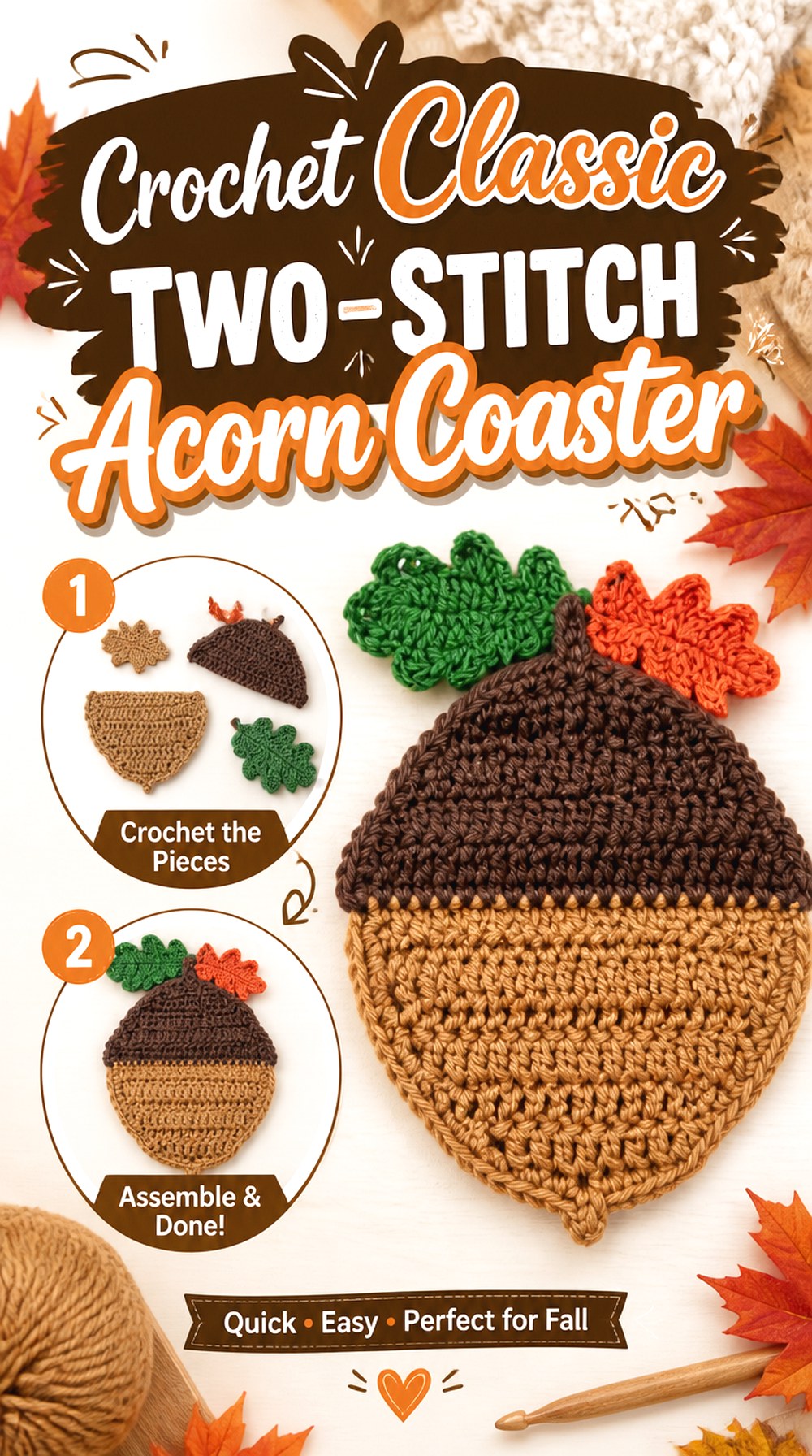
Crochetwithsumi’s full video tutorial is another project made specifically as an acorn coaster. The channel describes the design as using single and double crochet stitches, giving readers a video-based alternative to the written coaster tutorials above. The finished piece keeps the familiar contrast between the acorn body and darker cap while remaining a straightforward flat tabletop motif rather than a large square or heavily dimensional ornament.
This option is useful when you prefer to watch the overall shaping develop on screen and want a recognizable woodland coaster without moving into tapestry or C2C colorwork.
A Simpler Stitch Mix for Everyday Sets
Using a limited stitch vocabulary can make a repeated coaster set easier to manage, especially when consistency matters more than elaborate surface decoration. Even so, tension deserves attention from the first sample. If one coaster is noticeably looser than another, the silhouettes and cup-support areas may differ. Compare finished pieces side by side before weaving away every decision point so you can identify whether your tension is drifting across the set.
Keep the Silhouette Flat
Shaped crochet pieces can develop slight waves where increases, decreases, and edge transitions meet. Do not judge flatness while the piece is still being handled or stretched during construction. After finishing, set it on the table without pulling it into shape and see where the fabric naturally rests. If a corner or cap edge lifts, consult the tutorial and use only fiber-appropriate finishing methods rather than stretching the piece aggressively.
Original Tutorial and Creator Credit
Creator: Crochetwithsumi
4. Crochet Pocket Cap Acorn Mug Mat

Celtic Knot Crochet’s acorn-shaped project was designed as a hot pad and potholder rather than a standard drink coaster. Its approximately 7¾-by-7½-inch scale makes it better suited to an oversized mug mat in this collection. The base is worked with doubled yarn while the cap uses a single strand, and an opening beneath the cap allows the original project to function as a potholder. Raised post-stitch texture defines the cap.
That layered construction makes this one meaningfully different from a flat coaster: it offers more surface area and a substantial woodland silhouette, but also requires more attention to where a cup sits.
The Pocketed Cap Changes the Function
Because the cap forms part of a functional pocket in the source design, this project has more structure than an ordinary single-layer coaster. For mug-mat use, keep the cup on the broad base and use the upper portion as visual space rather than assuming every layered area will feel equally level. The extra room can also accommodate a spoon or small treat, making the larger footprint useful rather than simply oversized.
Separate Drink Use From Heat Use
This particular tutorial was deliberately designed for hot-pad and potholder use and specifies cotton for hot or warm applications. That does not mean the same heat-use assumption should be applied to the other acorn coasters in this article. If you make this version for cookware, follow Celtic Knot Crochet’s material and construction guidance directly. If you adapt it with a different fiber, reconsider the intended job instead of assuming the substitution retains the original heat-handling properties.
Original Tutorial and Creator Credit
Creator/Site: Celtic Knot Crochet
5. Crochet Oversized Acorn Table Coaster

Posh Pooch Designs offers another clearly shaped acorn, but at about 8 by 8 inches it lands firmly in oversized-coaster territory. The creator presents the design for multiple home uses, including a washcloth, hot pad, potholder, or table piece, and the broad outline leaves considerably more room than a conventional drink coaster.
As a fall table coaster, it can sit beneath a large mug and still leave much of the acorn visible. It also works as an individual place-setting accent where a tiny coaster might visually disappear among plates and seasonal decor.
When an Eight-Inch Acorn Makes Sense
A large coaster can be useful when you regularly pair a drink with a teaspoon, tea strainer, or small snack. The extra space keeps those items visually grouped while preserving the acorn silhouette. If your goal is only to protect a small side table beneath a narrow coffee cup, however, the scale may feel excessive. Consider your table dimensions and drinkware before choosing a larger tutorial merely because the motif appeals to you.
Fiber Choice Depends on the Job
The source mentions cotton or acrylic as project options, but the intended use should drive your own choice. A decorative table mat and an item placed beneath hot cookware are not equivalent applications. For ordinary drink-coaster use, consider absorbency, washability, surface texture, and the yarn label. For genuine hot-pad use, follow appropriate heat-use guidance rather than assuming every fiber listed for a multipurpose project performs identically around high heat.
Original Tutorial and Creator Credit
Creator/Site: Posh Pooch Designs
6. Crochet C2C Acorn Colorwork Coaster

Winding Road Crochet turns the acorn into a corner-to-corner graphic rather than an outlined shape. The source’s finished square is approximately 9½ inches across and is presented as a washcloth or, with additional construction, a potholder. For this list, that scale makes it an oversized C2C mug coaster or small table mat rather than a conventional drink coaster.
The square format is useful when you like autumn imagery but want straight edges that align neatly with placemats, trays, or other geometric table linens. The acorn appears through color placement, so accurate color changes matter more than shaped edging.
C2C Graphics Need a Stable Border
Corner-to-corner fabric has a different visual rhythm from a flat shaped coaster because the motif is built from small diagonal blocks. A border can help visually contain those blocks and define the square edge. For tabletop use, also check whether your chosen border causes the outer edge to flare or tighten. Lay the finished piece down without stretching it; a crisp-looking edge is only useful if the mat remains flat.
Decide Whether You Need a Backing
The original source distinguishes between its washcloth treatment and a doubled potholder version. For an ordinary mug mat, you should not automatically add a second layer simply because the source shows that option for another purpose. Extra thickness changes drying time, bulk, and flexibility. Decide based on your intended use, and return to the original tutorial if you plan to use the project in the kitchen role for which the backing is discussed.
Original Tutorial and Creator Credit
Creator/Site: Winding Road Crochet
7. Crochet Rustic C2C Acorn Mug Mat

EyeLoveKnots approaches the acorn through another C2C square, originally designed as a washcloth and also suggested by the creator as an afghan block. The approximately square format presents the woodland motif against a defined background rather than shaping the outer edge like an acorn.
As a mug mat, that background becomes functional space: the cup does not need to sit directly on the graphic itself, and the remaining surface can hold a small accessory. This format can also integrate more naturally with rectangular trays or layered table linens than an irregular acorn silhouette.
Color Changes Are the Main Planning Point
The appeal of a graphic C2C coaster depends on keeping the acorn recognizable against its background. Before substituting several new colors, think about contrast as well as whether the shades feel autumnal. Two colors that look distinct in separate skeins may blend when broken into small C2C blocks. Viewing a small swatch from normal table distance can reveal whether the motif remains readable without requiring you to alter the creator’s graph.
Treat the Larger Square as a Mug Zone
Because this source project is larger than a typical coaster, use the scale deliberately. Instead of trying to center a cup on every part of the acorn image, identify the flattest, most convenient area and let the remaining square act as a visual frame. If you choose to alter the finished size through yarn substitution, remember that a different yarn can also alter thickness and drape, not just the width and height.
Original Tutorial and Creator Credit
Creator/Site: EyeLoveKnots
8. Crochet Square or Diamond Acorn Coaster
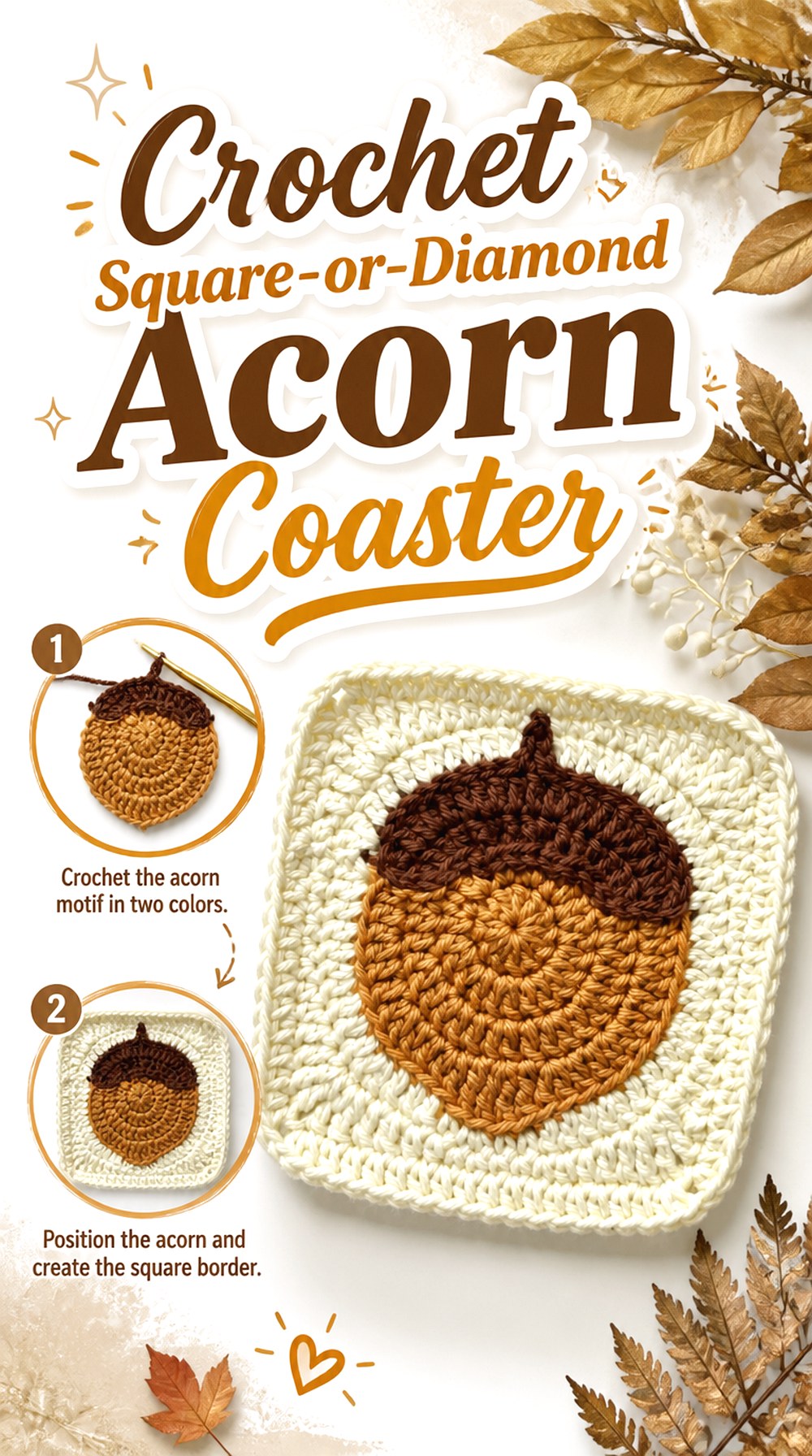
Blackstone Designs gives the acorn a compact granny-square setting with two layout possibilities: a conventional square or a diamond-oriented version. The source lists the finished motif at about 6 inches square with the stated materials, which places it much closer to coaster scale than many of the larger graphic squares in this collection. The design uses a cotton worsted-weight yarn in the creator’s sample and includes surface detail within the acorn motif.
This is a useful middle ground if you want the clean perimeter of a granny square but still want a distinct acorn centered on the fabric.
Square Versus Diamond Placement
Rotating a coaster changes more than its visual presentation. A square aligns neatly with straight table edges, while a diamond lets the corners extend farther around the cup and can create a stronger decorative silhouette. Try both orientations with your actual mug before deciding how to arrange a full set. The crochet does not need to change for that tabletop experiment, making orientation a simple way to alter the look without modifying the pattern.
Surface Detail Should Not Rock the Cup
The acorn motif includes dimensional stitch treatment, so cup placement deserves a quick test once the square is complete. A small amount of relief may be harmless with a broad mug base, while a narrower cup can react differently. If the motif sits too prominently under your drinkware, use the square as a small mug mat with the cup slightly offset rather than trying to flatten decorative stitches aggressively.
Original Tutorial and Creator Credit
Creator/Site: Blackstone Designs
9. Crochet Chubby Acorn Granny Coaster

The crochetcakes version centers a rounded “chub acorn” motif inside granny rounds, producing a finished square the creator reports at roughly 4.75 by 4.75 inches before blocking with the sample materials. That compact footprint makes it one of the more naturally coaster-sized granny projects in the collection.
Unlike a tapestry square, the central acorn is formed as a motif before the surrounding granny structure develops. The result has more dimensional personality than a flat pixel graphic while retaining the practical straight edges of a square coaster.
A Compact Granny Shape for Small Tables
A sub-five-inch sample footprint can suit side tables and small coffee stations where an oversized mug mat would dominate the available surface. Still, finished size depends on yarn, hook, and tension. Before producing a complete matching set, compare one finished square with the widest mug or glass you expect to use. You want the drink base comfortably inside the coaster rather than sitting directly on the outer edge.
Blocking Can Clarify the Corners
Granny construction can pull slightly differently around a shaped central motif, particularly if your tension changes between the acorn and surrounding rounds. If the finished corners do not settle evenly, first confirm that the construction matches the tutorial. Then use finishing appropriate to your chosen fiber. The goal is a naturally flat square, not an aggressively stretched one whose corners only stay straight while pinned.
Original Tutorial and Creator Credit
Creator/Site: crochetcakes
10. Crochet 3D Boho Acorn Mug Mat

Jayda InStitches takes the granny approach in a more dimensional direction. The full video tutorial shows a no-sew boho acorn granny measuring approximately 7 inches in the demonstrated version, and the channel notes that yarn choice can alter the scale.
Its raised, sculptural center gives this option stronger decorative impact than the flatter coaster designs. That same feature is why it is better treated cautiously as a mug mat: the project can frame a drink beautifully, but the cup should only sit where its base remains level and secure.
Raised Detail Needs a Cup-Stability Test
A three-dimensional motif should never be assumed to behave like a flat coaster simply because its overall size accommodates a mug. Finish the square and test it on a firm table with the actual cup you plan to use. If the raised acorn causes rocking or tilting, move the cup onto a flatter portion of the square or use the project beside the drink as decorative table textile instead.
Use the Seven-Inch Scale Deliberately
At around seven inches in the source sample, this granny provides enough visual space for the dimensional acorn to remain visible even with nearby drinkware. If you alter its scale with lighter or heavier yarn as the creator discusses, reconsider both cup footprint and fabric thickness. A smaller version may become coaster-like in width while retaining relatively prominent raised details, so reduced size alone does not guarantee better direct cup support.
Original Tutorial and Creator Credit
Creator: Jayda InStitches
11. Crochet Tapestry Acorn Square Coaster

Sunflower Cottage Crochet’s design uses tapestry crochet to place a large acorn graphic inside an approximately 8-inch square. The source explains that the piece is worked side to side and discusses practical color-carrying and tension concerns associated with tapestry work.
At this scale, it functions more naturally as an oversized coaster or mug mat than as a tiny drink coaster. Its appeal is the clean graphic treatment: instead of a projecting stem or irregular shaped edge, the acorn is contained inside a simple square that can coordinate with other fall-themed blocks.
Tapestry Fabric Brings a Cleaner Graphic
Tapestry crochet can create a relatively solid-looking image, but color management affects both appearance and fabric behavior. The source specifically warns that yarn carried too tightly can pinch the work, while loose carrying can create unwanted loops. For tabletop use, those tension issues matter because distorted fabric is harder to keep flat. Follow the designer’s colorwork guidance rather than pulling strands tight simply to make the back look neat.
Match the Fiber to Intended Table Use
The creator’s sample uses a medium-weight acrylic yarn, which is appropriate to understand as a source-specific material choice for the square. If your goal is a drink mat, you may choose materials according to the absorbency, care, and hand you prefer, provided you account for gauge changes. Do not automatically reinterpret the decorative square as heat protection for cookware; that is a different function requiring suitable material and construction decisions.
Original Tutorial and Creator Credit
Creator/Site: Sunflower Cottage Crochet
12. Crochet Acorn and Leaves Tapestry Coaster

RaffamusaDesigns expands the woodland theme beyond a single acorn by combining acorns with leaves in a tapestry-crochet potholder. The source uses Aran-weight cotton and works with two strands to create the dense, substantial fabric intended for the original hot-pad function.
At a little over 6 inches in each direction according to the tutorial, this option bridges the gap between a drink coaster and a small kitchen mat. Visually, the added leaves give it more movement than the centered single-acorn squares, making it a strong choice for readers who prefer a fuller autumn composition.
Acorns and Leaves Add Directional Interest
A motif with multiple natural elements is less symmetrical than one acorn centered in a plain field. Consider which way you want the design to face when setting the table, particularly if you are making several for opposite seats. Rotating the mats can create either a coordinated directional layout or a more casual scattered-leaf effect. That styling decision changes the finished presentation without requiring changes to the creator’s colorwork.
Dense Colorwork Helps the Mat Stay Substantial
The source deliberately carries two strands as part of its potholder construction, resulting in a thick, solid piece. For ordinary mug-mat use, that substantial hand may feel reassuring, but it also means more thickness than a lightweight coaster. Avoid casually removing structural elements from the tutorial if you still expect the original potholder function; adaptations for drinkware and requirements for hot cookware should be considered separately.
Original Tutorial and Creator Credit
Creator/Site: RaffamusaDesigns
13. Crochet Bud Texture Acorn Inspired Mug Mat
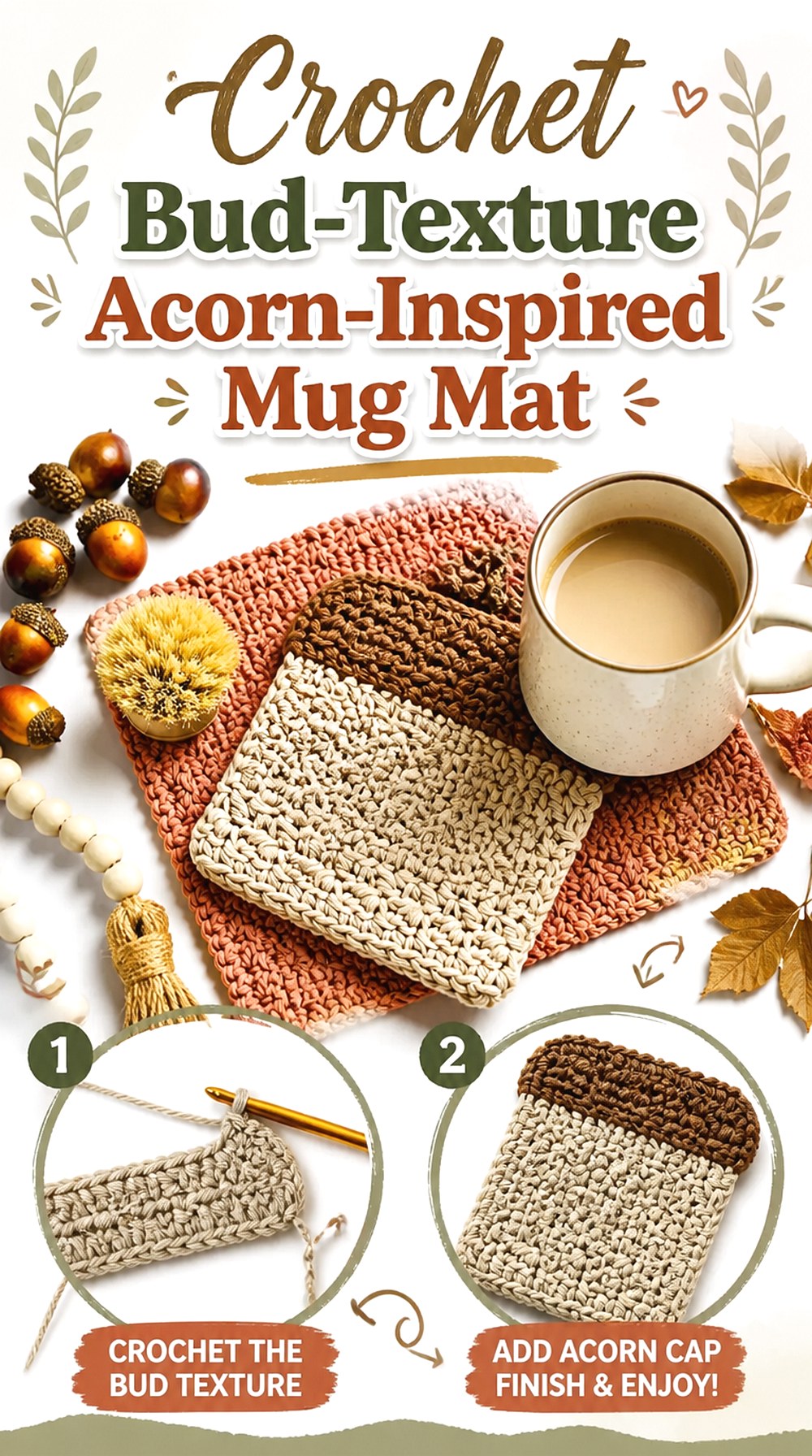
Lullaby Lodge’s Budding Acorns Dishcloth takes the most abstract approach in this collection. Rather than displaying a literal acorn silhouette, the project uses a raised bud-stitch texture and an autumn palette inspired by acorns and seasonal woodland colors. The original dishcloth measures about 9 inches in the creator’s example and uses cotton yarn.
That makes it an appealing mug-mat option for readers who want an acorn connection without pictorial colorwork. It also provides a useful contrast to the highly literal shapes, showing how texture alone can carry the seasonal theme.
Choose This for Texture Instead of a Picture
If your fall table already includes leaf prints, pumpkins, or other obvious seasonal motifs, another literal acorn graphic may feel busy. This design lets the theme appear through tactile surface and color instead. Because the source is fundamentally a textured dishcloth rather than an acorn-shaped coaster, treat that distinction as part of its appeal rather than trying to force the square into a pictorial format it was not designed to be.
Bud Stitch Height Deserves a Quick Check
Raised texture can make a mug mat interesting, but a cup still needs a stable base. Test your drinkware on the completed fabric and note whether the bottom bridges the textured areas comfortably or rocks between them. A broad mug may behave very differently from a narrow glass. If stability is marginal, keep the drink on a flatter section or use the textile as a tray liner or decorative mat instead.
Original Tutorial and Creator Credit
Creator/Site: Lullaby Lodge
14. Crochet Bobble Cap Acorn Table Coaster

Beatrice Ryan Designs creates a large shaped acorn dishcloth with separate upper and lower sections joined into one recognizable silhouette. The cap gains a bumpy surface through alternating stitch heights, while the lower body remains comparatively smooth. The source uses two colors of cotton yarn and includes shaping and finishing advice when the fabric pulls or curls.
For tabletop use, its larger dishcloth proportions make it better as an oversized table coaster or mug mat. The strong division between textured cap and smoother body gives you a natural place to position the drink.
The Textured Cap Creates a Strong Silhouette
The raised upper section is the main decorative feature, so there is little reason to hide it directly beneath a mug. Position drinkware lower on the body and allow the cap and stem to remain visible. This arrangement also reduces the chance that heavily textured stitches affect cup stability. Before making a matched set, check that your tension produces a cap that lies against the table rather than turning upward along its joined edge.
Joining and Shaping Affect Flatness
The designer constructs the top and base as separate areas and discusses joining them, along with light shaping when necessary. Any joined project can behave differently at that transition if stitch tension varies between pieces. Examine the seam before finishing: it should not pull the body into a cup shape. Follow the original construction notes rather than adding an overly tight improvised seam that could distort the acorn outline.
Original Tutorial and Creator Credit
Creator/Site: Beatrice Ryan Designs
15. Crochet Large Acorn Dishcloth Mug Mat

Yarnspirations’ Lily Sugar’n Cream acorn design is another full acorn silhouette on a deliberately generous scale. The source lists an approximate finished measurement of 10 inches high by 9 inches wide and presents the item as an autumn-themed dishcloth.
Those dimensions make it far larger than a standard drink coaster, but useful as a mug mat or individual seasonal table accent. A cup can occupy only part of the body while the cap, stem, and outline remain visible. This is a good choice when the acorn itself is meant to be part of the tablescape rather than mostly hidden under drinkware.
A Large Shape Works Better as a Mug Mat
Trying to treat a roughly 10-inch acorn exactly like a four-inch coaster wastes much of its design advantage. Give the extra area a purpose: pair the mug with a small spoon, tea bag rest, or packaged treat while keeping those accessories away from any unstable edge. On a narrow end table, measure the available surface first; an attractive large silhouette can become inconvenient if it hangs over the furniture.
Keep Care Instructions Source-Specific
Yarnspirations provides care information for the specified project and yarn on its page. If you substitute another fiber, do not assume those same instructions transfer automatically. Follow the label for the yarn you actually use, particularly if repeated beverage spills are likely. Mixed embellishments, different fibers, or altered construction can change what washing and drying methods are appropriate.
Original Tutorial and Creator Credit
Creator/Site: Yarnspirations
16. Crochet Character Acorn Granny Table Mat

Nana’s Crafty Home turns an acorn into a playful character within a large granny-square panel. The source describes a textured cap plus separately attached stem, leaf, eyes, and cheeks, and lists the finished square at approximately 14 inches. It was designed as part of a fall square collection with uses such as a wall hanging or pillow.
Because of that large scale and the raised, sewn-on features, this is best interpreted here as a decorative table mat rather than a direct under-cup coaster. It brings personality to a fall beverage station while leaving room to place the actual mug away from dimensional details.
Character Details Turn It Into Table Decor
Eyes, cheeks, a leaf, and a textured cap create a much more illustrative finish than a plain acorn motif. Those features deserve to remain visible, so consider positioning the square under a small tray, beside a mug, or at the center of a seasonal coffee station. This preserves the character design instead of covering the face while still using the square as part of the tabletop arrangement.
Keep Cups Away From Raised Features
The source specifies multiple pieces that are worked separately and attached to the panel. Raised attachments can interfere with the level base required for a filled cup. If you use the square on a table, identify a reliably flat zone or place drinkware on a separate conventional coaster. Decorative crochet and direct cup support do not need to be the same function simply because both occupy the tabletop.
Original Tutorial and Creator Credit
Creator/Site: Nana’s Crafty Home
17. Crochet Tiny Acorn Coffee Cup C2C Mug Mat

Divine Debris offers an especially fitting crossover between fall motifs and coffee-table styling: a C2C square centered on a coffee-cup concept decorated with tiny acorns. The source is part of a coffee-themed C2C collection and gives an approximately 11.5-inch version among its size information.
Rather than depicting one giant acorn, this design makes acorns part of the drinkware imagery itself. The result works naturally as a serving or coffee-station mat where the textile echoes the mug placed nearby. Its larger C2C scale should be embraced rather than mislabeled as a compact single-cup coaster.
The Coffee-Cup Graphic Changes the Theme
Most acorn projects in this list focus on woodland imagery first and drink use second. Here the coffee concept is already built into the graphic, making it an interesting choice for an autumn beverage bar or breakfast tray. Keep surrounding accessories relatively simple so the C2C image remains legible. Too many patterned napkins or other motifs around it can compete with the small acorn details.
C2C Scale Works Best as a Serving Mat
The source square is substantially larger than an ordinary coaster, so consider it a defined zone for several coffee-related items rather than just one cup. A mug, spoon, and wrapped snack can share the surface without obscuring the whole motif. If you experiment with a smaller yarn to reduce the dimensions, confirm that the tiny acorn elements remain readable and that the resulting fabric still lies flat.
Original Tutorial and Creator Credit
Creator/Site: Divine Debris
18. Crochet Pixel Acorn Patchwork Table Mat
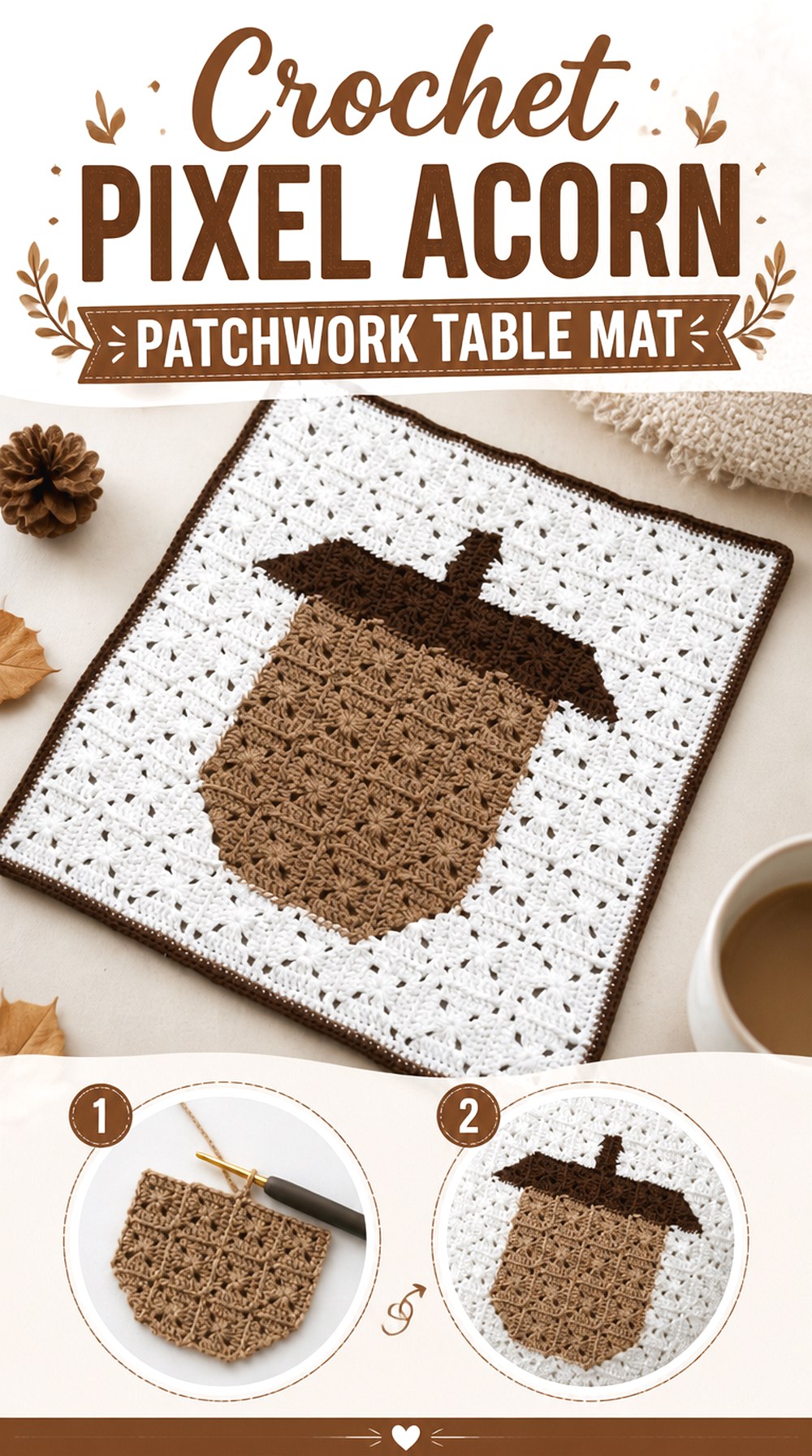
EyeLoveKnots’ pixel-art design approaches the acorn on the largest and most modular scale in this collection. The original project is a 16-inch square made from joined small solid granny squares in lightweight yarn, creating an acorn image through a patchwork grid. The creator discusses several possible decorative applications and notes that yarn choice can change the overall scale.
For a fall table, this makes more sense as a statement mat, centerpiece base, or coffee-station textile than as a direct coaster. Its interest lies in the visible pixel construction and repeated joined motifs rather than a small uninterrupted cup surface.
Pixel Construction Creates a Statement Piece
Because the acorn is assembled from many individual squares, the grid itself becomes part of the design. That patchwork character works well on a relatively open tabletop where the whole image can be seen. If you cover most of it with a large tray, the acorn may become difficult to recognize. Plan the surrounding objects around the completed graphic rather than treating the square as an anonymous background cloth.
Smaller Yarn Changes Scale, Not Complexity
The creator notes that changing yarn weight can produce different project sizes. A lighter-scale version could reduce the footprint for tabletop use, but it would not remove the joining involved in the pixel construction. Also inspect every join for flatness before placing drinkware nearby. A smaller piece is only a better coaster if the final surface is level enough for the intended cup.
Original Tutorial and Creator Credit
Creator/Site: EyeLoveKnots
Which Acorn Coaster Style Fits Your Table?
| Style | Ideas to Consider | Best Fit | Main Check |
|---|---|---|---|
| Compact shaped drink coasters | 1–3 | Individual mugs and glasses | Make sure the broad body supports the cup |
| Compact granny coasters | 8–9 | Small tables and coordinated sets | Check central texture and corner flatness |
| Larger shaped mats | 4–5, 14–15 | Mug-and-spoon settings or seasonal place accents | Keep cups on flatter body sections |
| C2C and tapestry mats | 6–7, 11–12, 17 | Graphic fall tables and coffee stations | Watch colorwork tension and overall scale |
| Dimensional or character mats | 10, 16 | Decorative beverage stations | Keep drinkware away from raised details |
| Abstract or patchwork mats | 13, 18 | Statement texture and broader table decor | Confirm the finished surface is stable |
The main decision is not simply which acorn looks nicest. Decide whether the finished crochet needs to support one cup, provide extra room around a mug, handle a kitchen-specific job, or serve mainly as fall decor. That choice quickly narrows the most practical options.
Conclusion
These 18 crochet acorn coaster ideas show how much the same woodland motif can change through construction. The compact shaped designs work most naturally beneath individual cups, while granny squares provide tidier geometric edges. Tapestry and C2C versions emphasize graphic colorwork, and the larger dishcloth or hot-pad designs are better treated as roomy mug mats. Dimensional acorns, character squares, and pixel projects make stronger decorative statements but deserve extra attention to cup stability.
Choose by function first, then by silhouette, texture, and technique. If you plan to alter yarn, scale, construction, or kitchen use, check the original tutorials for the designer’s exact instructions before adapting the project.
Frequently Asked Questions
What yarn is practical for crochet acorn coasters?
Several functional projects in this collection use cotton, and it is a common option for home crochet because it can provide good stitch definition and practical washability. That does not mean one fiber is mandatory for every coaster. Check the original pattern, the yarn label, and how you intend to use the piece. Changing fiber can affect absorbency, thickness, drape, drying behavior, and finished dimensions.
Can I resize an acorn dishcloth or granny square into a coaster?
Often you can experiment with yarn thickness or hook size to alter scale, but resizing is not purely a mathematical change. A smaller yarn can change fabric density, motif definition, thickness, and drape. C2C and tapestry graphics also need enough stitches or blocks for the acorn image to remain clear. Make a sample and check it against your cup rather than assuming a large pattern will automatically become a functional small coaster.
Can every crochet acorn coaster be used as a hot pad?
No. A drink coaster, decorative mat, and potholder have different functional demands. Some sources in this list were specifically designed as hot pads or potholders, while others were not. If you intend to handle or protect surfaces from hot cookware, use a project designed for that role and follow its construction and fiber guidance. Do not assume that a decorative coaster—or a yarn substitution—provides appropriate protection from high heat.
How can I reduce curling on a shaped acorn coaster?
First check that your stitch placement, tension, and shaping follow the original tutorial. Tight edging, uneven increases, or a major change in yarn can all influence how a small shaped piece settles. Once construction is correct, appropriate blocking may help some fibers lie more evenly. Follow the care instructions for the yarn you actually used, and avoid forcing the outline so aggressively that the stitches become stretched or distorted.
Should the textured acorn cap sit underneath the mug?
Only if the cup remains completely stable. Puff stitches, popcorns, post stitches, and three-dimensional motifs can create attractive acorn texture, but different mug bases respond differently to raised fabric. Test the filled cup on a firm surface. If it rocks, move the drink onto the smoother body of the acorn or treat the project as a mug mat with the textured section left visible.
Can I sell finished acorn coasters made from these tutorials?
Permissions vary by designer and can change, so there is no blanket answer for all 18 sources. Check the current terms on the specific original tutorial or the creator’s policies before selling finished items. Permission to sell a handmade finished project also does not automatically permit copying, redistributing, translating, republishing, or selling the creator’s written pattern, graph, tutorial photographs, or other protected content.


