
16 Crochet Witchy Table Mat Ideas for Spooky, Mystical Tables
Witchy crochet table mats can range from full dinner placemats to dramatic lace centerpieces and small shaped mats for mugs. That difference matters: a dense tapestry-crochet rectangle behaves very differently beneath a plate than an open spiderweb doily or crescent-shaped coaster. Motif visibility, flatness, fiber choice, and the amount of usable surface all affect where a finished piece works best.
The 16 ideas below cover graphic witch hats, black cats, moons, pumpkins, skulls, coffins, ghosts, spiders, pentacles, eyeballs, and bubbling-potion details. Some sources teach full-size placemats, while others intentionally teach coaster or doily formats that suit smaller table settings. Each project includes an original tutorial credit plus practical considerations to help you choose a design without turning this article into a substitute for the creator’s pattern.
Quick List
- Crochet Spiderweb Lace Placemat
- Crochet Jack-O’-Lantern Tapestry Table Mat
- Crochet Bat and Full-Moon Placemat
- Crochet Twisted Witch-Hat Placemat
- Crochet Black Cat Tapestry Placemat
- Crochet Pumpkin-Patch Round Table Mat
- Crochet Skull Lace Centerpiece Mat
- Crochet Floral Skull Mini Table Mat
- Crochet Coffin-Shaped Cup Mat
- Crochet Bloodshot Eyeball Table Coaster
- Crochet Crescent Moon Cup Mat
- Crochet Pentacle Doily Table Mat
- Crochet Spider-Shaped Drink Mat
- Crochet Ghost Scallop Mug Mat
- Crochet Blood-Splatter Table Coaster
- Crochet Bubbling Cauldron Coaster Set
Choose the Table-Mat Scale Before the Motif
“Table mat” can describe several useful sizes. Full rectangular placemats make sense beneath dinnerware because they provide a broad continuous surface. Medium round pieces can anchor a centerpiece, serving bowl, or decorative arrangement. Coaster-scale mats work at individual mugs or glasses, while lace doilies are strongest when their open spaces remain visible instead of being hidden completely beneath a large plate.
Decide on placement before changing yarn weight or enlarging a small design. Scaling a coaster with dramatically thicker yarn does not automatically turn it into a functional placemat; the resulting fabric, proportions, edge shape, and stability may change. When you need a particular finished footprint, check the creator’s measurements or adjustment guidance rather than assuming that a larger hook alone will produce the result you want.
Match Fiber and Surface Use Carefully
A table project has different practical demands from wall decor. Dense cotton is commonly chosen in several of the placemat and coaster tutorials here because it can provide clear stitch definition and a practical washable surface, but fiber choice should still follow the individual project and yarn-care guidance. Open lace, fluffy embellishments, carried colorwork, and raised stitches all behave differently around spills and everyday handling.
Do not assume that a drink coaster is also suitable beneath hot cookware. A tutorial labeled as a coaster or decorative mat does not establish trivet or potholder performance. If heat is part of the intended use, follow explicit creator guidance and the yarn manufacturer’s information rather than relying on appearance alone.
Keep Witchy Motifs Readable and Flat
Many witchy designs depend on silhouette more than complicated color palettes. A black cat, bat, crescent, spider, or pentacle needs enough contrast against both its background stitches and the actual tabletop. Before making a whole matching set, place one finished sample where it will be used and view it from standing distance. Fine details that look obvious while crocheting can disappear once plates, mugs, napkins, and centerpieces surround them.
Flatness deserves the same attention. Tapestry mats can distort when color-carry tension changes, circular pieces can ripple when increases do not suit the maker’s gauge, and open lace may need careful shaping. Follow the tutorial’s finishing recommendations and use a blocking method appropriate for the actual fiber.
1. Crochet Spiderweb Lace Placemat

A wide openwork spiderweb immediately establishes a witchy table without requiring a character motif or complicated color changes. This version works especially well as a decorative plate surround, Halloween party mat, or center-table layer because the radiating web remains visible around whatever sits on top. Cat-sitter tricote’s source tutorial specifically presents the finished web as a crochet placemat or tablecloth, so the tabletop role is built into the project rather than being an unrelated adaptation.
Its biggest distinction is negative space. Unlike the solid tapestry mats later in the list, the table surface becomes part of the design. That makes tabletop contrast and final shaping particularly important.
Leave Enough Web Visible
Openwork loses much of its effect when the entire center is hidden beneath oversized dinnerware. Before committing to a full set, compare the finished diameter with the plates or centerpiece you normally use. A smaller object over the middle allows the radial structure to remain obvious, while a very broad plate may reduce the piece to an outer lace border.
Shape the Radial Points Evenly
Spiderweb geometry makes uneven sections easy to notice. If the finished piece is intended to lie flat, use the creator’s finishing guidance and a blocking approach suitable for your yarn. Work around the circumference systematically rather than pulling isolated sections aggressively; balanced shaping helps preserve the web effect without distorting individual openings.
Original Tutorial and Creator Credit
Creator: Cat-sitter tricote
2. Crochet Jack O’ Lantern Tapestry Table Mat
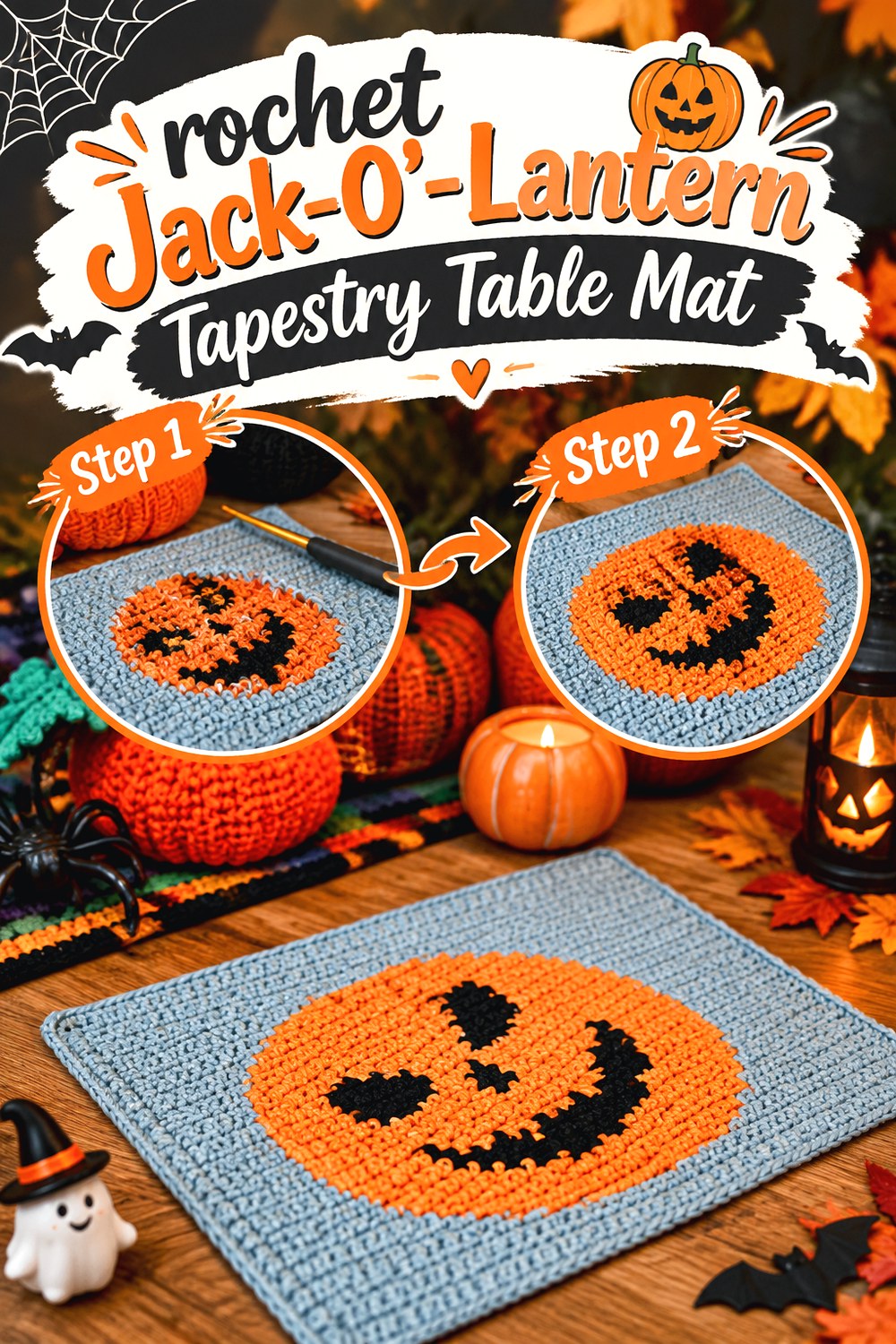
This rectangular table mat replaces open lace with dense graphic colorwork. A smiling jack-o’-lantern becomes the focal image while the surrounding background keeps the overall silhouette practical for a traditional place setting. Sunflower Cottage Crochet’s original pattern is specifically designed as a Halloween pumpkin placemat and uses tapestry crochet to build the facial image through color changes.
Choose this style when you want the motif to read almost like an illustration rather than a shaped object. It also gives plates, cutlery, and napkins a more predictable rectangular footprint than the spiderweb or coffin designs. The trade-off is that consistent color-carry tension matters much more.
Keep the Face Easy to Read
Graphic tapestry motifs depend on clean boundaries between the pumpkin, facial features, and background. Substitute colors should differ enough in value that the expression remains recognizable from across the table. Test a small grouping of the intended colors together before making the entire mat, particularly if you prefer muted autumn shades rather than the source palette.
Watch the Reverse Side of Colorwork
Carried yarn can influence thickness and tension even when the front looks correct. Periodically lay the work flat instead of waiting until the final row to inspect it. If carried strands are pulling the fabric inward, the finished rectangle may narrow or pucker. Follow the creator’s tapestry-crochet guidance rather than tightening floats simply to make the back look neater.
Original Tutorial and Creator Credit
Creator/Site: Sunflower Cottage Crochet
3. Crochet Bat and Full Moon Placemat

A bat crossing a large moon creates a more atmospheric table setting than a single Halloween character. The source design from Sunflower Cottage Crochet is another rectangular tapestry placemat, but the visual balance is very different from the jack-o’-lantern: a dark flying silhouette sits against a strong circular moon shape, giving the piece a layered night-sky effect.
This makes a good choice for a witchy table that leans celestial or gothic rather than cartoonish. It can also bridge black decor with orange, gold, cream, or another moon color. Because the motif spans several color areas, maintaining the distinction between background, moon, and bat is more important than adding extra embellishment.
Preserve the Moon Behind the Bat
The moon is doing structural visual work in this design: it provides the contrasting field that allows the bat to read instantly. When choosing a different palette, make sure the moon remains visibly separate from both the bat and the outer background. Three attractive yarn colors can still fail as a combination if their values are too similar.
Avoid Tight Color-Carry Sections
A dense tapestry mat can look square and level at the edges while still drawing inward around highly changed color sections. Pause occasionally and compare the width above and below the moon motif. If the fabric starts contracting, review how loosely you are carrying unused yarn before continuing through more rows.
Original Tutorial and Creator Credit
Creator/Site: Sunflower Cottage Crochet
4. Crochet Twisted Witch Hat Placemat

Few motifs identify a witch theme faster than a pointed hat. This placemat turns that familiar silhouette into a broad tapestry-crochet image rather than literally shaping the whole mat like a hat. Sunflower Cottage Crochet’s design features a twisted witch hat with contrasting band and buckle details within a rectangular place-setting format.
That combination makes it practical when you want whimsical witch imagery without irregular outer edges around plates and silverware. It also offers more room for personality through color: the crown can stay traditional or shift toward plum, moss, charcoal, rust, or another palette while the silhouette remains obvious.
Position Dinnerware Without Hiding the Hat
Before making several identical placemats, put a plate over one finished sample and see how much of the graphic remains visible. The ideal placement depends on your plate size and table setting. If most of the hat disappears, consider using the piece where the image can remain partially exposed rather than covering the focal area completely.
Treat the Buckle as an Accent
Small contrasting details need enough distinction to survive normal viewing distance. A buckle color that is too close to the hat band can vanish once the table is set. You do not need a brighter overall palette; one controlled accent can be enough to define the buckle while keeping the rest of the mat dark and atmospheric.
Original Tutorial and Creator Credit
Creator/Site: Sunflower Cottage Crochet
5. Crochet Black Cat Tapestry Placemat

A black cat gives the collection a quieter kind of witchiness. Instead of webs, bones, or dripping effects, the source placemat uses a sleek cat silhouette with a small contrasting collar detail. Sunflower Cottage Crochet teaches it as a tapestry-crochet placemat, so it has the same broad, flat place-setting format as the previous graphic pieces but a noticeably more understated motif.
This is a strong option when you want seasonal decor that can remain on the table beyond a single Halloween party. The cat can feel mysterious, playful, or gothic depending on the background palette, and a relatively simple silhouette means the edges of the animal matter more than extra decoration.
Protect the Cat’s Silhouette
Dark yarn does not automatically create strong contrast. A black cat against charcoal or deep purple can become difficult to recognize from a distance. Check yarn values in the lighting where the mat will actually be used. If you want a very dark palette, a lighter surrounding field usually gives the silhouette more visual space.
Use the Collar as a Controlled Color Note
The small collar is a useful place to repeat another color from your tablescape without redesigning the whole mat. It could visually connect to napkins, candles placed safely elsewhere, dishes, or other crochet accents. Keep the color relationship intentional; adding several extra shades can compete with the clean cat profile that gives this design its strength.
Original Tutorial and Creator Credit
Creator/Site: Sunflower Cottage Crochet
6. Crochet Pumpkin Patch Round Table Mat

This round pumpkin-patch design moves away from flat picture-style tapestry work and introduces visible texture. Zamiguz’s original placemat uses a circular format with raised pumpkin motifs, creating more surface interest and a stronger harvest-meets-witchy mood than a simple jack-o’-lantern graphic. The tutorial provides two finished size options and presents the piece for placemat or decorative tabletop use.
It is particularly suitable for a table where texture can remain exposed around a plate, centerpiece, or decorative vessel. Because dimensional details behave differently from a completely flat mat, think carefully about what will sit over the raised sections rather than choosing it only for appearance.
Decide Whether Texture or Plate Stability Comes First
Raised motifs look strongest when they remain visible, but dimensional stitches can also change how an object rests on top. Place the intended plate or centerpiece on a sample and check for wobbling before making a matching set. If the texture falls beneath the object’s base, this design may work better as a decorative mat than as an everyday dinner placemat.
Pick the Size for the Actual Job
The source offers more than one finished size, which is useful because a centerpiece mat and an individual place mat do not require the same footprint. Measure the object or dinnerware you expect to place on top, then compare that need with the tutorial’s stated sizes rather than choosing solely by which sample looks best in photographs.
Original Tutorial and Creator Credit
Creator/Site: Zamiguz
7. Crochet Skull Lace Centerpiece Mat

For a dramatic centerpiece rather than an individual place setting, a large skull doily changes the scale completely. Crochet Art Tutorials by Maggie Lopes demonstrates a substantial square skull doily centerpiece using crochet thread, with the skull integrated into a broad lace field. The video description identifies it specifically as a centerpiece-sized project rather than a small coaster.
This format gives a dining or coffee table one strong focal piece instead of repeating the same motif at every seat. Lace around the skull keeps the design visually lighter than a solid tapestry mat, while the larger footprint allows the skull theme to remain apparent even with restrained colors.
Let the Skull Remain the Focal Point
A detailed centerpiece does not need many competing decorations. Before layering bowls, vases, or seasonal objects over it, identify which parts create the recognizable skull image and keep those areas reasonably visible. A smaller central object often preserves the motif better than several scattered pieces covering different sections of the lace.
Give Large Lace Enough Finishing Space
A broad thread project needs enough flat space for shaping after completion. Prepare the intended blocking area before the last stages rather than discovering later that the mat is larger than your available board. Follow fiber-appropriate finishing methods and the creator’s guidance; the goal is even geometry, not stretching the lace to an arbitrary target.
Original Tutorial and Creator Credit
Creator: Crochet Art Tutorials by Maggie Lopes
8. Crochet Floral Skull Mini Table Mat

Someday Sarah’s skull doily offers a very different scale from the large centerpiece above. The source tutorial produces a small skull-centered lace motif surrounded by decorative fan, pinwheel, and petal-like sections, and the creator notes that finished size changes with yarn choice.
Used at table scale, it can function as a small decorative mat, coaster-like accent, or grouped motif beneath lightweight display pieces. The combination of a recognizable skull and a more floral lace perimeter gives it a softer gothic effect than a plain skull silhouette. Its compact scale also makes it easier to repeat several motifs without turning the entire tabletop into one large continuous textile.
Use Repetition Instead of Extreme Enlargement
If you need more table coverage, several small motifs may preserve the lace proportions better than radically enlarging one with very thick yarn. Changing yarn weight can alter both openness and stiffness. Make one test motif first and judge whether its scale suits the intended cup, candle-free decorative object, or small bowl before committing to multiples.
Let Yarn Choice Control the Mood
Fine cotton can emphasize lace openings and make the motif look delicate, while a somewhat heavier yarn can create a bolder, more graphic skull. The source itself notes that size varies with yarn choice. If substituting materials, also confirm the corresponding hook choice and finishing method rather than copying measurements from a different fiber setup.
Original Tutorial and Creator Credit
Creator: Someday Sarah
9. Crochet Coffin Shaped Cup Mat

A coffin-shaped coaster brings gothic geometry to the table without relying on a printed or tapestry motif. Nessa’s Knots Crochet teaches the finished object specifically as a coffin coaster, giving it a defined drink-mat purpose and a silhouette that remains recognizable even in a single color.
This design works well in a mixed witchy coaster set because it contrasts sharply with circles, crescents, and character shapes. The tapered lower edge and angled shoulders give it personality, but those same features mean it offers less continuous surface than a plain square. Choose it when silhouette matters as much as maximum coverage.
Center the Mug on the Broad Area
The extended coffin outline does not mean every part should support the mug. Test your normal cup on the broad central section and confirm that the base remains level. Decorative edging or stitched details can sit outside that contact zone where they remain visible without affecting stability.
Keep Embellishment Away From the Cup Base
A coffin practically invites crosses, webs, initials, flowers, or other gothic details. If you add anything beyond the tutorial, favor flat embroidery or place dimensional accents outside the main resting area. Raised knots or bulky appliqués directly beneath a drink can turn a functional coaster into an unstable decorative object.
Original Tutorial and Creator Credit
Creator: Nessa’s Knots Crochet
10. Crochet Bloodshot Eyeball Table Coaster

An eyeball coaster creates its witchy impact through concentric color rather than outer shape. Easy Breezy Crochet’s original tutorial builds a round eye with pupil, iris, white area, and a bloodshot-looking outer detail, producing a compact table piece designed specifically as a coaster.
This is one of the easiest motifs in the collection to personalize visually without changing its identity. Switching the iris from green to violet, blue, amber, or another accent can coordinate the coaster with an entire tablescape. Because most of the graphic information sits within a simple circle, it also gives a mug a more predictable support area than the crescent or spider shapes.
Build Contrast From the Center Out
The pupil, iris, white, and outer details need to remain visually distinct. Lay potential yarn colors beside each other before starting, particularly if you prefer a muted gothic palette. Two shades may look different as skeins but merge once worked into narrow concentric bands. The iris is usually the safest place for a strong accent.
Keep Vein-Like Details Flat
Bloodshot effects add character, but a drink mat still needs an even surface. The source uses crochet structure to create its outer effect rather than requiring bulky added decorations. If you customize further, avoid thick knots or beads under the cup’s footprint and keep extra dimensional details toward the visible edge.
Original Tutorial and Creator Credit
Creator/Site: Easy Breezy Crochet
11. Crochet Crescent Moon Cup Mat

A crescent moon shifts the mood from Halloween-specific imagery toward celestial witch decor. Crochet with marmara’s tutorial teaches a crescent-shaped coaster, giving the finished piece a clear tabletop role even though the original styling is for Ramadan decoration rather than witch decor.
The moon shape can move easily into a witchy palette through charcoal, cream, muted gold, dusty lavender, or deep blue. Its open inner curve makes it visually lighter than a solid circular coaster, and it pairs naturally with stars, black cats, or bat motifs. The practical trade-off is that the usable mug surface is less continuous than it would be on a full circle.
Check Cup Support Across the Crescent
A strong curve creates attractive negative space but reduces the area directly beneath a cup. Make one sample and place your usual mug on it before producing a whole set. If the cup base extends substantially beyond the crocheted section, keep the crescent as a decorative accent and choose a fuller mat for heavier or wider drinkware.
Shift the Styling Without Altering the Pattern
The tutorial’s original decorative context is not witch-themed. The celestial connection comes from the finished crescent shape, so there is no need to modify the creator’s construction to achieve a different mood. Instead, change the surrounding palette and pair the moon with complementary table elements while keeping the source’s actual crochet instructions intact.
Original Tutorial and Creator Credit
Creator: crochet with marmara
12. Crochet Pentacle Doily Table Mat

A pentacle provides one of the clearest occult-inspired motifs in this collection. Knot Magick’s original project is presented as a pentacle doily/pot holder, with the star integrated into a circular crochet structure rather than embroidered afterward. The creator also discusses how different cotton yarn choices affected the firmness of finished samples.
As a witchy table mat, its appeal comes from geometry. The central star and surrounding circle need enough definition to remain readable, making final shape and contrast more important than elaborate colorwork. It can sit beneath a decorative bowl, form part of an altar-style tabletop arrangement, or stand alone as a graphic accent.
Keep Decorative Use Separate From Heat Assumptions
The source discusses the project as a doily/pot holder, but any material substitution can change how a finished textile behaves. Do not assume that a version made with different fiber, yarn weight, or construction choices has the same heat-related suitability. For ordinary table decoration, focus on flatness and structure; for hot items, follow appropriate source and yarn guidance.
Preserve the Five-Point Geometry
Pentacle designs become visually awkward when one section stretches more than another. During finishing, check the star from directly above rather than judging only individual stitches. Shape corresponding points evenly and use a blocking method appropriate for your fiber. Symmetry is especially visible in a motif that depends on repeated straight and curved relationships.
Original Tutorial and Creator Credit
Creator/Site: Knot Magick
13. Crochet Spider Shaped Drink Mat

Instead of showing a web, this coaster turns the spider itself into the table silhouette. The Caffeinated Snail’s original tutorial creates an oval crochet spider coaster with extending legs, making the creature recognizable even without a complex color pattern.
It is a useful contrast to the first spiderweb placemat: one works through radial negative space, while this one relies on a solid central body and projecting limbs. A single spider can add a playful creepy note beside a mug, or several can be scattered around a party table. Those extending legs, however, need more clearance than a conventional round coaster.
Check Where the Legs Land
Projecting crochet legs can catch against cutlery, napkin edges, neighboring coasters, or decorative objects if the place setting is crowded. Mock up the full table arrangement before making a large batch. If the legs interfere with normal use, reserve spider mats for coffee tables, side tables, or less congested portions of the dining surface.
Create Contrast Around the Body
A dark spider placed directly on a dark runner can lose most of its outline. Contrast does not have to come from changing the spider itself; a pale tabletop, light plate nearby, or contrasting underlayer can make the legs visible. Test the actual setting from standing height, where fine black details may be harder to see than they are close up.
Original Tutorial and Creator Credit
Creator/Site: The Caffeinated Snail
14. Crochet Ghost Scallop Mug Mat

A ghost mat gives the table a softer, playful witchy accent among the darker skulls and coffins. Stitch by Fay’s original coaster is worked into a recognizable ghost form with a wavy lower edge and an embroidered face.
Because the body provides a relatively broad central area, the project can support a mug while leaving the scalloped “sheet” edge visible below. It also works well in mixed sets where every seat gets a different spooky motif. White is traditional, but the ghost shape can also read in muted gray, pale lavender, or another light shade if you maintain enough contrast with the tabletop.
Leave the Scalloped Edge Uncovered
The lower wave is one of the details that makes the silhouette unmistakably ghostlike. Position the mug high enough on the body that the scallops remain visible instead of disappearing underneath it. A small placement adjustment can preserve far more of the design without changing a single stitch.
Embroider the Face Without Creating Lumps
The source emphasizes the face as an important finishing detail. Keep the reverse side tidy and check that secured yarn does not form a bulky knot beneath the cup. If you alter the expression, place the embroidery within the visible upper portion rather than moving thick stitching into the main drink contact area.
Original Tutorial and Creator Credit
Creator/Site: Stitch by Fay
15. Crochet Blood Splatter Table Coaster

A blood-splatter coaster gives a horror-leaning table an irregular organic outline that no moon, rectangle, or traditional round mat can mimic. Crochet Crafters’ tutorial teaches a one-piece blood splatter coaster with a round central area and projecting drip shapes.
This is best used as a deliberate accent rather than repeated everywhere. One or two red splatter mats among darker neutral pieces can create more visual impact than an entire table of the same irregular silhouette. The projecting drips are largely decorative, so the important functional area remains the center where the cup rests.
Keep the Drips Outside the Mug Footprint
The irregular projections are the design feature, not extra support for the drink. Center your mug on the more continuous part of the coaster and let the extensions remain visible. If a particular cup is so wide that it covers almost every drip, a smaller cup or a different coaster may show the motif more effectively.
Use It as a Coaster, Not an Automatic Hot Pad
The source teaches a coaster. That does not establish suitability beneath pots, baking dishes, or other hot cookware. Keep its function within the creator’s stated role unless your materials and an appropriate source specifically support another use. This distinction is especially important with novelty table textiles that visually resemble potholders.
Original Tutorial and Creator Credit
Creator: Crochet Crafters
16. Crochet Bubbling Cauldron Coaster Set

This final project makes the table mat part of a larger display. Green Fox Farms Designs’ original pattern combines a crochet cauldron with potion-themed coasters, including a bubbling-edged version and a spiral option that can be stored in the cauldron when not in use.
That built-in storage makes the set substantially different from every standalone mat above. On a coffee table or tea station, the cauldron becomes the decorative centerpiece while the actual coasters remain available for drinks. Bright potion colors also provide a controlled way to add green, purple, orange, or another accent without turning every witchy item on the table black.
Let the Cauldron Store the Visual Clutter
When the coasters are not being used, returning them to the cauldron keeps a themed table from becoming crowded with several small circles. This works especially well in compact spaces where loose coasters can look scattered. Before adding unrelated decorations around the set, see whether the cauldron and visible potion edges already provide enough of a focal point.
Keep Bubbling Edges Beyond the Cup Base
The source includes dimensional edging that helps the stored coasters resemble bubbling potion. When a coaster is actually under a drink, position the cup so the most raised sections remain around the perimeter rather than directly beneath the base. The decorative effect stays visible while the central contact area can do its practical job.
Original Tutorial and Creator Credit
Creator/Site: Green Fox Farms Designs
Which Witchy Table Mat Style Fits Your Table?
For a full dinner setting, the rectangular jack-o’-lantern, bat-and-moon, witch-hat, and black-cat placemats provide the most conventional footprint. The pumpkin-patch round mat gives you a similar larger scale with more texture.
Choose the spiderweb, pentacle, or skull lace pieces when the textile itself should remain visually prominent rather than disappearing almost completely beneath dinnerware. Their negative space and geometry make them well suited to center-table display.
For coffee tables, tea trays, desks, or mixed party settings, the coffin, eyeball, crescent, spider, ghost, blood splatter, and cauldron coasters offer more variety at a smaller scale. Mixing two or three related motifs usually creates a more intentional collection than using every witchy symbol at once.
Conclusion
These 16 crochet witchy table mat ideas cover much more than one standard placemat shape. You can choose dense rectangular tapestry work for dinner settings, round textured pieces for seasonal table decor, open lace for centerpieces, or compact shaped mats for mugs and coffee-table displays. The best option depends on how much surface coverage you need, whether the motif should remain visible under tableware, and how much texture or openwork suits the setting.
Whichever direction you choose, make one sample before committing to a large matching set and check it with the dinnerware or drinkware you actually use. For exact construction, materials, stitch information, sizing, and finishing, follow the original tutorials credited with each project.
Frequently Asked Questions
What yarn is most practical for crochet witchy table mats?
There is no single fiber requirement for every design. Several table-focused sources in this collection use or recommend cotton, particularly for placemats and drink coasters, while lace projects may use much finer crochet thread. What matters is matching the fiber to the original construction and intended use. Check the tutorial and yarn label before substituting, especially when washability, dimensional texture, or heat exposure matters.
Can I enlarge a witchy crochet coaster into a full placemat?
Sometimes a shape can be adapted, but simply choosing very thick yarn and a larger hook may alter the proportions, stiffness, stitch definition, and usable surface. A coaster designed around a mug does not automatically become a balanced dinner placemat when scaled up. If the source provides resizing advice, use it. Otherwise, consider placing several small motifs together or choosing one of the tutorials already designed at placemat scale.
Do crochet table mats need to be blocked?
Not every project requires the same finishing treatment, but blocking or careful shaping can be especially useful for spiderwebs, doilies, pentacles, crescents, and other motifs where geometry controls the final appearance. Tapestry placemats may instead need attention to straight edges and even colorwork tension. Always use a method suitable for the actual fiber and follow the creator or yarn manufacturer’s care guidance rather than applying high heat automatically.
Can these crochet mats be used under hot pans?
Do not assume so. A coaster, decorative doily, or ordinary placemat is not automatically a trivet or potholder. Heat suitability depends on the project’s intended use, construction, fiber, thickness, and explicit material guidance. Use a design beneath hot cookware only when an appropriate source supports that purpose and your materials match the relevant requirements. Otherwise, keep these pieces for plates, mugs, cold or normally warm drinkware, and decoration.
How can I make witchy motifs look sophisticated instead of strictly Halloween-themed?
Color and repetition make a large difference. Try charcoal, cream, muted plum, moss, rust, deep blue, or antique-gold-looking yarn combinations rather than relying only on bright orange and black. Limit the number of competing motifs as well. A crescent moon, pentacle, or black cat repeated through a restrained table setting can feel more celestial or gothic, while a mixture of pumpkins, ghosts, splatters, and spiders reads more clearly as Halloween decor.
Should every place setting use the same witchy crochet mat?
Not necessarily. Matching full placemats create the most formal arrangement, but smaller table mats can work well as a coordinated set of different silhouettes. For example, a crescent, coffin, ghost, and eyeball can share the same limited palette while retaining different shapes. Keep their approximate functional scale and visual weight reasonably compatible so the table feels intentional rather than like unrelated leftovers.


