
16 Crochet Woodland Wreath Ideas for Forest-Inspired Seasonal Decor
Woodland wreaths can range from dense rings of autumn leaves to airy botanical hoops, textured yarn-covered forms, animal-inspired designs, and winter arrangements filled with pinecones and berries. That variety matters because the wreath base, motif density, attachment method, and scale of the decorations can change both the finished look and where the wreath works best.
The tutorials below cover several fall, Christmas, botanical, and all-season wreath styles that translate naturally into woodland decor. Some are already filled with forest details such as acorns, pinecones, branches, leaves, and berries; others provide useful wreath constructions that can be adapted with a woodland palette or compatible decorations. Use the comparisons and checkpoints here to choose the construction first, then follow the original creator’s tutorial for the exact crochet process.
Quick List
- Crochet Acorn-and-Leaf Woodland Wreath
- Crochet Layered Autumn Woodland Wreath
- Crochet Modern Hoop Woodland Wreath
- Crochet Pumpkin Woodland Door Wreath
- Crochet Owl Woodland Wreath
- Crochet Burlap-Base Woodland Wreath
- Crochet Falling-Leaves Woodland Wreath
- Crochet Bobble-Texture Woodland Wreath
- Crochet Cottage Botanical Woodland Wreath
- Crochet Customizable Forest-Palette Wreath
- Crochet Bell-and-Berry Woodland Wreath
- Crochet Pinecone-and-Cranberry Woodland Wreath
- Crochet Fern-and-Berry Woodland Wreath
- Crochet Wheat-Texture Woodland Wreath
- Crochet Curly-Branch Woodland Wreath
- Crochet Removable-Accent Woodland Wreath
Build the Woodland Look Around Shape, Not Just Color
Brown and green yarn alone will not make every wreath read as woodland. Form and motif choice usually do more of the work. Leaves, acorns, pinecones, berries, fern-like foliage, mushrooms, branches, and small forest animals immediately establish the theme, while muted flowers can soften the result into a cottage-woodland direction.
Decide whether you want a forest floor, woodland animal, botanical, or winter forest look before attaching anything permanently. A forest-floor arrangement might concentrate acorns, pumpkins, leaves, and earthy colors near the lower half. A botanical wreath can use longer stems and more open spacing. Winter woodland designs can rely on evergreen shades, pinecones, berries, and richer texture. Making that decision early helps prevent a wreath from becoming a collection of unrelated motifs.
Choose a Wreath Base That Matches the Weight of the Details
These tutorials demonstrate several useful approaches, including metal hoops, foam forms, wire forms, straw or burlap-wrapped bases, and crochet-covered rings. Each creates a different silhouette. An exposed metal hoop naturally suits an airy asymmetric arrangement, while a fully covered foam or wire form creates enough visual mass for dense leaves, berries, or dimensional crochet decorations.
Think about the decorations before committing to the base. Large padded motifs can visually overwhelm a very thin ring, while delicate leaves can disappear against an extremely bulky cover. Also check how the finished wreath will hang. A heavy cluster placed entirely on one side can rotate a loosely suspended ring, so temporarily arrange the main decorations while the wreath is hanging rather than judging everything flat on a table.
Plan Attachment and Storage Before Final Assembly
Woodland wreaths often have more dimensional elements than simple yarn-covered rings. Pinecones, berries, stuffed ornaments, long botanical stems, bows, and raised crochet textures can catch on neighboring items during storage. If you plan to reuse the wreath for several seasons, consider whether some elements should remain removable instead of being permanently fixed.
Before final attachment, photograph your preferred arrangement or mark major positions with removable pins. Confirm the hanger location as well, especially when the top of the wreath will be covered by foliage. For pieces that will be packed away, avoid crushing prominent flowers, leaves, or padded motifs under heavier decorations. A shallow box with enough room around the wreath can preserve the intended silhouette better than squeezing it into a crowded seasonal storage bin.
1. Crochet Acorn and Leaf Woodland Wreath

An acorn-and-leaf arrangement is one of the clearest ways to create a woodland wreath without relying on an animal character or novelty centerpiece. The Crochet Crowd’s fall wreath tutorial combines multiple leaf forms with acorns and additional harvest-style details, giving the ring a layered botanical surface rather than a single repeated motif.
This idea suits a traditional autumn woodland palette, but the strongest feature is the mixture of shapes. Broad leaves can establish the main rhythm while smaller acorns become focal accents. If you adapt the colors, keep enough contrast between the acorns and surrounding foliage that the dimensional pieces remain visible from normal viewing distance.
Keep the Acorns Visible Instead of Burying Them in Foliage
Acorns are relatively small compared with a full wreath, so placement matters more than quantity. Arrange your largest leaf groups first and then test the acorns in the remaining visual gaps. If they sit directly over similarly colored brown or rust leaves, their shape can disappear.
For stronger definition, place an acorn next to a lighter leaf or near an open patch of the base. This keeps the forest-floor theme obvious without requiring more embellishments.
Directional Leaves Make the Ring Feel More Natural
Repeated leaves can look stiff when every stem points outward at exactly the same angle. A more organic woodland arrangement can alternate orientation gradually around the ring, as though the foliage is flowing rather than radiating mechanically.
Before attaching the leaves, lay the wreath flat and check how neighboring pieces overlap. Small overlaps can hide attachment points, but excessive stacking adds unnecessary thickness and may obscure the different leaf shapes that make this style interesting.
Check the Hanging View Before Fixing the Final Cluster
A wreath can appear balanced on a worktable and noticeably uneven once vertical. Temporarily hang the ring after placing the largest motifs and step back far enough to see the complete silhouette.
Look especially at the bottom and sides. If one cluster projects significantly farther than everything else, either redistribute a few pieces or make that asymmetry clearly intentional. Woodland arrangements do not need perfect symmetry, but they benefit from deliberate visual balance.
2. Crochet Layered Autumn Woodland Wreath

This version leans toward a richly decorated autumn ring rather than an exposed hoop. Laura’s Art Design presents a step-by-step autumn wreath built from multiple crocheted components arranged over a wired wreath base. The finished approach gives you a useful reference when you want woodland decor that feels substantial and colorful rather than minimalist.
For a forest-inspired adaptation, concentrate on neighboring earth tones rather than introducing every possible fall shade. Rust, bark brown, muted gold, moss, and soft cream can create noticeable variety without making the wreath visually busy. The more completely the base is covered, the more important differences in motif scale become.
A Fully Decorated Ring Reads Denser Than a Sparse Hoop
When decorations cover most of the circumference, every additional motif contributes to the overall visual weight. Before making duplicates, test a representative group against the wreath form.
If the base already feels full, adding another large element may reduce definition rather than improve it. In that situation, smaller leaves or berries can fill gaps while preserving enough separation for the main shapes to remain recognizable.
Mix Scale Before You Mix More Colors
A woodland wreath does not need a large color palette to appear varied. Alternating larger motifs with smaller supporting pieces often creates more useful contrast than adding several extra yarn colors.
Try viewing the arrangement in a quick phone photo before committing. If everything merges into one textured band, change the size or spacing of nearby motifs. The individual forest details should still be readable without requiring a close-up view.
Leave a Clear Hanging Point Behind the Upper Motifs
Dense wreaths can make the hanger difficult to access once the last decorations are installed. Decide where the wreath will suspend before completing the top cluster.
Keeping that point structurally clear also prevents a hanger from pulling directly against a delicate leaf or flower. The visible crochet can still cover the area from the front; the practical goal is simply to preserve a reliable attachment point at the back.
Original Tutorial and Creator Credit
Creator: Laura’s Art Design
3. Crochet Modern Hoop Woodland Wreath

An exposed hoop gives woodland crochet a lighter, more contemporary silhouette. Bella Coco’s autumn wreath uses a metal hoop with a concentrated collection of crochet pumpkins, leaves, and flowers alongside pinecones and other decorative materials. Because part of the ring remains visible, the arrangement feels intentionally asymmetric instead of densely packed.
This construction is a good woodland option for someone who wants forest references without covering every inch in crochet. Pinecones and earthy botanicals can bridge the gap between yarn motifs and natural-looking materials. Keep the main cluster compact enough that the open section of hoop still feels like a deliberate design feature.
Negative Space Is Part of the Woodland Design
On an open hoop, the undecorated area is not unfinished space. It provides contrast for the detailed cluster and keeps individual motifs easier to distinguish.
Before adding another leaf or flower, compare the size of the occupied area with the remaining open curve. If decorations begin creeping around the entire ring, you may lose the clean modern effect that separates this project from a traditional full wreath.
Pinecones and Pampas Add Weight Beyond the Crochet Pieces
Bella Coco’s arrangement combines crochet with pinecones, felt, and pampas-style decorative material. Those elements differ in weight and stiffness from yarn motifs, so attachment deserves extra attention.
When adapting the idea, temporarily secure the heavier components and hang the hoop before finalizing placement. A metal ring can rotate when an asymmetric cluster becomes too heavy on one side. Adjusting the hanger position or redistributing the cluster can correct the balance without sacrificing the open design.
Keep the Crochet Cluster From Sliding Around the Metal Hoop
A smooth hoop gives decorative pieces less surface area to grip than a bulky foam base. If your motifs rotate or slide during layout, establish one secure anchor area first rather than attaching small pieces randomly around the metal.
From there, overlap neighboring elements so their joins support one another visually. The goal is a stable cluster whose attachment points remain hidden behind the decorative layer.
Original Tutorial and Creator Credit
Creator: Bella Coco
4. Crochet Pumpkin Woodland Door Wreath

Pumpkins can work in woodland decor when they are treated as forest-floor or harvest accents rather than the only feature. MJ’s Off The Hook Designs demonstrates a fall crochet wreath centered on a pumpkin-themed seasonal presentation, creating a useful base for a warm, rustic woodland doorway piece.
To shift the idea more firmly toward the woods, combine the pumpkin element with muted leaves, branch colors, or small pinecone-inspired details instead of bright Halloween contrasts. A pumpkin provides enough visual mass to serve as a focal point, so supporting pieces do not need to compete with it.
Let the Pumpkin Act as the Main Forest-Floor Accent
If the largest pumpkin is clearly visible, resist surrounding it with several other equally strong focal motifs. Too many large shapes can make the lower portion of the wreath feel crowded.
Use smaller woodland components to lead the eye toward the pumpkin instead. Narrow leaves, berry clusters, or subdued foliage can connect it to the circular form without creating a second centerpiece.
A Chunkier Base Needs Fewer Competing Details
A substantial yarn-covered wreath already contributes texture and volume. Before adding several padded decorations, judge the overall silhouette from a few feet away.
If the ring itself reads strongly, keep woodland embellishments selective. This is particularly helpful on a front door where the wreath is normally viewed at a distance. Clear large forms usually communicate better than many tiny details packed together.
Check Door Clearance Before Building Out the Front
Dimensional pumpkins and layered foliage can project well beyond the wreath base. If the finished piece will hang on a working door, check the available depth before permanently attaching the thickest pieces.
Also consider nearby storm doors, handles, or narrow entryways. A slightly flatter arrangement can preserve the same woodland idea while reducing the chance of prominent crochet elements being repeatedly pressed or snagged.
Original Tutorial and Creator Credit
Creator: MJ’s Off The Hook Designs
5. Crochet Owl Woodland Wreath

An owl wreath turns the woodland theme into the overall silhouette instead of relying only on leaves and forest colors. Julie’s Wreath Boutique demonstrates a fall wreath that uses crocheted chunky yarn around wreath forms and then transforms the arrangement into an owl with additional craft details.
This option stands apart from botanical wreaths because the entire piece reads as a woodland character. It works well when you want playful decor with a clear focal point. Because the face carries the design, keep any extra branches, leaves, or flowers subordinate enough that the owl remains recognizable from across the room.
The Owl Shape Needs a Readable Face From a Distance
Small shifts in eye spacing, beak position, or surrounding decorations can change how clearly the owl reads. Before securing those elements, prop the wreath upright and step away.
If you immediately see an owl rather than two stacked circles, the proportions are working. If not, simplify the surrounding details or adjust the strongest facial shapes before adding more decoration.
Branch Details Can Reinforce the Woodland Story
The tutorial uses a branch among the decorative materials, which gives the owl a natural perch rather than leaving it as a floating character.
When adapting the concept, keep the branch or twig-like detail visually connected to the lower part of the owl. A few leaves nearby can strengthen the forest setting, but avoid covering the feet or lower outline so completely that the perch relationship disappears.
Keep Mixed Craft Materials Secure and Neat
This wreath combines crochet with non-crochet materials, so the attachment method deserves as much attention as the yarn work. Check the back once assembly is complete and remove or cover anything likely to scratch the hanging surface.
If the wreath will be stored between seasons, make sure dimensional pieces cannot easily bend against the body of the owl. Character wreaths often depend on a few strong shapes, and protecting those shapes matters more than keeping every small decorative piece perfectly flat.
Original Tutorial and Creator Credit
Creator: Julie’s Wreath Boutique
6. Crochet Burlap Base Woodland Wreath

A burlap-wrapped straw wreath offers a rustic foundation that already feels compatible with woodland decor before the crochet embellishments are added. Michaels’ online fall wreath class with Moogly uses this type of base along with a broad autumn yarn palette and supporting floral hardware.
Because the underlying texture contributes to the final appearance, you can leave small portions visible rather than treating every gap as a problem. This makes the construction useful for an earthy woodland wreath where crochet leaves, flowers, or other harvest motifs appear to sit naturally on a rougher background.
A Burlap-Wrapped Straw Base Adds Rustic Texture Immediately
A visible natural-looking base changes the job of the crochet pieces. Instead of creating all the texture themselves, the motifs can function as concentrated accents.
Before attaching them, decide where the base should remain exposed. An intentionally visible section looks more polished than a few random gaps that appear to have been missed during assembly.
Spread Color Around the Ring Instead of Creating One Heavy Patch
The class materials include several distinct autumn colors. If you use a similarly varied palette, repeat at least some of the colors in more than one area rather than isolating each shade.
That repetition can connect the wreath visually while still allowing one side to be more heavily decorated. For a woodland adaptation, muted variations of moss, bark, berry, and leaf colors can create depth without becoming rainbow-like.
Pins and Wire Need a Storage Plan
Wreaths assembled with floral pins or wire can be rearrangeable, but exposed hardware can catch on neighboring textiles or seasonal decorations. Check the back and sides before storage.
If any wire ends remain accessible, make sure they are positioned safely against the wreath rather than projecting outward. This small finishing check is especially useful when the wreath shares a box with garlands, fabric ornaments, or other yarn projects.
Original Tutorial and Creator Credit
Creator: Michaels Stores
7. Crochet Falling Leaves Woodland Wreath

For a wreath that stays focused on foliage, Fiber Flux’s Falling Leaves design covers the form with repeated crochet leaves in autumn colors. The consistent motif creates movement around the entire circle without needing a large centerpiece, stuffed animal, or elaborate flower cluster.
That simplicity makes it easy to reinterpret as a woodland wreath. Use one tree-inspired palette for a quieter look or several related leaf colors for a changing-season effect. Because the same general motif repeats around the ring, careful orientation becomes one of the main design decisions.
Leaf Direction Controls the Sense of Movement
Leaves can point around the wreath in one continuous direction, alternate in small groups, or appear more randomly scattered. Each choice changes the finished rhythm.
Test several leaves before committing to the whole ring. A consistent direction creates a sweeping circular motion, while mixed angles feel looser and more like naturally fallen foliage. Neither approach is inherently better; choose the one that matches the woodland mood you want.
Repeated Motifs Need Consistent Finished Scale
When one leaf is noticeably larger or smaller than its neighbors, that difference becomes obvious because the motif repeats many times. Changes in tension, yarn thickness, or hook choice can therefore affect the visual rhythm.
Compare finished leaves before attaching them. If a few are visibly different, place them deliberately near the focal area or remake them rather than scattering inconsistent sizes randomly across the circle.
A Leaf-Only Wreath Can Stay Woodland Without Extra Figures
Foxes, owls, mushrooms, and acorns are useful woodland symbols, but they are not required. A strong collection of foliage can create the theme by itself.
This restrained option works particularly well when the wreath will share a room with other patterned seasonal decor. If the leaves already form a clear, textured ring, adding multiple small characters can reduce the calm botanical effect rather than strengthening it.
Original Tutorial and Creator Credit
Creator: Fiber Flux
8. Crochet Bobble Texture Woodland Wreath

Wild Flora’s fall/winter wreath makes texture the main attraction by covering a wire wreath with a bobble-rich crochet surface. That gives the design a soft, dimensional appearance even before additional forest motifs are considered.
For woodland styling, this type of base can suggest clustered berries, seed heads, mossy texture, or the uneven surface of the forest floor without literally representing any one object. It is a useful choice when you prefer an abstract woodland aesthetic rather than a wreath covered with recognizable animals and leaves.
Raised Texture Can Stand In for Extra Embellishments
A heavily textured crochet surface already creates shadow and variation, so you may not need decorations around the entire circumference.
Try adding only one small botanical cluster, a restrained bow, or a few forest-inspired accents. Leaving some of the bobble fabric clearly visible preserves the feature that differentiates this wreath from smooth covered forms.
Super-Bulky Yarn Changes the Visual Weight of the Ring
The tutorial uses super-bulky yarn for its bobble wreath. That scale produces a substantial surface compared with a fine cotton floral wreath.
If you add woodland decorations, compare their size to the thick base first. Tiny leaves may disappear against pronounced bobbles, while a larger branch, mushroom, or pinecone-inspired accent can hold its own more effectively.
Original Tutorial and Creator Credit
Creator: Wild Flora
9. Crochet Cottage Botanical Woodland Wreath

Moara Crochet’s cottage-style spring wreath offers a softer interpretation of woodland decor. The finished arrangement combines crochet sage stems with anemone, ranunculus, and veronica-style flowers, creating a wreath that feels more like the edge of a wild garden than a traditional harvest ring.
This makes a strong choice for spring woodland decorating or interiors where pumpkins and dark autumn colors would feel too seasonal. Keep leafy stems prominent and let flowers interrupt the greenery rather than covering it completely. The resulting wreath can remain botanical while still suggesting a forest clearing or country path.
Fine Stems Create a Softer Woodland Edge
Long, narrow botanical pieces extend beyond the main circle and break up the hard outline of the wreath. That makes the design feel looser than a form completely covered by identical motifs.
Arrange the longest stems first and judge the outer silhouette before adding smaller flowers. If every stem projects equally, the edge may become spiky; varied lengths create a more convincing natural rhythm.
Mixed Fiber Texture Can Change How the Botanicals Hold
Moara Crochet notes using different fibers, including cotton, silk, and mohair, across the botanical elements. These materials do not necessarily behave identically.
When adapting the wreath, consider whether a flower needs crisp definition or a softer halo. Save fuzzier or more drapey yarns for elements where softness supports the effect, and use clearer stitch definition where the outline of a leaf or flower matters most.
Arrange Long Stems Before Smaller Flowers
Starting with the largest directional pieces gives you a framework for the whole wreath. Once those stems are balanced, smaller blossoms can fill transitions and soften attachment points.
This order is particularly useful on an asymmetric botanical wreath because the long stems determine where the visual movement begins and ends. Rearranging one large stem later can otherwise force several surrounding flowers to move as well.
Original Tutorial and Creator Credit
Creator: Moara Crochet
10. Crochet Customizable Forest Palette Wreath

Bag-O-Day Crochet’s wreath tutorial is designed as a customizable decorative wreath rather than a tightly prescribed woodland composition. That flexibility makes it a useful construction choice when you already know which forest motifs you want but need a crochet wreath foundation that can be personalized by size, color, and adornment.
A forest palette could move from deep spruce through moss, bark brown, mushroom cream, and muted berry shades. Because the base is intentionally adaptable, decide on motif density before crocheting or purchasing a large collection of embellishments. A simple wreath can become woodland through a few carefully chosen details.
Start With the Base Size Before Planning Embellishment Density
A cluster that fills half of a small wreath may look sparse on a much larger form. Establish the intended display location and ring scale before deciding how many woodland accents the project needs.
Rather than relying on a fixed motif count, arrange paper shapes or previously crocheted samples around the base. That gives you a useful visual estimate without treating another creator’s wreath proportions as a universal formula.
A Neutral Ring Makes Seasonal Forest Accents Easier to Swap
If you want the same wreath to move from autumn woodland to winter forest, keep the permanent base relatively neutral and let removable details provide the seasonal color.
Cream, warm gray, brown, or subdued green can support pumpkins and rust leaves in fall, then pinecones, berries, or frosty foliage later. This approach reduces the need to make an entirely new structural wreath for every season.
Avoid Letting Decorative Add-Ons Hide the Crochet
A customizable wreath can quickly become a general craft project if nearly all the yarn surface disappears under purchased foliage or ribbon.
If crochet is meant to remain a major part of the finished object, deliberately leave visible areas of the ring. Let non-crochet materials support the woodland story rather than turning the crocheted base into an invisible armature.
Original Tutorial and Creator Credit
Creator: Bag-O-Day Crochet
11. Crochet Bell and Berry Woodland Wreath

Cleyoché Crafts creates a Christmas wreath with a covered ring, pronounced ruffles, berries, a bell, and ribbon details. The ruffled green surface gives this design a noticeably fuller edge than a smooth covered ring, making it easy to reinterpret as dense evergreen woodland texture.
For a forest-focused version, keep the bell as the seasonal centerpiece while allowing berries and foliage-like ruffles to do most of the visual work. The design suits winter woodland decor particularly well because it combines soft yarn texture with recognizable holiday accents without requiring a large number of separate leaf motifs.
Ruffles Create a Fuller Evergreen-Like Surface
A ruffled ring can provide the impression of layered greenery even when it is not built from individual crochet leaves. That makes the base itself decorative.
Because the outer edge already has movement, use additional woodland elements selectively. Too many projecting motifs can compete with the ruffles and make the silhouette difficult to read, especially on a smaller wreath.
Berries Need Visual Separation From the Bell
Both berries and a bell are compact focal details. If they are grouped too closely in the same color family, they can merge into one busy cluster.
Test the main centerpiece first, then distribute the berry accents where they can be seen against the green base. Small areas of plain ruffled texture between decorative components can actually make each element more noticeable.
A Large Bow Can Shift the Balance of the Ring
A substantial bow adds both visual and physical weight. Before attaching it permanently, hang the wreath and test its position at the top, bottom, or side.
A bottom bow can reinforce a centered traditional composition, while an off-center position may suit a looser woodland arrangement. The important checkpoint is whether the bow supports the bell and berry elements rather than becoming a competing centerpiece.
Original Tutorial and Creator Credit
Creator: Cleyoché Crafts
12. Crochet Pinecone and Cranberry Woodland Wreath

Few combinations communicate winter woodland as directly as pinecones, cranberries, and muted green. Crochet With Tiffany’s festive wreath includes crochet pinecones and cranberries on a wreath base, plus fringe that adds another layer of rustic texture.
This project already sits very close to the woodland theme, so adaptation can focus on color and arrangement rather than changing its identity. Brown pinecones provide earthy dimensional anchors, while small berry accents break up the green. It is a good alternative to flower-heavy wreaths when you want the finished object to feel unmistakably forest inspired.
Pinecones Give the Wreath an Instant Woodland Anchor
Pinecone motifs have enough shape and dimensional character to establish the theme without a large supporting cast. Position them where their outlines remain visible instead of hiding them under fringe.
If you create several, vary their orientation rather than lining them up identically. Natural-looking variation helps them feel integrated into the wreath rather than attached as repeated decorative badges.
Cranberries Work Best as Small Color Punctuation
Bright berry color can attract attention much faster than green or brown yarn. Spread the cranberries strategically so the eye moves around the wreath instead of stopping at one concentrated red patch.
For a quieter woodland version, reduce the number of berry accents rather than muting every other element. A small amount of strong contrast can give the wreath definition without overpowering the forest palette.
Fringe Changes the Edge From Clean to Rustic
Fringe gives the perimeter a looser, slightly irregular texture. That can support a woodland theme by making the ring feel less polished and geometric.
However, fringe can also obscure pinecones and berries when placed too densely around focal pieces. Leave enough visual clearance that the dimensional motifs project clearly beyond or in front of the softer yarn texture.
Original Tutorial and Creator Credit
Creator: Crochet With Tiffany
13. Crochet Fern and Berry Woodland Wreath
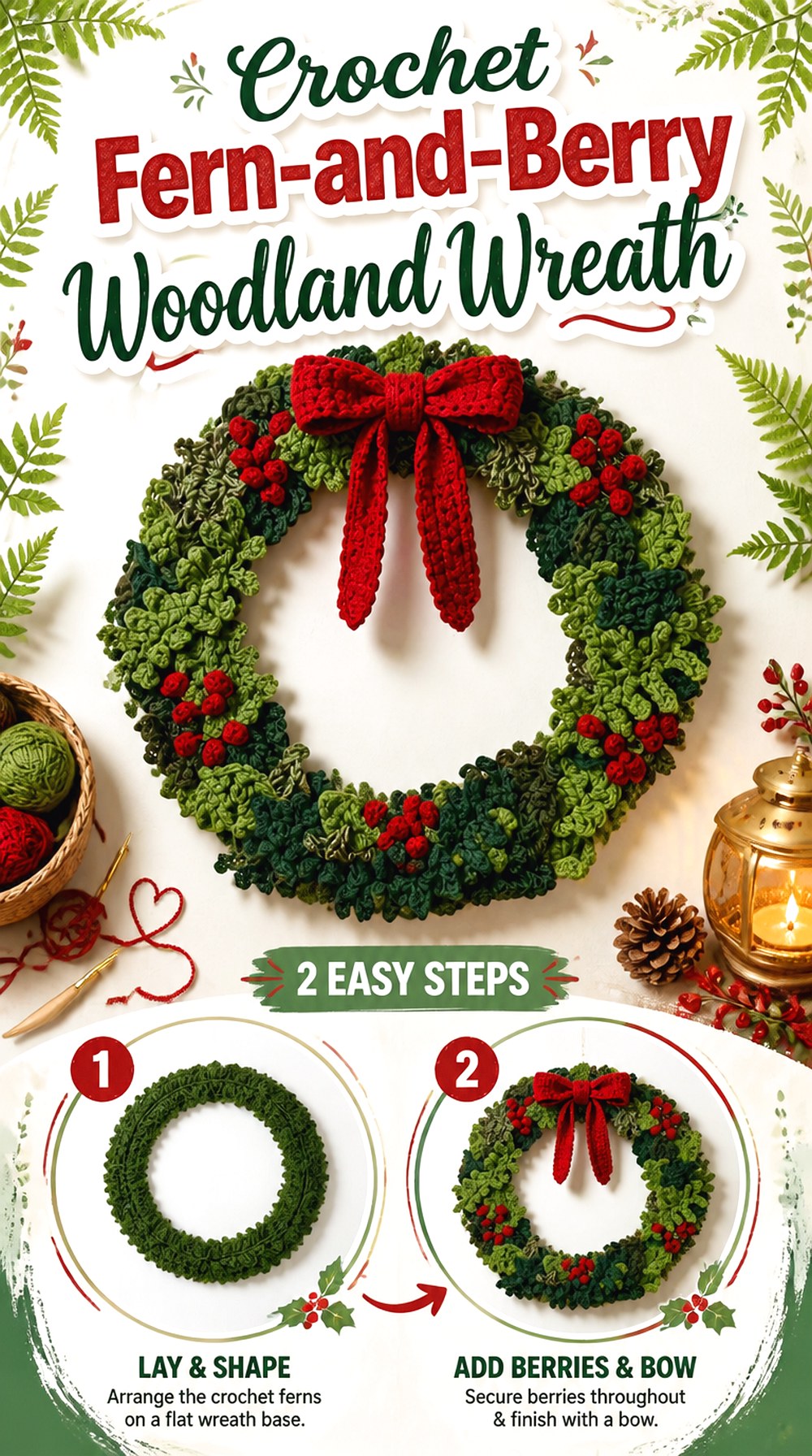
Alexandria Masse’s wreath incorporates several foliage types, including larger and smaller leaves, holly shapes, fern forms, berries, and a bow. That mix creates more botanical diversity than a wreath based on one repeated leaf, which makes it especially adaptable to a layered woodland look.
For a forest interpretation, let the fern shapes provide lighter movement between broader leaves. Berries can remain a small contrasting accent, while the bow gives you a place to introduce a seasonal color without repeating it around the entire wreath. The variation in foliage is the feature worth preserving.
Fern Shapes Bring a Lighter Forest Texture Than Broad Leaves
Broad leaves occupy visual space quickly, while narrow fern-like foliage creates detail without forming a solid mass. Combining both can prevent a heavily decorated wreath from feeling blocky.
Use fern pieces around the outer or inner edge where their slender shapes can extend beyond neighboring motifs. If they are completely covered by larger leaves, their main contribution—the airy texture—will be lost.
Holly and Berries Push the Design Toward Winter
Holly-style foliage and berries naturally make a wreath feel more seasonal. If you want a year-round woodland result, use those details sparingly and let general leaves and ferns dominate.
For a winter forest version, reverse that balance. Keeping the underlying construction the same while changing which motifs receive emphasis can alter the seasonal character without changing the entire wreath.
Shape the Foliage Before Judging the Final Layout
Alexandria Masse’s tutorial includes finishing and steaming as part of the wreath-making process. That matters because curled or uneven motifs may occupy different space once shaped.
Do not make final layout decisions solely from fresh-off-the-hook pieces if you intend to block or steam them. Shape first using a method appropriate for your yarn, then judge spacing and overlap.
Original Tutorial and Creator Credit
Creator: Alexandria Masse
14. Crochet Wheat Texture Woodland Wreath

Briana K’s wreath takes a different route: instead of covering the ring with many separate forest motifs, the wreath cover itself carries a pronounced Wheat Stitch texture, finished with a coordinating crochet bow. The tutorial demonstrates the design in multiple wreath sizes, making scale one of its useful distinguishing features.
For woodland decor, warm oat, bark, moss, cream, or forest green can push the raised texture toward a natural, grain-like look. Add very few extra embellishments if you want the stitch pattern to remain the star. This approach suits simpler interiors where a dense animal or leaf wreath might feel too busy.
The Textured Cover Makes the Base the Main Feature
With a strong stitch pattern, you do not need to hide the ring under a second layer of decoration. Treat the crochet surface as the visual equivalent of bark, grain, or seed texture.
If you add woodland motifs, place them in one contained area rather than distributing them everywhere. That preserves enough uninterrupted fabric for the raised stitch pattern to remain readable.
The Bow Should Not Hide the Wheat-Like Stitch Texture
A large crochet bow can be a focal point, but it should still feel connected to the textured base. Test its placement before permanent attachment and check how much of the ring it covers.
If the bow dominates the wreath from across the room, consider a quieter color relationship or place it where the strongest section of texture stays visible.
Use Size Changes to Control Where the Wreath Works
The tutorial includes several finished-size options rather than a single scale. That lets the same design language move from a small decorative accent to a more prominent wall or door piece.
Before choosing the size, consider viewing distance and surrounding furniture. Fine woodland embellishments will read differently on a small ring than on a larger statement wreath, even when the crochet construction remains similar.
Original Tutorial and Creator Credit
Creator: Briana K
15. Crochet Curly Branch Woodland Wreath

The Turtle Trunk’s Happy Holiday Wreath creates its fullness with curling crochet branches worked around a metal hoop rather than with dozens of separate leaf motifs. The resulting structure has a light, lively edge and can be adjusted for different hoop sizes and branch lengths within the creator’s tutorial.
For woodland styling, those curls can suggest small evergreen branches or unruly forest growth. A muted green base can stand alone with a simple bow, or you can add a few acorns, berries, or mushrooms while still allowing the branch-like surface to remain visible.
Curled Branches Create Volume Without Separate Leaf Motifs
This construction builds the decorative edge directly around the hoop, reducing the need to make and individually position a large collection of leaves.
That can be useful if you like a botanical silhouette but want fewer separate components at final assembly. Keep any added woodland embellishments clustered so they complement the curls rather than flattening or hiding them.
Hoop Size Changes How Airy the Center Feels
The creator specifically discusses adjusting the wreath for different hoop sizes. A larger open center can create a lighter, more graphic appearance, while a smaller ring may make the branches visually denser.
Judge that relationship before adding a centerpiece. Filling too much of an already small opening can make the wreath feel closed and heavy.
Adjust the Forest Palette Before Adding More Decorations
If the wreath still feels too holiday-specific, color may be the simplest change. Moss, lichen, fern, bark, or muted mushroom shades can create a woodland impression before any additional motif is introduced.
Only after seeing the completed branch texture should you decide whether the ring actually needs pinecones, berries, or other forest accents. The crochet surface may already provide enough interest.
Original Tutorial and Creator Credit
Creator: The Turtle Trunk
16. Crochet Removable Accent Woodland Wreath

Simply Made by Erin Crochet demonstrates an all-season wreath made by crocheting directly around a wreath form with very bulky roving-style yarn. The finished base is then designed to accept decorative greenery, florals, ribbon, and other seasonal embellishments.
For woodland use, this is the most modular idea in the collection. Start with a neutral cream, bark, or subdued green crochet ring, then add removable forest-style accents such as leafy picks, small pumpkins, berries, dried botanical details, or a restrained bow. Because the underlying wreath remains simple, the same base can shift between woodland seasons without rebuilding the whole project.
Roving Yarn Creates a Soft, Chunky Ground
Very thick yarn produces a visibly different wreath from the fine botanical and leaf-covered options earlier in this collection. The crochet ring itself becomes soft and substantial.
That scale means tiny woodland embellishments may feel underpowered. Compare accents against the finished base before committing; a few medium or large botanical pieces can create better proportion than dozens of tiny details.
Removable Attachments Make Seasonal Changes Easier
Simply Made by Erin discusses attaching embellishments with options such as twine or floral wire when removability is useful. That approach is well suited to a woodland wreath that changes through the year.
An autumn cluster might use leaves and pumpkins, while winter could shift toward pinecones, berries, and evergreen-style greenery. Keeping the permanent crochet base neutral makes those swaps visually easier.
Keep Natural-Style Picks From Overloading the Crochet Ring
Purchased greenery and dried or faux botanical accents can quickly cover a chunky crochet base. Before fixing them in place, decide how much yarn surface you want to remain visible.
A useful checkpoint is to photograph the wreath after each major addition. If the crochet has almost disappeared, remove a few stems or concentrate the accents more tightly. The finished object should still read as a crochet woodland wreath rather than simply a conventional floral wreath built on hidden yarn.
How to Choose Among These Woodland Wreath Styles
For the clearest traditional woodland theme, start with the Acorn-and-Leaf, Falling-Leaves, Pinecone-and-Cranberry, or Fern-and-Berry wreaths. Their foliage and forest details already carry most of the theme, so very little adaptation is necessary.
If you want something more playful, the Owl Woodland Wreath has the strongest character-based silhouette, while the Pumpkin Woodland Door Wreath creates a harvest-focused forest-floor look. For softer interiors, the Cottage Botanical Woodland Wreath and Modern Hoop Woodland Wreath leave more visual breathing room.
Choose the Bobble, Wheat-Texture, Curly-Branch, or Removable-Accent designs when crochet texture matters more than a large collection of motifs. These give you stronger control over how minimal or heavily decorated the finished wreath becomes.
Conclusion
The most effective crochet woodland wreath is not necessarily the one with the greatest number of forest motifs. Choose according to the kind of structure you want to see first: layered leaves for a traditional woodland look, an owl for playful decor, pinecones and berries for winter, airy stems for a botanical style, or a textured covered ring for something simpler.
Also consider how permanently you want the wreath assembled. Dense motif wreaths make strong seasonal statements, while neutral or removable bases are easier to restyle through the year. Once you have chosen the overall construction, use the original tutorials linked with each idea for the creators’ exact crochet and assembly details.
Frequently Asked Questions
What details make a crochet wreath look woodland rather than simply autumnal?
Forest-associated shapes usually establish the theme more clearly than color alone. Leaves, acorns, pinecones, ferns, berries, branch-like elements, mushrooms, and woodland animals can all help. You do not need to use them together. A restrained leaf-and-acorn wreath may read more clearly as woodland than a heavily decorated ring containing many unrelated fall objects.
Should I completely cover the wreath base with crochet?
Not necessarily. A covered foam or wire wreath suits dense, traditional designs, while an exposed metal hoop works well for asymmetric botanical arrangements. A burlap or natural-looking base can also become part of the visual design. Decide whether the foundation should disappear or remain visible before placing the main woodland motifs.
How do I stop a woodland wreath from looking overcrowded?
Start by placing the largest focal pieces and leave smaller gaps around them. Add supporting foliage only after the major shapes are balanced. If individual mushrooms, pinecones, animals, flowers, or acorns become difficult to identify from several feet away, the wreath probably needs more separation rather than more decoration.
Can I combine motifs from different crochet tutorials?
You can plan an original wreath using separately sourced compatible motifs, but compare their finished dimensions and visual weight before assembly. A small fine-yarn leaf may look out of scale beside a large super-bulky pinecone or thick wreath cover. Follow each creator’s source for the individual pattern and use your own layout rather than reconstructing another creator’s complete design.
What yarn qualities work well for woodland wreath decor?
It depends on the effect you want. Clear stitch definition can help leaves, acorns, and flowers retain recognizable outlines, while softer or fuzzier yarn can suit mossy, branch-like, or atmospheric botanical details. Very bulky yarn produces a strong structural wreath base but can visually overpower tiny embellishments. Compare the yarn scale with the wreath form and motif size before making many repeated pieces.
How can I make one crochet woodland wreath work for more than one season?
Keep the permanent base neutral and attach some decorative clusters in a removable way when the construction allows it. Autumn might use rust leaves and pumpkins; winter can shift toward pinecones, berries, and evergreen shades; spring can use lighter foliage and flowers. Removable accents are particularly useful when storage space is limited or you prefer one reusable crochet foundation.
Should crochet woodland wreath motifs be blocked before assembly?
Blocking or shaping can be useful when flat leaves, ferns, flowers, or other motifs need a cleaner outline, but the appropriate method depends on the fiber and the creator’s pattern. Finish the motifs as directed in their original tutorial before making final placement decisions. Their dimensions and shape may change enough during finishing to affect spacing and overlap.


