22 Crochet Woodland Wall Hanging Ideas for Forest-Inspired Decor
A crochet woodland wall hanging can be anything from a compact mushroom tapestry to a dimensional arrangement of leaves, birds, branches, flowers, or forest animals. That range matters because a flat colorwork panel behaves very differently on the wall from a hoop-mounted tree, an appliqué composition, or a freeform fiber-art piece with long fringe.
These 22 ideas cover those different approaches rather than repeating one silhouette in new colors. Most of the selected tutorials already feature animals, plants, trees, or other nature imagery. A few provide strong wall-hanging constructions that can be adapted with woodland colors or surface details, and those adaptations are identified clearly. Use the comparisons below to choose by structure, visual weight, hanging method, and the amount of dimensional detail you want before following the original creator for exact construction.
Quick List
- Crochet Mushroom Tapestry Woodland Wall Hanging
- Crochet Fox and Berry Woodland Wall Hanging
- Crochet Bear Face Woodland Wall Hanging
- Crochet Owl Branch Woodland Wall Hanging
- Crochet Bunny Silhouette Woodland Wall Hanging
- Crochet Little Bird Garden Woodland Wall Hanging
- Crochet Sparrow Branch Woodland Wall Hanging
- Crochet Tree of Life Hoop Woodland Wall Hanging
- Crochet Evergreen Tree Panel Woodland Wall Hanging
- Crochet Moon Phase Forest-Night Wall Hanging
- Crochet Botanical Leaf Branch Wall Hanging
- Crochet Autumn Leaf Cascade Woodland Wall Hanging
- Crochet Wildflower Chain Woodland Wall Hanging
- Crochet Floral Flag Woodland Wall Hanging
- Crochet Flower Granny Square Woodland Wall Hanging
- Crochet Bell Flower Woodland Wall Hanging
- Crochet Rose Vine Woodland Wall Hanging
- Crochet Rainbow Woodland-Nursery Wall Hanging
- Crochet Textured Boho Woodland Wall Hanging
- Crochet Forest-Palette Mandala Wall Hanging
- Crochet Diamond Lace Woodland Wall Hanging
- Crochet Woven Forest-Texture Wall Hanging
Choose the Hanging Structure Before the Woodland Motif
The motif gets attention first, but construction has a bigger effect on how wall art behaves. A flat tapestry panel gives mushrooms, animals, or landscapes a defined rectangular field and usually suits crisp graphic imagery. Appliqué-based hangings can create more depth because birds, leaves, flowers, and branches sit as separate elements. Hoop-mounted work creates a contained focal point, while freeform or woven-look pieces emphasize yarn texture rather than a single recognizable picture.
Think about the wall before choosing. A narrow vertical space can handle a cascading leaf or floral design without needing much width. Above a dresser or bed, a broader panel may feel more balanced. If you plan to use a branch instead of a dowel, also compare its weight and shape with the crochet fabric before committing to the final hanging arrangement.
Yarn, Weight, and Shape Retention Matter on the Wall
A wall hanging does not need garment-style drape, but it still needs enough flexibility to hang cleanly. Dense colorwork can become heavier than an airy lace panel, while multiple appliqués, beads, tassels, or long fringe add weight below the main fabric. A hanging that looks square while lying on a table may stretch differently once suspended.
Before finishing, check the piece in its actual hanging orientation. If the sides curl or motifs pull unevenly, blocking may help before the final rod, branch, or hoop is attached. Yarn choice also changes the visual result: smoother yarn makes small color changes and silhouettes easier to read, while fuzzy or heavily textured fibers can soften fine detail. When substituting materials from a tutorial, confirm the creator’s original yarn information before assuming the finished scale will remain the same.
Plan a Woodland Composition Without Crowding It
Woodland decor does not require every forest symbol in one piece. A single mushroom, fox, tree, or owl can provide a stronger focal point than a crowded mix of animals, leaves, flowers, moons, and fringe competing for attention. For dimensional arrangements, decide which element should be noticed first and let supporting foliage occupy quieter areas.
Scale is especially important when combining independently designed motifs. Lay finished, blocked pieces together before permanently joining them. A large bird next to tiny leaves may look intentional; a flower or mushroom that accidentally overwhelms the animal may not. Also check contrast from normal viewing distance. Similar moss, brown, and olive shades can produce a sophisticated forest palette, but adjacent motifs still need enough tonal separation for their outlines to remain visible.
1. Crochet Mushroom Tapestry Woodland Wall Hanging

A mushroom tapestry is one of the most direct ways to translate a woodland theme into crochet wall art. Stephanie Mitchard’s tutorial focuses specifically on making a mushroom crochet tapestry wall hanging, so the recognizable forest-floor subject is already built into the source rather than added as an afterthought.
This direction works particularly well when you want a compact graphic centerpiece instead of multiple loose motifs. The rectangular background also gives the mushroom a defined visual boundary, which can make it easier to coordinate with framed art, shelves, or other wall decor nearby.
Keep the Mushroom Readable From Across the Room
Tapestry crochet depends on contrast more than dimensional appliqué does. Before committing to a subtle woodland palette, compare the mushroom cap, stem, and background from several feet away. Colors that look distinct while crocheting can merge visually at normal wall-viewing distance. If you substitute colors, preserve enough contrast around the mushroom silhouette rather than trying to use every earthy shade in one panel.
Straight Edges Make the Finished Panel Look Intentional
Color changes can alter tension, particularly along sections where several yarns are being managed. Check the panel periodically by laying it flat instead of waiting until the hanging hardware is added. If one side begins narrowing or flaring, correcting tension earlier is usually more useful than relying on fringe or a dowel to disguise the shape later.
2. Crochet Fox and Berry Woodland Wall Hanging

A fox instantly gives woodland decor a more character-driven look. The SistersInStitch WalliFox tutorial builds a dedicated fox wall hanging and includes foliage-style finishing details around the animal, creating a useful reference for readers who prefer dimensional forest decor rather than a flat rectangular picture.
This type of composition works well as a single statement piece because the animal provides the focal point and the smaller botanical elements can frame it without needing a full background panel. It also gives you more freedom to adjust the negative space between components than a charted tapestry would.
Let the Fox Remain the Dominant Shape
Leaves and berry-like accents can enrich the woodland theme, but they should not obscure the animal’s silhouette. Arrange secondary elements temporarily before sewing them permanently. Looking at the hanging vertically rather than flat on a table will show whether foliage is framing the face or visually competing with it.
Check Dimensional Pieces for Sagging
An assembled animal wall hanging can distribute weight unevenly because ears, foliage, and other components do not all pull in the same direction. Check the finished composition on its hanger before finalizing every attachment. If one side drops noticeably lower, changing placement or adding support at a hidden connection point may give the piece a more balanced outline.
Use Color Contrast Around Facial Features
If adapting the palette toward rust, bark brown, moss, or cream, keep facial details distinct enough to read. Woodland colors naturally sit close together tonally, so a beautiful earthy palette can still lose definition if the face, ears, and surrounding foliage are too similar.
Original Tutorial and Creator Credit
Creator: SistersInStitch
3. Crochet Bear Face Woodland Wall Hanging

A bear wall hanging creates a bolder woodland focal point than a collection of small motifs. Odinka Wisanindhi’s tutorial series centers on a crochet bear wall hanging, making it a good direction for a nursery, cabin-inspired room, or animal-focused gallery wall where the face itself should carry most of the visual impact.
Because the source is presented as a multipart tutorial, treat the linked video as the starting section rather than assuming the entire project is completed in one video. Follow the creator’s continuation for the remaining construction and assembly details.
Facial Placement Deserves a Vertical Check
Small differences in eye, muzzle, or ear placement can change an animal face noticeably. Before permanently securing separate features, prop or pin them temporarily and view the piece upright. A placement that seems centered on a worktable can read differently when the bear is hanging at eye level.
A Simple Background Keeps the Bear From Feeling Busy
If you want to expand the woodland theme, consider restraint around the face. One or two leaf, acorn, or branch accents can establish the forest setting without surrounding every edge. The larger the animal head appears relative to the hanging, the more useful negative space becomes.
Support the Top Edge Before Adding More Decoration
A substantial animal motif can concentrate weight near the center. Check whether the upper attachment remains straight before adding fringe or extra appliqués below. Decorative additions are most successful after the main bear hangs evenly on its support.
Original Tutorial and Creator Credit
Creator: Odinka Wisanindhi
4. Crochet Owl Branch Woodland Wall Hanging

Owls work especially well for woodland wall decor because the bird can be combined naturally with branches and foliage instead of needing an artificial frame. Make It Yourself By Papari’s owl wall-hanging tutorial includes owls, branches, leaves, and floral details, giving this project a layered composition with more depth than a single flat motif.
The result suits readers who want the wall itself to remain visible between elements. Rather than filling a rectangular crochet background, the separate components create their own outline and allow the branches to function as part of the design.
Branch Direction Controls the Whole Composition
Before securing owls and leaves, decide where the viewer’s eye should travel. A gently rising branch can make the hanging feel more open, while symmetrical branches create a more formal arrangement. Test the entire layout together rather than placing each leaf independently.
Keep the Owls Visually Heavier Than the Foliage
When leaves and flowers use equally bold colors, they can compete with the birds. If the owls are meant to be the focal point, reserve stronger contrast for their faces or bodies and let the plant elements work as a quieter frame.
Watch the Full Series Before Final Assembly
The linked source is labeled Part 1. Review the creator’s continuation before making irreversible finishing choices, especially if you intend to change branch spacing, motif quantity, or hanging hardware. That gives you a clearer picture of how the components ultimately work together.
Original Tutorial and Creator Credit
Creator: Make It Yourself By Papari
5. Crochet Bunny Silhouette Woodland Wall Hanging

A bunny silhouette gives woodland decor a lighter, less visually dense animal option. Jo to the World Creations’ wall-hanging tutorial features a bunny design with fringe, a pom-style tail, and a wooden hanging support, so the finished piece combines a graphic central image with tactile details rather than relying on colorwork alone.
Although the source is also suitable for seasonal decorating, the rabbit translates naturally into year-round woodland or nursery decor when used with bark, oatmeal, fern, rust, or other subdued forest colors.
The Tail Works Best as a Controlled Accent
A dimensional tail draws attention quickly because it breaks away from the flat surface. Keep surrounding embellishments restrained if you want that feature to remain intentional. Adding several other raised details can dilute the clean silhouette that makes this design distinctive.
Fringe Changes the Apparent Height
Long fringe adds visual length even though it is not part of the main crocheted panel. When planning placement above furniture or beside other hangings, evaluate the complete piece—including fringe and hanging cord—rather than measuring only the rectangular crochet area.
Choose Contrast for the Silhouette First
For a recognizable rabbit, background-to-motif contrast matters more than using a large woodland palette. Two clearly separated values can produce a stronger image than multiple closely related earth tones.
Original Tutorial and Creator Credit
Creator: Jo to the World Creations
6. Crochet Little Bird Garden Woodland Wall Hanging

Small birds make a flexible woodland wall-hanging element because they can be spaced between leaves, branches, flowers, or open background areas. Jayda InStitches’ workshop teaches a little bird appliqué within a Garden Wall Hanging series, giving readers a useful route for building a scene from separate motifs instead of following one large tapestry chart.
This approach is especially helpful when you want to customize the composition gradually. A few birds can become focal points, while leaves and branches establish the woodland setting around them without forcing the entire hanging into a rigid rectangular format.
Test Bird Spacing Before Sewing Anything Down
Two or three small motifs can look crowded surprisingly quickly. Lay out the full hanging at the intended scale and vary both horizontal and vertical spacing. Avoid placing every bird on the same invisible line unless a deliberately symmetrical look is the goal.
Give Each Bird a Clear Background
Tiny details disappear more easily than large animal features. If a bird sits directly over visually busy foliage, its outline may be hard to read. Leaving a small area of calmer color or open space around the body can improve recognition without enlarging the motif.
Treat Small Attachments Carefully in Children’s Spaces
If the hanging will be placed where small children can reach it, examine any added beads or other small detachable embellishments and choose a more secure alternative when appropriate. Decorative wall art should remain out of reach if its components are not intended for handling.
Original Tutorial and Creator Credit
Creator: Jayda InStitches
YouTube Video: Little Bird Appliqué – Garden Wall Hanging – LIVE
7. Crochet Sparrow Branch Woodland Wall Hanging

For a more linear woodland composition, a sparrow wall hanging lets the bird and branch relationship provide the design instead of filling the entire background with crochet. Crochnitting’s tutorial is specifically presented as a step-by-step crochet sparrow wall-hanging project, making it a useful animal-focused alternative to the owl and fox options in this collection.
A bird-on-branch format fits narrow wall spaces especially well because the eye can follow the branch horizontally while the suspension and any dangling details create vertical movement.
Balance the Bird Against the Branch Length
If you alter the branch or support, compare its visible length with the size of the sparrow. A very long branch can make a small bird feel lost, while a short support may make the composition look cramped. Check the relationship before permanently fastening the crochet elements.
Keep the Silhouette Clear Around the Head and Tail
Bird shapes are recognized partly through their outline. Avoid clustering leaves directly around every edge of the sparrow. A little breathing room around the head, back, and tail can make the bird much easier to identify from across a room.
Original Tutorial and Creator Credit
Creator: Crochnitting
8. Crochet Tree of Life Hoop Woodland Wall Hanging

A circular tree-of-life piece introduces a completely different silhouette from dowel-mounted tapestries. mum2makes’ tutorial shows a crocheted tree-of-life wall decoration, with the tree contained within a circular support rather than hanging as a rectangular panel.
The hoop-like format makes the branching structure the main decorative feature and naturally creates open areas between limbs. That negative space can be useful in a woodland room where other textiles or artwork already provide plenty of color and you want one lighter, sculptural crochet accent.
Branch Spacing Is Part of the Design
The open spaces around a tree’s branches matter almost as much as the yarn itself. Check the balance between dense and sparse areas while the piece is held in its final circular shape. Uneven spacing may be charming when deliberate but distracting when one section looks unintentionally compressed.
Match the Circular Scale to the Wall
A hoop piece reads as a single strong shape. Before changing yarn or support size, mock up the approximate diameter on the wall with paper or removable tape. This gives a better sense of presence than judging the project only while holding it in your hands.
Original Tutorial and Creator Credit
Creator: mum2makes
9. Crochet Evergreen Tree Panel Woodland Wall Hanging

A single tree panel offers a cleaner forest reference than an elaborate animal scene. The Turtle Trunk’s tutorial creates a crochet tree wall hanging that can function as its own piece of wall decor, giving this roundup a straightforward vertical option centered on one recognizable tree form.
Because the composition is simpler, it can also sit more comfortably beside other woodland items. Instead of competing with an animal portrait or dense tapestry, the tree can work as a supporting piece in a larger gallery arrangement.
Use the Tree as the Visual Center
If you adapt this beyond its original presentation, avoid adding so many surrounding motifs that the tree loses its role. Small stars, leaves, mushrooms, or woodland colors can support the concept, but the tree’s outline should remain readable.
Check How the Lower Edge Hangs
A narrow tree-centered panel can emphasize any unevenness along the bottom edge. Before adding decorative finishing, hang the piece temporarily and check whether the center and sides fall at the intended level. Address the fabric’s shape first, then trim or add finishing details.
Original Tutorial and Creator Credit
Creator: The Turtle Trunk
10. Crochet Moon Phase Forest Night Wall Hanging

Not every woodland hanging needs an animal or plant. A moon-phase design can establish the nighttime side of a forest theme and works particularly well with charcoal, deep green, cream, muted gold, or midnight blue. Love & Stitch’s Teeny Weanie Moon Phase Wall Hanging tutorial provides a dedicated hanging format built around lunar imagery.
This is a useful counterpoint to the foliage-heavy pieces in the collection. It can suggest a woodland atmosphere without adding another leaf or animal, making it easier to build a coordinated gallery wall that still contains visual variety.
Use the Moon Shapes as Breathing Space
Moon imagery generally reads best when each phase has enough surrounding space to remain distinct. If adapting the piece with extra stars, leaves, or hanging beads, check that the additions do not fill every gap between the primary shapes.
Consider It as a Companion Piece
A moon hanging can sit beside a fox, owl, mushroom, or tree piece and connect them through a shared night-forest palette. Rather than forcing woodland motifs directly onto the moon design, let color establish the relationship.
Original Tutorial and Creator Credit
Creator: Love & Stitch
11. Crochet Botanical Leaf Branch Wall Hanging

Heart Hook Home’s Monstera Leaf tutorial is botanical rather than literally woodland, so use this project as a structural reference if you like the look of large leaves suspended from a natural-looking branch. The source specifically presents the crocheted Monstera leaves as wall-hanging decor.
For a more woodland-specific interpretation, the valuable idea is the branch-mounted arrangement and generous negative space, not pretending a Monstera is a forest species. Keep the original botanical identity or use the construction concept as inspiration for compatible leaf motifs from another properly sourced pattern.
Large Leaves Need Space Around Their Edges
A broad leaf silhouette can become visually heavy when several pieces overlap. Before attaching them to a support, hang the leaves loosely and compare overlapping versus separated layouts. Clear gaps can make each shape easier to appreciate.
Do Not Assume Another Leaf Motif Will Behave the Same
If you substitute a fern, oak leaf, maple leaf, or other woodland motif from a different design, its weight and attachment point may differ. Check that motif’s own source rather than transferring measurements or construction details from the Monstera tutorial.
Original Tutorial and Creator Credit
Creator: Heart Hook Home
12. Crochet Autumn Leaf Cascade Woodland Wall Hanging

A leaf cascade is one of the most adaptable woodland options because it does not depend on a single animal or season. Meladora’s Creations presents a leaf wall-hanging project built from separate leaves connected into branching strands, producing a looser wall arrangement than a framed tapestry or square panel.
This format can fill an awkward narrow space, trail beside a mirror, or create an asymmetrical forest accent. It is also a useful direction when you prefer repeated small motifs but do not want the rigid grid that comes with granny squares.
Vary Direction as Well as Color
A convincing leafy arrangement gains movement from changing orientation, not simply alternating yarn shades. Before fixing the strands to the wall, rotate some leaves and compare how the branches flow. A perfectly repeated angle can make organic motifs feel unexpectedly mechanical.
Finish the Layout Before Hiding Every Tail
For a freeform arrangement, keeping the structure adjustable until you are satisfied with the overall shape is practical. Evaluate the full cascade on the intended wall and make layout decisions before treating every connection as final.
Original Tutorial and Creator Credit
Creator: Meladora’s Creations
13. Crochet Wildflower Chain Woodland Wall Hanging

Brunaticality’s flower wall-decor tutorial combines crocheted flowers and leaves with hanging chains and a suspended presentation, creating an airy botanical format that can be adapted toward a woodland wildflower palette without changing the fundamental idea. The source also demonstrates additional bottom detailing rather than ending with a plain rectangular edge.
This approach suits readers who prefer scattered botanical elements to a large background panel. The spaces between chains let the wall color become part of the composition, which can keep a multicolor piece from feeling too dense.
Decide the Chain Spacing Before Adding Every Flower
The vertical lines are part of the composition even when they are visually quiet. Test the hanging with only a few motifs attached first. If the chains are too close, flowers can overlap; too far apart, and the piece may look disconnected.
Mix Flower Sizes With a Clear Hierarchy
If you add compatible flowers from other sources, choose one or two larger focal blooms and let smaller leaves or flowers support them. Using many equally dominant motifs can make the hanging feel more like a sample board than a deliberate woodland arrangement.
Check Decorative Weight at the Bottom
Beads, buttons, tassels, or other finishing details can pull thin chains downward. Hang the piece during planning so you can see the effect of gravity instead of judging the design only on a flat surface.
Original Tutorial and Creator Credit
Creator: Brunaticality
14. Crochet Floral Flag Woodland Wall Hanging

Woodland Stitchcraft’s full wall-hanging tutorial provides a flag-like floral format with a strong central fabric area and decorative finishing. It offers a useful middle ground between a loose appliqué composition and a highly graphic tapestry: the piece has a clear overall silhouette, but botanical details prevent it from feeling like a plain rectangle.
For a woodland interpretation, lean on meadow, bark, fern, mushroom, or autumn tones rather than assuming the tutorial itself contains every forest motif. The value here is the finished wall-hanging structure and botanical character.
A Flag Shape Benefits From a Strong Top Line
Because the eye notices the suspended top edge immediately, check that the crochet sits evenly along its support. Uneven attachment can make an otherwise symmetrical hanging look tilted even when the lower portion is correct.
Use Floral Details to Frame, Not Fill
Leaving calmer areas around the main botanical elements helps the flag retain a recognizable silhouette. If you want more woodland character, one carefully placed mushroom or leaf motif from a compatible source will usually read more clearly than covering every available space.
Original Tutorial and Creator Credit
Creator: Woodland Stitchcraft
15. Crochet Flower Granny Square Woodland Wall Hanging

A single flower granny square can become wall art without expanding into a blanket or garment. Hopeful Turns’ tutorial turns a flower-centered granny square into a hanging decor piece with a wooden support and decorative tassels, giving the familiar motif a clearly defined display purpose.
For woodland decor, this works nicely as a small meadow-inspired accent between more figurative animal pieces. Its square geometry also creates useful contrast beside organic leaf cascades, circular tree hoops, or irregular branch arrangements.
Block the Square Before Choosing the Support
A square that is still curling or slightly distorted can make dowel placement difficult to judge. Let the motif reach its intended finished shape first, then select or trim a support that looks proportionate to the actual blocked width.
Let the Central Flower Carry the Color
If the middle motif contains several shades, a quieter border can prevent the square from becoming visually fragmented. In a woodland palette, consider using background and edging colors that allow the flower to remain the focal point rather than competing with it.
Tassels Can Connect It to Other Wall Pieces
Repeating one yarn shade from a nearby mushroom, fox, or leaf hanging in the tassels can visually connect the pieces without making their main motifs match. That is often enough to create a coordinated gallery wall.
Original Tutorial and Creator Credit
Creator: Hopeful Turns
16. Crochet Bell Flower Woodland Wall Hanging

Bell-shaped flowers add a distinctly vertical botanical element to woodland decor. The Knot Studio’s tutorial focuses on a handmade crochet bell-flower wall hanging, providing an alternative to flat flower squares and horizontal floral panels.
The hanging shape can work particularly well in slim wall areas where a wide tapestry would feel crowded. For a forest-floor or cottage-woodland interpretation, muted purple, cream, sage, fern green, or natural brown can change the mood without altering the flower construction shown by the creator.
Staggered Flowers Create More Natural Movement
When several hanging blooms sit at exactly the same level, the result can feel formal. If the source construction allows, evaluate how the piece looks when the visible flower heights vary. Keep any changes compatible with the creator’s assembly method rather than modifying structural details blindly.
Check the Hanging Length in the Actual Location
Vertical floral pieces can appear much longer once suspension loops, stems, and blooms are combined. Compare the complete drop with the available wall space before mounting the final hook.
Original Tutorial and Creator Credit
Creator: The Knot Studio
17. Crochet Rose Vine Woodland Wall Hanging

A rose hanging brings a more romantic botanical direction to woodland decor and pairs especially well with cottage-style rooms. Knitting by Wajida’s tutorial is dedicated to crochet rose wall decor, making it a good choice when you want dimensional flowers to provide the main texture rather than a charted image.
To keep the finished look closer to woodland than formal floral decor, consider restrained natural colors around the roses and allow green or brown structural elements to remain visible. The goal is not to disguise the rose but to place it within a forest-garden palette.
Dimensional Petals Need Visual Room
Raised flowers cast their own shadows and occupy more apparent space than flat motifs. Avoid packing additional leaves or decorations tightly around every rose. Small gaps make the dimensional construction easier to appreciate.
Check Flower Weight Against the Suspension
Several dense flowers can create more localized weight than an open lace motif. View the piece fully suspended before deciding whether to add more embellishment. If the top support begins bending or the wall hanging tilts, extra decoration may make the problem more noticeable.
Original Tutorial and Creator Credit
Creator: Knitting by Wajida
18. Crochet Rainbow Woodland Nursery Wall Hanging

A rainbow is not inherently a woodland motif, so Conquer Crochet’s tutorial works here as a nursery-friendly construction that can sit beside rabbits, trees, mushrooms, or clouds rather than as a literal forest scene. The source demonstrates a dedicated crocheted rainbow wall hanging with its own finished display format.
For woodland styling, color is the easiest bridge: muted clay, ochre, moss, cream, rust, and bark tones can make the curved shape coordinate with forest-themed decor while preserving the tutorial’s recognizable rainbow structure.
Let the Palette Do the Adapting
There is no need to add mushrooms or leaves directly to every arc. Using forest-associated colors can establish enough visual connection, especially when the piece hangs beside a tree or animal motif. This keeps the rainbow design clean.
Compare Fringe With Nearby Wall Art
If several pieces in the same room use long fringe, the gallery can become bottom-heavy. Consider varying finished edge treatments across the collection so the rainbow contributes softness without repeating the silhouette of every other hanging.
Original Tutorial and Creator Credit
Creator: Conquer Crochet
19. Crochet Textured Boho Woodland Wall Hanging

For readers who care more about forest texture than a recognizable animal, Bloodimaryart Crochet’s boho wall-hanging tutorial offers a fiber-focused route. The design is not specifically woodland, so treat it as a construction framework for moss, bark, lichen, stone, and dried-grass colors rather than presenting the original project as a forest motif.
This direction can give a woodland gallery a useful quiet piece between more literal fox, owl, or mushroom designs. Texture becomes the subject, which prevents the collection from feeling overly themed.
Use Texture to Suggest Natural Surfaces
Instead of adding more appliqués, compare yarn textures and stitch definition. A mix that visually suggests rough bark, soft moss, or layered forest ground can create atmosphere without adding a single animal motif.
Keep a Limited Value Range From Becoming Flat
Earth tones often sit close together. If every section has similar lightness or darkness, texture may disappear from normal viewing distance. Include enough tonal change for ridges, openings, and surface transitions to remain visible.
Review the Creator’s Full Series
The linked video is labeled Part 1, so it should be treated as the beginning of the project rather than a standalone complete build. Check the channel’s continuation before deciding how you will adapt the finishing or suspension.
Original Tutorial and Creator Credit
Creator: Bloodimaryart Crochet
20. Crochet Forest Palette Mandala Wall Hanging

A mandala provides radial symmetry that none of the animal tapestries or branch arrangements offer. Ophelia Talks Crochet’s wall-hanging tutorial centers specifically on a crochet mandala, making this a useful choice when you want a circular focal point but prefer pattern and color over the literal tree imagery of a tree-of-life hoop.
The original motif does not need to become a fake woodland scene. Instead, use a forest palette to coordinate it with nearby botanical pieces while letting the circular crochet remain abstract.
Radial Designs Expose Uneven Tension
A circular piece makes distortion easy to notice because each section is expected to radiate evenly. Check the shape periodically on a flat surface and again when mounted. If the circle pulls into an oval, address that before adding decorative hanging elements.
Repeat Colors With a Purpose
Using every woodland shade once can make a mandala visually fragmented. Consider repeating a smaller group of colors at deliberate intervals so the eye can follow the radial structure.
Original Tutorial and Creator Credit
Creator: Ophelia Talks Crochet
21. Crochet Diamond Lace Woodland Wall Hanging

Ophire Co.’s diamond lace wall hanging supplies an airy geometric option for a collection otherwise dominated by recognizable forest imagery. The open pattern can be styled with a natural branch and woodland colors while remaining honestly geometric rather than being labeled as a leaf or tree motif it does not contain.
This kind of negative-space-heavy crochet works well beside dense tapestry pieces because the visible wall becomes part of the design. It can also soften a gallery that already contains several dark green and brown panels.
Open Lace Needs a Clean Hanging Line
Small inconsistencies become more visible when light passes through the crochet. Check that the upper edge is distributed evenly on the support so the diamond openings do not appear skewed simply because the fabric is pulling to one side.
A Natural Branch Can Supply the Woodland Connection
If you prefer a forest look without altering the crochet design, display hardware can do some of the work. A clean, dry decorative branch can visually link the lace to more literal tree or leaf pieces while allowing the original geometric construction to remain intact.
Original Tutorial and Creator Credit
Creator: Ophire Co.
22. Crochet Woven Forest Texture Wall Hanging
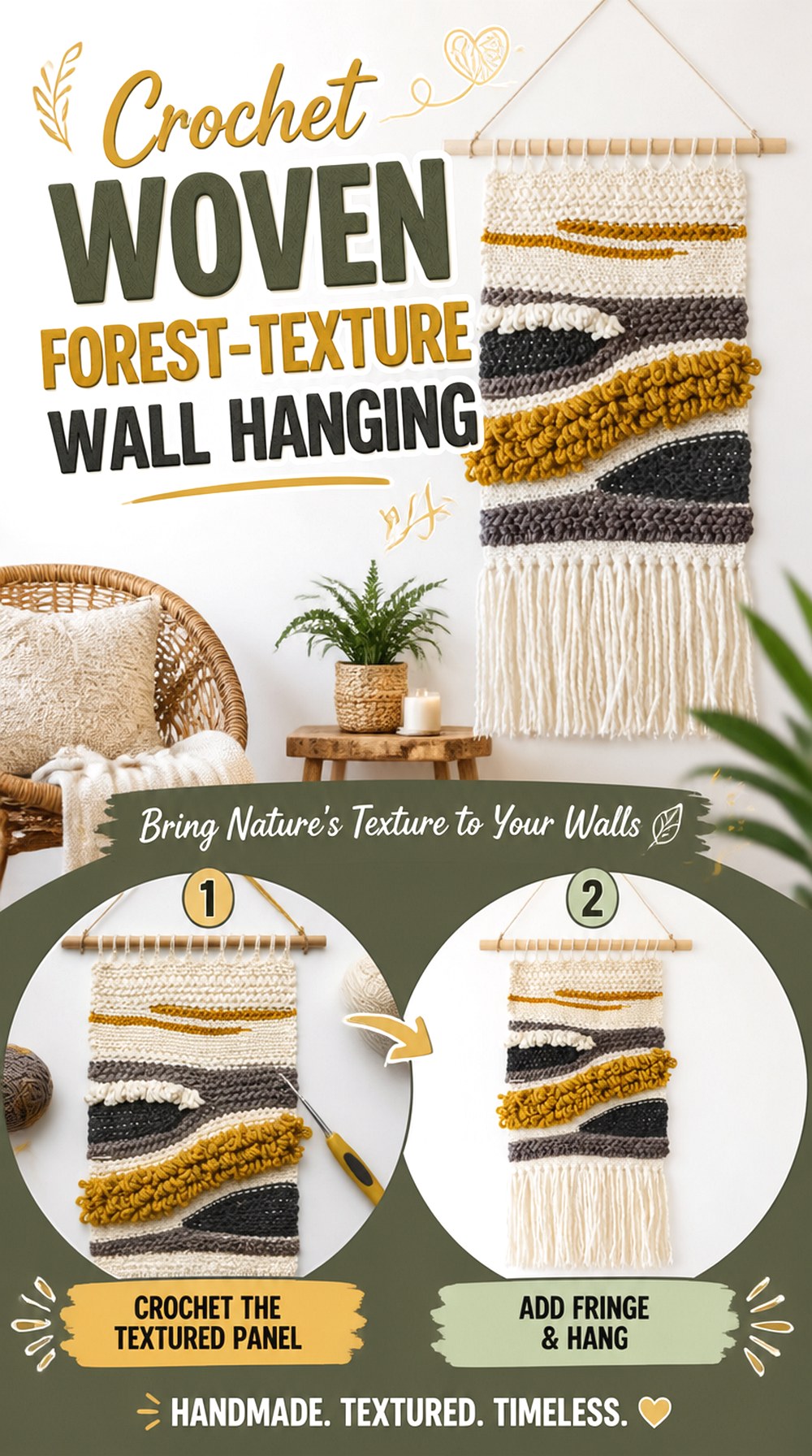
One Dog Woof’s tutorial shows how crochet can create the appearance of woven fiber art through a freeform mixture of color and texture. That makes this final option different from every motif-driven project above: there is no need for a fox, leaf, mushroom, or flower to establish visual interest.
A palette drawn from bark, lichen, moss, stone, rust, and dried grasses can push the piece toward woodland decor while preserving its abstract character. It works especially well as a larger neutral companion to smaller figurative hangings.
Plan Texture Blocks Before Fine Color Decisions
From across a room, changes in surface and silhouette may be more noticeable than small shifts between similar greens or browns. Decide where you want dense, soft, open, or fringed areas first, then refine the palette within those zones.
Freeform Still Benefits From Visual Balance
A freeform piece does not have to be symmetrical, but the visual weight should feel deliberate. Hang the work periodically while building it and check whether one dense section is pulling the eye or the fabric disproportionately to one side.
Original Tutorial and Creator Credit
Creator: One Dog Woof
Which Woodland Wall Hanging Style Fits Your Space?
| Style | Visual Effect | Useful When | Main Checkpoint |
|---|---|---|---|
| Tapestry panel | Graphic and contained | You want a clear mushroom, bunny, or other picture | Keep edges straight and color contrast readable |
| Animal appliqué composition | Dimensional and playful | The animal should be the main focal point | Test feature and foliage placement while hanging vertically |
| Branch or cascading botanical | Organic and open | You have a narrow or irregular wall area | Check motif spacing and overall drop |
| Hoop or circular design | Sculptural and self-contained | You want one strong round focal point | Keep the circle and internal tension balanced |
| Floral hanging | Soft and decorative | You prefer meadow or cottage-woodland styling | Watch accumulated weight from flowers and embellishments |
| Abstract lace or textured fiber art | Quiet and atmospheric | Other pieces already contain literal forest motifs | Let structure, negative space, and palette create the connection |
Conclusion
The most useful way to choose among these 22 crochet woodland wall hanging ideas is by construction first and motif second. Pick the mushroom or bunny tapestry when you want a contained graphic panel, the fox, owl, or bird designs for dimensional animal character, the tree hoop or leaf cascade for organic botanical structure, and the woven or lace options when a room needs quieter texture instead of another literal forest image.
You can also combine different formats in one gallery wall, provided their colors and overall scale relate to each other. Once you have chosen a direction, use the original tutorials for the creator’s exact construction details rather than assuming techniques or measurements transfer between projects.
Frequently Asked Questions
What yarn works well for a crochet woodland wall hanging?
There is no single yarn that suits every wall-hanging construction. Smoother yarn can help graphic tapestry motifs and small color changes read clearly, while more textured yarn can be effective in abstract or boho fiber art. The finished weight, stiffness, and scale can change when you substitute fibers or yarn thicknesses, so check each tutorial’s stated materials before making a replacement.
Can I use a natural tree branch instead of a wooden dowel?
A decorative branch can reinforce the woodland look, but make sure it is clean, dry, stable, and appropriate for indoor display. Compare its weight and diameter with the top of the crochet piece before attachment. An irregular branch may also make the hanging appear tilted if the attachment points are not balanced, so test the complete piece on the wall before securing everything permanently.
How can I stop a crochet tapestry wall hanging from curling?
First determine whether the curling comes from normal unfinished fabric or from uneven tension and color changes. Blocking can help many crochet pieces settle into a cleaner shape, but it cannot always correct a severely narrowed or stretched panel. Check the fiber’s appropriate blocking method and address tension problems during crocheting rather than expecting the dowel, fringe, or border to hide them later.
How many woodland motifs should I use in one wall hanging?
There is no universal number. A single mushroom, fox, owl, or tree can create a stronger focal point than many competing motifs. For a multi-element design, identify one dominant subject and use smaller leaves, flowers, stars, or berries as supporting details. Arrange all finished motifs together before final attachment so you can judge scale, spacing, and negative space as one composition.
Can I resize a woodland wall hanging from a YouTube tutorial?
Possibly, but the safest method depends on the construction. Changing yarn weight or hook size can alter both scale and fabric behavior, while changing a chart or motif count can affect proportions more substantially. If a creator does not provide resizing instructions, confirm how the original project is constructed before modifying it. Avoid assuming that one resizing method works equally for tapestry panels, appliqués, hoops, and lace.
How should crochet woodland wall art be cleaned?
Start with the care guidance for the actual fiber used in your project. Wall art often needs less frequent cleaning than wearable crochet, and gentle dust removal may be sufficient between deeper cleanings. Be especially cautious with pieces mounted on wood, hoops, wire, beads, or mixed materials because the crochet yarn’s normal washing method may not suit the complete assembled hanging.